
Arab Open University
2nd
Semester, 2006-2007
M301
Unit 5.4
Process Quality Management, Human
Resources, Quality
Assurance
reem.attas@arabou.org.sa
Reem AlAttas © 2
Topic Road Map
 Overview of process quality
Project Management
Quality Management
Configuration Management
Reem AlAttas © 3
Project Manager Jobs
 Planning the project schedule.
 Finding the right people to work on the project and assigning them
to tasks.
 Making sure the team is properly trained and has the proper tools
and work environment.
 Keeping the project on schedule and taking action if it slips.
 To work closely with the customer (could be another part of the
organization).
 Analyzing and managing the risks.
 Making sure that the lessons learned on other projects in the
organization feed into this project and that this project’s lessons are
passed on to others.
Reem AlAttas © 4
People Management
An important part of people management
is a combination of management and
leadership.
Reem AlAttas © 5
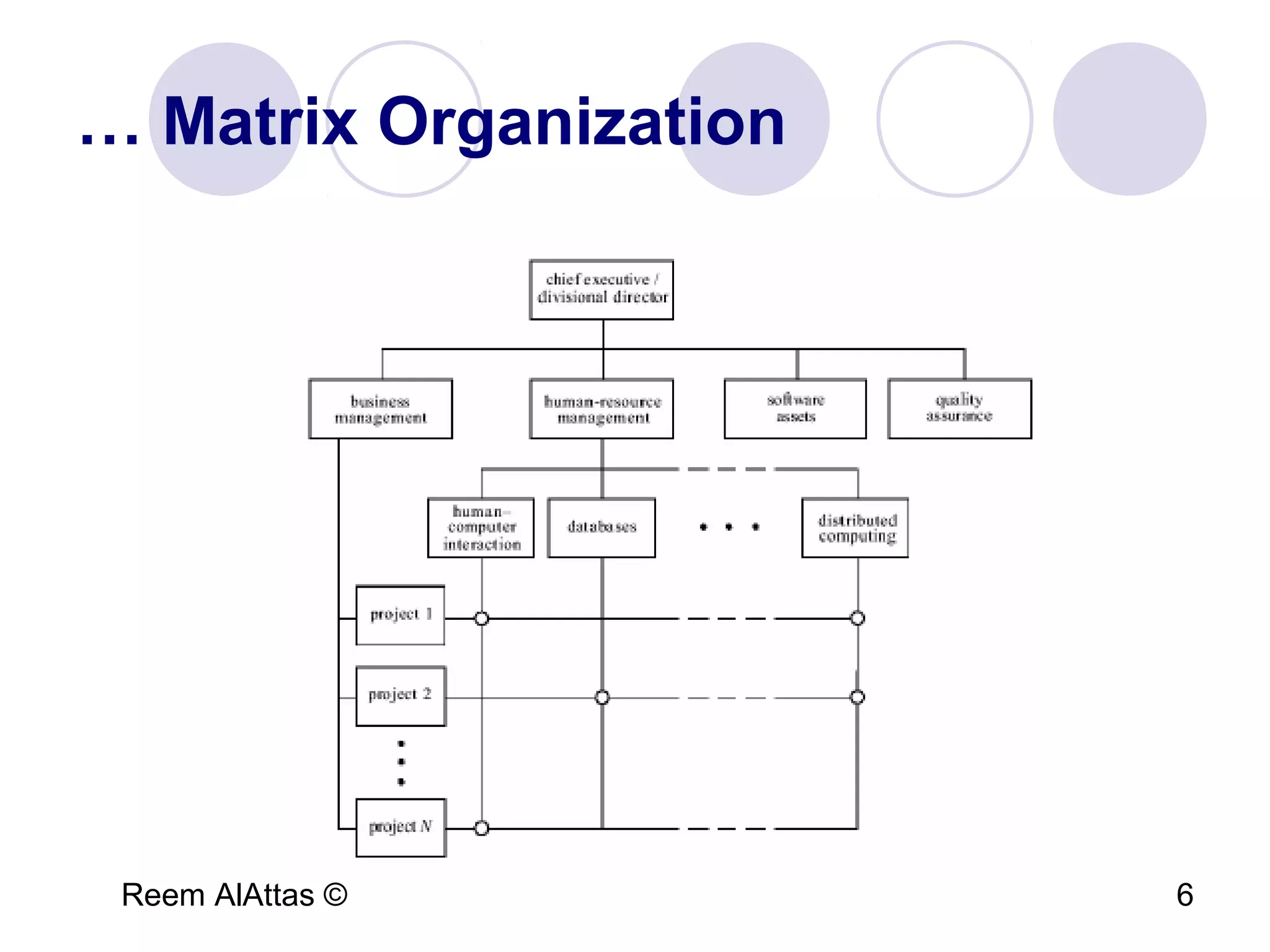
Matrix Organization
A popular way of organizing a software
development company, or division within a
larger company, to accommodate such
organization-wide people management.
Reem AlAttas © 6
… Matrix Organization
Reem AlAttas © 7
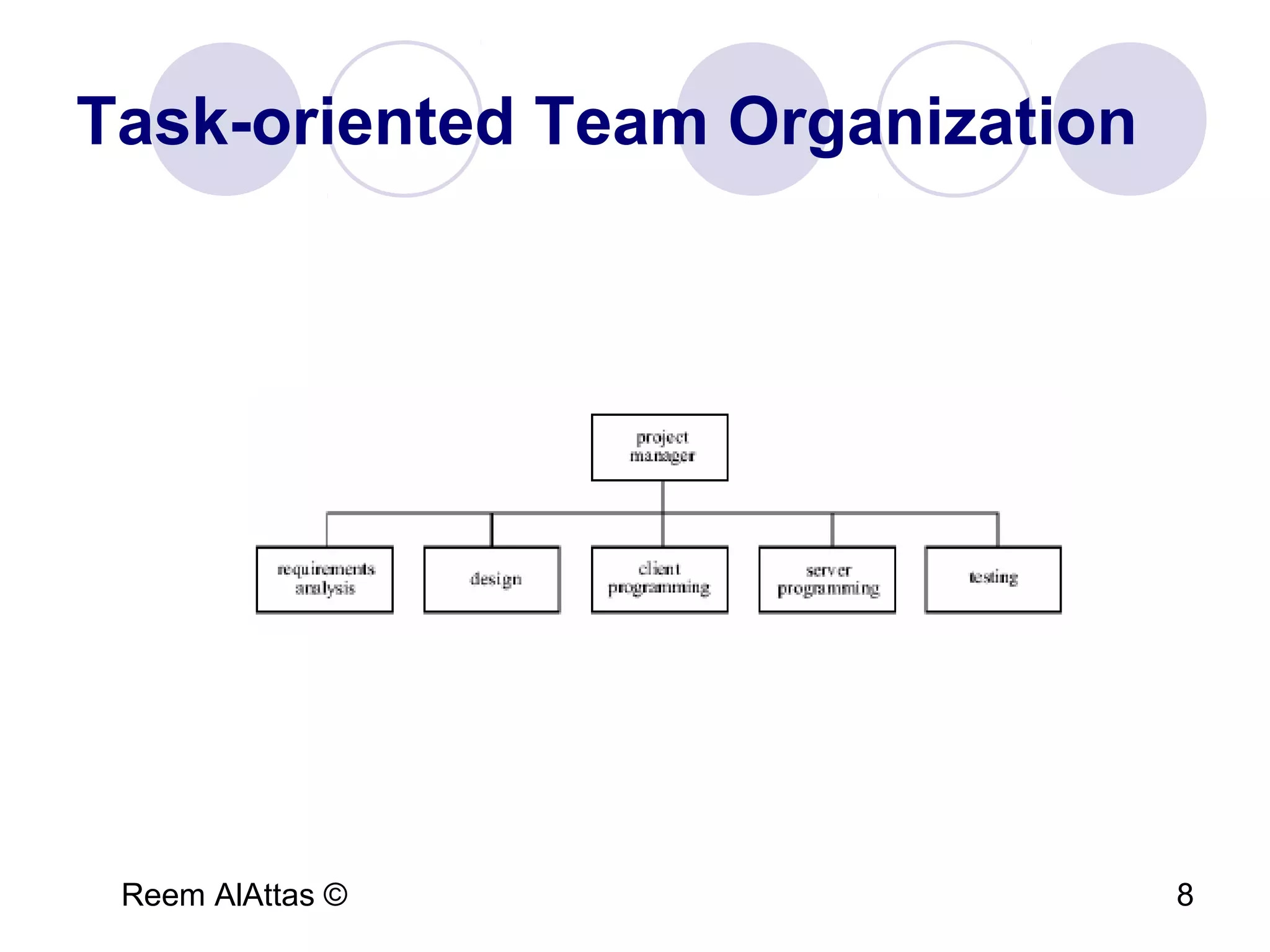
Team Organization
Task-oriented team organization
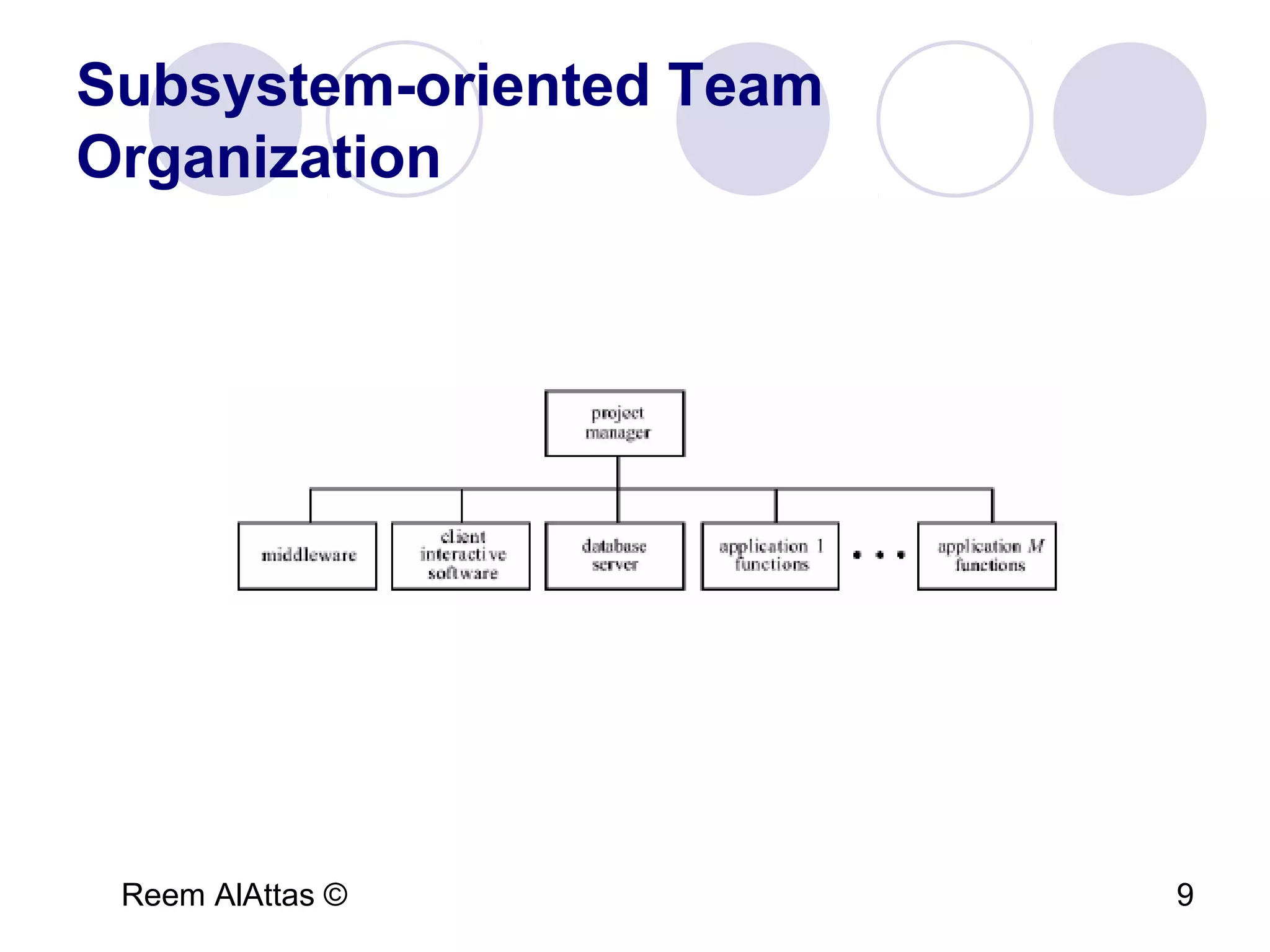
Subsystem-oriented team organization
Reem AlAttas © 8
Task-oriented Team Organization
Reem AlAttas © 9
Subsystem-oriented Team
Organization
Reem AlAttas © 10
Quality Management
Quality is fitness for purpose.
Quality Management is that aspect of the
overall management function that
determines and implements the quality
policy.
Reem AlAttas © 11
Configuration Management
The problem of managing different
versions of items can be solved by
configuration management.
Reem AlAttas © 12
Topic Road Map
Overview of process quality
 Project Management
Quality Management
Configuration Management
Reem AlAttas © 13
Project Management
The process of planning a project,
estimating the work content, assigning that
work to people and scheduling when it will
happen, and then monitoring the progress
of that work and taking corrective action if
something does not go according to plan.
Reem AlAttas © 14
Risk
The potential harm that may arise from
some present process or from some future
event.
Reem AlAttas © 15
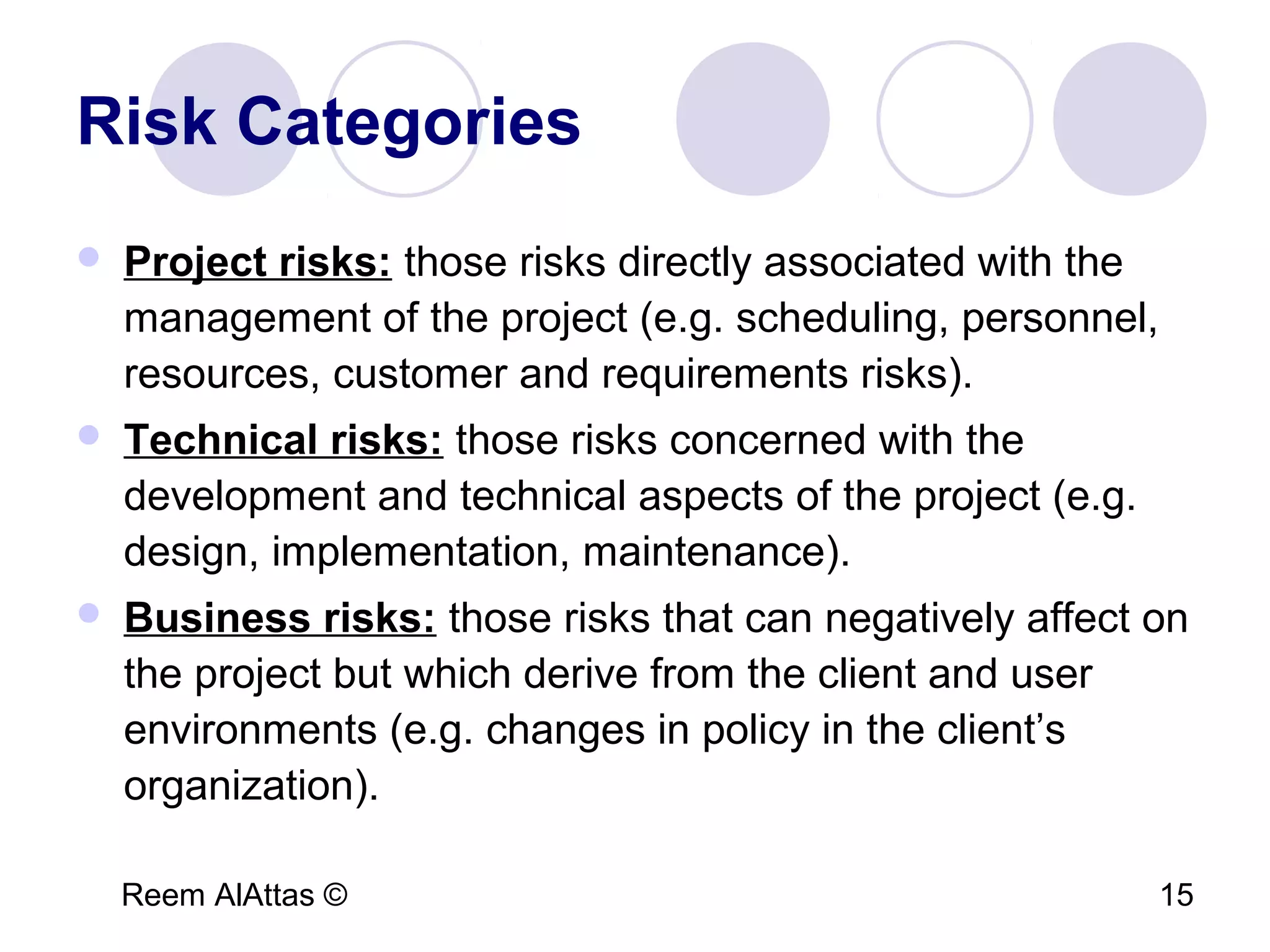
Risk Categories
 Project risks: those risks directly associated with the
management of the project (e.g. scheduling, personnel,
resources, customer and requirements risks).
 Technical risks: those risks concerned with the
development and technical aspects of the project (e.g.
design, implementation, maintenance).
 Business risks: those risks that can negatively affect on
the project but which derive from the client and user
environments (e.g. changes in policy in the client’s
organization).
Reem AlAttas © 16
Risk Planning Strategies (Treatments)
Risk Avoidance.
Risk Retention.
Risk Reduction.
Risk Transfer.
Reem AlAttas © 17
Risk Avoidance
Prevent the risk happening in the first
place.
Reem AlAttas © 18
Risk Retention
If the risk is seen as low probability and
low cost, in other words the risk is unlikely
to occur and if it did the effects would be
minimal, the project manager might
recommend that the risk be accepted.
Reem AlAttas © 19
Risk Reduction
It is unlikely that the project manager will
be able to eliminate risk entirely, but
controls and countermeasures can be put
in place to reduce the likelihood of a risk
and to reduce its impact should a risk
event occur.
Reem AlAttas © 20
Risk Transfer
The costs resulting from an occurrence of
the risk event are passed on to a third
party.
Example: insurance policy.
Reem AlAttas © 21
Estimation
 Predicting the required resources and time of a project.
 Project or system factors:
 System size: measured initially by the number of functions, the
amount of data and the number of users. At completion of the
project, it can be measured by the number of LOC.
 System complexity: a subjective measure and relates to the
interdependencies between elements of the system.
Reem AlAttas © 22
Estimation Methods
Estimation by analogy.
Estimation by work breakdown.
Function point analysis.
COCOMO.
Reem AlAttas © 23
Estimation by Analogy
If the software we wish to build is similar to
software we have built before, then we
can very directly use the experience from
that previous occasion or occasions.
Reem AlAttas © 24
Estimation by Work Breakdown
An alternative approach is estimation by
work breakdown, where the work to be
undertaken is broken down into smaller
chunks that can then be estimated by
analogy.
Reem AlAttas © 25
Function Point Analysis (FPA)
The size of systems can be accessed in
terms of the functions they perform.
An understanding of the software
functionality is gained by producing a use
case model and a class model.
Reem AlAttas © 26
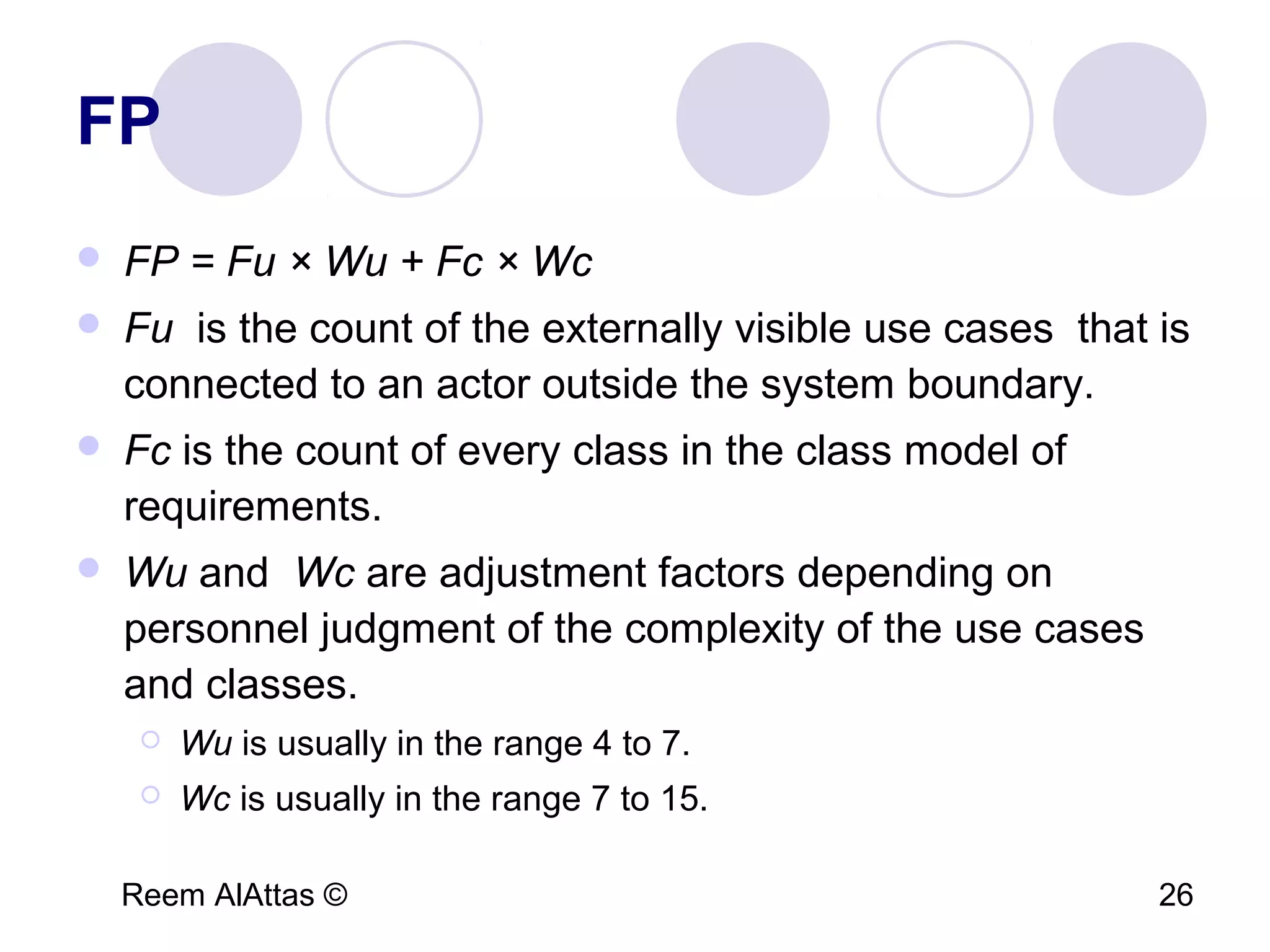
FP
 FP = Fu × Wu + Fc × Wc
 Fu is the count of the externally visible use cases that is
connected to an actor outside the system boundary.
 Fc is the count of every class in the class model of
requirements.
 Wu and Wc are adjustment factors depending on
personnel judgment of the complexity of the use cases
and classes.
 Wu is usually in the range 4 to 7.
 Wc is usually in the range 7 to 15.
Reem AlAttas © 27
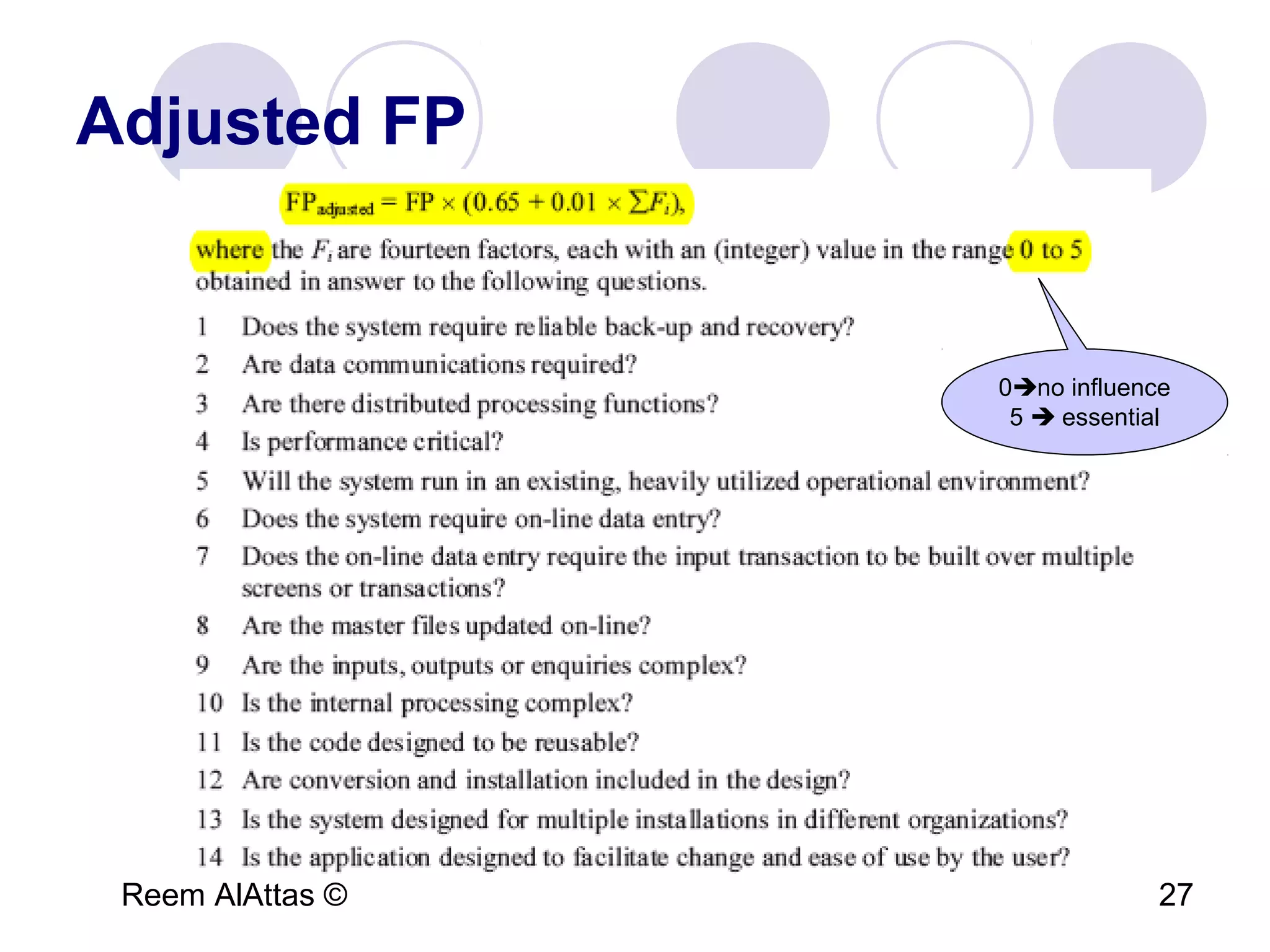
Adjusted FP
0no influence
5  essential
Example Page 21
Reem AlAttas © 29
COCOMO
COnstructive COst MOdel.
What COCOMO gives us is a simple
means of converting from code size (in
KLOCs) to effort in person-months and
optimal project duration in months.
Reem AlAttas © 30
… COCOMO
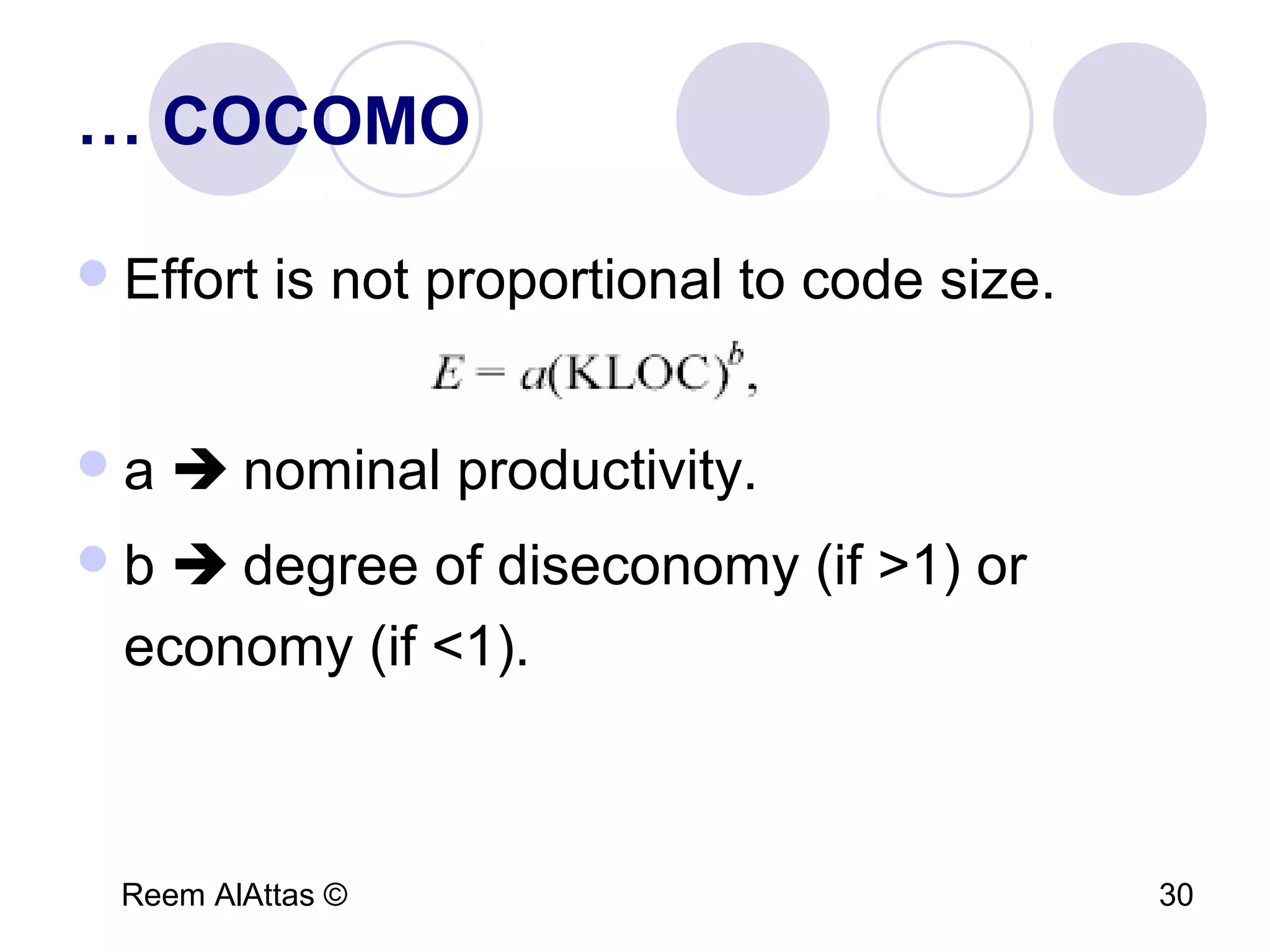
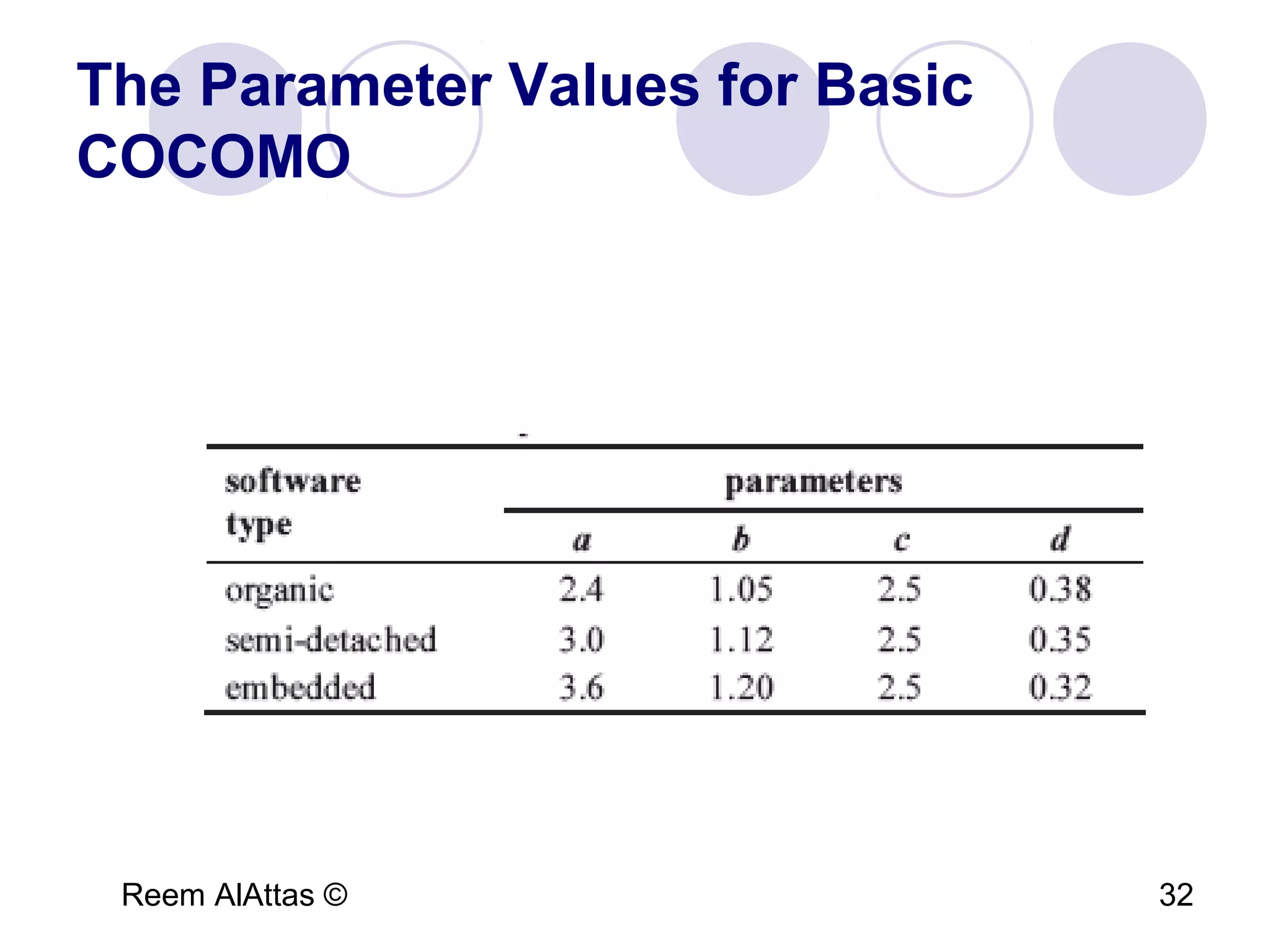
Effort is not proportional to code size.
a  nominal productivity.
b  degree of diseconomy (if >1) or
economy (if <1).
Reem AlAttas © 31
… COCOMO
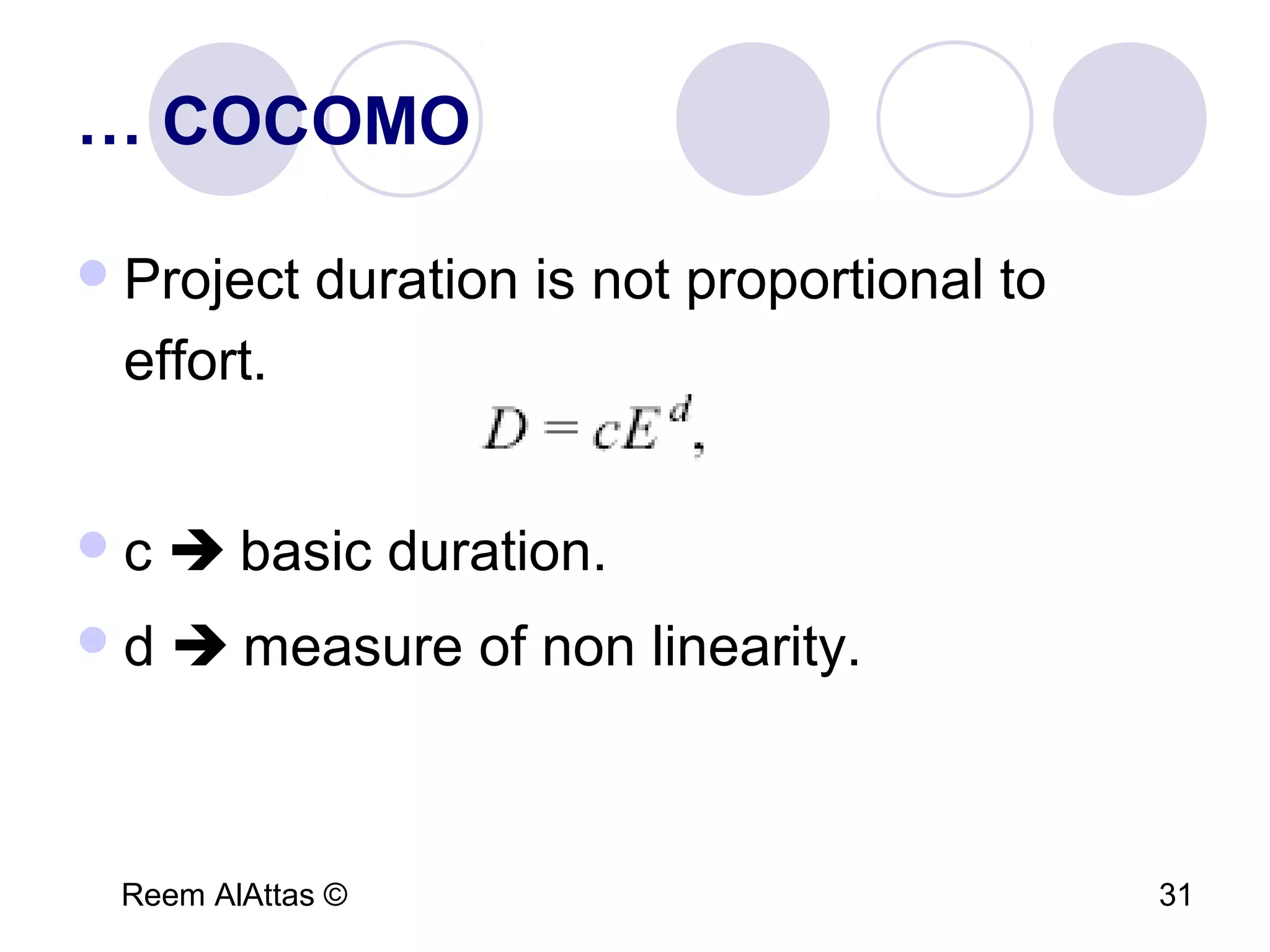
Project duration is not proportional to
effort.
c  basic duration.
d  measure of non linearity.
Reem AlAttas © 32
The Parameter Values for Basic
COCOMO
Example Page 23
Reem AlAttas © 34
A Project Plan can be Represented in
Many Ways:
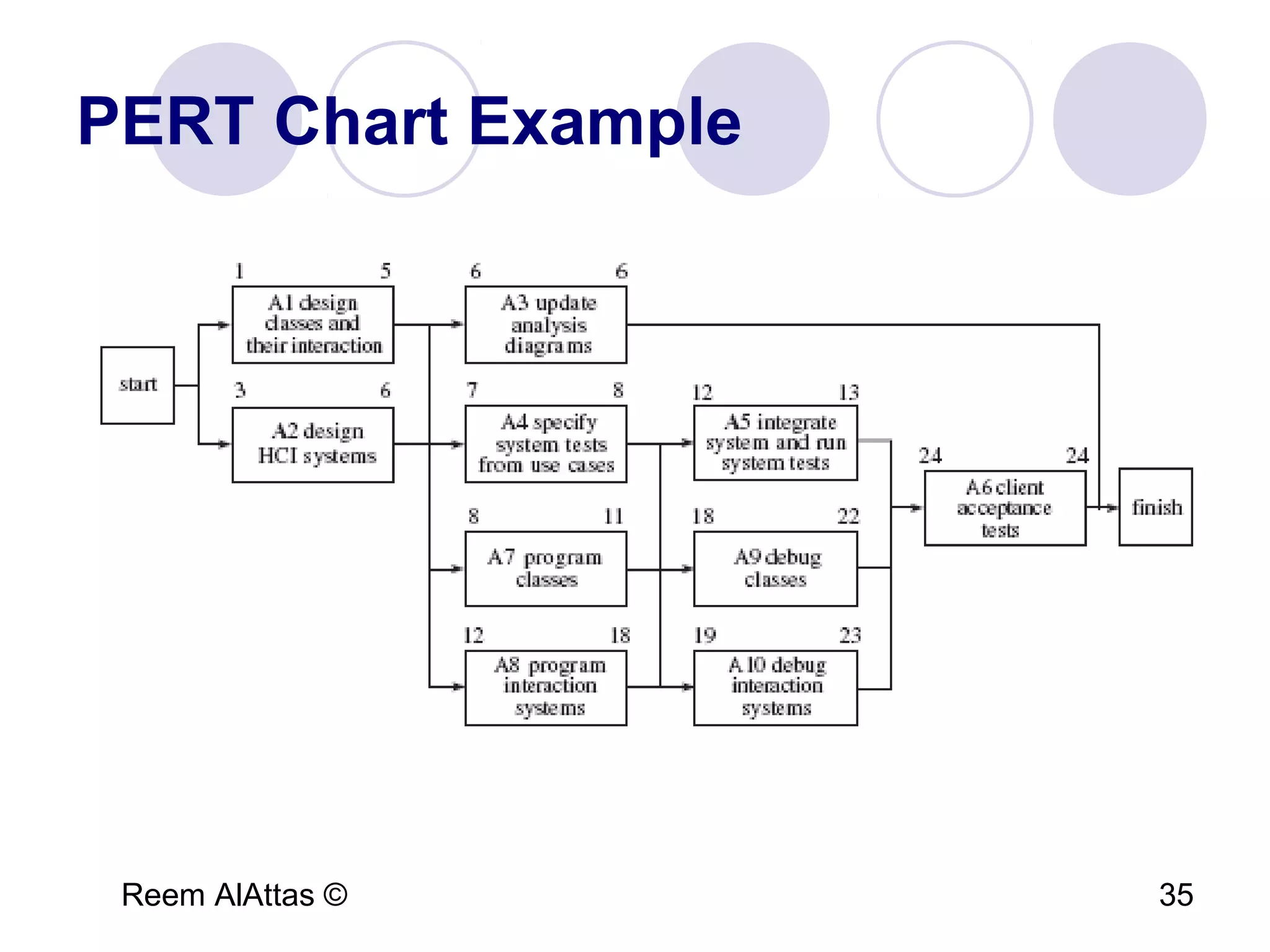
 PERT charts, which show the activities as boxes with
lines joining them
 Emphasize the interdependencies and flow of critical information.
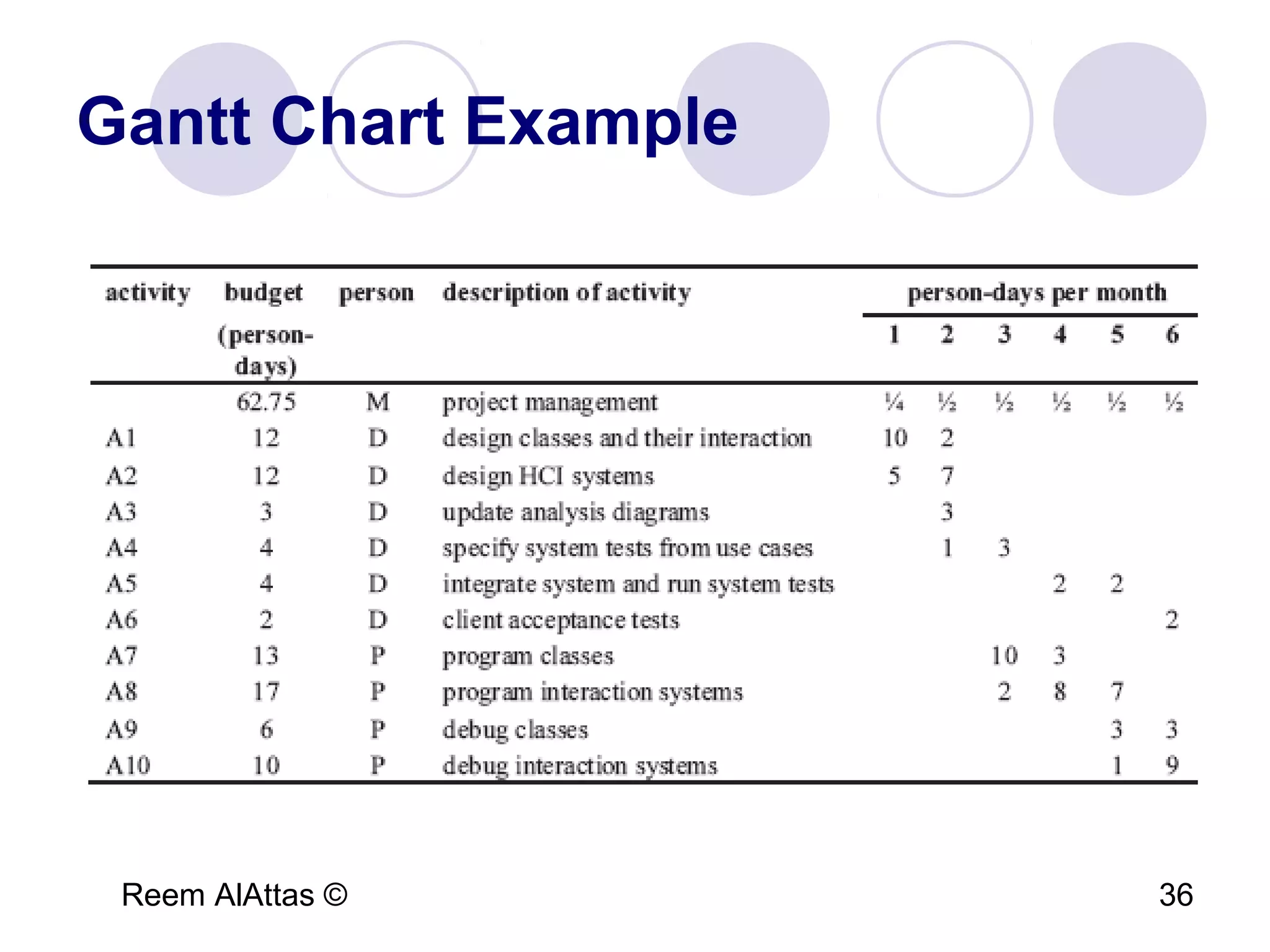
 Gantt charts, in which the horizontal direction
represents time and the vertical direction represents
activities, and which can be set out as tables, whose
rows show when the work takes place, or as bar charts,
whose horizontal bars show when the work takes place.
 Emphasize times at which things happen.
Reem AlAttas © 35
PERT Chart Example
Reem AlAttas © 36
Gantt Chart Example
Reem AlAttas © 37
Monitoring (Tracking)
A large part of a project manager’s time
must be spent monitoring the progress of
the project against the project plan
(including the project schedule).
Reem AlAttas © 38
Time-boxing
One approach to planning and monitoring
a project is to use time-boxing.
Using this approach, the project is
arranged to deliver something of use to
the customer every three to six months.
Reem AlAttas © 39
Topic Road Map
Overview of process quality
Project Management
 Quality Management
Configuration Management
Reem AlAttas © 40
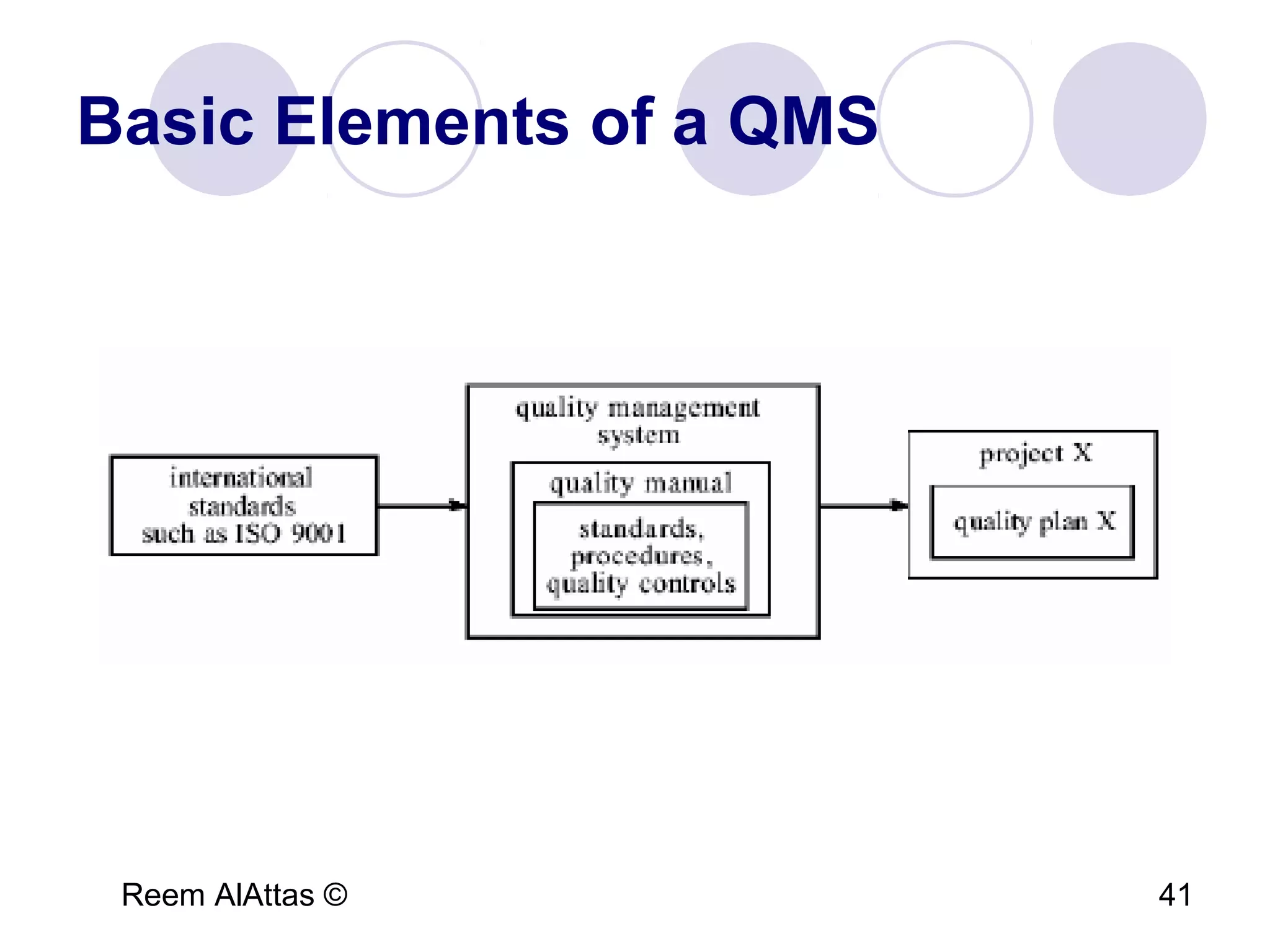
Quality Management System (QMS)
An organization-wide mechanism for
building quality into projects and for
managing the quality control process.
Reem AlAttas © 41
Basic Elements of a QMS
Reem AlAttas © 42
ISO 9001
 ISO 9001 is one member of a family of
international standards, known collectively as
ISO 9000 and published by the International
Standards Organization (ISO).
 ISO 9001 is not industry-specific and describes
the quality system used to support the
development of any product that requires
design. It applies to all steps from design right
through the manufacturing process.
Reem AlAttas © 43
ISO 9000-3
The specific needs of the software
development process have been
recognised by ISO, and a set of guidelines
for interpreting ISO 9001 in this context
have been published as ISO 9000-3.
Reem AlAttas © 44
Components of a QMS envisaged by
ISO 9001 & 9000-3
Management responsibility.
Quality management system.
Internal quality audits.
Corrective action mechanisms.
Reem AlAttas © 45
Capability Maturity Model (CMM)
A measure of an organization’s corporate
understanding of its development
processes.
Reem AlAttas © 46
SPICE
ISO standard 15504, SPICE (Software
Process Improvement and Capability
dEtermination).
The objective of SPICE was to blend ISO
9000 and the CMM.
Reem AlAttas © 47
Topic Road Map
Overview of process quality
Project Management
Quality Management
 Configuration Management
Reem AlAttas © 48
Configuration Item
Any elementary type of thing that is
produced during a project (e.g. use case
diagrams, interaction diagrams, etc.)
Reem AlAttas © 49
Configuration Repository
Configuration items would normally be
stored in machine-readable form in a
project repository or library or database.
Reem AlAttas © 50
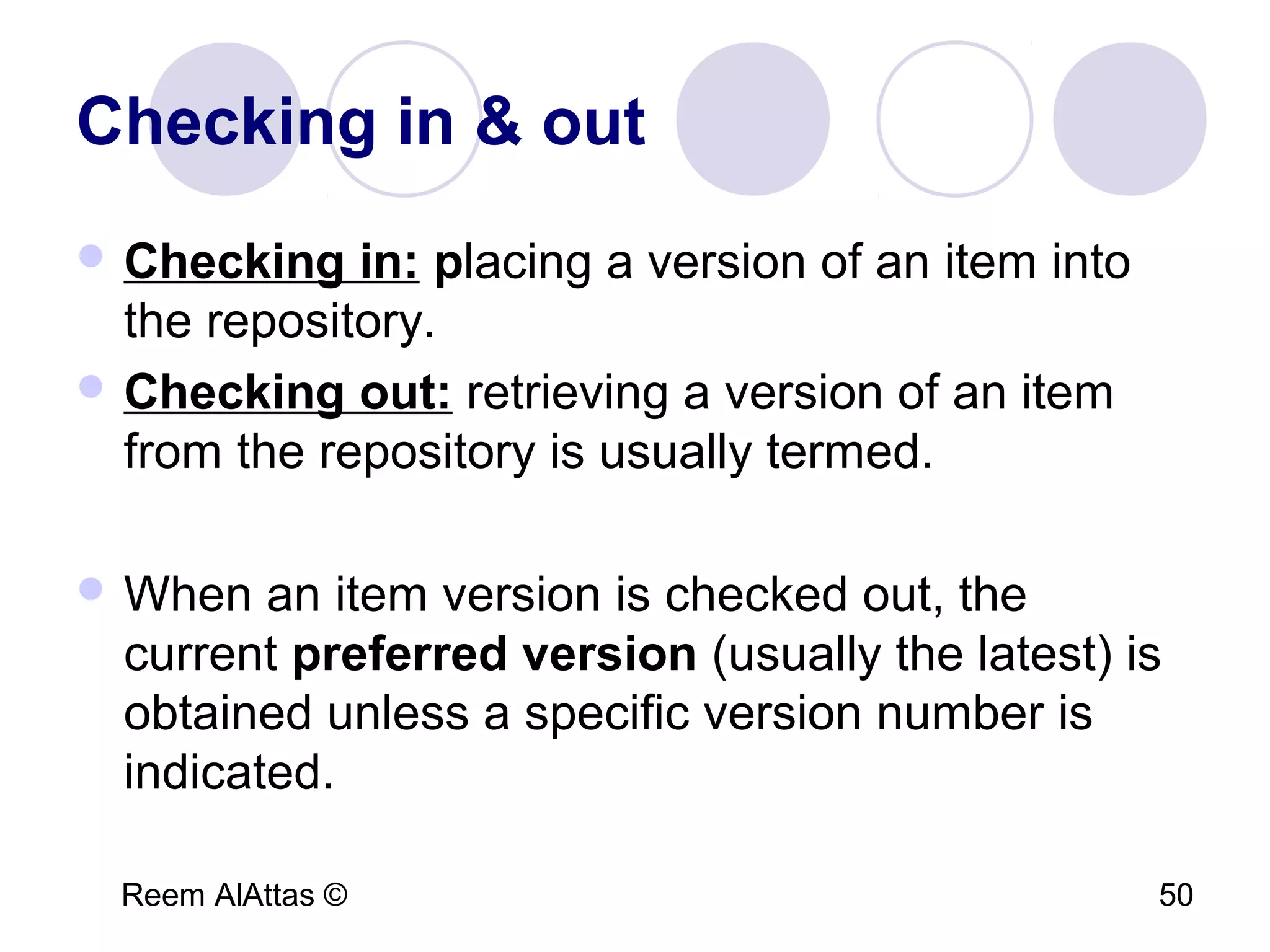
Checking in & out
 Checking in: placing a version of an item into
the repository.
 Checking out: retrieving a version of an item
from the repository is usually termed.
 When an item version is checked out, the
current preferred version (usually the latest) is
obtained unless a specific version number is
indicated.
Reem AlAttas © 51
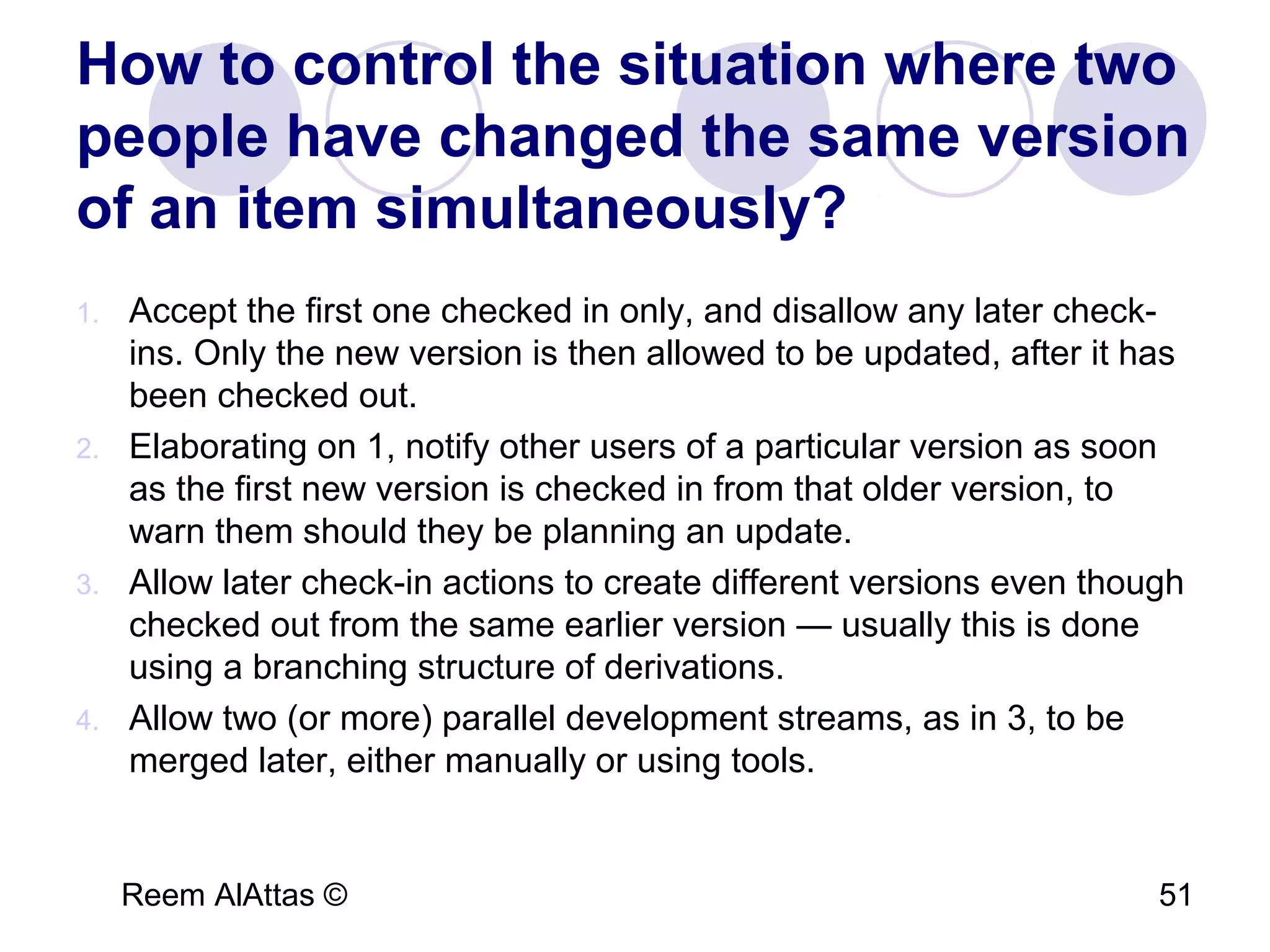
How to control the situation where two
people have changed the same version
of an item simultaneously?
1. Accept the first one checked in only, and disallow any later check-
ins. Only the new version is then allowed to be updated, after it has
been checked out.
2. Elaborating on 1, notify other users of a particular version as soon
as the first new version is checked in from that older version, to
warn them should they be planning an update.
3. Allow later check-in actions to create different versions even though
checked out from the same earlier version — usually this is done
using a branching structure of derivations.
4. Allow two (or more) parallel development streams, as in 3, to be
merged later, either manually or using tools.
Reem AlAttas © 52
Baselines
Configuration versions are singled out as
special because they form a foundation
from which further development can
progress.
Reem AlAttas © 53
Change Control
Updating a baseline in a controlled
manner.
TMA5 – Q4
Thank You!

Process Quality Management, Human Resources, Quality Assurance

  • 1.
    Arab Open University 2nd Semester,2006-2007 M301 Unit 5.4 Process Quality Management, Human Resources, Quality Assurance reem.attas@arabou.org.sa
  • 2.
    Reem AlAttas ©2 Topic Road Map  Overview of process quality Project Management Quality Management Configuration Management
  • 3.
    Reem AlAttas ©3 Project Manager Jobs  Planning the project schedule.  Finding the right people to work on the project and assigning them to tasks.  Making sure the team is properly trained and has the proper tools and work environment.  Keeping the project on schedule and taking action if it slips.  To work closely with the customer (could be another part of the organization).  Analyzing and managing the risks.  Making sure that the lessons learned on other projects in the organization feed into this project and that this project’s lessons are passed on to others.
  • 4.
    Reem AlAttas ©4 People Management An important part of people management is a combination of management and leadership.
  • 5.
    Reem AlAttas ©5 Matrix Organization A popular way of organizing a software development company, or division within a larger company, to accommodate such organization-wide people management.
  • 6.
    Reem AlAttas ©6 … Matrix Organization
  • 7.
    Reem AlAttas ©7 Team Organization Task-oriented team organization Subsystem-oriented team organization
  • 8.
    Reem AlAttas ©8 Task-oriented Team Organization
  • 9.
    Reem AlAttas ©9 Subsystem-oriented Team Organization
  • 10.
    Reem AlAttas ©10 Quality Management Quality is fitness for purpose. Quality Management is that aspect of the overall management function that determines and implements the quality policy.
  • 11.
    Reem AlAttas ©11 Configuration Management The problem of managing different versions of items can be solved by configuration management.
  • 12.
    Reem AlAttas ©12 Topic Road Map Overview of process quality  Project Management Quality Management Configuration Management
  • 13.
    Reem AlAttas ©13 Project Management The process of planning a project, estimating the work content, assigning that work to people and scheduling when it will happen, and then monitoring the progress of that work and taking corrective action if something does not go according to plan.
  • 14.
    Reem AlAttas ©14 Risk The potential harm that may arise from some present process or from some future event.
  • 15.
    Reem AlAttas ©15 Risk Categories  Project risks: those risks directly associated with the management of the project (e.g. scheduling, personnel, resources, customer and requirements risks).  Technical risks: those risks concerned with the development and technical aspects of the project (e.g. design, implementation, maintenance).  Business risks: those risks that can negatively affect on the project but which derive from the client and user environments (e.g. changes in policy in the client’s organization).
  • 16.
    Reem AlAttas ©16 Risk Planning Strategies (Treatments) Risk Avoidance. Risk Retention. Risk Reduction. Risk Transfer.
  • 17.
    Reem AlAttas ©17 Risk Avoidance Prevent the risk happening in the first place.
  • 18.
    Reem AlAttas ©18 Risk Retention If the risk is seen as low probability and low cost, in other words the risk is unlikely to occur and if it did the effects would be minimal, the project manager might recommend that the risk be accepted.
  • 19.
    Reem AlAttas ©19 Risk Reduction It is unlikely that the project manager will be able to eliminate risk entirely, but controls and countermeasures can be put in place to reduce the likelihood of a risk and to reduce its impact should a risk event occur.
  • 20.
    Reem AlAttas ©20 Risk Transfer The costs resulting from an occurrence of the risk event are passed on to a third party. Example: insurance policy.
  • 21.
    Reem AlAttas ©21 Estimation  Predicting the required resources and time of a project.  Project or system factors:  System size: measured initially by the number of functions, the amount of data and the number of users. At completion of the project, it can be measured by the number of LOC.  System complexity: a subjective measure and relates to the interdependencies between elements of the system.
  • 22.
    Reem AlAttas ©22 Estimation Methods Estimation by analogy. Estimation by work breakdown. Function point analysis. COCOMO.
  • 23.
    Reem AlAttas ©23 Estimation by Analogy If the software we wish to build is similar to software we have built before, then we can very directly use the experience from that previous occasion or occasions.
  • 24.
    Reem AlAttas ©24 Estimation by Work Breakdown An alternative approach is estimation by work breakdown, where the work to be undertaken is broken down into smaller chunks that can then be estimated by analogy.
  • 25.
    Reem AlAttas ©25 Function Point Analysis (FPA) The size of systems can be accessed in terms of the functions they perform. An understanding of the software functionality is gained by producing a use case model and a class model.
  • 26.
    Reem AlAttas ©26 FP  FP = Fu × Wu + Fc × Wc  Fu is the count of the externally visible use cases that is connected to an actor outside the system boundary.  Fc is the count of every class in the class model of requirements.  Wu and Wc are adjustment factors depending on personnel judgment of the complexity of the use cases and classes.  Wu is usually in the range 4 to 7.  Wc is usually in the range 7 to 15.
  • 27.
    Reem AlAttas ©27 Adjusted FP 0no influence 5  essential
  • 28.
  • 29.
    Reem AlAttas ©29 COCOMO COnstructive COst MOdel. What COCOMO gives us is a simple means of converting from code size (in KLOCs) to effort in person-months and optimal project duration in months.
  • 30.
    Reem AlAttas ©30 … COCOMO Effort is not proportional to code size. a  nominal productivity. b  degree of diseconomy (if >1) or economy (if <1).
  • 31.
    Reem AlAttas ©31 … COCOMO Project duration is not proportional to effort. c  basic duration. d  measure of non linearity.
  • 32.
    Reem AlAttas ©32 The Parameter Values for Basic COCOMO
  • 33.
  • 34.
    Reem AlAttas ©34 A Project Plan can be Represented in Many Ways:  PERT charts, which show the activities as boxes with lines joining them  Emphasize the interdependencies and flow of critical information.  Gantt charts, in which the horizontal direction represents time and the vertical direction represents activities, and which can be set out as tables, whose rows show when the work takes place, or as bar charts, whose horizontal bars show when the work takes place.  Emphasize times at which things happen.
  • 35.
    Reem AlAttas ©35 PERT Chart Example
  • 36.
    Reem AlAttas ©36 Gantt Chart Example
  • 37.
    Reem AlAttas ©37 Monitoring (Tracking) A large part of a project manager’s time must be spent monitoring the progress of the project against the project plan (including the project schedule).
  • 38.
    Reem AlAttas ©38 Time-boxing One approach to planning and monitoring a project is to use time-boxing. Using this approach, the project is arranged to deliver something of use to the customer every three to six months.
  • 39.
    Reem AlAttas ©39 Topic Road Map Overview of process quality Project Management  Quality Management Configuration Management
  • 40.
    Reem AlAttas ©40 Quality Management System (QMS) An organization-wide mechanism for building quality into projects and for managing the quality control process.
  • 41.
    Reem AlAttas ©41 Basic Elements of a QMS
  • 42.
    Reem AlAttas ©42 ISO 9001  ISO 9001 is one member of a family of international standards, known collectively as ISO 9000 and published by the International Standards Organization (ISO).  ISO 9001 is not industry-specific and describes the quality system used to support the development of any product that requires design. It applies to all steps from design right through the manufacturing process.
  • 43.
    Reem AlAttas ©43 ISO 9000-3 The specific needs of the software development process have been recognised by ISO, and a set of guidelines for interpreting ISO 9001 in this context have been published as ISO 9000-3.
  • 44.
    Reem AlAttas ©44 Components of a QMS envisaged by ISO 9001 & 9000-3 Management responsibility. Quality management system. Internal quality audits. Corrective action mechanisms.
  • 45.
    Reem AlAttas ©45 Capability Maturity Model (CMM) A measure of an organization’s corporate understanding of its development processes.
  • 46.
    Reem AlAttas ©46 SPICE ISO standard 15504, SPICE (Software Process Improvement and Capability dEtermination). The objective of SPICE was to blend ISO 9000 and the CMM.
  • 47.
    Reem AlAttas ©47 Topic Road Map Overview of process quality Project Management Quality Management  Configuration Management
  • 48.
    Reem AlAttas ©48 Configuration Item Any elementary type of thing that is produced during a project (e.g. use case diagrams, interaction diagrams, etc.)
  • 49.
    Reem AlAttas ©49 Configuration Repository Configuration items would normally be stored in machine-readable form in a project repository or library or database.
  • 50.
    Reem AlAttas ©50 Checking in & out  Checking in: placing a version of an item into the repository.  Checking out: retrieving a version of an item from the repository is usually termed.  When an item version is checked out, the current preferred version (usually the latest) is obtained unless a specific version number is indicated.
  • 51.
    Reem AlAttas ©51 How to control the situation where two people have changed the same version of an item simultaneously? 1. Accept the first one checked in only, and disallow any later check- ins. Only the new version is then allowed to be updated, after it has been checked out. 2. Elaborating on 1, notify other users of a particular version as soon as the first new version is checked in from that older version, to warn them should they be planning an update. 3. Allow later check-in actions to create different versions even though checked out from the same earlier version — usually this is done using a branching structure of derivations. 4. Allow two (or more) parallel development streams, as in 3, to be merged later, either manually or using tools.
  • 52.
    Reem AlAttas ©52 Baselines Configuration versions are singled out as special because they form a foundation from which further development can progress.
  • 53.
    Reem AlAttas ©53 Change Control Updating a baseline in a controlled manner.
  • 54.
  • 55.

Editor's Notes

  • #7 As new projects get started by the business manager, functions are assigned to projects, as shown by the small circles on the intersections of the project and function lines. (On any particular project, not all functions would necessarily be present.) Each circle represents one or more people.
  • #42 A quality management system will include a quality manual, which in turn includes a number of standards, guidelines and procedures that are applied within the organization. The quality manual will require that each project develops its own quality plan, which must comply with the guidelines laid down in the quality manual. The quality management system itself is likely to want to claim conformance to some external national or international standard for quality (e.g. ISO 9001).