BY- SHRUTIKA
     SUSMITA
  VENKETESH
        PUJA
INTRODUCTION
 Quality –based organizations should strive to achieve
  perfection by continuously improving the business and
  production processes.
 Improvement is made by-
 Viewing all work as a process, whether it is associated with
  production or business
 Making all processes effective, efficient and adaptable.
 Anticipating changing customer needs.
 Eliminating waste and rework wherever it occurs.
 Using benchmarking to improve competitive advantage.
Continuous improvement is design to utilize the resources of
  the organization to achieve a quality- culture. An
  organization attempts to reach a single-minded link
  between quality and work execution by educating its
  constituents to “continuously "analyze & improve their own
  work ,the process & their work group.
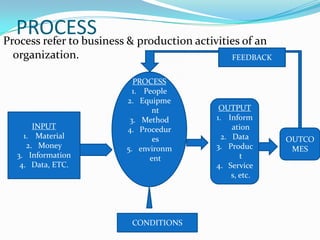
PROCESS & production activities of an
Process refer to business
 organization.                        FEEDBACK


                     PROCESS
                     1. People
                   2. Equipme
                          nt      OUTPUT
                    3. Method    1. Inform
       INPUT       4. Procedur        ation
    1. Material           es       2. Data       OUTCO
     2. Money      5. environm   3. Produc        MES
  3. Information         ent             t
   4. Data, ETC.                 4. Service
                                      s, etc.


                    CONDITIONS
STEP TO CONTINUOUS IMPROVEMENT
1. Employing a consistent organization-wide approach to
   continual improvement of the organization
   performance.
2. Establishing goal to guide & measures to track.
   Continual improvement.
3. Provide people with training in the methods & tools of
   continual improvement.
4. Recognizing & acknowledging improvement.
IMPROVEMENT STRATEGIES:
 There are four primary improvement strategies-Rep
air, refinement ,renovation, & reinvention.
1. Repair: this strategy is simple-anything broken must be fixed so
      that it functions as designed.
2. Refinement: this strategy involves activities that continually
      improve a process that is not broken. Improvements to processes
      ,products, & services are accomplished on an incremental basis.
3. Renovation: this strategy result in major or breakthrough
      improvements. Although resulting product, services, process, or
      activity might often appear to be different from original ,it is
      basically the same.
4. Reinvention: reinvention is the most demanding improvement
      strategy. it is preceded by the feeling that the current approach
      will never satisfy customer requirements. a new product
      ,service, process, or activity is developed using teams based on a
      complete understanding of the customer’s requirements &
      expectation.
TYPES OF PROBLEMS
 There are five types of problems: compliance, unstructured
  , efficiency, process-design, product design.
1. Compliance: compliance problem occur when a
     structured system having standardized
     inputs, processes, & outputs is performing unacceptably
     from the users.
2. Unstructured: unstructured problem resemble
     compliance problem.
3. Efficiency: efficiency problems occur when the system is
     performing unacceptably from the view-point of its
     owners or operators .
4. Process-design: process-design problems involve the
     development of new processes & revision of existing
     process.
5. Product design: product design problems involve the
     development of new product * the improvement of
     existing products.
PROBLEM –SOLVING METHOD
1. Identify the opportunity: the objective is to identify &
   prioritize opportunities for improvement. it consists of
   three parts: identify the problem, form the team & define
   the scope.
2. Analyze the current process: the objective is to
   understand the process & how it is currently performed.
   define process boundaries, outputs &
   customers, determine levels of customers satisfaction &
   measurements needs.
3. Develop the optimal solutions: the objective is to
   establishing potential & feasible solution &
   recommending the best solution to improve the process.
4. Implement changes: the objective is to preparing the
   implementation plan , obtaining approval, &
   implementing the process improvement.
PROBLEM-SOLVING METHODS
5. Study the result: the objective is to monitoring &
  evaluating the change by tracking & studying the
  effectiveness of the improvement efforts through data
  collection & review of progress.
6. Plan for the future: the objective is to achieving
  improved levels of process performance.pl
TOP PRIORITY ISSUES
 Customer relationship &
 Employee relationship & involvement
 Process improvement
 Information system
 Awareness raising & education
 Supplier relationship.
CONCLUSION
 Continuous improvement is an organization-wide process.
 It seeks to always build small changes into work practice.
 These result from everyone in the company being keen to
  develop their ideas and skills, enabling step-by-step
  improvement.
 The CI programmed will evolve by providing customers
  with better value, in a cost-effective way.
 Putting customer needs at the heart of the business creates
  the Continuous Improvement culture.

Contionus improvement case analysis

  • 1.
    BY- SHRUTIKA SUSMITA VENKETESH PUJA
  • 2.
    INTRODUCTION  Quality –basedorganizations should strive to achieve perfection by continuously improving the business and production processes.  Improvement is made by-  Viewing all work as a process, whether it is associated with production or business  Making all processes effective, efficient and adaptable.  Anticipating changing customer needs.  Eliminating waste and rework wherever it occurs.  Using benchmarking to improve competitive advantage. Continuous improvement is design to utilize the resources of the organization to achieve a quality- culture. An organization attempts to reach a single-minded link between quality and work execution by educating its constituents to “continuously "analyze & improve their own work ,the process & their work group.
  • 3.
    PROCESS & productionactivities of an Process refer to business organization. FEEDBACK PROCESS 1. People 2. Equipme nt OUTPUT 3. Method 1. Inform INPUT 4. Procedur ation 1. Material es 2. Data OUTCO 2. Money 5. environm 3. Produc MES 3. Information ent t 4. Data, ETC. 4. Service s, etc. CONDITIONS
  • 4.
    STEP TO CONTINUOUSIMPROVEMENT 1. Employing a consistent organization-wide approach to continual improvement of the organization performance. 2. Establishing goal to guide & measures to track. Continual improvement. 3. Provide people with training in the methods & tools of continual improvement. 4. Recognizing & acknowledging improvement.
  • 5.
    IMPROVEMENT STRATEGIES:  Thereare four primary improvement strategies-Rep air, refinement ,renovation, & reinvention. 1. Repair: this strategy is simple-anything broken must be fixed so that it functions as designed. 2. Refinement: this strategy involves activities that continually improve a process that is not broken. Improvements to processes ,products, & services are accomplished on an incremental basis. 3. Renovation: this strategy result in major or breakthrough improvements. Although resulting product, services, process, or activity might often appear to be different from original ,it is basically the same. 4. Reinvention: reinvention is the most demanding improvement strategy. it is preceded by the feeling that the current approach will never satisfy customer requirements. a new product ,service, process, or activity is developed using teams based on a complete understanding of the customer’s requirements & expectation.
  • 6.
    TYPES OF PROBLEMS There are five types of problems: compliance, unstructured , efficiency, process-design, product design. 1. Compliance: compliance problem occur when a structured system having standardized inputs, processes, & outputs is performing unacceptably from the users. 2. Unstructured: unstructured problem resemble compliance problem. 3. Efficiency: efficiency problems occur when the system is performing unacceptably from the view-point of its owners or operators . 4. Process-design: process-design problems involve the development of new processes & revision of existing process. 5. Product design: product design problems involve the development of new product * the improvement of existing products.
  • 7.
    PROBLEM –SOLVING METHOD 1.Identify the opportunity: the objective is to identify & prioritize opportunities for improvement. it consists of three parts: identify the problem, form the team & define the scope. 2. Analyze the current process: the objective is to understand the process & how it is currently performed. define process boundaries, outputs & customers, determine levels of customers satisfaction & measurements needs. 3. Develop the optimal solutions: the objective is to establishing potential & feasible solution & recommending the best solution to improve the process. 4. Implement changes: the objective is to preparing the implementation plan , obtaining approval, & implementing the process improvement.
  • 8.
    PROBLEM-SOLVING METHODS 5. Studythe result: the objective is to monitoring & evaluating the change by tracking & studying the effectiveness of the improvement efforts through data collection & review of progress. 6. Plan for the future: the objective is to achieving improved levels of process performance.pl
  • 9.
    TOP PRIORITY ISSUES Customer relationship &  Employee relationship & involvement  Process improvement  Information system  Awareness raising & education  Supplier relationship.
  • 10.
    CONCLUSION  Continuous improvementis an organization-wide process.  It seeks to always build small changes into work practice.  These result from everyone in the company being keen to develop their ideas and skills, enabling step-by-step improvement.  The CI programmed will evolve by providing customers with better value, in a cost-effective way.  Putting customer needs at the heart of the business creates the Continuous Improvement culture.