1
An Introduction
Chapter 1
Robert Hughes and
Mike Cotterell
What is a project?
What is a project?
Some dictionary definitions:
“A specific plan or design”
“A planned undertaking”
“A large undertaking e.g. a public works
scheme”
Longmans dictionary
Key points above are planning and size
of task
2
Jobs versus projects
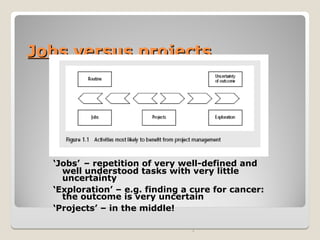
‘Jobs’ – repetition of very well-defined and
well understood tasks with very little
uncertainty
‘Exploration’ – e.g. finding a cure for cancer:
the outcome is very uncertain
‘Projects’ – in the middle!
3
Characteristics of projects
A task is more ‘project-like’ if it is:
 Non-routine
 Planned
 Aiming at a specific target
 Work carried out for a customer
 Involving several specialisms
 Made up of several different phases
 Constrained by time and resources
 Large and/or complex
4
Are
Are software
software projects
projects
really different from other
projects?
projects?
Not really! …but…
 Invisibility
 Complexity
 Conformity
 Flexibility
make software more problematic to build
than other engineered artefacts.
5
Activities covered by
project management
project management
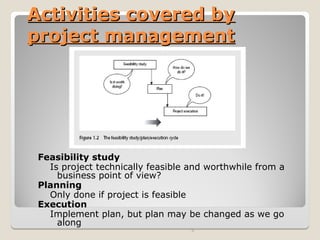
Feasibility study
Is project technically feasible and worthwhile from a
business point of view?
Planning
Only done if project is feasible
Execution
Implement plan, but plan may be changed as we go
along
6
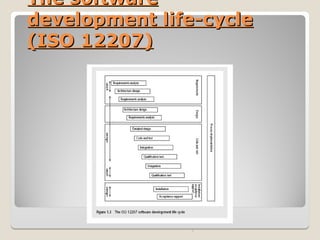
The software
The software
development life-cycle
(ISO 12207)
(ISO 12207)
7
ISO 12207 life-cycle
Requirements analysis
◦ Requirements elicitation: what does the
client need?
◦ Analysis: converting ‘customer-facing’
requirements into equivalents that
developers can understand
◦ Requirements will cover
 Functions
 Quality
 Resource constraints i.e. costs
8
ISO12207 continued
ISO12207 continued
 Qualification testing
◦ Testing the system (not just the software)
 Installation
◦ The process of making the system
operational
◦ Includes setting up standing data, setting
system parameters, installing on operational
hardware platforms, user training etc
 Acceptance support
◦ Including maintenance and enhancement
9
Some ways of
Some ways of
categorizing projects
Distinguishing different types of project is
important as different types of task
need different project approaches e.g.
 Information systems versus embedded
systems
 Objective-based versus product-based
10
What is management?
What is management?
This involves the following activities:
 Planning – deciding what is to be done
 Organizing – making arrangements
 Staffing – selecting the right people for
the job
 Directing – giving instructions
continued…
11
What is management?
What is management?
(continued)
(continued)
 Monitoring – checking on progress
 Controlling – taking action to remedy
hold-ups
 Innovating – coming up with solutions
when problems emerge
 Representing – liaising with clients,
users, developers and other
stakeholders
12
Setting objectives
Setting objectives
 Answering the question ‘What do we
have to do to have a success?’
 Need for a project authority
◦ Sets the project scope
◦ Allocates/approves costs
 Could be one person - or a group
◦ Project Board
◦ Project Management Board
◦ Steering committee
13
Objectives should be SMART
S – specific, that is, concrete and well-defined
M – measurable, that is, satisfaction of the
objective can be objectively judged
A – achievable, that is, it is within the power
of the individual or group concerned to
meet the target
R – relevant, the objective must relevant to
the true purpose of the project
T – time constrained: there is defined point in
time by which the objective should be achieved
14
Goals/sub-objectives
These are steps along the way to
achieving the objective. Informally,
these can be defined by completing the
sentence…
Objective X will be achieved
IF the following goals are all achieved
A……………
B……………
C…………… etc
15
Goals/sub-objectives continued
Often a goal can be allocated to an individual.
Individual may have the capability of
achieving goal, but not the objective on their
own e.g.
Objective – user satisfaction with software
product
Analyst goal – accurate requirements
Developer goal – software that is reliable
16
Measures of effectiveness
How do we know that the goal or objective
has been achieved?
By a practical test, that can be objectively
assessed.
e.g. for user satisfaction with software
product:
 Repeat business – they buy further products
from us
 Number of complaints – if low etc etc
17
The business case
The business case
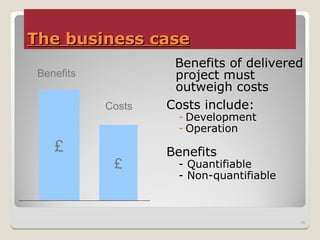
Benefits of delivered
project must
outweigh costs
Costs include:
- Development
- Operation
Benefits
- Quantifiable
- Non-quantifiable
18
£
£
Benefits
Costs
Management control
Management control
19
Management control
Management control
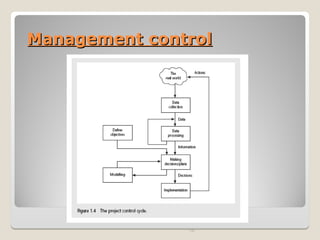
Data – the raw details
e.g. ‘6,000 documents processed at location X’
Information – the data is processed to
produce something that is meaningful and
useful
e.g. ‘productivity is 100 documents a day’
Comparison with objectives/goals
e.g. we will not meet target of processing all
documents by 31st
March
continued…..
20
Management control - continued
Modelling – working out the probable
outcomes of various decisions
e.g. if we employ two more staff at location X
how quickly can we get the documents
processed?
Implementation – carrying out the
remedial actions that have been decided
upon
21
Key points in lecture
 Projects are non-routine - thus uncertain
 The particular problems of projects e.g.
lack of visibility
 Clear objectives are essential which can be
objectively assessed
 Stuff happens. Not usually possible to keep
precisely plan – need for control
 Communicate, communicate, communicate!
22

Copy og thd se gtfor engineering using so so so

  • 1.
    1 An Introduction Chapter 1 RobertHughes and Mike Cotterell
  • 2.
    What is aproject? What is a project? Some dictionary definitions: “A specific plan or design” “A planned undertaking” “A large undertaking e.g. a public works scheme” Longmans dictionary Key points above are planning and size of task 2
  • 3.
    Jobs versus projects Jobsversus projects ‘Jobs’ – repetition of very well-defined and well understood tasks with very little uncertainty ‘Exploration’ – e.g. finding a cure for cancer: the outcome is very uncertain ‘Projects’ – in the middle! 3
  • 4.
    Characteristics of projects Characteristicsof projects A task is more ‘project-like’ if it is:  Non-routine  Planned  Aiming at a specific target  Work carried out for a customer  Involving several specialisms  Made up of several different phases  Constrained by time and resources  Large and/or complex 4
  • 5.
    Are Are software software projects projects reallydifferent from other really different from other projects? projects? Not really! …but…  Invisibility  Complexity  Conformity  Flexibility make software more problematic to build than other engineered artefacts. 5
  • 6.
    Activities covered by Activitiescovered by project management project management Feasibility study Is project technically feasible and worthwhile from a business point of view? Planning Only done if project is feasible Execution Implement plan, but plan may be changed as we go along 6
  • 7.
    The software The software developmentlife-cycle development life-cycle (ISO 12207) (ISO 12207) 7
  • 8.
    ISO 12207 life-cycle ISO12207 life-cycle Requirements analysis ◦ Requirements elicitation: what does the client need? ◦ Analysis: converting ‘customer-facing’ requirements into equivalents that developers can understand ◦ Requirements will cover  Functions  Quality  Resource constraints i.e. costs 8
  • 9.
    ISO12207 continued ISO12207 continued Qualification testing ◦ Testing the system (not just the software)  Installation ◦ The process of making the system operational ◦ Includes setting up standing data, setting system parameters, installing on operational hardware platforms, user training etc  Acceptance support ◦ Including maintenance and enhancement 9
  • 10.
    Some ways of Someways of categorizing projects categorizing projects Distinguishing different types of project is important as different types of task need different project approaches e.g.  Information systems versus embedded systems  Objective-based versus product-based 10
  • 11.
    What is management? Whatis management? This involves the following activities:  Planning – deciding what is to be done  Organizing – making arrangements  Staffing – selecting the right people for the job  Directing – giving instructions continued… 11
  • 12.
    What is management? Whatis management? (continued) (continued)  Monitoring – checking on progress  Controlling – taking action to remedy hold-ups  Innovating – coming up with solutions when problems emerge  Representing – liaising with clients, users, developers and other stakeholders 12
  • 13.
    Setting objectives Setting objectives Answering the question ‘What do we have to do to have a success?’  Need for a project authority ◦ Sets the project scope ◦ Allocates/approves costs  Could be one person - or a group ◦ Project Board ◦ Project Management Board ◦ Steering committee 13
  • 14.
    Objectives should beSMART Objectives should be SMART S – specific, that is, concrete and well-defined M – measurable, that is, satisfaction of the objective can be objectively judged A – achievable, that is, it is within the power of the individual or group concerned to meet the target R – relevant, the objective must relevant to the true purpose of the project T – time constrained: there is defined point in time by which the objective should be achieved 14
  • 15.
    Goals/sub-objectives Goals/sub-objectives These are stepsalong the way to achieving the objective. Informally, these can be defined by completing the sentence… Objective X will be achieved IF the following goals are all achieved A…………… B…………… C…………… etc 15
  • 16.
    Goals/sub-objectives continued Goals/sub-objectives continued Oftena goal can be allocated to an individual. Individual may have the capability of achieving goal, but not the objective on their own e.g. Objective – user satisfaction with software product Analyst goal – accurate requirements Developer goal – software that is reliable 16
  • 17.
    Measures of effectiveness Measuresof effectiveness How do we know that the goal or objective has been achieved? By a practical test, that can be objectively assessed. e.g. for user satisfaction with software product:  Repeat business – they buy further products from us  Number of complaints – if low etc etc 17
  • 18.
    The business case Thebusiness case Benefits of delivered project must outweigh costs Costs include: - Development - Operation Benefits - Quantifiable - Non-quantifiable 18 £ £ Benefits Costs
  • 19.
  • 20.
    Management control Management control Data– the raw details e.g. ‘6,000 documents processed at location X’ Information – the data is processed to produce something that is meaningful and useful e.g. ‘productivity is 100 documents a day’ Comparison with objectives/goals e.g. we will not meet target of processing all documents by 31st March continued….. 20
  • 21.
    Management control -continued Management control - continued Modelling – working out the probable outcomes of various decisions e.g. if we employ two more staff at location X how quickly can we get the documents processed? Implementation – carrying out the remedial actions that have been decided upon 21
  • 22.
    Key points inlecture Key points in lecture  Projects are non-routine - thus uncertain  The particular problems of projects e.g. lack of visibility  Clear objectives are essential which can be objectively assessed  Stuff happens. Not usually possible to keep precisely plan – need for control  Communicate, communicate, communicate! 22

Editor's Notes

  • #2 Here are some definitions of ‘project’. No doubt there are other ones: for example ‘Unique process, consisting of a set of coordinated and controlled activities with start and finish dates, undertaken to achieve an objective conforming to specific requirements, including constraints of time, cost and resources’ BSO ISO 10006: 1997
  • #3 On the one hand there are repetitive jobs a similar task is carried out repeatedly, for example Kwikfit replacing a tyre on a car or a lecturer giving an introductory talk on project management. The task is well-defined and there is very little uncertainty. In some organizations, software development might tend to be like this – in these environments software process management might be more important than software project management On the other hand some exploratory activities are very uncertain. Some research projects can be like this – we may not be sure what the outcome will be, but we hope that we will learn some things of importance. It may be very difficult to come up with precise plans, although we would probably have some idea of a general approach. Projects seem to come somewhere between these two extremes. There are usually well-defined hoped-for outcomes but there are risks and uncertainties about achieving those outcomes.
  • #4 Exercise 1.1 in the Software Project Management text is a good way of introducing this material if you have time. I have found this exercise to be a good ‘ice-breaker’. Get each student to list the example activities in an order which matches the degree to which they merit the description of ‘project’. You can create a grid on a whiteboard with the projects on the vertical axis and the positions 1st, 2nd, 3rd etc on the horizontal axis. You then go through asking how many put ‘producing a newspaper’ first, second, etc. (Avoid making jokes about this being like the Eurovision song contest). This is time-consuming but it does mean that every student participates in building up a general picture of people’s perceptions, and you can discuss disagreements in perceptions as you go along.
  • #5 This is based on Fred Brooks’ paper No Silver Bullet: Essence and Accidents of Software Engineering which appeared in IEEE Computer 20(4) pp10-19 April 1987
  • #6 There are two key points here. Often you see something like ‘feasibility study’ being put as the first stage of development life cycle, and indeed it might be. However, the outcome of the feasibility study might be not to carry out the proposed project. Planning of the project should therefore take place after the feasibility study (or as a part of the feasibility study perhaps). Clearly the feasibility study itself might need a plan. All plans are to some extent provisional and subject to change. The key point is that the evolving plan allows us to control the project.
  • #7 This section of the lecture discusses the software development life cycle. Note that this is a technical model. It identifies the technical constraints on the order activities are done. This does NOT imply that a ‘waterfall’ approach is the only way to organize projects. The technical model could be implemented as increments or in an evolutionary manner.
  • #8 The key point here is that requirement analysis has to face in (at least) two different directions. It needs to communicate and elicit the requirements of the users, speaking in their language. It needs to organize and translate those requirements into a form that developers can understand and relate to.
  • #9 The confusion about what ‘implementation’ really means could be mentioned. Does it mean implementing the design (that is, coding) or implementing the complete system in its user environment? It is best to use ‘installation’ to describe the latter in order to avoid confusion.
  • #10 With objective-based projects, a general objective or problem is defined, and there are several different ways in which that objective could be reached. The project team have freedom to select what appears to be the most appropriate approach. With product-based projects, the product is already very strictly defined and the development team’s job is to implement the specification with which they have been presented. Arguably, information systems projects are more likely to be objective-based than is the case with software engineering. In many cases, an objective-based project could consider a problem and recommend a solution that is then implemented by a product-based project. Exercise 1.5 in the text is relevant here.
  • #11 This list is based on one that can be found in Introduction to Software Project Management and Quality Assurance by Darrel Ince, Helen Sharp and Mark Woodman, McGraw-Hill, 1993.
  • #12 Exercise 1.6 (a day in the life of a project manager) is of relevance here.
  • #13 Different people who are involved in a project (Stakeholders) will have different interests in the project and are likely to see different outcomes as being important. For example, end-users would want a system that is ‘user-friendly’, that is, easy to learn and to use, and a system that helps rather than hinders them from doing their jobs. Their managers may be more interested in whether the new system would allow them to reduce staffing levels. It is important therefore that a set of clearly defined objectives are identified and published for the project. Some individual or group needs to be pinpointed who acts as the main client for the project. See Exercise 1.7 in the text.
  • #14 I have seen some places where the R is said to stand for ‘resource-constrained’, that is that there is a target cost associated with the achievement of the objective.
  • #15 Scoring a goal in football is a ‘goal’ or sub-objective on the way to achieving the overall objective of winning the match. Sub-objectives and objectives can be nested in a hierarchy, so that the objective of winning the match could itself be a goal or sub-objective on the way to winning the league etc.
  • #16 Goals can be formulated in such a way that they represent what an individual or group need to do to contribute to the success of the project’s objectives. In the example above, the analyst or developer, by themselves, cannot guarantee user satisfaction. However, the analyst can contribute to the achievement of the objective by making sure the users’ requirements are accurately recorded and the developer by making sure that the software is reliable. See Exercise 1.7 in the text.
  • #17 See Exercise 1.8 in the text.
  • #18 It is not always possible to put a precise financial on the benefits of a project. The client’s willingness to pay up to a certain price to get a project implemented implies that they have informally identified a value to them of getting that project implemented.
  • #19 This is explained on the next overhead.
  • #20 This example is expanded in the text.
  • #21 The authors’ view is that an initially defective plan can often be remedied by good project control and management. This could be a discussion point.