
By
 Anu Mary Yohannan
TWO PHASES OF OPERATIONS
 CONTROL of an operation in process-STATISTICAL
 INSPECTION control of Raw Materials, Semi-finished
  products, and Finished products
 Method of Measuring and Continuously Improving
    Work Process before the final inspection of the
    product
   It is Preventive & Remedial
   Based on THEORY OF SAMPLING-analysis of few
    items out of total population
   Considerations-Setting Tolerance Limit of acceptable
    quality & measuring the Product Quality
   Useful in Automated Operations & Production of
    Product in large volumes
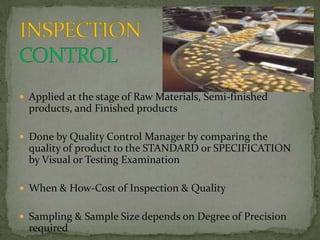
 Applied at the stage of Raw Materials, Semi-finished
  products, and Finished products

 Done by Quality Control Manager by comparing the
  quality of product to the STANDARD or SPECIFICATION
  by Visual or Testing Examination

 When & How-Cost of Inspection & Quality


 Sampling & Sample Size depends on Degree of Precision
  required
 Comprehensive Quality Control is the Effort of an
 Organization to Develop, Design, Manufacture,
 Inspect, Market & Service products that will Satisfy
 the Customers at the time of Purchase and give them
 Satisfaction for a long time after purchase


IDEA OF QC
 Western countries-by Quality Control Dept.
(results not satisfactory)
 Japanese system of Management integrated Quality
 Control with Manufacturing Dept.
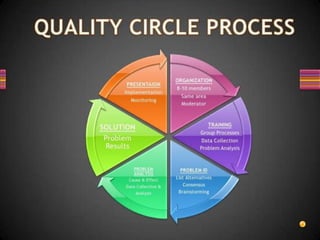
 QC is a group of employees that meets regularly to solve
  problems affecting its work area(6-12 volunteers)
 Receive training in problem solving, statistical quality
  control & group process
 Control activities, Self-Development and mutual
  development & Control and Improvement within
  workplace utilizing QC techniques with all the
  members participating
 Get solutions for quality & productivity problems-
  Implementation
 An approach to bring Participation & Teamwork
 Philosophy & Methodology-Provides opportunity to
    realize & satisfy peoples needs at the work place
   Motivates people to contribute towards organisational
    effectiveness through group processes
   It is not only applicable to manufacturing
    organizations but to banking, insurance, finance,…
   Respect humanity & build a happy workplace
    worthwhile to work
   Display human capabilities fully & eventually draw out
    infinite possibilities
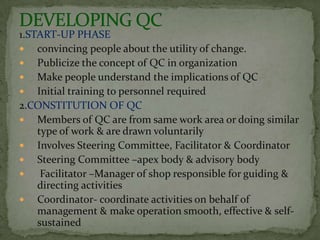
1.START-UP PHASE
 convincing people about the utility of change.
 Publicize the concept of QC in organization
 Make people understand the implications of QC
 Initial training to personnel required
2.CONSTITUTION OF QC
 Members of QC are from same work area or doing similar
    type of work & are drawn voluntarily
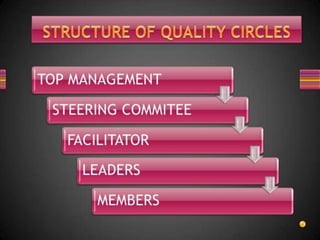
 Involves Steering Committee, Facilitator & Coordinator
 Steering Committee –apex body & advisory body
    Facilitator –Manager of shop responsible for guiding &
    directing activities
 Coordinator- coordinate activities on behalf of
    management & make operation smooth, effective & self-
    sustained
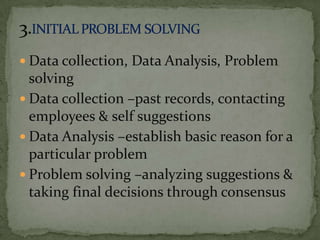
 Data collection, Data Analysis, Problem
  solving
 Data collection –past records, contacting
  employees & self suggestions
 Data Analysis –establish basic reason for a
  particular problem
 Problem solving –analyzing suggestions &
  taking final decisions through consensus
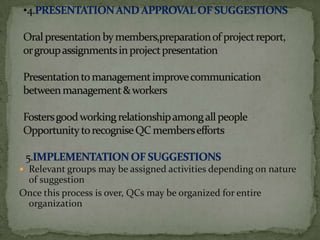
 Relevant groups may be assigned activities depending on nature
 of suggestion
Once this process is over, QCs may be organized for entire
 organization
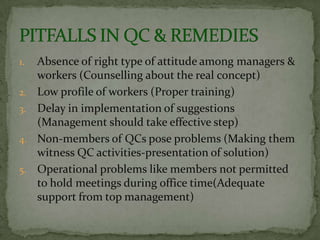
1.   Absence of right type of attitude among managers &
     workers (Counselling about the real concept)
2.   Low profile of workers (Proper training)
3.   Delay in implementation of suggestions
     (Management should take effective step)
4.   Non-members of QCs pose problems (Making them
     witness QC activities-presentation of solution)
5.   Operational problems like members not permitted
     to hold meetings during office time(Adequate
     support from top management)
Techniques & qc

Techniques & qc

  • 1.
    By Anu MaryYohannan
  • 2.
    TWO PHASES OFOPERATIONS  CONTROL of an operation in process-STATISTICAL  INSPECTION control of Raw Materials, Semi-finished products, and Finished products
  • 3.
     Method ofMeasuring and Continuously Improving Work Process before the final inspection of the product  It is Preventive & Remedial  Based on THEORY OF SAMPLING-analysis of few items out of total population  Considerations-Setting Tolerance Limit of acceptable quality & measuring the Product Quality  Useful in Automated Operations & Production of Product in large volumes
  • 5.
     Applied atthe stage of Raw Materials, Semi-finished products, and Finished products  Done by Quality Control Manager by comparing the quality of product to the STANDARD or SPECIFICATION by Visual or Testing Examination  When & How-Cost of Inspection & Quality  Sampling & Sample Size depends on Degree of Precision required
  • 6.
     Comprehensive QualityControl is the Effort of an Organization to Develop, Design, Manufacture, Inspect, Market & Service products that will Satisfy the Customers at the time of Purchase and give them Satisfaction for a long time after purchase IDEA OF QC  Western countries-by Quality Control Dept. (results not satisfactory)  Japanese system of Management integrated Quality Control with Manufacturing Dept.
  • 7.
     QC isa group of employees that meets regularly to solve problems affecting its work area(6-12 volunteers)  Receive training in problem solving, statistical quality control & group process  Control activities, Self-Development and mutual development & Control and Improvement within workplace utilizing QC techniques with all the members participating  Get solutions for quality & productivity problems- Implementation
  • 8.
     An approachto bring Participation & Teamwork  Philosophy & Methodology-Provides opportunity to realize & satisfy peoples needs at the work place  Motivates people to contribute towards organisational effectiveness through group processes  It is not only applicable to manufacturing organizations but to banking, insurance, finance,…  Respect humanity & build a happy workplace worthwhile to work  Display human capabilities fully & eventually draw out infinite possibilities
  • 10.
    1.START-UP PHASE  convincingpeople about the utility of change.  Publicize the concept of QC in organization  Make people understand the implications of QC  Initial training to personnel required 2.CONSTITUTION OF QC  Members of QC are from same work area or doing similar type of work & are drawn voluntarily  Involves Steering Committee, Facilitator & Coordinator  Steering Committee –apex body & advisory body  Facilitator –Manager of shop responsible for guiding & directing activities  Coordinator- coordinate activities on behalf of management & make operation smooth, effective & self- sustained
  • 12.
     Data collection,Data Analysis, Problem solving  Data collection –past records, contacting employees & self suggestions  Data Analysis –establish basic reason for a particular problem  Problem solving –analyzing suggestions & taking final decisions through consensus
  • 13.
     Relevant groupsmay be assigned activities depending on nature of suggestion Once this process is over, QCs may be organized for entire organization
  • 14.
    1. Absence of right type of attitude among managers & workers (Counselling about the real concept) 2. Low profile of workers (Proper training) 3. Delay in implementation of suggestions (Management should take effective step) 4. Non-members of QCs pose problems (Making them witness QC activities-presentation of solution) 5. Operational problems like members not permitted to hold meetings during office time(Adequate support from top management)