QQuuaalliittyy BByy DDeessiiggnn 
By: Ruth Burgess, Ann LeDuc 
& Paula Ziegler
DDeeffiinniittiioonn ooff:: 
Quality by Design is 
the practice of using a 
multidisciplinary team to 
conduct conceptual 
thinking, product design, 
and production planning 
all at one time.
A More General Definition 
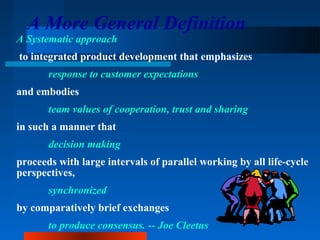
A Systematic approach 
to integrated product development that emphasizes 
response to customer expectations 
and embodies 
team values of cooperation, trust and sharing 
in such a manner that 
decision making 
proceeds with large intervals of parallel working by all life-cycle 
perspectives, 
synchronized 
by comparatively brief exchanges 
to produce consensus. -- Joe Cleetus
TThhee EEaassyy DDeeffiinniittiioonn!!!!!! 
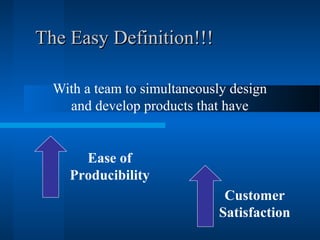
With a team to simultaneously design 
and develop products that have 
Ease of 
Producibility 
Customer 
Satisfaction
OOtthheerr TTeerrmmss ffoorr QQuuaalliittyy bbyy 
DDeessiiggnn 
Concurrent Engineering 
Simultaneous Engineering 
Parallel Engineering
PPeeooppllee ttoo IInncclluuddee oonn YYoouurr 
QQuuaalliittyy bbyy DDeessiiggnn TTeeaamm 
Specialist From Business 
Engineering 
Production 
The Customer Base 
and at appropriate times 
Suppliers of Equipment, Purchased Parts 
and Services
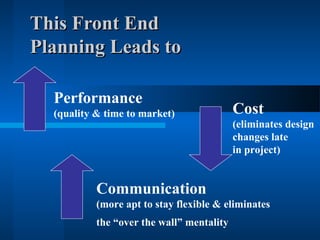
TThhiiss FFrroonntt EEnndd 
PPllaannnniinngg LLeeaaddss ttoo 
Performance 
(quality & time to market) Cost 
(eliminates design 
changes late 
in project) 
Communication 
(more apt to stay flexible & eliminates 
the “over the wall” mentality
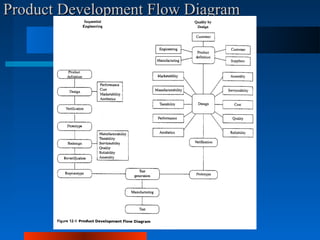
PPrroodduucctt DDeevveellooppmmeenntt FFllooww DDiiaaggrraamm
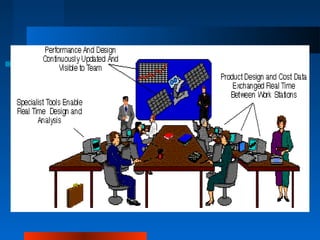
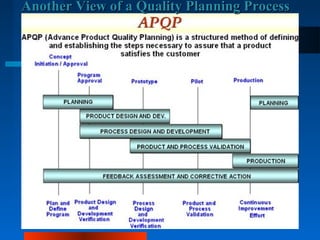
Another VViieeww ooff aa QQuuaalliittyy PPllaannnniinngg PPrroocceessss
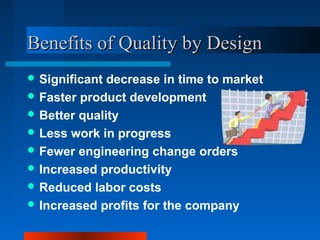
BBeenneeffiittss ooff QQuuaalliittyy bbyy DDeessiiggnn 
Significant decrease in time to market 
Faster product development 
Better quality 
Less work in progress 
Fewer engineering change orders 
Increased productivity 
Reduced labor costs 
Increased profits for the company
Quality by Design 
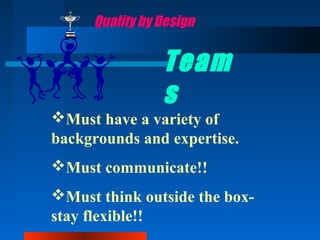
Team 
s 
Must have a variety of 
backgrounds and expertise. 
Must communicate!! 
Must think outside the box-stay 
flexible!!
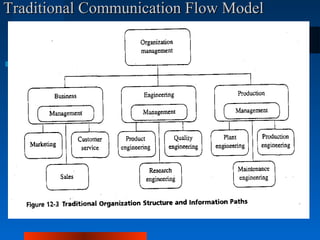
TTrraaddiittiioonnaall CCoommmmuunniiccaattiioonn FFllooww MMooddeell
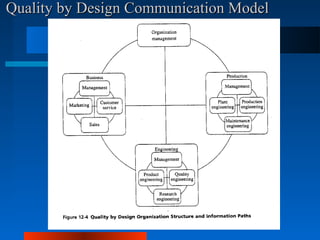
QQuuaalliittyy bbyy DDeessiiggnn CCoommmmuunniiccaattiioonn MMooddeell
IImmpplleemmeennttaattiioonn
WWhhyy IImmpplleemmeenntt 
Budgets are more critical today than 
in past 
1970’s 
– Fewer brands to choose from 
– Price = Cost + profit amount 
Today 
– Design changes in product 
development creates higher costs.
WWhhyy IImmpplleemmeenntt 
– Control cost by designing at the start of 
a project 
– Increased time in the design stage 
• Changes in design stage cost 10 times more 
than in testing stage 
• Spending 10 times more creates the need 
for development software EX: CAD/CAM
WWhhyy IImmpplleemmeenntt 
More time designing 
results in a more 
complete final product 
Less Rework 
Less waste of Materials
WWhhyy IImmpplleemmeenntt 
Fewer Design Changes + Shorter Lead 
Times = Quicker Response to Customer’s 
Needs 
Lower Rejects and Scraps = Increased 
Profits 
Customer Returns decrease 
Profit Margins increase
KKeeyy CCoonncceeppttss 
Look at the whole product life cycle 
Agree that organization has internal 
and external customers and suppliers 
Commitment to quality for the entire 
process of making the product
PPrreeppaarraattiioonn ffoorr IImmpplleemmeennttaattiioonn 
Principles - 
– Statement of principles that the 
company operates on 
Assessment - 
– How the company currently operates 
and the changes that will be made 
Work Process - 
– Define procedures for the new process
PPrreeppaarraattiioonn ((ccoonnttiinnuueedd)) 
Internal Organizational Changes - 
– Define how reporting and management will 
change 
Supply Chain - 
– Define how the supply chain will participate in 
development of the project 
People Systems - 
– Define reward systems, goals and objectives 
Technology - 
– What new technology needs to be in place to 
complete the project
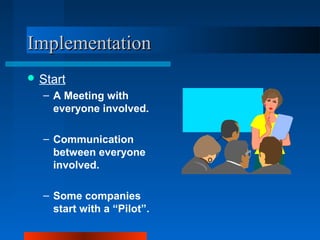
IImmpplleemmeennttaattiioonn 
Start 
– A Meeting with 
everyone involved. 
– Communication 
between everyone 
involved. 
– Some companies 
start with a “Pilot”.
IImmpplleemmeennttaattiioonn 
Benefits of Meetings 
– Project members meet face to face and develop 
personal relationships with internal and external 
customers and suppliers. 
– Everyone understands goals. 
– Clear up misconceptions 
– Answer questions
IImmpplleemmeennttaattiioonn 
Meetings 
– Regular meeting should be set for reviewing the 
project 
– Exchange ideas and resolve complaints 
– Time between meeting should be long enough for 
questions to arise and short enough to make 
design decisions
IImmpplleemmeennttaattiioonn 
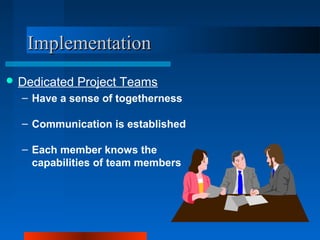
Dedicated Project Teams 
– Have a sense of togetherness 
– Communication is established 
– Each member knows the 
capabilities of team members
IImmpplleemmeennttaattiioonn 
Flaws of Dedicated Project Teams 
– Sense of stability and settling occurs 
– Tend not to look for better ways to solve 
problems and rely on past practices
IImmpplleemmeennttaattiioonn 
Co-Location 
– Placing team members in same location 
– Team stimulated to continuously find 
solutions to problems with the project 
– Increased communication and 
continuous improvements
IImmpplleemmeennttaattiioonn 
Disadvantages of Co-Location 
– Cost of moving and providing for 
project team members 
– Team members lose communication 
with the department they came from 
– Product in that department may suffer
IImmpplleemmeennttaattiioonn 
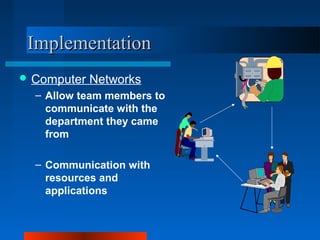
Computer Networks 
– Allow team members to 
communicate with the 
department they came 
from 
– Communication with 
resources and 
applications
IImmpplleemmeennttaattiioonn 
Advantages of Computer Networks 
– Eliminates cost of Co-Location 
– Communication between team members 
and outside consultants 
– Records progress for managers and 
accounting department
IImmpplleemmeennttaattiioonn 
Cost Increases 
– Time and Money have to be considered before 
applying the design 
Cultural Changes 
– Solutions require cultural changes before becoming 
effective 
– Through meetings, managers can slowly change the 
culture of the organization 
– After cultural changes, project facilitator may be 
hired
IImmpplleemmeennttaattiioonn 
Implementation of Quality by Design 
is a way to true quality by design.
TThhee TToooollss 
–A brief history 
–Who uses them 
–What they do
HHiissttoorryy ooff tthhee TToooollss 
Finite element analysis developed in the 
50’s and 60’s 
Aircraft manufacturers start using CAD in 
late 1970’s 
Many tools not available until late 1980’s 
Today, small organizations are able to buy 
personal computer software tools
OOvveerrvviieeww 
Organizational Tools 
– Improve communication and understanding 
Product Development Tools 
– Decrease product development time 
Production Tools 
– Improve quality of manufactured parts and 
decreases production time 
Statistical Tools 
– Allow studying and targeting of variables effecting 
design, testing, and production
WWhhoo UUsseess tthhee TToooollss 
Organizational Tools 
– Everyone 
Product Development Tools 
– Engineering and Design Professionals 
Production Tools 
– Production Engineers 
Statistical Tools 
– Quality Engineers and Others when needed
OOrrggaanniizzaattiioonnaall TToooollss 
TQM Philosophy 
Computer Networks 
ISO 9000 and ISO 14000 
Total Productive Maintenance 
Quality Function Deployment 
Electronic Data Interchange
PPrroodduucctt DDeevveellooppmmeenntt TToooollss 
Computer-aided drafting software 
Solid modeling software 
Finite element analysis software 
Parametric analysis software 
Rapid prototyping techniques 
Design for manufacture and assembly 
techniques 
Failure mode and effect analysis
PPrroodduuccttiioonn TToooollss 
Computer-aided Manufacturing 
Computer numerical controlled tools 
Continuous process improvement 
Just-in-time production 
Virtual manufacturing software 
Agile manufacturing
SSttaattiissttiiccaall TToooollss 
Design of Experiments 
Statistical Process Control
OOtthheerr CCoonnssiiddeerraattiioonnss 
Training is a must 
– Requires money and time 
Using the tools increases employee 
retention and satisfaction
MMiissccoonncceeppttiioonnss ooff 
QQuuaalliittyy bbyy DDeessiiggnn 
It is NOT simultaneous design and production. 
ALL designs are finalized BEFORE production 
begins. 
It is NOT a quick fix or magical formula for 
success. 
It does NOT require multiple testing of 
products. 
Should NOT be confused with TQM inspection 
techniques.
PPiittffaallllss ttoo AAvvooiidd 
 Don’t eliminate the old type sequential 
engineering system too quickly. 
 Avoid having an unobtainable schedule. Better 
to be done early (longer predicted time) than to 
be late (shorter predicted time). 
 Avoid using tight tolerances and stringent 
requirements. 
 Avoid changing the product specs during the 
design phase. 
 Avoid using the low bidder. 
 Avoid automating the product development 
phase before it is simplified.
RReeffeerreenncceess 
 Besterfield, D. H., Besterfield, G. H., Besterfield- 
Michna, C., & Besterfield-Sacre, M. 1999. Total 
Quality Management. New York:Prentice Hall. 
 http://www.erim.org/cec/column/mar00.htm 
 http://www.erim.org/cec/column/nov96.htm 
 http://www.cerc.wvu.edu/documents.htm 
 http://www.icsassociates.com/index.html 
 http://www.amkor.com/services/quality/apqp.cfm

Quality by design(paula_ruth_ann)

  • 1.
    QQuuaalliittyy BByy DDeessiiggnn By: Ruth Burgess, Ann LeDuc & Paula Ziegler
  • 2.
    DDeeffiinniittiioonn ooff:: Qualityby Design is the practice of using a multidisciplinary team to conduct conceptual thinking, product design, and production planning all at one time.
  • 3.
    A More GeneralDefinition A Systematic approach to integrated product development that emphasizes response to customer expectations and embodies team values of cooperation, trust and sharing in such a manner that decision making proceeds with large intervals of parallel working by all life-cycle perspectives, synchronized by comparatively brief exchanges to produce consensus. -- Joe Cleetus
  • 5.
    TThhee EEaassyy DDeeffiinniittiioonn!!!!!! With a team to simultaneously design and develop products that have Ease of Producibility Customer Satisfaction
  • 6.
    OOtthheerr TTeerrmmss ffoorrQQuuaalliittyy bbyy DDeessiiggnn Concurrent Engineering Simultaneous Engineering Parallel Engineering
  • 7.
    PPeeooppllee ttoo IInncclluuddeeoonn YYoouurr QQuuaalliittyy bbyy DDeessiiggnn TTeeaamm Specialist From Business Engineering Production The Customer Base and at appropriate times Suppliers of Equipment, Purchased Parts and Services
  • 8.
    TThhiiss FFrroonntt EEnndd PPllaannnniinngg LLeeaaddss ttoo Performance (quality & time to market) Cost (eliminates design changes late in project) Communication (more apt to stay flexible & eliminates the “over the wall” mentality
  • 9.
  • 10.
    Another VViieeww ooffaa QQuuaalliittyy PPllaannnniinngg PPrroocceessss
  • 11.
    BBeenneeffiittss ooff QQuuaalliittyybbyy DDeessiiggnn Significant decrease in time to market Faster product development Better quality Less work in progress Fewer engineering change orders Increased productivity Reduced labor costs Increased profits for the company
  • 12.
    Quality by Design Team s Must have a variety of backgrounds and expertise. Must communicate!! Must think outside the box-stay flexible!!
  • 13.
  • 14.
    QQuuaalliittyy bbyy DDeessiiggnnCCoommmmuunniiccaattiioonn MMooddeell
  • 15.
  • 16.
    WWhhyy IImmpplleemmeenntt Budgetsare more critical today than in past 1970’s – Fewer brands to choose from – Price = Cost + profit amount Today – Design changes in product development creates higher costs.
  • 17.
    WWhhyy IImmpplleemmeenntt –Control cost by designing at the start of a project – Increased time in the design stage • Changes in design stage cost 10 times more than in testing stage • Spending 10 times more creates the need for development software EX: CAD/CAM
  • 18.
    WWhhyy IImmpplleemmeenntt Moretime designing results in a more complete final product Less Rework Less waste of Materials
  • 19.
    WWhhyy IImmpplleemmeenntt FewerDesign Changes + Shorter Lead Times = Quicker Response to Customer’s Needs Lower Rejects and Scraps = Increased Profits Customer Returns decrease Profit Margins increase
  • 20.
    KKeeyy CCoonncceeppttss Lookat the whole product life cycle Agree that organization has internal and external customers and suppliers Commitment to quality for the entire process of making the product
  • 21.
    PPrreeppaarraattiioonn ffoorr IImmpplleemmeennttaattiioonn Principles - – Statement of principles that the company operates on Assessment - – How the company currently operates and the changes that will be made Work Process - – Define procedures for the new process
  • 22.
    PPrreeppaarraattiioonn ((ccoonnttiinnuueedd)) InternalOrganizational Changes - – Define how reporting and management will change Supply Chain - – Define how the supply chain will participate in development of the project People Systems - – Define reward systems, goals and objectives Technology - – What new technology needs to be in place to complete the project
  • 23.
    IImmpplleemmeennttaattiioonn Start –A Meeting with everyone involved. – Communication between everyone involved. – Some companies start with a “Pilot”.
  • 24.
    IImmpplleemmeennttaattiioonn Benefits ofMeetings – Project members meet face to face and develop personal relationships with internal and external customers and suppliers. – Everyone understands goals. – Clear up misconceptions – Answer questions
  • 25.
    IImmpplleemmeennttaattiioonn Meetings –Regular meeting should be set for reviewing the project – Exchange ideas and resolve complaints – Time between meeting should be long enough for questions to arise and short enough to make design decisions
  • 26.
    IImmpplleemmeennttaattiioonn Dedicated ProjectTeams – Have a sense of togetherness – Communication is established – Each member knows the capabilities of team members
  • 27.
    IImmpplleemmeennttaattiioonn Flaws ofDedicated Project Teams – Sense of stability and settling occurs – Tend not to look for better ways to solve problems and rely on past practices
  • 28.
    IImmpplleemmeennttaattiioonn Co-Location –Placing team members in same location – Team stimulated to continuously find solutions to problems with the project – Increased communication and continuous improvements
  • 29.
    IImmpplleemmeennttaattiioonn Disadvantages ofCo-Location – Cost of moving and providing for project team members – Team members lose communication with the department they came from – Product in that department may suffer
  • 30.
    IImmpplleemmeennttaattiioonn Computer Networks – Allow team members to communicate with the department they came from – Communication with resources and applications
  • 31.
    IImmpplleemmeennttaattiioonn Advantages ofComputer Networks – Eliminates cost of Co-Location – Communication between team members and outside consultants – Records progress for managers and accounting department
  • 32.
    IImmpplleemmeennttaattiioonn Cost Increases – Time and Money have to be considered before applying the design Cultural Changes – Solutions require cultural changes before becoming effective – Through meetings, managers can slowly change the culture of the organization – After cultural changes, project facilitator may be hired
  • 33.
    IImmpplleemmeennttaattiioonn Implementation ofQuality by Design is a way to true quality by design.
  • 34.
    TThhee TToooollss –Abrief history –Who uses them –What they do
  • 35.
    HHiissttoorryy ooff tthheeTToooollss Finite element analysis developed in the 50’s and 60’s Aircraft manufacturers start using CAD in late 1970’s Many tools not available until late 1980’s Today, small organizations are able to buy personal computer software tools
  • 36.
    OOvveerrvviieeww Organizational Tools – Improve communication and understanding Product Development Tools – Decrease product development time Production Tools – Improve quality of manufactured parts and decreases production time Statistical Tools – Allow studying and targeting of variables effecting design, testing, and production
  • 37.
    WWhhoo UUsseess tthheeTToooollss Organizational Tools – Everyone Product Development Tools – Engineering and Design Professionals Production Tools – Production Engineers Statistical Tools – Quality Engineers and Others when needed
  • 38.
    OOrrggaanniizzaattiioonnaall TToooollss TQMPhilosophy Computer Networks ISO 9000 and ISO 14000 Total Productive Maintenance Quality Function Deployment Electronic Data Interchange
  • 39.
    PPrroodduucctt DDeevveellooppmmeenntt TToooollss Computer-aided drafting software Solid modeling software Finite element analysis software Parametric analysis software Rapid prototyping techniques Design for manufacture and assembly techniques Failure mode and effect analysis
  • 40.
    PPrroodduuccttiioonn TToooollss Computer-aidedManufacturing Computer numerical controlled tools Continuous process improvement Just-in-time production Virtual manufacturing software Agile manufacturing
  • 41.
    SSttaattiissttiiccaall TToooollss Designof Experiments Statistical Process Control
  • 42.
    OOtthheerr CCoonnssiiddeerraattiioonnss Trainingis a must – Requires money and time Using the tools increases employee retention and satisfaction
  • 43.
    MMiissccoonncceeppttiioonnss ooff QQuuaalliittyybbyy DDeessiiggnn It is NOT simultaneous design and production. ALL designs are finalized BEFORE production begins. It is NOT a quick fix or magical formula for success. It does NOT require multiple testing of products. Should NOT be confused with TQM inspection techniques.
  • 44.
    PPiittffaallllss ttoo AAvvooiidd  Don’t eliminate the old type sequential engineering system too quickly.  Avoid having an unobtainable schedule. Better to be done early (longer predicted time) than to be late (shorter predicted time).  Avoid using tight tolerances and stringent requirements.  Avoid changing the product specs during the design phase.  Avoid using the low bidder.  Avoid automating the product development phase before it is simplified.
  • 45.
    RReeffeerreenncceess  Besterfield,D. H., Besterfield, G. H., Besterfield- Michna, C., & Besterfield-Sacre, M. 1999. Total Quality Management. New York:Prentice Hall.  http://www.erim.org/cec/column/mar00.htm  http://www.erim.org/cec/column/nov96.htm  http://www.cerc.wvu.edu/documents.htm  http://www.icsassociates.com/index.html  http://www.amkor.com/services/quality/apqp.cfm

Editor's Notes

  • #36 Before the late 80’s CAD software was only available to major aircraft manufacturers. Finite Analysis software was only available to aircraft organizations, automobile manufacturers, and government laboratories. These organizations had the use of high-powered supercomputers. The desktop computer processing power explosion with advanced computer graphics abilities made the tools available in the late 80’s.
  • #39 TQM - all employees must understand these principles in order to understand the organization’s goals and strive to achieve them. Networks - allow for sharing of information both locally and globally ISO’s - set standards QFD - matches/relates customer requirements with engineering characteristics and production processes. Deployed through product planning, design, engineering production, assembly and field service. Results of QFD are measured with the number of design and engineering changes, time to market, cost, and quality. EDI - provides a standard mode for companies, departments, suppliers, and competitors to share information on products, parts, components, inventory, analysis, specifications, etc.. Uses the internet. Companies are able to communicate very efficiently, allowing the growth of and in the global marketplace.
  • #40 CAD - produces engineering production drawings. Allows for quick and easy engineering changes. Easily used with other software used for computer-aided manufacturing, design for manufacture, and CNC machines. Solid modeling software - Creates a visual verification of a component or a system. FEA - analyzes and optimizes the response of a system prior to prototype development and testing. Helps detect problems early, allows design team to implement alternative changes instantly, test the changes and see the effect on quality and performance. Parametric Analysis Software - expands the capabilities of solid modeling and FEA software by including parametric modeling from parts libraries and design optimization. Automates changes in design by programming the software to make decisions based on specified functions, variables, and other analysis criteria. Rapid Prototyping techniques - quickly produces a physical model of a product. Techniques include - stereolithography, solid ground curing, selective laser sintering, fused deposition modeling, direct shell production casting, and laminated object method. Prototypes do not have realistic mechanical characteristics. DFMA - design philosophy that identifies production and assembly problems prior to production. FMEA - identifies failure modes of a product or process before they happen and plans for their elimination.Includes a group of activities that recognize and evaluate potential failure of a product or process and its effects; identify actions that could eliminate or reduce the chance of failure, documents the process. Requires a team effort.
  • #41 CAM - software that identifies machine tool paths and other production parameters to optimize the machining of a part. Includes parameters such as machine tool feed rates, stock required, bit size and optimum tool path. CNC - Controls mills, lathes, and presses using a computer. CPI - systematic year after year study to improve the production processes by eliminating waste and rework, reducing scrap and cycle time, eliminating activities that do not increase product value, and eliminating non-conformities JIT - a process control method and production philosophy that provides parts, components, and assemblies to production at the exact time they are needed, resulting in less inventory of raw materials and parts, less work in process, and shorter lead times. One problem with JIT is the reduction of inventory to critically low levels. Suppliers with excellent quality products and services as well as a knowledge of production lead and process times must be used. Virtual Manufacturing Software - enables production engineers to create a factory on their desktop computer. Engineers can analyze and debug production facilities prior to the capital equipment investment. Agile Manufacturing - A manufacturing environment that responds quickly to marketplace demands by quickly incorporating new technologies into products and easily adapts to many different customer needs.
  • #42 DOE - a numerical study that identifies and studies many variables in a process or product at once that are the critical parameters or cause significant variation in the process. Three approaches to DOE are classical, Taguchi, and Shainin. A mix of the three approaches is often a wise choice. SPC - “The primary TQM tool.” It is a charting technique used to monitor process variations and correct problems before they occur. Because DOE identifies the variables, it should be used before SPC. Otherwise the wrong variables may be monitored by SPC.