Process Mapping
Rebecca S. (Suzie) Miltner, PhD, RN
Associate Professor, School of Nursing
Learning Objectives
Practice use of common and useful quality
improvement tools:
Process Maps
2
Rationale for Process Literacy
Common understanding, shared model for an
improvement team
Identify parts of the system to measure
Helps generate hypotheses for change
Context is critical
Process Arrogance &
Complex Systems
“Exaggerated sense of knowing how
things work” – Ogrinc et al, 2012
-4-
Describe an elephant
Rationale for Process Literacy
Common understanding, shared model for
an improvement team
Identify parts of the system to measure
Helps generate hypotheses for change
Context is critical
Gathering Data to Understand the
Problem: Suggested Steps
Appreciate culture and context
Observe processes
Interview key personnel
Get ideas down in writing
Feedback from key stakeholders
Create symbolic representation
-7-
Understanding a Process
Common tools to help organize your thoughts:
 Brainstorming and use of affinity diagrams
 Cause and effect diagrams (“fishbone” or “Ishikawa”)
 Process flow maps (in Lean = “value stream map”)
 Deployment flowchart
 Workflow (“spaghetti”) diagram
Create a conceptual map of the process
you use to get ready to come to work in
the morning.
Use the labels provided.
There are blanks ones for other steps
you may use.
11
Skill Exercise
What is your process?
12
Alarm
goes off
Drive to
work
???
Developing a Process Map
Why?
 Provides a common picture of a process for the
whole team.
 Helps identify which parts of the system are
important to measure.
 Helps generate ideas for change. (Define,
standardize or find areas for improvement in a
process.)
13
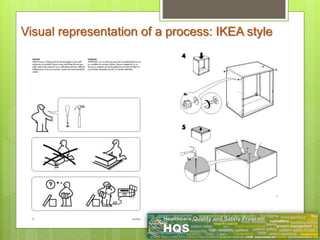
Visual representation of a process: IKEA style
Developing a Process Map
How?
 Use symbols to represent steps in the process
 Start with big picture and develop detail later
 Need to have people who do the process
involved
15
Process Map Symbols
16
Rectangle: Denotes a
step in the process or
instructions
Oval: Denotes the
Start or Stop point in
the process
Diamond:
Denotes a
decision
point in the
process
Arrow: Denotes direction
Triangle:
Measurement
point
Simple Process Map
Preheat
Oven
Carve and
serve meat
Cook
Meat
Prepare
Turkey
Let
meat
rest
Done?
Yes
No
Simple Process Map
Preheat
Oven
Carve and
serve meat
Cook
Meat
Prepare
Turkey
Let
meat
rest
Done?
Yes
No
Indicator 1: Time to preheat Indicator 2: Time at rest
Step 1. Heat 2 TBSP oil in large wok or pan
Step 2. Add the vegetables in order of how long
they will take to cook
Step 3. Add the cooked meat
Step 4. Crack two eggs into the middle stir to
scramble them until they are almost cooked through
Step 5. Add the rice
Step 6. Stir swiftly around the wok until the rice is
heated through
Step 1. Heat 2 TBSP oil in large wok or pan
Step 2. Add the vegetables in order of how long
they will take to cook
Step 3. Add the cooked meat
Step 4. Crack two eggs into the middle stir to
scramble them until they are almost cooked through
Step 5. Add the rice
Step 6. Stir swiftly around the wok until the rice is
heated through
“Looks good. But the six "easy" steps follow the less-easy
and more messy - buy, wash, chop veggies; buy, cook rice;
buy, chop, cook meat(s).
The cooks in the back of the kitchen make the chef appear
awesomely efficient.” (Kris Miltner)
Developing a Process Map*
When?
 When you need to clarify the process
 When you need to identify places to measure
key steps of the process.
 When you need to help others understand the
process.
 Procedure manuals?
21
Not So Simple Process Map
Yes
Current IAD Process Map
Ideal IAD Process Map
Tips
Begin with the global aim statement
 Where the process begins and ends
 Boundaries should be aligned with the aim
statement and improvement theme.
Do not mix reality with wishful thinking.
 Always map the CURRENT process
 Helps to understand where you can improve the
process
-25-
Ideally!
We haven’t
done this yet!
Tips
Ask what happens first, next, and then what
happens next.
 If DEPENDS, then pick the most common next step and
follow what happens after, and then go back to follow
the other one.
Keep it simple
Turn the list of steps into a flow chart using
symbols
-26-
Who is a puzzler?
Breakout: Process Map
We are going to break out into 5 groups.
One group is our puzzle experts. They
are going to create an ideal process map
for a puzzle based on their knowledge of
the process.
The other 4 groups will put a puzzle
together.
28
Breakout: Process Map
Puzzle teams:
Each team will get a set of puzzles.
Put together the puzzle marked by a
circle on the back.
Write down all the steps in the process of
solving the puzzle.
Map the process on the board/paper.
29
Discussion: Process Map
Puzzle experts will share the IDEAL
process map.
Compare your team’s actual process to
the ideal.
 Are they the same?
 If not, where is the variation?
What did you learn about the process of
putting a puzzle together?
30

Process Maps

  • 1.
    Process Mapping Rebecca S.(Suzie) Miltner, PhD, RN Associate Professor, School of Nursing
  • 2.
    Learning Objectives Practice useof common and useful quality improvement tools: Process Maps 2
  • 3.
    Rationale for ProcessLiteracy Common understanding, shared model for an improvement team Identify parts of the system to measure Helps generate hypotheses for change Context is critical
  • 4.
    Process Arrogance & ComplexSystems “Exaggerated sense of knowing how things work” – Ogrinc et al, 2012 -4-
  • 5.
  • 6.
    Rationale for ProcessLiteracy Common understanding, shared model for an improvement team Identify parts of the system to measure Helps generate hypotheses for change Context is critical
  • 7.
    Gathering Data toUnderstand the Problem: Suggested Steps Appreciate culture and context Observe processes Interview key personnel Get ideas down in writing Feedback from key stakeholders Create symbolic representation -7-
  • 8.
    Understanding a Process Commontools to help organize your thoughts:  Brainstorming and use of affinity diagrams  Cause and effect diagrams (“fishbone” or “Ishikawa”)  Process flow maps (in Lean = “value stream map”)  Deployment flowchart  Workflow (“spaghetti”) diagram
  • 11.
    Create a conceptualmap of the process you use to get ready to come to work in the morning. Use the labels provided. There are blanks ones for other steps you may use. 11 Skill Exercise
  • 12.
    What is yourprocess? 12 Alarm goes off Drive to work ???
  • 13.
    Developing a ProcessMap Why?  Provides a common picture of a process for the whole team.  Helps identify which parts of the system are important to measure.  Helps generate ideas for change. (Define, standardize or find areas for improvement in a process.) 13
  • 14.
    Visual representation ofa process: IKEA style
  • 15.
    Developing a ProcessMap How?  Use symbols to represent steps in the process  Start with big picture and develop detail later  Need to have people who do the process involved 15
  • 16.
    Process Map Symbols 16 Rectangle:Denotes a step in the process or instructions Oval: Denotes the Start or Stop point in the process Diamond: Denotes a decision point in the process Arrow: Denotes direction Triangle: Measurement point
  • 17.
    Simple Process Map Preheat Oven Carveand serve meat Cook Meat Prepare Turkey Let meat rest Done? Yes No
  • 18.
    Simple Process Map Preheat Oven Carveand serve meat Cook Meat Prepare Turkey Let meat rest Done? Yes No Indicator 1: Time to preheat Indicator 2: Time at rest
  • 19.
    Step 1. Heat2 TBSP oil in large wok or pan Step 2. Add the vegetables in order of how long they will take to cook Step 3. Add the cooked meat Step 4. Crack two eggs into the middle stir to scramble them until they are almost cooked through Step 5. Add the rice Step 6. Stir swiftly around the wok until the rice is heated through
  • 20.
    Step 1. Heat2 TBSP oil in large wok or pan Step 2. Add the vegetables in order of how long they will take to cook Step 3. Add the cooked meat Step 4. Crack two eggs into the middle stir to scramble them until they are almost cooked through Step 5. Add the rice Step 6. Stir swiftly around the wok until the rice is heated through “Looks good. But the six "easy" steps follow the less-easy and more messy - buy, wash, chop veggies; buy, cook rice; buy, chop, cook meat(s). The cooks in the back of the kitchen make the chef appear awesomely efficient.” (Kris Miltner)
  • 21.
    Developing a ProcessMap* When?  When you need to clarify the process  When you need to identify places to measure key steps of the process.  When you need to help others understand the process.  Procedure manuals? 21
  • 22.
    Not So SimpleProcess Map Yes
  • 23.
  • 24.
  • 25.
    Tips Begin with theglobal aim statement  Where the process begins and ends  Boundaries should be aligned with the aim statement and improvement theme. Do not mix reality with wishful thinking.  Always map the CURRENT process  Helps to understand where you can improve the process -25- Ideally! We haven’t done this yet!
  • 26.
    Tips Ask what happensfirst, next, and then what happens next.  If DEPENDS, then pick the most common next step and follow what happens after, and then go back to follow the other one. Keep it simple Turn the list of steps into a flow chart using symbols -26-
  • 27.
    Who is apuzzler?
  • 28.
    Breakout: Process Map Weare going to break out into 5 groups. One group is our puzzle experts. They are going to create an ideal process map for a puzzle based on their knowledge of the process. The other 4 groups will put a puzzle together. 28
  • 29.
    Breakout: Process Map Puzzleteams: Each team will get a set of puzzles. Put together the puzzle marked by a circle on the back. Write down all the steps in the process of solving the puzzle. Map the process on the board/paper. 29
  • 30.
    Discussion: Process Map Puzzleexperts will share the IDEAL process map. Compare your team’s actual process to the ideal.  Are they the same?  If not, where is the variation? What did you learn about the process of putting a puzzle together? 30