PRESENTATION ON
QUALITY IMPROVEMENT PARADIGM


 Presented by:
 Chaitanya Pratap Singh
 MCA 5th Semester
 South Asian University, New Delhi
OVERVIEW
 Introduction
 Purpose

 Principles

 The QIP cycle
       Its phases
   PIA-variant of the QIP cycle
       Its phases
 Conclusion
 References
INTRODUCTION
 The Quality Improvement Paradigm (QIP) evolved from
  the co-operative effort between NASA Goddard Space
  Flight Center / Flight Dynamics Division and the
  Department of Computer Science, University of
  Maryland.
 QIP-model designed to support process improvement
  and technology infusion.
 The chief author of the model is Victor Basili and it was
  first published in 1984 (Basili & Weiss 1984)
 The QIP model is a part of a larger system model,
  called the Experience Factory.
PURPOSE
   The purpose of the QIP model is
     To support continuous process improvement and
      engineering of the development processes (Rombach 1998,
      13)
     To help in technology infusion (Basili 1994, 2, 65)
PRINCIPLES
 Based on the principle that software discipline is
  evolutionary and experimental.
 Takes the premise that all project environments and
  products are different.
       For example flight control software is entirely different thing
        from game software
QIP CYCLES
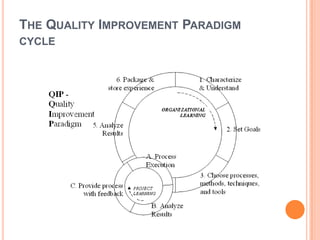
   QIP cycle is broken into two closed loop cycles –
     Organizational (larger cycle) and
     Project (smaller cycle)

 Project specific feedback cycle is to provide feedback to
  the project during the execution phase in order to prevent
  and solve problems, monitor and support the project.
 Organizational feedback cycle provides feedback to the
  organization after the completion of the project.
CONT…
 Purpose of the Organizational feedback is to analyze the
  similarities and differences of the collected data against
  previous experiences and models.
 This helps to increase the understanding of the concluded
  experience.
THE QUALITY IMPROVEMENT PARADIGM
CYCLE
QIP CYCLE
   QIP cycle can be used as a tool-
       to learn more of already existing packaged experiences
       to create completely new, packaged experiences.
 QIP cycle itself does not change, but if the goal is to
  produce a new experience and package it for future
  reuse, the fourth phase (Execute the Processes) requires
  several iterations.
 Reason is that the experience should not be packaged
  based on one single case, but requires several
  experimentations until there is sufficient knowledge of
  where it works and what it requires to work.
ORGANIZATIONAL CYCLE
   The organizational cycle represents how organization
    learns. It is divided into following six phases:
       Characterize and Understand
       Set Goals
       Choose Processes, methods, techniques and tools
       Execute the Processes (run the project cycle)
       Analyze Results
       Package and store experience
1.CHARACTERIZE AND UNDERSTAND
 Starting phase for the cycle.
 Aim is to describe the current project and its
  environment with respect to available
       Process, Product, Quality models, Data, etc.
   Also establishes quantifiable baselines based on past
    experiences and characterizes their criticality.

   (What does our world look like?)
2.SET GOALS
 Second phase is to Set Goals for successful project
  performance improvement results.
 Aim is to be able to get reliable, measurable data.

 For this reason the goals need to be quantifiable and
  defined from a variety of perspectives, including-
     Customer,
     Project and
     Organization viewpoints.


   (What do we want to know about our world and what do
    we want to accomplish?)
3.CHOOSE PROCESSES, METHODS,
TECHNIQUES AND TOOLS
 The objective of the third phase is to Choose
  Processes, Methods, Techniques and Tools that are
  appropriate for this project
 The decision is based on the characterization of the
  environment and product and on the goals that have been
  set
 It is important to make sure that the selection is
  consistent with the goals set for products and processes.

   (What processes might work for these goals in this
    environment?)
4.EXECUTE THE PROCESS
 Fourth phase of the organizational cycle is where the
  selected project(s) Execute the Processes.
 From organization point of view, this phase is where the
  project cycle runs.
 The project cycle, which represents how project learns
  and guides itself, is divided into three activities:
     Process Execution
     Analyze Results
     Provide Process with Feedback
CONT…
 The projects Execute the Processes to construct the
  products.
 At the same time data of resources, processes and
  products is being collected, validated and Results
  Analyzed to measure the achievement of the goals.
 This information is then fed back to the project for
  corrective action.

   (What happens during the application of the selected
    processes?)
5.ANALYZE RESULTS
   Fifth phase is to Analyze Results to
     Evaluate practices,
     Determine problems,
     Record findings and
     Make recommendations for future project improvements.
   The data is analyzed against the goals for the following
    reasons
       To achieve better characterization
       To understand the context,
       To evaluate and analyze the experiments (improvements),
       To determine problems,
       To gain more information to be used for better prediction and
        control and
       To motivate future improvements.

   (How well did the proposed solutions work, what was
    missing, and how should we fix it?)
6.PACKAGE AND STORE EXPERIENCE
 The aim is to Package Experiences and to store them in the
  experience base for future reuse.
 QIP cycle is used for improving processes through
  experimenting with new procedures, methods or tools.
 So it may require several cycle iterations and projects before
  there is sufficient information for packaging the experiences.
 In this phase, the experience gained is consolidated in the
  form of new or updated and refined models gained from this
  and prior projects.

    (How do we integrate what we learned into the
    organization?)
PIA CALLED PERFECT IMPROVEMENT
APPROACH, OR PIA FOR SHORT
   A variant of the QIP has been developed at
    Fraunhofer Institute, Germany.

   Has a modified project cycle and the steps have
    been refined to a more detailed level.

   Has a modified project cycle and the steps have
    been refined to a more detailed level.
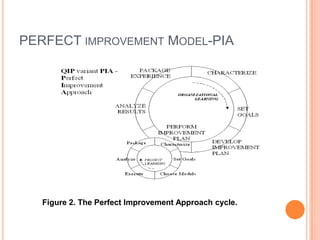
PERFECT IMPROVEMENT MODEL-PIA


   Figure 2. The Perfect Improvement Approach cycle.
CONT…


   Organisational cycle, called Strategic Cycle in PIA,
    is much the same as in the QIP, except more
    detailed in descriptions.
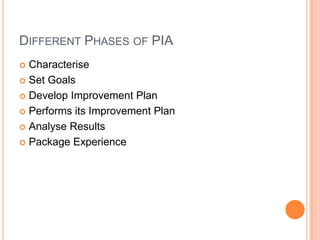
DIFFERENT PHASES OF PIA
 Characterise
 Set Goals

 Develop Improvement Plan

 Performs its Improvement Plan

 Analyse Results

 Package Experience
1ST PHASE: CHARACTERISE
   The function produces (or updates) a characterisation of
    the organisation and identifies the organisational
    improvement goals and major problems.

   Characterisation includes references to available
    process models, but if these don't exist it is
    recommended that one be developed during this phase,
    for further use in the measurement program.

   The improvement goals need to be derived from high-
    level business goals. The problems are used to find a
    starting point for improvement goals.
2ND PHASE: SET GOALS
   Strategic improvement goals are
    defined, corresponding hypotheses are
    developed, and an improvement program plan is
    produced for how to achieve the goals.

   Strategic goal -instance of organisational goals and
    hypothesis further refines that goal.

   The scope of the goals and hypotheses on this
    phase is generic (problem-specific), not project-
    specific.
3RD PHASE: DEVELOP IMPROVEMENT PLAN
   The projects, pilots, or experiments are identified
    for investigating the hypotheses.

  Resource usage and schedule for the
  experimentation is planned.
 Project characterisation provides a tool to select
  candidate projects, and documentation of the
  context within which the experiences apply.
 Suitable project(s) are evaluated and selected
  based on the goals in the improvement program
  plan.
4TH PHASE: PERFORMS ITS IMPROVEMENT
PLAN
 selected pilot projects are running
 At the strategic level, this is where the organisation
  Performs its Improvement Plan by conducting
  experiments.
 strategic actions are to initiate the project and
  monitor and give guidance to it in order to ensure
  the success of the measurement program (data
  collection) and to motivate the project team.
CONTINUED…
   When initiating the project, the strategic level needs to
    prepare the project according to improvement plan and
    motivate and train the people participating in the project.

    Monitoring the project is to ensure that the improvement
    program is performed according to the defaults and
    guidance is given to coach the project through the
    improvement program part of the project.

   After the first experiment has been concluded, the
    improvement program plan is refined / modified (PIA
    phases 2 and 3 on the strategic level) by evaluating the
    results and experiences.
5TH PHASE: ANALYSE RESULTS
  Is entered once the improvement program and
  selected pilots have been concluded.
 Collected data is prepared for presentation.

 Data is then presented in a feedback session and
  feedback is analysed with reference to
  corresponding hypotheses of the goals of the
  improvement program.
 Results of other improvement programs can be
  used as a base for comparisons in this activity.
6TH PHASE:

   experiences are identified for future reuse needs and
    stored as experience package to the experience base.
PROJECT CYCLE

 Changed   to include same six phases as the
  organisational cycle has.
 These includes:

 Characterise

 Set the project Goals

 Chooses appropriate Models

 Execute

 Analyse

 Package
PHASES IN PROJECT CYCLE
1: Characterise :The project and identify relevant
  models to be reused.
 Includes the characterisation of project,
  organisational environment of the project, and
  project goals. Existing reusable models are
  retrieved from experience base.
2:Goals: Next Set the project Goals in measurable
  terms and derive metrics from them.
 Includes goal identification, making the
  measurement plan for those goals, and validating
  the plans.
CONTINUED…
3: Chooses appropriate Models : Choose appropriate
  Models for processes and develops the project plan.
 This phase includes:

   - tailoring the selected reusable models.
   - developing new models,
   - creating an instance of the agreed models and
  integrating the models and the measurement plans.

4: Execute – is where the project performs according to its
  plans, collects data and both provides and gets feedback
  for project guidance.
CONTINUED..
5:Analyse: Analyse the project and collected data
  and to suggest improvements.
 -The analysis is done with reference to hypotheses.

6: Package the analysis results into improved
  reusable models.
CONCLUSION
   An Origination's use of the quality improvement
    paradigm is an iterative process that repeatedly
    characterizes the environment.

    Sets appropriate goals, and chooses the process
    for achieving those goals. It then proceeds with the
    execution and analytical phase.

   At each iteration, it redefines and improves
    characteristics and goals.
REFERENCES
 Kinnula, Atte. Software process engineering
  systems: models and industry cases[3.2. Quality
  Improvement Paradigm -cycle].Retrieved from
  Lecture Notes Online Web site:
  http://herkules.oulu.fi/isbn9514265084/html/index.ht
  ml
 Basili, Victor R. OutLine. Retrieved form Lecture
  Notes Onine Web site:
  http://www.cs.umd.edu/users/basili/qip/
THANK YOU

Quality improvement paradigm (QIP)

  • 1.
    PRESENTATION ON QUALITY IMPROVEMENTPARADIGM Presented by: Chaitanya Pratap Singh MCA 5th Semester South Asian University, New Delhi
  • 2.
    OVERVIEW  Introduction  Purpose Principles  The QIP cycle  Its phases  PIA-variant of the QIP cycle  Its phases  Conclusion  References
  • 3.
    INTRODUCTION  The QualityImprovement Paradigm (QIP) evolved from the co-operative effort between NASA Goddard Space Flight Center / Flight Dynamics Division and the Department of Computer Science, University of Maryland.  QIP-model designed to support process improvement and technology infusion.  The chief author of the model is Victor Basili and it was first published in 1984 (Basili & Weiss 1984)  The QIP model is a part of a larger system model, called the Experience Factory.
  • 4.
    PURPOSE  The purpose of the QIP model is  To support continuous process improvement and engineering of the development processes (Rombach 1998, 13)  To help in technology infusion (Basili 1994, 2, 65)
  • 5.
    PRINCIPLES  Based onthe principle that software discipline is evolutionary and experimental.  Takes the premise that all project environments and products are different.  For example flight control software is entirely different thing from game software
  • 6.
    QIP CYCLES  QIP cycle is broken into two closed loop cycles –  Organizational (larger cycle) and  Project (smaller cycle)  Project specific feedback cycle is to provide feedback to the project during the execution phase in order to prevent and solve problems, monitor and support the project.  Organizational feedback cycle provides feedback to the organization after the completion of the project.
  • 7.
    CONT…  Purpose ofthe Organizational feedback is to analyze the similarities and differences of the collected data against previous experiences and models.  This helps to increase the understanding of the concluded experience.
  • 8.
  • 9.
    QIP CYCLE  QIP cycle can be used as a tool-  to learn more of already existing packaged experiences  to create completely new, packaged experiences.  QIP cycle itself does not change, but if the goal is to produce a new experience and package it for future reuse, the fourth phase (Execute the Processes) requires several iterations.  Reason is that the experience should not be packaged based on one single case, but requires several experimentations until there is sufficient knowledge of where it works and what it requires to work.
  • 10.
    ORGANIZATIONAL CYCLE  The organizational cycle represents how organization learns. It is divided into following six phases:  Characterize and Understand  Set Goals  Choose Processes, methods, techniques and tools  Execute the Processes (run the project cycle)  Analyze Results  Package and store experience
  • 11.
    1.CHARACTERIZE AND UNDERSTAND Starting phase for the cycle.  Aim is to describe the current project and its environment with respect to available  Process, Product, Quality models, Data, etc.  Also establishes quantifiable baselines based on past experiences and characterizes their criticality.  (What does our world look like?)
  • 12.
    2.SET GOALS  Secondphase is to Set Goals for successful project performance improvement results.  Aim is to be able to get reliable, measurable data.  For this reason the goals need to be quantifiable and defined from a variety of perspectives, including-  Customer,  Project and  Organization viewpoints.  (What do we want to know about our world and what do we want to accomplish?)
  • 13.
    3.CHOOSE PROCESSES, METHODS, TECHNIQUESAND TOOLS  The objective of the third phase is to Choose Processes, Methods, Techniques and Tools that are appropriate for this project  The decision is based on the characterization of the environment and product and on the goals that have been set  It is important to make sure that the selection is consistent with the goals set for products and processes.  (What processes might work for these goals in this environment?)
  • 14.
    4.EXECUTE THE PROCESS Fourth phase of the organizational cycle is where the selected project(s) Execute the Processes.  From organization point of view, this phase is where the project cycle runs.  The project cycle, which represents how project learns and guides itself, is divided into three activities:  Process Execution  Analyze Results  Provide Process with Feedback
  • 15.
    CONT…  The projectsExecute the Processes to construct the products.  At the same time data of resources, processes and products is being collected, validated and Results Analyzed to measure the achievement of the goals.  This information is then fed back to the project for corrective action.  (What happens during the application of the selected processes?)
  • 16.
    5.ANALYZE RESULTS  Fifth phase is to Analyze Results to  Evaluate practices,  Determine problems,  Record findings and  Make recommendations for future project improvements.  The data is analyzed against the goals for the following reasons  To achieve better characterization  To understand the context,  To evaluate and analyze the experiments (improvements),  To determine problems,  To gain more information to be used for better prediction and control and  To motivate future improvements.  (How well did the proposed solutions work, what was missing, and how should we fix it?)
  • 17.
    6.PACKAGE AND STOREEXPERIENCE  The aim is to Package Experiences and to store them in the experience base for future reuse.  QIP cycle is used for improving processes through experimenting with new procedures, methods or tools.  So it may require several cycle iterations and projects before there is sufficient information for packaging the experiences.  In this phase, the experience gained is consolidated in the form of new or updated and refined models gained from this and prior projects.  (How do we integrate what we learned into the organization?)
  • 18.
    PIA CALLED PERFECTIMPROVEMENT APPROACH, OR PIA FOR SHORT  A variant of the QIP has been developed at Fraunhofer Institute, Germany.  Has a modified project cycle and the steps have been refined to a more detailed level.  Has a modified project cycle and the steps have been refined to a more detailed level.
  • 19.
    PERFECT IMPROVEMENT MODEL-PIA Figure 2. The Perfect Improvement Approach cycle.
  • 20.
    CONT…  Organisational cycle, called Strategic Cycle in PIA, is much the same as in the QIP, except more detailed in descriptions.
  • 21.
    DIFFERENT PHASES OFPIA  Characterise  Set Goals  Develop Improvement Plan  Performs its Improvement Plan  Analyse Results  Package Experience
  • 22.
    1ST PHASE: CHARACTERISE  The function produces (or updates) a characterisation of the organisation and identifies the organisational improvement goals and major problems.  Characterisation includes references to available process models, but if these don't exist it is recommended that one be developed during this phase, for further use in the measurement program.  The improvement goals need to be derived from high- level business goals. The problems are used to find a starting point for improvement goals.
  • 23.
    2ND PHASE: SETGOALS  Strategic improvement goals are defined, corresponding hypotheses are developed, and an improvement program plan is produced for how to achieve the goals.  Strategic goal -instance of organisational goals and hypothesis further refines that goal.  The scope of the goals and hypotheses on this phase is generic (problem-specific), not project- specific.
  • 24.
    3RD PHASE: DEVELOPIMPROVEMENT PLAN  The projects, pilots, or experiments are identified for investigating the hypotheses.  Resource usage and schedule for the experimentation is planned.  Project characterisation provides a tool to select candidate projects, and documentation of the context within which the experiences apply.  Suitable project(s) are evaluated and selected based on the goals in the improvement program plan.
  • 25.
    4TH PHASE: PERFORMSITS IMPROVEMENT PLAN  selected pilot projects are running  At the strategic level, this is where the organisation Performs its Improvement Plan by conducting experiments.  strategic actions are to initiate the project and monitor and give guidance to it in order to ensure the success of the measurement program (data collection) and to motivate the project team.
  • 26.
    CONTINUED…  When initiating the project, the strategic level needs to prepare the project according to improvement plan and motivate and train the people participating in the project.  Monitoring the project is to ensure that the improvement program is performed according to the defaults and guidance is given to coach the project through the improvement program part of the project.  After the first experiment has been concluded, the improvement program plan is refined / modified (PIA phases 2 and 3 on the strategic level) by evaluating the results and experiences.
  • 27.
    5TH PHASE: ANALYSERESULTS  Is entered once the improvement program and selected pilots have been concluded.  Collected data is prepared for presentation.  Data is then presented in a feedback session and feedback is analysed with reference to corresponding hypotheses of the goals of the improvement program.  Results of other improvement programs can be used as a base for comparisons in this activity.
  • 28.
    6TH PHASE:  experiences are identified for future reuse needs and stored as experience package to the experience base.
  • 29.
    PROJECT CYCLE  Changed to include same six phases as the organisational cycle has.  These includes:  Characterise  Set the project Goals  Chooses appropriate Models  Execute  Analyse  Package
  • 30.
    PHASES IN PROJECTCYCLE 1: Characterise :The project and identify relevant models to be reused.  Includes the characterisation of project, organisational environment of the project, and project goals. Existing reusable models are retrieved from experience base. 2:Goals: Next Set the project Goals in measurable terms and derive metrics from them.  Includes goal identification, making the measurement plan for those goals, and validating the plans.
  • 31.
    CONTINUED… 3: Chooses appropriateModels : Choose appropriate Models for processes and develops the project plan.  This phase includes: - tailoring the selected reusable models. - developing new models, - creating an instance of the agreed models and integrating the models and the measurement plans. 4: Execute – is where the project performs according to its plans, collects data and both provides and gets feedback for project guidance.
  • 32.
    CONTINUED.. 5:Analyse: Analyse theproject and collected data and to suggest improvements. -The analysis is done with reference to hypotheses. 6: Package the analysis results into improved reusable models.
  • 33.
    CONCLUSION  An Origination's use of the quality improvement paradigm is an iterative process that repeatedly characterizes the environment.  Sets appropriate goals, and chooses the process for achieving those goals. It then proceeds with the execution and analytical phase.  At each iteration, it redefines and improves characteristics and goals.
  • 34.
    REFERENCES  Kinnula, Atte.Software process engineering systems: models and industry cases[3.2. Quality Improvement Paradigm -cycle].Retrieved from Lecture Notes Online Web site: http://herkules.oulu.fi/isbn9514265084/html/index.ht ml  Basili, Victor R. OutLine. Retrieved form Lecture Notes Onine Web site: http://www.cs.umd.edu/users/basili/qip/
  • 35.