Plan-Do-Check-Act
(PDCA)
Outline
 What is PDCA ?
 Background
 Phases of PDCA
 When to Use Plan–Do–Check–Act
 Case Study
 Benefits of PDCA
What is PDCA?
 PDCA stands for Plan-Do-Check-Act [1]
 Iterative four-stage model for continuous improvement (CI)
 It teaches organizations to
• PLAN an action
• DO it
• CHECK it
• ACT on it
[1].http://whatis.techtarget.com/definition/PDCA-plan-do-check-act
What is PDCA?[1]
 Implementing New Ideas in a Controlled Way
 It is also known as
• plan–do–check–adjust
• Deming circle/cycle/wheel
• Shewhart cycle, control circle/cycle
• or plan–do–study–act (PDSA)
[1].http://whatis.techtarget.com/definition/PDCA-plan-do-check-act
Background
 Walter Shewhart (1920’s)
Shewhart Learning and
Improvement cycle [2]
 W. Edwards Deming (1950’s)
[2]
 It is a combination of
management thinking with
statistical analysis
 Japanese translation into
English became PDCA.
[3]https://www.isixsigma.com/dictionary/deming-cycle-pdca/
[2]https://www.ncbi.nlm.nih.gov/pmc/articles/PMC2464836/
PDCA – Overview
Plan
Do
Check
AchievedNo
Modify
parameters
goal?
Yes
Act
Another problem
or improvement
[1].http://whatis.techtarget.com/definition/PDCA-plan-do-check-act
Four Phases of PDCA [5]
 Plan a change aimed at improvement
 Do – Carry out the change
 Check/Study the results
 Act - Adopt, adapt, or abandon
[5]www.yourarticlelibrary.com/business/continuous-business-process...4-phases/21128/
PLAN
Analyze current condition
Identify exactly what your problem is
Map the process
Establish the objectives
[5]www.yourarticlelibrary.com/business/continuous-business-process...4-phases/21128/
DO
 Implement the plan
 Generate possible solutions
 execute the process
 make the product.
 Collect data for charting and analysis in the following "CHECK" and
"ACT" steps.
[5]www.yourarticlelibrary.com/business/continuous-business-process...4-phases/21128/
Check/Study
 Study the actual results (measured and collected in "DO"
above)
 Compare
 Against the expected results
[5]www.yourarticlelibrary.com/business/continuous-business-process...4-phases/21128/
Act
 Take action based on what you learned in the study step
 Two Possibilities
1. If the change did not work, go through the cycle again
with a different plan.
2. If you were successful then standardize.
[5]www.yourarticlelibrary.com/business/continuous-business-process...4-phases/21128/
 As a model for continuous improvement.
 When starting a new improvement project.
 When developing a new or improved design of a process,
product or service.
 Exploring a range of possible new solutions to problems
When to Use Plan–Do–Check–Act?[7]
[7]http://asq.org/learn-about-quality/project-planning-tools/overview/pdca-cycle.html
 When defining a repetitive work process.
 When planning data collection and analysis in order to
verify and prioritize problems or root causes.
 When implementing any change.
 Avoiding the large scale wastage of resources that comes
with full scale implementation of poor solution.
When to Use Plan–Do–Check–
Act?
[7]http://asq.org/learn-about-quality/project-planning-tools/overview/pdca-cycle.html
A Case Study
Maroco (Supplier of: Leather Goods,
leather items )
 About Company
• Production unit under study
• Located in northern Portugal,
• Famous on the Production of leather components for
leather goods
[8]Fábio A. Fernandes, Sérgio D. Sousa, Member, IAENG and Isabel Lopes , “On the Use of Quality Tools: A Case
Study ”, Journal of World Congress on Engineering July 3-5, 2013.
Quality Management
Methodology
 Three Stages of Quality Management
• Assessment of quality management processes
• General quality data analysis
• The application PDCA cycle (to solve a specific problem that was
considered a priority in the previous step
[8]Fábio A. Fernandes, Sérgio D. Sousa, Member, IAENG and Isabel Lopes , “On the Use of Quality Tools: A Case
Study ”, Journal of World Congress on Engineering July 3-5, 2013.
Production system of Functional
Sections
 It is organized into three functional sections
• cutting (raw material (leather) is cut giving rise to various
components);
• preparation (components undergo various operations,
including, uniformity and reduction of leather thickness,
pressing, bonding, molding and painting);
• assembly (components are assembled to form the end
product, through sewing operations).
[8]Fábio A. Fernandes, Sérgio D. Sousa, Member, IAENG and Isabel Lopes , “On the Use of Quality Tools: A Case
Study ”, Journal of World Congress on Engineering July 3-5, 2013.
 In Quality Assessment Process we evaluate that we are
following the quality Processes or not like Quality Planning,
Quality Control and Quality Improvement
 By Analyzing Historical Data we found the defects section e.g.
The average number of nonconforming components in the
preparation section is 3.5%. Similarly, the average number of
nonconforming components in the assembly section was
2.1% of defective components.
 PDCA Quality Improvement Process used to solve the Quality
Problem
PDCA
Fábio A. Fernandes, Sérgio D. Sousa, Member, IAENG and Isabel Lopes , “On the Use of Quality Tools: A Case Study
”, Journal of World Congress on Engineering July 3-5, 2013.
Plan
 In Plan phase causes of the problem were analyzed and an
action plan was established
 The problem identified in preparation section, it was related to
the nonconforming components e.g. thinning of the leather, that
were detected in process and which led to several complaints
from customers.
• The thickness of the component is outside the specification limits of
0.40 ± 0.05 mm;
[8]Fábio A. Fernandes, Sérgio D. Sousa, Member, IAENG and Isabel Lopes , “On the Use of Quality Tools: A Case
Study ”, Journal of World Congress on Engineering July 3-5, 2013.
 Brainstorming sessions were performed in regular meetings to
identify the possible causes of the problem and build the action plan.
e.g. Replacement of the measuring instrument, the implementation
of the optimum combination of parameters for the equalization
machine
[8]Fábio A. Fernandes, Sérgio D. Sousa, Member, IAENG and Isabel Lopes , “On the Use of Quality Tools: A Case
Study ”, Journal of World Congress on Engineering July 3-5, 2013.
DO & Check
 Do Phase
 After formulating the action plan it was necessary to implement it,
by acting on the processes.
 Our plan is to increased the machine blades sharpness
 Check Phase
 After the Plan and Do steps, the Check step was carried out to
evaluate the effectiveness of the actions. E.g. In this case study The
average production of nonconforming components decreased from
about 0.40% to 0.20%.
 If we don’t achieve effective result then we again perform the
Improvement process till that we get the effective result
[8]Fábio A. Fernandes, Sérgio D. Sousa, Member, IAENG and Isabel Lopes , “On the Use of Quality Tools: A Case
Study ”, Journal of World Congress on Engineering July 3-5, 2013.
Act
 Act Phase
 The last step of the PDCA cycle is based on the standardization of the
actions in which effectiveness was observed in the Check step.
 Result
[8]Fábio A. Fernandes, Sérgio D. Sousa, Member, IAENG and Isabel Lopes , “On the Use of Quality Tools: A Case
Study ”, Journal of World Congress on Engineering July 3-5, 2013.
Benefits of PDCA
 Effective and rapid method for implementing continuous
improvement.
 Minimizes Cost
 Built-in Check
 Expandable
 standardized method
 Fosters teamwork
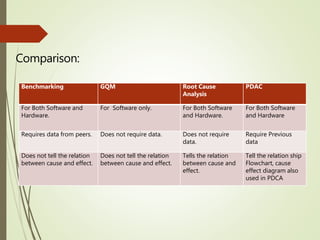
Comparison:
Benchmarking GQM Root Cause
Analysis
PDAC
For Both Software and
Hardware.
For Software only. For Both Software
and Hardware.
For Both Software
and Hardware
Requires data from peers. Does not require data. Does not require
data.
Require Previous
data
Does not tell the relation
between cause and effect.
Does not tell the relation
between cause and effect.
Tells the relation
between cause and
effect.
Tell the relation ship
Flowchart, cause
effect diagram also
used in PDCA
References
[3]https://www.isixsigma.com/dictionary/deming-cycle-pdca/
[2]https://www.ncbi.nlm.nih.gov/pmc/articles/PMC2464836/
[1].http://whatis.techtarget.com/definition/PDCA-plan-do-check-act
[4]www.change-management-consultant.com/deming-cycle.html
[5]www.yourarticlelibrary.com/business/continuous-business-
process...4-phases/21128/
[6]www.brighthubpm.com › Methods and Ideologies
[8]Fábio A. Fernandes, Sérgio D. Sousa, Member, IAENG and Isabel
Lopes , “On the Use of Quality Tools: A Case Study ”, Journal of World
Congress on Engineering July 3-5, 2013.
[7]http://asq.org/learn-about-quality/project-planning-
tools/overview/pdca-cycle.html

PDCA Plan Do Check Act

  • 1.
  • 2.
    Outline  What isPDCA ?  Background  Phases of PDCA  When to Use Plan–Do–Check–Act  Case Study  Benefits of PDCA
  • 3.
    What is PDCA? PDCA stands for Plan-Do-Check-Act [1]  Iterative four-stage model for continuous improvement (CI)  It teaches organizations to • PLAN an action • DO it • CHECK it • ACT on it [1].http://whatis.techtarget.com/definition/PDCA-plan-do-check-act
  • 4.
    What is PDCA?[1] Implementing New Ideas in a Controlled Way  It is also known as • plan–do–check–adjust • Deming circle/cycle/wheel • Shewhart cycle, control circle/cycle • or plan–do–study–act (PDSA) [1].http://whatis.techtarget.com/definition/PDCA-plan-do-check-act
  • 5.
    Background  Walter Shewhart(1920’s) Shewhart Learning and Improvement cycle [2]  W. Edwards Deming (1950’s) [2]  It is a combination of management thinking with statistical analysis  Japanese translation into English became PDCA. [3]https://www.isixsigma.com/dictionary/deming-cycle-pdca/ [2]https://www.ncbi.nlm.nih.gov/pmc/articles/PMC2464836/
  • 6.
    PDCA – Overview Plan Do Check AchievedNo Modify parameters goal? Yes Act Anotherproblem or improvement [1].http://whatis.techtarget.com/definition/PDCA-plan-do-check-act
  • 7.
    Four Phases ofPDCA [5]  Plan a change aimed at improvement  Do – Carry out the change  Check/Study the results  Act - Adopt, adapt, or abandon [5]www.yourarticlelibrary.com/business/continuous-business-process...4-phases/21128/
  • 8.
    PLAN Analyze current condition Identifyexactly what your problem is Map the process Establish the objectives [5]www.yourarticlelibrary.com/business/continuous-business-process...4-phases/21128/
  • 9.
    DO  Implement theplan  Generate possible solutions  execute the process  make the product.  Collect data for charting and analysis in the following "CHECK" and "ACT" steps. [5]www.yourarticlelibrary.com/business/continuous-business-process...4-phases/21128/
  • 10.
    Check/Study  Study theactual results (measured and collected in "DO" above)  Compare  Against the expected results [5]www.yourarticlelibrary.com/business/continuous-business-process...4-phases/21128/
  • 11.
    Act  Take actionbased on what you learned in the study step  Two Possibilities 1. If the change did not work, go through the cycle again with a different plan. 2. If you were successful then standardize. [5]www.yourarticlelibrary.com/business/continuous-business-process...4-phases/21128/
  • 12.
     As amodel for continuous improvement.  When starting a new improvement project.  When developing a new or improved design of a process, product or service.  Exploring a range of possible new solutions to problems When to Use Plan–Do–Check–Act?[7] [7]http://asq.org/learn-about-quality/project-planning-tools/overview/pdca-cycle.html
  • 13.
     When defininga repetitive work process.  When planning data collection and analysis in order to verify and prioritize problems or root causes.  When implementing any change.  Avoiding the large scale wastage of resources that comes with full scale implementation of poor solution. When to Use Plan–Do–Check– Act? [7]http://asq.org/learn-about-quality/project-planning-tools/overview/pdca-cycle.html
  • 14.
    A Case Study Maroco(Supplier of: Leather Goods, leather items )  About Company • Production unit under study • Located in northern Portugal, • Famous on the Production of leather components for leather goods [8]Fábio A. Fernandes, Sérgio D. Sousa, Member, IAENG and Isabel Lopes , “On the Use of Quality Tools: A Case Study ”, Journal of World Congress on Engineering July 3-5, 2013.
  • 15.
    Quality Management Methodology  ThreeStages of Quality Management • Assessment of quality management processes • General quality data analysis • The application PDCA cycle (to solve a specific problem that was considered a priority in the previous step [8]Fábio A. Fernandes, Sérgio D. Sousa, Member, IAENG and Isabel Lopes , “On the Use of Quality Tools: A Case Study ”, Journal of World Congress on Engineering July 3-5, 2013.
  • 16.
    Production system ofFunctional Sections  It is organized into three functional sections • cutting (raw material (leather) is cut giving rise to various components); • preparation (components undergo various operations, including, uniformity and reduction of leather thickness, pressing, bonding, molding and painting); • assembly (components are assembled to form the end product, through sewing operations). [8]Fábio A. Fernandes, Sérgio D. Sousa, Member, IAENG and Isabel Lopes , “On the Use of Quality Tools: A Case Study ”, Journal of World Congress on Engineering July 3-5, 2013.
  • 17.
     In QualityAssessment Process we evaluate that we are following the quality Processes or not like Quality Planning, Quality Control and Quality Improvement  By Analyzing Historical Data we found the defects section e.g. The average number of nonconforming components in the preparation section is 3.5%. Similarly, the average number of nonconforming components in the assembly section was 2.1% of defective components.  PDCA Quality Improvement Process used to solve the Quality Problem PDCA Fábio A. Fernandes, Sérgio D. Sousa, Member, IAENG and Isabel Lopes , “On the Use of Quality Tools: A Case Study ”, Journal of World Congress on Engineering July 3-5, 2013.
  • 18.
    Plan  In Planphase causes of the problem were analyzed and an action plan was established  The problem identified in preparation section, it was related to the nonconforming components e.g. thinning of the leather, that were detected in process and which led to several complaints from customers. • The thickness of the component is outside the specification limits of 0.40 ± 0.05 mm; [8]Fábio A. Fernandes, Sérgio D. Sousa, Member, IAENG and Isabel Lopes , “On the Use of Quality Tools: A Case Study ”, Journal of World Congress on Engineering July 3-5, 2013.
  • 19.
     Brainstorming sessionswere performed in regular meetings to identify the possible causes of the problem and build the action plan. e.g. Replacement of the measuring instrument, the implementation of the optimum combination of parameters for the equalization machine [8]Fábio A. Fernandes, Sérgio D. Sousa, Member, IAENG and Isabel Lopes , “On the Use of Quality Tools: A Case Study ”, Journal of World Congress on Engineering July 3-5, 2013.
  • 20.
    DO & Check Do Phase  After formulating the action plan it was necessary to implement it, by acting on the processes.  Our plan is to increased the machine blades sharpness  Check Phase  After the Plan and Do steps, the Check step was carried out to evaluate the effectiveness of the actions. E.g. In this case study The average production of nonconforming components decreased from about 0.40% to 0.20%.  If we don’t achieve effective result then we again perform the Improvement process till that we get the effective result [8]Fábio A. Fernandes, Sérgio D. Sousa, Member, IAENG and Isabel Lopes , “On the Use of Quality Tools: A Case Study ”, Journal of World Congress on Engineering July 3-5, 2013.
  • 21.
    Act  Act Phase The last step of the PDCA cycle is based on the standardization of the actions in which effectiveness was observed in the Check step.  Result [8]Fábio A. Fernandes, Sérgio D. Sousa, Member, IAENG and Isabel Lopes , “On the Use of Quality Tools: A Case Study ”, Journal of World Congress on Engineering July 3-5, 2013.
  • 22.
    Benefits of PDCA Effective and rapid method for implementing continuous improvement.  Minimizes Cost  Built-in Check  Expandable  standardized method  Fosters teamwork
  • 23.
    Comparison: Benchmarking GQM RootCause Analysis PDAC For Both Software and Hardware. For Software only. For Both Software and Hardware. For Both Software and Hardware Requires data from peers. Does not require data. Does not require data. Require Previous data Does not tell the relation between cause and effect. Does not tell the relation between cause and effect. Tells the relation between cause and effect. Tell the relation ship Flowchart, cause effect diagram also used in PDCA
  • 24.
    References [3]https://www.isixsigma.com/dictionary/deming-cycle-pdca/ [2]https://www.ncbi.nlm.nih.gov/pmc/articles/PMC2464836/ [1].http://whatis.techtarget.com/definition/PDCA-plan-do-check-act [4]www.change-management-consultant.com/deming-cycle.html [5]www.yourarticlelibrary.com/business/continuous-business- process...4-phases/21128/ [6]www.brighthubpm.com › Methodsand Ideologies [8]Fábio A. Fernandes, Sérgio D. Sousa, Member, IAENG and Isabel Lopes , “On the Use of Quality Tools: A Case Study ”, Journal of World Congress on Engineering July 3-5, 2013. [7]http://asq.org/learn-about-quality/project-planning- tools/overview/pdca-cycle.html

Editor's Notes

  • #6 The PDCA cycle is also known by two other names, the Shewhart cycle and the Deming cycle. Walter A. Shewhart first discussed the concept of PDCA in his 1939 book, Statistical Method From the Viewpoint of Quality Control. Shewhart said the cycle draws its structure from the notion that constant evaluation of management practices, as well as the willingness of management to adopt and disregard unsupported ideas, is key to the evolution of a successful enterprise.4 W. Edwards Deming was the one who first coined the term "Shewhart cycle" for PDCA, naming it after his mentor and teacher at Bell Laboratories in New York. Deming promoted PDCA as a primary means of achieving CPI.5 He also referred to the PDCA cycle as the PDSA cycle ("S" for study). Deming is credited with encouraging the Japanese in the 1950s to adopt PDCA. The Japanese eagerly embraced PDCA and other quality concepts, and to honor Deming for his instruction, they refer to the PDCA cycle as the Deming cycle.
  • #8 Plan: Identifying and analyzing the problem. Do: Developing and testing or implementing a potential solution. Check: Evaluate the Results, Do you achieve your desired goal? Act: Do you achieve your desired goal
  • #9 Plan •Analyze current condition •Root cause analyzes •Define performance measurement •Establish improvement plan
  • #10 Do: •Implement improvement plan The phrase "Plan Do Check Act" or PDCA is easy to remember, but it's important you are quite clear exactly what "Do" means. ""Do" means "Try" or "Test". It does not mean "Implement fully." Full implementation happens in the "Act" phase.
  • #11 • Evaluation of results
  • #12 •Learning •Standardization
  • #23 Provides a standardized method to achieving continuous improvement that can be used by employees in any department to resolve new and recurring issues Prevents wasted time implementing ineffective or inferior solutions Fosters teamwork through brainstorming and problem-solving Inexpensive – Overcome obstacles internally Minimizes Cost Using the PDCA technique allows a business to test a process change on a small scale before spending on a method that may not work or that requires adjustment. The company can continue to run as usual while analyzing the affect of a change to the process. For example, a new method may require additional tools or machinery to put it in place on the production floor. Before purchasing additional tools, the organization can test the process to ensure that it will bring about results such as an increase in productivity or an improvement in quality. Built-in Check The "check" step of the quality management tool ensures the company analyzes the effect of a change before going full steam ahead. When the data shows a process or new method does not have the effect planned, the "act" step provides an opportunity to tweak the new method to correct a problem. Expandable Once a new technique or process method is successfully checked and analyzed, the company can expand the method with the assurance it will provide the expected benefits. For example, when a new production method reduces waste material and improves the quality of the product, the method can be incorporated across the board to expand the efficiencies in the organization.