CREATIVITY & MANAGEMENT OF INNOVATION
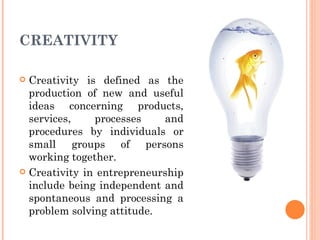
CREATIVITY Creativity is defined as the production of new and useful ideas concerning products, services, processes and procedures by individuals or small groups of persons working together. Creativity in entrepreneurship include being independent and spontaneous and processing a problem solving attitude.
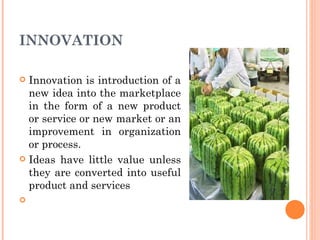
INNOVATION Innovation is introduction of a new idea into the marketplace in the form of a new product or service or new market or an improvement in organization or process.  Ideas have little value unless they are converted into useful product and services
Characteristics of INNOVATION Innovation leads to changes Result of a thoughtful plan Can bring complete revolution or an extension to existing products Provide unique identity to a business Innovation are action oriented and result oriented Help in making products and processes simple to understand Innovation involve continuous experimentation and testing.
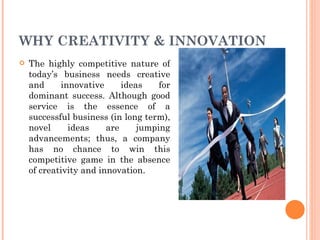
WHY CREATIVITY & INNOVATION The highly competitive nature of today’s business needs creative and innovative ideas for dominant success. Although good service is the essence of a successful business (in long term), novel ideas are jumping advancements; thus, a company has no chance to win this competitive game in the absence of creativity and innovation.
DO IT IS A PROCESS FOR CREATIVITY D - Define problem O - Open mind and apply creative techniques I - Identify best solution T - Transform
Components of Creativity Intrinsic Motivation Intrinsic motivation refers to motivation that comes from inside an individual rather than from any external or outside rewards, such as money or grades. The motivation comes from the pleasure one gets from the task itself or from the sense of satisfaction in completing or even working on a task. An intrinsically motivated person will work on a math equation, for example, because it is enjoyable. Intrinsic motivation facilitates creativity and academic performance, whereas extrinsic motivation hinders creativity but has no effect on academic performance.
Skills in task A developed talent or ability:  writing skills.   Knowledge of the problem technical skill required in solving it Skill in Creative thinking  - refers to the ability to form new combinations of ideas to fulfill a need, or to get original or otherwise appropriate results by the criteria of the domain in question.  To hold as an opinion; believe; suppose To anticipate or expect To make a mental discovery
CREATIVE PEOPLE IN ORGANIZATION This creative group is divided to two different groups namely initiators and problem solvers. A person who initiates a course of action   A person who start working when problem arises Creative people can be said to have : A particular Style  Originality Experience  Determination Flexibility Positive outlook
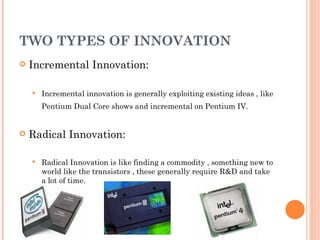
TWO TYPES OF INNOVATION Incremental Innovation: Incremental innovation is generally exploiting existing ideas , like Pentium Dual Core shows and incremental on Pentium IV.   Radical Innovation: Radical Innovation is like finding a commodity , something new to world like the transistors , these generally require R&D and take a lot of time.
WHERE DO INNOVATIVE IDEAS COME FROM? Unsatisfied customers. Demographic changes in society. Market changes Knowledge based concepts Research and Development. Problem solving.
INNOVATION IN AUTOMOBILE INDUSTRY Automobile industry is one of the most competitive industry , which has to innovate much in its R&D .  TATA created  a revolution  with the Nano , the worlds cheapest car. Mahindra and Mahindra, which was mostly known only for tractors , had to come up with the  Scorpio and Scooter that changed the way people looked at M & M.
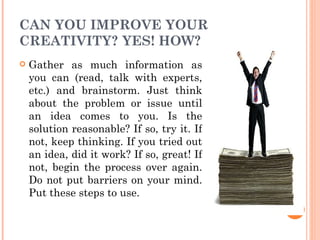
CAN YOU IMPROVE YOUR CREATIVITY? YES! HOW? Gather as much information as you can (read, talk with experts, etc.) and brainstorm. Just think about the problem or issue until an idea comes to you. Is the solution reasonable? If so, try it. If not, keep thinking. If you tried out an idea, did it work? If so, great! If not, begin the process over again. Do not put barriers on your mind. Put these steps to use.
LATERAL THINKING Lateral thinking is a term coined by  Edward de Bono  in the book  New Think: The Use of Lateral Thinking  published in 1967; it refers to solving problems through an  indirect  and  creative  approach. Lateral thinking is about  reasoning  that is not immediately obvious and about ideas that may not be obtainable by using only traditional step-by-step  logic .
Problem A man walks into a bar and asks the barman for a glass of water. The barman pulls out a gun and points it at the man. The man says 'Thank you' and walks out.
SOLUTION The man had hiccups. The barman recognized this from his speech and drew the gun to give him a shock. It worked and cured the hiccups - so the man no longer needed the water.

51644726 23660967-creativity-and-innovation-management-ppt

  • 1.
  • 2.
    CREATIVITY Creativity isdefined as the production of new and useful ideas concerning products, services, processes and procedures by individuals or small groups of persons working together. Creativity in entrepreneurship include being independent and spontaneous and processing a problem solving attitude.
  • 3.
    INNOVATION Innovation isintroduction of a new idea into the marketplace in the form of a new product or service or new market or an improvement in organization or process. Ideas have little value unless they are converted into useful product and services
  • 4.
    Characteristics of INNOVATIONInnovation leads to changes Result of a thoughtful plan Can bring complete revolution or an extension to existing products Provide unique identity to a business Innovation are action oriented and result oriented Help in making products and processes simple to understand Innovation involve continuous experimentation and testing.
  • 5.
    WHY CREATIVITY &INNOVATION The highly competitive nature of today’s business needs creative and innovative ideas for dominant success. Although good service is the essence of a successful business (in long term), novel ideas are jumping advancements; thus, a company has no chance to win this competitive game in the absence of creativity and innovation.
  • 6.
    DO IT ISA PROCESS FOR CREATIVITY D - Define problem O - Open mind and apply creative techniques I - Identify best solution T - Transform
  • 7.
    Components of CreativityIntrinsic Motivation Intrinsic motivation refers to motivation that comes from inside an individual rather than from any external or outside rewards, such as money or grades. The motivation comes from the pleasure one gets from the task itself or from the sense of satisfaction in completing or even working on a task. An intrinsically motivated person will work on a math equation, for example, because it is enjoyable. Intrinsic motivation facilitates creativity and academic performance, whereas extrinsic motivation hinders creativity but has no effect on academic performance.
  • 8.
    Skills in taskA developed talent or ability: writing skills. Knowledge of the problem technical skill required in solving it Skill in Creative thinking - refers to the ability to form new combinations of ideas to fulfill a need, or to get original or otherwise appropriate results by the criteria of the domain in question. To hold as an opinion; believe; suppose To anticipate or expect To make a mental discovery
  • 9.
    CREATIVE PEOPLE INORGANIZATION This creative group is divided to two different groups namely initiators and problem solvers. A person who initiates a course of action A person who start working when problem arises Creative people can be said to have : A particular Style Originality Experience Determination Flexibility Positive outlook
  • 10.
    TWO TYPES OFINNOVATION Incremental Innovation: Incremental innovation is generally exploiting existing ideas , like Pentium Dual Core shows and incremental on Pentium IV. Radical Innovation: Radical Innovation is like finding a commodity , something new to world like the transistors , these generally require R&D and take a lot of time.
  • 11.
    WHERE DO INNOVATIVEIDEAS COME FROM? Unsatisfied customers. Demographic changes in society. Market changes Knowledge based concepts Research and Development. Problem solving.
  • 12.
    INNOVATION IN AUTOMOBILEINDUSTRY Automobile industry is one of the most competitive industry , which has to innovate much in its R&D . TATA created a revolution with the Nano , the worlds cheapest car. Mahindra and Mahindra, which was mostly known only for tractors , had to come up with the Scorpio and Scooter that changed the way people looked at M & M.
  • 13.
    CAN YOU IMPROVEYOUR CREATIVITY? YES! HOW? Gather as much information as you can (read, talk with experts, etc.) and brainstorm. Just think about the problem or issue until an idea comes to you. Is the solution reasonable? If so, try it. If not, keep thinking. If you tried out an idea, did it work? If so, great! If not, begin the process over again. Do not put barriers on your mind. Put these steps to use.
  • 14.
    LATERAL THINKING Lateralthinking is a term coined by Edward de Bono in the book New Think: The Use of Lateral Thinking published in 1967; it refers to solving problems through an indirect and creative approach. Lateral thinking is about reasoning that is not immediately obvious and about ideas that may not be obtainable by using only traditional step-by-step logic .
  • 15.
    Problem A manwalks into a bar and asks the barman for a glass of water. The barman pulls out a gun and points it at the man. The man says 'Thank you' and walks out.
  • 16.
    SOLUTION The manhad hiccups. The barman recognized this from his speech and drew the gun to give him a shock. It worked and cured the hiccups - so the man no longer needed the water.