




Igniting Change
 Discovering Innovation Games®


Andrea J. Simon PhD
Igniting Change

 • How to ignite change?
 • Build innovation into your organization?
 • Create a culture that embraces change?
 • Build an Idea Bank? Watch for the
   possibilities?
Agenda

 • Why Innovation is so hot a topic now?
 • A process to train teams how to ―see, feel
   and think‖ in new ways
 • Active learning: do some innovation games
 • Wrap with what to take away when you
   leave


                                                3
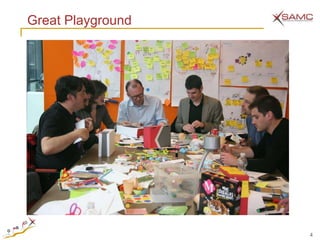
Great Playground


                   4
How does it feel?
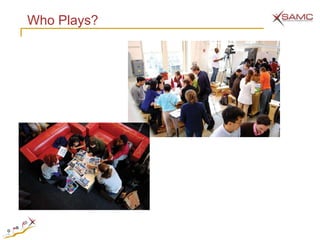
Who Plays?
Everyone is talking about Innovation

WHY?


                                       7
Innovation Problem
Stuck

 • February 2011
 • ―The first iPhone shipped in 2007, and we
   still don't have a product that is close to
   their experience. Android came on the
   scene just over 2 years ago, and this week
   they took our leadership position in
   smartphone volumes. Unbelievable.―

                            Stephen Elop
                             Nokia CEO
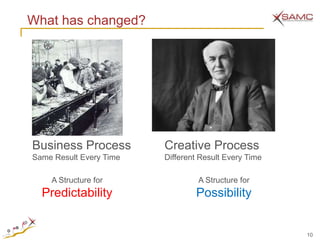
What has changed?


Business Process         Creative Process
Same Result Every Time   Different Result Every Time

    A Structure for               A Structure for
  Predictability                 Possibility


                                                       10
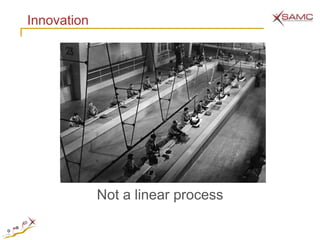
Innovation


             Not a linear process
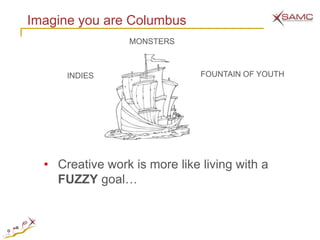
Imagine you are Columbus
                 MONSTERS


      INDIES                   FOUNTAIN OF YOUTH


  • Creative work is more like living with a
    FUZZY goal…
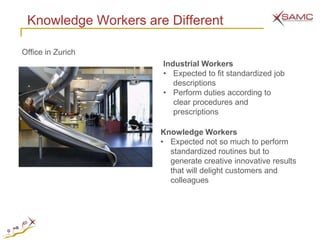
Knowledge Workers are Different

Office in Zurich
                      Industrial Workers
                      • Expected to fit standardized job
                         descriptions
                      • Perform duties according to
                         clear procedures and
                         prescriptions

                      Knowledge Workers
                      • Expected not so much to perform
                        standardized routines but to
                        generate creative innovative results
                        that will delight customers and
                        colleagues
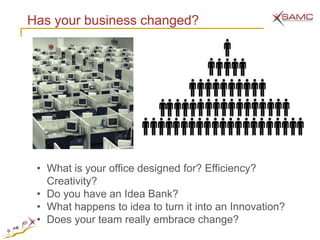
Has your business changed?


 • What is your office designed for? Efficiency?
   Creativity?
 • Do you have an Idea Bank?
 • What happens to idea to turn it into an Innovation?
 • Does your team really embrace change?
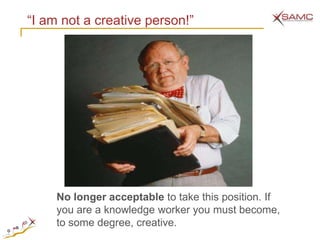
―I am not a creative person!‖


     No longer acceptable to take this position. If
     you are a knowledge worker you must become,
     to some degree, creative.
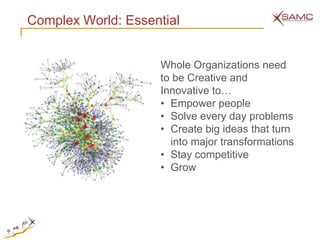
Complex World: Essential


                    Whole Organizations need
                    to be Creative and
                    Innovative to…
                    • Empower people
                    • Solve every day problems
                    • Create big ideas that turn
                      into major transformations
                    • Stay competitive
                    • Grow
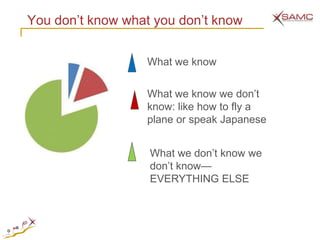
You don’t know what you don’t know


                  What we know


                  What we know we don’t
                  know: like how to fly a
                  plane or speak Japanese


                   What we don’t know we
                   don’t know—
                   EVERYTHING ELSE
Paradox of Discovery

 • Find things you are not looking for when you
   are not looking.
 • But if you are not looking for something, you
   will not find anything.


                                                   18
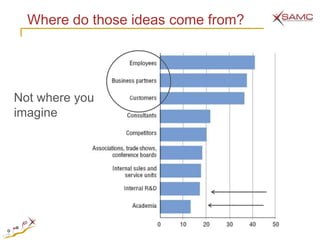
Where do those ideas come from?


Not where you
imagine
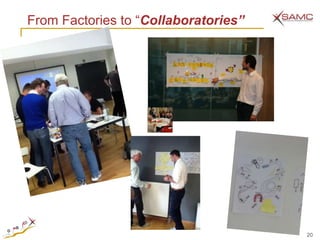
From Factories to ―Collaboratories”


                                      20
San Jose ― Build a Better Budget‖


                                    21
There is a process here

BUSINESS GAMES ARE NOT
VIDEO GAMES
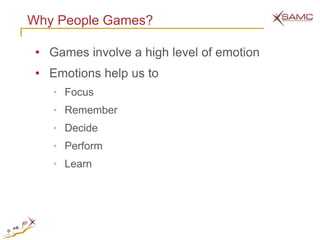
Why People Games?

 • Games involve a high level of emotion
 • Emotions help us to
    • Focus
    • Remember
    • Decide
    • Perform
    • Learn
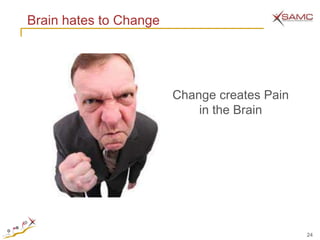
Brain hates to Change


                        Change creates Pain
                            in the Brain


                                              24
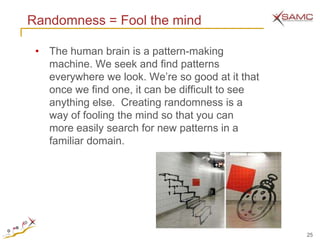
Randomness = Fool the mind

 • The human brain is a pattern-making
   machine. We seek and find patterns
   everywhere we look. We’re so good at it that
   once we find one, it can be difficult to see
   anything else. Creating randomness is a
   way of fooling the mind so that you can
   more easily search for new patterns in a
   familiar domain.


                                                  25
Steps to Innovation

WHAT IS THE STRUCTURE?


                         26
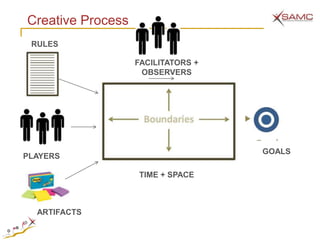
Creative Process
 RULES

                   FACILITATORS +
                    OBSERVERS


                                    GOALS
PLAYERS

                   TIME + SPACE


  ARTIFACTS
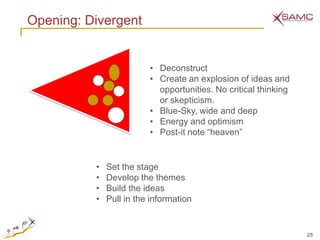
Opening: Divergent


                         • Deconstruct
                         • Create an explosion of ideas and
                           opportunities. No critical thinking
                           or skepticism.
                         • Blue-Sky, wide and deep
                         • Energy and optimism
                         • Post-it note ―heaven‖


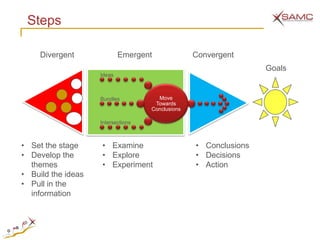
          •   Set the stage
          •   Develop the themes
          •   Build the ideas
          •   Pull in the information


                                                                 28
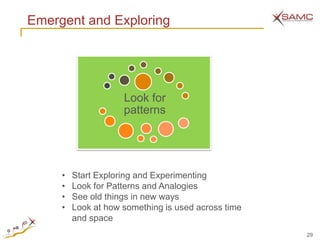
Emergent and Exploring


                     Look for
                     patterns


     •   Start Exploring and Experimenting
     •   Look for Patterns and Analogies
     •   See old things in new ways
     •   Look at how something is used across time
         and space
                                                     29
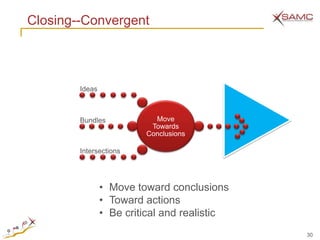
Closing--Convergent


        Ideas


        Bundles            Move
                          Towards
                         Conclusions

        Intersections


                • Move toward conclusions
                • Toward actions
                • Be critical and realistic
                                              30
Steps

     Divergent              Emergent              Convergent
                                                                  Goals
                    Ideas


                    Bundles           Move
                                     Towards
                                    Conclusions

                    Intersections


• Set the stage     • Examine                     • Conclusions
• Develop the       • Explore                     • Decisions
  themes            • Experiment                  • Action
• Build the ideas
• Pull in the
  information
How could this help you and your company?

LET’S TRY TO PLAY


                                            32
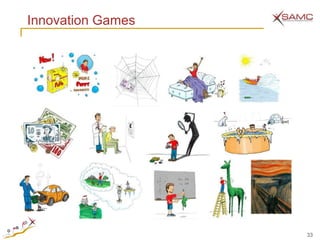
Innovation Games


                   33
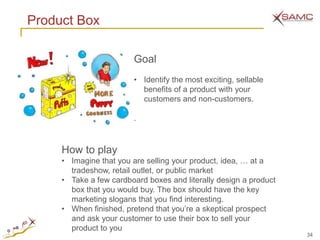
Product Box

                        Goal
                        • Identify the most exciting, sellable
                          benefits of a product with your
                          customers and non-customers.

                        .


     How to play
     • Imagine that you are selling your product, idea, … at a
       tradeshow, retail outlet, or public market
     • Take a few cardboard boxes and literally design a product
       box that you would buy. The box should have the key
       marketing slogans that you find interesting.
     • When finished, pretend that you’re a skeptical prospect
       and ask your customer to use their box to sell your
       product to you
                                                                   34
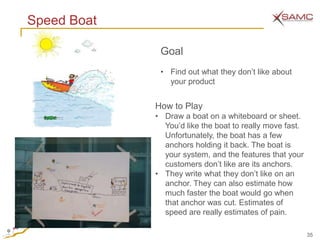
Speed Boat

              Goal
              • Find out what they don’t like about
                your product


             How to Play
             • Draw a boat on a whiteboard or sheet.
               You’d like the boat to really move fast.
               Unfortunately, the boat has a few
               anchors holding it back. The boat is
               your system, and the features that your
               customers don’t like are its anchors.
             • They write what they don’t like on an
               anchor. They can also estimate how
               much faster the boat would go when
               that anchor was cut. Estimates of
               speed are really estimates of pain.

                                                          35
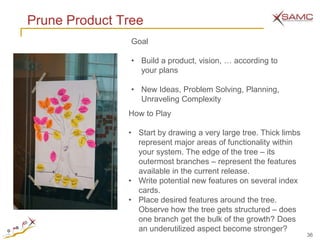
Prune Product Tree
                Goal

                • Build a product, vision, … according to
                  your plans

                • New Ideas, Problem Solving, Planning,
                  Unraveling Complexity
               How to Play

               • Start by drawing a very large tree. Thick limbs
                 represent major areas of functionality within
                 your system. The edge of the tree – its
                 outermost branches – represent the features
                 available in the current release.
               • Write potential new features on several index
                 cards.
               • Place desired features around the tree.
                 Observe how the tree gets structured – does
                 one branch get the bulk of the growth? Does
                 an underutilized aspect become stronger?
                                                                   36
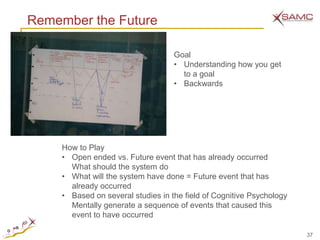
Remember the Future

                                    Goal
                                    • Understanding how you get
                                      to a goal
                                    • Backwards


     How to Play
     • Open ended vs. Future event that has already occurred
       What should the system do
     • What will the system have done = Future event that has
       already occurred
     • Based on several studies in the field of Cognitive Psychology
       Mentally generate a sequence of events that caused this
       event to have occurred

                                                                       37
Problem to solve

LOTS TRY SOME INNOVATION
GAMES

                           38
Common Issue

 • How to address the health and
   wellness of your employees
   • Reduce costs
   • Improve work productivity
   • Positively impact society


                                   39
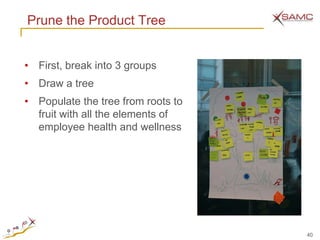
Prune the Product Tree


• First, break into 3 groups
• Draw a tree
• Populate the tree from roots to
  fruit with all the elements of
  employee health and wellness


                                    40
Prune the tree

 • Discuss what is at each part of the tree:
    •   What are the essentials in the roots?
    •   The supportive trunk?
    •   The major and minor branches?
    •   The leaves?
    •   The fruit?
 • Prune it so you have the most important for
   that tree to thrive
 • Discuss, debate and decide


                                                 41
Remember the Future
               • You have the Tree, well
                 pruned
               • You can make this happen in
                 3 years
               • What is the Health and
                 Wellness Story that you have
                 built
               • Remember how you get there
               • Map out a 3 year timeline
               • Going Backwards, remember
                 the major moments
               • How did it feel when?
                                                42
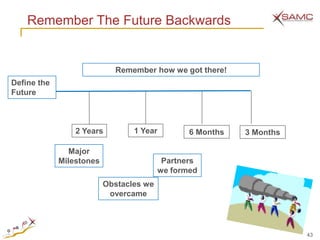
Remember The Future Backwards


                            Remember how we got there!
Define the
Future


                 2 Years         1 Year         6 Months   3 Months

               Major
             Milestones                   Partners
                                         we formed
                          Obstacles we
                           overcame


                                                                      43
Sustaining Change

FINAL THOUGHTS


                    44
Playing Games Works

 • We know it sounds weird, at first: Playing
   games to do work.
 • Research shows that human beings have
   been hard-wired to express themselves and
   interact with each other through play.


                                                45
Playing Innovation Games® helps you…

 •   Understand your customers’ needs
 •   Deliver the right features
 •   Make better strategy decisions
 •   Increase empathy for your customers’ experience
 •   Improve the effectiveness of sales and services
 •   Identify the most effective marketing messages and
     sellable features
 •   Uncover breakthrough opportunities
 •   And have serious fun doing serious work!


                                                          46
Discovery

 • The toughest part of innovation is accurately
   predicting what customers want, need or will
   pay for.
 • Even if you ask them, your customers
   probably can’t explain to you what they truly
   want.
 • And the typical brainstorming sessions,
   surveys or focus groups just don’t produce
   actionable results.


                                                   47
Play frees the mind

 • That’s where Innovation Games comes to
   the rescue. Playing Innovation Games® like
   Speed Boat, Prune the Product Tree or
   Product Box with your customers enables
   you to tap into your customers’ needs and
   desires through the magic of game play.


                                                48
Shape

 • Sometimes the hardest task isn’t the invention. It’s
   not the discovery of new features or even
   uncovering glitches in a well-oiled process.
 • Hardest part: Wrestling with the mountain of data
   that your discovery efforts have produced,
   attempting to shape the information into a form
   that can be ordered and acted upon.
 • The game mechanics underlying Innovation
   Games like Remember the Future cuts through
   the tedium and enables you to find the bright
   ideas, the breakthroughs.


                                                          49
Prioritization

 • It’s not enough to know what features your
   customers want; you need to know which
   features are essential and which ones can
   be tabled until the next phase.
 • Innovation Games like Prune The Tree
   makes setting priorities, trading off options,
   really ensuring that your team is focusing on
   the right features at the right time.


                                                    50
Act

 • Playing games equals real work.
 • Innovation Games aren’t practice, aren’t
   simulations, but how leading companies are
   doing real work every day.
      •   Discovering new trends
      •   Shaping and managing workloads
      •   Prioritizing new features or projects
 • There’s a game to improve and enlighten
   every phase of work.


                                                  51
How can we Ignite Change?

 • Recognize that your brain hates change
 • You have to do something to push beyond
   the ―habit-trail‖ where you are most
   comfortable.
 • Innovate! Play!
 • Empower your teams to play often, solve
   problems through interactive games and
   build Idea Banks where new solutions can
   emerge at the intersections.


                                              52
It will become how you see the world

 • Instead of it being a ―thing‖ you do
   sometimes.
 • It will be the way you ―see‖ all the time.
 • You will begin to look at the intersections of
   ideas.
 • You will turn to play to find solutions to small
   and big problems, inside and outside the
   box.
 • You will listen differently, listening for dots.


                                                      53
Enjoy


        54
We would like to express our appreciation for Innovation Games® and Agile Minds
for the use of their graphics, photos and game concepts. The approach was
developed by SAMC as part of our certification process.

This copy of our presentation today was created to help you take these tools and
apply them to your own company. The goal is to discover your company’s own
innovative Culture--with new ideas, new market space, new customers and new
demand. Please let us know how your exploring goes. We like to help others with
case studies. Perhaps you will become a success story we can share as well.

Send us your story to: asimon@simonassociates.net
We would love to continue our discussions. Feel free to Skype us andrea.j.simon
or connect however you like.


Simon Associates Management Consultants
1905 Hunter Brook Road
Yorktown Heights, NY 10598
www.simonassociates.net
Info@simonassociates.net


                                                                                   55

Igniting Change Innovation Games

  • 1.
    Igniting Change DiscoveringInnovation Games® Andrea J. Simon PhD
  • 2.
    Igniting Change •How to ignite change? • Build innovation into your organization? • Create a culture that embraces change? • Build an Idea Bank? Watch for the possibilities?
  • 3.
    Agenda • WhyInnovation is so hot a topic now? • A process to train teams how to ―see, feel and think‖ in new ways • Active learning: do some innovation games • Wrap with what to take away when you leave 3
  • 4.
  • 5.
  • 6.
  • 7.
    Everyone is talkingabout Innovation WHY? 7
  • 8.
  • 9.
    Stuck • February2011 • ―The first iPhone shipped in 2007, and we still don't have a product that is close to their experience. Android came on the scene just over 2 years ago, and this week they took our leadership position in smartphone volumes. Unbelievable.― Stephen Elop Nokia CEO
  • 10.
    What has changed? BusinessProcess Creative Process Same Result Every Time Different Result Every Time A Structure for A Structure for Predictability Possibility 10
  • 11.
    Innovation Not a linear process
  • 12.
    Imagine you areColumbus MONSTERS INDIES FOUNTAIN OF YOUTH • Creative work is more like living with a FUZZY goal…
  • 13.
    Knowledge Workers areDifferent Office in Zurich Industrial Workers • Expected to fit standardized job descriptions • Perform duties according to clear procedures and prescriptions Knowledge Workers • Expected not so much to perform standardized routines but to generate creative innovative results that will delight customers and colleagues
  • 14.
    Has your businesschanged? • What is your office designed for? Efficiency? Creativity? • Do you have an Idea Bank? • What happens to idea to turn it into an Innovation? • Does your team really embrace change?
  • 15.
    ―I am nota creative person!‖ No longer acceptable to take this position. If you are a knowledge worker you must become, to some degree, creative.
  • 16.
    Complex World: Essential Whole Organizations need to be Creative and Innovative to… • Empower people • Solve every day problems • Create big ideas that turn into major transformations • Stay competitive • Grow
  • 17.
    You don’t knowwhat you don’t know What we know What we know we don’t know: like how to fly a plane or speak Japanese What we don’t know we don’t know— EVERYTHING ELSE
  • 18.
    Paradox of Discovery • Find things you are not looking for when you are not looking. • But if you are not looking for something, you will not find anything. 18
  • 19.
    Where do thoseideas come from? Not where you imagine
  • 20.
    From Factories to―Collaboratories” 20
  • 21.
    San Jose ―Build a Better Budget‖ 21
  • 22.
    There is aprocess here BUSINESS GAMES ARE NOT VIDEO GAMES
  • 23.
    Why People Games? • Games involve a high level of emotion • Emotions help us to • Focus • Remember • Decide • Perform • Learn
  • 24.
    Brain hates toChange Change creates Pain in the Brain 24
  • 25.
    Randomness = Foolthe mind • The human brain is a pattern-making machine. We seek and find patterns everywhere we look. We’re so good at it that once we find one, it can be difficult to see anything else. Creating randomness is a way of fooling the mind so that you can more easily search for new patterns in a familiar domain. 25
  • 26.
    Steps to Innovation WHATIS THE STRUCTURE? 26
  • 27.
    Creative Process RULES FACILITATORS + OBSERVERS GOALS PLAYERS TIME + SPACE ARTIFACTS
  • 28.
    Opening: Divergent • Deconstruct • Create an explosion of ideas and opportunities. No critical thinking or skepticism. • Blue-Sky, wide and deep • Energy and optimism • Post-it note ―heaven‖ • Set the stage • Develop the themes • Build the ideas • Pull in the information 28
  • 29.
    Emergent and Exploring Look for patterns • Start Exploring and Experimenting • Look for Patterns and Analogies • See old things in new ways • Look at how something is used across time and space 29
  • 30.
    Closing--Convergent Ideas Bundles Move Towards Conclusions Intersections • Move toward conclusions • Toward actions • Be critical and realistic 30
  • 31.
    Steps Divergent Emergent Convergent Goals Ideas Bundles Move Towards Conclusions Intersections • Set the stage • Examine • Conclusions • Develop the • Explore • Decisions themes • Experiment • Action • Build the ideas • Pull in the information
  • 32.
    How could thishelp you and your company? LET’S TRY TO PLAY 32
  • 33.
  • 34.
    Product Box Goal • Identify the most exciting, sellable benefits of a product with your customers and non-customers. . How to play • Imagine that you are selling your product, idea, … at a tradeshow, retail outlet, or public market • Take a few cardboard boxes and literally design a product box that you would buy. The box should have the key marketing slogans that you find interesting. • When finished, pretend that you’re a skeptical prospect and ask your customer to use their box to sell your product to you 34
  • 35.
    Speed Boat Goal • Find out what they don’t like about your product How to Play • Draw a boat on a whiteboard or sheet. You’d like the boat to really move fast. Unfortunately, the boat has a few anchors holding it back. The boat is your system, and the features that your customers don’t like are its anchors. • They write what they don’t like on an anchor. They can also estimate how much faster the boat would go when that anchor was cut. Estimates of speed are really estimates of pain. 35
  • 36.
    Prune Product Tree Goal • Build a product, vision, … according to your plans • New Ideas, Problem Solving, Planning, Unraveling Complexity How to Play • Start by drawing a very large tree. Thick limbs represent major areas of functionality within your system. The edge of the tree – its outermost branches – represent the features available in the current release. • Write potential new features on several index cards. • Place desired features around the tree. Observe how the tree gets structured – does one branch get the bulk of the growth? Does an underutilized aspect become stronger? 36
  • 37.
    Remember the Future Goal • Understanding how you get to a goal • Backwards How to Play • Open ended vs. Future event that has already occurred What should the system do • What will the system have done = Future event that has already occurred • Based on several studies in the field of Cognitive Psychology Mentally generate a sequence of events that caused this event to have occurred 37
  • 38.
    Problem to solve LOTSTRY SOME INNOVATION GAMES 38
  • 39.
    Common Issue •How to address the health and wellness of your employees • Reduce costs • Improve work productivity • Positively impact society 39
  • 40.
    Prune the ProductTree • First, break into 3 groups • Draw a tree • Populate the tree from roots to fruit with all the elements of employee health and wellness 40
  • 41.
    Prune the tree • Discuss what is at each part of the tree: • What are the essentials in the roots? • The supportive trunk? • The major and minor branches? • The leaves? • The fruit? • Prune it so you have the most important for that tree to thrive • Discuss, debate and decide 41
  • 42.
    Remember the Future • You have the Tree, well pruned • You can make this happen in 3 years • What is the Health and Wellness Story that you have built • Remember how you get there • Map out a 3 year timeline • Going Backwards, remember the major moments • How did it feel when? 42
  • 43.
    Remember The FutureBackwards Remember how we got there! Define the Future 2 Years 1 Year 6 Months 3 Months Major Milestones Partners we formed Obstacles we overcame 43
  • 44.
  • 45.
    Playing Games Works • We know it sounds weird, at first: Playing games to do work. • Research shows that human beings have been hard-wired to express themselves and interact with each other through play. 45
  • 46.
    Playing Innovation Games®helps you… • Understand your customers’ needs • Deliver the right features • Make better strategy decisions • Increase empathy for your customers’ experience • Improve the effectiveness of sales and services • Identify the most effective marketing messages and sellable features • Uncover breakthrough opportunities • And have serious fun doing serious work! 46
  • 47.
    Discovery • Thetoughest part of innovation is accurately predicting what customers want, need or will pay for. • Even if you ask them, your customers probably can’t explain to you what they truly want. • And the typical brainstorming sessions, surveys or focus groups just don’t produce actionable results. 47
  • 48.
    Play frees themind • That’s where Innovation Games comes to the rescue. Playing Innovation Games® like Speed Boat, Prune the Product Tree or Product Box with your customers enables you to tap into your customers’ needs and desires through the magic of game play. 48
  • 49.
    Shape • Sometimesthe hardest task isn’t the invention. It’s not the discovery of new features or even uncovering glitches in a well-oiled process. • Hardest part: Wrestling with the mountain of data that your discovery efforts have produced, attempting to shape the information into a form that can be ordered and acted upon. • The game mechanics underlying Innovation Games like Remember the Future cuts through the tedium and enables you to find the bright ideas, the breakthroughs. 49
  • 50.
    Prioritization • It’snot enough to know what features your customers want; you need to know which features are essential and which ones can be tabled until the next phase. • Innovation Games like Prune The Tree makes setting priorities, trading off options, really ensuring that your team is focusing on the right features at the right time. 50
  • 51.
    Act • Playinggames equals real work. • Innovation Games aren’t practice, aren’t simulations, but how leading companies are doing real work every day. • Discovering new trends • Shaping and managing workloads • Prioritizing new features or projects • There’s a game to improve and enlighten every phase of work. 51
  • 52.
    How can weIgnite Change? • Recognize that your brain hates change • You have to do something to push beyond the ―habit-trail‖ where you are most comfortable. • Innovate! Play! • Empower your teams to play often, solve problems through interactive games and build Idea Banks where new solutions can emerge at the intersections. 52
  • 53.
    It will becomehow you see the world • Instead of it being a ―thing‖ you do sometimes. • It will be the way you ―see‖ all the time. • You will begin to look at the intersections of ideas. • You will turn to play to find solutions to small and big problems, inside and outside the box. • You will listen differently, listening for dots. 53
  • 54.
  • 55.
    We would liketo express our appreciation for Innovation Games® and Agile Minds for the use of their graphics, photos and game concepts. The approach was developed by SAMC as part of our certification process. This copy of our presentation today was created to help you take these tools and apply them to your own company. The goal is to discover your company’s own innovative Culture--with new ideas, new market space, new customers and new demand. Please let us know how your exploring goes. We like to help others with case studies. Perhaps you will become a success story we can share as well. Send us your story to: asimon@simonassociates.net We would love to continue our discussions. Feel free to Skype us andrea.j.simon or connect however you like. Simon Associates Management Consultants 1905 Hunter Brook Road Yorktown Heights, NY 10598 www.simonassociates.net Info@simonassociates.net 55

Editor's Notes

  • #23 But you can be an avatar and you have a lot of do-overs. Fast is better than slow
  • #41 Start by drawing a very large tree. Thick limbs represent major areas of functionality within your system. The edge of the tree – its outermost branches – represent the features available in the current release. Write potential new features on several index cards, ideally shaped as leaves. Ask them to place desired features around the tree. Observe how the tree gets structured – does one branch get the bulk of the growth? Does an underutilized aspect become stronger?
  • #43 Or do I do speed boat??
  • #44 Hand each of them a few pieces of paper. Ask them to imagine that it is sometime in the future and that they’ve been using your product almost continuously between now and that future date (month, year, whatever). Then ask them to write down exactly what your product will have done to make them happy or successful or rich or safe or secure or art – choose what works best for your product. Key point – ask “What will the system have done?” not “What should the system do?”