What we can learn from
Evaluating OD Interventions
▪ Presentation Prepared by :
▪ Sohail Tariq
(LBS) University of Lahore
ORGANIZATIONAL DEVELOPMENT
▪ Organization Development is the process of planned change in the culture and
structure of an organization by the use of behavioral sciences.
OD INTERVENTIONS
▪ OD Interventions refers to those techniques or activities which are undertaken to
implement OD programs. OD Intervention is any process used in an attempt to
improve or change in organizational culture.
▪ A set of sequenced , planned actions or events intended to help an organization to
increase its effectiveness.
EVALUATING OD INTERVENTIONS
▪ Evaluating OD Interventions means making judgment or accessing the effectiveness
Of Interventions.
We conclude with reflections on evalution from the perspective of Gestalt OD Theory
and collective consciousness.
GESTALT THEORY OF OD:
Gestalt is ideally suited to provide a framework for analysis and interventions in
organizational systems. It is geared towards looking at the whole picture and designing
accurate and useful ways to enhance organizational learning , growth and development
through action learning.
1. Exploring the paradox of competing demands
2. introduce a pragmatic model for selecting the optimal evaluation.
THE PARADOX OF COMPETING DEMANDS
▪ Assessing the efficacy of OD interventions
The paradox is that , as an organization wishes to increase the proving and
improving of an intervention.
The greater the required accuracy, the more rigorous and therefore more costly the
design.
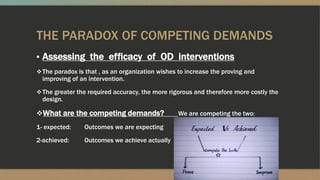
What are the competing demands? We are competing the two:
1- expected: Outcomes we are expecting
2-achieved: Outcomes we achieve actually
COMPETING DEMANDS
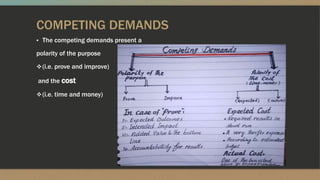
▪ The competing demands present a
polarity of the purpose
(i.e. prove and improve)
and the cost
(i.e. time and money)
PURPOSE TO EVALUATE OD INTERVENTIONS
▪ 1. The first purpose is to determine the prove or improve for the OD intervention
implementation.
▪ The second aim is to evaluate in order to improve the intervention and the organization
for the future.
▪ To understand how interventions worked to identify the relatively important element of
the interventions
▪ To advance theories and create more robust interventions.
You Can’t Have Your Cake, and Eat It Too
▪ The competing demand comes from the desire to prove the effect of an
intervention and improve it while minimizing the associated costs. Although a
focus on the proving and improving of an intervention may result in better
outcomes, it will cost more in terms of time and money (see Figure 1).
TO FIGURE OUT THE FUTURE PATH, EVALUATION IS THE BEST OPTION
▪ “HOW DO YOU FIND THE OPTIONAL POINT THAT BALANCE THE POLARITY OF THE
BENEFIT AND COST” OPTION ARE:
▪ 1. you can choose a costly evaluation that bears important implications for organization
.
▪ 2. choose a long term implication plan for intervention. The intended impact is likely vital
to the future.
▪ 3. conduct an unelaborated meeting just to discuss the reactions of your interventions.
▪ 4. allocate some time and cost choose a less rigorous approach thus get general
guidance about interventions but also help persuade the skeptics about the need for an
evaluation.
▪ 5. choose a high rigorous evaluation method that conducts a formal survey with the
consumption of time and high cost.
▪ Obviously fourth one is the best option we name as the pragmatics strategy for
evaluation.
PRAGMATIC STRATEGY FOR EVALUATION
▪ “A pragmatic strategy for evaluation is less
rigorous providing understanding of how to
improve the interventions by gathering
information with limited resources in short
time”
CONCLUSION
▪ What We Can Learn from Evaluating OD Interventions is the answer to the questions:
▪ » How effective was the team mediation intervention?
▪ » How can it be more effective?
▪ » What difference has it made?
▪ » What errors have been averted?
▪ » How much cost has been saved?
» What revenues have been improved?
In closing, the evaluation of OD interventions supports the development of a learning
organization, and this is where a consultant as an intervener can play an important
role in helping the organization in service or disservice of itself.
When the system begins to change its thinking paradigm, the learning has begun and
“action learning” occurs. This shift in thinking and learning is what will lead to new
organizational habits that result in long-term sustainability.
THANK YOU

Evaluation od intervention

  • 1.
    What we canlearn from Evaluating OD Interventions ▪ Presentation Prepared by : ▪ Sohail Tariq (LBS) University of Lahore
  • 2.
    ORGANIZATIONAL DEVELOPMENT ▪ OrganizationDevelopment is the process of planned change in the culture and structure of an organization by the use of behavioral sciences. OD INTERVENTIONS ▪ OD Interventions refers to those techniques or activities which are undertaken to implement OD programs. OD Intervention is any process used in an attempt to improve or change in organizational culture. ▪ A set of sequenced , planned actions or events intended to help an organization to increase its effectiveness.
  • 3.
    EVALUATING OD INTERVENTIONS ▪Evaluating OD Interventions means making judgment or accessing the effectiveness Of Interventions. We conclude with reflections on evalution from the perspective of Gestalt OD Theory and collective consciousness. GESTALT THEORY OF OD: Gestalt is ideally suited to provide a framework for analysis and interventions in organizational systems. It is geared towards looking at the whole picture and designing accurate and useful ways to enhance organizational learning , growth and development through action learning. 1. Exploring the paradox of competing demands 2. introduce a pragmatic model for selecting the optimal evaluation.
  • 4.
    THE PARADOX OFCOMPETING DEMANDS ▪ Assessing the efficacy of OD interventions The paradox is that , as an organization wishes to increase the proving and improving of an intervention. The greater the required accuracy, the more rigorous and therefore more costly the design. What are the competing demands? We are competing the two: 1- expected: Outcomes we are expecting 2-achieved: Outcomes we achieve actually
  • 5.
    COMPETING DEMANDS ▪ Thecompeting demands present a polarity of the purpose (i.e. prove and improve) and the cost (i.e. time and money)
  • 6.
    PURPOSE TO EVALUATEOD INTERVENTIONS ▪ 1. The first purpose is to determine the prove or improve for the OD intervention implementation. ▪ The second aim is to evaluate in order to improve the intervention and the organization for the future. ▪ To understand how interventions worked to identify the relatively important element of the interventions ▪ To advance theories and create more robust interventions.
  • 7.
    You Can’t HaveYour Cake, and Eat It Too ▪ The competing demand comes from the desire to prove the effect of an intervention and improve it while minimizing the associated costs. Although a focus on the proving and improving of an intervention may result in better outcomes, it will cost more in terms of time and money (see Figure 1).
  • 8.
    TO FIGURE OUTTHE FUTURE PATH, EVALUATION IS THE BEST OPTION ▪ “HOW DO YOU FIND THE OPTIONAL POINT THAT BALANCE THE POLARITY OF THE BENEFIT AND COST” OPTION ARE: ▪ 1. you can choose a costly evaluation that bears important implications for organization . ▪ 2. choose a long term implication plan for intervention. The intended impact is likely vital to the future. ▪ 3. conduct an unelaborated meeting just to discuss the reactions of your interventions. ▪ 4. allocate some time and cost choose a less rigorous approach thus get general guidance about interventions but also help persuade the skeptics about the need for an evaluation. ▪ 5. choose a high rigorous evaluation method that conducts a formal survey with the consumption of time and high cost. ▪ Obviously fourth one is the best option we name as the pragmatics strategy for evaluation.
  • 9.
    PRAGMATIC STRATEGY FOREVALUATION ▪ “A pragmatic strategy for evaluation is less rigorous providing understanding of how to improve the interventions by gathering information with limited resources in short time”
  • 10.
    CONCLUSION ▪ What WeCan Learn from Evaluating OD Interventions is the answer to the questions: ▪ » How effective was the team mediation intervention? ▪ » How can it be more effective? ▪ » What difference has it made? ▪ » What errors have been averted? ▪ » How much cost has been saved? » What revenues have been improved? In closing, the evaluation of OD interventions supports the development of a learning organization, and this is where a consultant as an intervener can play an important role in helping the organization in service or disservice of itself. When the system begins to change its thinking paradigm, the learning has begun and “action learning” occurs. This shift in thinking and learning is what will lead to new organizational habits that result in long-term sustainability.
  • 11.