Organizational Creativity Wendy M. Williams & Lana T. Yang Cesar Ortega & Matt Villaneuva “ If you want creative workers, give them enough time to play”  - John Cleese
The Gameplan Classic Views of Organization How Organizational Creativity can be Increased Formal Views of Creativity Division of Labor Modern Work Environment Systems Model Componential Model Selznick’s Approach Corporate Strategies Training Creativity?
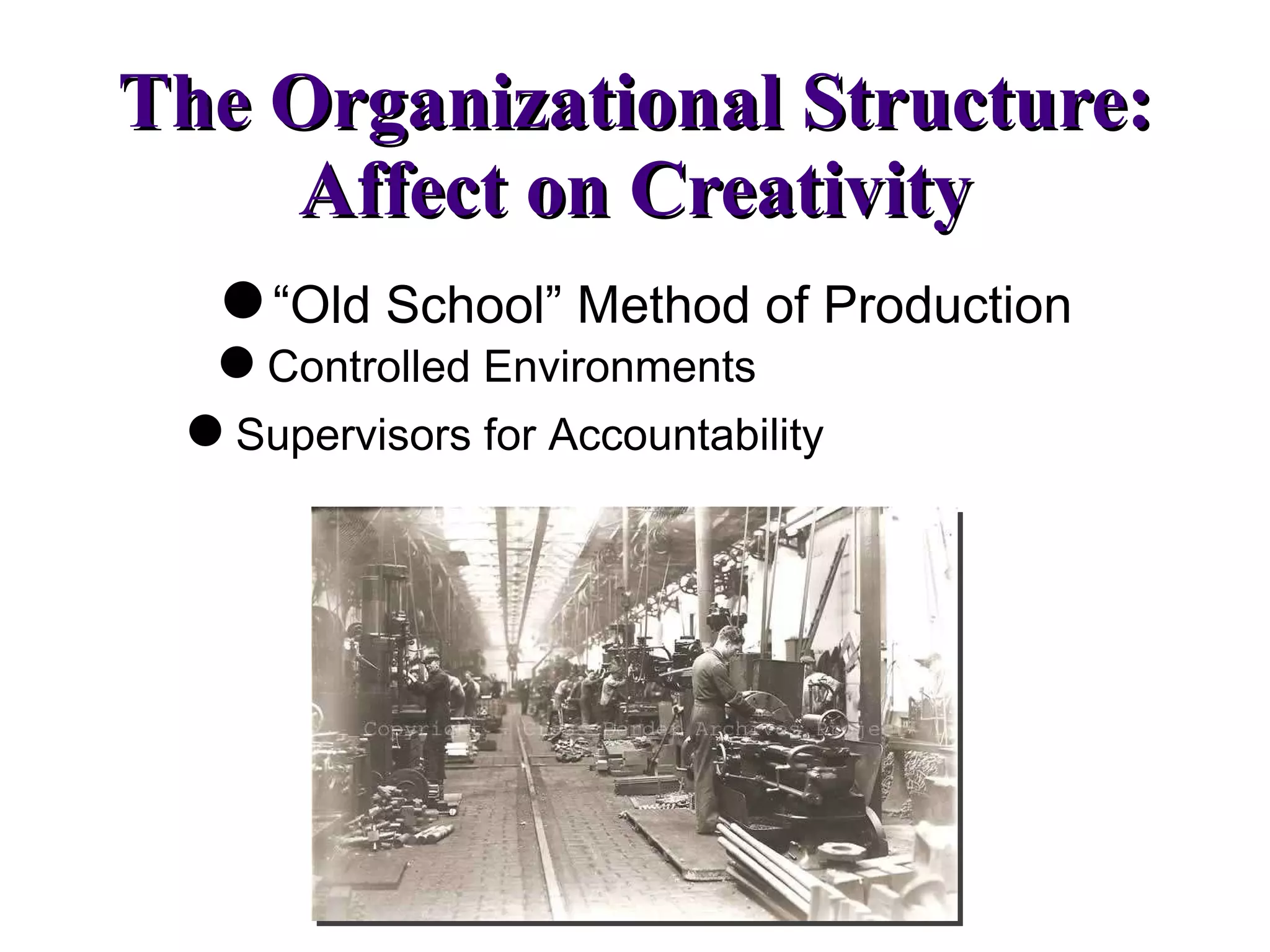
The Organizational Structure: Affect on Creativity “ Old School” Method of Production Supervisors for Accountability Controlled Environments
Adam Smith 1723-1790 At age 4, he was kidnapped by Gypsies in Scotland. Pioneer of Political Economics Individual Self Interest = Good of Society Free Market is Guided by Invisible Hand An Inquiry into the Nature and Causes of the Wealth of Nations
Modern Work Environment Structural Obstacles to Innovation Lack of Open Communication Sprint Up Learning Curve Product Life Cycle < Worker Life Cycle Unity of Command ≠ Job Specialization
Modern Work Environment Personal Obstacles to Innovation Retraining Current Workforce  Hiring Employees that Think Differently The “New” Employee Goal Displacement Bureaucratic Personality Merton:
Theories of Creativity: In the Workplace Systems Views of Creativity Csikszentmihalyi Creative Process is not in a vacuum Environments Have an Effect on Creativity
Theories of Creativity: In the Workplace Thinking Process Views of Creativity Investment Theory Buy Low / Sell High Quick Turn-Around
Theories of Creativity: In the Workplace Organizational Views of Creativity Amabile’s Componential Model Intrinsic Task Motivation Domain-Relevant  Skills Creativity Relevant Skillz Corporate Culture Allocating  Resources Time, Freedom, Openness
Intrinsic Task Motivation Domain-Relevant  Skills Creativity Relevant Skillz Allocating Resources Corporate Culture Time, Freedom, Openness Good Project Management Considerable Freedom Sufficient Resources Good Project Management Good Project Management Encouragement Atmosphere of Cooperation Sufficient Resources Sufficient Resources Ample Recognition Sufficient Time for Creative Thinking Atmosphere of Cooperation Atmosphere of Cooperation Sense of Challenge Pressure to Accomplish Goals
Gaining Acceptance of Innovation “ Keep your friends close, and your enemies closer.”  Trained Incapacity  Idiosyncrasy Credit Selznick’s Ideas:
Should Organizations Train Creativity? Training leads to... Self-efficacy  Empowerment Motivation
Corporate Strategies “ Self-Directed Work Teams” Team Spirit “ Z Organizations” Company Investment is the Key
Google Zurich
Pixar
VW Plant
Mindlab at the Ministry of Economic and Business Affairs
Blockbuster Bankruptcy  Resistant to Change Employees Not Motivated No Vertical Communication What Happened?
Proactive Employee Hate Your Job? Here’s How to Reshape It www.time.com/time/business/article/0,8599,1944101,00.html
Discussion Questions 2. Can work environments that are too free-spirited get to the level in which the workplace actually becomes a distraction, and therefore hinder creativity? 5.  Should Businesses and Communication Arts programs be on the same page in terms of what is taught, the traditional or new creativity accepting methods? 4.  In your personal work/life experience what environmental factors are  most important?  1.  Many businesses have not embraced establishing a creative atmosphere in the workplace. For what reasons would one argue in defense of the hierarchy system?  3.  Do you see the structural or personal obstacles to creativity as being easier to remedy in the workplace?
Discussion Questions 6.  Outside the workplace, are there any situations in which idiosyncrasy credit plays a prominent role? 7.  Is our culture so embedded with the idea of “upward mobility” and surpassing our parents’ level of success that Z Organizations would not work in the US corporate setting? 8. Is it more cost-effective to retrain existing workers to have a creative mindset or hire new workers with the preexisting skill set?  10.  Using what you have learned about creativity in the workplace what were some possible failures that lead to the collapse of Blockbuster? 9.  Based on the information we've provided on organizational creativity that allows for creative-inducing work environments, do you think that Unions have an affect - positive, negative, or both - on harnessing creativity in the workplace?

Organizational Creativity

  • 1.
    Organizational Creativity WendyM. Williams & Lana T. Yang Cesar Ortega & Matt Villaneuva “ If you want creative workers, give them enough time to play” - John Cleese
  • 2.
    The Gameplan ClassicViews of Organization How Organizational Creativity can be Increased Formal Views of Creativity Division of Labor Modern Work Environment Systems Model Componential Model Selznick’s Approach Corporate Strategies Training Creativity?
  • 3.
    The Organizational Structure:Affect on Creativity “ Old School” Method of Production Supervisors for Accountability Controlled Environments
  • 4.
    Adam Smith 1723-1790At age 4, he was kidnapped by Gypsies in Scotland. Pioneer of Political Economics Individual Self Interest = Good of Society Free Market is Guided by Invisible Hand An Inquiry into the Nature and Causes of the Wealth of Nations
  • 5.
    Modern Work EnvironmentStructural Obstacles to Innovation Lack of Open Communication Sprint Up Learning Curve Product Life Cycle < Worker Life Cycle Unity of Command ≠ Job Specialization
  • 6.
    Modern Work EnvironmentPersonal Obstacles to Innovation Retraining Current Workforce Hiring Employees that Think Differently The “New” Employee Goal Displacement Bureaucratic Personality Merton:
  • 7.
    Theories of Creativity:In the Workplace Systems Views of Creativity Csikszentmihalyi Creative Process is not in a vacuum Environments Have an Effect on Creativity
  • 8.
    Theories of Creativity:In the Workplace Thinking Process Views of Creativity Investment Theory Buy Low / Sell High Quick Turn-Around
  • 9.
    Theories of Creativity:In the Workplace Organizational Views of Creativity Amabile’s Componential Model Intrinsic Task Motivation Domain-Relevant Skills Creativity Relevant Skillz Corporate Culture Allocating Resources Time, Freedom, Openness
  • 10.
    Intrinsic Task MotivationDomain-Relevant Skills Creativity Relevant Skillz Allocating Resources Corporate Culture Time, Freedom, Openness Good Project Management Considerable Freedom Sufficient Resources Good Project Management Good Project Management Encouragement Atmosphere of Cooperation Sufficient Resources Sufficient Resources Ample Recognition Sufficient Time for Creative Thinking Atmosphere of Cooperation Atmosphere of Cooperation Sense of Challenge Pressure to Accomplish Goals
  • 11.
    Gaining Acceptance ofInnovation “ Keep your friends close, and your enemies closer.” Trained Incapacity Idiosyncrasy Credit Selznick’s Ideas:
  • 12.
    Should Organizations TrainCreativity? Training leads to... Self-efficacy Empowerment Motivation
  • 13.
    Corporate Strategies “Self-Directed Work Teams” Team Spirit “ Z Organizations” Company Investment is the Key
  • 14.
  • 15.
  • 16.
  • 17.
    Mindlab at theMinistry of Economic and Business Affairs
  • 18.
    Blockbuster Bankruptcy Resistant to Change Employees Not Motivated No Vertical Communication What Happened?
  • 19.
    Proactive Employee HateYour Job? Here’s How to Reshape It www.time.com/time/business/article/0,8599,1944101,00.html
  • 20.
    Discussion Questions 2.Can work environments that are too free-spirited get to the level in which the workplace actually becomes a distraction, and therefore hinder creativity? 5. Should Businesses and Communication Arts programs be on the same page in terms of what is taught, the traditional or new creativity accepting methods? 4. In your personal work/life experience what environmental factors are most important? 1. Many businesses have not embraced establishing a creative atmosphere in the workplace. For what reasons would one argue in defense of the hierarchy system? 3. Do you see the structural or personal obstacles to creativity as being easier to remedy in the workplace?
  • 21.
    Discussion Questions 6. Outside the workplace, are there any situations in which idiosyncrasy credit plays a prominent role? 7. Is our culture so embedded with the idea of “upward mobility” and surpassing our parents’ level of success that Z Organizations would not work in the US corporate setting? 8. Is it more cost-effective to retrain existing workers to have a creative mindset or hire new workers with the preexisting skill set? 10. Using what you have learned about creativity in the workplace what were some possible failures that lead to the collapse of Blockbuster? 9. Based on the information we've provided on organizational creativity that allows for creative-inducing work environments, do you think that Unions have an affect - positive, negative, or both - on harnessing creativity in the workplace?