Meaning
Process costing isa method of operation costing which is used to ascertain the
cost of production at each process, operation or stage of manufacture, where
processes are carried in having one or more of the following features:
Where the product of one process becomes the material of another process or
operation
Where there is simultaneous production at one or more process of different
products, with or without by product,
Where, during one or more processes or operations of a series, the products
or materials are not distinguishable from one another, as for instance when
finished products differ finally only in shape or form.
3.
Process costing isdefined by Kohler as: “A method of accounting whereby
costs are charged to processes or operations and averaged over units
produced; it is employed principally where a finished product is the result of
a more or less continuous operation, as in paper mills, refineries, canneries
and chemical plants; distinguished from job costing, where costs are
assigned to specific orders, lots or units.
4.
Characteristics
Process Costing Methodis applicable where the output results from a
continuous or repetitive operations or processes.
Products are identical and cannot be segregated.
It enables the ascertainment of cost of the product at each process or stage of
manufacture.
The output consists of products, which are homogenous.
Production is carried on in different stages (each of which is called a process)
having a continuous flow.
The input will pass through two or more processes before it takes the shape of
the output. The output of each process becomes the input for the next process
until the final product is obtained, with the last process giving the final product.
5.
The output ofa process except the last may also be saleable in which case the
process may generate some profit.
The input of a process except the first may be capable of being acquired from
the outside sources.
The output of a process is transferred to the next process generally at cost to the
process. It may also be transferred at market price to enable checking efficiency
of operations in comparison to the market conditions.
Normal and abnormal losses may arise in the processes.
6.
Advantages
It is possibleto determine process costs periodically at short intervals.
Average unit cost can be computed weekly or even daily.
It is simple and less expensive to find out the process costs.
It is possible to have managerial control by evaluating the performance of each
process.
It is easy to allocate the expenses to processes in order to have accurate costs.
It is easy to quote the prices with standardization of process. Standard costing
can be established easily in process type of manufacture.
7.
Disadvantages of Process
Costing
Costobtained at the end of the accounting period are only of historical
value and are not very useful for effective control.
Valuation of work-in-progress is generally done of estimated basis which
introduces further inaccuracies in total cost.
Where different products arise in the same process, it is not possible to exactly
ascertain the total cost of the products.
If any error occurs while calculating average costs, it will be carried through
all
the processes to the valuation of work in process and finished goods.
The computation of average cost is more difficult in those cases where more
than one type of product is manufactured and a division of the cost element
is necessary.
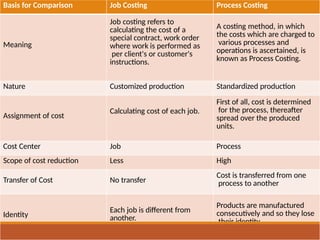
Basis for ComparisonJob Costing Process Costing
Meaning
Job costing refers to
calculating the cost of a
special contract, work order
where work is performed as
per client's or customer's
instructions.
A costing method, in which
the costs which are charged to
various processes and
operations is ascertained, is
known as Process Costing.
Nature Customized production Standardized production
Assignment of cost
Calculating cost of each job.
First of all, cost is determined
for the process, thereafter
spread over the produced
units.
Cost Center Job Process
Scope of cost reduction Less High
Transfer of Cost No transfer
Cost is transferred from one
process to another
Identity
Each job is different from
another.
Products are manufactured
consecutively and so they lose
their identity.
10.
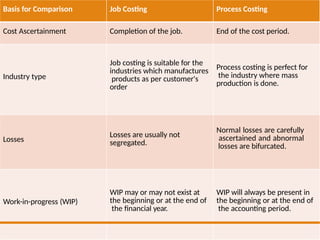
Basis for ComparisonJob Costing Process Costing
Cost Ascertainment Completion of the job. End of the cost period.
Industry type
Job costing is suitable for the
industries which manufactures
products as per customer's
order
Process costing is perfect for
the industry where mass
production is done.
Losses
Losses are usually not
segregated.
Normal losses are carefully
ascertained and abnormal
losses are bifurcated.
Work-in-progress (WIP)
WIP may or may not exist at
the beginning or at the end of
the financial year.
WIP will always be present in
the beginning or at the end of
the accounting period.
11.
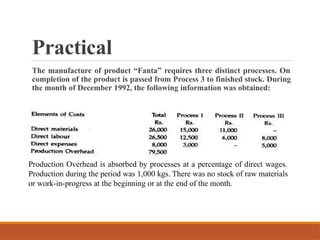
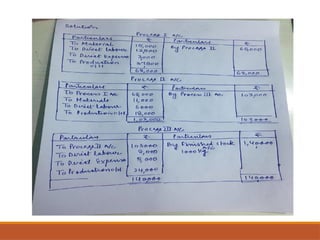
Practical
The manufacture ofproduct “Fanta” requires three distinct processes. On
completion of the product is passed from Process 3 to finished stock. During
the month of December 1992, the following information was obtained:
Production Overhead is absorbed by processes at a percentage of direct wages.
Production during the period was 1,000 kgs. There was no stock of raw materials
or work-in-progress at the beginning or at the end of the month.
13.
Losses in
Process
Normal Loss:The fundamental principle of costing is that the good
units should bear the amount of normal loss. Normal loss
is
anticipated and in a process it is inevitable. It is included in total cost
of the product due to which cost per unit is increases. The cost of
normal loss is therefore not worked out. The number of units
of
normal loss is credited to the Process Account and if they have some
scrap value or realizable value the amount is also credited to the
process account. If there is no scrap value or realizable value, only
the units are credited to the process
account.
14.
Abnormal Loss: Ifthe units lost in the production process are more than the
normal loss, the difference between the two is the abnormal loss. It is excluded
from total cost due to which it does not affect the cost per unit of the product.
The relevant process of account is credited and abnormal loss account is
debited with the abnormal loss valued at full cost of finished output. The
amount realized from sale of scrap of abnormal loss units is credited to the
abnormal loss account and the balance in the abnormal loss account is
transferred to the Costing Profit and Loss Account.
15.
Abnormal Gain: Ifthe actual production units are more than the anticipated
units after deducting the normal loss, the difference between the two is known as
abnormal gain. It is excluded from total cost due to which it does not affect the
cost per unit of the product. The valuation of abnormal gain is done in the same
manner like that of the abnormal loss. The units and the amount is debited to the
relevant Process Account and credited to the Abnormal Gain Account.
16.
Treatment of Normal
Loss
Thecost of normal loss is considered as part of the cost of production in which
it occurs. If normal loss units have any realizable scrap value, the process
account is credited by that amount. If there is no abnormal gain, then there is no
necessity to maintain a separate account for normal loss.
Generally the cost of normal loss is absorbed by the cost units.
Normal Output = Units introduced – Units of normal loss
Normal Cost of Normal Output = Total Cost – Scrap value of
Normal Loss.
In process A/c units of normal wastage is shown in unit column of credit side
and if there is any scrap value then that will be shown in amount column of the
credit side corresponding to lost units.
17.
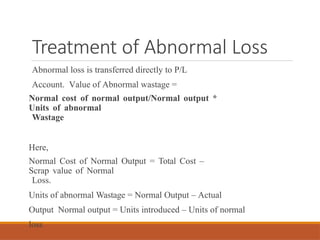
Treatment of AbnormalLoss
Abnormal loss is transferred directly to P/L
Account. Value of Abnormal wastage =
Normal cost of normal output/Normal output *
Units of abnormal
Wastage
Here,
Normal Cost of Normal Output = Total Cost –
Scrap value of Normal
Loss.
Units of abnormal Wastage = Normal Output – Actual
Output Normal output = Units introduced – Units of normal
loss
18.
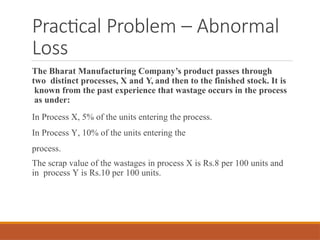
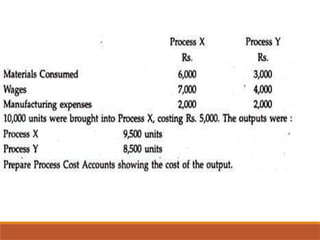
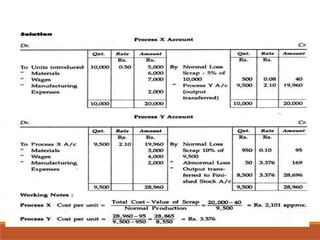
Practical Problem –Abnormal
Loss
The Bharat Manufacturing Company’s product passes through
two distinct processes, X and Y, and then to the finished stock. It is
known from the past experience that wastage occurs in the process
as under:
In Process X, 5% of the units entering the process.
In Process Y, 10% of the units entering the
process.
The scrap value of the wastages in process X is Rs.8 per 100 units and
in process Y is Rs.10 per 100 units.
21.
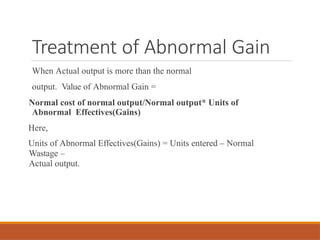
Treatment of AbnormalGain
When Actual output is more than the normal
output. Value of Abnormal Gain =
Normal cost of normal output/Normal output* Units of
Abnormal Effectives(Gains)
Here,
Units of Abnormal Effectives(Gains) = Units entered – Normal
Wastage –
Actual output.
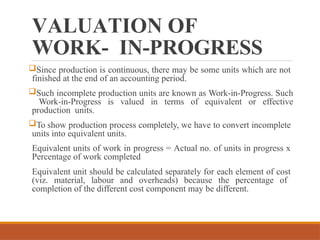
VALUATION OF
WORK- IN-PROGRESS
Sinceproduction is continuous, there may be some units which are not
finished at the end of an accounting period.
Such incomplete production units are known as Work-in-Progress. Such
Work-in-Progress is valued in terms of equivalent or effective
production units.
To show production process completely, we have to convert incomplete
units into equivalent units.
Equivalent units of work in progress = Actual no. of units in progress x
Percentage of work completed
Equivalent unit should be calculated separately for each element of cost
(viz. material, labour and overheads) because the percentage of
completion of the different cost component may be different.
24.
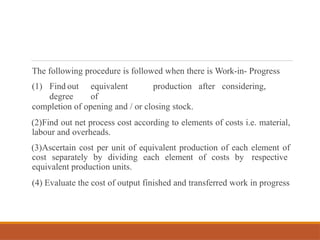
The following procedureis followed when there is Work-in- Progress
(1) Find out equivalent production after considering,
degree of
completion of opening and / or closing stock.
(2)Find out net process cost according to elements of costs i.e. material,
labour and overheads.
(3)Ascertain cost per unit of equivalent production of each element of
cost separately by dividing each element of costs by respective
equivalent production units.
(4) Evaluate the cost of output finished and transferred work in progress
25.
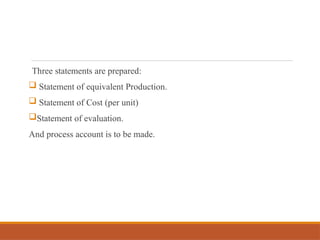
Three statements areprepared:
Statement of equivalent Production.
Statement of Cost (per unit)
Statement of evaluation.
And process account is to be made.
26.
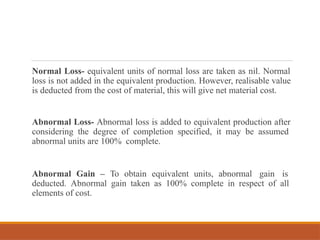
Normal Loss- equivalentunits of normal loss are taken as nil. Normal
loss is not added in the equivalent production. However, realisable value
is deducted from the cost of material, this will give net material cost.
Abnormal Loss- Abnormal loss is added to equivalent production after
considering the degree of completion specified, it may be assumed
abnormal units are 100% complete.
Abnormal Gain – To obtain equivalent units, abnormal gain is
deducted. Abnormal gain taken as 100% complete in respect of all
elements of cost.
27.
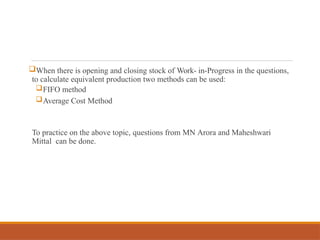
When there isopening and closing stock of Work- in-Progress in the questions,
to calculate equivalent production two methods can be used:
FIFO method
Average Cost Method
To practice on the above topic, questions from MN Arora and Maheshwari
Mittal can be done.
28.
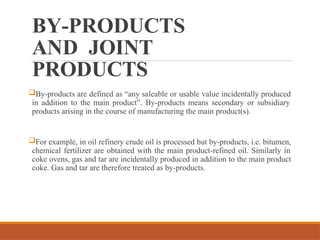
BY-PRODUCTS
AND JOINT
PRODUCTS
By-products aredefined as “any saleable or usable value incidentally produced
in addition to the main product”. By-products means secondary or subsidiary
products arising in the course of manufacturing the main product(s).
For example, in oil refinery crude oil is processed but by-products, i.e. bitumen,
chemical fertilizer are obtained with the main product-refined oil. Similarly in
coke ovens, gas and tar are incidentally produced in addition to the main product
coke. Gas and tar are therefore treated as by-products.
29.
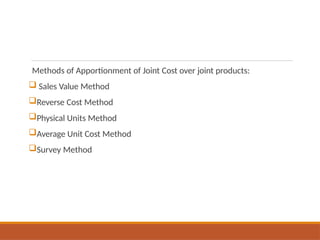
Methods of Apportionmentof Joint Cost over joint products:
Sales Value Method
Reverse Cost Method
Physical Units Method
Average Unit Cost Method
Survey Method