PROCESS COSTING
 Process Costing is defined as a branch
of operation costing, that determines the cost
of a product at each stage, i.e. process of
production.
 It is an accounting method which is adopted
by the factories or industries where the
standardized identical product is produced, as
well as it passes through multiple processes for
being transformed into the final product.
PROCESS COSTING
 Process costing is used in mass production producing
standard products such as cement , sugar, steel , oil refining
etc
 In such industries goods produced are identical and
processes are standardized.
 For manufacturing a product, the raw material has to pass
several stages of manufacture in a pre determined sequence .
 Such stage of manufacture is called process .
 Methods of cost ascertainment in such industries is called
process costing
MEANING OF PROCESS COSTING
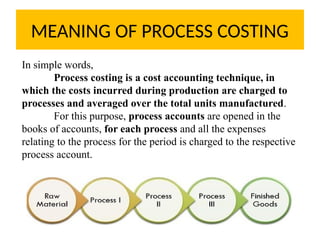
In simple words,
Process costing is a cost accounting technique, in
which the costs incurred during production are charged to
processes and averaged over the total units manufactured.
For this purpose, process accounts are opened in the
books of accounts, for each process and all the expenses
relating to the process for the period is charged to the respective
process account.
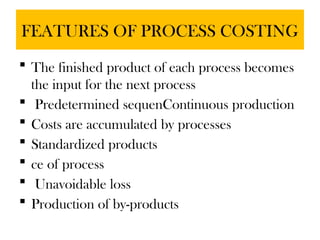
FEATURES OF PROCESS COSTING
 The finished product of each process becomes
the input for the next process
 Predetermined sequenContinuous production
 Costs are accumulated by processes
 Standardized products
 ce of process
 Unavoidable loss
 Production of by-products
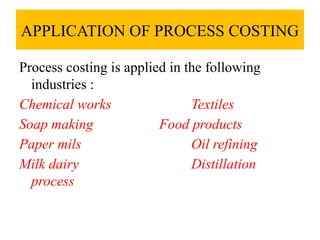
APPLICATION OF PROCESS COSTING
Process costing is applied in the following
industries :
Chemical works Textiles
Soap making Food products
Paper mils Oil refining
Milk dairy Distillation
process
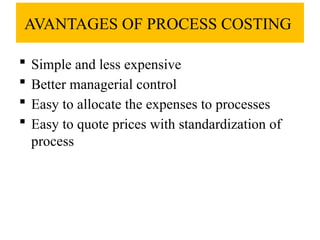
Advantages of Process costing
 Simple and less expensive
 Better managerial control
 Easy to allocate the expenses to processes
 Easy to quote prices with standardization of
process
AVANTAGES OF PROCESS COSTING
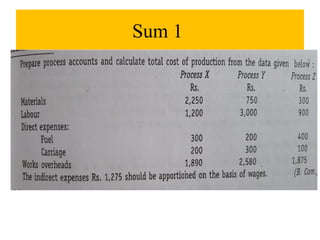
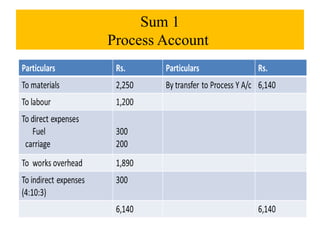
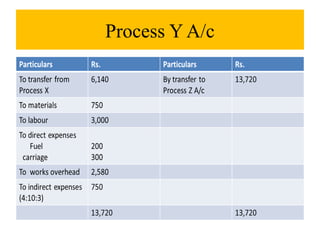
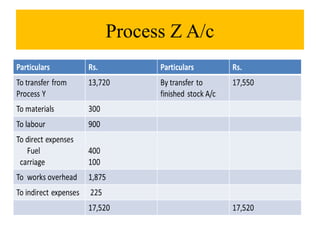
Sum 1
Sum 1
Process Account
Process Y A/c
Process Z A/c
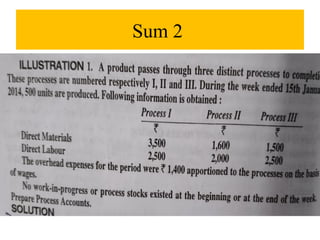
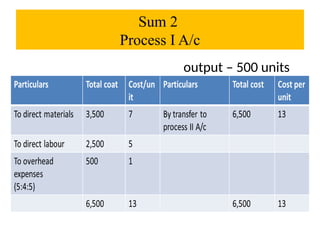
Sum 2
Sum 2
Process I A/c
output – 500 units
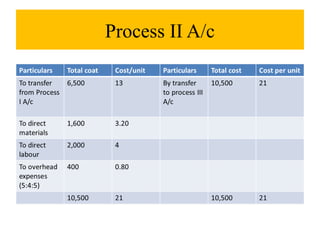
Process II A/c
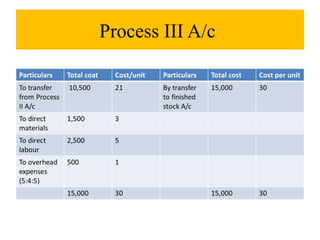
Process III A/c
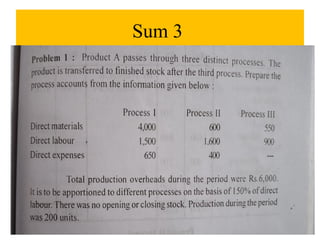
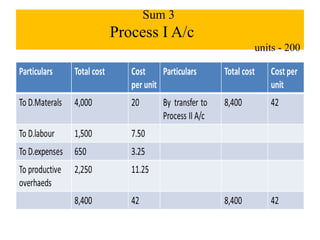
Sum 3
Sum 3
Process I A/c
units - 200
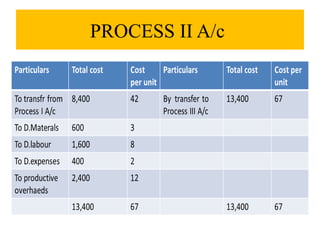
PROCESS II A/c
.
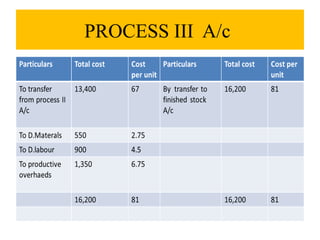
PROCESS III A/c
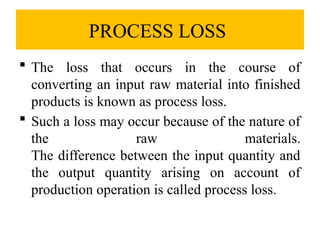
PROCESS LOSS
 The loss that occurs in the course of
converting an input raw material into finished
products is known as process loss.
 Such a loss may occur because of the nature of
the raw materials.
The difference between the input quantity and
the output quantity arising on account of
production operation is called process loss.
TYPES OF PROCESS LOSS
 NORMAL LOSS
 ABNORMAL LOSS
NORMAL LOSS
Normal loss means that loss which is inherent in the
processing operations. It can be expected or
anticipated in advance i.e. at the time of estimation.
Accounting Treatment: The cost of normal loss is
considered as part of the cost of production in
which it occurs.
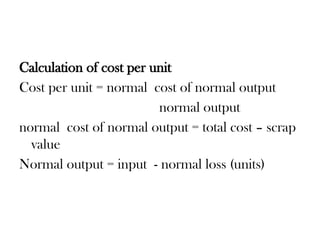
Calculation of cost per unit
Cost per unit = normal cost of normal output
normal output
normal cost of normal output = total cost – scrap
value
Normal output = input - normal loss (units)
ABNORMAL PROCESS LOSS
 The loss realized over the normal loss is called
an abnormal loss.
 Abnormal loss arises because of abnormal
working conditions, bad working condition,
carelessness, rough handling, lack of proper
knowledge, low quality raw material, machine
breakdown, accident etc.
 Therefore an abnormal loss is an unanticipated
loss.
 Abnormal loss is a controllable loss and thus
can be avoided if corrective measures are taken.
 Therefore, abnormal loss is also called an
avoidable loss.
 The value of an abnormal loss is assessed on
the basis of the production cost with which the
profit and loss account is charged.
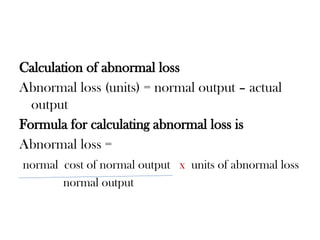
Calculation of abnormal loss
Abnormal loss (units) = normal output – actual
output
Formula for calculating abnormal loss is
Abnormal loss =
normal cost of normal output x units of abnormal loss
normal output
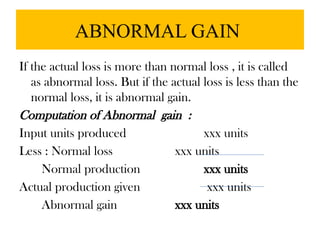
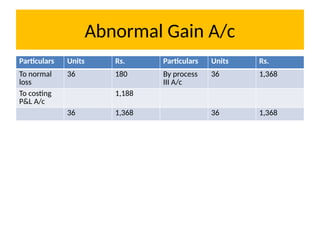
ABNORMAL GAIN
If the actual loss is more than normal loss , it is called
as abnormal loss. But if the actual loss is less than the
normal loss, it is abnormal gain.
Computation of Abnormal gain :
Input units produced xxx units
Less : Normal loss xxx units
Normal production xxx units
Actual production given xxx units
Abnormal gain xxx units
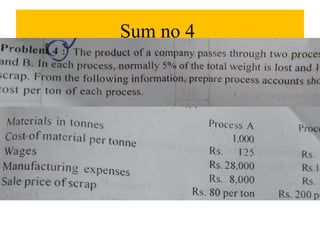
Sum no 4
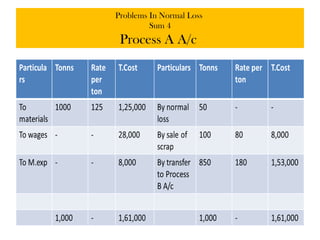
Problems In Normal Loss
Sum 4
Process A A/c
Process B A/c
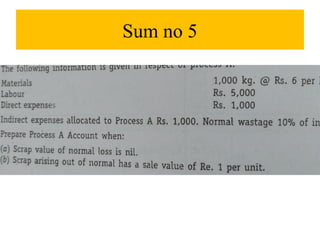
Sum no 5
Sum 5
Process A A/c
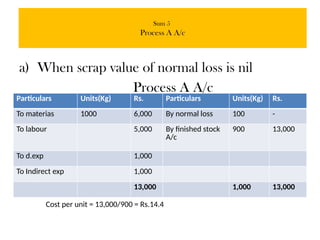
a) When scrap value of normal loss is nil
Process A A/c
Particulars Units(Kg) Rs. Particulars Units(Kg) Rs.
To materias 1000 6,000 By normal loss 100 -
To labour 5,000 By finished stock
A/c
900 13,000
To d.exp 1,000
To Indirect exp 1,000
13,000 1,000 13,000
Cost per unit = 13,000/900 = Rs.14.4
Process A A/c
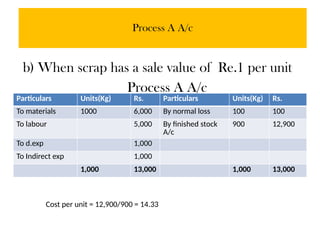
b) When scrap has a sale value of Re.1 per unit
Process A A/c
Particulars Units(Kg) Rs. Particulars Units(Kg) Rs.
To materials 1000 6,000 By normal loss 100 100
To labour 5,000 By finished stock
A/c
900 12,900
To d.exp 1,000
To Indirect exp 1,000
1,000 13,000 1,000 13,000
Cost per unit = 12,900/900 = 14.33
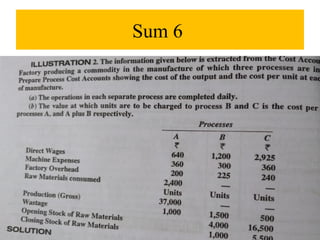
Sum 6
Sum 6
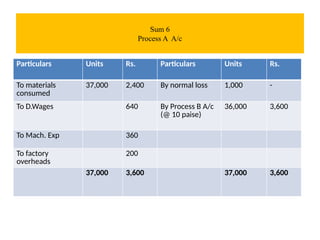
Process A A/c
Particulars Units Rs. Particulars Units Rs.
To materials
consumed
37,000 2,400 By normal loss 1,000 -
To D.Wages 640 By Process B A/c
(@ 10 paise)
36,000 3,600
To Mach. Exp 360
To factory
overheads
200
37,000 3,600 37,000 3,600
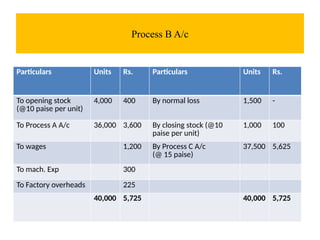
Process B A/c
Particulars Units Rs. Particulars Units Rs.
To opening stock
(@10 paise per unit)
4,000 400 By normal loss 1,500 -
To Process A A/c 36,000 3,600 By closing stock (@10
paise per unit)
1,000 100
To wages 1,200 By Process C A/c
(@ 15 paise)
37,500 5,625
To mach. Exp 300
To Factory overheads 225
40,000 5,725 40,000 5,725
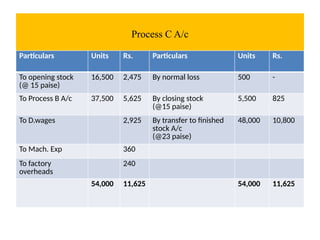
Process C A/c
Particulars Units Rs. Particulars Units Rs.
To opening stock
(@ 15 paise)
16,500 2,475 By normal loss 500 -
To Process B A/c 37,500 5,625 By closing stock
(@15 paise)
5,500 825
To D.wages 2,925 By transfer to finished
stock A/c
(@23 paise)
48,000 10,800
To Mach. Exp 360
To factory
overheads
240
54,000 11,625 54,000 11,625
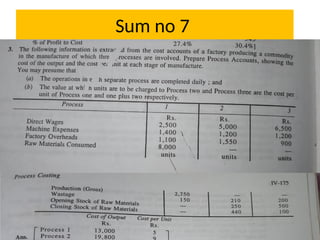
Sum no 7
Process I A/c
Particulars Units Rs. Particulars Units Rs.
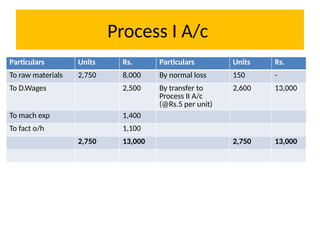
To raw materials 2,750 8,000 By normal loss 150 -
To D.Wages 2,500 By transfer to
Process II A/c
(@Rs.5 per unit)
2,600 13,000
To mach exp 1,400
To fact o/h 1,100
2,750 13,000 2,750 13,000
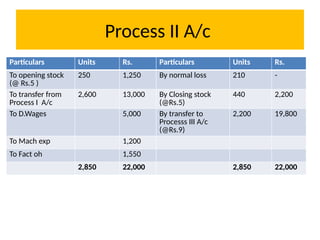
Process II A/c
Particulars Units Rs. Particulars Units Rs.
To opening stock
(@ Rs.5 )
250 1,250 By normal loss 210 -
To transfer from
Process I A/c
2,600 13,000 By Closing stock
(@Rs.5)
440 2,200
To D.Wages 5,000 By transfer to
Processs III A/c
(@Rs.9)
2,200 19,800
To Mach exp 1,200
To Fact oh 1,550
2,850 22,000 2,850 22,000
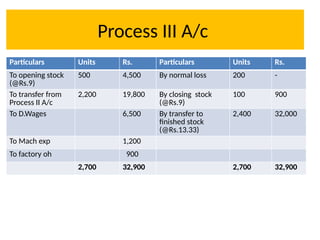
Process III A/c
Particulars Units Rs. Particulars Units Rs.
To opening stock
(@Rs.9)
500 4,500 By normal loss 200 -
To transfer from
Process II A/c
2,200 19,800 By closing stock
(@Rs.9)
100 900
To D.Wages 6,500 By transfer to
finished stock
(@Rs.13.33)
2,400 32,000
To Mach exp 1,200
To factory oh 900
2,700 32,900 2,700 32,900
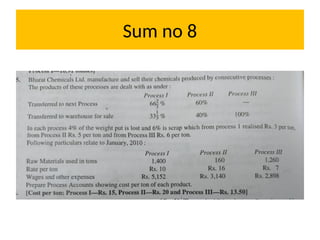
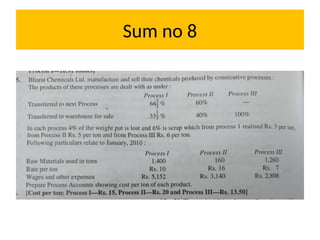
Sum no 8
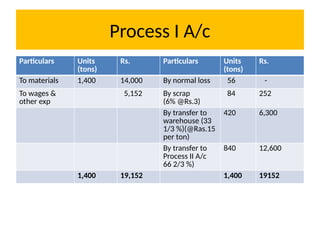
Process I A/c
Particulars Units
(tons)
Rs. Particulars Units
(tons)
Rs.
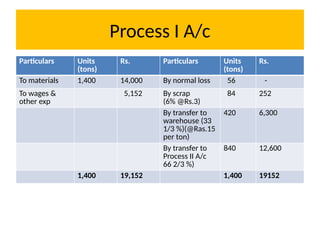
To materials 1,400 14,000 By normal loss 56 -
To wages &
other exp
5,152 By scrap
(6% @Rs.3)
84 252
By transfer to
warehouse (33
1/3 %)(@Ras.15
per ton)
420 6,300
By transfer to
Process II A/c
66 2/3 %)
840 12,600
1,400 19,152 1,400 19152
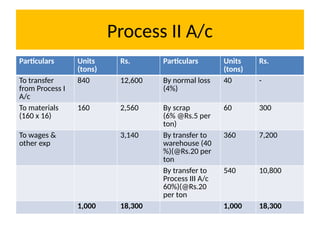
Process II A/c
Particulars Units
(tons)
Rs. Particulars Units
(tons)
Rs.
To transfer
from Process I
A/c
840 12,600 By normal loss
(4%)
40 -
To materials
(160 x 16)
160 2,560 By scrap
(6% @Rs.5 per
ton)
60 300
To wages &
other exp
3,140 By transfer to
warehouse (40
%)(@Rs.20 per
ton
360 7,200
By transfer to
Process III A/c
60%)(@Rs.20
per ton
540 10,800
1,000 18,300 1,000 18,300
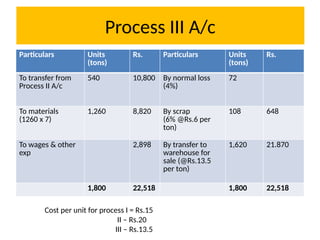
Process III A/c
Particulars Units
(tons)
Rs. Particulars Units
(tons)
Rs.
To transfer from
Process II A/c
540 10,800 By normal loss
(4%)
72
To materials
(1260 x 7)
1,260 8,820 By scrap
(6% @Rs.6 per
ton)
108 648
To wages & other
exp
2,898 By transfer to
warehouse for
sale (@Rs.13.5
per ton)
1,620 21.870
1,800 22,518 1,800 22,518
Cost per unit for process I = Rs.15
II – Rs.20
III – Rs.13.5
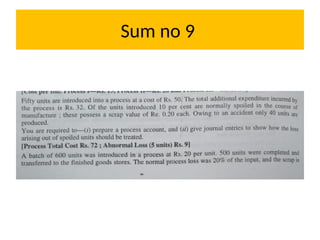
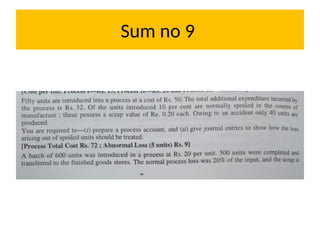
Sum no 9
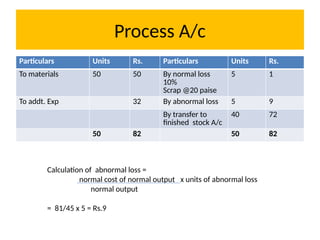
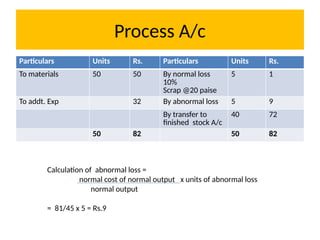
Process A/c
Particulars Units Rs. Particulars Units Rs.
To materials 50 50 By normal loss
10%
Scrap @20 paise
5 1
To addt. Exp 32 By abnormal loss 5 9
By transfer to
finished stock A/c
40 72
50 82 50 82
Calculation of abnormal loss =
normal cost of normal output x units of abnormal loss
normal output
= 81/45 x 5 = Rs.9
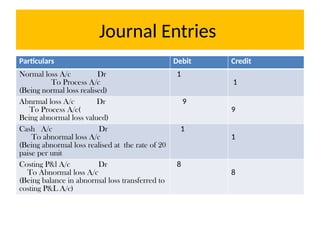
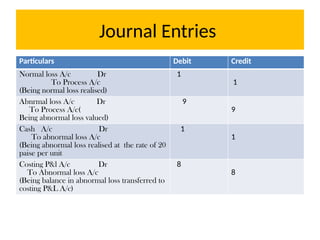
Journal Entries
Particulars Debit Credit
Normal loss A/c Dr
To Process A/c
(Being normal loss realised)
1
1
Abnrmal loss A/c Dr
To Process A/c(
Being abnormal loss valued)
9
9
Cash A/c Dr
To abnormal loss A/c
(Being abnormal loss realised at the rate of 20
paise per unit
1
1
Costing P&l A/c Dr
To Abnormal loss A/c
(Being balance in abnormal loss transferred to
costing P&L A/c)
8
8
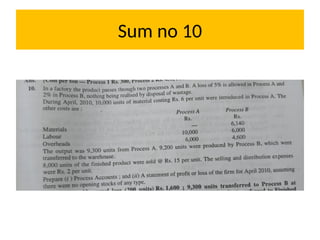
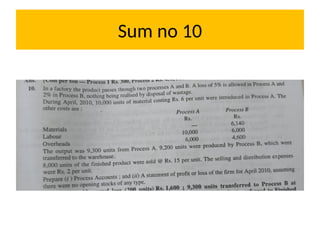
Sum no 10
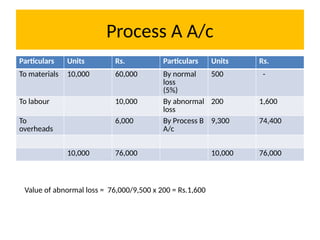
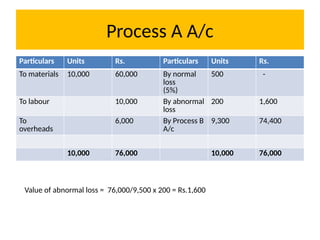
Process A A/c
Particulars Units Rs. Particulars Units Rs.
To materials 10,000 60,000 By normal
loss
(5%)
500 -
To labour 10,000 By abnormal
loss
200 1,600
To
overheads
6,000 By Process B
A/c
9,300 74,400
10,000 76,000 10,000 76,000
Value of abnormal loss = 76,000/9,500 x 200 = Rs.1,600
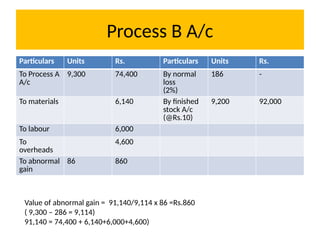
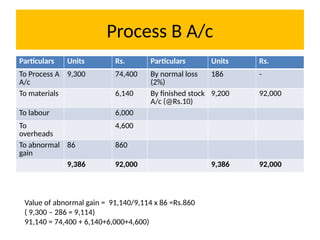
Process B A/c
Particulars Units Rs. Particulars Units Rs.
To Process A
A/c
9,300 74,400 By normal
loss
(2%)
186 -
To materials 6,140 By finished
stock A/c
(@Rs.10)
9,200 92,000
To labour 6,000
To
overheads
4,600
To abnormal
gain
86 860
Value of abnormal gain = 91,140/9,114 x 86 =Rs.860
( 9,300 – 286 = 9,114)
91,140 = 74,400 + 6,140+6,000+4,600)
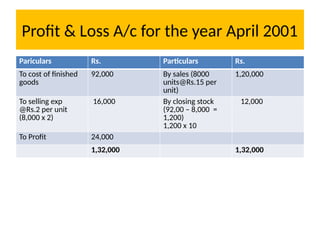
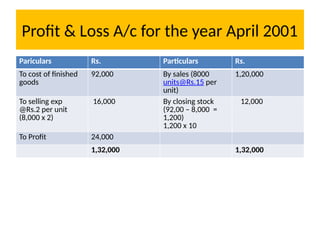
Profit & Loss A/c for the year April 2001
Pariculars Rs. Particulars Rs.
To cost of finished
goods
92,000 By sales (8000
units@Rs.15 per
unit)
1,20,000
To selling exp
@Rs.2 per unit
(8,000 x 2)
16,000 By closing stock
(92,00 – 8,000 =
1,200)
1,200 x 10
12,000
To Profit 24,000
1,32,000 1,32,000
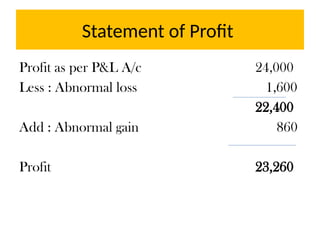
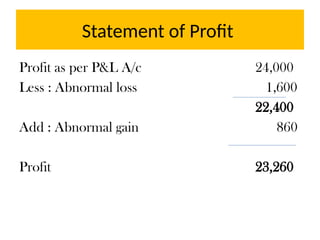
Statement of Profit
Profit as per P&L A/c 24,000
Less : Abnormal loss 1,600
22,400
Add : Abnormal gain 860
Profit 23,260
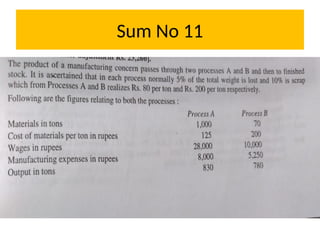
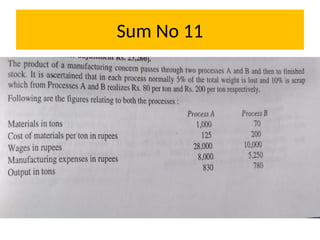
Sum No 11
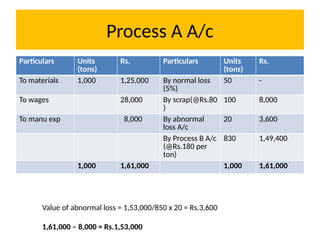
Process A A/c
Particulars Units
(tons)
Rs. Particulars Units
(tons)
Rs.
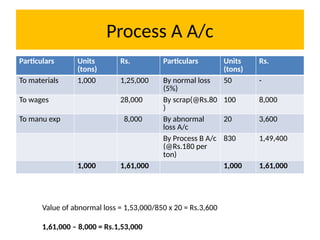
To materials 1,000 1,25,000 By normal loss
(5%)
50 -
To wages 28,000 By scrap(@Rs.80
)
100 8,000
To manu exp 8,000 By abnormal
loss A/c
20 3,600
By Process B A/c
(@Rs.180 per
ton)
830 1,49,400
1,000 1,61,000 1,000 1,61,000
Value of abnormal loss = 1,53,000/850 x 20 = Rs.3,600
1,61,000 – 8,000 = Rs.1,53,000
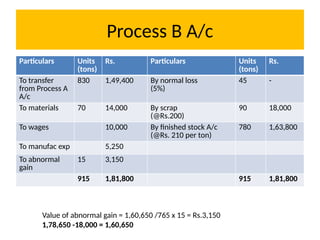
Process B A/c
Particulars Units
(tons)
Rs. Particulars Units
(tons)
Rs.
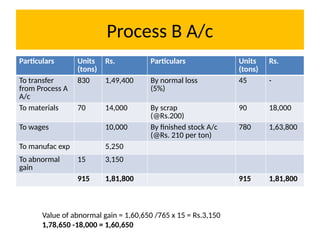
To transfer
from Process A
A/c
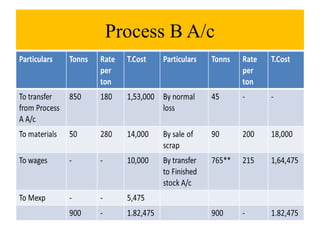
830 1,49,400 By normal loss
(5%)
45 -
To materials 70 14,000 By scrap
(@Rs.200)
90 18,000
To wages 10,000 By finished stock A/c
(@Rs. 210 per ton)
780 1,63,800
To manufac exp 5,250
To abnormal
gain
15 3,150
915 1,81,800 915 1,81,800
Value of abnormal gain = 1,60,650 /765 x 15 = Rs.3,150
1,78,650 -18,000 = 1,60,650
Sum no 8
Process I A/c
Particulars Units
(tons)
Rs. Particulars Units
(tons)
Rs.
To materials 1,400 14,000 By normal loss 56 -
To wages &
other exp
5,152 By scrap
(6% @Rs.3)
84 252
By transfer to
warehouse (33
1/3 %)(@Ras.15
per ton)
420 6,300
By transfer to
Process II A/c
66 2/3 %)
840 12,600
1,400 19,152 1,400 19152
Process II A/c
Particulars Units
(tons)
Rs. Particulars Units
(tons)
Rs.
To transfer
from Process I
A/c
840 12,600 By normal loss
(4%)
40 -
To materials
(160 x 16)
160 2,560 By scrap
(6% @Rs.5 per
ton)
60 300
To wages &
other exp
3,140 By transfer to
warehouse (40
%)(@Rs.20 per
ton
360 7,200
By transfer to
Process III A/c
60%)(@Rs.20
per ton
540 10,800
1,000 18,300 1,000 18,300
Process III A/c
Particulars Units
(tons)
Rs. Particulars Units
(tons)
Rs.
To transfer from
Process II A/c
540 10,800 By normal loss
(4%)
72
To materials
(1260 x 7)
1,260 8,820 By scrap
(6% @Rs.6 per
ton)
108 648
To wages & other
exp
2,898 By transfer to
warehouse for
sale (@Rs.13.5
per ton)
1,620 21.870
1,800 22,518 1,800 22,518
Cost per unit for process I = Rs.15
II – Rs.20
III – Rs.13.5
Sum no 9
Process A/c
Particulars Units Rs. Particulars Units Rs.
To materials 50 50 By normal loss
10%
Scrap @20 paise
5 1
To addt. Exp 32 By abnormal loss 5 9
By transfer to
finished stock A/c
40 72
50 82 50 82
Calculation of abnormal loss =
normal cost of normal output x units of abnormal loss
normal output
= 81/45 x 5 = Rs.9
Journal Entries
Particulars Debit Credit
Normal loss A/c Dr
To Process A/c
(Being normal loss realised)
1
1
Abnrmal loss A/c Dr
To Process A/c(
Being abnormal loss valued)
9
9
Cash A/c Dr
To abnormal loss A/c
(Being abnormal loss realised at the rate of 20
paise per unit
1
1
Costing P&l A/c Dr
To Abnormal loss A/c
(Being balance in abnormal loss transferred to
costing P&L A/c)
8
8
Sum no 10
Process A A/c
Particulars Units Rs. Particulars Units Rs.
To materials 10,000 60,000 By normal
loss
(5%)
500 -
To labour 10,000 By abnormal
loss
200 1,600
To
overheads
6,000 By Process B
A/c
9,300 74,400
10,000 76,000 10,000 76,000
Value of abnormal loss = 76,000/9,500 x 200 = Rs.1,600
Process B A/c
Particulars Units Rs. Particulars Units Rs.
To Process A
A/c
9,300 74,400 By normal loss
(2%)
186 -
To materials 6,140 By finished stock
A/c (@Rs.10)
9,200 92,000
To labour 6,000
To
overheads
4,600
To abnormal
gain
86 860
9,386 92,000 9,386 92,000
Value of abnormal gain = 91,140/9,114 x 86 =Rs.860
( 9,300 – 286 = 9,114)
91,140 = 74,400 + 6,140+6,000+4,600)
Profit & Loss A/c for the year April 2001
Pariculars Rs. Particulars Rs.
To cost of finished
goods
92,000 By sales (8000
units@Rs.15 per
unit)
1,20,000
To selling exp
@Rs.2 per unit
(8,000 x 2)
16,000 By closing stock
(92,00 – 8,000 =
1,200)
1,200 x 10
12,000
To Profit 24,000
1,32,000 1,32,000
Statement of Profit
Profit as per P&L A/c 24,000
Less : Abnormal loss 1,600
22,400
Add : Abnormal gain 860
Profit 23,260
Sum No 11
Process A A/c
Particulars Units
(tons)
Rs. Particulars Units
(tons)
Rs.
To materials 1,000 1,25,000 By normal loss
(5%)
50 -
To wages 28,000 By scrap(@Rs.80
)
100 8,000
To manu exp 8,000 By abnormal
loss A/c
20 3,600
By Process B A/c
(@Rs.180 per
ton)
830 1,49,400
1,000 1,61,000 1,000 1,61,000
Value of abnormal loss = 1,53,000/850 x 20 = Rs.3,600
1,61,000 – 8,000 = Rs.1,53,000
Process B A/c
Particulars Units
(tons)
Rs. Particulars Units
(tons)
Rs.
To transfer
from Process A
A/c
830 1,49,400 By normal loss
(5%)
45 -
To materials 70 14,000 By scrap
(@Rs.200)
90 18,000
To wages 10,000 By finished stock A/c
(@Rs. 210 per ton)
780 1,63,800
To manufac exp 5,250
To abnormal
gain
15 3,150
915 1,81,800 915 1,81,800
Value of abnormal gain = 1,60,650 /765 x 15 = Rs.3,150
1,78,650 -18,000 = 1,60,650
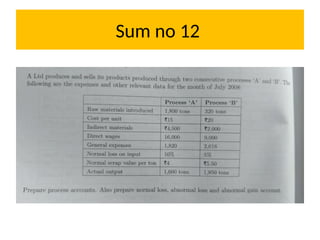
Sum no 12
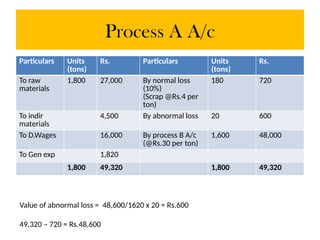
Process A A/c
Particulars Units
(tons)
Rs. Particulars Units
(tons)
Rs.
To raw
materials
1,800 27,000 By normal loss
(10%)
(Scrap @Rs.4 per
ton)
180 720
To indir
materials
4,500 By abnormal loss 20 600
To D.Wages 16,000 By process B A/c
(@Rs.30 per ton)
1,600 48,000
To Gen exp 1,820
1,800 49,320 1,800 49,320
Value of abnormal loss = 48,600/1620 x 20 = Rs.600
49,320 – 720 = Rs.48,600
Process B A/c
Particulars Units
(tons)
Rs. Particulars Units
(tons)
Rs.
To process A A/c 1,600 48,000 By normal loss (5%)
(Scrap @Rs. 5.50 per
ton)
96 528
To raw materials
(@Rs.20 per
unit)
320 6,400 By Finished stock A/c
(@Rs. 37 per ton)
1,850 68,450
To indirect
materials
2,000
To D.Wages 9,000
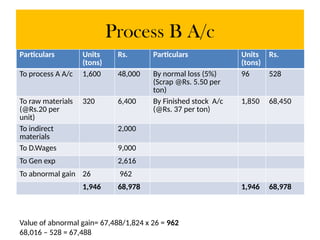
To Gen exp 2,616
To abnormal gain 26 962
1,946 68,978 1,946 68,978
Value of abnormal gain= 67,488/1,824 x 26 = 962
68,016 – 528 = 67,488
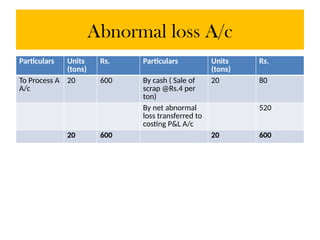
Abnormal loss A/c
Particulars Units
(tons)
Rs. Particulars Units
(tons)
Rs.
To Process A
A/c
20 600 By cash ( Sale of
scrap @Rs.4 per
ton)
20 80
By net abnormal
loss transferred to
costing P&L A/c
520
20 600 20 600
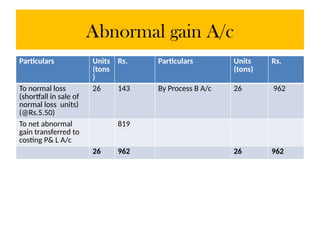
Abnormal gain A/c
Particulars Units
(tons
)
Rs. Particulars Units
(tons)
Rs.
To normal loss
(shortfall in sale of
normal loss units)
(@Rs.5.50)
26 143 By Process B A/c 26 962
To net abnormal
gain transferred to
costing P& L A/c
819
26 962 26 962
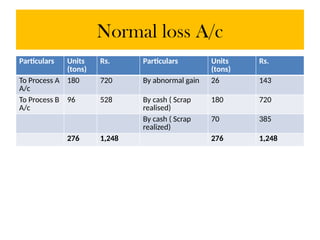
Normal loss A/c
Particulars Units
(tons)
Rs. Particulars Units
(tons)
Rs.
To Process A
A/c
180 720 By abnormal gain 26 143
To Process B
A/c
96 528 By cash ( Scrap
realised)
180 720
By cash ( Scrap
realized)
70 385
276 1,248 276 1,248
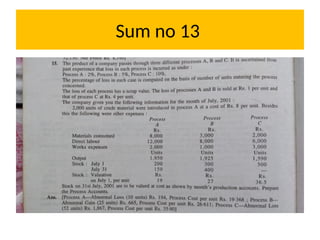
Sum no 13
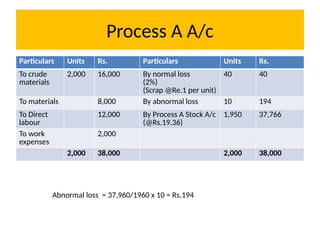
Process A A/c
Particulars Units Rs. Particulars Units Rs.
To crude
materials
2,000 16,000 By normal loss
(2%)
(Scrap @Re.1 per unit)
40 40
To materials 8,000 By abnormal loss 10 194
To Direct
labour
12,000 By Process A Stock A/c
(@Rs.19.36)
1,950 37,766
To work
expenses
2,000
2,000 38,000 2,000 38,000
Abnormal loss = 37,960/1960 x 10 = Rs.194
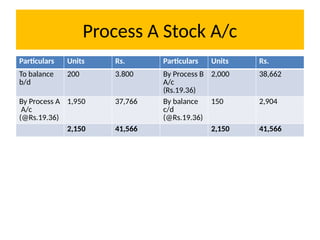
Process A Stock A/c
Particulars Units Rs. Particulars Units Rs.
To balance
b/d
200 3.800 By Process B
A/c
(Rs.19.36)
2,000 38,662
By Process A
A/c
(@Rs.19.36)
1,950 37,766 By balance
c/d
(@Rs.19.36)
150 2,904
2,150 41,566 2,150 41,566
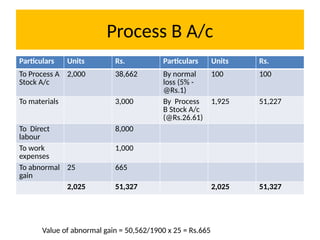
Process B A/c
Particulars Units Rs. Particulars Units Rs.
To Process A
Stock A/c
2,000 38,662 By normal
loss (5% -
@Rs.1)
100 100
To materials 3,000 By Process
B Stock A/c
(@Rs.26.61)
1,925 51,227
To Direct
labour
8,000
To work
expenses
1,000
To abnormal
gain
25 665
2,025 51,327 2,025 51,327
Value of abnormal gain = 50,562/1900 x 25 = Rs.665
Process B Stock A/c
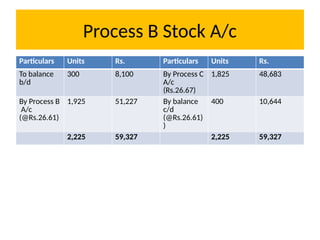
Particulars Units Rs. Particulars Units Rs.
To balance
b/d
300 8,100 By Process C
A/c
(Rs.26.67)
1,825 48,683
By Process B
A/c
(@Rs.26.61)
1,925 51,227 By balance
c/d
(@Rs.26.61)
)
400 10,644
2,225 59,327 2,225 59,327
Process C A/c
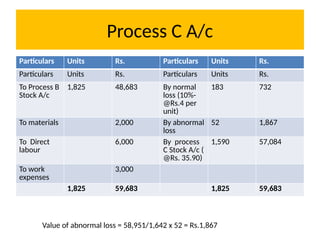
Particulars Units Rs. Particulars Units Rs.
To Process B
Stock A/c
1,825 48,683 By normal
loss (10%-
@Rs.4 per
unit)
183 732
To materials 2,000 By abnormal
loss
52 1,867
To Direct
labour
6,000 By process
C Stock A/c (
@Rs. 35.90)
1,590 57,084
To work
expenses
3,000
1,825 59,683 1,825 59,683
Value of abnormal loss = 58,951/1,642 x 52 = Rs.1,867
Process C Stock A/c
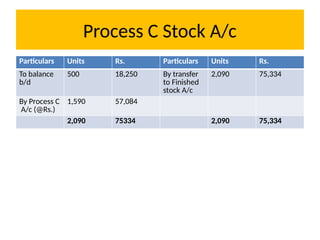
Particulars Units Rs. Particulars Units Rs.
To balance
b/d
500 18,250 By transfer
to Finished
stock A/c
2,090 75,334
By Process C
A/c (@Rs.)
1,590 57,084
2,090 75334 2,090 75,334
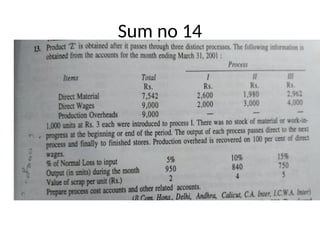
Sum no 14
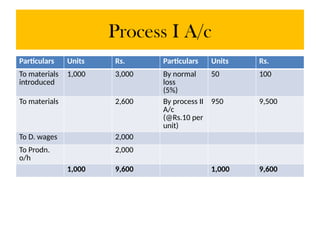
Process I A/c
Particulars Units Rs. Particulars Units Rs.
To materials
introduced
1,000 3,000 By normal
loss
(5%)
50 100
To materials 2,600 By process II
A/c
(@Rs.10 per
unit)
950 9,500
To D. wages 2,000
To Prodn.
o/h
2,000
1,000 9,600 1,000 9,600
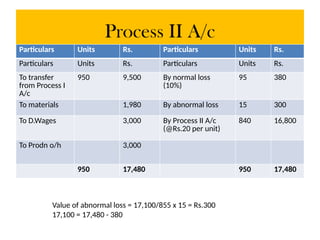
Process II A/c
Particulars Units Rs. Particulars Units Rs.
To transfer
from Process I
A/c
950 9,500 By normal loss
(10%)
95 380
To materials 1,980 By abnormal loss 15 300
To D.Wages 3,000 By Process II A/c
(@Rs.20 per unit)
840 16,800
To Prodn o/h 3,000
950 17,480 950 17,480
Value of abnormal loss = 17,100/855 x 15 = Rs.300
17,100 = 17,480 - 380
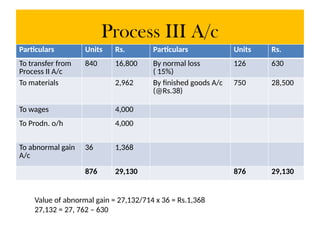
Process III A/c
Particulars Units Rs. Particulars Units Rs.
To transfer from
Process II A/c
840 16,800 By normal loss
( 15%)
126 630
To materials 2,962 By finished goods A/c
(@Rs.38)
750 28,500
To wages 4,000
To Prodn. o/h 4,000
To abnormal gain
A/c
36 1,368
876 29,130 876 29,130
Value of abnormal gain = 27,132/714 x 36 = Rs.1,368
27,132 = 27, 762 – 630
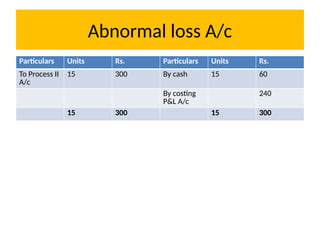
Abnormal loss A/c
Particulars Units Rs. Particulars Units Rs.
To Process II
A/c
15 300 By cash 15 60
By costing
P&L A/c
240
15 300 15 300
Abnormal Gain A/c
Particulars Units Rs. Particulars Units Rs.
To normal
loss
36 180 By process
III A/c
36 1,368
To costing
P&L A/c
1,188
36 1,368 36 1,368
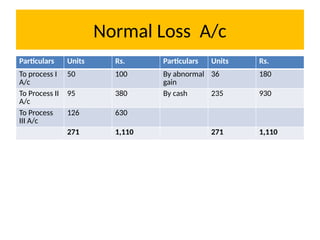
Normal Loss A/c
Particulars Units Rs. Particulars Units Rs.
To process I
A/c
50 100 By abnormal
gain
36 180
To Process II
A/c
95 380 By cash 235 930
To Process
III A/c
126 630
271 1,110 271 1,110
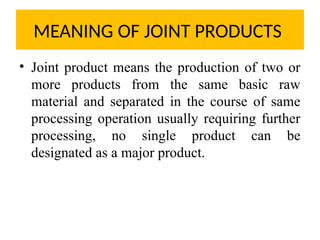
MEANING OF JOINT PRODUCTS
• Joint product means the production of two or
more products from the same basic raw
material and separated in the course of same
processing operation usually requiring further
processing, no single product can be
designated as a major product.
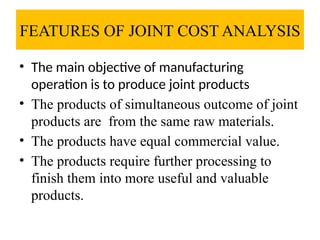
JOINT PRODUCTS
• In some industries ,two or more products of
equal importance and value are
produced,simultaneously in a process. Such
products are called joint products.
• Motor spirit,kerosene oil,fuel oil,lubricating
oil,wax,tar are examples of joint products
produced from crude petroleum.
FEATURES OF JOINT COST ANALYSIS
• The main objective of manufacturing
operation is to produce joint products
• The products of simultaneous outcome of joint
products are from the same raw materials.
• The products have equal commercial value.
• The products require further processing to
finish them into more useful and valuable
products.
OBJECTIVES OF JOINT PRODUCTS
• Correct collection, compilation and
classification of process costs.
• The profit or loss of joint products
manufacture is determined.
• The method or pattern of production may be
determined.
• Fixing most profitable product mix may
increase the profit.
OBJECTIVES OF JOINT PRODUCTS
• The relationship between the cost and profit can
be studied to fix the price of joint products.
• The effect of increase or decrease in cost is to be
find out due to increase or decrease in the output
of joint products.
• The profitability in selling of joint products and
by-products can be determined.
• The volume of profit may also be maximized
with the help of marginal contribution analysis.
ACCOUNTING FOR JOINT PRODUCTS
• Generally the products are not identifiable as
different individual products until a certain
stage of production known as split off point
• All the costs incurred prior to the split off
point are called Joint Product cost.
• Accounting for joint products implies the
assignment of a portion of the joint cost to
each of the joint products
METHODS OF APPORTIONMNET OF
COSTS
Average cost method
• Under this method, the total units produced at
that point divide the total cost incurred up to
the split-off point to get average cost per unit
of production.
• All joint products are valued at the average
cost.
• This method can be used when all products
are expressed in terms of same units.
Sum – 1
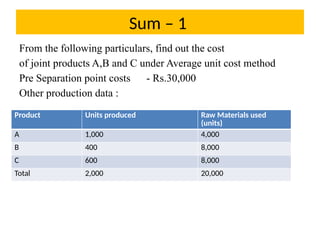
From the following particulars, find out the cost
of joint products A,B and C under Average unit cost method
Pre Separation point costs - Rs.30,000
Other production data :
Product Units produced Raw Materials used
(units)
A 1,000 4,000
B 400 8,000
C 600 8,000
Total 2,000 20,000
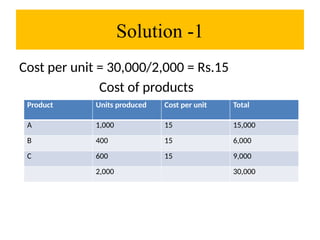
Solution -1
Cost per unit = 30,000/2,000 = Rs.15
Cost of products
Product Units produced Cost per unit Total
A 1,000 15 15,000
B 400 15 6,000
C 600 15 9,000
2,000 30,000
METHODS OF APPORTIONMNET OF
COSTS
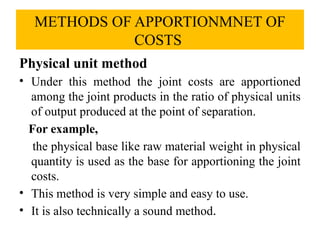
Physical unit method
• Under this method the joint costs are apportioned
among the joint products in the ratio of physical units
of output produced at the point of separation.
For example,
the physical base like raw material weight in physical
quantity is used as the base for apportioning the joint
costs.
• This method is very simple and easy to use.
• It is also technically a sound method.
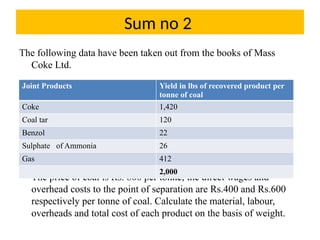
Sum no 2
The following data have been taken out from the books of Mass
Coke Ltd.
• The price of coal is Rs. 800 per tonne; the direct wages and
overhead costs to the point of separation are Rs.400 and Rs.600
respectively per tonne of coal. Calculate the material, labour,
overheads and total cost of each product on the basis of weight.
Joint Products Yield in lbs of recovered product per
tonne of coal
Coke 1,420
Coal tar 120
Benzol 22
Sulphate of Ammonia 26
Gas 412
2,000
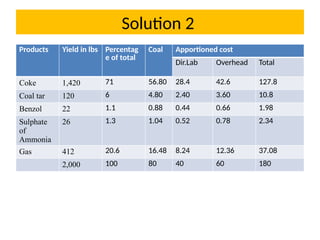
Solution 2
Products Yield in lbs Percentag
e of total
Coal Apportioned cost
Dir.Lab Overhead Total
Coke 1,420 71 56.80 28.4 42.6 127.8
Coal tar 120 6 4.80 2.40 3.60 10.8
Benzol 22 1.1 0.88 0.44 0.66 1.98
Sulphate
of
Ammonia
26 1.3 1.04 0.52 0.78 2.34
Gas 412 20.6 16.48 8.24 12.36 37.08
2,000 100 80 40 60 180

PROCESS COSTING-BRANCH OPERATION COSTING

  • 1.
    PROCESS COSTING  ProcessCosting is defined as a branch of operation costing, that determines the cost of a product at each stage, i.e. process of production.  It is an accounting method which is adopted by the factories or industries where the standardized identical product is produced, as well as it passes through multiple processes for being transformed into the final product.
  • 2.
    PROCESS COSTING  Processcosting is used in mass production producing standard products such as cement , sugar, steel , oil refining etc  In such industries goods produced are identical and processes are standardized.  For manufacturing a product, the raw material has to pass several stages of manufacture in a pre determined sequence .  Such stage of manufacture is called process .  Methods of cost ascertainment in such industries is called process costing
  • 3.
    MEANING OF PROCESSCOSTING In simple words, Process costing is a cost accounting technique, in which the costs incurred during production are charged to processes and averaged over the total units manufactured. For this purpose, process accounts are opened in the books of accounts, for each process and all the expenses relating to the process for the period is charged to the respective process account.
  • 4.
    FEATURES OF PROCESSCOSTING  The finished product of each process becomes the input for the next process  Predetermined sequenContinuous production  Costs are accumulated by processes  Standardized products  ce of process  Unavoidable loss  Production of by-products
  • 5.
    APPLICATION OF PROCESSCOSTING Process costing is applied in the following industries : Chemical works Textiles Soap making Food products Paper mils Oil refining Milk dairy Distillation process
  • 6.
    Advantages of Processcosting  Simple and less expensive  Better managerial control  Easy to allocate the expenses to processes  Easy to quote prices with standardization of process AVANTAGES OF PROCESS COSTING
  • 7.
  • 8.
  • 9.
  • 10.
  • 11.
  • 12.
    Sum 2 Process IA/c output – 500 units
  • 13.
  • 14.
  • 15.
  • 16.
    Sum 3 Process IA/c units - 200
  • 17.
  • 18.
  • 19.
    PROCESS LOSS  Theloss that occurs in the course of converting an input raw material into finished products is known as process loss.  Such a loss may occur because of the nature of the raw materials. The difference between the input quantity and the output quantity arising on account of production operation is called process loss.
  • 20.
    TYPES OF PROCESSLOSS  NORMAL LOSS  ABNORMAL LOSS NORMAL LOSS Normal loss means that loss which is inherent in the processing operations. It can be expected or anticipated in advance i.e. at the time of estimation. Accounting Treatment: The cost of normal loss is considered as part of the cost of production in which it occurs.
  • 21.
    Calculation of costper unit Cost per unit = normal cost of normal output normal output normal cost of normal output = total cost – scrap value Normal output = input - normal loss (units)
  • 22.
    ABNORMAL PROCESS LOSS The loss realized over the normal loss is called an abnormal loss.  Abnormal loss arises because of abnormal working conditions, bad working condition, carelessness, rough handling, lack of proper knowledge, low quality raw material, machine breakdown, accident etc.  Therefore an abnormal loss is an unanticipated loss.
  • 23.
     Abnormal lossis a controllable loss and thus can be avoided if corrective measures are taken.  Therefore, abnormal loss is also called an avoidable loss.  The value of an abnormal loss is assessed on the basis of the production cost with which the profit and loss account is charged.
  • 24.
    Calculation of abnormalloss Abnormal loss (units) = normal output – actual output Formula for calculating abnormal loss is Abnormal loss = normal cost of normal output x units of abnormal loss normal output
  • 25.
    ABNORMAL GAIN If theactual loss is more than normal loss , it is called as abnormal loss. But if the actual loss is less than the normal loss, it is abnormal gain. Computation of Abnormal gain : Input units produced xxx units Less : Normal loss xxx units Normal production xxx units Actual production given xxx units Abnormal gain xxx units
  • 26.
  • 27.
    Problems In NormalLoss Sum 4 Process A A/c
  • 28.
  • 29.
  • 30.
    Sum 5 Process AA/c a) When scrap value of normal loss is nil Process A A/c Particulars Units(Kg) Rs. Particulars Units(Kg) Rs. To materias 1000 6,000 By normal loss 100 - To labour 5,000 By finished stock A/c 900 13,000 To d.exp 1,000 To Indirect exp 1,000 13,000 1,000 13,000 Cost per unit = 13,000/900 = Rs.14.4
  • 31.
    Process A A/c b)When scrap has a sale value of Re.1 per unit Process A A/c Particulars Units(Kg) Rs. Particulars Units(Kg) Rs. To materials 1000 6,000 By normal loss 100 100 To labour 5,000 By finished stock A/c 900 12,900 To d.exp 1,000 To Indirect exp 1,000 1,000 13,000 1,000 13,000 Cost per unit = 12,900/900 = 14.33
  • 32.
  • 33.
    Sum 6 Process AA/c Particulars Units Rs. Particulars Units Rs. To materials consumed 37,000 2,400 By normal loss 1,000 - To D.Wages 640 By Process B A/c (@ 10 paise) 36,000 3,600 To Mach. Exp 360 To factory overheads 200 37,000 3,600 37,000 3,600
  • 34.
    Process B A/c ParticularsUnits Rs. Particulars Units Rs. To opening stock (@10 paise per unit) 4,000 400 By normal loss 1,500 - To Process A A/c 36,000 3,600 By closing stock (@10 paise per unit) 1,000 100 To wages 1,200 By Process C A/c (@ 15 paise) 37,500 5,625 To mach. Exp 300 To Factory overheads 225 40,000 5,725 40,000 5,725
  • 35.
    Process C A/c ParticularsUnits Rs. Particulars Units Rs. To opening stock (@ 15 paise) 16,500 2,475 By normal loss 500 - To Process B A/c 37,500 5,625 By closing stock (@15 paise) 5,500 825 To D.wages 2,925 By transfer to finished stock A/c (@23 paise) 48,000 10,800 To Mach. Exp 360 To factory overheads 240 54,000 11,625 54,000 11,625
  • 36.
  • 37.
    Process I A/c ParticularsUnits Rs. Particulars Units Rs. To raw materials 2,750 8,000 By normal loss 150 - To D.Wages 2,500 By transfer to Process II A/c (@Rs.5 per unit) 2,600 13,000 To mach exp 1,400 To fact o/h 1,100 2,750 13,000 2,750 13,000
  • 38.
    Process II A/c ParticularsUnits Rs. Particulars Units Rs. To opening stock (@ Rs.5 ) 250 1,250 By normal loss 210 - To transfer from Process I A/c 2,600 13,000 By Closing stock (@Rs.5) 440 2,200 To D.Wages 5,000 By transfer to Processs III A/c (@Rs.9) 2,200 19,800 To Mach exp 1,200 To Fact oh 1,550 2,850 22,000 2,850 22,000
  • 39.
    Process III A/c ParticularsUnits Rs. Particulars Units Rs. To opening stock (@Rs.9) 500 4,500 By normal loss 200 - To transfer from Process II A/c 2,200 19,800 By closing stock (@Rs.9) 100 900 To D.Wages 6,500 By transfer to finished stock (@Rs.13.33) 2,400 32,000 To Mach exp 1,200 To factory oh 900 2,700 32,900 2,700 32,900
  • 40.
  • 41.
    Process I A/c ParticularsUnits (tons) Rs. Particulars Units (tons) Rs. To materials 1,400 14,000 By normal loss 56 - To wages & other exp 5,152 By scrap (6% @Rs.3) 84 252 By transfer to warehouse (33 1/3 %)(@Ras.15 per ton) 420 6,300 By transfer to Process II A/c 66 2/3 %) 840 12,600 1,400 19,152 1,400 19152
  • 42.
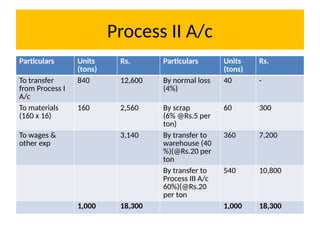
    Process II A/c ParticularsUnits (tons) Rs. Particulars Units (tons) Rs. To transfer from Process I A/c 840 12,600 By normal loss (4%) 40 - To materials (160 x 16) 160 2,560 By scrap (6% @Rs.5 per ton) 60 300 To wages & other exp 3,140 By transfer to warehouse (40 %)(@Rs.20 per ton 360 7,200 By transfer to Process III A/c 60%)(@Rs.20 per ton 540 10,800 1,000 18,300 1,000 18,300
  • 43.
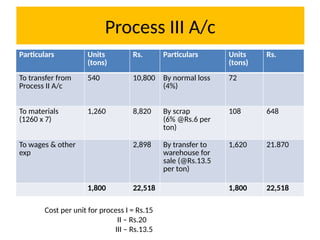
    Process III A/c ParticularsUnits (tons) Rs. Particulars Units (tons) Rs. To transfer from Process II A/c 540 10,800 By normal loss (4%) 72 To materials (1260 x 7) 1,260 8,820 By scrap (6% @Rs.6 per ton) 108 648 To wages & other exp 2,898 By transfer to warehouse for sale (@Rs.13.5 per ton) 1,620 21.870 1,800 22,518 1,800 22,518 Cost per unit for process I = Rs.15 II – Rs.20 III – Rs.13.5
  • 44.
  • 45.
    Process A/c Particulars UnitsRs. Particulars Units Rs. To materials 50 50 By normal loss 10% Scrap @20 paise 5 1 To addt. Exp 32 By abnormal loss 5 9 By transfer to finished stock A/c 40 72 50 82 50 82 Calculation of abnormal loss = normal cost of normal output x units of abnormal loss normal output = 81/45 x 5 = Rs.9
  • 46.
    Journal Entries Particulars DebitCredit Normal loss A/c Dr To Process A/c (Being normal loss realised) 1 1 Abnrmal loss A/c Dr To Process A/c( Being abnormal loss valued) 9 9 Cash A/c Dr To abnormal loss A/c (Being abnormal loss realised at the rate of 20 paise per unit 1 1 Costing P&l A/c Dr To Abnormal loss A/c (Being balance in abnormal loss transferred to costing P&L A/c) 8 8
  • 47.
  • 48.
    Process A A/c ParticularsUnits Rs. Particulars Units Rs. To materials 10,000 60,000 By normal loss (5%) 500 - To labour 10,000 By abnormal loss 200 1,600 To overheads 6,000 By Process B A/c 9,300 74,400 10,000 76,000 10,000 76,000 Value of abnormal loss = 76,000/9,500 x 200 = Rs.1,600
  • 49.
    Process B A/c ParticularsUnits Rs. Particulars Units Rs. To Process A A/c 9,300 74,400 By normal loss (2%) 186 - To materials 6,140 By finished stock A/c (@Rs.10) 9,200 92,000 To labour 6,000 To overheads 4,600 To abnormal gain 86 860 Value of abnormal gain = 91,140/9,114 x 86 =Rs.860 ( 9,300 – 286 = 9,114) 91,140 = 74,400 + 6,140+6,000+4,600)
  • 50.
    Profit & LossA/c for the year April 2001 Pariculars Rs. Particulars Rs. To cost of finished goods 92,000 By sales (8000 units@Rs.15 per unit) 1,20,000 To selling exp @Rs.2 per unit (8,000 x 2) 16,000 By closing stock (92,00 – 8,000 = 1,200) 1,200 x 10 12,000 To Profit 24,000 1,32,000 1,32,000
  • 51.
    Statement of Profit Profitas per P&L A/c 24,000 Less : Abnormal loss 1,600 22,400 Add : Abnormal gain 860 Profit 23,260
  • 52.
  • 53.
    Process A A/c ParticularsUnits (tons) Rs. Particulars Units (tons) Rs. To materials 1,000 1,25,000 By normal loss (5%) 50 - To wages 28,000 By scrap(@Rs.80 ) 100 8,000 To manu exp 8,000 By abnormal loss A/c 20 3,600 By Process B A/c (@Rs.180 per ton) 830 1,49,400 1,000 1,61,000 1,000 1,61,000 Value of abnormal loss = 1,53,000/850 x 20 = Rs.3,600 1,61,000 – 8,000 = Rs.1,53,000
  • 54.
    Process B A/c ParticularsUnits (tons) Rs. Particulars Units (tons) Rs. To transfer from Process A A/c 830 1,49,400 By normal loss (5%) 45 - To materials 70 14,000 By scrap (@Rs.200) 90 18,000 To wages 10,000 By finished stock A/c (@Rs. 210 per ton) 780 1,63,800 To manufac exp 5,250 To abnormal gain 15 3,150 915 1,81,800 915 1,81,800 Value of abnormal gain = 1,60,650 /765 x 15 = Rs.3,150 1,78,650 -18,000 = 1,60,650
  • 55.
  • 56.
    Process I A/c ParticularsUnits (tons) Rs. Particulars Units (tons) Rs. To materials 1,400 14,000 By normal loss 56 - To wages & other exp 5,152 By scrap (6% @Rs.3) 84 252 By transfer to warehouse (33 1/3 %)(@Ras.15 per ton) 420 6,300 By transfer to Process II A/c 66 2/3 %) 840 12,600 1,400 19,152 1,400 19152
  • 57.
    Process II A/c ParticularsUnits (tons) Rs. Particulars Units (tons) Rs. To transfer from Process I A/c 840 12,600 By normal loss (4%) 40 - To materials (160 x 16) 160 2,560 By scrap (6% @Rs.5 per ton) 60 300 To wages & other exp 3,140 By transfer to warehouse (40 %)(@Rs.20 per ton 360 7,200 By transfer to Process III A/c 60%)(@Rs.20 per ton 540 10,800 1,000 18,300 1,000 18,300
  • 58.
    Process III A/c ParticularsUnits (tons) Rs. Particulars Units (tons) Rs. To transfer from Process II A/c 540 10,800 By normal loss (4%) 72 To materials (1260 x 7) 1,260 8,820 By scrap (6% @Rs.6 per ton) 108 648 To wages & other exp 2,898 By transfer to warehouse for sale (@Rs.13.5 per ton) 1,620 21.870 1,800 22,518 1,800 22,518 Cost per unit for process I = Rs.15 II – Rs.20 III – Rs.13.5
  • 59.
  • 60.
    Process A/c Particulars UnitsRs. Particulars Units Rs. To materials 50 50 By normal loss 10% Scrap @20 paise 5 1 To addt. Exp 32 By abnormal loss 5 9 By transfer to finished stock A/c 40 72 50 82 50 82 Calculation of abnormal loss = normal cost of normal output x units of abnormal loss normal output = 81/45 x 5 = Rs.9
  • 61.
    Journal Entries Particulars DebitCredit Normal loss A/c Dr To Process A/c (Being normal loss realised) 1 1 Abnrmal loss A/c Dr To Process A/c( Being abnormal loss valued) 9 9 Cash A/c Dr To abnormal loss A/c (Being abnormal loss realised at the rate of 20 paise per unit 1 1 Costing P&l A/c Dr To Abnormal loss A/c (Being balance in abnormal loss transferred to costing P&L A/c) 8 8
  • 62.
  • 63.
    Process A A/c ParticularsUnits Rs. Particulars Units Rs. To materials 10,000 60,000 By normal loss (5%) 500 - To labour 10,000 By abnormal loss 200 1,600 To overheads 6,000 By Process B A/c 9,300 74,400 10,000 76,000 10,000 76,000 Value of abnormal loss = 76,000/9,500 x 200 = Rs.1,600
  • 64.
    Process B A/c ParticularsUnits Rs. Particulars Units Rs. To Process A A/c 9,300 74,400 By normal loss (2%) 186 - To materials 6,140 By finished stock A/c (@Rs.10) 9,200 92,000 To labour 6,000 To overheads 4,600 To abnormal gain 86 860 9,386 92,000 9,386 92,000 Value of abnormal gain = 91,140/9,114 x 86 =Rs.860 ( 9,300 – 286 = 9,114) 91,140 = 74,400 + 6,140+6,000+4,600)
  • 65.
    Profit & LossA/c for the year April 2001 Pariculars Rs. Particulars Rs. To cost of finished goods 92,000 By sales (8000 units@Rs.15 per unit) 1,20,000 To selling exp @Rs.2 per unit (8,000 x 2) 16,000 By closing stock (92,00 – 8,000 = 1,200) 1,200 x 10 12,000 To Profit 24,000 1,32,000 1,32,000
  • 66.
    Statement of Profit Profitas per P&L A/c 24,000 Less : Abnormal loss 1,600 22,400 Add : Abnormal gain 860 Profit 23,260
  • 67.
  • 68.
    Process A A/c ParticularsUnits (tons) Rs. Particulars Units (tons) Rs. To materials 1,000 1,25,000 By normal loss (5%) 50 - To wages 28,000 By scrap(@Rs.80 ) 100 8,000 To manu exp 8,000 By abnormal loss A/c 20 3,600 By Process B A/c (@Rs.180 per ton) 830 1,49,400 1,000 1,61,000 1,000 1,61,000 Value of abnormal loss = 1,53,000/850 x 20 = Rs.3,600 1,61,000 – 8,000 = Rs.1,53,000
  • 69.
    Process B A/c ParticularsUnits (tons) Rs. Particulars Units (tons) Rs. To transfer from Process A A/c 830 1,49,400 By normal loss (5%) 45 - To materials 70 14,000 By scrap (@Rs.200) 90 18,000 To wages 10,000 By finished stock A/c (@Rs. 210 per ton) 780 1,63,800 To manufac exp 5,250 To abnormal gain 15 3,150 915 1,81,800 915 1,81,800 Value of abnormal gain = 1,60,650 /765 x 15 = Rs.3,150 1,78,650 -18,000 = 1,60,650
  • 70.
  • 71.
    Process A A/c ParticularsUnits (tons) Rs. Particulars Units (tons) Rs. To raw materials 1,800 27,000 By normal loss (10%) (Scrap @Rs.4 per ton) 180 720 To indir materials 4,500 By abnormal loss 20 600 To D.Wages 16,000 By process B A/c (@Rs.30 per ton) 1,600 48,000 To Gen exp 1,820 1,800 49,320 1,800 49,320 Value of abnormal loss = 48,600/1620 x 20 = Rs.600 49,320 – 720 = Rs.48,600
  • 72.
    Process B A/c ParticularsUnits (tons) Rs. Particulars Units (tons) Rs. To process A A/c 1,600 48,000 By normal loss (5%) (Scrap @Rs. 5.50 per ton) 96 528 To raw materials (@Rs.20 per unit) 320 6,400 By Finished stock A/c (@Rs. 37 per ton) 1,850 68,450 To indirect materials 2,000 To D.Wages 9,000 To Gen exp 2,616 To abnormal gain 26 962 1,946 68,978 1,946 68,978 Value of abnormal gain= 67,488/1,824 x 26 = 962 68,016 – 528 = 67,488
  • 73.
    Abnormal loss A/c ParticularsUnits (tons) Rs. Particulars Units (tons) Rs. To Process A A/c 20 600 By cash ( Sale of scrap @Rs.4 per ton) 20 80 By net abnormal loss transferred to costing P&L A/c 520 20 600 20 600
  • 74.
    Abnormal gain A/c ParticularsUnits (tons ) Rs. Particulars Units (tons) Rs. To normal loss (shortfall in sale of normal loss units) (@Rs.5.50) 26 143 By Process B A/c 26 962 To net abnormal gain transferred to costing P& L A/c 819 26 962 26 962
  • 75.
    Normal loss A/c ParticularsUnits (tons) Rs. Particulars Units (tons) Rs. To Process A A/c 180 720 By abnormal gain 26 143 To Process B A/c 96 528 By cash ( Scrap realised) 180 720 By cash ( Scrap realized) 70 385 276 1,248 276 1,248
  • 76.
  • 77.
    Process A A/c ParticularsUnits Rs. Particulars Units Rs. To crude materials 2,000 16,000 By normal loss (2%) (Scrap @Re.1 per unit) 40 40 To materials 8,000 By abnormal loss 10 194 To Direct labour 12,000 By Process A Stock A/c (@Rs.19.36) 1,950 37,766 To work expenses 2,000 2,000 38,000 2,000 38,000 Abnormal loss = 37,960/1960 x 10 = Rs.194
  • 78.
    Process A StockA/c Particulars Units Rs. Particulars Units Rs. To balance b/d 200 3.800 By Process B A/c (Rs.19.36) 2,000 38,662 By Process A A/c (@Rs.19.36) 1,950 37,766 By balance c/d (@Rs.19.36) 150 2,904 2,150 41,566 2,150 41,566
  • 79.
    Process B A/c ParticularsUnits Rs. Particulars Units Rs. To Process A Stock A/c 2,000 38,662 By normal loss (5% - @Rs.1) 100 100 To materials 3,000 By Process B Stock A/c (@Rs.26.61) 1,925 51,227 To Direct labour 8,000 To work expenses 1,000 To abnormal gain 25 665 2,025 51,327 2,025 51,327 Value of abnormal gain = 50,562/1900 x 25 = Rs.665
  • 80.
    Process B StockA/c Particulars Units Rs. Particulars Units Rs. To balance b/d 300 8,100 By Process C A/c (Rs.26.67) 1,825 48,683 By Process B A/c (@Rs.26.61) 1,925 51,227 By balance c/d (@Rs.26.61) ) 400 10,644 2,225 59,327 2,225 59,327
  • 81.
    Process C A/c ParticularsUnits Rs. Particulars Units Rs. Particulars Units Rs. Particulars Units Rs. To Process B Stock A/c 1,825 48,683 By normal loss (10%- @Rs.4 per unit) 183 732 To materials 2,000 By abnormal loss 52 1,867 To Direct labour 6,000 By process C Stock A/c ( @Rs. 35.90) 1,590 57,084 To work expenses 3,000 1,825 59,683 1,825 59,683 Value of abnormal loss = 58,951/1,642 x 52 = Rs.1,867
  • 82.
    Process C StockA/c Particulars Units Rs. Particulars Units Rs. To balance b/d 500 18,250 By transfer to Finished stock A/c 2,090 75,334 By Process C A/c (@Rs.) 1,590 57,084 2,090 75334 2,090 75,334
  • 83.
  • 84.
    Process I A/c ParticularsUnits Rs. Particulars Units Rs. To materials introduced 1,000 3,000 By normal loss (5%) 50 100 To materials 2,600 By process II A/c (@Rs.10 per unit) 950 9,500 To D. wages 2,000 To Prodn. o/h 2,000 1,000 9,600 1,000 9,600
  • 85.
    Process II A/c ParticularsUnits Rs. Particulars Units Rs. Particulars Units Rs. Particulars Units Rs. To transfer from Process I A/c 950 9,500 By normal loss (10%) 95 380 To materials 1,980 By abnormal loss 15 300 To D.Wages 3,000 By Process II A/c (@Rs.20 per unit) 840 16,800 To Prodn o/h 3,000 950 17,480 950 17,480 Value of abnormal loss = 17,100/855 x 15 = Rs.300 17,100 = 17,480 - 380
  • 86.
    Process III A/c ParticularsUnits Rs. Particulars Units Rs. To transfer from Process II A/c 840 16,800 By normal loss ( 15%) 126 630 To materials 2,962 By finished goods A/c (@Rs.38) 750 28,500 To wages 4,000 To Prodn. o/h 4,000 To abnormal gain A/c 36 1,368 876 29,130 876 29,130 Value of abnormal gain = 27,132/714 x 36 = Rs.1,368 27,132 = 27, 762 – 630
  • 87.
    Abnormal loss A/c ParticularsUnits Rs. Particulars Units Rs. To Process II A/c 15 300 By cash 15 60 By costing P&L A/c 240 15 300 15 300
  • 88.
    Abnormal Gain A/c ParticularsUnits Rs. Particulars Units Rs. To normal loss 36 180 By process III A/c 36 1,368 To costing P&L A/c 1,188 36 1,368 36 1,368
  • 89.
    Normal Loss A/c ParticularsUnits Rs. Particulars Units Rs. To process I A/c 50 100 By abnormal gain 36 180 To Process II A/c 95 380 By cash 235 930 To Process III A/c 126 630 271 1,110 271 1,110
  • 90.
    MEANING OF JOINTPRODUCTS • Joint product means the production of two or more products from the same basic raw material and separated in the course of same processing operation usually requiring further processing, no single product can be designated as a major product.
  • 91.
    JOINT PRODUCTS • Insome industries ,two or more products of equal importance and value are produced,simultaneously in a process. Such products are called joint products. • Motor spirit,kerosene oil,fuel oil,lubricating oil,wax,tar are examples of joint products produced from crude petroleum.
  • 92.
    FEATURES OF JOINTCOST ANALYSIS • The main objective of manufacturing operation is to produce joint products • The products of simultaneous outcome of joint products are from the same raw materials. • The products have equal commercial value. • The products require further processing to finish them into more useful and valuable products.
  • 93.
    OBJECTIVES OF JOINTPRODUCTS • Correct collection, compilation and classification of process costs. • The profit or loss of joint products manufacture is determined. • The method or pattern of production may be determined. • Fixing most profitable product mix may increase the profit.
  • 94.
    OBJECTIVES OF JOINTPRODUCTS • The relationship between the cost and profit can be studied to fix the price of joint products. • The effect of increase or decrease in cost is to be find out due to increase or decrease in the output of joint products. • The profitability in selling of joint products and by-products can be determined. • The volume of profit may also be maximized with the help of marginal contribution analysis.
  • 95.
    ACCOUNTING FOR JOINTPRODUCTS • Generally the products are not identifiable as different individual products until a certain stage of production known as split off point • All the costs incurred prior to the split off point are called Joint Product cost. • Accounting for joint products implies the assignment of a portion of the joint cost to each of the joint products
  • 96.
    METHODS OF APPORTIONMNETOF COSTS Average cost method • Under this method, the total units produced at that point divide the total cost incurred up to the split-off point to get average cost per unit of production. • All joint products are valued at the average cost. • This method can be used when all products are expressed in terms of same units.
  • 97.
    Sum – 1 Fromthe following particulars, find out the cost of joint products A,B and C under Average unit cost method Pre Separation point costs - Rs.30,000 Other production data : Product Units produced Raw Materials used (units) A 1,000 4,000 B 400 8,000 C 600 8,000 Total 2,000 20,000
  • 98.
    Solution -1 Cost perunit = 30,000/2,000 = Rs.15 Cost of products Product Units produced Cost per unit Total A 1,000 15 15,000 B 400 15 6,000 C 600 15 9,000 2,000 30,000
  • 99.
    METHODS OF APPORTIONMNETOF COSTS Physical unit method • Under this method the joint costs are apportioned among the joint products in the ratio of physical units of output produced at the point of separation. For example, the physical base like raw material weight in physical quantity is used as the base for apportioning the joint costs. • This method is very simple and easy to use. • It is also technically a sound method.
  • 100.
    Sum no 2 Thefollowing data have been taken out from the books of Mass Coke Ltd. • The price of coal is Rs. 800 per tonne; the direct wages and overhead costs to the point of separation are Rs.400 and Rs.600 respectively per tonne of coal. Calculate the material, labour, overheads and total cost of each product on the basis of weight. Joint Products Yield in lbs of recovered product per tonne of coal Coke 1,420 Coal tar 120 Benzol 22 Sulphate of Ammonia 26 Gas 412 2,000
  • 101.
    Solution 2 Products Yieldin lbs Percentag e of total Coal Apportioned cost Dir.Lab Overhead Total Coke 1,420 71 56.80 28.4 42.6 127.8 Coal tar 120 6 4.80 2.40 3.60 10.8 Benzol 22 1.1 0.88 0.44 0.66 1.98 Sulphate of Ammonia 26 1.3 1.04 0.52 0.78 2.34 Gas 412 20.6 16.48 8.24 12.36 37.08 2,000 100 80 40 60 180