Cost and ManagementCost and Management
AccountingAccounting
TopicTopic
Process costingProcess costing
• Process costing is a type of costingProcess costing is a type of costing
system that is used for uniform orsystem that is used for uniform or
homogeneous product.Process costhomogeneous product.Process cost
average the cost over all unit to come toaverage the cost over all unit to come to
the per unit cost.the per unit cost.
Features of process costingFeatures of process costing
• Process costing is a type of operationProcess costing is a type of operation
costing which is used to ascertain the costcosting which is used to ascertain the cost
of the product at each process or stage ofof the product at each process or stage of
manufacturing.manufacturing.
• It is a method of allocating manufacturingIt is a method of allocating manufacturing
cost to product to determine an averagecost to product to determine an average
per unit cost.per unit cost.
• It traces and accumulate direct cost andIt traces and accumulate direct cost and
allocate indirect cost through aallocate indirect cost through a
manufacturing process.manufacturing process.
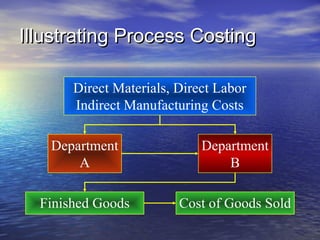
Illustrating Process CostingIllustrating Process Costing
Direct Materials, Direct Labor
Indirect Manufacturing Costs
Department
A
Department
B
Finished Goods Cost of Goods Sold
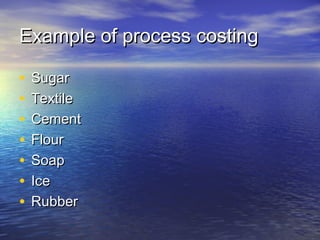
Example of process costingExample of process costing
• SugarSugar
• TextileTextile
• CementCement
• FlourFlour
• SoapSoap
• IceIce
• RubberRubber
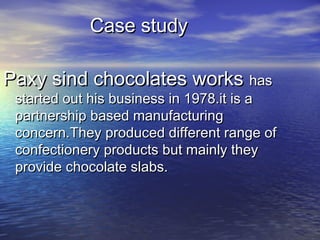
Case studyCase study
Paxy sind chocolates worksPaxy sind chocolates works hashas
started out his business in 1978.it is astarted out his business in 1978.it is a
partnership based manufacturingpartnership based manufacturing
concern.They produced different range ofconcern.They produced different range of
confectionery products but mainly theyconfectionery products but mainly they
provide chocolate slabs.provide chocolate slabs.
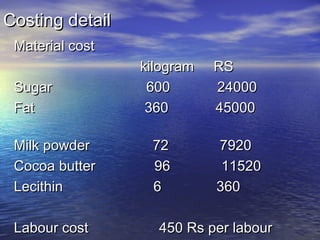
Costing detailCosting detail
Material costMaterial cost
kilogram RSkilogram RS
Sugar 600 24000Sugar 600 24000
Fat 360 45000Fat 360 45000
Milk powder 72 7920Milk powder 72 7920
Cocoa butter 96 11520Cocoa butter 96 11520
Lecithin 6 360Lecithin 6 360
Labour cost 450 Rs per labourLabour cost 450 Rs per labour
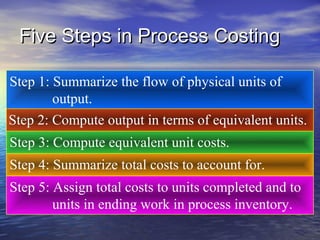
Five Steps in Process CostingFive Steps in Process Costing
Step 1: Summarize the flow of physical units of
output.
Step 2: Compute output in terms of equivalent units.
Step 3: Compute equivalent unit costs.
Step 4: Summarize total costs to account for.
Step 5: Assign total costs to units completed and to
units in ending work in process inventory.
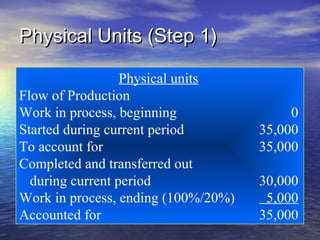
Physical Units (Step 1)Physical Units (Step 1)
Physical units
Flow of Production
Work in process, beginning 0
Started during current period 35,000
To account for 35,000
Completed and transferred out
during current period 30,000
Work in process, ending (100%/20%) 5,000
Accounted for 35,000
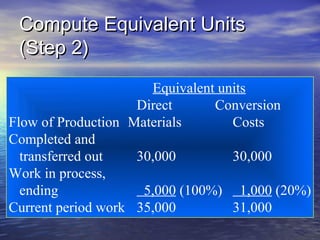
Compute Equivalent UnitsCompute Equivalent Units
(Step 2)(Step 2)
Equivalent units
Direct Conversion
Flow of Production Materials Costs
Completed and
transferred out 30,000 30,000
Work in process,
ending 5,000 (100%) 1,000 (20%)
Current period work 35,000 31,000
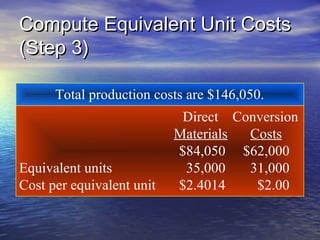
Compute Equivalent Unit CostsCompute Equivalent Unit Costs
(Step 3)(Step 3)
Direct Conversion
Materials Costs
$84,050 $62,000
Equivalent units 35,000 31,000
Cost per equivalent unit $2.4014 $2.00
Total production costs are $146,050.
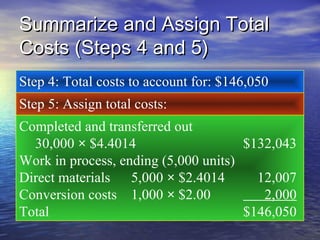
Summarize and Assign TotalSummarize and Assign Total
Costs (Steps 4 and 5)Costs (Steps 4 and 5)
Step 4: Total costs to account for: $146,050
Step 5: Assign total costs:
Completed and transferred out
30,000 × $4.4014 $132,043
Work in process, ending (5,000 units)
Direct materials 5,000 × $2.4014 12,007
Conversion costs 1,000 × $2.00 2,000
Total $146,050
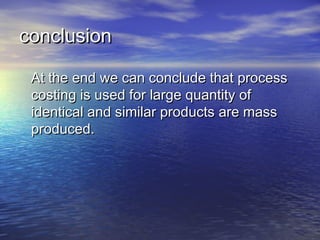
conclusionconclusion
At the end we can conclude that processAt the end we can conclude that process
costing is used for large quantity ofcosting is used for large quantity of
identical and similar products are massidentical and similar products are mass
produced.produced.

Process Costing

  • 1.
    Cost and ManagementCostand Management AccountingAccounting
  • 2.
  • 3.
    Process costingProcess costing •Process costing is a type of costingProcess costing is a type of costing system that is used for uniform orsystem that is used for uniform or homogeneous product.Process costhomogeneous product.Process cost average the cost over all unit to come toaverage the cost over all unit to come to the per unit cost.the per unit cost.
  • 4.
    Features of processcostingFeatures of process costing • Process costing is a type of operationProcess costing is a type of operation costing which is used to ascertain the costcosting which is used to ascertain the cost of the product at each process or stage ofof the product at each process or stage of manufacturing.manufacturing. • It is a method of allocating manufacturingIt is a method of allocating manufacturing cost to product to determine an averagecost to product to determine an average per unit cost.per unit cost. • It traces and accumulate direct cost andIt traces and accumulate direct cost and allocate indirect cost through aallocate indirect cost through a manufacturing process.manufacturing process.
  • 5.
    Illustrating Process CostingIllustratingProcess Costing Direct Materials, Direct Labor Indirect Manufacturing Costs Department A Department B Finished Goods Cost of Goods Sold
  • 6.
    Example of processcostingExample of process costing • SugarSugar • TextileTextile • CementCement • FlourFlour • SoapSoap • IceIce • RubberRubber
  • 7.
    Case studyCase study Paxysind chocolates worksPaxy sind chocolates works hashas started out his business in 1978.it is astarted out his business in 1978.it is a partnership based manufacturingpartnership based manufacturing concern.They produced different range ofconcern.They produced different range of confectionery products but mainly theyconfectionery products but mainly they provide chocolate slabs.provide chocolate slabs.
  • 8.
    Costing detailCosting detail MaterialcostMaterial cost kilogram RSkilogram RS Sugar 600 24000Sugar 600 24000 Fat 360 45000Fat 360 45000 Milk powder 72 7920Milk powder 72 7920 Cocoa butter 96 11520Cocoa butter 96 11520 Lecithin 6 360Lecithin 6 360 Labour cost 450 Rs per labourLabour cost 450 Rs per labour
  • 9.
    Five Steps inProcess CostingFive Steps in Process Costing Step 1: Summarize the flow of physical units of output. Step 2: Compute output in terms of equivalent units. Step 3: Compute equivalent unit costs. Step 4: Summarize total costs to account for. Step 5: Assign total costs to units completed and to units in ending work in process inventory.
  • 10.
    Physical Units (Step1)Physical Units (Step 1) Physical units Flow of Production Work in process, beginning 0 Started during current period 35,000 To account for 35,000 Completed and transferred out during current period 30,000 Work in process, ending (100%/20%) 5,000 Accounted for 35,000
  • 11.
    Compute Equivalent UnitsComputeEquivalent Units (Step 2)(Step 2) Equivalent units Direct Conversion Flow of Production Materials Costs Completed and transferred out 30,000 30,000 Work in process, ending 5,000 (100%) 1,000 (20%) Current period work 35,000 31,000
  • 12.
    Compute Equivalent UnitCostsCompute Equivalent Unit Costs (Step 3)(Step 3) Direct Conversion Materials Costs $84,050 $62,000 Equivalent units 35,000 31,000 Cost per equivalent unit $2.4014 $2.00 Total production costs are $146,050.
  • 13.
    Summarize and AssignTotalSummarize and Assign Total Costs (Steps 4 and 5)Costs (Steps 4 and 5) Step 4: Total costs to account for: $146,050 Step 5: Assign total costs: Completed and transferred out 30,000 × $4.4014 $132,043 Work in process, ending (5,000 units) Direct materials 5,000 × $2.4014 12,007 Conversion costs 1,000 × $2.00 2,000 Total $146,050
  • 14.
    conclusionconclusion At the endwe can conclude that processAt the end we can conclude that process costing is used for large quantity ofcosting is used for large quantity of identical and similar products are massidentical and similar products are mass produced.produced.