ELEMENTS OF COST
&
COST SHEET
Dr. Mohamed Kutty Kakkakunnan
Associate Professor
P G Dept. of Commerce
NAM College Kallikkandy- Kannur
Kerala – India
kuttynam@gmail.com
ELEMENTS OF COST
Introduction
• Production of goods and services require
different factors such as raw material, human
resource, power, machinery and a lot of other
elements.
• A firm engaged in production activities have to
pay for these entirely different expenses, which
constitute the cost of production
• Total cost is composed of payments made for
different goods and services necessary for
production of the commodity
• These different parts of cost of production is
known as the elements of cost
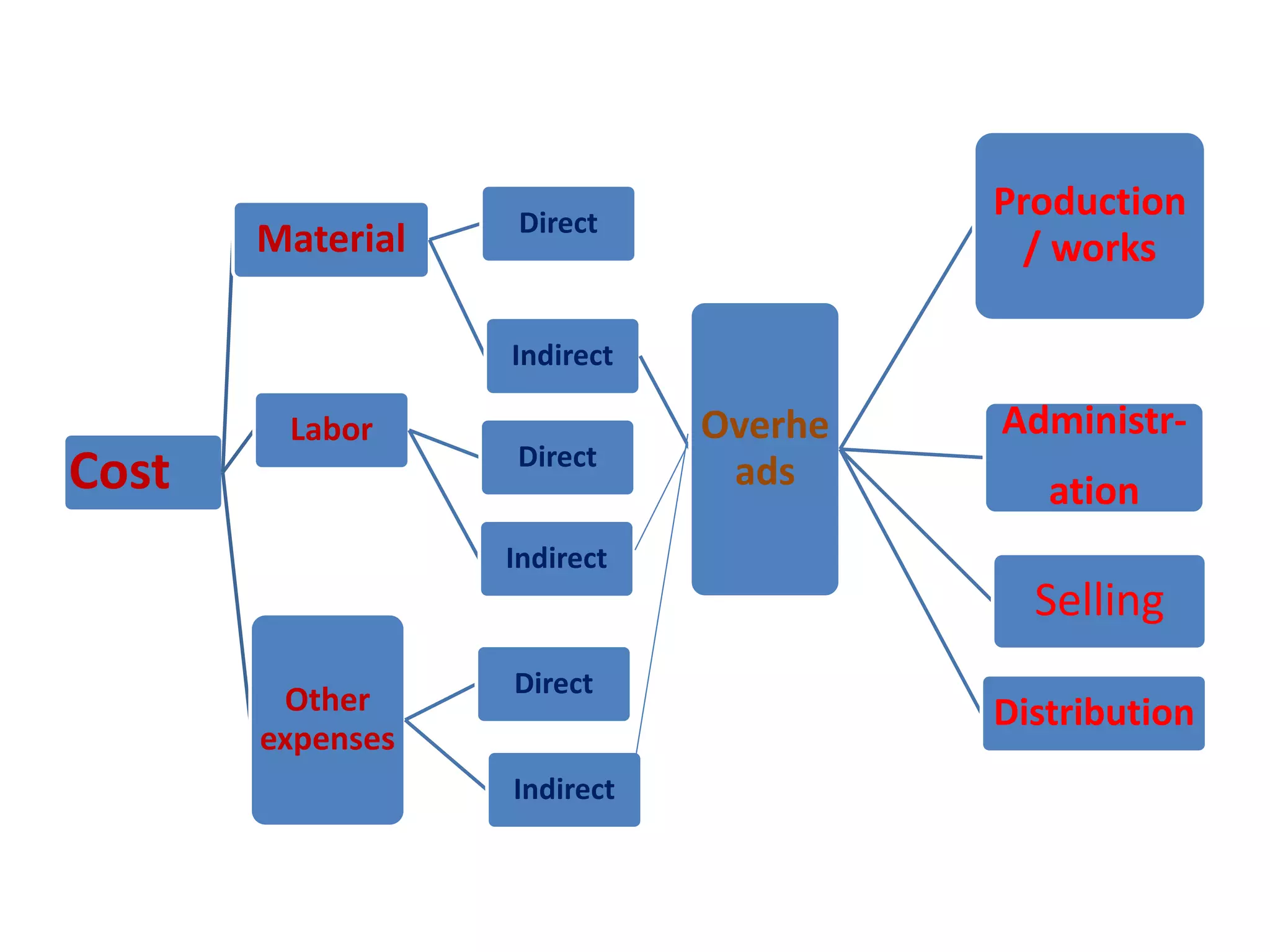
Cost
Material Direct
Indirect
Overhe
ads
Production
/ works
Administr-
ation
Selling
Distribution
Labor
Direct
Indirect
Other
expenses
Direct
Indirect
Direct Materials
• Materials which can be identified in the
product and can be conveniently measured
and directly charged to the product.
• Directly enter into production process and
form part of the finished product
• Include all raw materials, materials specifically
purchased for a specific job /process/order
• Parts or component purchased or produced
• Primary packing materials
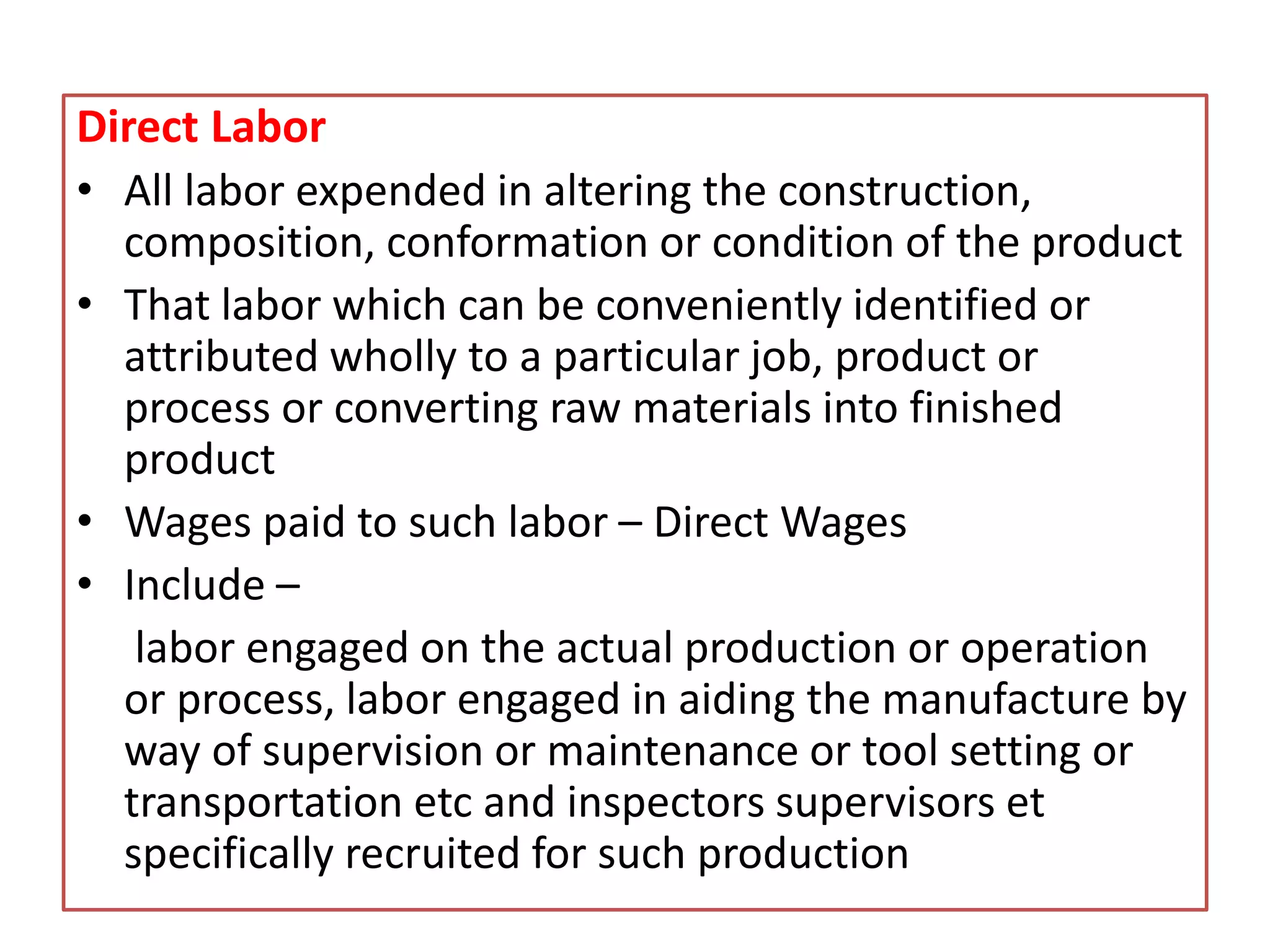
Direct Labor
• All labor expended in altering the construction,
composition, conformation or condition of the product
• That labor which can be conveniently identified or
attributed wholly to a particular job, product or
process or converting raw materials into finished
product
• Wages paid to such labor – Direct Wages
• Include –
labor engaged on the actual production or operation
or process, labor engaged in aiding the manufacture by
way of supervision or maintenance or tool setting or
transportation etc and inspectors supervisors et
specifically recruited for such production
Direct labor will not include
• Wages paid to supervisors, inspectors etc are
not treated as direct, but if they are directly
engaged on specific production process and
the hours spend by them on it can be
conveniently identified and measured without
much effort are treated as direct wages
• If the amount is insignificant like wages of
trainees, apprentices – through directly spent,
are considered as indirect
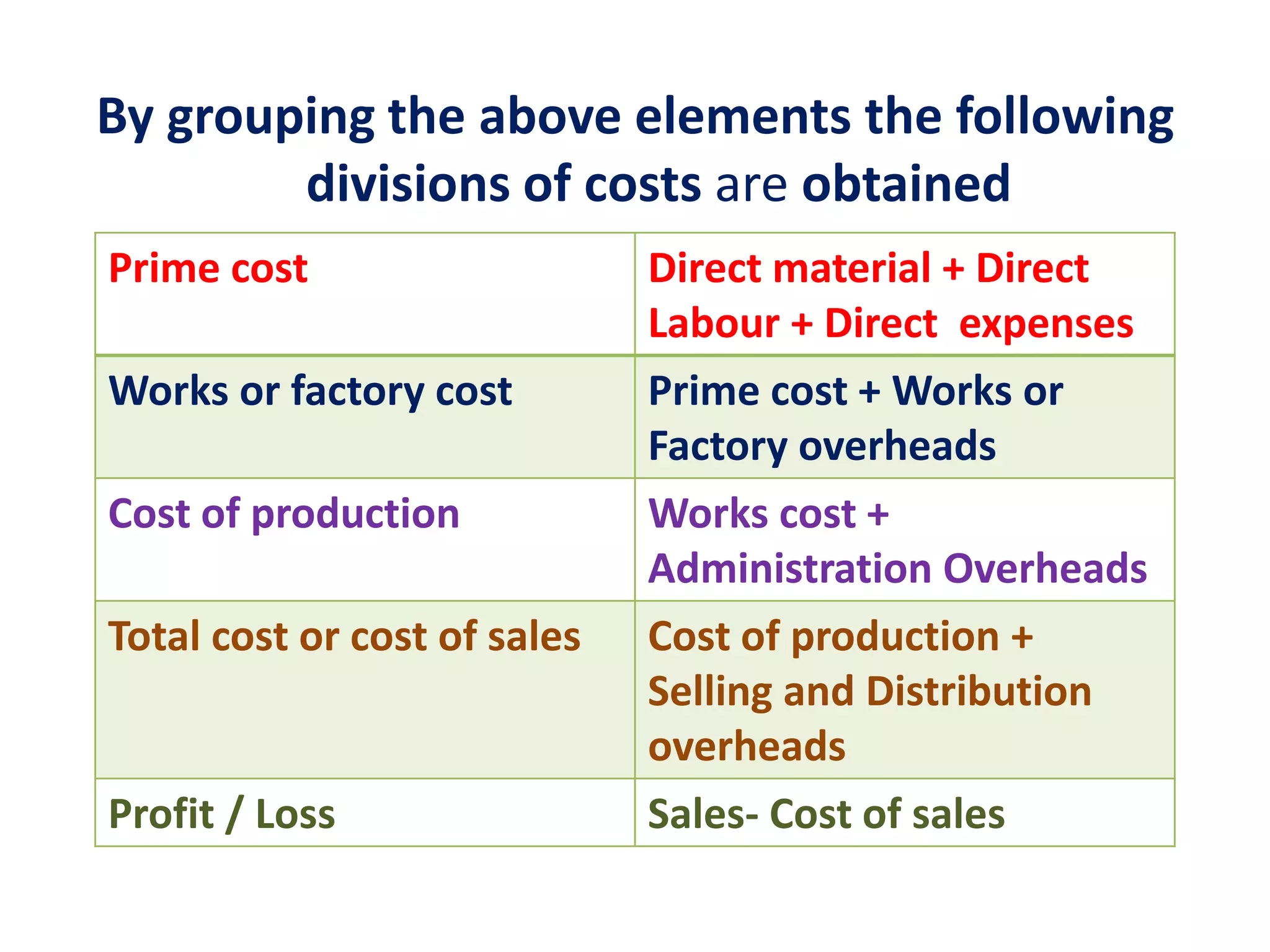
Prime cost Direct material + Direct
Labour + Direct expenses
Works or factory cost Prime cost + Works or
Factory overheads
Cost of production Works cost +
Administration Overheads
Total cost or cost of sales Cost of production +
Selling and Distribution
overheads
Profit / Loss Sales- Cost of sales
By grouping the above elements the following
divisions of costs are obtained
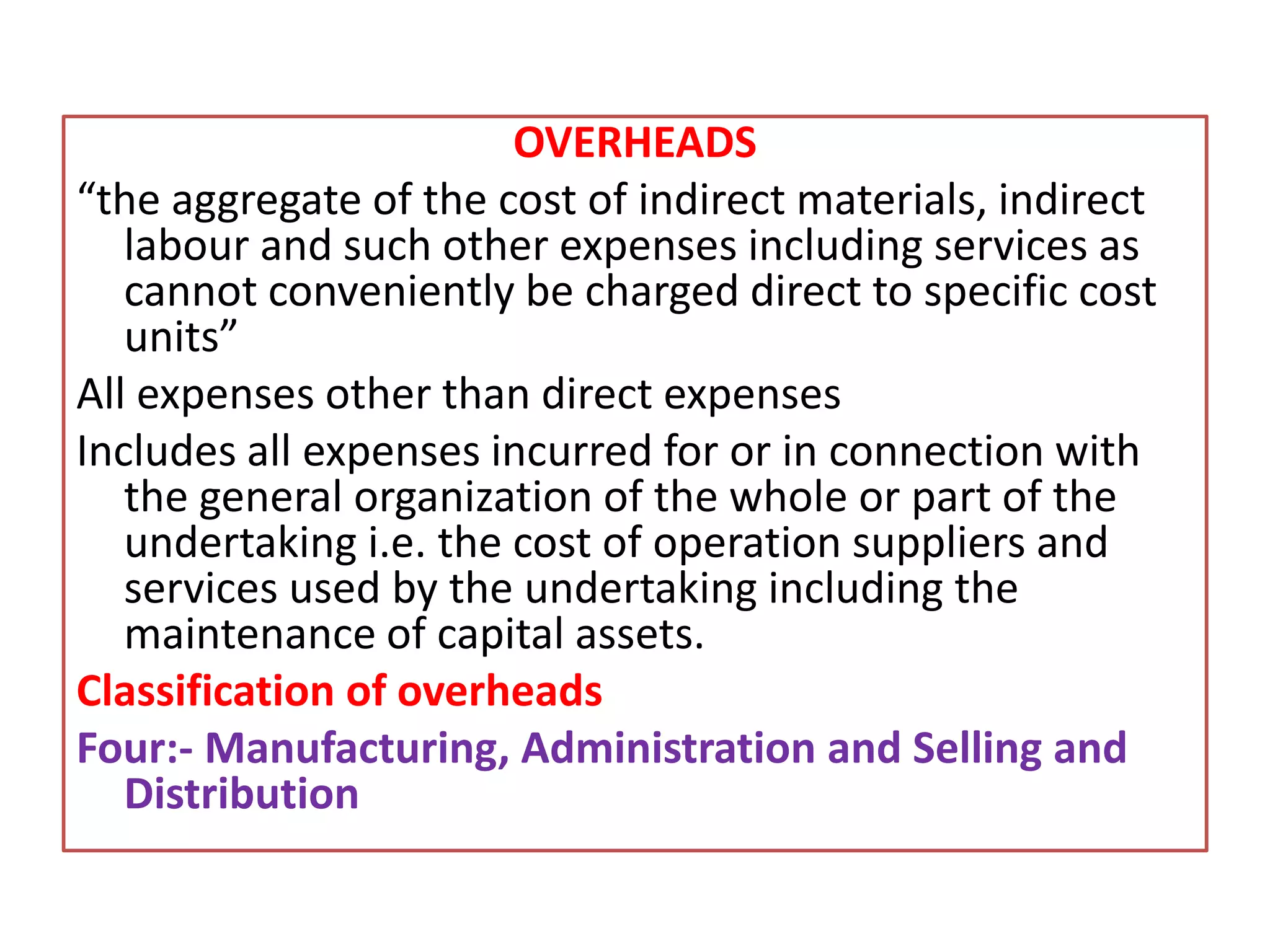
OVERHEADS
ā€œthe aggregate of the cost of indirect materials, indirect
labour and such other expenses including services as
cannot conveniently be charged direct to specific cost
unitsā€
All expenses other than direct expenses
Includes all expenses incurred for or in connection with
the general organization of the whole or part of the
undertaking i.e. the cost of operation suppliers and
services used by the undertaking including the
maintenance of capital assets.
Classification of overheads
Four:- Manufacturing, Administration and Selling and
Distribution
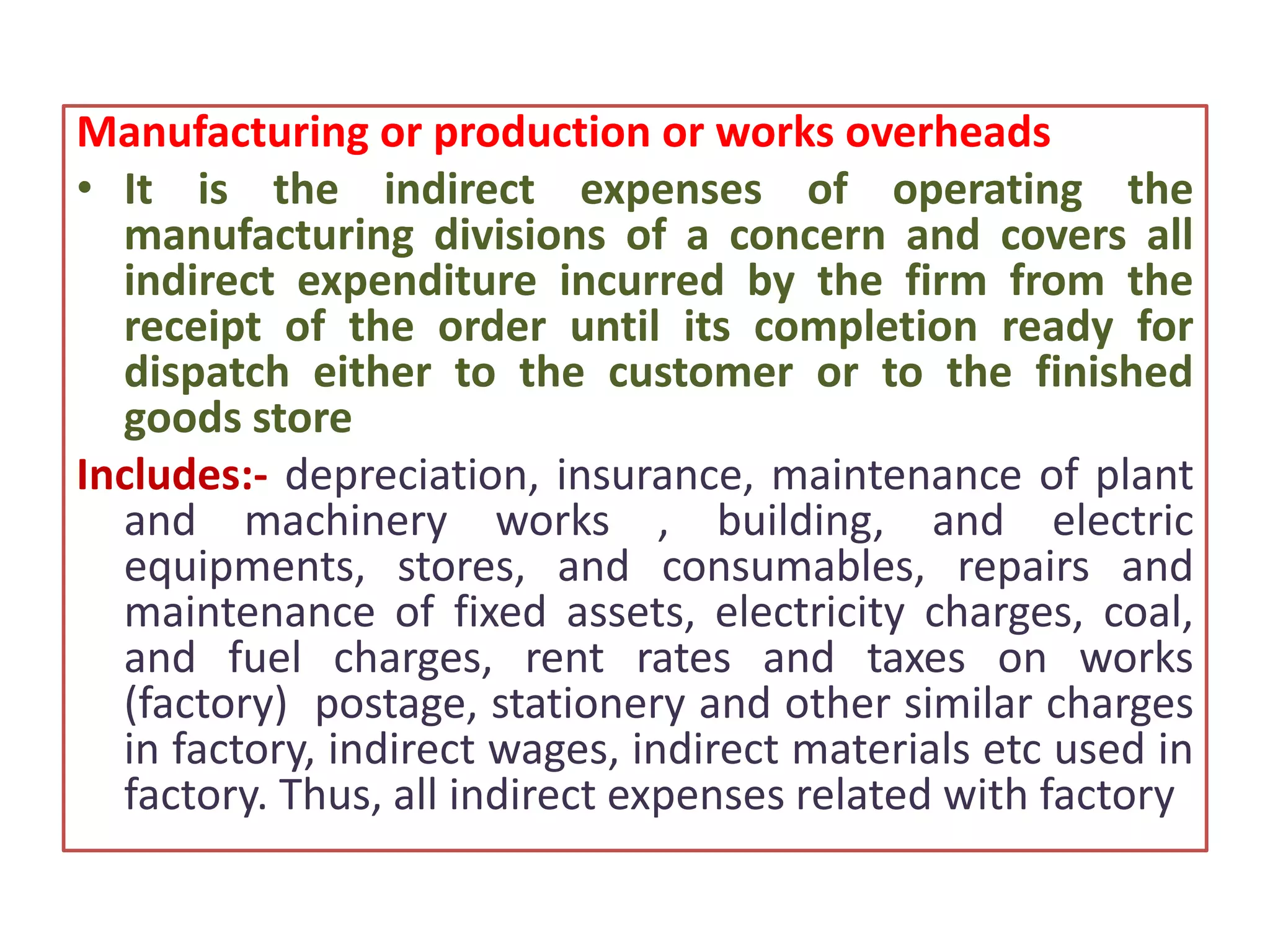
Manufacturing or production or works overheads
• It is the indirect expenses of operating the
manufacturing divisions of a concern and covers all
indirect expenditure incurred by the firm from the
receipt of the order until its completion ready for
dispatch either to the customer or to the finished
goods store
Includes:- depreciation, insurance, maintenance of plant
and machinery works , building, and electric
equipments, stores, and consumables, repairs and
maintenance of fixed assets, electricity charges, coal,
and fuel charges, rent rates and taxes on works
(factory) postage, stationery and other similar charges
in factory, indirect wages, indirect materials etc used in
factory. Thus, all indirect expenses related with factory
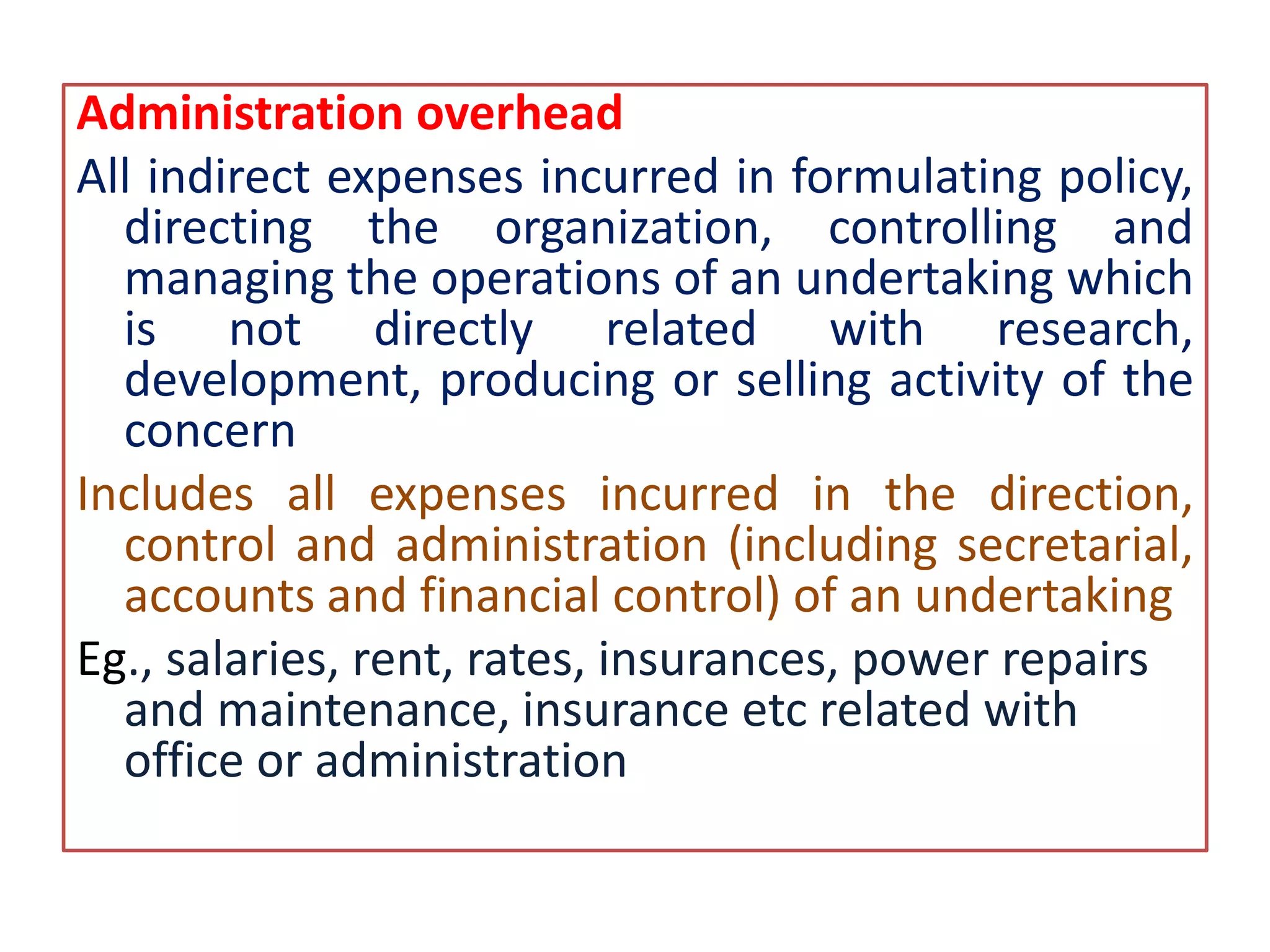
Administration overhead
All indirect expenses incurred in formulating policy,
directing the organization, controlling and
managing the operations of an undertaking which
is not directly related with research,
development, producing or selling activity of the
concern
Includes all expenses incurred in the direction,
control and administration (including secretarial,
accounts and financial control) of an undertaking
Eg., salaries, rent, rates, insurances, power repairs
and maintenance, insurance etc related with
office or administration
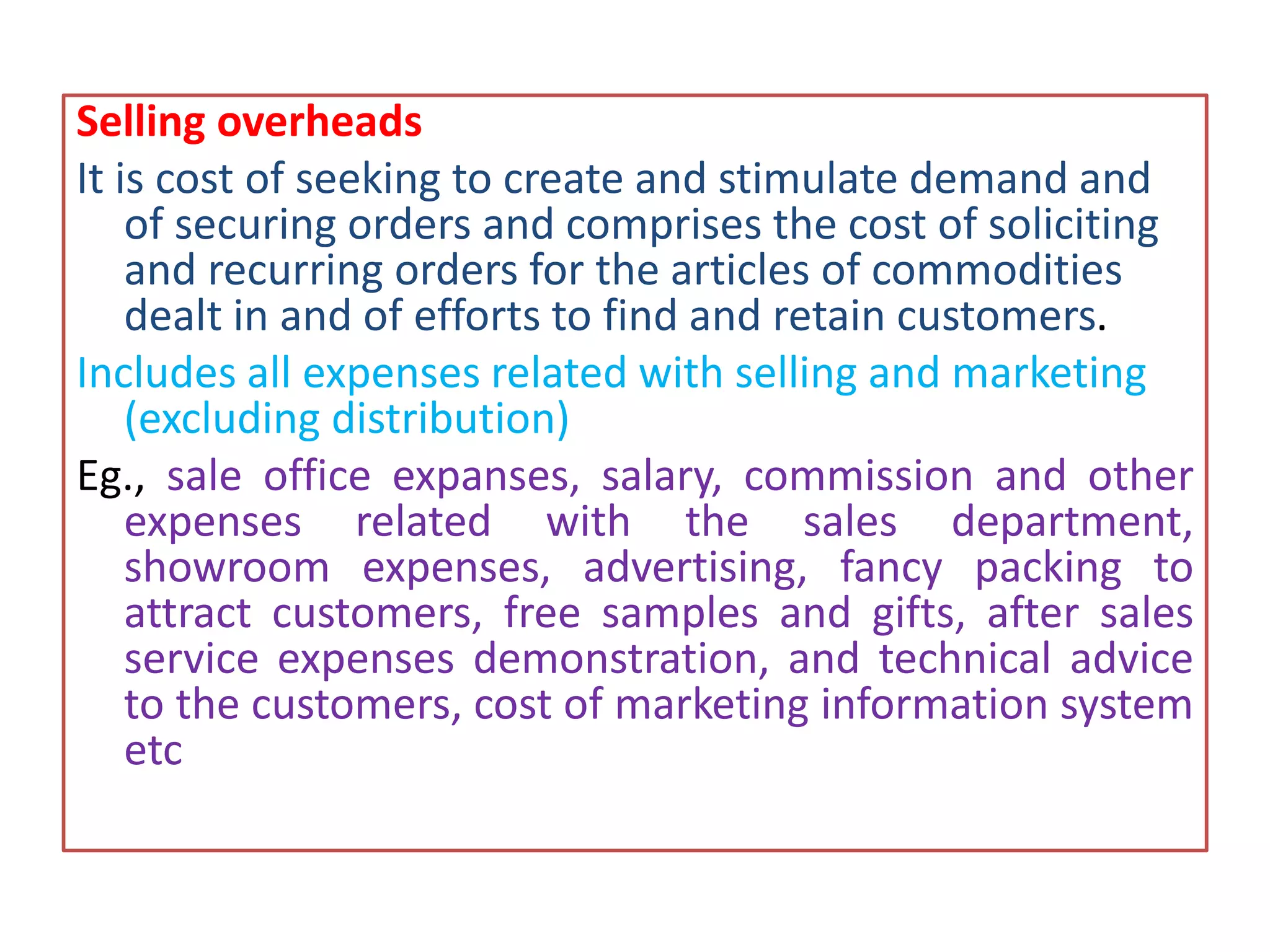
Selling overheads
It is cost of seeking to create and stimulate demand and
of securing orders and comprises the cost of soliciting
and recurring orders for the articles of commodities
dealt in and of efforts to find and retain customers.
Includes all expenses related with selling and marketing
(excluding distribution)
Eg., sale office expanses, salary, commission and other
expenses related with the sales department,
showroom expenses, advertising, fancy packing to
attract customers, free samples and gifts, after sales
service expenses demonstration, and technical advice
to the customers, cost of marketing information system
etc
Distribution expenses
It is the expenditure incurred in the process which
begins with making the packed product available
of dispatch and ends with making the
reconditioned return of empty package, if any
available for reuse.
Comprises of all expanses incurred from the time
the product is completed in the works (factory)
until it reaches its destination
Eg., warehouse rent, salary, insurance, rent rates
taxes etc of godown or warehouse.
All expense related with the warehouse,storeage or
godown
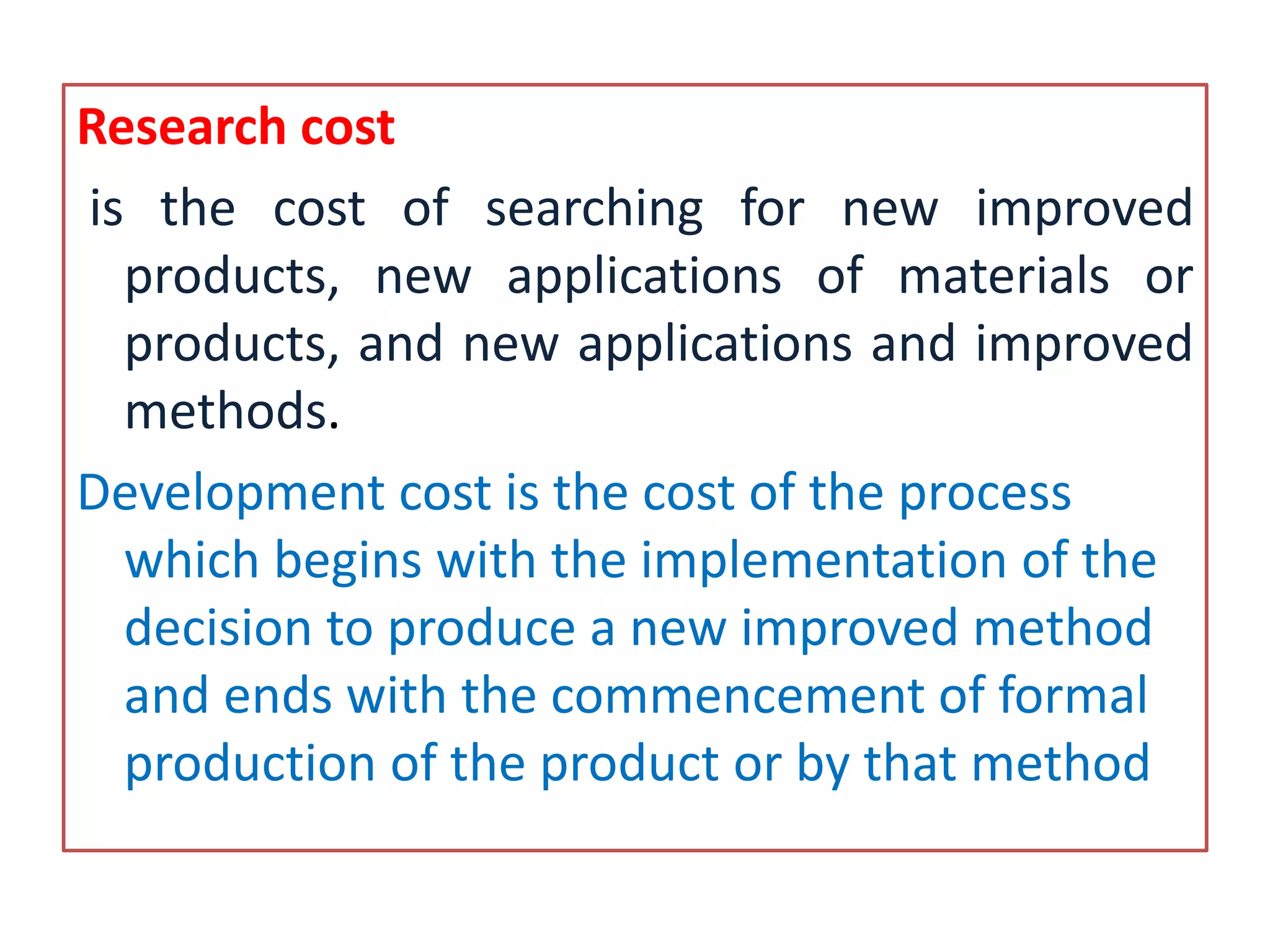
Research cost
is the cost of searching for new improved
products, new applications of materials or
products, and new applications and improved
methods.
Development cost is the cost of the process
which begins with the implementation of the
decision to produce a new improved method
and ends with the commencement of formal
production of the product or by that method
Expenses excluded form costs
In costing only those expenses which are a charge against profit of
the product, are only considered.
Items of expenses relating to capital assets, capital losses,
payments by way of distribution of profits and matters of pure
finance will not be considered and do not form part of the cost
Following items are not included in cost accounts
1. Purely financial charges
(i) loss arising form sale of fixed assets, (ii) loss on investments,
discount on issue of shares and debentures or other securities
(iii) interest on bank loan, mortgages, debentures and other
borrowings (iv) expenses on the companies share transfer
office (v)damages payable (vi) penalties and fines (vii) losses
due to scrapping of machinery (viii) remuneration to the
proprietor in excess of fair reward for his service (ix) interest
on capital (x) expenses of raising capital (xi) cost discount
Appropriation of profit
(i). Donations and charities (ii) taxes on income and profit (iii)
dividend paid (iv)transfer to sinking funds and reserves (v)
additional provision for depreciation on fixed assets and for bad
debts (vi) capital expenditure specially charged to revenue
Writing off of intangible assets and fictitious assets
(i) goodwill, patents copyrights, advertisements, preliminary
expenses, organization expenses, underwriting commission,
discount on issue of shares and debentures
Purely financial incomes
Rent receivable, profits on sale of fixed assets, transfer fee received,
interest received on bank deposits, dividend received, brokerage
received, discount and commission received
Abnormal gains and losses
abnormal wastage of material, wages paid for abnormal idle time,
excessive depreciation, abnormal manufacturing gains
Thus, income tax, dividends, abnormal wastages of
material, abnormal idle time, interest on capital
(both received and paid), expenses of raising
capital, discount on issue of shares and
debentures, profit or losses form sale of assets or
investments, excessive depreciation,
appropriation of profits. Writing off goodwill,
preliminary expenses, underwriting commission,
cash discount, debenture interest incomes which
are received connected with the business
transfers fee, rent, interest covered are generally
excluded from costs. Thus profits will differ
Cost Sheet or Statement of Cost
Is a statement designed to show the output of a particular
accounting period along with breakup of costs.
Is a memorandum statement, which shows the total cost of
production and cost per unit.
There is no a fixed form or format for preparation of cost
sheet, but generally prepared in columnar form.
There will be columns for total cost and per unit cost of
current period, previous period and for budgets. The
information contained depends upon the management
Cost sheet does not form part of double entry cost accounting
records. However, data required for preparation of cost
sheet is derived from financial accounts (except when
standard or pre-determined costs are used).
Thus, periodic reconciliation of cost and financial information
become necessary
Advantages or Uses of Cost Sheet
• Discloses the total cost and cost per unit of the units
produced during the period
• Enables the manufacturer to keep a close watch and
control over cost of production
• Helps to conduct comparative study of current cost
with previous costs, actual costs with predetermined or
standard cost and cost of other firms
• Helps the manufacturer to frame and follow suitable
production policy
• Helps in the fixation of selling price accurately
• Helps to minimize cost of production
• Helps to submit quotation s with reasonable degree of
accuracy against tenders for the supply of goods
Form of a Cost Sheet
Total cost
(Rs.)
Cost per
unit (Rs.)
Direct Material
Direct Labor
Direct Expenses
PRIME COST
Add Works Overheads
WORKS COST
Add Administration Overheads
COST OF PRODUCTION
Add Selling And Distribution Overheads
TOTAL COST or COST OF SALES
Add Profit
SALES
Thus, in a cost sheet elements of costs are
grouped and re-arranged in the following way
Prime Cost Direct material + Direct
Labor + Direct expenses
Works or Factory Cost Prime cost + Works or
Factory overheads
Cost of Production Works cost +
Administration Overheads
Total Cost or Cost Of Sales Cost of production +
Selling and Distribution
overheads
Profit / Loss Sales- Cost of sales
Cost Sheet (Statement of Cost and Profit)
Total Per unit
Direct Material 100000 100
Direct Wages 25000 25
Direct Expenses 5000 5
PRIME COST 130000 130
Add Factory Overheads
Wages Of Foremen 2500
Electric Power 500
Storekeeper's Wages 1000
Oil And Water 500
Factory Rent 5000
Repairs And Renewals -Factory 3500
Factory Lighting 1500
Depreciation-Factory 500
Consumable Stores 2500 17500 17.5
FACTORY COST 147500 147.5
Add Administration Overheads
Office Rent 2500
Repairs And Renewals- Office 500
Office Lighting 500
Depreciation-Office 1250
Manager's Salary 5000
Director’s Fees 1250
Office Stationery 500
Telephone Charges 125
Postage And Telegram 250 11875 11.875
COST OF PRODUCTION 159375 159.375
Add Selling And Distribution Overheads
Carriage Outwards 375
Salesmen's Salary 1250
Travelling Expenses 500
Advertising 1250
Warehouse Charges 500 3875 3.875
COST OF SALES 163250 163.25
PROFIT 26250 26.25
SALES 189500 189.5
Treatment of stock
Stock require special treatment while preparing
cost sheet. Stock may include
• Raw materials
• Work-in-progress
• Finished goods
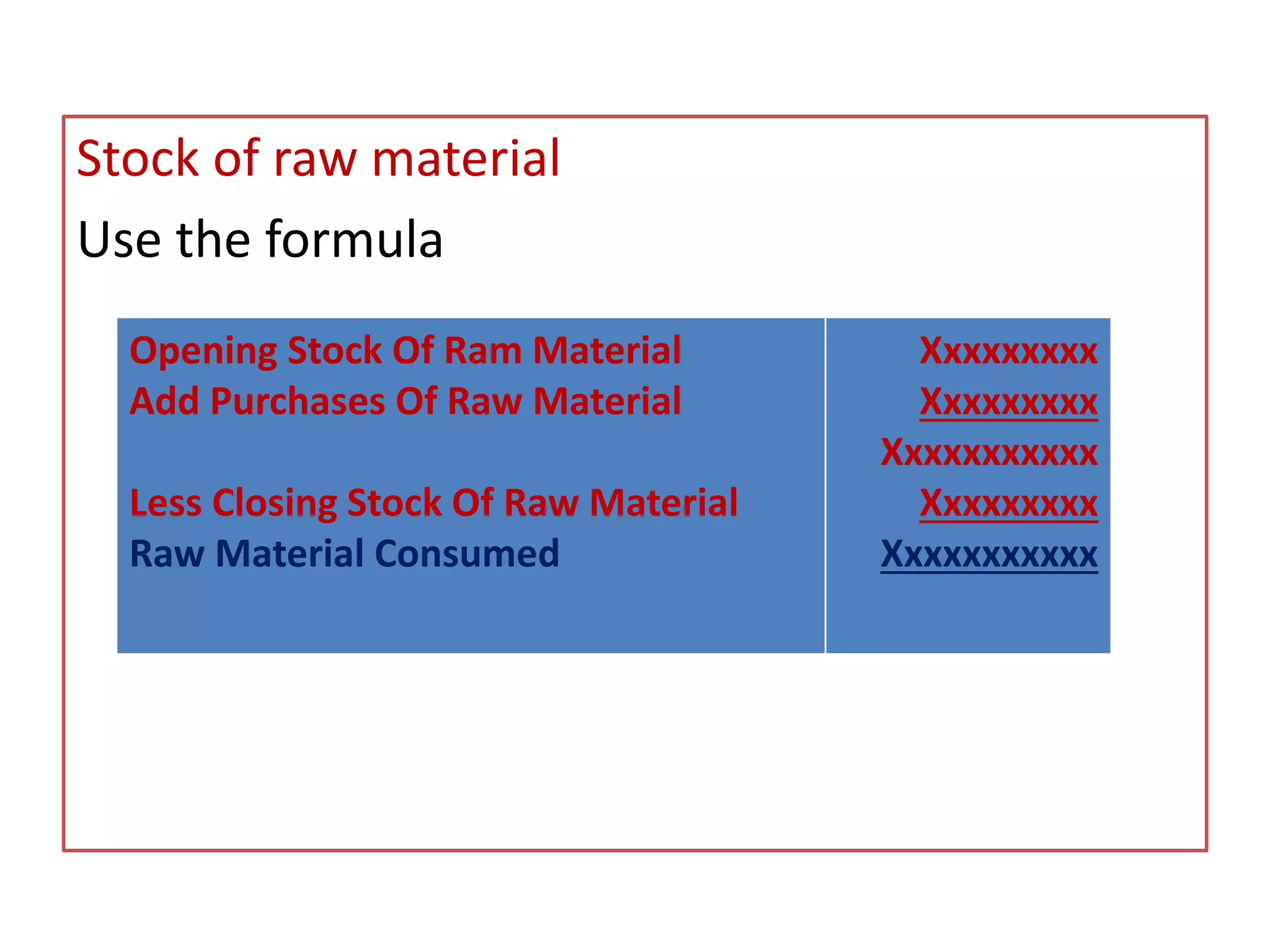
Stock of raw material
Use the formula
Opening Stock Of Ram Material
Add Purchases Of Raw Material
Less Closing Stock Of Raw Material
Raw Material Consumed
Xxxxxxxxx
Xxxxxxxxx
Xxxxxxxxxxx
Xxxxxxxxx
Xxxxxxxxxxx
Stock of Work-in-Progress
WIP means units on which work has been done but which are
not yet complete. Is valued at prime cost or works cost basis,
but works cost is preferred. (read the question carefully,
understand the basis and proceed) If valued at works cost use
the formula
Prime Cost
Add Factory Overheads
Add Opening Stock Of WIP
Less Closing WIP
xxxxxxxxx
xxxxxxxx
xxxxxxxxx
xxxxxxxxxxxxx
xxxxxxxxxx
Works Cost xxxxxxxxxxx
Stock of Finished Goods
Cost of production
Add opening stock of finished goods
Less closing stock of finished goods
xxxxxxxxxxx
xxxxxxxxx
xxxxxxxxxxx
xxxxxxxxx
Cost of Goods Sold xxxxxxxxxxx

Elements of cost and cost sheet

  • 1.
    ELEMENTS OF COST & COSTSHEET Dr. Mohamed Kutty Kakkakunnan Associate Professor P G Dept. of Commerce NAM College Kallikkandy- Kannur Kerala – India kuttynam@gmail.com
  • 2.
    ELEMENTS OF COST Introduction •Production of goods and services require different factors such as raw material, human resource, power, machinery and a lot of other elements. • A firm engaged in production activities have to pay for these entirely different expenses, which constitute the cost of production • Total cost is composed of payments made for different goods and services necessary for production of the commodity • These different parts of cost of production is known as the elements of cost
  • 3.
  • 4.
    Direct Materials • Materialswhich can be identified in the product and can be conveniently measured and directly charged to the product. • Directly enter into production process and form part of the finished product • Include all raw materials, materials specifically purchased for a specific job /process/order • Parts or component purchased or produced • Primary packing materials
  • 5.
    Direct Labor • Alllabor expended in altering the construction, composition, conformation or condition of the product • That labor which can be conveniently identified or attributed wholly to a particular job, product or process or converting raw materials into finished product • Wages paid to such labor – Direct Wages • Include – labor engaged on the actual production or operation or process, labor engaged in aiding the manufacture by way of supervision or maintenance or tool setting or transportation etc and inspectors supervisors et specifically recruited for such production
  • 6.
    Direct labor willnot include • Wages paid to supervisors, inspectors etc are not treated as direct, but if they are directly engaged on specific production process and the hours spend by them on it can be conveniently identified and measured without much effort are treated as direct wages • If the amount is insignificant like wages of trainees, apprentices – through directly spent, are considered as indirect
  • 7.
    Prime cost Directmaterial + Direct Labour + Direct expenses Works or factory cost Prime cost + Works or Factory overheads Cost of production Works cost + Administration Overheads Total cost or cost of sales Cost of production + Selling and Distribution overheads Profit / Loss Sales- Cost of sales By grouping the above elements the following divisions of costs are obtained
  • 8.
    OVERHEADS ā€œthe aggregate ofthe cost of indirect materials, indirect labour and such other expenses including services as cannot conveniently be charged direct to specific cost unitsā€ All expenses other than direct expenses Includes all expenses incurred for or in connection with the general organization of the whole or part of the undertaking i.e. the cost of operation suppliers and services used by the undertaking including the maintenance of capital assets. Classification of overheads Four:- Manufacturing, Administration and Selling and Distribution
  • 9.
    Manufacturing or productionor works overheads • It is the indirect expenses of operating the manufacturing divisions of a concern and covers all indirect expenditure incurred by the firm from the receipt of the order until its completion ready for dispatch either to the customer or to the finished goods store Includes:- depreciation, insurance, maintenance of plant and machinery works , building, and electric equipments, stores, and consumables, repairs and maintenance of fixed assets, electricity charges, coal, and fuel charges, rent rates and taxes on works (factory) postage, stationery and other similar charges in factory, indirect wages, indirect materials etc used in factory. Thus, all indirect expenses related with factory
  • 10.
    Administration overhead All indirectexpenses incurred in formulating policy, directing the organization, controlling and managing the operations of an undertaking which is not directly related with research, development, producing or selling activity of the concern Includes all expenses incurred in the direction, control and administration (including secretarial, accounts and financial control) of an undertaking Eg., salaries, rent, rates, insurances, power repairs and maintenance, insurance etc related with office or administration
  • 11.
    Selling overheads It iscost of seeking to create and stimulate demand and of securing orders and comprises the cost of soliciting and recurring orders for the articles of commodities dealt in and of efforts to find and retain customers. Includes all expenses related with selling and marketing (excluding distribution) Eg., sale office expanses, salary, commission and other expenses related with the sales department, showroom expenses, advertising, fancy packing to attract customers, free samples and gifts, after sales service expenses demonstration, and technical advice to the customers, cost of marketing information system etc
  • 12.
    Distribution expenses It isthe expenditure incurred in the process which begins with making the packed product available of dispatch and ends with making the reconditioned return of empty package, if any available for reuse. Comprises of all expanses incurred from the time the product is completed in the works (factory) until it reaches its destination Eg., warehouse rent, salary, insurance, rent rates taxes etc of godown or warehouse. All expense related with the warehouse,storeage or godown
  • 13.
    Research cost is thecost of searching for new improved products, new applications of materials or products, and new applications and improved methods. Development cost is the cost of the process which begins with the implementation of the decision to produce a new improved method and ends with the commencement of formal production of the product or by that method
  • 14.
    Expenses excluded formcosts In costing only those expenses which are a charge against profit of the product, are only considered. Items of expenses relating to capital assets, capital losses, payments by way of distribution of profits and matters of pure finance will not be considered and do not form part of the cost Following items are not included in cost accounts 1. Purely financial charges (i) loss arising form sale of fixed assets, (ii) loss on investments, discount on issue of shares and debentures or other securities (iii) interest on bank loan, mortgages, debentures and other borrowings (iv) expenses on the companies share transfer office (v)damages payable (vi) penalties and fines (vii) losses due to scrapping of machinery (viii) remuneration to the proprietor in excess of fair reward for his service (ix) interest on capital (x) expenses of raising capital (xi) cost discount
  • 15.
    Appropriation of profit (i).Donations and charities (ii) taxes on income and profit (iii) dividend paid (iv)transfer to sinking funds and reserves (v) additional provision for depreciation on fixed assets and for bad debts (vi) capital expenditure specially charged to revenue Writing off of intangible assets and fictitious assets (i) goodwill, patents copyrights, advertisements, preliminary expenses, organization expenses, underwriting commission, discount on issue of shares and debentures Purely financial incomes Rent receivable, profits on sale of fixed assets, transfer fee received, interest received on bank deposits, dividend received, brokerage received, discount and commission received Abnormal gains and losses abnormal wastage of material, wages paid for abnormal idle time, excessive depreciation, abnormal manufacturing gains
  • 16.
    Thus, income tax,dividends, abnormal wastages of material, abnormal idle time, interest on capital (both received and paid), expenses of raising capital, discount on issue of shares and debentures, profit or losses form sale of assets or investments, excessive depreciation, appropriation of profits. Writing off goodwill, preliminary expenses, underwriting commission, cash discount, debenture interest incomes which are received connected with the business transfers fee, rent, interest covered are generally excluded from costs. Thus profits will differ
  • 17.
    Cost Sheet orStatement of Cost Is a statement designed to show the output of a particular accounting period along with breakup of costs. Is a memorandum statement, which shows the total cost of production and cost per unit. There is no a fixed form or format for preparation of cost sheet, but generally prepared in columnar form. There will be columns for total cost and per unit cost of current period, previous period and for budgets. The information contained depends upon the management Cost sheet does not form part of double entry cost accounting records. However, data required for preparation of cost sheet is derived from financial accounts (except when standard or pre-determined costs are used). Thus, periodic reconciliation of cost and financial information become necessary
  • 18.
    Advantages or Usesof Cost Sheet • Discloses the total cost and cost per unit of the units produced during the period • Enables the manufacturer to keep a close watch and control over cost of production • Helps to conduct comparative study of current cost with previous costs, actual costs with predetermined or standard cost and cost of other firms • Helps the manufacturer to frame and follow suitable production policy • Helps in the fixation of selling price accurately • Helps to minimize cost of production • Helps to submit quotation s with reasonable degree of accuracy against tenders for the supply of goods
  • 19.
    Form of aCost Sheet Total cost (Rs.) Cost per unit (Rs.) Direct Material Direct Labor Direct Expenses PRIME COST Add Works Overheads WORKS COST Add Administration Overheads COST OF PRODUCTION Add Selling And Distribution Overheads TOTAL COST or COST OF SALES Add Profit SALES
  • 20.
    Thus, in acost sheet elements of costs are grouped and re-arranged in the following way Prime Cost Direct material + Direct Labor + Direct expenses Works or Factory Cost Prime cost + Works or Factory overheads Cost of Production Works cost + Administration Overheads Total Cost or Cost Of Sales Cost of production + Selling and Distribution overheads Profit / Loss Sales- Cost of sales
  • 21.
    Cost Sheet (Statementof Cost and Profit) Total Per unit Direct Material 100000 100 Direct Wages 25000 25 Direct Expenses 5000 5 PRIME COST 130000 130
  • 22.
    PRIME COST 130000130 Add Factory Overheads Wages Of Foremen 2500 Electric Power 500 Storekeeper's Wages 1000 Oil And Water 500 Factory Rent 5000 Repairs And Renewals -Factory 3500 Factory Lighting 1500 Depreciation-Factory 500 Consumable Stores 2500 17500 17.5 FACTORY COST 147500 147.5
  • 23.
    FACTORY COST 147500147.5 Add Administration Overheads Office Rent 2500 Repairs And Renewals- Office 500 Office Lighting 500 Depreciation-Office 1250 Manager's Salary 5000 Director’s Fees 1250 Office Stationery 500 Telephone Charges 125 Postage And Telegram 250 11875 11.875 COST OF PRODUCTION 159375 159.375
  • 24.
    COST OF PRODUCTION159375 159.375 Add Selling And Distribution Overheads Carriage Outwards 375 Salesmen's Salary 1250 Travelling Expenses 500 Advertising 1250 Warehouse Charges 500 3875 3.875 COST OF SALES 163250 163.25 PROFIT 26250 26.25 SALES 189500 189.5
  • 25.
    Treatment of stock Stockrequire special treatment while preparing cost sheet. Stock may include • Raw materials • Work-in-progress • Finished goods
  • 26.
    Stock of rawmaterial Use the formula Opening Stock Of Ram Material Add Purchases Of Raw Material Less Closing Stock Of Raw Material Raw Material Consumed Xxxxxxxxx Xxxxxxxxx Xxxxxxxxxxx Xxxxxxxxx Xxxxxxxxxxx
  • 27.
    Stock of Work-in-Progress WIPmeans units on which work has been done but which are not yet complete. Is valued at prime cost or works cost basis, but works cost is preferred. (read the question carefully, understand the basis and proceed) If valued at works cost use the formula Prime Cost Add Factory Overheads Add Opening Stock Of WIP Less Closing WIP xxxxxxxxx xxxxxxxx xxxxxxxxx xxxxxxxxxxxxx xxxxxxxxxx Works Cost xxxxxxxxxxx
  • 28.
    Stock of FinishedGoods Cost of production Add opening stock of finished goods Less closing stock of finished goods xxxxxxxxxxx xxxxxxxxx xxxxxxxxxxx xxxxxxxxx Cost of Goods Sold xxxxxxxxxxx