Wong Yew Yip
yewyip@gmail.com
Designed & Developed by : Wong Yew Yip 23 June 2021
What are Problems?
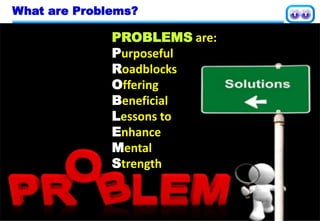
PROBLEMS are:
Purposeful
Roadblocks
Offering
Beneficial
Lessons to
Enhance
Mental
Strength
Designed & Developed by : Wong Yew Yip 23 June 2021
What is Problem Solving?
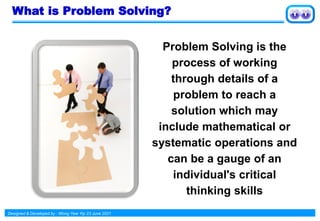
Problem Solving is the
process of working
through details of a
problem to reach a
solution which may
include mathematical or
systematic operations and
can be a gauge of an
individual's critical
thinking skills
Designed & Developed by : Wong Yew Yip 23 June 2021
Why Problem Solving?
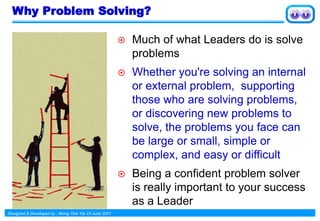
 Much of what Leaders do is solve
problems
 Whether you're solving an internal
or external problem, supporting
those who are solving problems,
or discovering new problems to
solve, the problems you face can
be large or small, simple or
complex, and easy or difficult
 Being a confident problem solver
is really important to your success
as a Leader
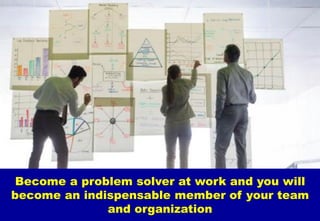
Become a problem solver at work and you will
become an indispensable member of your team
and organization
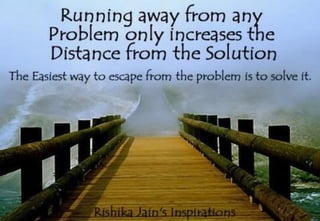
If a problem can be solved, no need
to worry about it
If a problem cannot be solved
what is the use of worrying?
Designed & Developed by : Wong Yew Yip 23 June 2021
Why organizations seek problem solvers?
Employers value people who can handle minor
irritations and major problems that are a part of
every business
 What do you do when a customer comes
to you with a problem or complaint?
 Can you help when your team runs into
production or service problems?
 Can you help save your company from
losing its business?
You will move faster and higher up the ladder of
success if you are an effective problem solver
Designed & Developed by : Wong Yew Yip 23 June 2021
Why problems are not solved?
Not my problem
1
Not my fault
2
Not my responsibility
3
Cannot handle difficult problems
4
Slow to take action
5
Tell customer to ask somebody else
6
Generates only one solution to a problem
7
Not persistent in problem solving
8
Designed & Developed by : Wong Yew Yip 23 June 2021
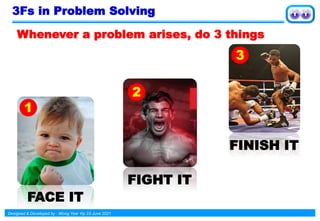
3Fs in Problem Solving
Whenever a problem arises, do 3 things
FACE IT
1
FIGHT IT
2
FINISH IT
3
Designed & Developed by : Wong Yew Yip 23 June 2021
Creativity in Problem Solving
 Creative problem solvers treat all
problems as if they were their own
 Creative problem solvers have
creative and flexible minds to solve
problems that are not straightforward
 Creative problem solvers are curious
people with a can-do attitudes
The best tool you have at your disposal for solving
problems is YOUR MIND
Problem solving begins with clear thinking -
scientific and creative
Designed & Developed by : Wong Yew Yip 23 June 2021
 There was a father who left 17 properties of equal value for his 3
sons
 When the father passed away, his sons opened up the Will
 The father’s Will stated that the eldest son should get 1/2 (half)
of total properties, the middle son should be given 1/3rd (one-
third) and the youngest son should be given 1/9th (one-ninth) of
the total properties
 As it was not possible to divide 17 by half, or 17 by 3, or 17 by 9,
the three sons started to fight with each other
Can you solve the problem for them
How do you solve the problem?
Designed & Developed by : Wong Yew Yip 23 June 2021
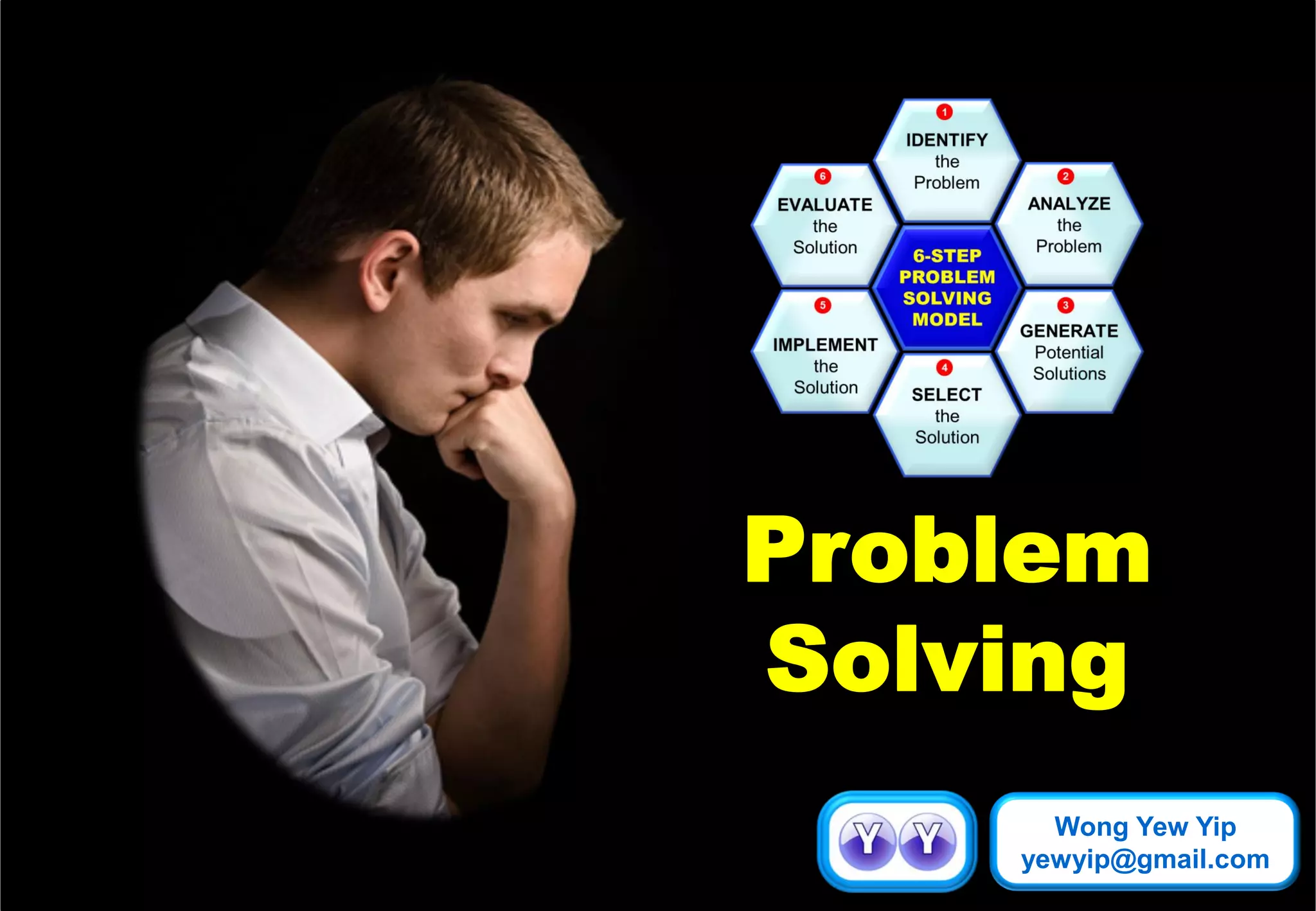
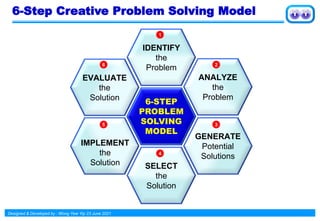
6-Step Creative Problem Solving Model
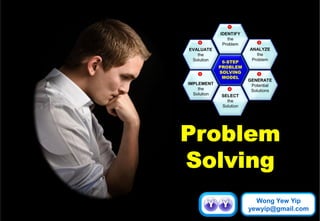
6-STEP
PROBLEM
SOLVING
MODEL
IDENTIFY
the
Problem
1
ANALYZE
the
Problem
2
GENERATE
Potential
Solutions
3
SELECT
the
Solution
4
IMPLEMENT
the
Solution
5
EVALUATE
the
Solution
6
Designed & Developed by : Wong Yew Yip 23 June 2021
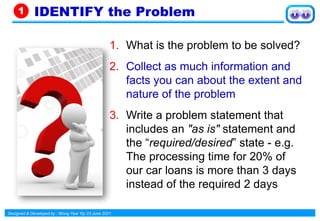
1. What is the problem to be solved?
2. Collect as much information and
facts you can about the extent and
nature of the problem
3. Write a problem statement that
includes an "as is" statement and
the “required/desired” state - e.g.
The processing time for 20% of
our car loans is more than 3 days
instead of the required 2 days
IDENTIFY the Problem
1
Designed & Developed by : Wong Yew Yip 23 June 2021
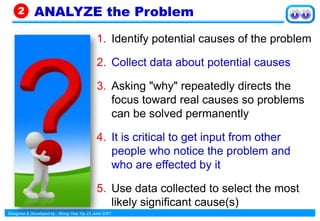
1. Identify potential causes of the problem
2. Collect data about potential causes
3. Asking "why" repeatedly directs the
focus toward real causes so problems
can be solved permanently
4. It is critical to get input from other
people who notice the problem and
who are effected by it
5. Use data collected to select the most
likely significant cause(s)
ANALYZE the Problem
2
Designed & Developed by : Wong Yew Yip 23 June 2021
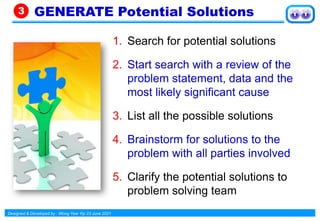
1. Search for potential solutions
2. Start search with a review of the
problem statement, data and the
most likely significant cause
3. List all the possible solutions
4. Brainstorm for solutions to the
problem with all parties involved
5. Clarify the potential solutions to
problem solving team
GENERATE Potential Solutions
3
Designed & Developed by : Wong Yew Yip 23 June 2021
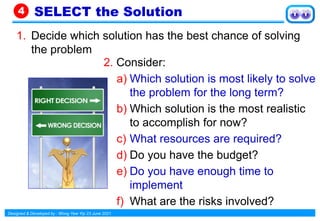
1. Decide which solution has the best chance of solving
the problem
SELECT the Solution
4
2. Consider:
a) Which solution is most likely to solve
the problem for the long term?
b) Which solution is the most realistic
to accomplish for now?
c) What resources are required?
d) Do you have the budget?
e) Do you have enough time to
implement
f) What are the risks involved?
Designed & Developed by : Wong Yew Yip 23 June 2021
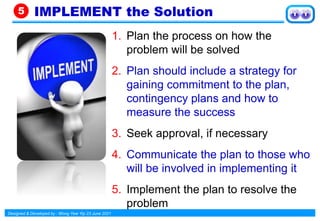
1. Plan the process on how the
problem will be solved
2. Plan should include a strategy for
gaining commitment to the plan,
contingency plans and how to
measure the success
3. Seek approval, if necessary
4. Communicate the plan to those who
will be involved in implementing it
5. Implement the plan to resolve the
problem
IMPLEMENT the Solution
5
Designed & Developed by : Wong Yew Yip 23 June 2021
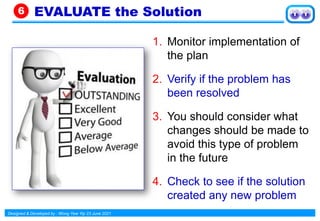
1. Monitor implementation of
the plan
2. Verify if the problem has
been resolved
3. You should consider what
changes should be made to
avoid this type of problem
in the future
4. Check to see if the solution
created any new problem
EVALUATE the Solution
6
Designed & Developed by : Wong Yew Yip 23 June 2021
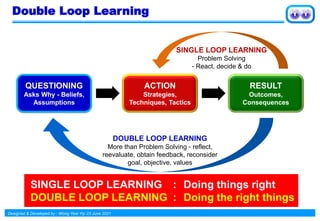
ACTION
Strategies,
Techniques, Tactics
RESULT
Outcomes,
Consequences
QUESTIONING
Asks Why - Beliefs,
Assumptions
SINGLE LOOP LEARNING
Problem Solving
- React, decide & do
DOUBLE LOOP LEARNING
More than Problem Solving - reflect,
reevaluate, obtain feedback, reconsider
goal, objective, values
SINGLE LOOP LEARNING : Doing things right
DOUBLE LOOP LEARNING : Doing the right things
Double Loop Learning
Designed & Developed by : Wong Yew Yip 23 June 2021
Overcoming Obstacles to Problem Solving
Functional Fixedness
1
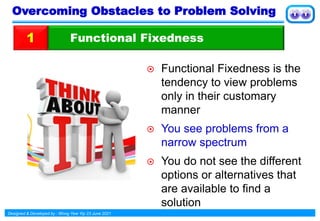
 Functional Fixedness is the
tendency to view problems
only in their customary
manner
 You see problems from a
narrow spectrum
 You do not see the different
options or alternatives that
are available to find a
solution
Designed & Developed by : Wong Yew Yip 23 June 2021
Overcoming Obstacles to Problem Solving
Irrelevant or Misleading Information
2
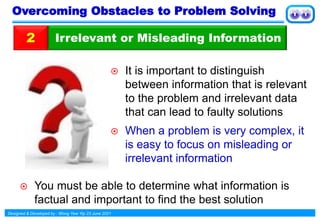
 It is important to distinguish
between information that is relevant
to the problem and irrelevant data
that can lead to faulty solutions
 When a problem is very complex, it
is easy to focus on misleading or
irrelevant information
 You must be able to determine what information is
factual and important to find the best solution
Designed & Developed by : Wong Yew Yip 23 June 2021
Overcoming Obstacles to Problem Solving
Assumptions
3
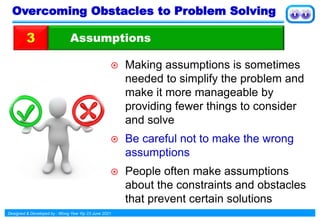
 Making assumptions is sometimes
needed to simplify the problem and
make it more manageable by
providing fewer things to consider
and solve
 Be careful not to make the wrong
assumptions
 People often make assumptions
about the constraints and obstacles
that prevent certain solutions
Designed & Developed by : Wong Yew Yip 23 June 2021
Overcoming Obstacles to Problem Solving
Mental Set
4
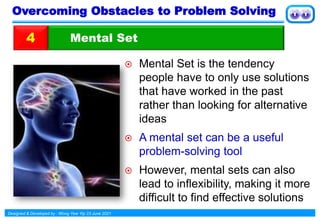
 Mental Set is the tendency
people have to only use solutions
that have worked in the past
rather than looking for alternative
ideas
 A mental set can be a useful
problem-solving tool
 However, mental sets can also
lead to inflexibility, making it more
difficult to find effective solutions
Designed & Developed by : Wong Yew Yip 23 June 2021
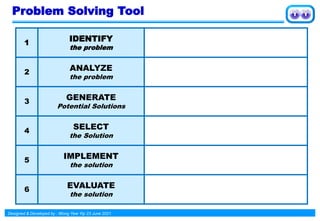
Problem Solving Tool
1
IDENTIFY
the problem
2
ANALYZE
the problem
3
GENERATE
Potential Solutions
4
SELECT
the Solution
5
IMPLEMENT
the solution
6
EVALUATE
the solution
Designed & Developed by : Wong Yew Yip 23 June 2021
Individual Learning Project
1. Select a problem that
you are facing in your
work
2. Use the 6-Step Creative
Problem Solving Tool to
resolve the problem
3. Present your report
Thank You
Contact :
yewyip@gmail.com
for PowerPoint file

Problem Solving

  • 1.
  • 2.
    Designed & Developedby : Wong Yew Yip 23 June 2021 What are Problems? PROBLEMS are: Purposeful Roadblocks Offering Beneficial Lessons to Enhance Mental Strength
  • 3.
    Designed & Developedby : Wong Yew Yip 23 June 2021 What is Problem Solving? Problem Solving is the process of working through details of a problem to reach a solution which may include mathematical or systematic operations and can be a gauge of an individual's critical thinking skills
  • 4.
    Designed & Developedby : Wong Yew Yip 23 June 2021 Why Problem Solving?  Much of what Leaders do is solve problems  Whether you're solving an internal or external problem, supporting those who are solving problems, or discovering new problems to solve, the problems you face can be large or small, simple or complex, and easy or difficult  Being a confident problem solver is really important to your success as a Leader
  • 5.
    Become a problemsolver at work and you will become an indispensable member of your team and organization
  • 6.
    If a problemcan be solved, no need to worry about it If a problem cannot be solved what is the use of worrying?
  • 7.
    Designed & Developedby : Wong Yew Yip 23 June 2021 Why organizations seek problem solvers? Employers value people who can handle minor irritations and major problems that are a part of every business  What do you do when a customer comes to you with a problem or complaint?  Can you help when your team runs into production or service problems?  Can you help save your company from losing its business? You will move faster and higher up the ladder of success if you are an effective problem solver
  • 8.
    Designed & Developedby : Wong Yew Yip 23 June 2021 Why problems are not solved? Not my problem 1 Not my fault 2 Not my responsibility 3 Cannot handle difficult problems 4 Slow to take action 5 Tell customer to ask somebody else 6 Generates only one solution to a problem 7 Not persistent in problem solving 8
  • 9.
    Designed & Developedby : Wong Yew Yip 23 June 2021
  • 10.
    Designed & Developedby : Wong Yew Yip 23 June 2021 3Fs in Problem Solving Whenever a problem arises, do 3 things FACE IT 1 FIGHT IT 2 FINISH IT 3
  • 11.
    Designed & Developedby : Wong Yew Yip 23 June 2021 Creativity in Problem Solving  Creative problem solvers treat all problems as if they were their own  Creative problem solvers have creative and flexible minds to solve problems that are not straightforward  Creative problem solvers are curious people with a can-do attitudes The best tool you have at your disposal for solving problems is YOUR MIND Problem solving begins with clear thinking - scientific and creative
  • 12.
    Designed & Developedby : Wong Yew Yip 23 June 2021  There was a father who left 17 properties of equal value for his 3 sons  When the father passed away, his sons opened up the Will  The father’s Will stated that the eldest son should get 1/2 (half) of total properties, the middle son should be given 1/3rd (one- third) and the youngest son should be given 1/9th (one-ninth) of the total properties  As it was not possible to divide 17 by half, or 17 by 3, or 17 by 9, the three sons started to fight with each other Can you solve the problem for them How do you solve the problem?
  • 13.
    Designed & Developedby : Wong Yew Yip 23 June 2021 6-Step Creative Problem Solving Model 6-STEP PROBLEM SOLVING MODEL IDENTIFY the Problem 1 ANALYZE the Problem 2 GENERATE Potential Solutions 3 SELECT the Solution 4 IMPLEMENT the Solution 5 EVALUATE the Solution 6
  • 14.
    Designed & Developedby : Wong Yew Yip 23 June 2021 1. What is the problem to be solved? 2. Collect as much information and facts you can about the extent and nature of the problem 3. Write a problem statement that includes an "as is" statement and the “required/desired” state - e.g. The processing time for 20% of our car loans is more than 3 days instead of the required 2 days IDENTIFY the Problem 1
  • 15.
    Designed & Developedby : Wong Yew Yip 23 June 2021 1. Identify potential causes of the problem 2. Collect data about potential causes 3. Asking "why" repeatedly directs the focus toward real causes so problems can be solved permanently 4. It is critical to get input from other people who notice the problem and who are effected by it 5. Use data collected to select the most likely significant cause(s) ANALYZE the Problem 2
  • 16.
    Designed & Developedby : Wong Yew Yip 23 June 2021 1. Search for potential solutions 2. Start search with a review of the problem statement, data and the most likely significant cause 3. List all the possible solutions 4. Brainstorm for solutions to the problem with all parties involved 5. Clarify the potential solutions to problem solving team GENERATE Potential Solutions 3
  • 17.
    Designed & Developedby : Wong Yew Yip 23 June 2021 1. Decide which solution has the best chance of solving the problem SELECT the Solution 4 2. Consider: a) Which solution is most likely to solve the problem for the long term? b) Which solution is the most realistic to accomplish for now? c) What resources are required? d) Do you have the budget? e) Do you have enough time to implement f) What are the risks involved?
  • 18.
    Designed & Developedby : Wong Yew Yip 23 June 2021 1. Plan the process on how the problem will be solved 2. Plan should include a strategy for gaining commitment to the plan, contingency plans and how to measure the success 3. Seek approval, if necessary 4. Communicate the plan to those who will be involved in implementing it 5. Implement the plan to resolve the problem IMPLEMENT the Solution 5
  • 19.
    Designed & Developedby : Wong Yew Yip 23 June 2021 1. Monitor implementation of the plan 2. Verify if the problem has been resolved 3. You should consider what changes should be made to avoid this type of problem in the future 4. Check to see if the solution created any new problem EVALUATE the Solution 6
  • 20.
    Designed & Developedby : Wong Yew Yip 23 June 2021 ACTION Strategies, Techniques, Tactics RESULT Outcomes, Consequences QUESTIONING Asks Why - Beliefs, Assumptions SINGLE LOOP LEARNING Problem Solving - React, decide & do DOUBLE LOOP LEARNING More than Problem Solving - reflect, reevaluate, obtain feedback, reconsider goal, objective, values SINGLE LOOP LEARNING : Doing things right DOUBLE LOOP LEARNING : Doing the right things Double Loop Learning
  • 21.
    Designed & Developedby : Wong Yew Yip 23 June 2021 Overcoming Obstacles to Problem Solving Functional Fixedness 1  Functional Fixedness is the tendency to view problems only in their customary manner  You see problems from a narrow spectrum  You do not see the different options or alternatives that are available to find a solution
  • 22.
    Designed & Developedby : Wong Yew Yip 23 June 2021 Overcoming Obstacles to Problem Solving Irrelevant or Misleading Information 2  It is important to distinguish between information that is relevant to the problem and irrelevant data that can lead to faulty solutions  When a problem is very complex, it is easy to focus on misleading or irrelevant information  You must be able to determine what information is factual and important to find the best solution
  • 23.
    Designed & Developedby : Wong Yew Yip 23 June 2021 Overcoming Obstacles to Problem Solving Assumptions 3  Making assumptions is sometimes needed to simplify the problem and make it more manageable by providing fewer things to consider and solve  Be careful not to make the wrong assumptions  People often make assumptions about the constraints and obstacles that prevent certain solutions
  • 24.
    Designed & Developedby : Wong Yew Yip 23 June 2021 Overcoming Obstacles to Problem Solving Mental Set 4  Mental Set is the tendency people have to only use solutions that have worked in the past rather than looking for alternative ideas  A mental set can be a useful problem-solving tool  However, mental sets can also lead to inflexibility, making it more difficult to find effective solutions
  • 25.
    Designed & Developedby : Wong Yew Yip 23 June 2021 Problem Solving Tool 1 IDENTIFY the problem 2 ANALYZE the problem 3 GENERATE Potential Solutions 4 SELECT the Solution 5 IMPLEMENT the solution 6 EVALUATE the solution
  • 26.
    Designed & Developedby : Wong Yew Yip 23 June 2021 Individual Learning Project 1. Select a problem that you are facing in your work 2. Use the 6-Step Creative Problem Solving Tool to resolve the problem 3. Present your report
  • 27.