Wong Yew Yip
yewyip@gmail.com
Designed & Developed by : Wong Yew Yip ~ updated 22 October 2021
Flawless Execution
is the implementation of systems, action plans,
techniques and tools to ensure
strategies that are effectively formulated
are effectively executed to achieve the desired Goal
What is Flawless Execution?
Designed & Developed by : Wong Yew Yip ~ updated 22 October 2021
What is Flawless Execution?
Flawless Execution
is using techniques and systems of
Fighter Pilots to execute flawlessly
to win Business Battles
Designed & Developed by : Wong Yew Yip ~ updated 22 October 2021
In a study of 200 companies in the Times 1000,
80% directors said they had the right strategies
but only 14% thought they were implementing them well
“Why do only one third of UK companies achieve strategic success?
– I Cobbold & G Lawrie, 2GC Ltd.
“Less than 10% of
strategies effectively
formulated are
effectively executed”
Fortune Magazine
“70% of CEOs who fails do so
not because of bad strategy,
but because of bad
execution.”
“Why CEO’s Fail”- R Charan & C
Golvin, Fortune Magazine
Why Strategies fail?
Designed & Developed by : Wong Yew Yip ~ updated 22 October 2021
Poor Flawless
Poor
Flawless
STRATEGY
EXECUTION
Strategy is getting it right and Execution is doing it right
We have to pick the right course of action
Once chosen, we have to carry it flawlessly
Link Between Strategy & Execution
The
road to
Success
A
sure
miss
‘Suicide’
from
the start
A tiring
journey to
nowhere
Designed & Developed by : Wong Yew Yip ~ updated 22 October 2021
Strategy is . . .
direction and destination
• Plan – how we intend to realize our
goals
• Position - the stance we take e.g. low-
cost provider
• Perspective – how it guides decisions
and actions
Getting
it Right!
Execution is . . .
a process, not an action or step
• Successful implementation of the plan
• In alignment with the company’s
direction
• A series of integrated
decisions/actions over time
Implementing
it Right!
Strategy & Execution
Designed & Developed by : Wong Yew Yip ~ updated 22 October 2021
Strategy & Execution
Strategy - Execution = Well-Dressed Inertia
Execution - Strategy = Randomized Failing
Strategy + Execution = SUCCESS
Designed & Developed by : Wong Yew Yip ~ updated 22 October 2021
Philip Crosby is an American who promoted the
phrases “zero defects” and “right first time”
“Zero defects” doesn’t mean mistakes never happen,
rather that there is no allowable number of errors
built into a product or process and that you get it
right first time
“Right first time” has also been misinterpreted to
mean “don’t allow changes.” In fact, once we
acknowledge that change is a fundamental customer
requirement, it becomes clear that “right first time”
requires that we provide for change
Implementing it Right the First Time
Designed & Developed by : Wong Yew Yip ~ updated 22 October 2021
Fighter pilots follow a rigorous but
simple process of Planning, Briefing,
Executing and Debriefing to ensure that
they succeed at each and every
mission.
This process is called
Flawless Execution Model
The same tools and techniques that are
applied and proven successful in
combat have been applied successfully
in business, whether you are a member
of a sales team, manager and even a
CEO to significantly improve your
performance!
Afterburner, Inc
Flawless Execution Model
Designed & Developed by : Wong Yew Yip ~ updated 22 October 2021
 the ability to perform a task in the prescribed
manner
 one of the most daunting yet vitally important
missions facing organizations today
 the drumbeat of modern business and the tool to
energize systems
 not simply tactics but a system of getting things
done
FLAWLESS EXECUTION is . . .
Flawless Execution Model
Designed & Developed by : Wong Yew Yip ~ updated 22 October 2021
Flawless Execution Model is
a learnable, teachable and repeatable process
to improve execution of project or task
5 PHASE FLAWLESS EXECUTION MODEL
PLAN
1
BRIEF
2
EXECUTE
3
DEBRIEF
4
WIN
5
Flawless Execution Model
Designed & Developed by : Wong Yew Yip ~ updated 22 October 2021
Determine
Objectives
1.1
Identify threats
and available
resources
Evaluate lessons
learned
1.3
Develop
actions/tactics
1.4
Plan
contingencies
1.5
1.2
Set timing & Lay
out objectives
2.1
Brief scenario,
environment &
threats
Specify standards
tactics & timelines
2.3
Brief
contingencies
2.4
Wrap up briefing
2.5
2.2
Follow work list
3.1
Cross check
Mutual support
3.3
Monitor work
3.4
Correct deviations
3.5
3.2
Set time &
location
4.1
Analyze execution
against objectives
Lessons learnt
4.3
Transfer lessons
learnt
4.4
Positive
summation
4.5
4.2
Recognize
outcomes &
achievements
5.1
Celebrate
success
5.2
5 PHASE FLAWLESS EXECUTION MODEL
PLAN
1
BRIEF
2
EXECUTE
3
DEBRIEF
4
WIN
5
Flawless Execution Model
Designed & Developed by : Wong Yew Yip ~ updated 22 October 2021
Determine
Objectives
Identify threats
and available
resources
Evaluate lessons
learned
1.3
Develop
actions/tactics
1.4
Plan
contingencies
1.5
1.2
The reason most people never reach their goal
is that they don’t define them, learn about them
or even seriously consider them as believable
or achievable. Winners can tell you where they
are going, what they plan to do along the way
and who will ~ Denis Waitley
He who fails to plan,
plans to fail
5 PHASE FLAWLESS EXECUTION MODEL
PLAN
1
BRIEF
2
EXECUTE
3
DEBRIEF
4
WIN
5
1.1
Phase 1 : PLAN
Designed & Developed by : Wong Yew Yip ~ updated 22 October 2021
1.1 Determine Objectives
Objectives must be :
 clear and specific, using ordinary
and simple language to be easily
understood by all
 measurable on some
quantifiable scale
 achievable, that is believable
and attainable, not an
impossible task
 support the overall vision,
mission or strategy
Designed & Developed by : Wong Yew Yip ~ updated 22 October 2021
1.2 Identify Threats and Available Resources
 Identify what threats (internally and externally) stand in the
way of your objectives, especially the one that can do the
most damage
 Know who and what are your available resources - people,
money, systems, technologies, products, clients, time, known
strengths, skills
 Know the people in other business units and what they can
do for you – talk to them, listen to what they have to say and
understand what they do
 Ask yourself – how can they help me?
 Look at everything and everyone, both internally and
externally, as a potential asset and think how they might help
in the task or eliminate the threats – Look for nuggets of gold
everywhere
Designed & Developed by : Wong Yew Yip ~ updated 22 October 2021
1.3 Evaluate Lessons Learnt
 Everyone has experiences,
someone has done it before, so
tap into those experiences and
apply the lessons learnt
 Lessons learnt can be little or big
– your experiences, the team’s
experiences or experiences of
another organization
 Search them out, analyze them
and apply them in the planning
process
Designed & Developed by : Wong Yew Yip ~ updated 22 October 2021
1.4 Develop Actions and Tactics
 Analyze and finalize the plan with
actions/tactics most likely to
accomplish the task, preferably
with a Gantt Chart
 Finalize who will do what and
when
 Set timelines to each course of
action to put accountability into
the plan
 Then defend your plan asking
others to “beat it up, defeat our
plan”
Designed & Developed by : Wong Yew Yip ~ updated 22 October 2021
1.4 Example of a Gantt Chart
Designed & Developed by : Wong Yew Yip ~ updated 22 October 2021
1.5 Plan Contingencies
 Planning for contingencies should be as detailed as
possible
 Look for weaknesses in the plan
 Ask the “What if?” questions
 Develop “Plan B” actions
 During execution of the plan, there may be no time to
think things through and the answers to “what-if”
questions have to be made during the planning phase.
There is only time to fine-tune the executional
decisions
Designed & Developed by : Wong Yew Yip ~ updated 22 October 2021
“FLAWLESS EXECUTION” PLANNING TOOL
No. PLANNING PROCESS DESCRIPTION
1.1 Determine Objectives
1.2
Identify Threats and
Available Resources
1.3 Evaluate Lessons Learnt
1.4 Develop Actions / Tactics
1.5 Plan Contingencies
Tool for Phase 1 : PLAN
Designed & Developed by : Wong Yew Yip ~ updated 22 October 2021
Set timing & Lay
out objectives
2.1
Brief scenario,
environment &
threats
Specify standards
tactics & timelines
2.3
Brief
contingencies
2.4
Wrap up briefing
2.5
2.2
Issue instructions
to head
for the finish line only after
you have told your team
where the finish line is . . .
5 PHASE FLAWLESS EXECUTION MODEL
PLAN
1
BRIEF
2
EXECUTE
3
DEBRIEF
4
WIN
5
Phase 2 : BRIEF
Designed & Developed by : Wong Yew Yip ~ updated 22 October 2021
2.1 Set Timing and Lay Out Objectives
 The way you start your briefing will always dictate
the outcome of your execution
Sloppy Brief = Sloppy execution
 If you want to set the tone of Flawless Execution,
respect your team and their busy lives by starting
and ending on time – every time
 The next thing is the all important objective – one
phrase that is clear, specific, measurable and
achievable, and of course believable
 Next, lay out the secondary objectives
Designed & Developed by : Wong Yew Yip ~ updated 22 October 2021
2.2 Brief scenario, Environment and Threats
 Brief the scenario to deepen buy-in by stating the
importance of the project and why what we are
about to do matters to give the team a sense of the
stakes involved
 Environment is the external factors that might affect
the project - economical, social, political, attitudinal,
technological, consumer sentiments, regulations
 Communicate to the team the significant stumbling
blocks to the project, your counter-tactics and the
resources that will be applied to overcome them -
technological, financial, pricing
Designed & Developed by : Wong Yew Yip ~ updated 22 October 2021
2.3 Specify Standards, Tactics & Timelines
 State which of the standard operating procedures are in
effect for the project and, if not, tell them so
 Tactics is about exactly how the team is going to execute
the project – usually takes up about 75% of the briefing
time
 Go through the tactics and course of actions in detail,
including possible scenarios and scripted responses -
the team may not know what can happen but they will
know what they will do when it does happen
 Give your team timelines for each course of action,
make it clear the expectations and factor in variances if
needed
Designed & Developed by : Wong Yew Yip ~ updated 22 October 2021
2.4 Brief Contingencies
 Invariably, the team will always ask
“what-if” questions
 Brief the team the contingencies now
so that they are not going to
brainstorm when it is too late or
during the execution phase as then
time is everything and you want to be
quick
 You also want the team to react to
situations based on the decisions that
have already been made during the
planning phase - scripted responses
Designed & Developed by : Wong Yew Yip ~ updated 22 October 2021
2.5 Wrap up Briefing
 Make sure that all questions are
answered and there are no
confusions
 Make sure that no single member of
the team walks away from the briefing
with a question on his/her mind on
how he/she is going to execute the
project
 You can deepen buy-in by wrapping
up the briefing with the organization’s
slogan or vision statement
Designed & Developed by : Wong Yew Yip ~ updated 22 October 2021
“FLAWLESS EXECUTION” BRIEFING TOOL
No. BRIEFING PROCESS CONTENT
2.1
Set timing & Lay out
objectives
2.2
Brief scenario,
environment & threats
2.3
Specify standards tactics
& timelines
2.4 Brief contingencies
2.5 Wrap up briefing
Tool for Phase 2 : BRIEF
Designed & Developed by : Wong Yew Yip ~ updated 22 October 2021
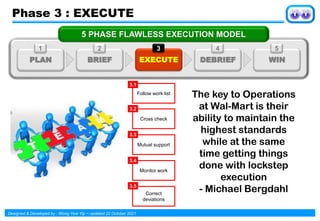
Follow work list
Cross check
Mutual support
3.3
Monitor work
3.4
Correct
deviations
3.5
3.2
The key to Operations
at Wal-Mart is their
ability to maintain the
highest standards
while at the same
time getting things
done with lockstep
execution
- Michael Bergdahl
5 PHASE FLAWLESS EXECUTION MODEL
PLAN
1
BRIEF
2
EXECUTE
3
DEBRIEF
4
WIN
5
3.1
Phase 3 : EXECUTE
Designed & Developed by : Wong Yew Yip ~ updated 22 October 2021
3.1 Follow Work List
 Work list is a check list of
actions or procedures, like a
memory jogger
 People may not take work list
seriously - you think you know
what to do and it seems
juvenile
 Work list is something to jog
your memory, lessen the need
to remember and lower the
stress
Designed & Developed by : Wong Yew Yip ~ updated 22 October 2021
3.2 Cross Check
 Use a dashboard to indicate and
keep track of the key tasks
 The indicators will be determined
by the priorities of your business
or project
 Update your dashboard with
regularity to ensure a disciplined
and up-to-date cross check
 You have to watch your
dashboard and adjust as a form
of consistent cross check
Designed & Developed by : Wong Yew Yip ~ updated 22 October 2021
3.3 Mutual Support
 Mutual support requires that you learn each
others’ roles to help and rely on each other
 Do not give up or miss any team member,
cooperate and support each other to ensure
the accomplishment of the task/project
 Learn to use combat communication -
speaking with clear, concise words without
a lot of filler materials
 In important meetings or presentations,
have at least 2 people – you hear one thing
while your partner picks up something you
missed
Designed & Developed by : Wong Yew Yip ~ updated 22 October 2021
3.4 Monitor Work
 Track differences between what was planned
and what is actually happening - whether
start and finish dates for activities are being
met, how cost estimates are working out in
reality, planned resource requirements are
matching actual utilization, whether the
expected outputs are being created
 Use various media - face-to-face meetings,
e-mail, written reports, periodic groups
meetings,
 If you are not receiving the information you
need, you must go and get it
Designed & Developed by : Wong Yew Yip ~ updated 22 October 2021
3.5 Correct Deviations
 Deviations that may cause
changes in the project plan
are sometimes unavoidable
however well you have
planned
 Deviations are not always negative as they can have
positive impacts
 To resolve deviations every information is required and
priority is given to resolve them by involving all parties
 Implement knowledge sharing and transparency within
the boundaries of the project
Designed & Developed by : Wong Yew Yip ~ updated 22 October 2021
“FLAWLESS EXECUTION” EXECUTION TOOL
No. EXECUTING PROCESS CONTENT
3.1 Follow Work List
3.2 Cross check
3.3 Mutual support
3.4 Monitor work
3.5 Correct deviations
Tool for Phase 3 : EXECUTE
Designed & Developed by : Wong Yew Yip ~ updated 22 October 2021
Set time &
location
4.1
Analyze
execution against
objectives
Lessons learnt
4.3
Transfer lessons
learnt
4.4
Positive
summation
4.5
4.2
The Debrief is one of the most
powerful tool in the business
world
The first debriefs allow you to
survive your inexperience
The next debriefs help you to hold
on to what you have got and pass
around best practices
5 PHASE FLAWLESS EXECUTION MODEL
PLAN
1
BRIEF
2
EXECUTE
3
DEBRIEF
4
WIN
5
Phase 4 : DEBRIEF
Designed & Developed by : Wong Yew Yip ~ updated 22 October 2021
 The goal of an effective debrief is to
generate valuable lessons learnt and
institutionalize those lessons learnt
into a core of best business practices
or benchmarks
 Best practices are transferred
throughout the organization to
accomplish:
 Accelerated learning, which is a process
 Increased experience, which is an asset
 This will improve future execution
Phase 4 : DEBRIEF
Designed & Developed by : Wong Yew Yip ~ updated 22 October 2021
4.1 Set Time and Location
 The best time to debrief is when information is still fresh
 You debrief at the end of an incident - work shift, fiscal quarter,
new product, gain of new business, etc
 Set the date, start and end times
 Set the location with an environment that enhance open
communication
 Engage all the people involved in the project
 Always start on time - don’t penalize those who are on time and
never allow the power of the debrief to shift to the late people
 Always end on time – never allow the debrief to degrade into
endless postmortem
 Define everyone’s roles
Designed & Developed by : Wong Yew Yip ~ updated 22 October 2021
4.2 Analyze Execution against Objectives
 How well did the team
execute based on the
plan?
 Focus on the results
rather than the objectives,
whether the result is a
success or failure
 Fish out execution errors as well as successes and
list the root causes
 Re-evaluate how you should change your brief or
execution to do it better the next time
Designed & Developed by : Wong Yew Yip ~ updated 22 October 2021
4.3 Lessons Learnt
 Look for patterns – prominent or
recurring root cause that bridges
several errors or success
 Do you have a significant
problem or opportunity?
 If you have a problem, identify a
fix - the fix is called lesson learnt
 Lessons learnt are systemic
issues that can be turned into a
process
Designed & Developed by : Wong Yew Yip ~ updated 22 October 2021
4.4 Transfer Lessons Learnt
 Communicate lessons learnt to your
team and if it is significant,
communicate throughout the
organization
 The specific fix you recommend has
to be clearly written so that others in
your team or organization can
understand the issue and benefit
from the solution even if they were
not there
 Transfer knowledge quickly to help
accelerate everyone’s learning curve
Designed & Developed by : Wong Yew Yip ~ updated 22 October 2021
4.5 Positive Summation
 End the debrief on a high note
 Even if the execution did not
achieve the objective as planned,
point out that the debrief process is
positive as it will:
 Set the foundation for the next project
 Help the team execute better the next
time
 Accelerate learning experiences
 Encourage the team to continue
the good work
Designed & Developed by : Wong Yew Yip ~ updated 22 October 2021
“FLAWLESS EXECUTION” DEBRIEFING TOOL
No. DEBRIEFING PROCESS CONTENT
4.1 Set time & location
4.2
Analyze execution against
objectives
4.3 Lessons learnt
4.4 Transfer lessons learnt
4.5 Positive summation
Tool for Phase 4 : DEBRIEF
Designed & Developed by : Wong Yew Yip ~ updated 22 October 2021
AFTER ACTION REVIEW (AAR)
 What was supposed to happen?  What actually happened?
 Why were there differences?  How will I do better the next time?
Tool for Phase 4 : DEBRIEF
Designed & Developed by : Wong Yew Yip ~ updated 22 October 2021
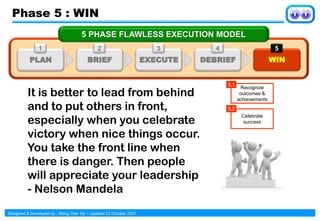
Recognize
outcomes &
achievements
5.1
Celebrate
success
5.2
It is better to lead from behind
and to put others in front,
especially when you celebrate
victory when nice things occur.
You take the front line when
there is danger. Then people
will appreciate your leadership
- Nelson Mandela
5 PHASE FLAWLESS EXECUTION MODEL
PLAN
1
BRIEF
2
EXECUTE
3
DEBRIEF
4
WIN
5
Phase 5 : WIN
Designed & Developed by : Wong Yew Yip ~ updated 22 October 2021
5.1 Recognize Outcomes & Achievements
 Highlight positive outcomes and
achievements of the project
stating quantifiable results
 Express your appreciation for all
the efforts of the team
 Share stories where staff went
"above and beyond" to achieve
success
 Recognize and praise
outstanding performers
 Advise those not up to the mark
to improve
Designed & Developed by : Wong Yew Yip ~ updated 22 October 2021
5.2 Celebrate Success
 Celebrate the success of
the team and others who
have contributed
 Let the team decide the
celebration activities, e.g.
get-together,
appreciation dinner, get-
away, outing,
commendation letters
Designed & Developed by : Wong Yew Yip ~ updated 22 October 2021
“FLAWLESS EXECUTION” WINNING TOOL
No. WINNING PROCESS CONTENT
5.1 Recognize outcomes and
achievements
5.2 Celebrate Success
• What
• When
• Who
• How
Tool for Phase 5 : WIN
Thank You
Contact :
yewyip@gmail.com
for PowerPoint file

Flawless Execution

  • 1.
  • 2.
    Designed & Developedby : Wong Yew Yip ~ updated 22 October 2021 Flawless Execution is the implementation of systems, action plans, techniques and tools to ensure strategies that are effectively formulated are effectively executed to achieve the desired Goal What is Flawless Execution?
  • 3.
    Designed & Developedby : Wong Yew Yip ~ updated 22 October 2021 What is Flawless Execution? Flawless Execution is using techniques and systems of Fighter Pilots to execute flawlessly to win Business Battles
  • 4.
    Designed & Developedby : Wong Yew Yip ~ updated 22 October 2021 In a study of 200 companies in the Times 1000, 80% directors said they had the right strategies but only 14% thought they were implementing them well “Why do only one third of UK companies achieve strategic success? – I Cobbold & G Lawrie, 2GC Ltd. “Less than 10% of strategies effectively formulated are effectively executed” Fortune Magazine “70% of CEOs who fails do so not because of bad strategy, but because of bad execution.” “Why CEO’s Fail”- R Charan & C Golvin, Fortune Magazine Why Strategies fail?
  • 5.
    Designed & Developedby : Wong Yew Yip ~ updated 22 October 2021 Poor Flawless Poor Flawless STRATEGY EXECUTION Strategy is getting it right and Execution is doing it right We have to pick the right course of action Once chosen, we have to carry it flawlessly Link Between Strategy & Execution The road to Success A sure miss ‘Suicide’ from the start A tiring journey to nowhere
  • 6.
    Designed & Developedby : Wong Yew Yip ~ updated 22 October 2021 Strategy is . . . direction and destination • Plan – how we intend to realize our goals • Position - the stance we take e.g. low- cost provider • Perspective – how it guides decisions and actions Getting it Right! Execution is . . . a process, not an action or step • Successful implementation of the plan • In alignment with the company’s direction • A series of integrated decisions/actions over time Implementing it Right! Strategy & Execution
  • 7.
    Designed & Developedby : Wong Yew Yip ~ updated 22 October 2021 Strategy & Execution Strategy - Execution = Well-Dressed Inertia Execution - Strategy = Randomized Failing Strategy + Execution = SUCCESS
  • 8.
    Designed & Developedby : Wong Yew Yip ~ updated 22 October 2021 Philip Crosby is an American who promoted the phrases “zero defects” and “right first time” “Zero defects” doesn’t mean mistakes never happen, rather that there is no allowable number of errors built into a product or process and that you get it right first time “Right first time” has also been misinterpreted to mean “don’t allow changes.” In fact, once we acknowledge that change is a fundamental customer requirement, it becomes clear that “right first time” requires that we provide for change Implementing it Right the First Time
  • 9.
    Designed & Developedby : Wong Yew Yip ~ updated 22 October 2021 Fighter pilots follow a rigorous but simple process of Planning, Briefing, Executing and Debriefing to ensure that they succeed at each and every mission. This process is called Flawless Execution Model The same tools and techniques that are applied and proven successful in combat have been applied successfully in business, whether you are a member of a sales team, manager and even a CEO to significantly improve your performance! Afterburner, Inc Flawless Execution Model
  • 10.
    Designed & Developedby : Wong Yew Yip ~ updated 22 October 2021  the ability to perform a task in the prescribed manner  one of the most daunting yet vitally important missions facing organizations today  the drumbeat of modern business and the tool to energize systems  not simply tactics but a system of getting things done FLAWLESS EXECUTION is . . . Flawless Execution Model
  • 11.
    Designed & Developedby : Wong Yew Yip ~ updated 22 October 2021 Flawless Execution Model is a learnable, teachable and repeatable process to improve execution of project or task 5 PHASE FLAWLESS EXECUTION MODEL PLAN 1 BRIEF 2 EXECUTE 3 DEBRIEF 4 WIN 5 Flawless Execution Model
  • 12.
    Designed & Developedby : Wong Yew Yip ~ updated 22 October 2021 Determine Objectives 1.1 Identify threats and available resources Evaluate lessons learned 1.3 Develop actions/tactics 1.4 Plan contingencies 1.5 1.2 Set timing & Lay out objectives 2.1 Brief scenario, environment & threats Specify standards tactics & timelines 2.3 Brief contingencies 2.4 Wrap up briefing 2.5 2.2 Follow work list 3.1 Cross check Mutual support 3.3 Monitor work 3.4 Correct deviations 3.5 3.2 Set time & location 4.1 Analyze execution against objectives Lessons learnt 4.3 Transfer lessons learnt 4.4 Positive summation 4.5 4.2 Recognize outcomes & achievements 5.1 Celebrate success 5.2 5 PHASE FLAWLESS EXECUTION MODEL PLAN 1 BRIEF 2 EXECUTE 3 DEBRIEF 4 WIN 5 Flawless Execution Model
  • 13.
    Designed & Developedby : Wong Yew Yip ~ updated 22 October 2021 Determine Objectives Identify threats and available resources Evaluate lessons learned 1.3 Develop actions/tactics 1.4 Plan contingencies 1.5 1.2 The reason most people never reach their goal is that they don’t define them, learn about them or even seriously consider them as believable or achievable. Winners can tell you where they are going, what they plan to do along the way and who will ~ Denis Waitley He who fails to plan, plans to fail 5 PHASE FLAWLESS EXECUTION MODEL PLAN 1 BRIEF 2 EXECUTE 3 DEBRIEF 4 WIN 5 1.1 Phase 1 : PLAN
  • 14.
    Designed & Developedby : Wong Yew Yip ~ updated 22 October 2021 1.1 Determine Objectives Objectives must be :  clear and specific, using ordinary and simple language to be easily understood by all  measurable on some quantifiable scale  achievable, that is believable and attainable, not an impossible task  support the overall vision, mission or strategy
  • 15.
    Designed & Developedby : Wong Yew Yip ~ updated 22 October 2021 1.2 Identify Threats and Available Resources  Identify what threats (internally and externally) stand in the way of your objectives, especially the one that can do the most damage  Know who and what are your available resources - people, money, systems, technologies, products, clients, time, known strengths, skills  Know the people in other business units and what they can do for you – talk to them, listen to what they have to say and understand what they do  Ask yourself – how can they help me?  Look at everything and everyone, both internally and externally, as a potential asset and think how they might help in the task or eliminate the threats – Look for nuggets of gold everywhere
  • 16.
    Designed & Developedby : Wong Yew Yip ~ updated 22 October 2021 1.3 Evaluate Lessons Learnt  Everyone has experiences, someone has done it before, so tap into those experiences and apply the lessons learnt  Lessons learnt can be little or big – your experiences, the team’s experiences or experiences of another organization  Search them out, analyze them and apply them in the planning process
  • 17.
    Designed & Developedby : Wong Yew Yip ~ updated 22 October 2021 1.4 Develop Actions and Tactics  Analyze and finalize the plan with actions/tactics most likely to accomplish the task, preferably with a Gantt Chart  Finalize who will do what and when  Set timelines to each course of action to put accountability into the plan  Then defend your plan asking others to “beat it up, defeat our plan”
  • 18.
    Designed & Developedby : Wong Yew Yip ~ updated 22 October 2021 1.4 Example of a Gantt Chart
  • 19.
    Designed & Developedby : Wong Yew Yip ~ updated 22 October 2021 1.5 Plan Contingencies  Planning for contingencies should be as detailed as possible  Look for weaknesses in the plan  Ask the “What if?” questions  Develop “Plan B” actions  During execution of the plan, there may be no time to think things through and the answers to “what-if” questions have to be made during the planning phase. There is only time to fine-tune the executional decisions
  • 20.
    Designed & Developedby : Wong Yew Yip ~ updated 22 October 2021 “FLAWLESS EXECUTION” PLANNING TOOL No. PLANNING PROCESS DESCRIPTION 1.1 Determine Objectives 1.2 Identify Threats and Available Resources 1.3 Evaluate Lessons Learnt 1.4 Develop Actions / Tactics 1.5 Plan Contingencies Tool for Phase 1 : PLAN
  • 21.
    Designed & Developedby : Wong Yew Yip ~ updated 22 October 2021 Set timing & Lay out objectives 2.1 Brief scenario, environment & threats Specify standards tactics & timelines 2.3 Brief contingencies 2.4 Wrap up briefing 2.5 2.2 Issue instructions to head for the finish line only after you have told your team where the finish line is . . . 5 PHASE FLAWLESS EXECUTION MODEL PLAN 1 BRIEF 2 EXECUTE 3 DEBRIEF 4 WIN 5 Phase 2 : BRIEF
  • 22.
    Designed & Developedby : Wong Yew Yip ~ updated 22 October 2021 2.1 Set Timing and Lay Out Objectives  The way you start your briefing will always dictate the outcome of your execution Sloppy Brief = Sloppy execution  If you want to set the tone of Flawless Execution, respect your team and their busy lives by starting and ending on time – every time  The next thing is the all important objective – one phrase that is clear, specific, measurable and achievable, and of course believable  Next, lay out the secondary objectives
  • 23.
    Designed & Developedby : Wong Yew Yip ~ updated 22 October 2021 2.2 Brief scenario, Environment and Threats  Brief the scenario to deepen buy-in by stating the importance of the project and why what we are about to do matters to give the team a sense of the stakes involved  Environment is the external factors that might affect the project - economical, social, political, attitudinal, technological, consumer sentiments, regulations  Communicate to the team the significant stumbling blocks to the project, your counter-tactics and the resources that will be applied to overcome them - technological, financial, pricing
  • 24.
    Designed & Developedby : Wong Yew Yip ~ updated 22 October 2021 2.3 Specify Standards, Tactics & Timelines  State which of the standard operating procedures are in effect for the project and, if not, tell them so  Tactics is about exactly how the team is going to execute the project – usually takes up about 75% of the briefing time  Go through the tactics and course of actions in detail, including possible scenarios and scripted responses - the team may not know what can happen but they will know what they will do when it does happen  Give your team timelines for each course of action, make it clear the expectations and factor in variances if needed
  • 25.
    Designed & Developedby : Wong Yew Yip ~ updated 22 October 2021 2.4 Brief Contingencies  Invariably, the team will always ask “what-if” questions  Brief the team the contingencies now so that they are not going to brainstorm when it is too late or during the execution phase as then time is everything and you want to be quick  You also want the team to react to situations based on the decisions that have already been made during the planning phase - scripted responses
  • 26.
    Designed & Developedby : Wong Yew Yip ~ updated 22 October 2021 2.5 Wrap up Briefing  Make sure that all questions are answered and there are no confusions  Make sure that no single member of the team walks away from the briefing with a question on his/her mind on how he/she is going to execute the project  You can deepen buy-in by wrapping up the briefing with the organization’s slogan or vision statement
  • 27.
    Designed & Developedby : Wong Yew Yip ~ updated 22 October 2021 “FLAWLESS EXECUTION” BRIEFING TOOL No. BRIEFING PROCESS CONTENT 2.1 Set timing & Lay out objectives 2.2 Brief scenario, environment & threats 2.3 Specify standards tactics & timelines 2.4 Brief contingencies 2.5 Wrap up briefing Tool for Phase 2 : BRIEF
  • 28.
    Designed & Developedby : Wong Yew Yip ~ updated 22 October 2021 Follow work list Cross check Mutual support 3.3 Monitor work 3.4 Correct deviations 3.5 3.2 The key to Operations at Wal-Mart is their ability to maintain the highest standards while at the same time getting things done with lockstep execution - Michael Bergdahl 5 PHASE FLAWLESS EXECUTION MODEL PLAN 1 BRIEF 2 EXECUTE 3 DEBRIEF 4 WIN 5 3.1 Phase 3 : EXECUTE
  • 29.
    Designed & Developedby : Wong Yew Yip ~ updated 22 October 2021 3.1 Follow Work List  Work list is a check list of actions or procedures, like a memory jogger  People may not take work list seriously - you think you know what to do and it seems juvenile  Work list is something to jog your memory, lessen the need to remember and lower the stress
  • 30.
    Designed & Developedby : Wong Yew Yip ~ updated 22 October 2021 3.2 Cross Check  Use a dashboard to indicate and keep track of the key tasks  The indicators will be determined by the priorities of your business or project  Update your dashboard with regularity to ensure a disciplined and up-to-date cross check  You have to watch your dashboard and adjust as a form of consistent cross check
  • 31.
    Designed & Developedby : Wong Yew Yip ~ updated 22 October 2021 3.3 Mutual Support  Mutual support requires that you learn each others’ roles to help and rely on each other  Do not give up or miss any team member, cooperate and support each other to ensure the accomplishment of the task/project  Learn to use combat communication - speaking with clear, concise words without a lot of filler materials  In important meetings or presentations, have at least 2 people – you hear one thing while your partner picks up something you missed
  • 32.
    Designed & Developedby : Wong Yew Yip ~ updated 22 October 2021 3.4 Monitor Work  Track differences between what was planned and what is actually happening - whether start and finish dates for activities are being met, how cost estimates are working out in reality, planned resource requirements are matching actual utilization, whether the expected outputs are being created  Use various media - face-to-face meetings, e-mail, written reports, periodic groups meetings,  If you are not receiving the information you need, you must go and get it
  • 33.
    Designed & Developedby : Wong Yew Yip ~ updated 22 October 2021 3.5 Correct Deviations  Deviations that may cause changes in the project plan are sometimes unavoidable however well you have planned  Deviations are not always negative as they can have positive impacts  To resolve deviations every information is required and priority is given to resolve them by involving all parties  Implement knowledge sharing and transparency within the boundaries of the project
  • 34.
    Designed & Developedby : Wong Yew Yip ~ updated 22 October 2021 “FLAWLESS EXECUTION” EXECUTION TOOL No. EXECUTING PROCESS CONTENT 3.1 Follow Work List 3.2 Cross check 3.3 Mutual support 3.4 Monitor work 3.5 Correct deviations Tool for Phase 3 : EXECUTE
  • 35.
    Designed & Developedby : Wong Yew Yip ~ updated 22 October 2021 Set time & location 4.1 Analyze execution against objectives Lessons learnt 4.3 Transfer lessons learnt 4.4 Positive summation 4.5 4.2 The Debrief is one of the most powerful tool in the business world The first debriefs allow you to survive your inexperience The next debriefs help you to hold on to what you have got and pass around best practices 5 PHASE FLAWLESS EXECUTION MODEL PLAN 1 BRIEF 2 EXECUTE 3 DEBRIEF 4 WIN 5 Phase 4 : DEBRIEF
  • 36.
    Designed & Developedby : Wong Yew Yip ~ updated 22 October 2021  The goal of an effective debrief is to generate valuable lessons learnt and institutionalize those lessons learnt into a core of best business practices or benchmarks  Best practices are transferred throughout the organization to accomplish:  Accelerated learning, which is a process  Increased experience, which is an asset  This will improve future execution Phase 4 : DEBRIEF
  • 37.
    Designed & Developedby : Wong Yew Yip ~ updated 22 October 2021 4.1 Set Time and Location  The best time to debrief is when information is still fresh  You debrief at the end of an incident - work shift, fiscal quarter, new product, gain of new business, etc  Set the date, start and end times  Set the location with an environment that enhance open communication  Engage all the people involved in the project  Always start on time - don’t penalize those who are on time and never allow the power of the debrief to shift to the late people  Always end on time – never allow the debrief to degrade into endless postmortem  Define everyone’s roles
  • 38.
    Designed & Developedby : Wong Yew Yip ~ updated 22 October 2021 4.2 Analyze Execution against Objectives  How well did the team execute based on the plan?  Focus on the results rather than the objectives, whether the result is a success or failure  Fish out execution errors as well as successes and list the root causes  Re-evaluate how you should change your brief or execution to do it better the next time
  • 39.
    Designed & Developedby : Wong Yew Yip ~ updated 22 October 2021 4.3 Lessons Learnt  Look for patterns – prominent or recurring root cause that bridges several errors or success  Do you have a significant problem or opportunity?  If you have a problem, identify a fix - the fix is called lesson learnt  Lessons learnt are systemic issues that can be turned into a process
  • 40.
    Designed & Developedby : Wong Yew Yip ~ updated 22 October 2021 4.4 Transfer Lessons Learnt  Communicate lessons learnt to your team and if it is significant, communicate throughout the organization  The specific fix you recommend has to be clearly written so that others in your team or organization can understand the issue and benefit from the solution even if they were not there  Transfer knowledge quickly to help accelerate everyone’s learning curve
  • 41.
    Designed & Developedby : Wong Yew Yip ~ updated 22 October 2021 4.5 Positive Summation  End the debrief on a high note  Even if the execution did not achieve the objective as planned, point out that the debrief process is positive as it will:  Set the foundation for the next project  Help the team execute better the next time  Accelerate learning experiences  Encourage the team to continue the good work
  • 42.
    Designed & Developedby : Wong Yew Yip ~ updated 22 October 2021 “FLAWLESS EXECUTION” DEBRIEFING TOOL No. DEBRIEFING PROCESS CONTENT 4.1 Set time & location 4.2 Analyze execution against objectives 4.3 Lessons learnt 4.4 Transfer lessons learnt 4.5 Positive summation Tool for Phase 4 : DEBRIEF
  • 43.
    Designed & Developedby : Wong Yew Yip ~ updated 22 October 2021 AFTER ACTION REVIEW (AAR)  What was supposed to happen?  What actually happened?  Why were there differences?  How will I do better the next time? Tool for Phase 4 : DEBRIEF
  • 44.
    Designed & Developedby : Wong Yew Yip ~ updated 22 October 2021 Recognize outcomes & achievements 5.1 Celebrate success 5.2 It is better to lead from behind and to put others in front, especially when you celebrate victory when nice things occur. You take the front line when there is danger. Then people will appreciate your leadership - Nelson Mandela 5 PHASE FLAWLESS EXECUTION MODEL PLAN 1 BRIEF 2 EXECUTE 3 DEBRIEF 4 WIN 5 Phase 5 : WIN
  • 45.
    Designed & Developedby : Wong Yew Yip ~ updated 22 October 2021 5.1 Recognize Outcomes & Achievements  Highlight positive outcomes and achievements of the project stating quantifiable results  Express your appreciation for all the efforts of the team  Share stories where staff went "above and beyond" to achieve success  Recognize and praise outstanding performers  Advise those not up to the mark to improve
  • 46.
    Designed & Developedby : Wong Yew Yip ~ updated 22 October 2021 5.2 Celebrate Success  Celebrate the success of the team and others who have contributed  Let the team decide the celebration activities, e.g. get-together, appreciation dinner, get- away, outing, commendation letters
  • 47.
    Designed & Developedby : Wong Yew Yip ~ updated 22 October 2021 “FLAWLESS EXECUTION” WINNING TOOL No. WINNING PROCESS CONTENT 5.1 Recognize outcomes and achievements 5.2 Celebrate Success • What • When • Who • How Tool for Phase 5 : WIN
  • 48.