Cognitive psychology
Steps & approaches & Obstacles in the
process of Problem solving
Cognitive strategies
There are in general 8 broader steps
involved in the process of problem
solving
Step 1: Define the Problem
โ€ข What is the problem?
โ€ข How did you discover the problem?
โ€ข When did the problem start and how
long has this problem been going on?
โ€ข Is there enough data available to
contain the problem and prevent it
from getting passed to the next
process step? If yes, contain the
problem.
Steps involved in the process of problem solving
Step 2: Clarify the Problem
โ€ข What data is available or needed to
help clarify, or fully understand the
problem?
โ€ข Is it a top priority to resolve the
problem at this point in time?
โ€ข Are additional resources required to
clarify the problem? If yes, elevate
the problem to your leader to help
locate the right resources and form a
team.
โ€ข Ensure the problem is contained and
does not get passed to the next
process step.
Steps involved in the process of problem solving
Step 3: Define the Goals
โ€ข What is your end goal or desired
future state?
โ€ข What will you accomplish if you fix
this problem?
โ€ข What is the desired timeline for
solving this problem?
Step 4: Identify Root Cause of the
Problem
โ€ข Identify possible causes of the
problem.
โ€ข Prioritize possible root causes of the
problem.
โ€ข What information or data is there to
validate the root cause?
Steps involved in the process of problem solving
Step 5: Develop Action Plan
โ€ข Generate a list of actions required to
address the root cause and prevent
problem from getting to others.
โ€ข Assign an owner and timeline to each
action.
โ€ข Status actions to ensure completion.
Step 6: Execute Action Plan
โ€ข Implement action plan to address the
root cause.
โ€ข Verify actions are completed.
Steps involved in the process of problem solving
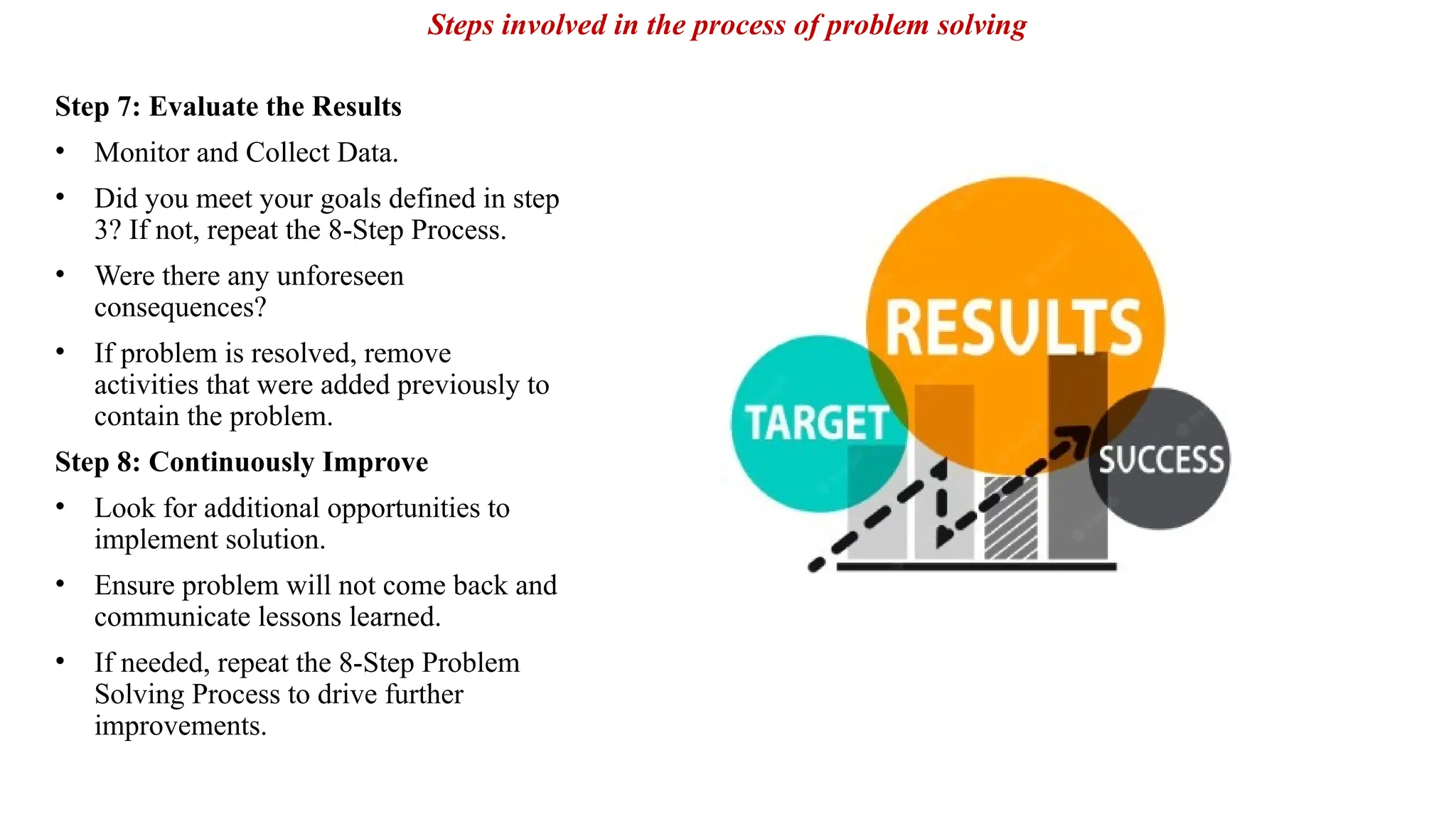
Step 7: Evaluate the Results
โ€ข Monitor and Collect Data.
โ€ข Did you meet your goals defined in step
3? If not, repeat the 8-Step Process.
โ€ข Were there any unforeseen
consequences?
โ€ข If problem is resolved, remove
activities that were added previously to
contain the problem.
Step 8: Continuously Improve
โ€ข Look for additional opportunities to
implement solution.
โ€ข Ensure problem will not come back and
communicate lessons learned.
โ€ข If needed, repeat the 8-Step Problem
Solving Process to drive further
improvements.
Steps involved in the process of problem solving
1. Rational
โ€ข One of the most common problem-solving
approaches
โ€ข A multi-step process that works well for a
wide range of problems.
โ€ข Many other problem-solving techniques
mirror or build off of its seven steps, so it
may be helpful to begin with the rational
approach before moving on to other
techniques. Here are the seven steps of the
rational approach:
1. Define the problem.
2. Identify possible causes.
3. Brainstorm options to solve the problem.
4. Select an option.
5. Create an implementation plan.
6. Execute the plan and monitor the results.
7. Evaluate the solution
Approaches involved in the process of problem solving
2. Collaborative
โ€ข This approach involves including multiple
people in the problem-solving process.
โ€ข Brainstorming should include a diverse
group of stakeholders: people who are
affected by the problem and/or may be
affected by any changes made in an
attempt to solve it.
โ€ข Seek continuous feedback from these
stakeholders as you monitor the
implementation of your solution to make
sure it works well for everyone.
3. Creative
โ€ข The creative approach mirrors the rational
approach but places greater emphasis on
the brainstorming phase.
โ€ข People using the creative approach utilize
ideation techniques such as mind mapping,
storyboards and analogies.
Approaches involved in the process of problem solving
3. Historical
โ€ข The historical approach is helpful when
the problem you're facing has precedent
within your field or industry.
โ€ข Researching how others have solved the
problem can guide you as you develop
your own solution.
4. The 5 Whys
โ€ข This approach can help you get to the root
of a complex problem. Begin by asking
why the problem occurred, and then ask
the same question about your response.
โ€ข For example, if you answer that
productivity has stagnated because morale
is low, follow up by asking, "Why is
morale low?" Ask "why" a total of five
times.
โ€ข Doing so will help you find the problem's
root cause.
Approaches involved in the process of problem solving
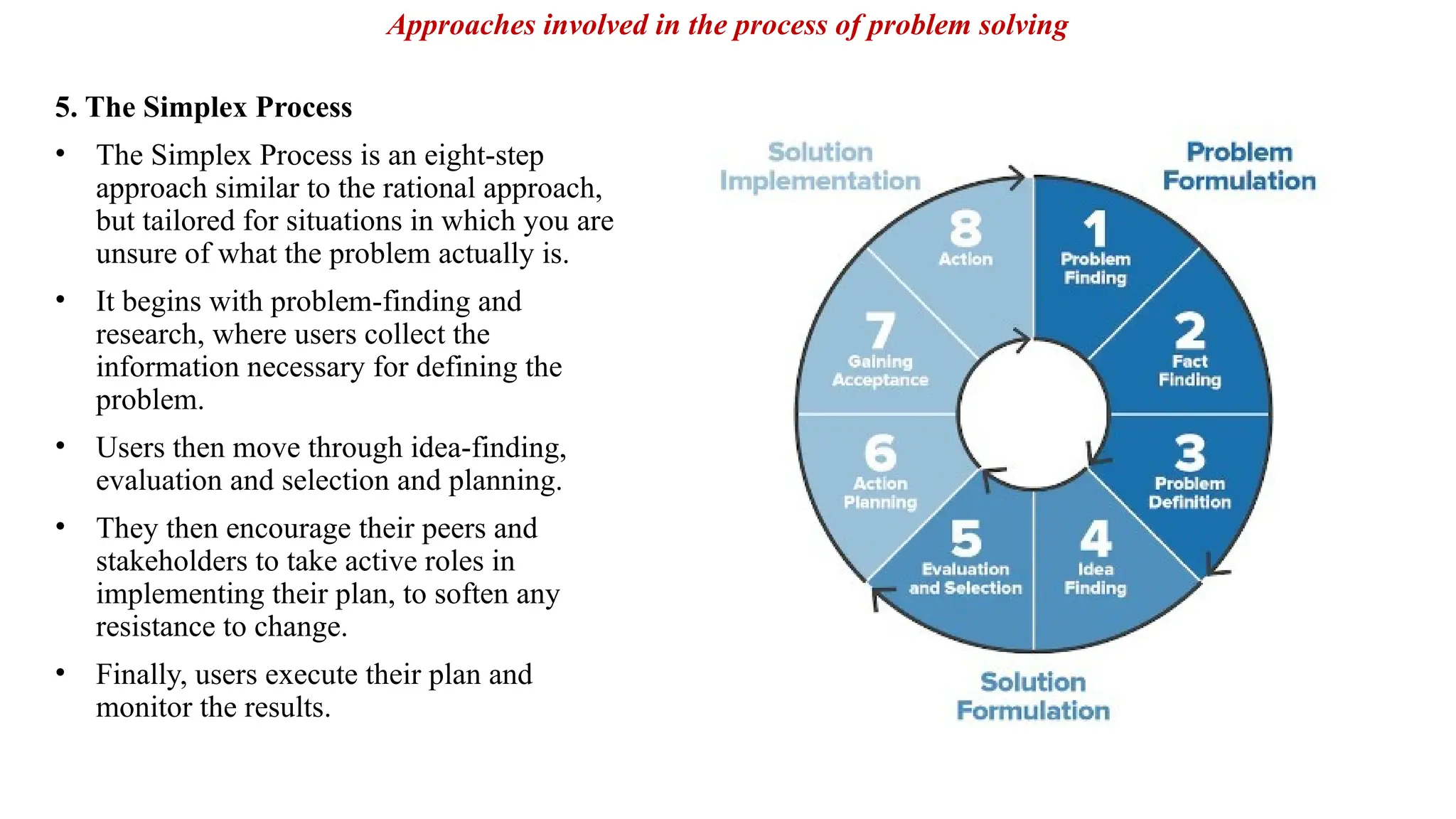
5. The Simplex Process
โ€ข The Simplex Process is an eight-step
approach similar to the rational approach,
but tailored for situations in which you are
unsure of what the problem actually is.
โ€ข It begins with problem-finding and
research, where users collect the
information necessary for defining the
problem.
โ€ข Users then move through idea-finding,
evaluation and selection and planning.
โ€ข They then encourage their peers and
stakeholders to take active roles in
implementing their plan, to soften any
resistance to change.
โ€ข Finally, users execute their plan and
monitor the results.
Approaches involved in the process of problem solving
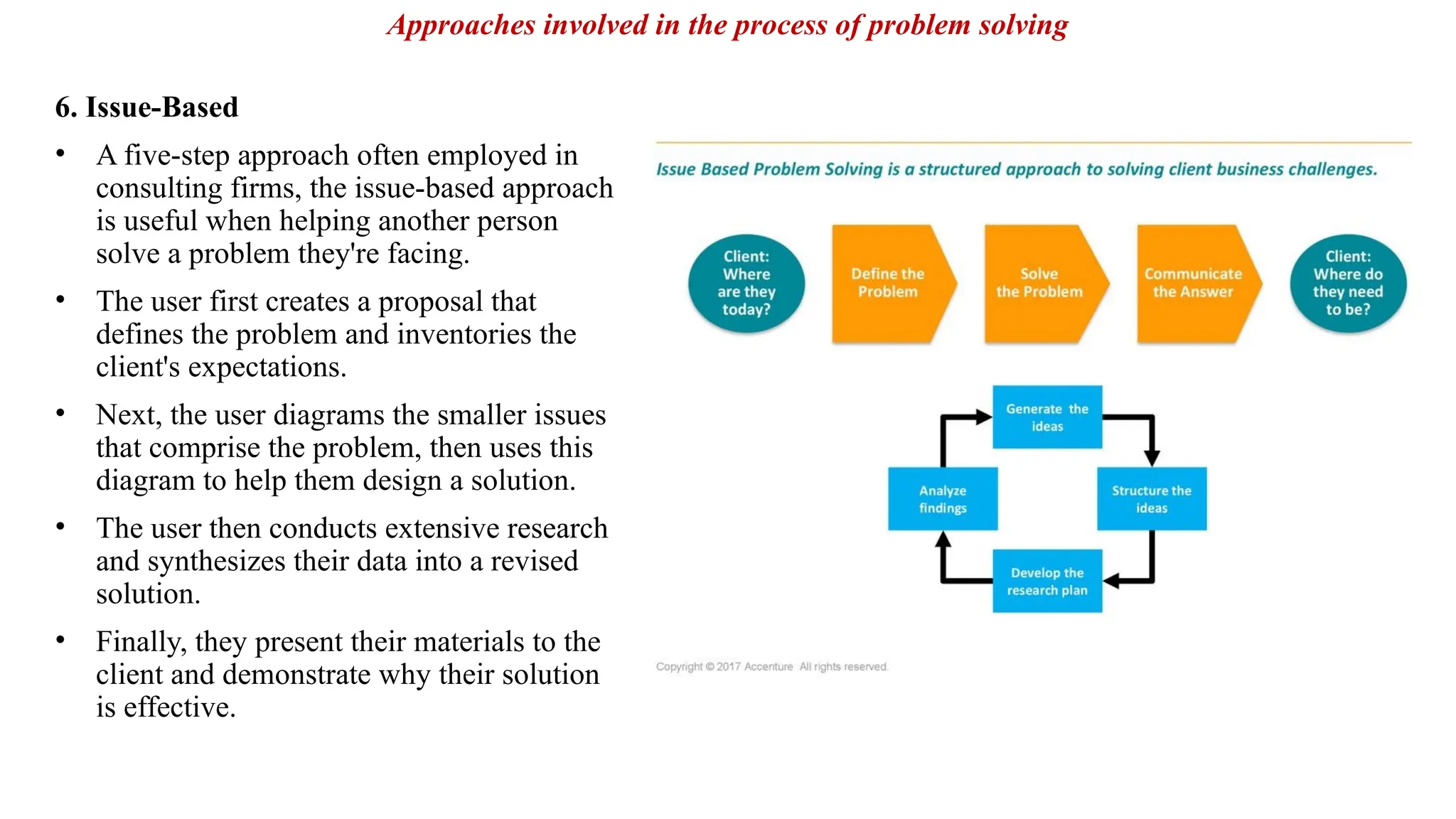
6. Issue-Based
โ€ข A five-step approach often employed in
consulting firms, the issue-based approach
is useful when helping another person
solve a problem they're facing.
โ€ข The user first creates a proposal that
defines the problem and inventories the
client's expectations.
โ€ข Next, the user diagrams the smaller issues
that comprise the problem, then uses this
diagram to help them design a solution.
โ€ข The user then conducts extensive research
and synthesizes their data into a revised
solution.
โ€ข Finally, they present their materials to the
client and demonstrate why their solution
is effective.
Approaches involved in the process of problem solving
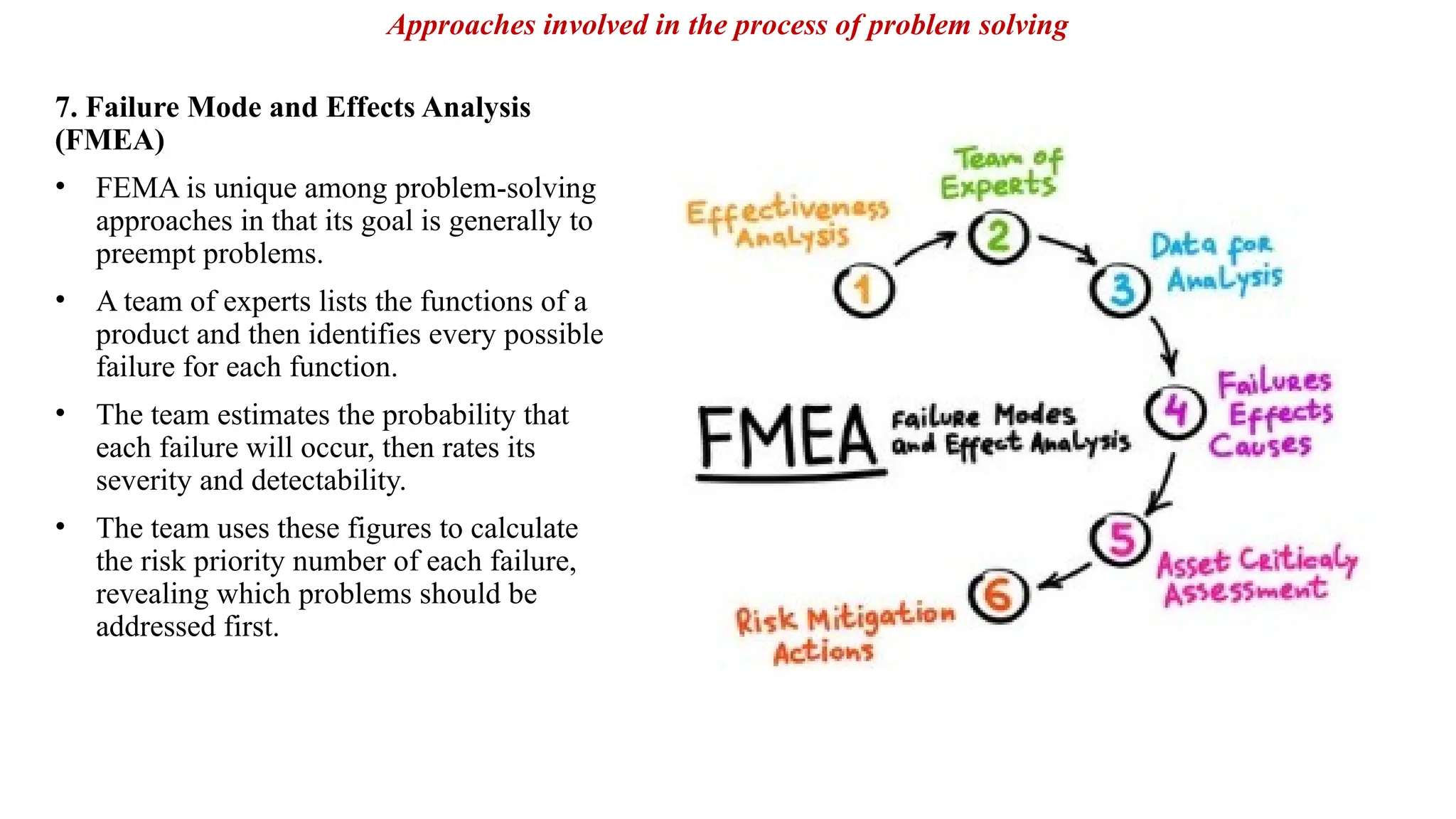
7. Failure Mode and Effects Analysis
(FMEA)
โ€ข FEMA is unique among problem-solving
approaches in that its goal is generally to
preempt problems.
โ€ข A team of experts lists the functions of a
product and then identifies every possible
failure for each function.
โ€ข The team estimates the probability that
each failure will occur, then rates its
severity and detectability.
โ€ข The team uses these figures to calculate
the risk priority number of each failure,
revealing which problems should be
addressed first.
Approaches involved in the process of problem solving
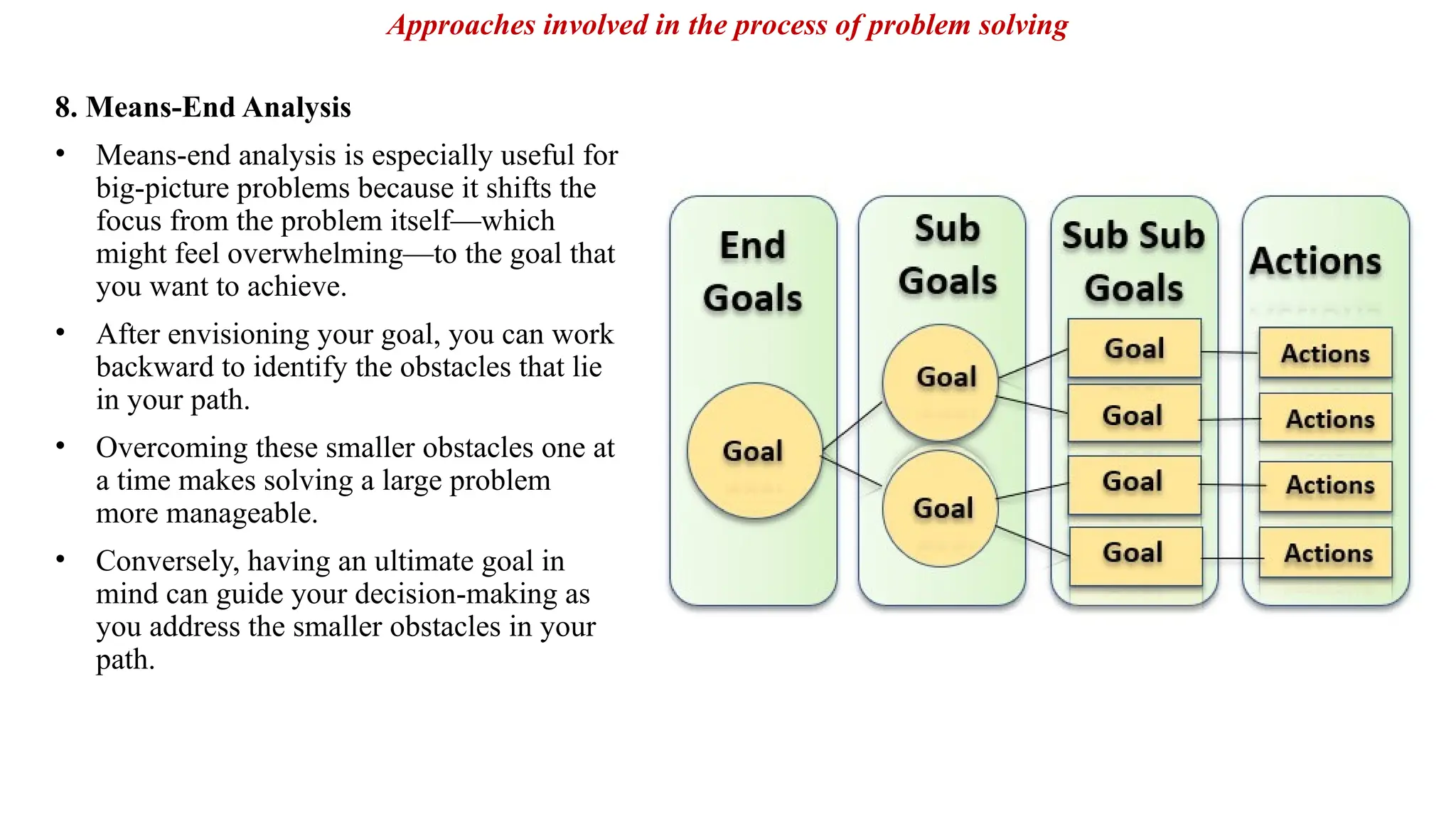
8. Means-End Analysis
โ€ข Means-end analysis is especially useful for
big-picture problems because it shifts the
focus from the problem itselfโ€”which
might feel overwhelmingโ€”to the goal that
you want to achieve.
โ€ข After envisioning your goal, you can work
backward to identify the obstacles that lie
in your path.
โ€ข Overcoming these smaller obstacles one at
a time makes solving a large problem
more manageable.
โ€ข Conversely, having an ultimate goal in
mind can guide your decision-making as
you address the smaller obstacles in your
path.
Approaches involved in the process of problem solving
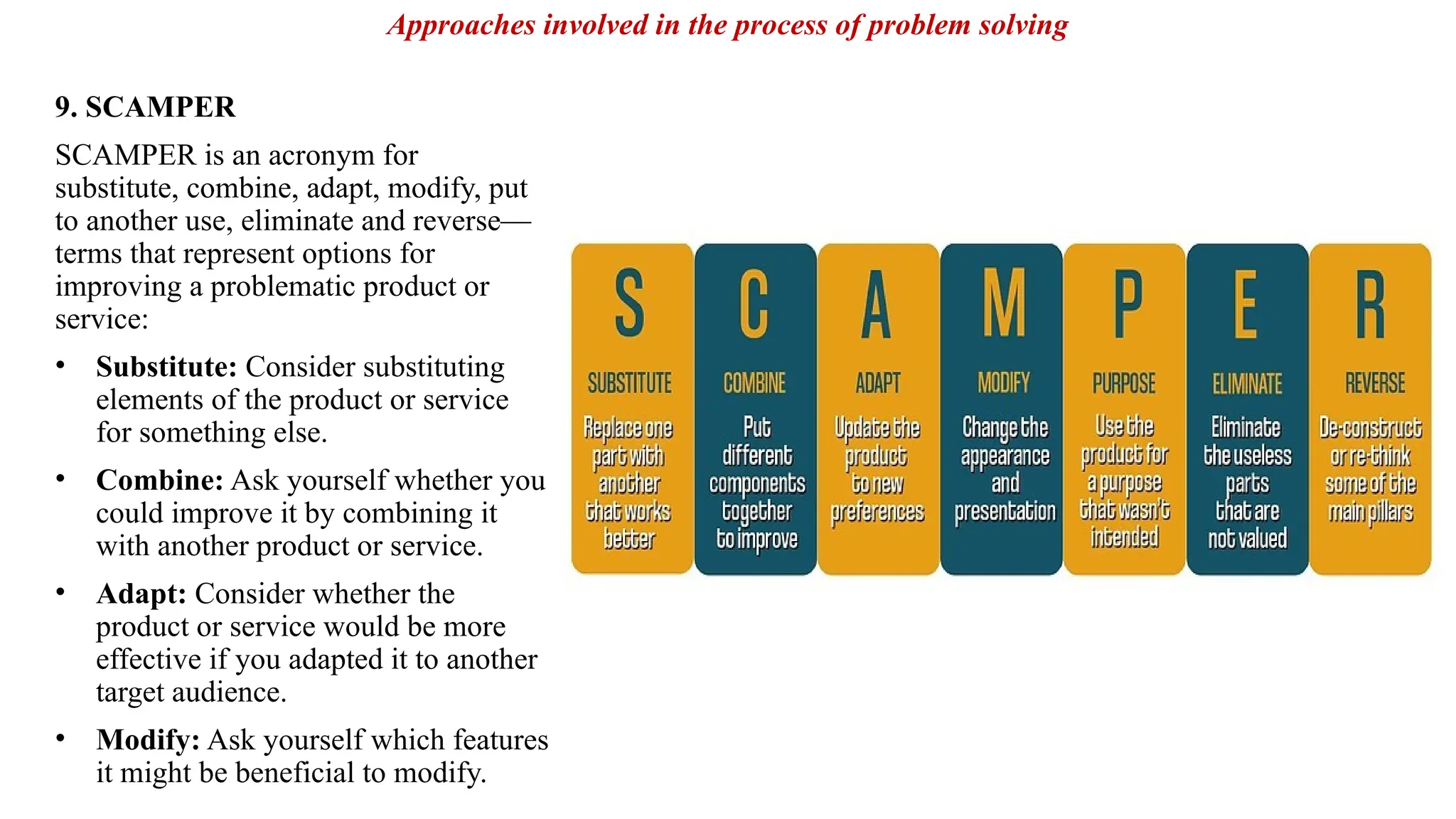
9. SCAMPER
SCAMPER is an acronym for
substitute, combine, adapt, modify, put
to another use, eliminate and reverseโ€”
terms that represent options for
improving a problematic product or
service:
โ€ข Substitute: Consider substituting
elements of the product or service
for something else.
โ€ข Combine: Ask yourself whether you
could improve it by combining it
with another product or service.
โ€ข Adapt: Consider whether the
product or service would be more
effective if you adapted it to another
target audience.
โ€ข Modify: Ask yourself which features
it might be beneficial to modify.
Approaches involved in the process of problem solving
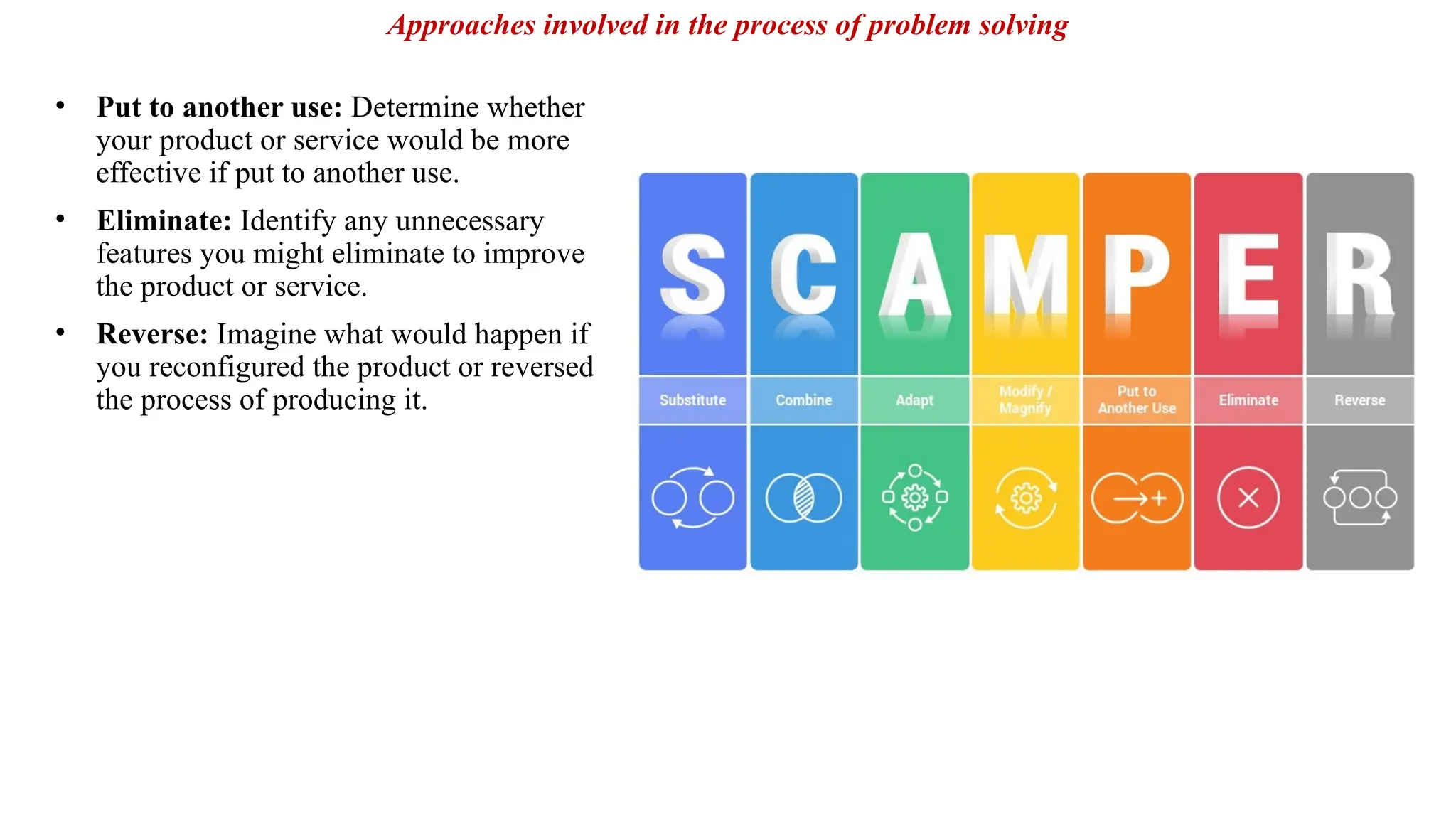
โ€ข Put to another use: Determine whether
your product or service would be more
effective if put to another use.
โ€ข Eliminate: Identify any unnecessary
features you might eliminate to improve
the product or service.
โ€ข Reverse: Imagine what would happen if
you reconfigured the product or reversed
the process of producing it.
Approaches involved in the process of problem solving
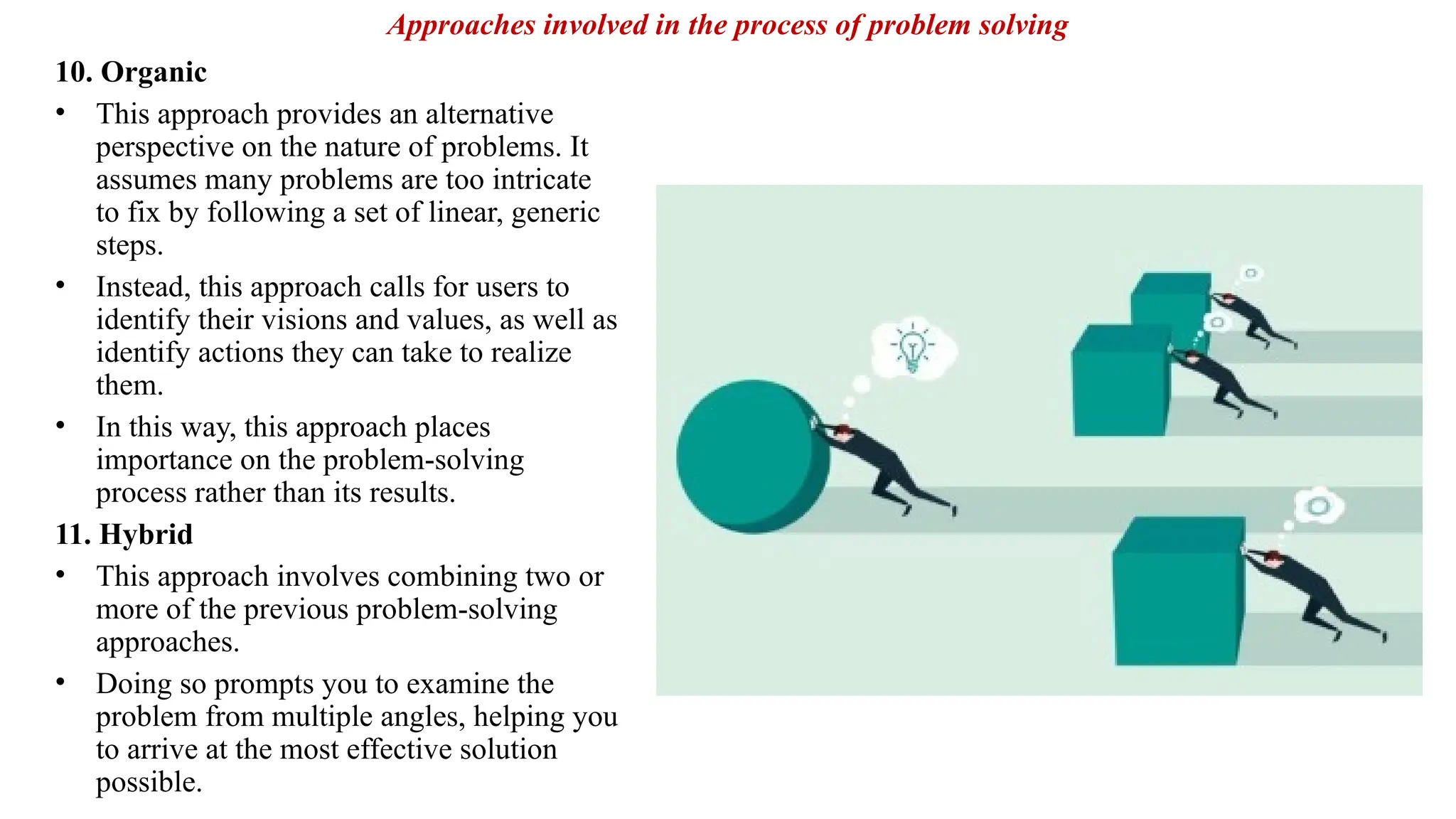
10. Organic
โ€ข This approach provides an alternative
perspective on the nature of problems. It
assumes many problems are too intricate
to fix by following a set of linear, generic
steps.
โ€ข Instead, this approach calls for users to
identify their visions and values, as well as
identify actions they can take to realize
them.
โ€ข In this way, this approach places
importance on the problem-solving
process rather than its results.
11. Hybrid
โ€ข This approach involves combining two or
more of the previous problem-solving
approaches.
โ€ข Doing so prompts you to examine the
problem from multiple angles, helping you
to arrive at the most effective solution
possible.
Approaches involved in the process of problem solving
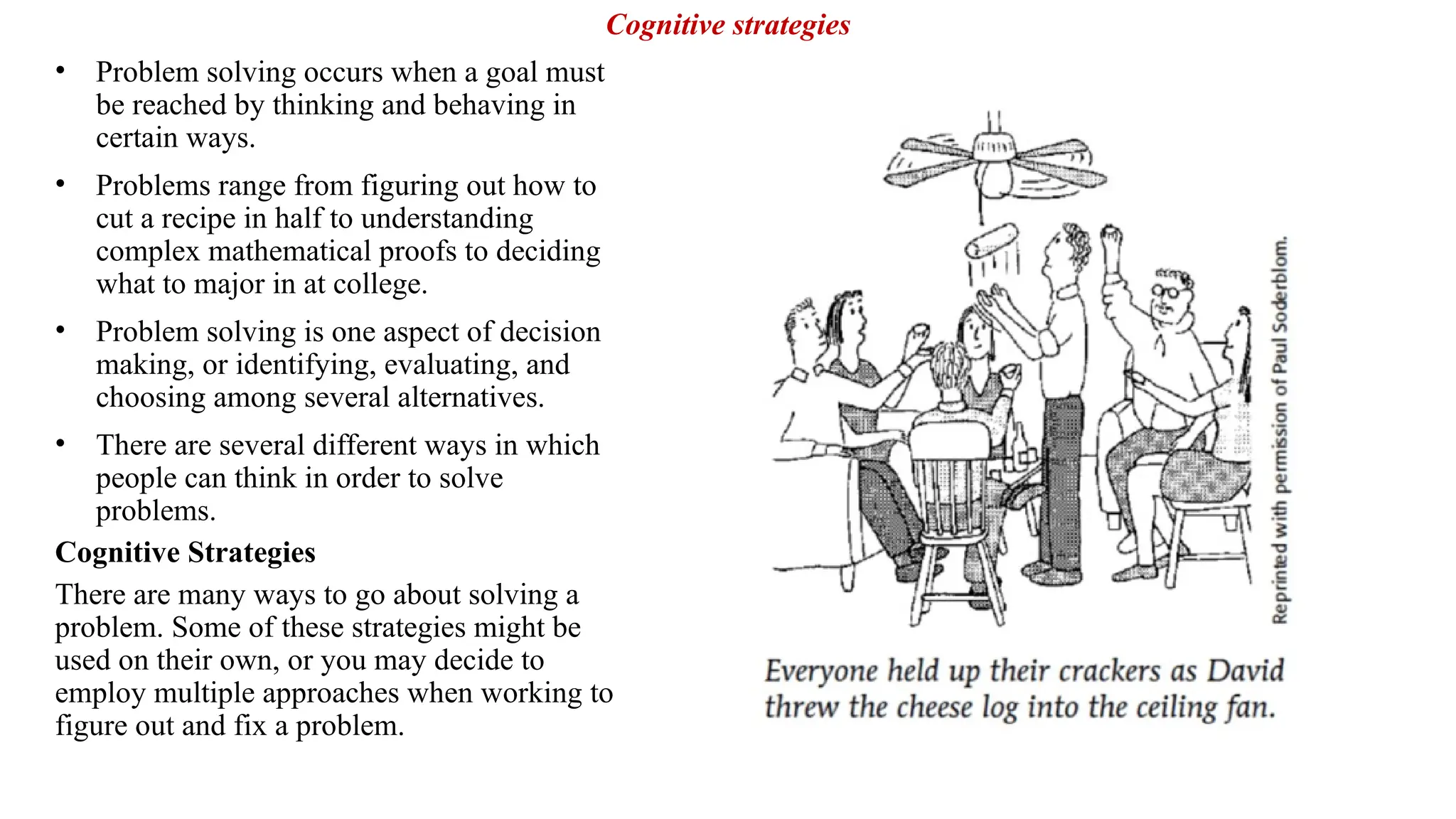
โ€ข Problem solving occurs when a goal must
be reached by thinking and behaving in
certain ways.
โ€ข Problems range from figuring out how to
cut a recipe in half to understanding
complex mathematical proofs to deciding
what to major in at college.
โ€ข Problem solving is one aspect of decision
making, or identifying, evaluating, and
choosing among several alternatives.
โ€ข There are several different ways in which
people can think in order to solve
problems.
Cognitive Strategies
There are many ways to go about solving a
problem. Some of these strategies might be
used on their own, or you may decide to
employ multiple approaches when working to
figure out and fix a problem.
Cognitive strategies
Trial and error (mechanical solutions)
โ€ข One method is to use trial and error, also
known as a mechanical solution. Trial and
error refers to trying one solution after
another until finding one that works.
โ€ข Mechanical solutions can also involve
solving by rote, or a learned set of rules.
This is how word problems were solved in
grade school, for example. One type of
rote solution is to use an algorithm.
โ€ข But if there are many different choices
available, narrowing down the possible
options using another problem-solving
technique can be helpful before attempting
trial and error.
Cognitive strategies
Algorithms
โ€ข Algorithms are specific, step-by-step
procedures for solving certain types of
problems.
โ€ข Algorithms will always result in a correct
solution if there is a correct solution to be
found and you have enough time to find it.
โ€ข Mathematical formulas are algorithms. But
algorithms arenโ€™t always practical to use.
โ€ข Computers can run searches like this one
very quickly, so the systematic search
algorithm is a useful part of some
computer programs
โ€ข However, they aren't always the best
approach to problem-solving, in part
because detecting patterns can be
incredibly time-consuming.
Cognitive strategies
Heuristics
โ€ข Unfortunately, humans arenโ€™t as fast as
computers and need some other way to
narrow down the possible solutions to
only a few.
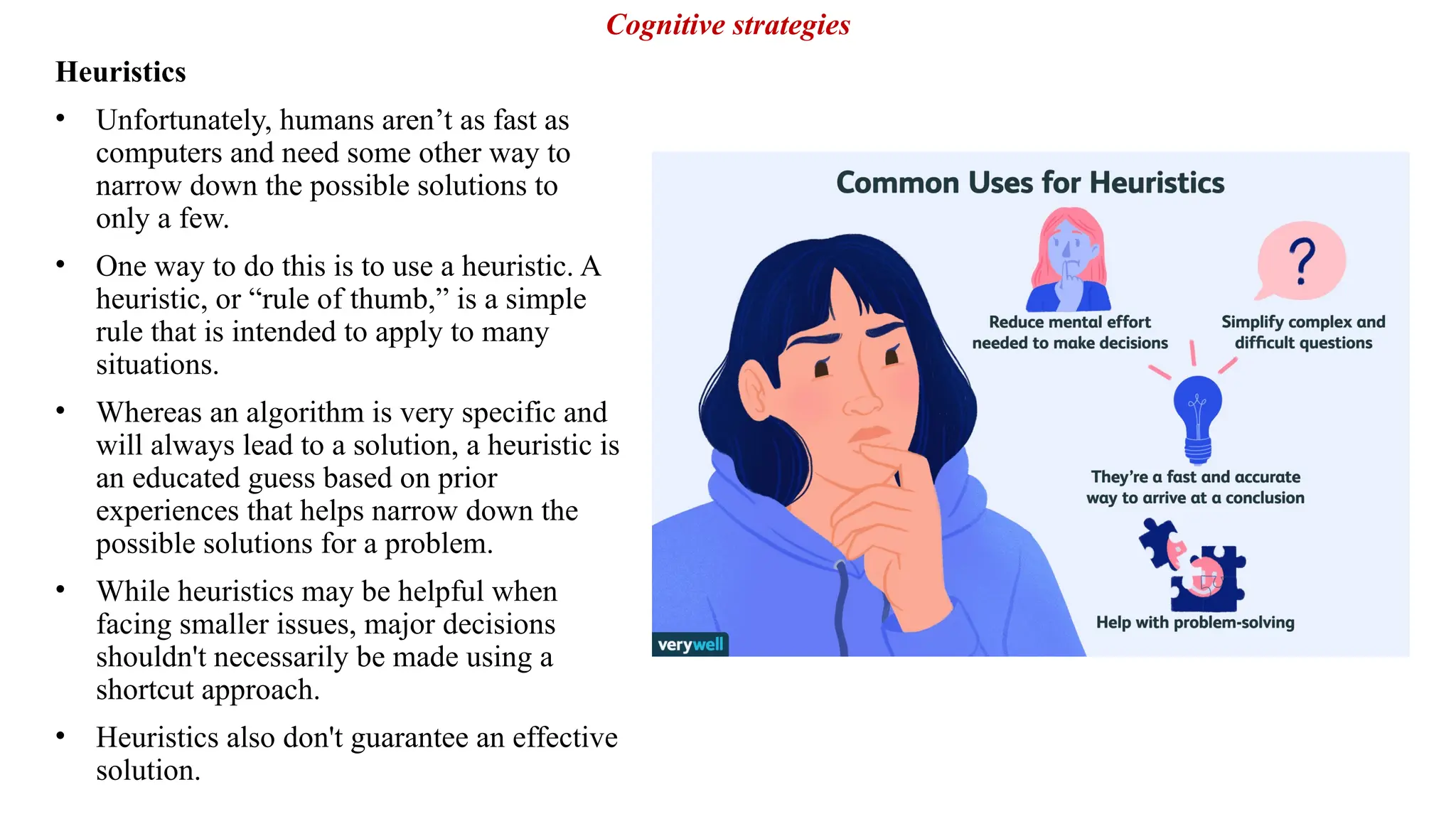
โ€ข One way to do this is to use a heuristic. A
heuristic, or โ€œrule of thumb,โ€ is a simple
rule that is intended to apply to many
situations.
โ€ข Whereas an algorithm is very specific and
will always lead to a solution, a heuristic is
an educated guess based on prior
experiences that helps narrow down the
possible solutions for a problem.
โ€ข While heuristics may be helpful when
facing smaller issues, major decisions
shouldn't necessarily be made using a
shortcut approach.
โ€ข Heuristics also don't guarantee an effective
solution.
Cognitive strategies
Representativeness heuristic
โ€ข Using a heuristic is faster than using an
algorithm in many cases, but unlike
algorithms, heuristics will not always lead
to the correct solution. What you gain in
speed is sometimes lost in accuracy.
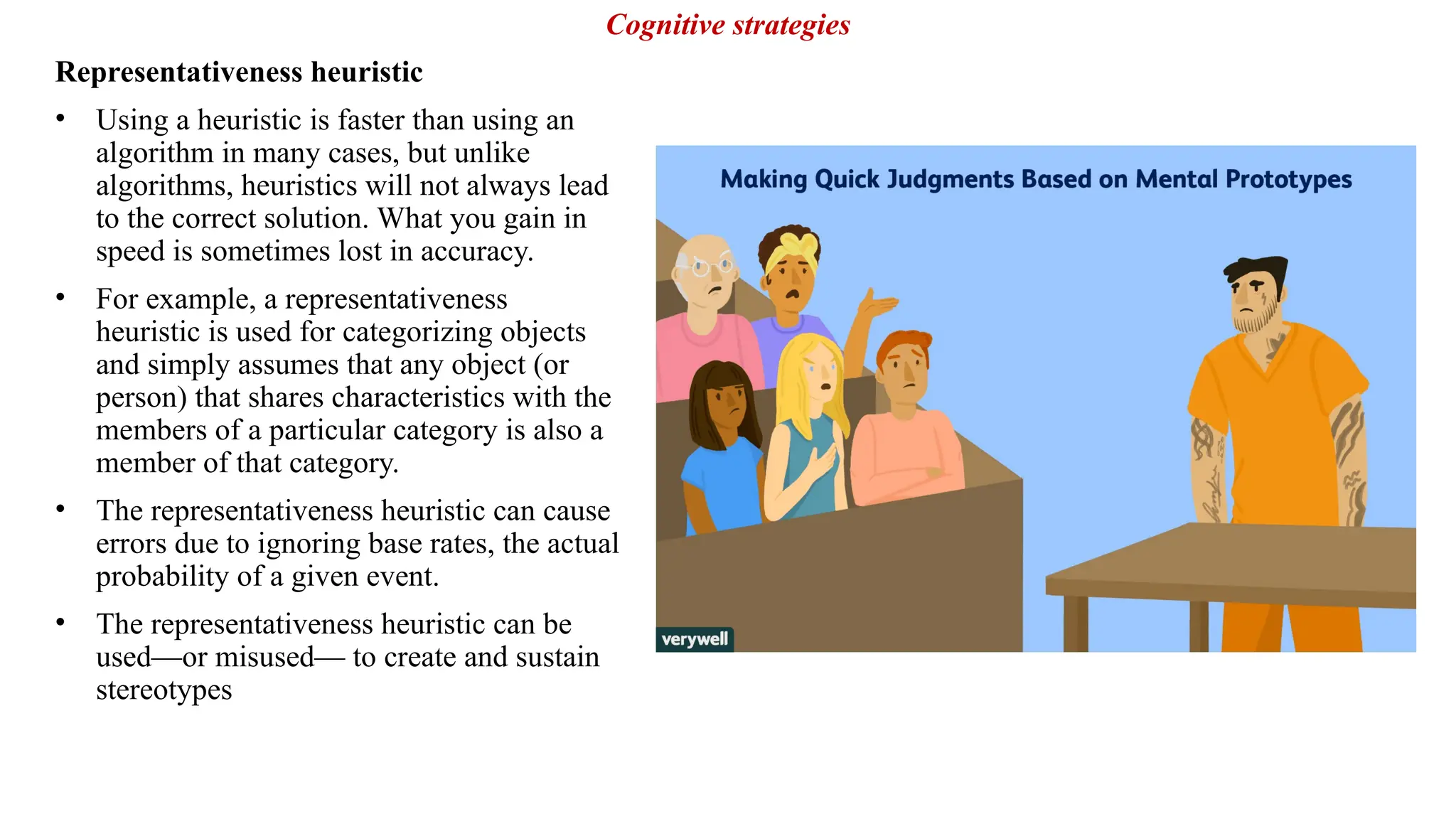
โ€ข For example, a representativeness
heuristic is used for categorizing objects
and simply assumes that any object (or
person) that shares characteristics with the
members of a particular category is also a
member of that category.
โ€ข The representativeness heuristic can cause
errors due to ignoring base rates, the actual
probability of a given event.
โ€ข The representativeness heuristic can be
usedโ€”or misusedโ€” to create and sustain
stereotypes
Cognitive strategies
Availability heuristic
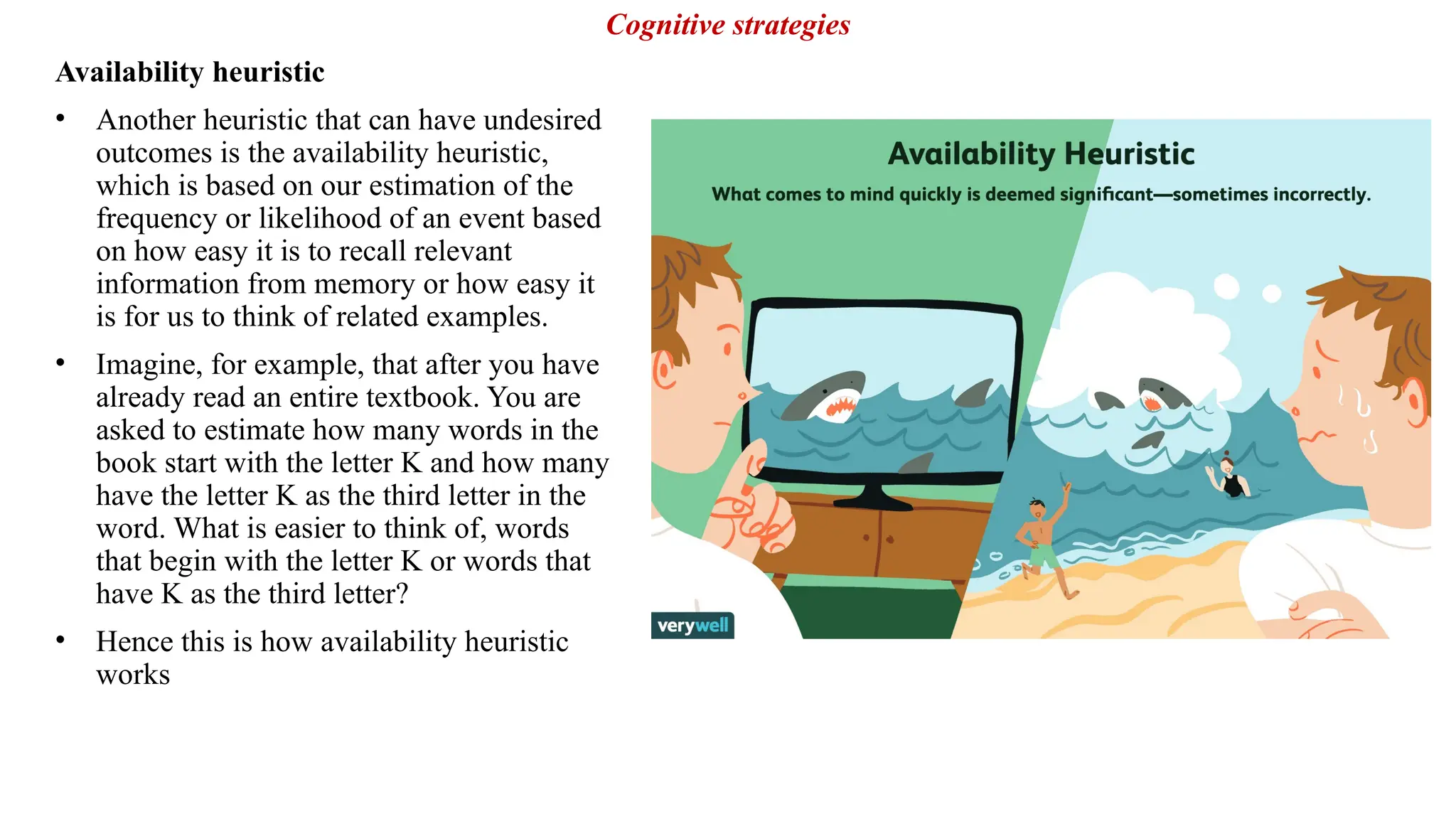
โ€ข Another heuristic that can have undesired
outcomes is the availability heuristic,
which is based on our estimation of the
frequency or likelihood of an event based
on how easy it is to recall relevant
information from memory or how easy it
is for us to think of related examples.
โ€ข Imagine, for example, that after you have
already read an entire textbook. You are
asked to estimate how many words in the
book start with the letter K and how many
have the letter K as the third letter in the
word. What is easier to think of, words
that begin with the letter K or words that
have K as the third letter?
โ€ข Hence this is how availability heuristic
works
Cognitive strategies
Working backward
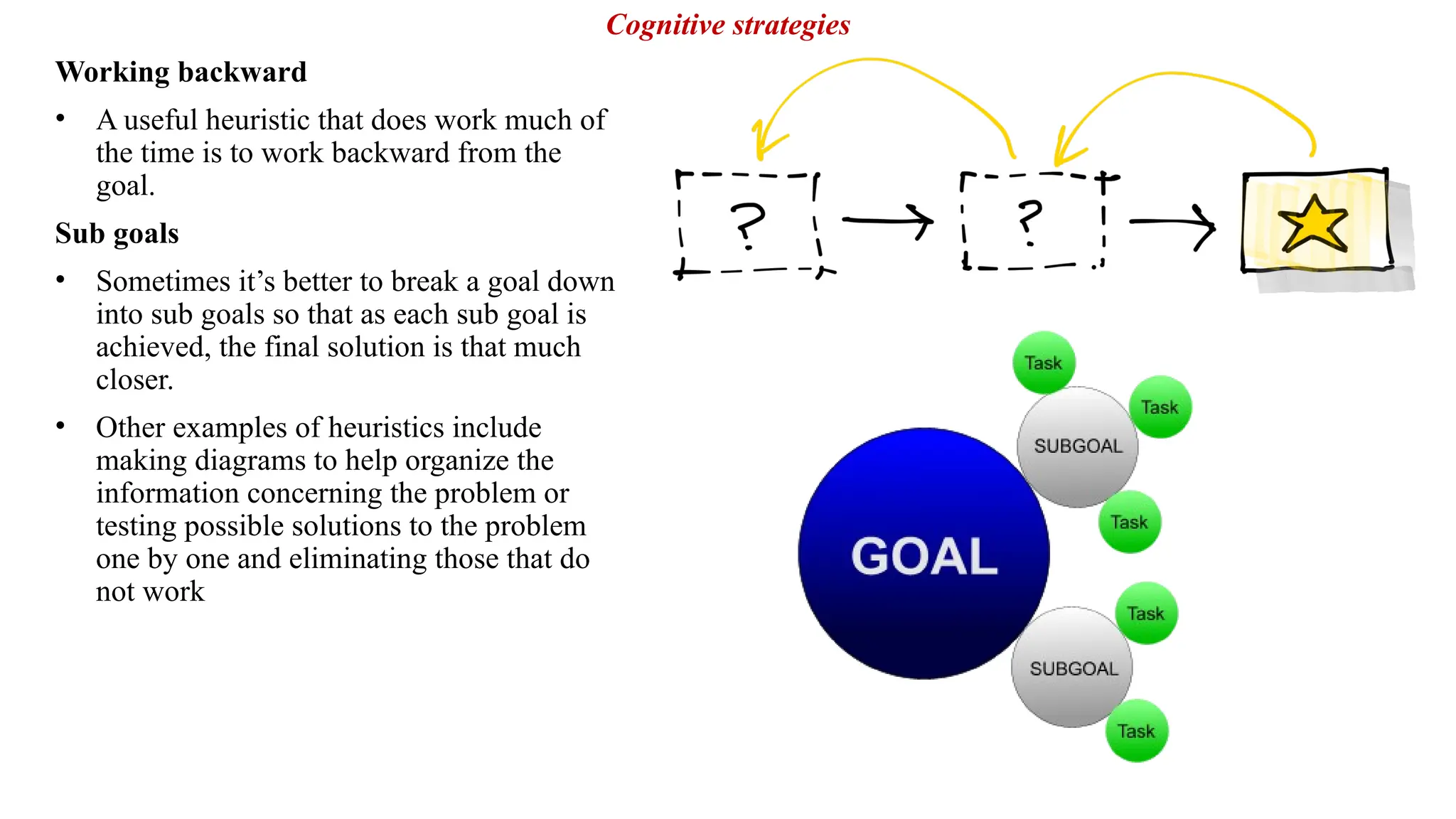
โ€ข A useful heuristic that does work much of
the time is to work backward from the
goal.
Sub goals
โ€ข Sometimes itโ€™s better to break a goal down
into sub goals so that as each sub goal is
achieved, the final solution is that much
closer.
โ€ข Other examples of heuristics include
making diagrams to help organize the
information concerning the problem or
testing possible solutions to the problem
one by one and eliminating those that do
not work
Cognitive strategies
Insight
โ€ข When the solution to a problem seems to
come suddenly to mind, it is called insight.
โ€ข In humans, insight often takes the form of
an โ€œaha!โ€ momentโ€”the solution seems to
come in a flash.
โ€ข A person may realize that this problem is
similar to another one that he or she
already knows how to solve or might see
that an object can be used for a different
purpose than its original one, like using a
dime as a screwdriver.
โ€ข What usually happens is that the mind
simply reorganizes a problem, sometimes
while the person is thinking about
something else
Cognitive strategies
โ€ข Sometimes a solution to a problem
remains just โ€œout of reachโ€ because the
elements of the problem are not arranged
properly or because people get stuck in
certain ways of thinking that act as
barriers to solving problems.
โ€ข Such ways of thinking occur more or less
automatically, influencing attempts to
solve problems without any conscious
awareness of that influence.
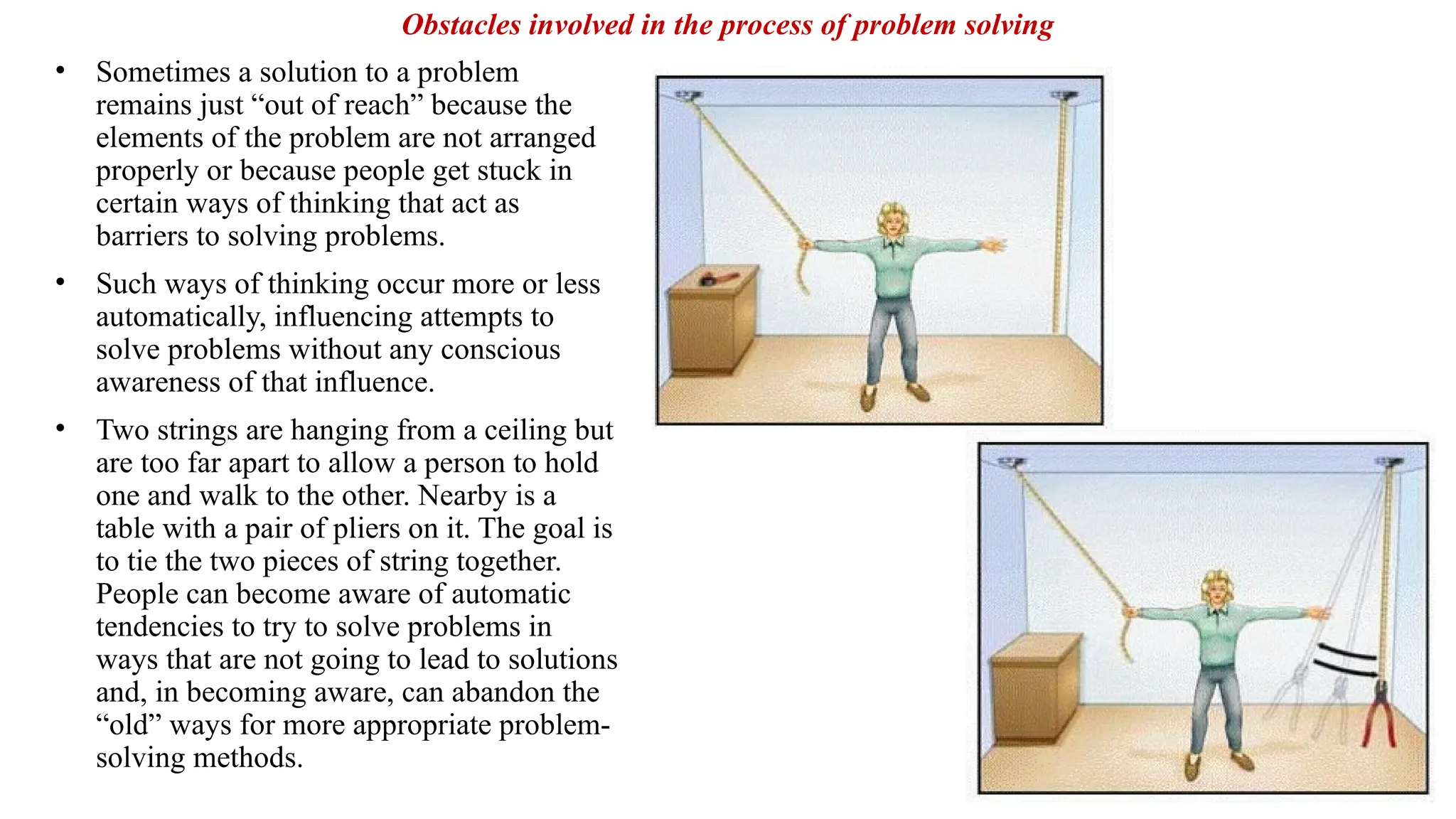
โ€ข Two strings are hanging from a ceiling but
are too far apart to allow a person to hold
one and walk to the other. Nearby is a
table with a pair of pliers on it. The goal is
to tie the two pieces of string together.
People can become aware of automatic
tendencies to try to solve problems in
ways that are not going to lead to solutions
and, in becoming aware, can abandon the
โ€œoldโ€ ways for more appropriate problem-
solving methods.
Obstacles involved in the process of problem solving
Functional fixedness
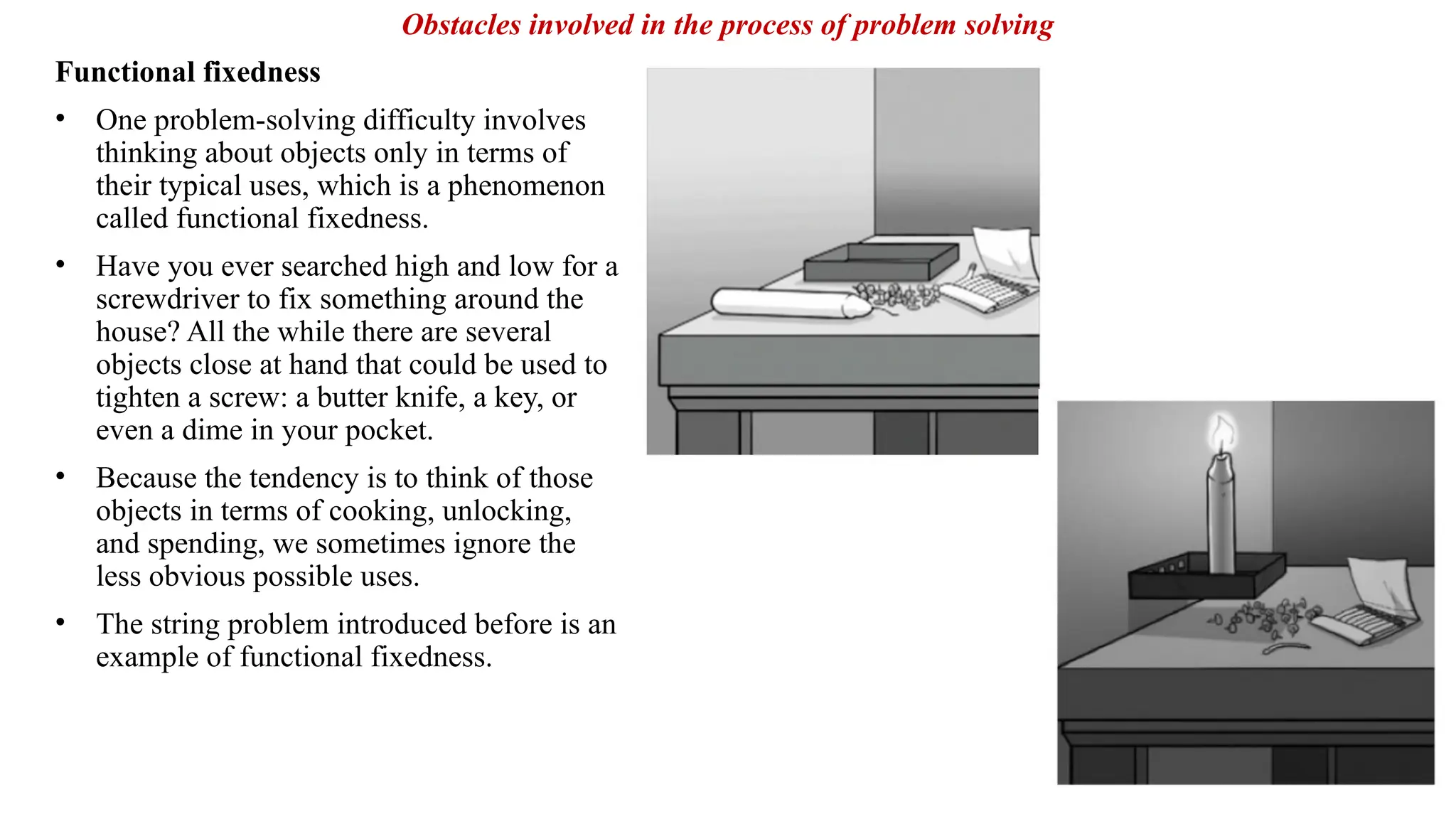
โ€ข One problem-solving difficulty involves
thinking about objects only in terms of
their typical uses, which is a phenomenon
called functional fixedness.
โ€ข Have you ever searched high and low for a
screwdriver to fix something around the
house? All the while there are several
objects close at hand that could be used to
tighten a screw: a butter knife, a key, or
even a dime in your pocket.
โ€ข Because the tendency is to think of those
objects in terms of cooking, unlocking,
and spending, we sometimes ignore the
less obvious possible uses.
โ€ข The string problem introduced before is an
example of functional fixedness.
Obstacles involved in the process of problem solving
Mental sets
โ€ข Functional fixedness is actually a kind of
mental set, which is defined as the
tendency for people to persist in using
problem-solving patterns that have worked
for them in the past.
โ€ข Solutions that have worked in the past
tend to be the ones people try first, and
people are often hesitant or even unable to
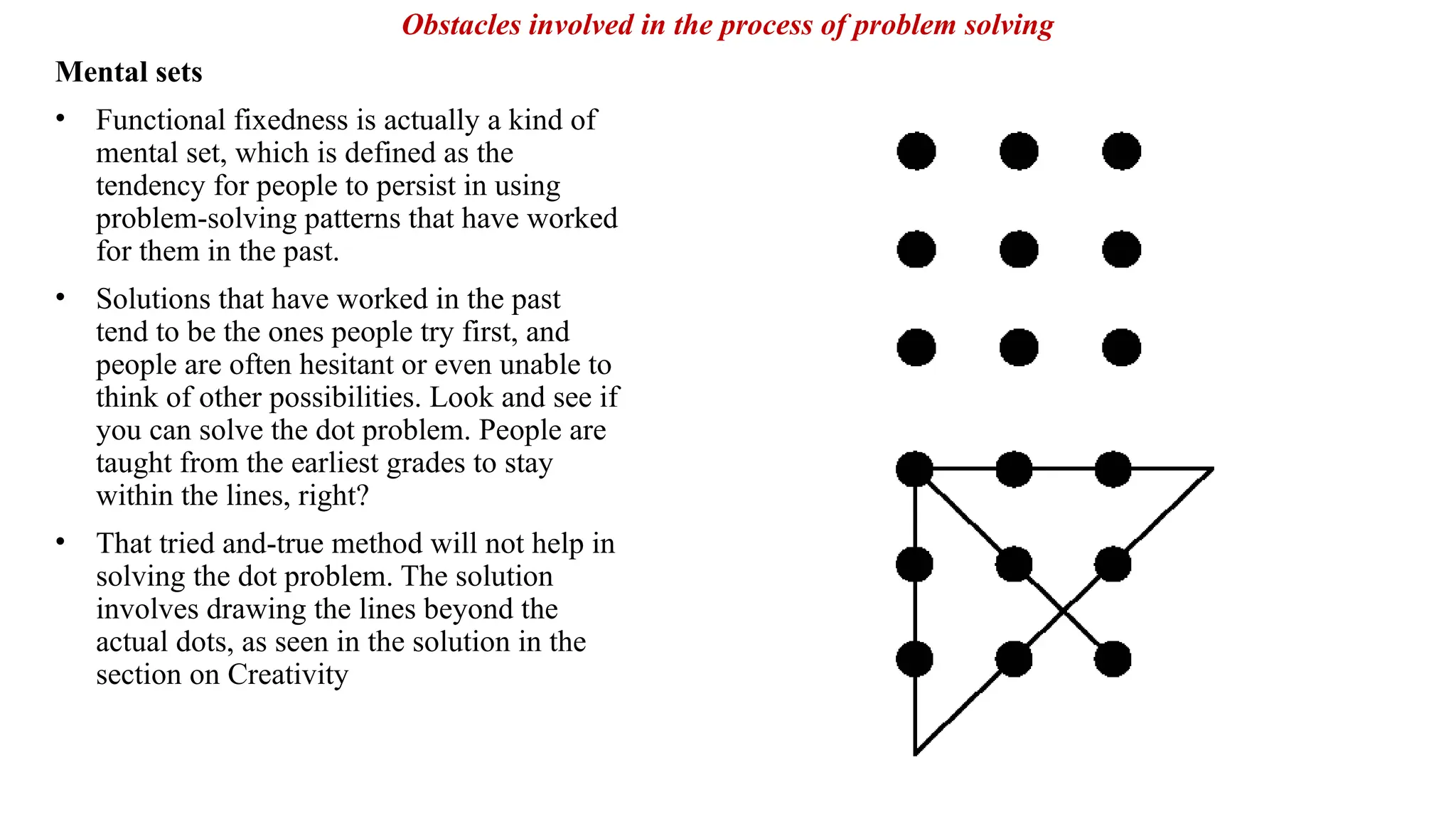
think of other possibilities. Look and see if
you can solve the dot problem. People are
taught from the earliest grades to stay
within the lines, right?
โ€ข That tried and-true method will not help in
solving the dot problem. The solution
involves drawing the lines beyond the
actual dots, as seen in the solution in the
section on Creativity
Obstacles involved in the process of problem solving
Confirmation bias
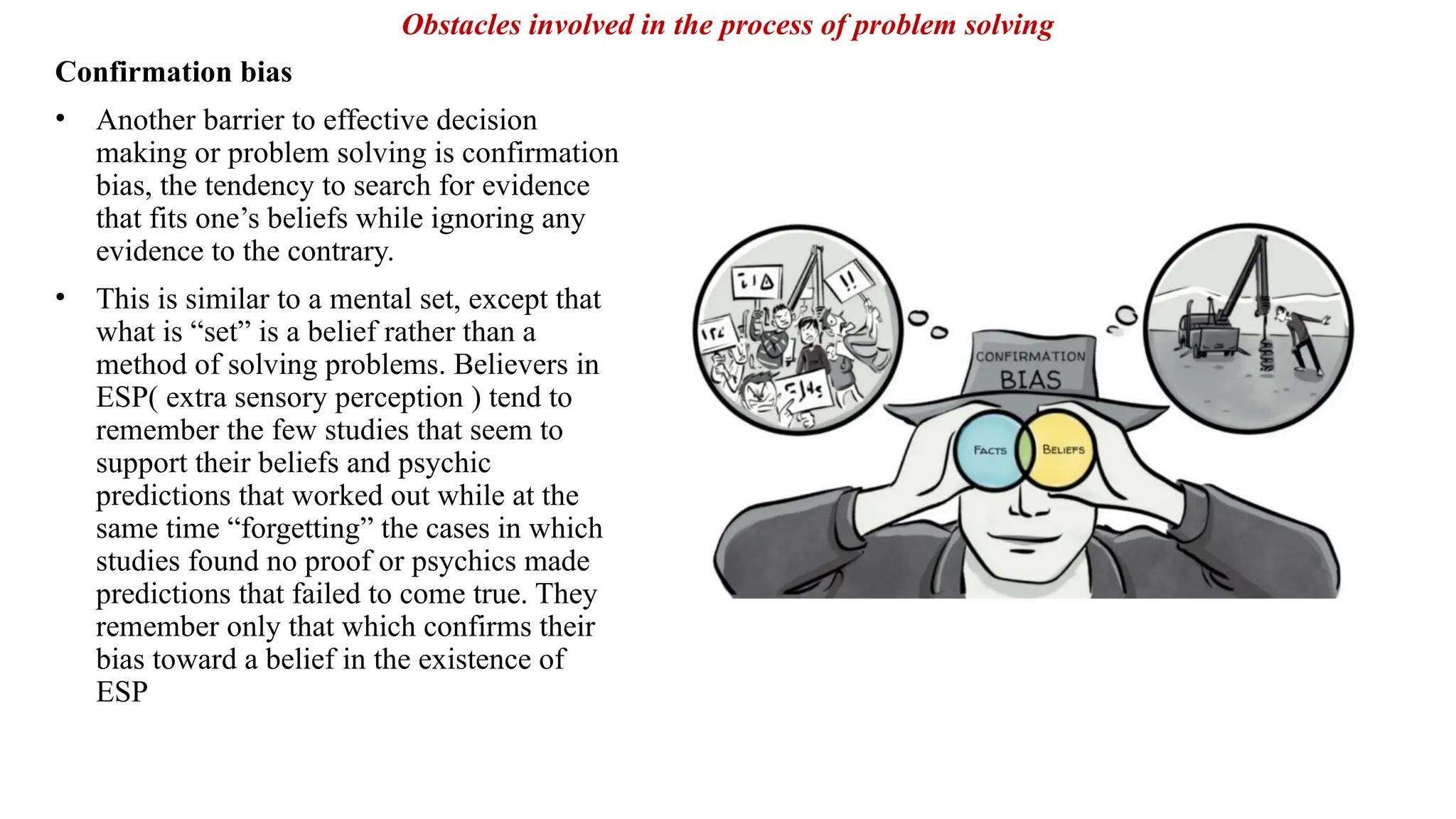
โ€ข Another barrier to effective decision
making or problem solving is confirmation
bias, the tendency to search for evidence
that fits oneโ€™s beliefs while ignoring any
evidence to the contrary.
โ€ข This is similar to a mental set, except that
what is โ€œsetโ€ is a belief rather than a
method of solving problems. Believers in
ESP( extra sensory perception ) tend to
remember the few studies that seem to
support their beliefs and psychic
predictions that worked out while at the
same time โ€œforgettingโ€ the cases in which
studies found no proof or psychics made
predictions that failed to come true. They
remember only that which confirms their
bias toward a belief in the existence of
ESP
Obstacles involved in the process of problem solving
Assumptions:
โ€ข When dealing with a problem, people can
make assumptions about the constraints
and obstacles that prevent certain
solutions.
โ€ข Thus, they may not even try some
potential options.
Irrelevant or misleading information:
โ€ข When trying to solve a problem, it's
important to distinguish between
information that is relevant to the issue
and irrelevant data that can lead to faulty
solutions.
โ€ข The more complex the problem, the easier
it is to focus on misleading or irrelevant
information.
Obstacles involved in the process of problem solving

Cognitive strategies for problem solving

  • 1.
    Cognitive psychology Steps &approaches & Obstacles in the process of Problem solving Cognitive strategies
  • 2.
    There are ingeneral 8 broader steps involved in the process of problem solving Step 1: Define the Problem โ€ข What is the problem? โ€ข How did you discover the problem? โ€ข When did the problem start and how long has this problem been going on? โ€ข Is there enough data available to contain the problem and prevent it from getting passed to the next process step? If yes, contain the problem. Steps involved in the process of problem solving
  • 3.
    Step 2: Clarifythe Problem โ€ข What data is available or needed to help clarify, or fully understand the problem? โ€ข Is it a top priority to resolve the problem at this point in time? โ€ข Are additional resources required to clarify the problem? If yes, elevate the problem to your leader to help locate the right resources and form a team. โ€ข Ensure the problem is contained and does not get passed to the next process step. Steps involved in the process of problem solving
  • 4.
    Step 3: Definethe Goals โ€ข What is your end goal or desired future state? โ€ข What will you accomplish if you fix this problem? โ€ข What is the desired timeline for solving this problem? Step 4: Identify Root Cause of the Problem โ€ข Identify possible causes of the problem. โ€ข Prioritize possible root causes of the problem. โ€ข What information or data is there to validate the root cause? Steps involved in the process of problem solving
  • 5.
    Step 5: DevelopAction Plan โ€ข Generate a list of actions required to address the root cause and prevent problem from getting to others. โ€ข Assign an owner and timeline to each action. โ€ข Status actions to ensure completion. Step 6: Execute Action Plan โ€ข Implement action plan to address the root cause. โ€ข Verify actions are completed. Steps involved in the process of problem solving
  • 6.
    Step 7: Evaluatethe Results โ€ข Monitor and Collect Data. โ€ข Did you meet your goals defined in step 3? If not, repeat the 8-Step Process. โ€ข Were there any unforeseen consequences? โ€ข If problem is resolved, remove activities that were added previously to contain the problem. Step 8: Continuously Improve โ€ข Look for additional opportunities to implement solution. โ€ข Ensure problem will not come back and communicate lessons learned. โ€ข If needed, repeat the 8-Step Problem Solving Process to drive further improvements. Steps involved in the process of problem solving
  • 7.
    1. Rational โ€ข Oneof the most common problem-solving approaches โ€ข A multi-step process that works well for a wide range of problems. โ€ข Many other problem-solving techniques mirror or build off of its seven steps, so it may be helpful to begin with the rational approach before moving on to other techniques. Here are the seven steps of the rational approach: 1. Define the problem. 2. Identify possible causes. 3. Brainstorm options to solve the problem. 4. Select an option. 5. Create an implementation plan. 6. Execute the plan and monitor the results. 7. Evaluate the solution Approaches involved in the process of problem solving
  • 8.
    2. Collaborative โ€ข Thisapproach involves including multiple people in the problem-solving process. โ€ข Brainstorming should include a diverse group of stakeholders: people who are affected by the problem and/or may be affected by any changes made in an attempt to solve it. โ€ข Seek continuous feedback from these stakeholders as you monitor the implementation of your solution to make sure it works well for everyone. 3. Creative โ€ข The creative approach mirrors the rational approach but places greater emphasis on the brainstorming phase. โ€ข People using the creative approach utilize ideation techniques such as mind mapping, storyboards and analogies. Approaches involved in the process of problem solving
  • 9.
    3. Historical โ€ข Thehistorical approach is helpful when the problem you're facing has precedent within your field or industry. โ€ข Researching how others have solved the problem can guide you as you develop your own solution. 4. The 5 Whys โ€ข This approach can help you get to the root of a complex problem. Begin by asking why the problem occurred, and then ask the same question about your response. โ€ข For example, if you answer that productivity has stagnated because morale is low, follow up by asking, "Why is morale low?" Ask "why" a total of five times. โ€ข Doing so will help you find the problem's root cause. Approaches involved in the process of problem solving
  • 10.
    5. The SimplexProcess โ€ข The Simplex Process is an eight-step approach similar to the rational approach, but tailored for situations in which you are unsure of what the problem actually is. โ€ข It begins with problem-finding and research, where users collect the information necessary for defining the problem. โ€ข Users then move through idea-finding, evaluation and selection and planning. โ€ข They then encourage their peers and stakeholders to take active roles in implementing their plan, to soften any resistance to change. โ€ข Finally, users execute their plan and monitor the results. Approaches involved in the process of problem solving
  • 11.
    6. Issue-Based โ€ข Afive-step approach often employed in consulting firms, the issue-based approach is useful when helping another person solve a problem they're facing. โ€ข The user first creates a proposal that defines the problem and inventories the client's expectations. โ€ข Next, the user diagrams the smaller issues that comprise the problem, then uses this diagram to help them design a solution. โ€ข The user then conducts extensive research and synthesizes their data into a revised solution. โ€ข Finally, they present their materials to the client and demonstrate why their solution is effective. Approaches involved in the process of problem solving
  • 12.
    7. Failure Modeand Effects Analysis (FMEA) โ€ข FEMA is unique among problem-solving approaches in that its goal is generally to preempt problems. โ€ข A team of experts lists the functions of a product and then identifies every possible failure for each function. โ€ข The team estimates the probability that each failure will occur, then rates its severity and detectability. โ€ข The team uses these figures to calculate the risk priority number of each failure, revealing which problems should be addressed first. Approaches involved in the process of problem solving
  • 13.
    8. Means-End Analysis โ€ขMeans-end analysis is especially useful for big-picture problems because it shifts the focus from the problem itselfโ€”which might feel overwhelmingโ€”to the goal that you want to achieve. โ€ข After envisioning your goal, you can work backward to identify the obstacles that lie in your path. โ€ข Overcoming these smaller obstacles one at a time makes solving a large problem more manageable. โ€ข Conversely, having an ultimate goal in mind can guide your decision-making as you address the smaller obstacles in your path. Approaches involved in the process of problem solving
  • 14.
    9. SCAMPER SCAMPER isan acronym for substitute, combine, adapt, modify, put to another use, eliminate and reverseโ€” terms that represent options for improving a problematic product or service: โ€ข Substitute: Consider substituting elements of the product or service for something else. โ€ข Combine: Ask yourself whether you could improve it by combining it with another product or service. โ€ข Adapt: Consider whether the product or service would be more effective if you adapted it to another target audience. โ€ข Modify: Ask yourself which features it might be beneficial to modify. Approaches involved in the process of problem solving
  • 15.
    โ€ข Put toanother use: Determine whether your product or service would be more effective if put to another use. โ€ข Eliminate: Identify any unnecessary features you might eliminate to improve the product or service. โ€ข Reverse: Imagine what would happen if you reconfigured the product or reversed the process of producing it. Approaches involved in the process of problem solving
  • 16.
    10. Organic โ€ข Thisapproach provides an alternative perspective on the nature of problems. It assumes many problems are too intricate to fix by following a set of linear, generic steps. โ€ข Instead, this approach calls for users to identify their visions and values, as well as identify actions they can take to realize them. โ€ข In this way, this approach places importance on the problem-solving process rather than its results. 11. Hybrid โ€ข This approach involves combining two or more of the previous problem-solving approaches. โ€ข Doing so prompts you to examine the problem from multiple angles, helping you to arrive at the most effective solution possible. Approaches involved in the process of problem solving
  • 17.
    โ€ข Problem solvingoccurs when a goal must be reached by thinking and behaving in certain ways. โ€ข Problems range from figuring out how to cut a recipe in half to understanding complex mathematical proofs to deciding what to major in at college. โ€ข Problem solving is one aspect of decision making, or identifying, evaluating, and choosing among several alternatives. โ€ข There are several different ways in which people can think in order to solve problems. Cognitive Strategies There are many ways to go about solving a problem. Some of these strategies might be used on their own, or you may decide to employ multiple approaches when working to figure out and fix a problem. Cognitive strategies
  • 18.
    Trial and error(mechanical solutions) โ€ข One method is to use trial and error, also known as a mechanical solution. Trial and error refers to trying one solution after another until finding one that works. โ€ข Mechanical solutions can also involve solving by rote, or a learned set of rules. This is how word problems were solved in grade school, for example. One type of rote solution is to use an algorithm. โ€ข But if there are many different choices available, narrowing down the possible options using another problem-solving technique can be helpful before attempting trial and error. Cognitive strategies
  • 19.
    Algorithms โ€ข Algorithms arespecific, step-by-step procedures for solving certain types of problems. โ€ข Algorithms will always result in a correct solution if there is a correct solution to be found and you have enough time to find it. โ€ข Mathematical formulas are algorithms. But algorithms arenโ€™t always practical to use. โ€ข Computers can run searches like this one very quickly, so the systematic search algorithm is a useful part of some computer programs โ€ข However, they aren't always the best approach to problem-solving, in part because detecting patterns can be incredibly time-consuming. Cognitive strategies
  • 20.
    Heuristics โ€ข Unfortunately, humansarenโ€™t as fast as computers and need some other way to narrow down the possible solutions to only a few. โ€ข One way to do this is to use a heuristic. A heuristic, or โ€œrule of thumb,โ€ is a simple rule that is intended to apply to many situations. โ€ข Whereas an algorithm is very specific and will always lead to a solution, a heuristic is an educated guess based on prior experiences that helps narrow down the possible solutions for a problem. โ€ข While heuristics may be helpful when facing smaller issues, major decisions shouldn't necessarily be made using a shortcut approach. โ€ข Heuristics also don't guarantee an effective solution. Cognitive strategies
  • 21.
    Representativeness heuristic โ€ข Usinga heuristic is faster than using an algorithm in many cases, but unlike algorithms, heuristics will not always lead to the correct solution. What you gain in speed is sometimes lost in accuracy. โ€ข For example, a representativeness heuristic is used for categorizing objects and simply assumes that any object (or person) that shares characteristics with the members of a particular category is also a member of that category. โ€ข The representativeness heuristic can cause errors due to ignoring base rates, the actual probability of a given event. โ€ข The representativeness heuristic can be usedโ€”or misusedโ€” to create and sustain stereotypes Cognitive strategies
  • 22.
    Availability heuristic โ€ข Anotherheuristic that can have undesired outcomes is the availability heuristic, which is based on our estimation of the frequency or likelihood of an event based on how easy it is to recall relevant information from memory or how easy it is for us to think of related examples. โ€ข Imagine, for example, that after you have already read an entire textbook. You are asked to estimate how many words in the book start with the letter K and how many have the letter K as the third letter in the word. What is easier to think of, words that begin with the letter K or words that have K as the third letter? โ€ข Hence this is how availability heuristic works Cognitive strategies
  • 23.
    Working backward โ€ข Auseful heuristic that does work much of the time is to work backward from the goal. Sub goals โ€ข Sometimes itโ€™s better to break a goal down into sub goals so that as each sub goal is achieved, the final solution is that much closer. โ€ข Other examples of heuristics include making diagrams to help organize the information concerning the problem or testing possible solutions to the problem one by one and eliminating those that do not work Cognitive strategies
  • 24.
    Insight โ€ข When thesolution to a problem seems to come suddenly to mind, it is called insight. โ€ข In humans, insight often takes the form of an โ€œaha!โ€ momentโ€”the solution seems to come in a flash. โ€ข A person may realize that this problem is similar to another one that he or she already knows how to solve or might see that an object can be used for a different purpose than its original one, like using a dime as a screwdriver. โ€ข What usually happens is that the mind simply reorganizes a problem, sometimes while the person is thinking about something else Cognitive strategies
  • 25.
    โ€ข Sometimes asolution to a problem remains just โ€œout of reachโ€ because the elements of the problem are not arranged properly or because people get stuck in certain ways of thinking that act as barriers to solving problems. โ€ข Such ways of thinking occur more or less automatically, influencing attempts to solve problems without any conscious awareness of that influence. โ€ข Two strings are hanging from a ceiling but are too far apart to allow a person to hold one and walk to the other. Nearby is a table with a pair of pliers on it. The goal is to tie the two pieces of string together. People can become aware of automatic tendencies to try to solve problems in ways that are not going to lead to solutions and, in becoming aware, can abandon the โ€œoldโ€ ways for more appropriate problem- solving methods. Obstacles involved in the process of problem solving
  • 26.
    Functional fixedness โ€ข Oneproblem-solving difficulty involves thinking about objects only in terms of their typical uses, which is a phenomenon called functional fixedness. โ€ข Have you ever searched high and low for a screwdriver to fix something around the house? All the while there are several objects close at hand that could be used to tighten a screw: a butter knife, a key, or even a dime in your pocket. โ€ข Because the tendency is to think of those objects in terms of cooking, unlocking, and spending, we sometimes ignore the less obvious possible uses. โ€ข The string problem introduced before is an example of functional fixedness. Obstacles involved in the process of problem solving
  • 27.
    Mental sets โ€ข Functionalfixedness is actually a kind of mental set, which is defined as the tendency for people to persist in using problem-solving patterns that have worked for them in the past. โ€ข Solutions that have worked in the past tend to be the ones people try first, and people are often hesitant or even unable to think of other possibilities. Look and see if you can solve the dot problem. People are taught from the earliest grades to stay within the lines, right? โ€ข That tried and-true method will not help in solving the dot problem. The solution involves drawing the lines beyond the actual dots, as seen in the solution in the section on Creativity Obstacles involved in the process of problem solving
  • 28.
    Confirmation bias โ€ข Anotherbarrier to effective decision making or problem solving is confirmation bias, the tendency to search for evidence that fits oneโ€™s beliefs while ignoring any evidence to the contrary. โ€ข This is similar to a mental set, except that what is โ€œsetโ€ is a belief rather than a method of solving problems. Believers in ESP( extra sensory perception ) tend to remember the few studies that seem to support their beliefs and psychic predictions that worked out while at the same time โ€œforgettingโ€ the cases in which studies found no proof or psychics made predictions that failed to come true. They remember only that which confirms their bias toward a belief in the existence of ESP Obstacles involved in the process of problem solving
  • 29.
    Assumptions: โ€ข When dealingwith a problem, people can make assumptions about the constraints and obstacles that prevent certain solutions. โ€ข Thus, they may not even try some potential options. Irrelevant or misleading information: โ€ข When trying to solve a problem, it's important to distinguish between information that is relevant to the issue and irrelevant data that can lead to faulty solutions. โ€ข The more complex the problem, the easier it is to focus on misleading or irrelevant information. Obstacles involved in the process of problem solving