Probability
of Simple
Events
Probability of Simple Events
Objective:
You will be able to find the probability of a
simple event.
You will be able to understand the distinction
between simple events and compound events.
Essential Question:
(1) How do I find the probability of a simple
event?
(2) How can I distinguish between a simple and
compound event?
Probability of Simple Events
Vocabulary:
 Outcome – one possible result of a probability.
 Sample Space – the list of possible outcomes
for a probability event.
 Random – outcomes that occur at random if
each outcome is equally likely to occur.
 Simple Event – a specific outcome or type of
outcome.
 Complementary Events – the events of one
outcome happening and that outcomes not
happening are complimentary; the sum of the
probabilities of complementary events is 1.
Real World Example:
Best Buy is having an IPOD giveaway.
They put all the IPOD Shuffles in a
bag. Customers may choose an IPOD
without looking at the color. Inside the
bag are 4 orange, 5 blue, 6 green, and
5 pink IPODS. If Maria chooses one
IPOD at random, what is the probability
she will choose an orange IPOD?
Probability of Simple Events
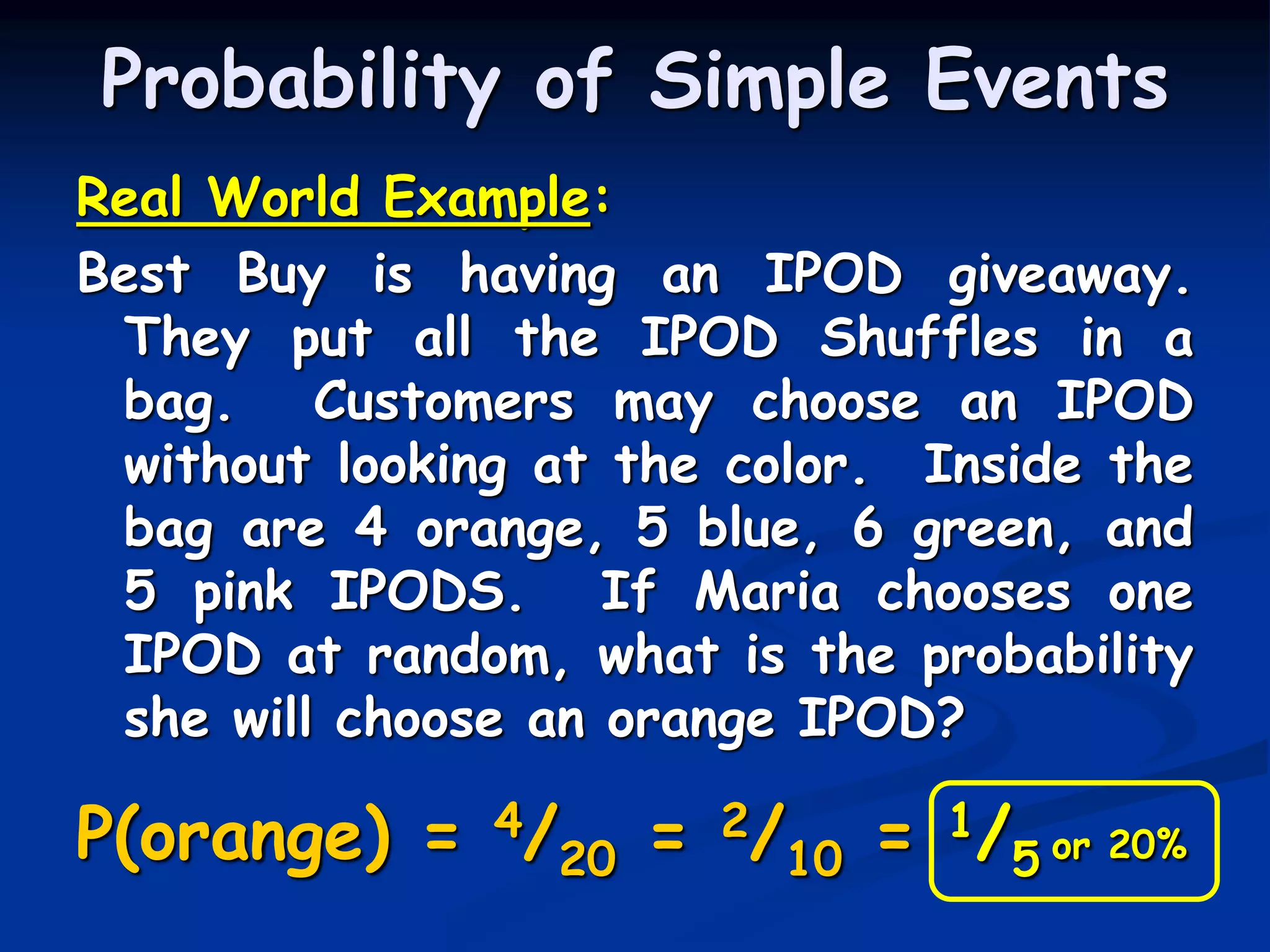
Real World Example:
Best Buy is having an IPOD giveaway.
They put all the IPOD Shuffles in a
bag. Customers may choose an IPOD
without looking at the color. Inside the
bag are 4 orange, 5 blue, 6 green, and
5 pink IPODS. If Maria chooses one
IPOD at random, what is the probability
she will choose an orange IPOD?
P(orange) = 4/20 = 2/10 = 1/5 or 20%
Probability of Simple Events
What is a PROBABILITY?
- Probability is the chance that some
event will happen
- It is the ratio of the number of
ways a certain event can occur to
the number of possible outcomes
Probability of Simple Events
Probability
 Refers to the likelihood for
something to happen.
 It is also often refers to as the
measure of chances.
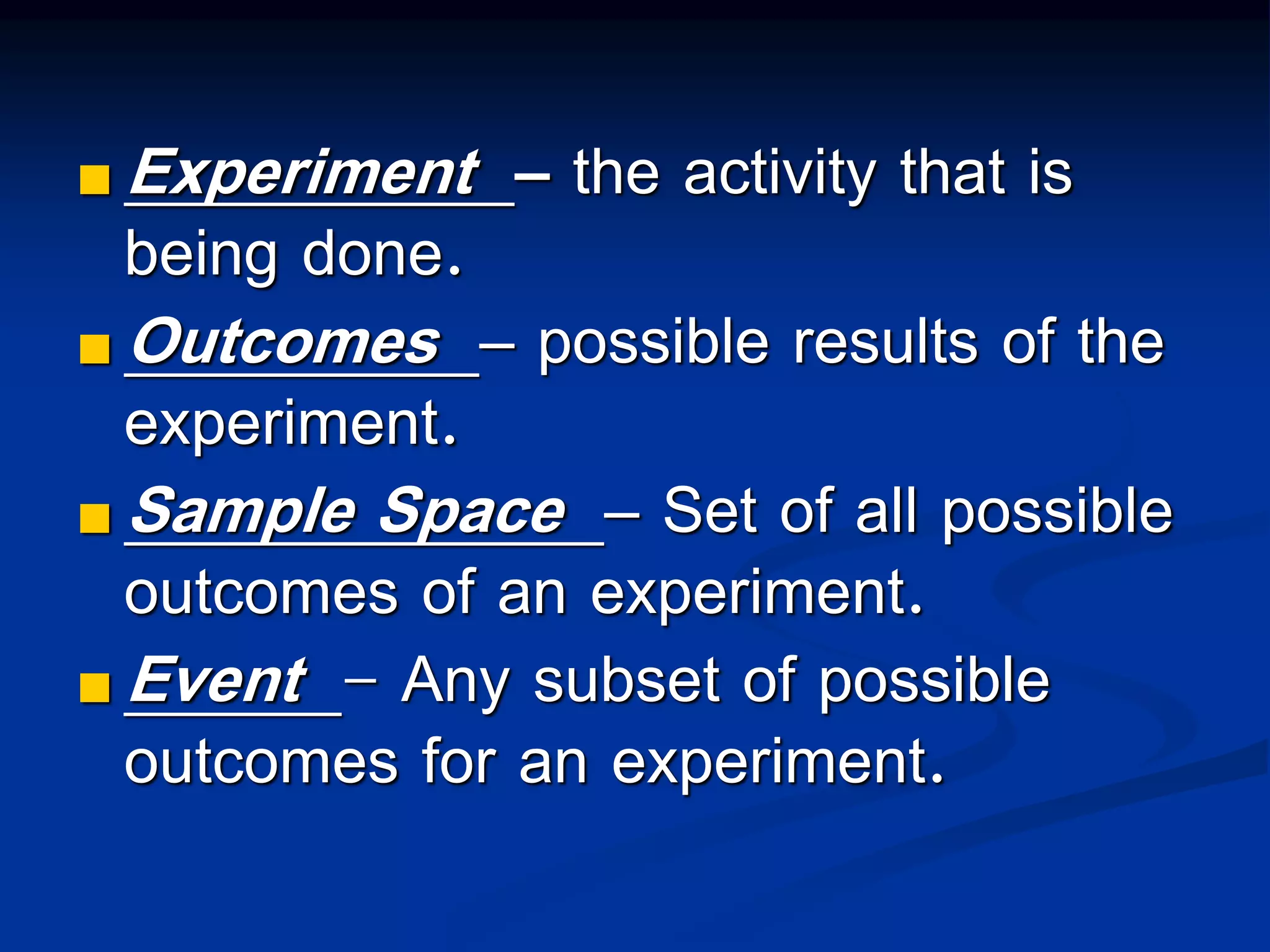
 Experiment – the activity that is
being done.
 Outcomes – possible results of the
experiment.
 Sample Space – Set of all possible
outcomes of an experiment.
 Event - Any subset of possible
outcomes for an experiment.
What is a PROBABILITY?
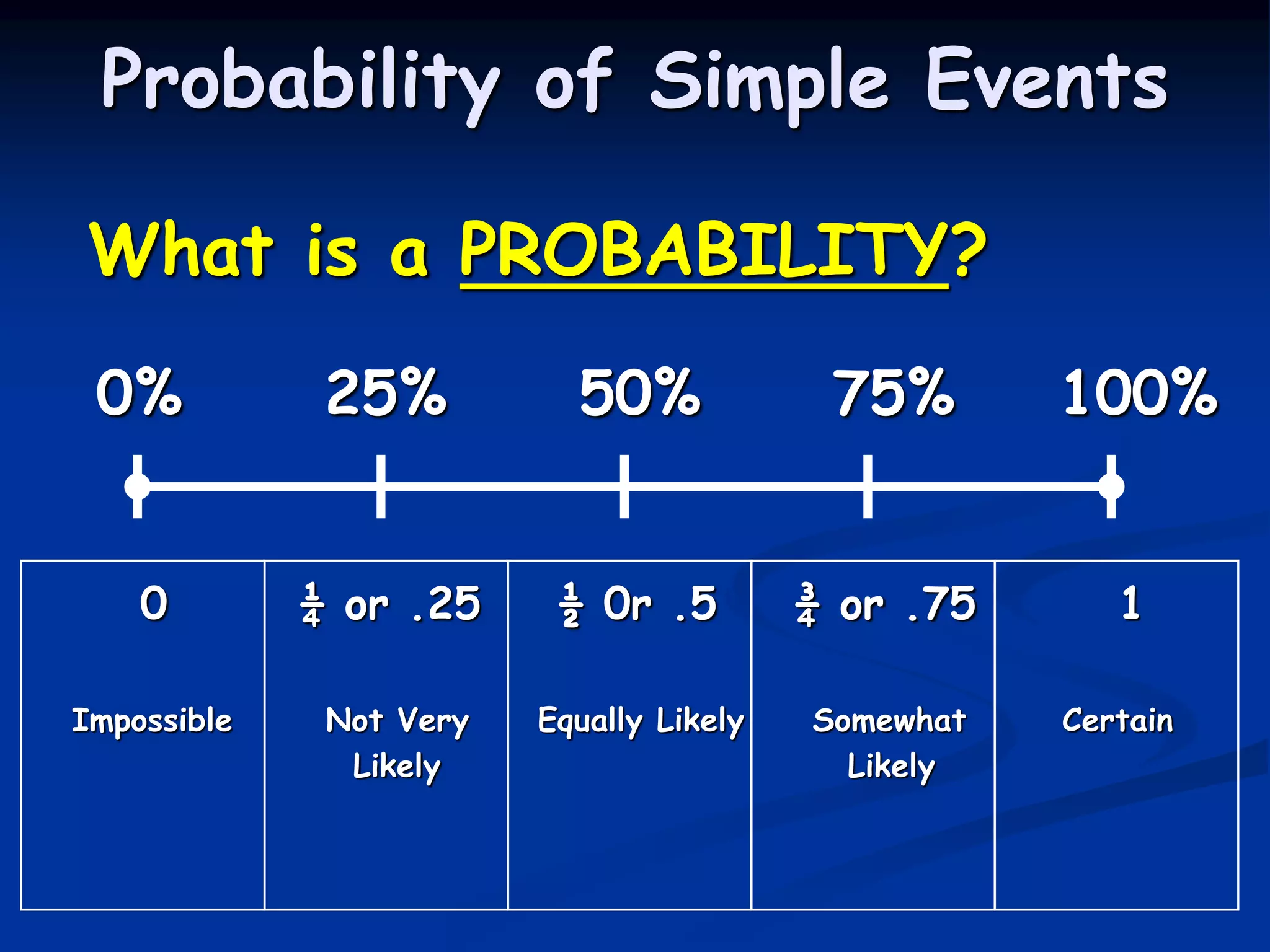
0% 25% 50% 75% 100%
0 ¼ or .25 ½ 0r .5 ¾ or .75 1
Impossible Not Very Equally Likely Somewhat Certain
Likely Likely
Probability of Simple Events
What is a PROBABILITY?
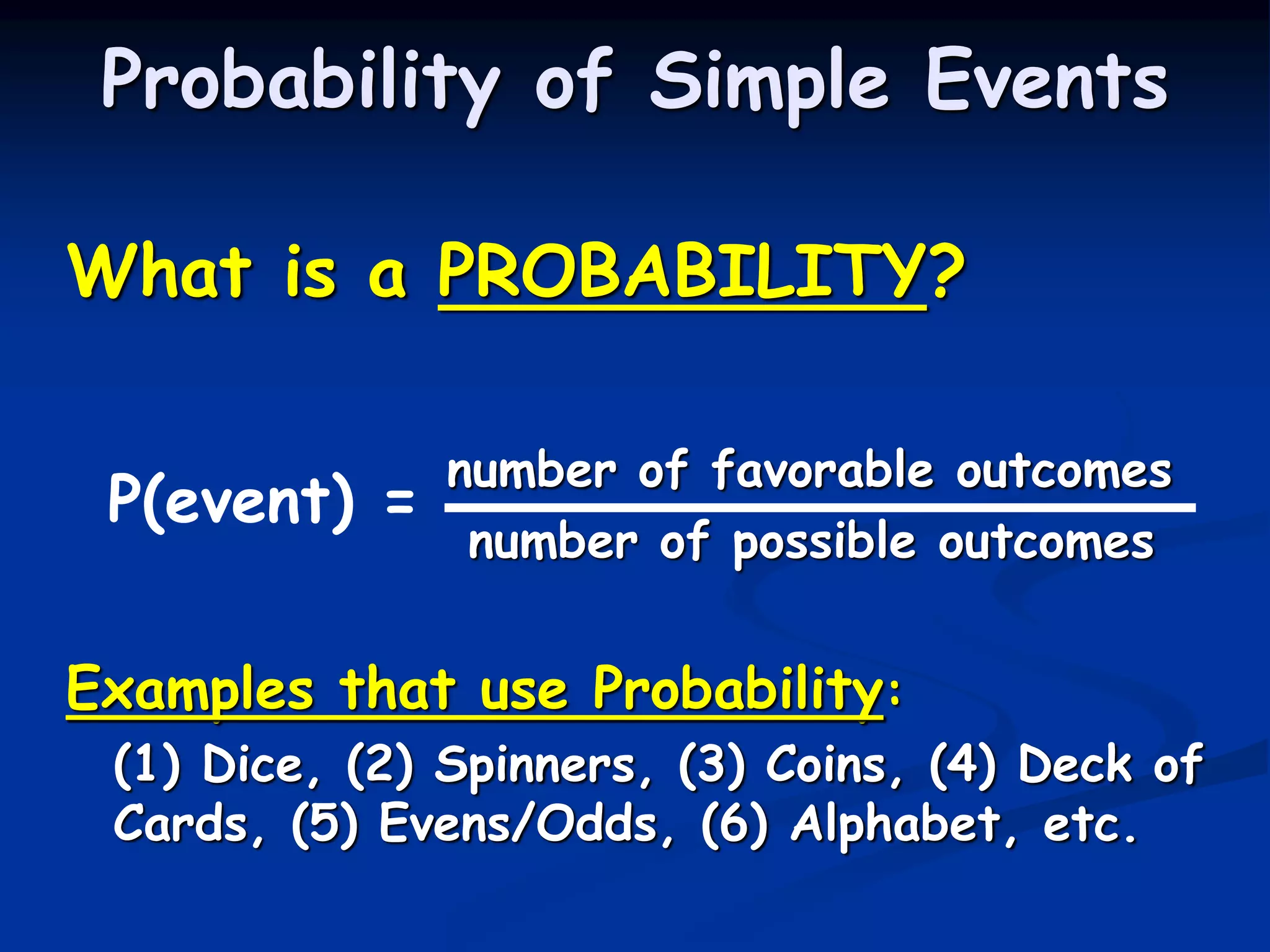
number of favorable outcomes
number of possible outcomes
Examples that use Probability:
(1) Dice, (2) Spinners, (3) Coins, (4) Deck of
Cards, (5) Evens/Odds, (6) Alphabet, etc.
Probability of Simple Events
P(event) =
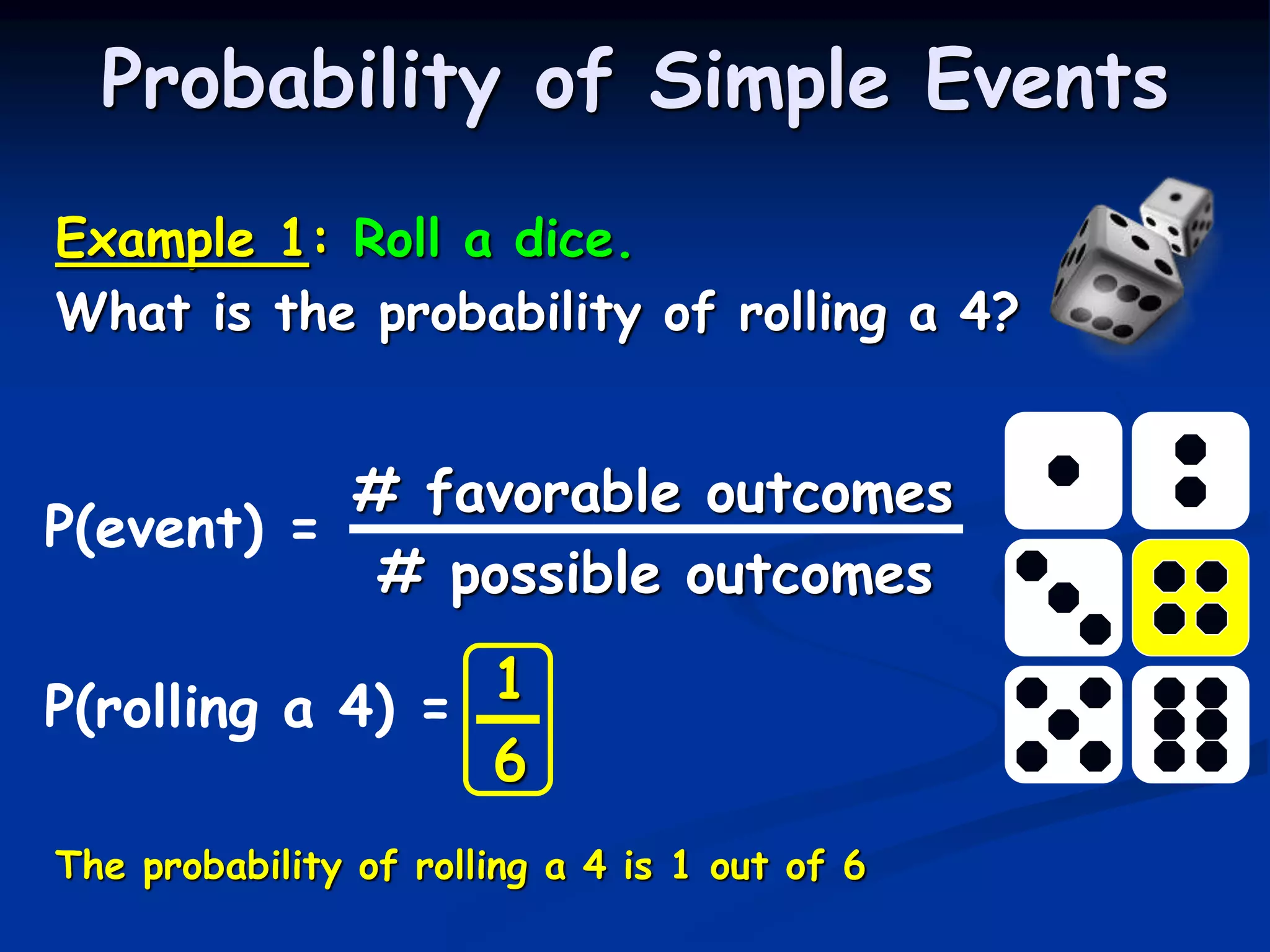
Example 1: Roll a dice.
What is the probability of rolling a 4?
# favorable outcomes
# possible outcomes
1
6
The probability of rolling a 4 is 1 out of 6
Probability of Simple Events
P(event) =
P(rolling a 4) =
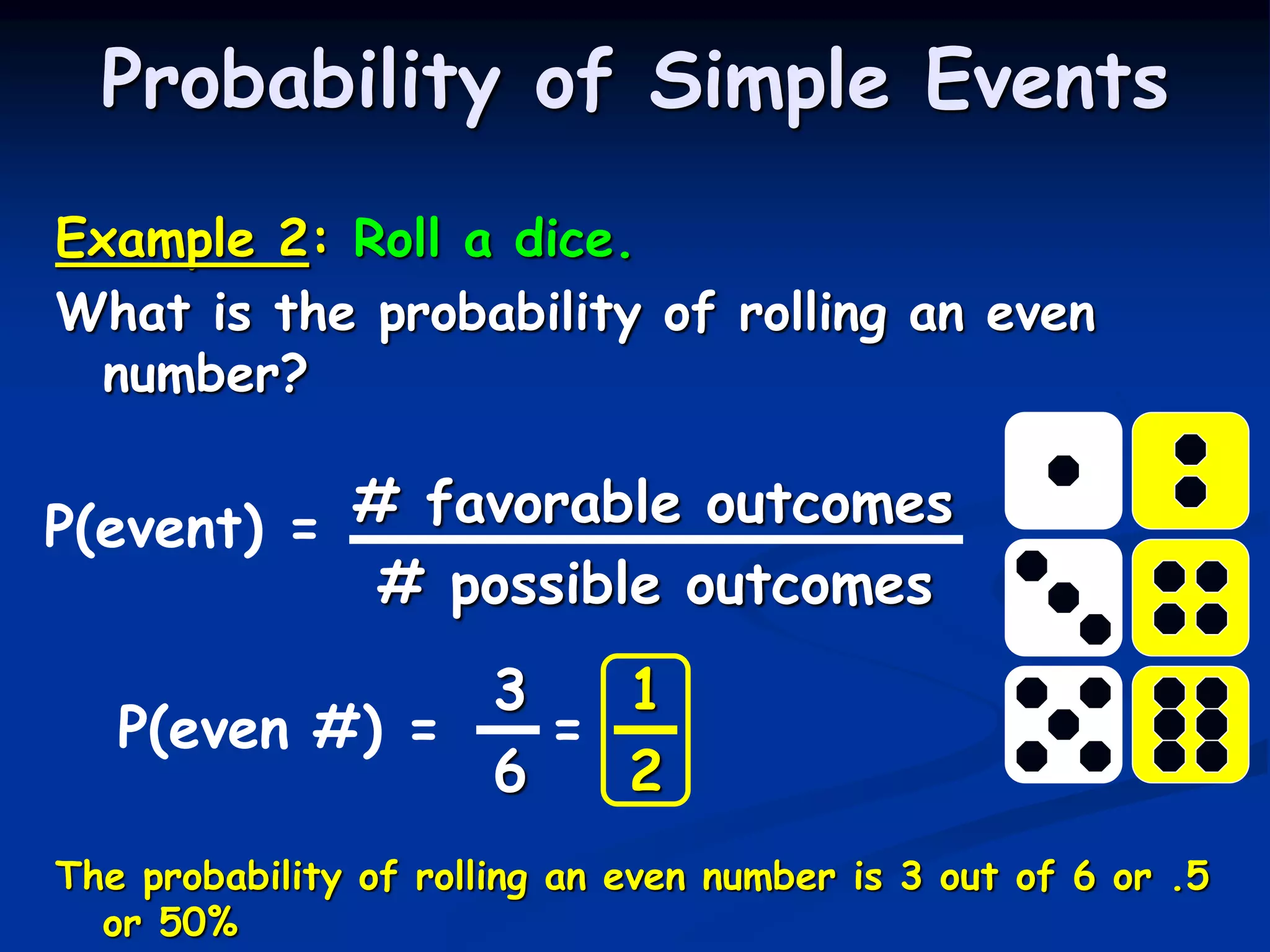
Example 2: Roll a dice.
What is the probability of rolling an even
number?
# favorable outcomes
# possible outcomes
3 1
6 2
The probability of rolling an even number is 3 out of 6 or .5
or 50%
Probability of Simple Events
P(event) =
P(even #) = =
Example 3: Spinners.
What is the probability of spinning green?
# favorable outcomes
# possible outcomes
1 1
4 4
The probability of spinning green is 1 out of 4 or .25 or
25%
Probability of Simple Events
P(event) =
P(green) = =
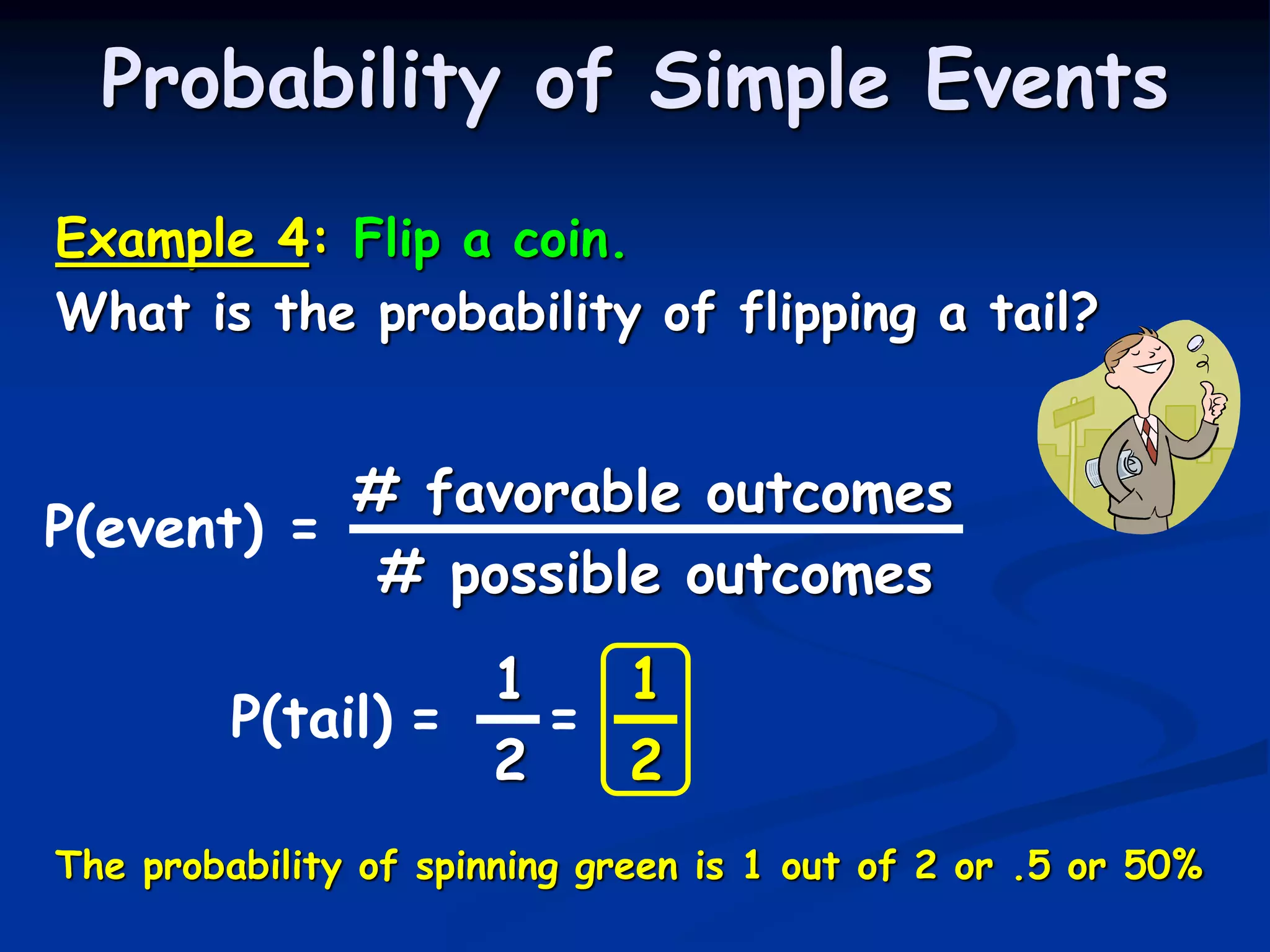
Example 4: Flip a coin.
What is the probability of flipping a tail?
# favorable outcomes
# possible outcomes
1 1
2 2
The probability of spinning green is 1 out of 2 or .5 or 50%
Probability of Simple Events
P(event) =
P(tail) = =
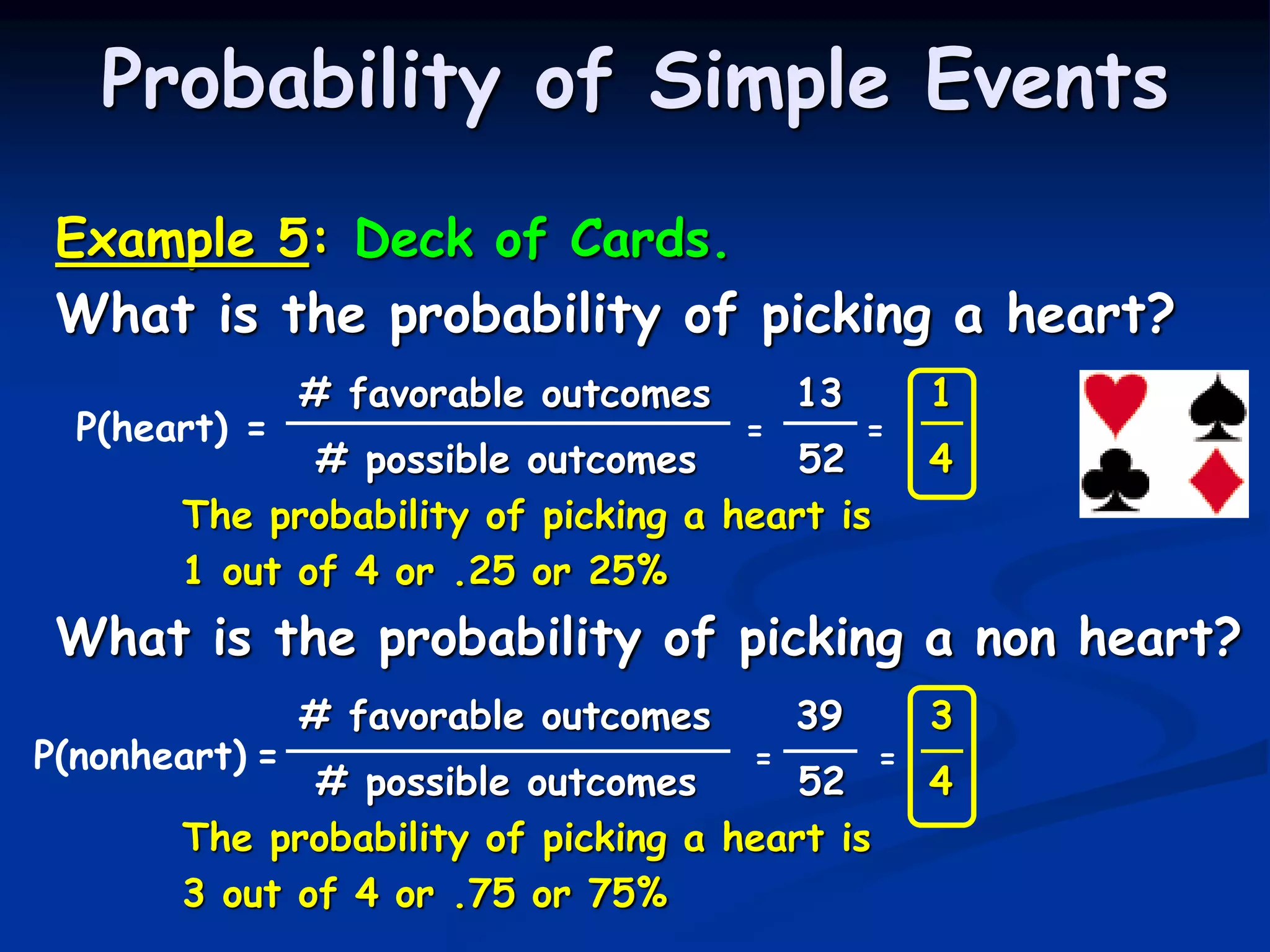
Example 5: Deck of Cards.
What is the probability of picking a heart?
# favorable outcomes 13 1
# possible outcomes 52 4
The probability of picking a heart is
1 out of 4 or .25 or 25%
What is the probability of picking a non heart?
# favorable outcomes 39 3
# possible outcomes 52 4
The probability of picking a heart is
3 out of 4 or .75 or 75%
Probability of Simple Events
P(heart) = = =
P(nonheart) = = =
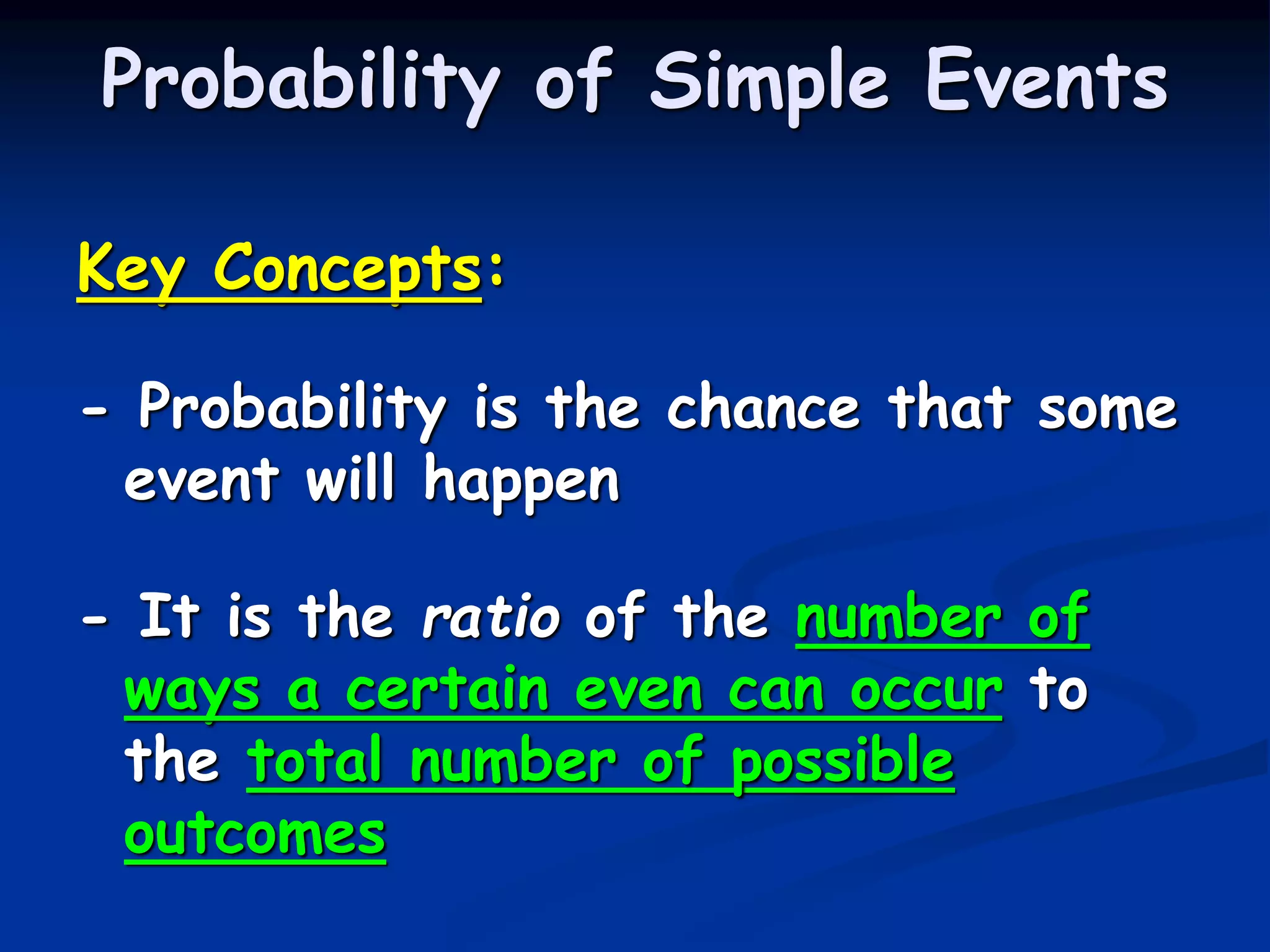
Key Concepts:
- Probability is the chance that some
event will happen
- It is the ratio of the number of
ways a certain even can occur to
the total number of possible
outcomes
Probability of Simple Events
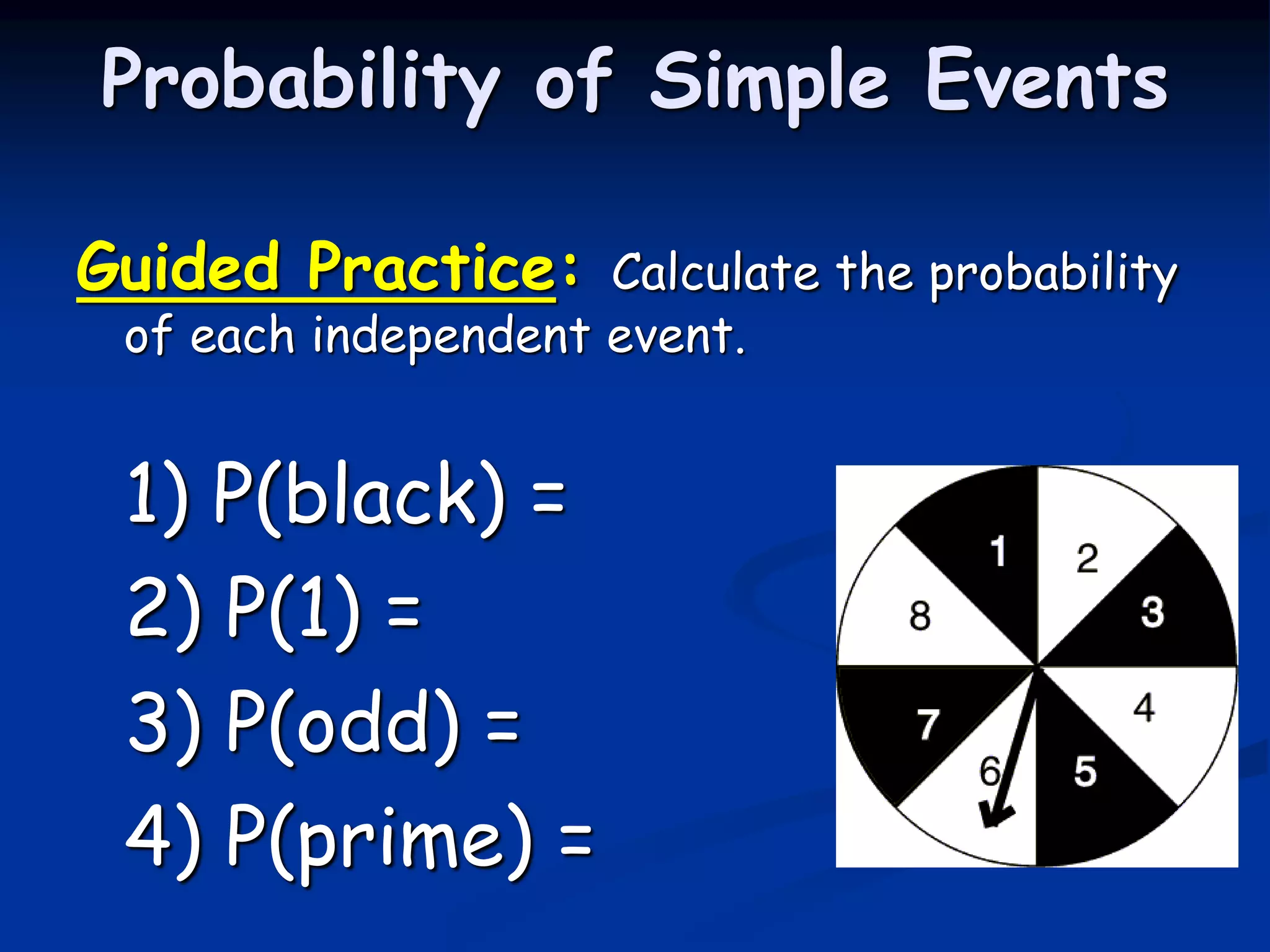
Guided Practice: Calculate the probability
of each independent event.
1) P(black) =
2) P(1) =
3) P(odd) =
4) P(prime) =
Probability of Simple Events
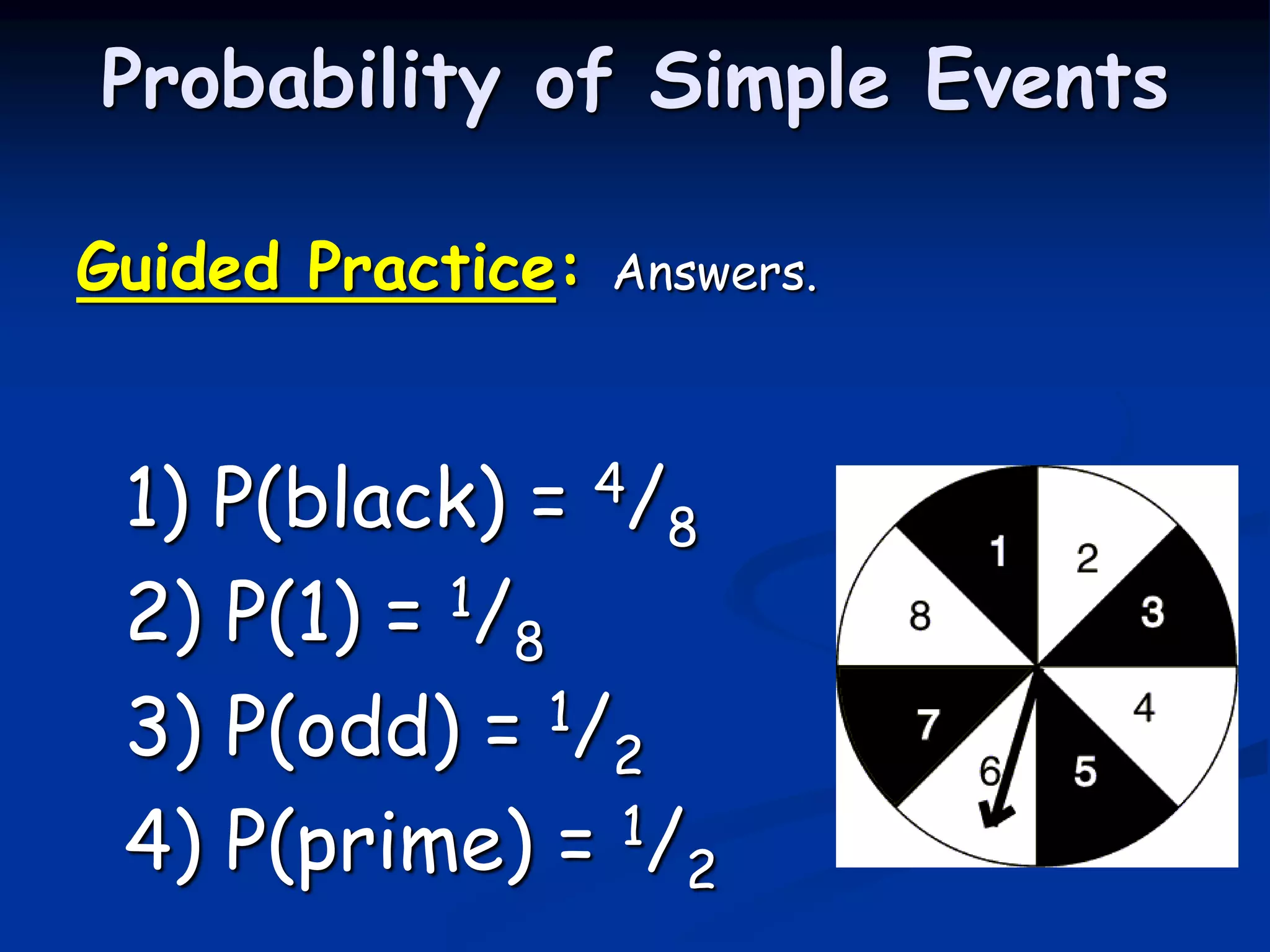
Guided Practice: Answers.
1) P(black) = 4/8
2) P(1) = 1/8
3) P(odd) = 1/2
4) P(prime) = 1/2
Probability of Simple Events
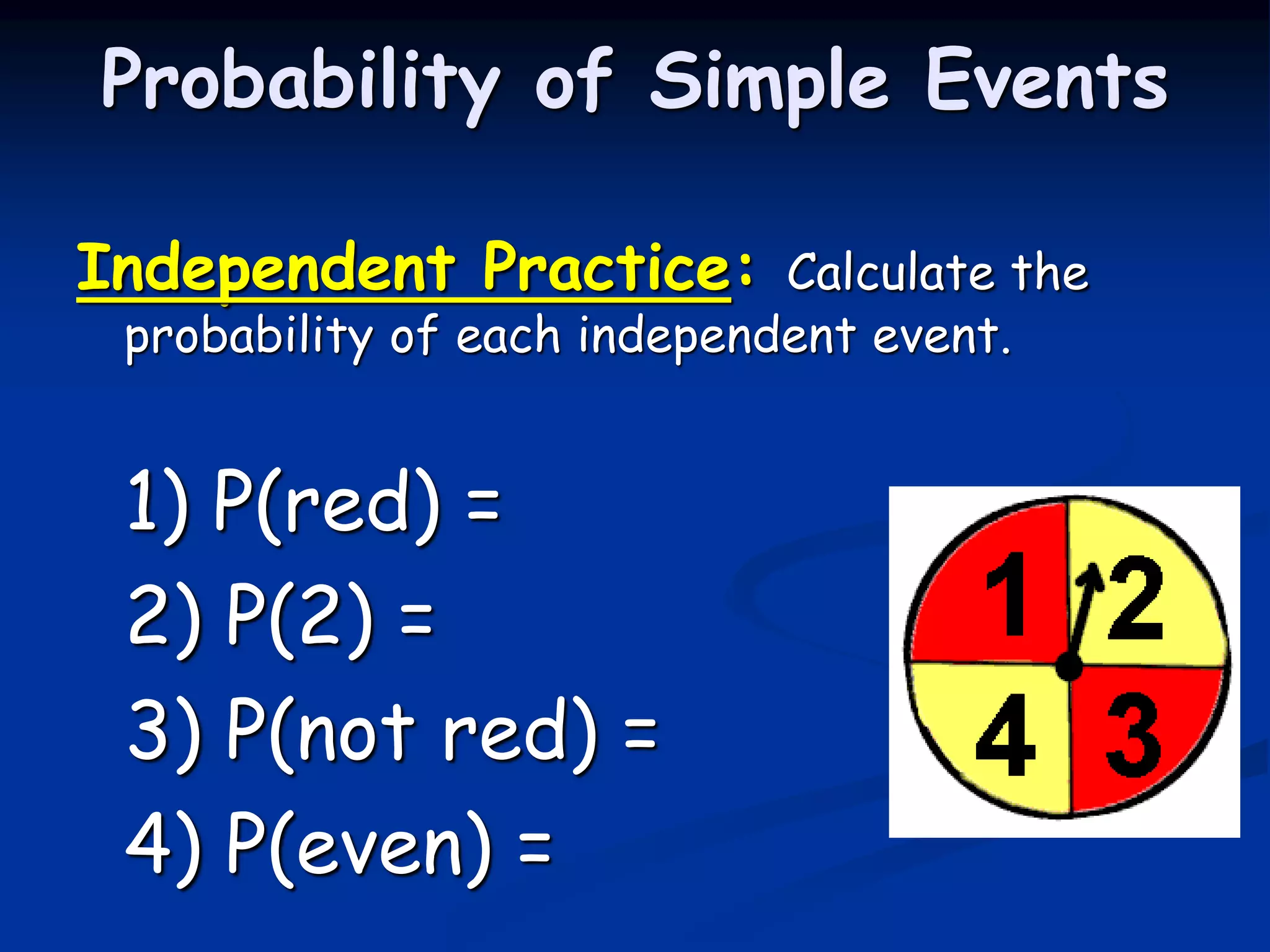
Independent Practice: Calculate the
probability of each independent event.
1) P(red) =
2) P(2) =
3) P(not red) =
4) P(even) =
Probability of Simple Events
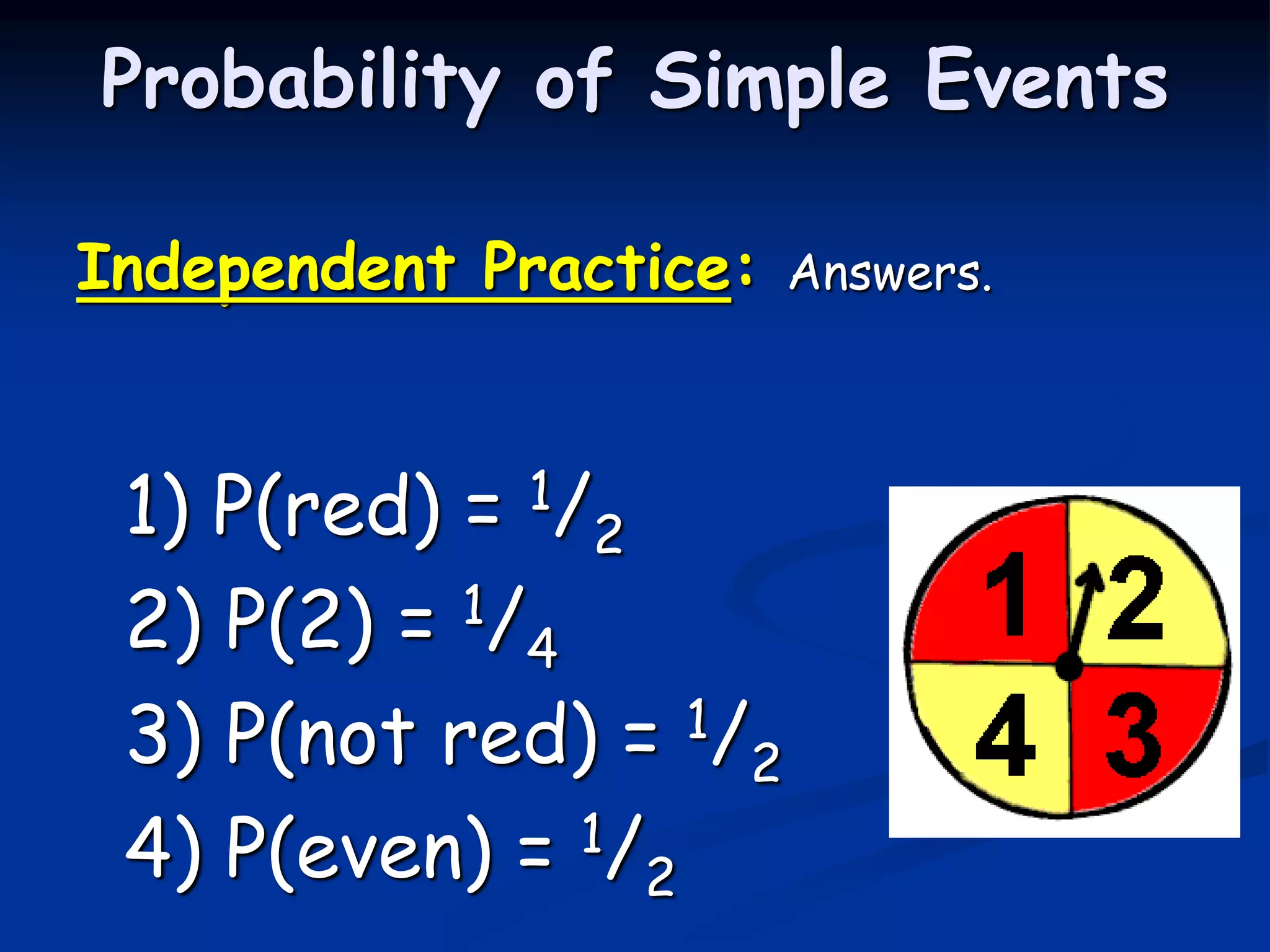
Independent Practice: Answers.
1) P(red) = 1/2
2) P(2) = 1/4
3) P(not red) = 1/2
4) P(even) = 1/2
Probability of Simple Events
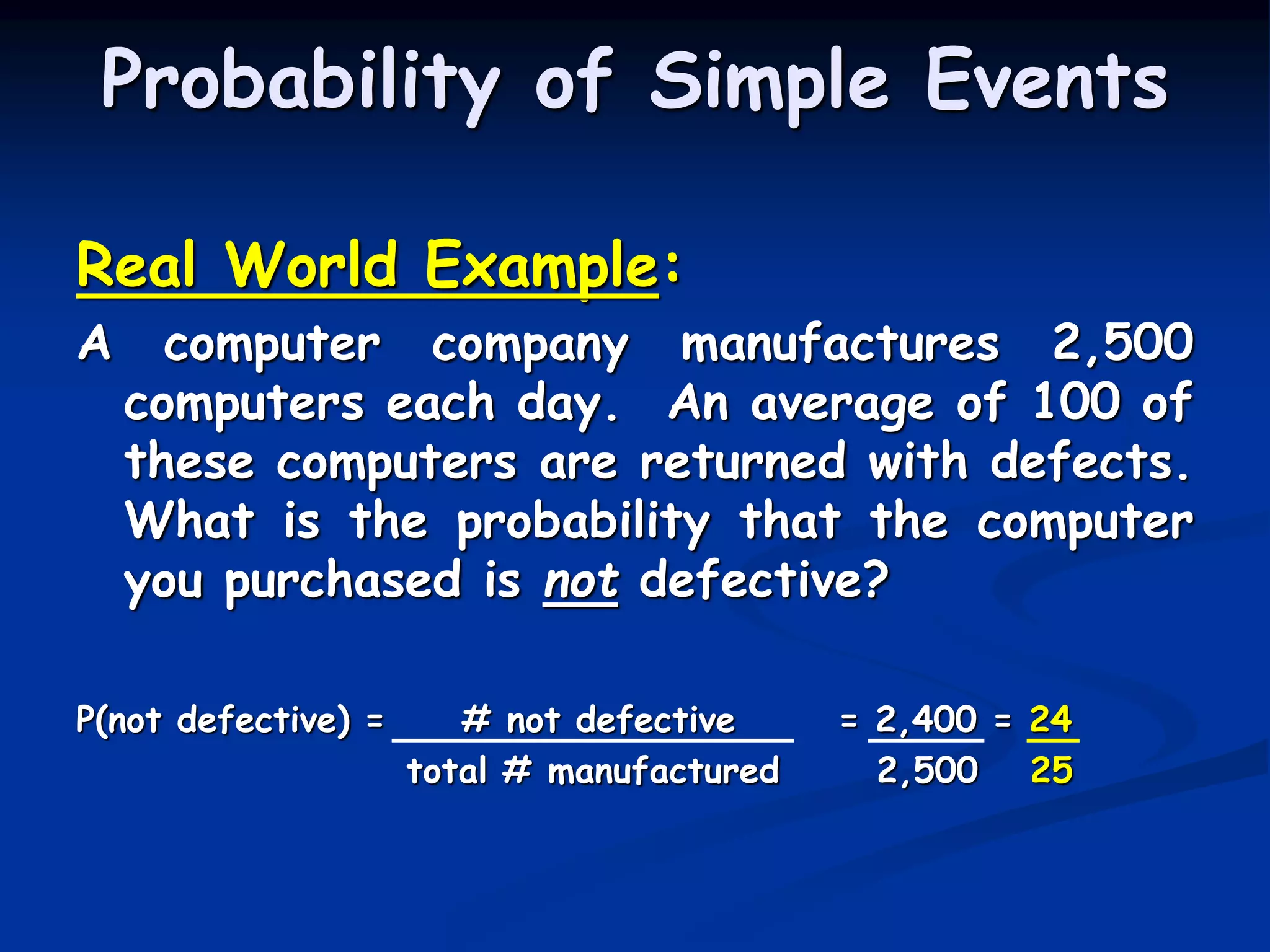
Real World Example:
A computer company manufactures 2,500
computers each day. An average of 100 of
these computers are returned with defects.
What is the probability that the computer
you purchased is not defective?
P(not defective) = # not defective = 2,400 = 24
total # manufactured 2,500 25
Probability of Simple Events
Seatwork:
Page 163, Letter A only.
My Distance Learning Buddy
Probability of Simple Events

01_Probability of Simple Events.ppt

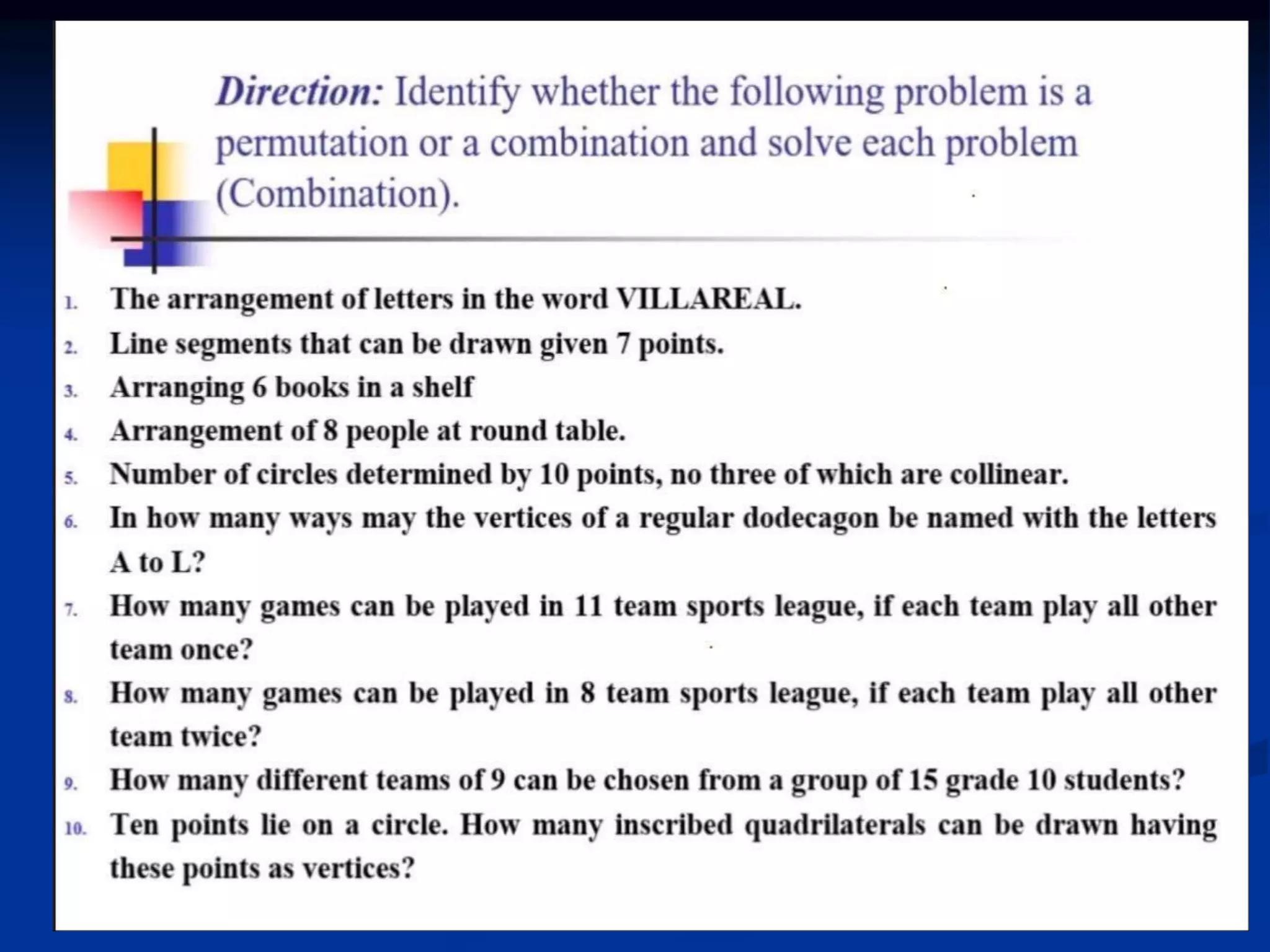
  • 3.
  • 4.
    Probability of SimpleEvents Objective: You will be able to find the probability of a simple event. You will be able to understand the distinction between simple events and compound events. Essential Question: (1) How do I find the probability of a simple event? (2) How can I distinguish between a simple and compound event?
  • 5.
    Probability of SimpleEvents Vocabulary:  Outcome – one possible result of a probability.  Sample Space – the list of possible outcomes for a probability event.  Random – outcomes that occur at random if each outcome is equally likely to occur.  Simple Event – a specific outcome or type of outcome.  Complementary Events – the events of one outcome happening and that outcomes not happening are complimentary; the sum of the probabilities of complementary events is 1.
  • 6.
    Real World Example: BestBuy is having an IPOD giveaway. They put all the IPOD Shuffles in a bag. Customers may choose an IPOD without looking at the color. Inside the bag are 4 orange, 5 blue, 6 green, and 5 pink IPODS. If Maria chooses one IPOD at random, what is the probability she will choose an orange IPOD? Probability of Simple Events
  • 7.
    Real World Example: BestBuy is having an IPOD giveaway. They put all the IPOD Shuffles in a bag. Customers may choose an IPOD without looking at the color. Inside the bag are 4 orange, 5 blue, 6 green, and 5 pink IPODS. If Maria chooses one IPOD at random, what is the probability she will choose an orange IPOD? P(orange) = 4/20 = 2/10 = 1/5 or 20% Probability of Simple Events
  • 8.
    What is aPROBABILITY? - Probability is the chance that some event will happen - It is the ratio of the number of ways a certain event can occur to the number of possible outcomes Probability of Simple Events
  • 9.
    Probability  Refers tothe likelihood for something to happen.  It is also often refers to as the measure of chances.
  • 10.
     Experiment –the activity that is being done.  Outcomes – possible results of the experiment.  Sample Space – Set of all possible outcomes of an experiment.  Event - Any subset of possible outcomes for an experiment.
  • 11.
    What is aPROBABILITY? 0% 25% 50% 75% 100% 0 ¼ or .25 ½ 0r .5 ¾ or .75 1 Impossible Not Very Equally Likely Somewhat Certain Likely Likely Probability of Simple Events
  • 12.
    What is aPROBABILITY? number of favorable outcomes number of possible outcomes Examples that use Probability: (1) Dice, (2) Spinners, (3) Coins, (4) Deck of Cards, (5) Evens/Odds, (6) Alphabet, etc. Probability of Simple Events P(event) =
  • 13.
    Example 1: Rolla dice. What is the probability of rolling a 4? # favorable outcomes # possible outcomes 1 6 The probability of rolling a 4 is 1 out of 6 Probability of Simple Events P(event) = P(rolling a 4) =
  • 14.
    Example 2: Rolla dice. What is the probability of rolling an even number? # favorable outcomes # possible outcomes 3 1 6 2 The probability of rolling an even number is 3 out of 6 or .5 or 50% Probability of Simple Events P(event) = P(even #) = =
  • 15.
    Example 3: Spinners. Whatis the probability of spinning green? # favorable outcomes # possible outcomes 1 1 4 4 The probability of spinning green is 1 out of 4 or .25 or 25% Probability of Simple Events P(event) = P(green) = =
  • 16.
    Example 4: Flipa coin. What is the probability of flipping a tail? # favorable outcomes # possible outcomes 1 1 2 2 The probability of spinning green is 1 out of 2 or .5 or 50% Probability of Simple Events P(event) = P(tail) = =
  • 17.
    Example 5: Deckof Cards. What is the probability of picking a heart? # favorable outcomes 13 1 # possible outcomes 52 4 The probability of picking a heart is 1 out of 4 or .25 or 25% What is the probability of picking a non heart? # favorable outcomes 39 3 # possible outcomes 52 4 The probability of picking a heart is 3 out of 4 or .75 or 75% Probability of Simple Events P(heart) = = = P(nonheart) = = =
  • 18.
    Key Concepts: - Probabilityis the chance that some event will happen - It is the ratio of the number of ways a certain even can occur to the total number of possible outcomes Probability of Simple Events
  • 19.
    Guided Practice: Calculatethe probability of each independent event. 1) P(black) = 2) P(1) = 3) P(odd) = 4) P(prime) = Probability of Simple Events
  • 20.
    Guided Practice: Answers. 1)P(black) = 4/8 2) P(1) = 1/8 3) P(odd) = 1/2 4) P(prime) = 1/2 Probability of Simple Events
  • 21.
    Independent Practice: Calculatethe probability of each independent event. 1) P(red) = 2) P(2) = 3) P(not red) = 4) P(even) = Probability of Simple Events
  • 22.
    Independent Practice: Answers. 1)P(red) = 1/2 2) P(2) = 1/4 3) P(not red) = 1/2 4) P(even) = 1/2 Probability of Simple Events
  • 23.
    Real World Example: Acomputer company manufactures 2,500 computers each day. An average of 100 of these computers are returned with defects. What is the probability that the computer you purchased is not defective? P(not defective) = # not defective = 2,400 = 24 total # manufactured 2,500 25 Probability of Simple Events
  • 24.
    Seatwork: Page 163, LetterA only. My Distance Learning Buddy Probability of Simple Events