Activity:
GUESS
THE
WORD!!!
1. E _ _ E R _ M _ _ T
2. S _ _ P L _
_ P A _ E
3. _ V E _ T
4. C _ M P O _ _D
E V _ _ T
5. S _ M P _ E
E _ _ N T
6. P _ O _ A B I _ _ T _
7. T _ _ A L
8. O _ T C _ M E _
Prepared by: Moises Jay A. Rosete
Learning Objectives
At the end of the lesson, the student should be able to:
a. define probability and simple events
b. illustrate the key concepts of simple events
c. use tables or tree diagram to illustrate compound events.
d. solve problem involving probability of simple and compound events
Probability
is a branch of mathematics that deals
with the measurement of likelihood or
chance that an event will occur.
It can be written in fraction, decimal, and
percentage.
Experiment – an activity with an
observable result.
Important Terms
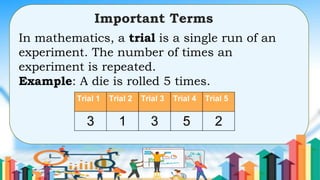
In mathematics, a trial is a single run of an
experiment. The number of times an
experiment is repeated.
Example: A die is rolled 5 times.
Important Terms
Outcomes- is an observed result to an
experiment.
Important Terms
Example: Tossing a coin four times.
Toss 1- H
Toss 2- T
Toss 3- H
Toss 4- H
Important Terms
Sample Space- the set of all possible outcomes in an
experiment. On the other hand, event is the subset of
the sample space.
For example, when rolling a die once.
The sample space when a die is rolled:
SS= {1, 2, 3, 4, 5, 6}
Another, when a coin is tossed.
Sample Space= {Head, Tail}
Simple Events- any event which consists of a
single outcome in the sample space.
For example:
a.Getting a head by tossing a coin.
b.Rolling a 3 on a die, and
c.Drawing the ace of hearts from a deck of cards.
Probability of Simple Events
If each of the outcomes in a sample space is equally
likely to occur, then the probability of an event E,
denoted as P(E) is given by:
• P(E) =
𝑛𝑢𝑚𝑏𝑒𝑟 𝑜𝑓 𝑤𝑎𝑦𝑠 𝑡ℎ𝑒 𝑒𝑣𝑒𝑛𝑡 𝑐𝑎𝑛 𝑜𝑐𝑐𝑢𝑟
𝑛𝑢𝑚𝑏𝑒𝑟 𝑜𝑓 𝑝𝑜𝑠𝑠𝑖𝑏𝑙𝑒 𝑜𝑢𝑡𝑐𝑜𝑚𝑒𝑠
or
• P(E)=
𝑛𝑢𝑚𝑏𝑒𝑟 𝑜𝑓 𝑜𝑢𝑡𝑐𝑜𝑚𝑒𝑠 𝑖𝑛 𝑡ℎ𝑒 𝑒𝑣𝑒𝑛𝑡
𝑛𝑢𝑚𝑏𝑒𝑟 𝑜𝑓 𝑜𝑢𝑡𝑐𝑜𝑚𝑒𝑠 𝑖𝑛 𝑡ℎ𝑒 𝑠𝑎𝑚𝑝𝑙𝑒 𝑠𝑝𝑎𝑐𝑒
When a coin is tossed. Find the probability of getting a
HEAD.
Sample Space – {Head, Tail}
Event- getting a head
Now to solve the probability, let us use the formula.
P(E) =
𝑛𝑢𝑚𝑏𝑒𝑟 𝑜𝑓 𝑜𝑢𝑡𝑐𝑜𝑚𝑒𝑠 𝑖𝑛 𝑡ℎ𝑒 𝑒𝑣𝑒𝑛𝑡
𝑛𝑢𝑚𝑏𝑒𝑟 𝑜𝑓 𝑜𝑢𝑡𝑐𝑜𝑚𝑒𝑠 𝑖𝑛 𝑡ℎ𝑒 𝑠𝑎𝑚𝑝𝑙𝑒 𝑠𝑝𝑎𝑐𝑒
• P(Head) =
1
2
Example 1
A die is rolled once. Find the probability of obtaining a
prime number greater than 2.
Solution:
Sample Space:
{1, 2, 3, 4, 5, 6}
Number of total outcomes = 6
Prime number greater than 2= {3, 5}
Number of outcomes in the event = 2
Example 2
Using the formula:
P(E) =
𝑛𝑢𝑚𝑏𝑒𝑟 𝑜𝑓 𝑜𝑢𝑡𝑐𝑜𝑚𝑒𝑠 𝑖𝑛 𝑡ℎ𝑒 𝑒𝑣𝑒𝑛𝑡
𝑛𝑢𝑚𝑏𝑒𝑟 𝑜𝑓 𝑜𝑢𝑡𝑐𝑜𝑚𝑒𝑠 𝑖𝑛 𝑡ℎ𝑒 𝑠𝑎𝑚𝑝𝑙𝑒 𝑠𝑝𝑎𝑐𝑒
• P (prime number greater than 2) =
2
6
or
1
3
Example 2:
Compound Events
- Events which consist of more than one
outcome. It consists of two or more simple
events
Example of Compound Events:
a. Rolling an even number divisible by 2
b. Drawing a red cards or black cards from a deck of
cards
c. Tossing three coins in getting at least 2
a. S= {1, 2, 3, 4, 5, 6, 7, 8, 9}
P(even) = 4/9
P(E’) = 1- P(E)
P(not even)= 1- P(even)
= 1- 4/9
P(not even) = (9-4)/9 = 5/9
Example 1:
Finding the probability of “getting 6 and a 1”
when two dice are rolled is an event consisting
of (1,6), (6,1) as outcomes. The first die falls in
6 different ways and the second die also falls
in 6 different ways.
Sample Space
Find the
probability of
getting a 6
and 1.
a. S= {1, 2, 3, 4, 5, 6, 7, 8, 9}
P(even) = 4/9
P(E’) = 1- P(E)
P(not even)= 1- P(even)
= 1- 4/9
P(not even) = (9-4)/9 = 5/9
n(S)= 6 x 6 = 36
Event: getting a 6 and 1 = {(6, 1), (1,6)}
P(getting 6 and 1) =
𝑛(𝑔𝑒𝑡𝑡𝑖𝑛𝑔 𝑎 6 𝑎𝑛𝑑 1)
𝑛(𝑆)
=
2
36
=
1
18
Therefore, the probability of getting 6 and 1 is
1
18
.
When you tossed a coin and
rolled a die at the same time.
How many possible
outcomes are there? Find
the probability that the coin
shows a head and the die
shows an odd number.
a. S= {1, 2, 3, 4, 5, 6, 7, 8, 9}
P(even) = 4/9
P(E’) = 1- P(E)
P(not even)= 1- P(even)
= 1- 4/9
P(not even) = (9-4)/9 = 5/9
Tree Diagram
Find the probability that the coin shows a head
and the die shows an odd number.
Number of outcomes of the coin showing a head
and a die showing an odd number= (H, 1), (H,
3) (H, 5)= 3 outcomes
Total outcomes in the sample space= 12
Therefore, P(getting a head and an odd number)
=
3
12
=
1
4
(Determine whether it is simple event or
compound event)
1.If three coins are tossed, what is the
probability of getting exactly two heads?
2.A bag has 3 red, 4 yellow, 6 blue and 7
white marbles. If a marble is picked at
random, what is probability that the picked
marble is blue?
(Determine whether it is simple event or
compound event)
1. If three coins are tossed, what is the
probability of getting exactly two heads?
2. A bag has 3 red, 4 yellow, 6 blue and 7
white marbles. If a marble is picked at
random, what is probability that the
picked marble is blue?
(Read the problem and answer the
following questions that follows.)
A standard deck of card has four suites:
spade, clubs, diamond, and heart. Each
suite has 13 cards: ace,2,3,4,5,6,7,8,9,10,
jack, queen, king. Thus, the entire deck
has 52 card total.
A playing card is drawn at random from a
standard deck of 52 playing card. Find the
probability of getting
a.A spade
b.A black card
c. 9 or a king
d.Ace or a heart
POST DEVELOPMENTAL ACTIVITY
(The teacher will ask some questions to the
questions.)
1. Differentiate simple events and compounds
events.
2. What is the formula that you will use in finding
the probability of simple events?
3. What are the examples of compound events?
(Answer the following questions)
1. Which of the following is a simple event?
A) rolling a fair six-sided die and getting a 3.
B) drawing a red card and then drawing a black card
from a standard deck of cards.
C) flipping a fair coin and getting heads.
D) rolling a fair six-sided die and getting an even
number or a number greater than 3.
2. Which of the following is a compound event?
A) Rolling a fair six-sided die and getting a 3.
B) Drawing a red card and then drawing a black card from a
standard deck of cards.
C) Flipping a fair coin and getting heads.
D) Rolling a fair six-sided die and getting an even number or a
number greater than 3.
3. Which of the following is a simple event?
A) Drawing a red ball from a bag containing only red balls.
B) Tossing a fair coin twice and getting two heads.
C) Picking an ace from a standard deck of cards.
D) Rolling a fair six-sided die and getting a number greater than 4 or
an odd number.
ASSIGNMENT
ASSIGNMENT
(Answer the given problem)
1. A bag contains 5 red balls, 3 blue balls,
and 2 green balls. Two balls are drawn at
random from the bag, one after the other
without replacement. What is the
probability that both balls drawn are red?
Thank You and god bless.

Week-7_Day-1_Complementary-Events_PPT.pptx

  • 1.
  • 2.
    1. E __ E R _ M _ _ T
  • 3.
    2. S __ P L _ _ P A _ E
  • 4.
    3. _ VE _ T
  • 5.
    4. C _M P O _ _D E V _ _ T
  • 6.
    5. S _M P _ E E _ _ N T
  • 7.
    6. P _O _ A B I _ _ T _
  • 8.
    7. T __ A L
  • 9.
    8. O _T C _ M E _
  • 10.
    Prepared by: MoisesJay A. Rosete
  • 11.
    Learning Objectives At theend of the lesson, the student should be able to: a. define probability and simple events b. illustrate the key concepts of simple events c. use tables or tree diagram to illustrate compound events. d. solve problem involving probability of simple and compound events
  • 12.
    Probability is a branchof mathematics that deals with the measurement of likelihood or chance that an event will occur. It can be written in fraction, decimal, and percentage.
  • 13.
    Experiment – anactivity with an observable result. Important Terms
  • 14.
    In mathematics, atrial is a single run of an experiment. The number of times an experiment is repeated. Example: A die is rolled 5 times. Important Terms
  • 15.
    Outcomes- is anobserved result to an experiment. Important Terms Example: Tossing a coin four times. Toss 1- H Toss 2- T Toss 3- H Toss 4- H
  • 16.
    Important Terms Sample Space-the set of all possible outcomes in an experiment. On the other hand, event is the subset of the sample space. For example, when rolling a die once. The sample space when a die is rolled: SS= {1, 2, 3, 4, 5, 6} Another, when a coin is tossed. Sample Space= {Head, Tail}
  • 17.
    Simple Events- anyevent which consists of a single outcome in the sample space. For example: a.Getting a head by tossing a coin. b.Rolling a 3 on a die, and c.Drawing the ace of hearts from a deck of cards.
  • 18.
    Probability of SimpleEvents If each of the outcomes in a sample space is equally likely to occur, then the probability of an event E, denoted as P(E) is given by: • P(E) = 𝑛𝑢𝑚𝑏𝑒𝑟 𝑜𝑓 𝑤𝑎𝑦𝑠 𝑡ℎ𝑒 𝑒𝑣𝑒𝑛𝑡 𝑐𝑎𝑛 𝑜𝑐𝑐𝑢𝑟 𝑛𝑢𝑚𝑏𝑒𝑟 𝑜𝑓 𝑝𝑜𝑠𝑠𝑖𝑏𝑙𝑒 𝑜𝑢𝑡𝑐𝑜𝑚𝑒𝑠 or • P(E)= 𝑛𝑢𝑚𝑏𝑒𝑟 𝑜𝑓 𝑜𝑢𝑡𝑐𝑜𝑚𝑒𝑠 𝑖𝑛 𝑡ℎ𝑒 𝑒𝑣𝑒𝑛𝑡 𝑛𝑢𝑚𝑏𝑒𝑟 𝑜𝑓 𝑜𝑢𝑡𝑐𝑜𝑚𝑒𝑠 𝑖𝑛 𝑡ℎ𝑒 𝑠𝑎𝑚𝑝𝑙𝑒 𝑠𝑝𝑎𝑐𝑒
  • 19.
    When a coinis tossed. Find the probability of getting a HEAD. Sample Space – {Head, Tail} Event- getting a head Now to solve the probability, let us use the formula. P(E) = 𝑛𝑢𝑚𝑏𝑒𝑟 𝑜𝑓 𝑜𝑢𝑡𝑐𝑜𝑚𝑒𝑠 𝑖𝑛 𝑡ℎ𝑒 𝑒𝑣𝑒𝑛𝑡 𝑛𝑢𝑚𝑏𝑒𝑟 𝑜𝑓 𝑜𝑢𝑡𝑐𝑜𝑚𝑒𝑠 𝑖𝑛 𝑡ℎ𝑒 𝑠𝑎𝑚𝑝𝑙𝑒 𝑠𝑝𝑎𝑐𝑒 • P(Head) = 1 2 Example 1
  • 20.
    A die isrolled once. Find the probability of obtaining a prime number greater than 2. Solution: Sample Space: {1, 2, 3, 4, 5, 6} Number of total outcomes = 6 Prime number greater than 2= {3, 5} Number of outcomes in the event = 2 Example 2
  • 21.
    Using the formula: P(E)= 𝑛𝑢𝑚𝑏𝑒𝑟 𝑜𝑓 𝑜𝑢𝑡𝑐𝑜𝑚𝑒𝑠 𝑖𝑛 𝑡ℎ𝑒 𝑒𝑣𝑒𝑛𝑡 𝑛𝑢𝑚𝑏𝑒𝑟 𝑜𝑓 𝑜𝑢𝑡𝑐𝑜𝑚𝑒𝑠 𝑖𝑛 𝑡ℎ𝑒 𝑠𝑎𝑚𝑝𝑙𝑒 𝑠𝑝𝑎𝑐𝑒 • P (prime number greater than 2) = 2 6 or 1 3 Example 2:
  • 22.
    Compound Events - Eventswhich consist of more than one outcome. It consists of two or more simple events
  • 23.
    Example of CompoundEvents: a. Rolling an even number divisible by 2 b. Drawing a red cards or black cards from a deck of cards c. Tossing three coins in getting at least 2
  • 24.
    a. S= {1,2, 3, 4, 5, 6, 7, 8, 9} P(even) = 4/9 P(E’) = 1- P(E) P(not even)= 1- P(even) = 1- 4/9 P(not even) = (9-4)/9 = 5/9 Example 1: Finding the probability of “getting 6 and a 1” when two dice are rolled is an event consisting of (1,6), (6,1) as outcomes. The first die falls in 6 different ways and the second die also falls in 6 different ways.
  • 25.
    Sample Space Find the probabilityof getting a 6 and 1.
  • 26.
    a. S= {1,2, 3, 4, 5, 6, 7, 8, 9} P(even) = 4/9 P(E’) = 1- P(E) P(not even)= 1- P(even) = 1- 4/9 P(not even) = (9-4)/9 = 5/9 n(S)= 6 x 6 = 36 Event: getting a 6 and 1 = {(6, 1), (1,6)} P(getting 6 and 1) = 𝑛(𝑔𝑒𝑡𝑡𝑖𝑛𝑔 𝑎 6 𝑎𝑛𝑑 1) 𝑛(𝑆) = 2 36 = 1 18 Therefore, the probability of getting 6 and 1 is 1 18 .
  • 27.
    When you tosseda coin and rolled a die at the same time. How many possible outcomes are there? Find the probability that the coin shows a head and the die shows an odd number.
  • 28.
    a. S= {1,2, 3, 4, 5, 6, 7, 8, 9} P(even) = 4/9 P(E’) = 1- P(E) P(not even)= 1- P(even) = 1- 4/9 P(not even) = (9-4)/9 = 5/9 Tree Diagram
  • 29.
    Find the probabilitythat the coin shows a head and the die shows an odd number. Number of outcomes of the coin showing a head and a die showing an odd number= (H, 1), (H, 3) (H, 5)= 3 outcomes Total outcomes in the sample space= 12 Therefore, P(getting a head and an odd number) = 3 12 = 1 4
  • 30.
    (Determine whether itis simple event or compound event) 1.If three coins are tossed, what is the probability of getting exactly two heads? 2.A bag has 3 red, 4 yellow, 6 blue and 7 white marbles. If a marble is picked at random, what is probability that the picked marble is blue?
  • 31.
    (Determine whether itis simple event or compound event) 1. If three coins are tossed, what is the probability of getting exactly two heads? 2. A bag has 3 red, 4 yellow, 6 blue and 7 white marbles. If a marble is picked at random, what is probability that the picked marble is blue?
  • 32.
    (Read the problemand answer the following questions that follows.) A standard deck of card has four suites: spade, clubs, diamond, and heart. Each suite has 13 cards: ace,2,3,4,5,6,7,8,9,10, jack, queen, king. Thus, the entire deck has 52 card total.
  • 33.
    A playing cardis drawn at random from a standard deck of 52 playing card. Find the probability of getting a.A spade b.A black card c. 9 or a king d.Ace or a heart
  • 34.
    POST DEVELOPMENTAL ACTIVITY (Theteacher will ask some questions to the questions.) 1. Differentiate simple events and compounds events. 2. What is the formula that you will use in finding the probability of simple events? 3. What are the examples of compound events?
  • 35.
    (Answer the followingquestions) 1. Which of the following is a simple event? A) rolling a fair six-sided die and getting a 3. B) drawing a red card and then drawing a black card from a standard deck of cards. C) flipping a fair coin and getting heads. D) rolling a fair six-sided die and getting an even number or a number greater than 3.
  • 36.
    2. Which ofthe following is a compound event? A) Rolling a fair six-sided die and getting a 3. B) Drawing a red card and then drawing a black card from a standard deck of cards. C) Flipping a fair coin and getting heads. D) Rolling a fair six-sided die and getting an even number or a number greater than 3. 3. Which of the following is a simple event? A) Drawing a red ball from a bag containing only red balls. B) Tossing a fair coin twice and getting two heads. C) Picking an ace from a standard deck of cards. D) Rolling a fair six-sided die and getting a number greater than 4 or an odd number.
  • 37.
  • 38.
  • 39.
    (Answer the givenproblem) 1. A bag contains 5 red balls, 3 blue balls, and 2 green balls. Two balls are drawn at random from the bag, one after the other without replacement. What is the probability that both balls drawn are red?
  • 40.
    Thank You andgod bless.