Group Assignment
welding
Prepared by:
ABDUL JABBAR KHAN
PANDIARAJ A/L RETENAM
2
WELDING
Definition: Material joining process. Two
parts connected at their contacting
surfaces by suitable heat and pressure.
Many welding processes are
accomplished by heat alone, some others
by heat and pressure, and some with
pressure only.
In some welding operations a filler
material is used.
Welding operation usually applied to
metals but also used for plastics.
Parts produced by any of the manufacturing processes
can be made into larger, more complex bodies via Joining
processes
• Creating a metallurgical bond by adhesion and diffusion
• Joining by fusion with the use of various heat sources
• Brazing or soldering with a lower-melting metal
• Mechanical fastening
Joining ProcessesJoining Processes
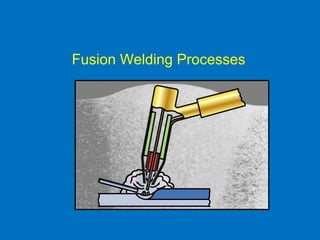
Fusion Welding Processes
Sources of Energy for Fusion Welding
• Chemical reactions
– Burning gases
– GAS WELDING
• Heat from electricity
– Arc
– ARC WELDING
SYSTEMS
– Resistance welding
• LightLight
LASERLASER
Three Specific Types of Welding
Modules
• In this Welding, Cutting, and Brazing
module, three specific types of welding are
covered. These are listed below:
– Oxygen-fuel gas welding and cutting
– Arc welding and cutting
– Resistance welding
• Definition:
–This is a group of fusion welding
processes that use heat and pressure to
make the coalescence.
• The heat comes from electrical
resistance to current flow at the site of
the weld.
– The processes include:
• Spot Welding
• Projection Welding
• Seam Welding
Resistance Welding
• Spot Welding
–A process typically used in high-
volume, rapid welding applications.
•The pieces to be joined are
clamped between two electrodes
under force, and an electrical
current is sent through them.
Resistance Welding
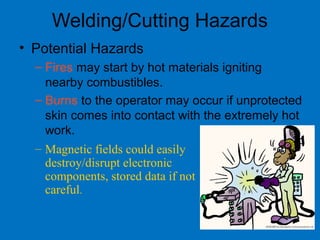
Welding/Cutting Hazards
• Potential Hazards
– Fires may start by hot materials igniting
nearby combustibles.
– Burns to the operator may occur if unprotected
skin comes into contact with the extremely hot
work.
– Magnetic fields could easily
destroy/disrupt electronic
components, stored data if not
careful.
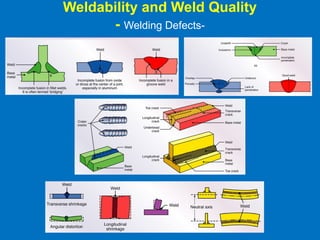
Weldability and Weld Quality
- Welding Defects-
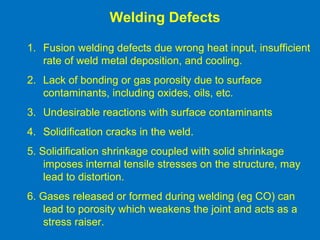
1. Fusion welding defects due wrong heat input, insufficient
rate of weld metal deposition, and cooling.
2. Lack of bonding or gas porosity due to surface
contaminants, including oxides, oils, etc.
3. Undesirable reactions with surface contaminants
4. Solidification cracks in the weld.
5. Solidification shrinkage coupled with solid shrinkage
imposes internal tensile stresses on the structure, may
lead to distortion.
6. Gases released or formed during welding (eg CO) can
lead to porosity which weakens the joint and acts as a
stress raiser.
Welding Defects
12
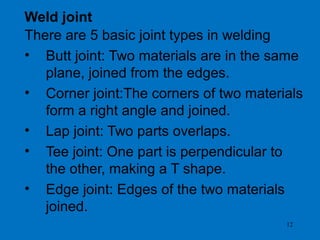
Weld joint
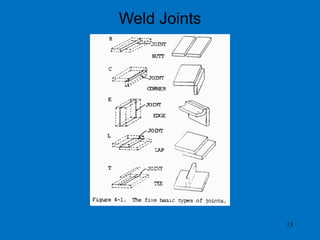
There are 5 basic joint types in welding
• Butt joint: Two materials are in the same
plane, joined from the edges.
• Corner joint:The corners of two materials
form a right angle and joined.
• Lap joint: Two parts overlaps.
• Tee joint: One part is perpendicular to
the other, making a T shape.
• Edge joint: Edges of the two materials
joined.
13
Weld Joints
14
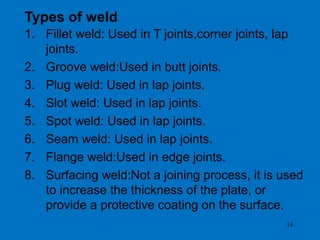
Types of weld
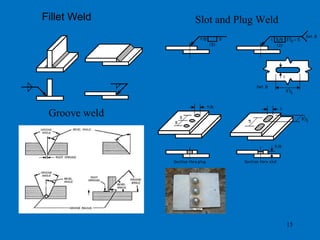
1. Fillet weld: Used in T joints,corner joints, lap
joints.
2. Groove weld:Used in butt joints.
3. Plug weld: Used in lap joints.
4. Slot weld: Used in lap joints.
5. Spot weld: Used in lap joints.
6. Seam weld: Used in lap joints.
7. Flange weld:Used in edge joints.
8. Surfacing weld:Not a joining process, it is used
to increase the thickness of the plate, or
provide a protective coating on the surface.
15
Fillet Weld
Groove weld
Slot and Plug Weld
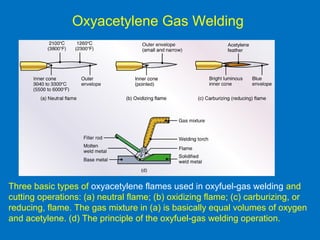
Oxyacetylene Gas Welding
Three basic types of oxyacetylene flames used in oxyfuel-gas welding and
cutting operations: (a) neutral flame; (b) oxidizing flame; (c) carburizing, or
reducing, flame. The gas mixture in (a) is basically equal volumes of oxygen
and acetylene. (d) The principle of the oxyfuel-gas welding operation.
Oxygen-fuel gas welding & Cutting
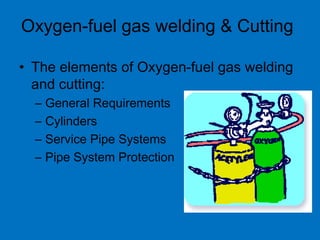
• The elements of Oxygen-fuel gas welding
and cutting:
– General Requirements
– Cylinders
– Service Pipe Systems
– Pipe System Protection
Oxygen-fuel gas welding and cutting
• General Requirements
– Focuses on using Acetylene Safely
• Flammable
• Unstable
• Cannot be adjusted above 15 psi
– Safe Work Practices
• Blow out cylinder valve
• Turn on cylinder valve first and
then adjust the regulator pressure screw.
• Never stand in front or behind
a regulator when opening the cylinder valve
• Open cylinder valve slowly
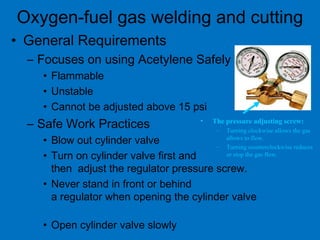
• The pressure adjusting screw:
– Turning clockwise allows the gas
allows to flow.
– Turning counterclockwise reduces
or stop the gas flow.
• General Requirements Cont.:
– Safe Work Practices
• Purge oxygen and acetylene passages
• Light the acetylene
• Never use oil or grease
• Do not use oxygen as a substitute for air
• Keep your work area clean
Oxygen-fuel gas welding and cutting
20
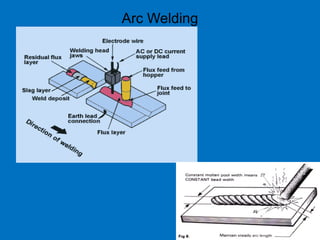
Arc Welding
t
Arc Welding and Cutting
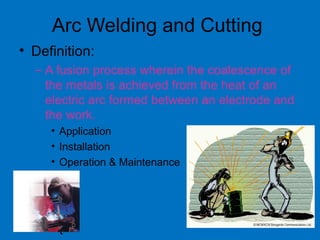
• Definition:
– A fusion process wherein the coalescence of
the metals is achieved from the heat of an
electric arc formed between an electrode and
the work.
• Application
• Installation
• Operation & Maintenance
• Application
– Applies to a large and varied group of
processes that use an electric arc as the
source of heat to melt and join metals.
• Installation
– Arc welding requires proper installation of
equipment.
– A critical part of installation is ensuring that
proper grounding is completed.
Arc Welding & Cutting
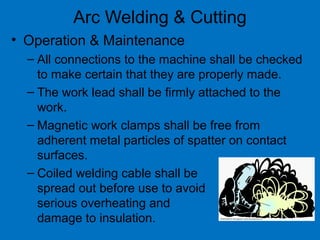
• Operation & Maintenance
– All connections to the machine shall be checked
to make certain that they are properly made.
– The work lead shall be firmly attached to the
work.
– Magnetic work clamps shall be free from
adherent metal particles of spatter on contact
surfaces.
– Coiled welding cable shall be
spread out before use to avoid
serious overheating and
damage to insulation.
Methods of Arc Welding
• Three Types of Welding Methods:
– Tungsten Inert Gas Welding (TIG)
– Gas Metal Arc Welding (MIG)
– Shielded Metal Arc Welding (SMAW)/ Stick
Welding
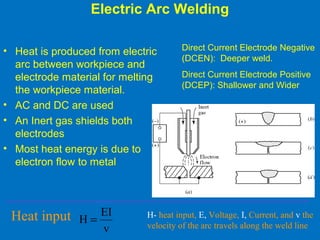
• Heat is produced from electric
arc between workpiece and
electrode material for melting
the workpiece material.
• AC and DC are used
• An Inert gas shields both
electrodes
• Most heat energy is due to
electron flow to metal
Direct Current Electrode Negative
(DCEN): Deeper weld.
Direct Current Electrode Positive
(DCEP): Shallower and Wider
Heat input
v
EI
H = H- heat input, E, Voltage, I, Current, and v the
velocity of the arc travels along the weld line
Electric Arc Welding
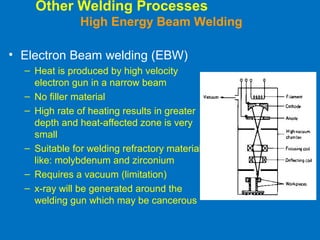
• Electron Beam welding (EBW)
– Heat is produced by high velocity
electron gun in a narrow beam
– No filler material
– High rate of heating results in greater
depth and heat-affected zone is very
small
– Suitable for welding refractory materials
like: molybdenum and zirconium
– Requires a vacuum (limitation)
– x-ray will be generated around the
welding gun which may be cancerous
Other Welding Processes
High Energy Beam Welding
Safe Work Practices
• Electric & Gas Welding
– Safety Check:
• Ensure electrical cord, electrode holder
and cables are free from defects
– No cable splices within 10 feet of electrode holder.
• Ensure welding unit is properly grounded.
This helps to avoid over heating.
• All defective equipment shall be repaired
or replaced before using.
Safe Work Practices
• Electric & Gas Welding Cont.:
– Safety Check:
• Remove all jewelry – rings, watches, bracelets,
etc…
• Ensure PPE e.g.. welding hood, gloves, rubber
boots or safety shoes, apron are available and in
good condition.
• Ensure fire extinguisher is charged and available.
• Ensure adequate ventilation and lighting is in place.
• Set Voltage Regulator to Manufacture’s
specifications.
• Avoid electrical shock DON’T wrap cables around
any body part.
• Ensure fittings are tight.
Safe Work Practices
• Electric & Gas Welding Cont.:
– Safety Check:
• Inspect hoses for cuts and frayed areas.
• Set gauges to desired PSI.
• Ensure that sufficient PPE is made
available.
• Locate welding screens to protect
employee’s – DON’T block your exit.
• Ensure that adequate ventilation and
lighting are in place.
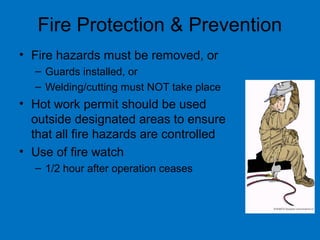
Fire Protection & Prevention
• Fire hazards must be removed, or
– Guards installed, or
– Welding/cutting must NOT take place
• Hot work permit should be used
outside designated areas to ensure
that all fire hazards are controlled
• Use of fire watch
– 1/2 hour after operation ceases
L10 : Joining processesL10 : Joining processesProper Ventilation for Welding
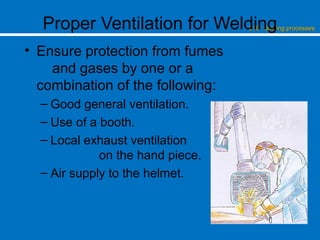
• Ensure protection from fumes
and gases by one or a
combination of the following:
– Good general ventilation.
– Use of a booth.
– Local exhaust ventilation
on the hand piece.
– Air supply to the helmet.
U
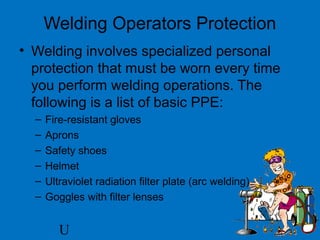
Welding Operators Protection
• Welding involves specialized personal
protection that must be worn every time
you perform welding operations. The
following is a list of basic PPE:
– Fire-resistant gloves
– Aprons
– Safety shoes
– Helmet
– Ultraviolet radiation filter plate (arc welding)
– Goggles with filter lenses
Sequences of welding
1.Do not over weld
2.Control fit up
4.For groove welds, use joints that will minimize the volume of weld metal.
Consider double-sided joints instead of single-sided joints
5.Weld alternately on either side of the joint when possible with multiple-pass
welds
6.Use minimal number of weld passes
7.Use low heat input procedures. This generally means high deposition rates
and higher travel speeds
9.Use welding positioners to achieve the maximum amount of flat-position
welding.
10.Balance welds about the neutral axis
11.Distribute the welding heat as evenly as possible through a planned welding
sequence
12.Weld toward the unrestrained part of the member
13.Use clamps, fixtures, and strong backs to maintain fit up and alignment
14. welds being made continually balance each other
Any Questions
????

welding

  • 1.
    Group Assignment welding Prepared by: ABDULJABBAR KHAN PANDIARAJ A/L RETENAM
  • 2.
    2 WELDING Definition: Material joiningprocess. Two parts connected at their contacting surfaces by suitable heat and pressure. Many welding processes are accomplished by heat alone, some others by heat and pressure, and some with pressure only. In some welding operations a filler material is used. Welding operation usually applied to metals but also used for plastics.
  • 3.
    Parts produced byany of the manufacturing processes can be made into larger, more complex bodies via Joining processes • Creating a metallurgical bond by adhesion and diffusion • Joining by fusion with the use of various heat sources • Brazing or soldering with a lower-melting metal • Mechanical fastening Joining ProcessesJoining Processes
  • 4.
  • 5.
    Sources of Energyfor Fusion Welding • Chemical reactions – Burning gases – GAS WELDING • Heat from electricity – Arc – ARC WELDING SYSTEMS – Resistance welding • LightLight LASERLASER
  • 6.
    Three Specific Typesof Welding Modules • In this Welding, Cutting, and Brazing module, three specific types of welding are covered. These are listed below: – Oxygen-fuel gas welding and cutting – Arc welding and cutting – Resistance welding
  • 7.
    • Definition: –This isa group of fusion welding processes that use heat and pressure to make the coalescence. • The heat comes from electrical resistance to current flow at the site of the weld. – The processes include: • Spot Welding • Projection Welding • Seam Welding Resistance Welding
  • 8.
    • Spot Welding –Aprocess typically used in high- volume, rapid welding applications. •The pieces to be joined are clamped between two electrodes under force, and an electrical current is sent through them. Resistance Welding
  • 9.
    Welding/Cutting Hazards • PotentialHazards – Fires may start by hot materials igniting nearby combustibles. – Burns to the operator may occur if unprotected skin comes into contact with the extremely hot work. – Magnetic fields could easily destroy/disrupt electronic components, stored data if not careful.
  • 10.
    Weldability and WeldQuality - Welding Defects-
  • 11.
    1. Fusion weldingdefects due wrong heat input, insufficient rate of weld metal deposition, and cooling. 2. Lack of bonding or gas porosity due to surface contaminants, including oxides, oils, etc. 3. Undesirable reactions with surface contaminants 4. Solidification cracks in the weld. 5. Solidification shrinkage coupled with solid shrinkage imposes internal tensile stresses on the structure, may lead to distortion. 6. Gases released or formed during welding (eg CO) can lead to porosity which weakens the joint and acts as a stress raiser. Welding Defects
  • 12.
    12 Weld joint There are5 basic joint types in welding • Butt joint: Two materials are in the same plane, joined from the edges. • Corner joint:The corners of two materials form a right angle and joined. • Lap joint: Two parts overlaps. • Tee joint: One part is perpendicular to the other, making a T shape. • Edge joint: Edges of the two materials joined.
  • 13.
  • 14.
    14 Types of weld 1.Fillet weld: Used in T joints,corner joints, lap joints. 2. Groove weld:Used in butt joints. 3. Plug weld: Used in lap joints. 4. Slot weld: Used in lap joints. 5. Spot weld: Used in lap joints. 6. Seam weld: Used in lap joints. 7. Flange weld:Used in edge joints. 8. Surfacing weld:Not a joining process, it is used to increase the thickness of the plate, or provide a protective coating on the surface.
  • 15.
  • 16.
    Oxyacetylene Gas Welding Threebasic types of oxyacetylene flames used in oxyfuel-gas welding and cutting operations: (a) neutral flame; (b) oxidizing flame; (c) carburizing, or reducing, flame. The gas mixture in (a) is basically equal volumes of oxygen and acetylene. (d) The principle of the oxyfuel-gas welding operation.
  • 17.
    Oxygen-fuel gas welding& Cutting • The elements of Oxygen-fuel gas welding and cutting: – General Requirements – Cylinders – Service Pipe Systems – Pipe System Protection
  • 18.
    Oxygen-fuel gas weldingand cutting • General Requirements – Focuses on using Acetylene Safely • Flammable • Unstable • Cannot be adjusted above 15 psi – Safe Work Practices • Blow out cylinder valve • Turn on cylinder valve first and then adjust the regulator pressure screw. • Never stand in front or behind a regulator when opening the cylinder valve • Open cylinder valve slowly • The pressure adjusting screw: – Turning clockwise allows the gas allows to flow. – Turning counterclockwise reduces or stop the gas flow.
  • 19.
    • General RequirementsCont.: – Safe Work Practices • Purge oxygen and acetylene passages • Light the acetylene • Never use oil or grease • Do not use oxygen as a substitute for air • Keep your work area clean Oxygen-fuel gas welding and cutting
  • 20.
  • 21.
    t Arc Welding andCutting • Definition: – A fusion process wherein the coalescence of the metals is achieved from the heat of an electric arc formed between an electrode and the work. • Application • Installation • Operation & Maintenance
  • 22.
    • Application – Appliesto a large and varied group of processes that use an electric arc as the source of heat to melt and join metals. • Installation – Arc welding requires proper installation of equipment. – A critical part of installation is ensuring that proper grounding is completed. Arc Welding & Cutting
  • 23.
    Arc Welding &Cutting • Operation & Maintenance – All connections to the machine shall be checked to make certain that they are properly made. – The work lead shall be firmly attached to the work. – Magnetic work clamps shall be free from adherent metal particles of spatter on contact surfaces. – Coiled welding cable shall be spread out before use to avoid serious overheating and damage to insulation.
  • 24.
    Methods of ArcWelding • Three Types of Welding Methods: – Tungsten Inert Gas Welding (TIG) – Gas Metal Arc Welding (MIG) – Shielded Metal Arc Welding (SMAW)/ Stick Welding
  • 25.
    • Heat isproduced from electric arc between workpiece and electrode material for melting the workpiece material. • AC and DC are used • An Inert gas shields both electrodes • Most heat energy is due to electron flow to metal Direct Current Electrode Negative (DCEN): Deeper weld. Direct Current Electrode Positive (DCEP): Shallower and Wider Heat input v EI H = H- heat input, E, Voltage, I, Current, and v the velocity of the arc travels along the weld line Electric Arc Welding
  • 26.
    • Electron Beamwelding (EBW) – Heat is produced by high velocity electron gun in a narrow beam – No filler material – High rate of heating results in greater depth and heat-affected zone is very small – Suitable for welding refractory materials like: molybdenum and zirconium – Requires a vacuum (limitation) – x-ray will be generated around the welding gun which may be cancerous Other Welding Processes High Energy Beam Welding
  • 27.
    Safe Work Practices •Electric & Gas Welding – Safety Check: • Ensure electrical cord, electrode holder and cables are free from defects – No cable splices within 10 feet of electrode holder. • Ensure welding unit is properly grounded. This helps to avoid over heating. • All defective equipment shall be repaired or replaced before using.
  • 28.
    Safe Work Practices •Electric & Gas Welding Cont.: – Safety Check: • Remove all jewelry – rings, watches, bracelets, etc… • Ensure PPE e.g.. welding hood, gloves, rubber boots or safety shoes, apron are available and in good condition. • Ensure fire extinguisher is charged and available. • Ensure adequate ventilation and lighting is in place. • Set Voltage Regulator to Manufacture’s specifications. • Avoid electrical shock DON’T wrap cables around any body part. • Ensure fittings are tight.
  • 29.
    Safe Work Practices •Electric & Gas Welding Cont.: – Safety Check: • Inspect hoses for cuts and frayed areas. • Set gauges to desired PSI. • Ensure that sufficient PPE is made available. • Locate welding screens to protect employee’s – DON’T block your exit. • Ensure that adequate ventilation and lighting are in place.
  • 30.
    Fire Protection &Prevention • Fire hazards must be removed, or – Guards installed, or – Welding/cutting must NOT take place • Hot work permit should be used outside designated areas to ensure that all fire hazards are controlled • Use of fire watch – 1/2 hour after operation ceases
  • 31.
    L10 : JoiningprocessesL10 : Joining processesProper Ventilation for Welding • Ensure protection from fumes and gases by one or a combination of the following: – Good general ventilation. – Use of a booth. – Local exhaust ventilation on the hand piece. – Air supply to the helmet.
  • 32.
    U Welding Operators Protection •Welding involves specialized personal protection that must be worn every time you perform welding operations. The following is a list of basic PPE: – Fire-resistant gloves – Aprons – Safety shoes – Helmet – Ultraviolet radiation filter plate (arc welding) – Goggles with filter lenses
  • 33.
    Sequences of welding 1.Donot over weld 2.Control fit up 4.For groove welds, use joints that will minimize the volume of weld metal. Consider double-sided joints instead of single-sided joints 5.Weld alternately on either side of the joint when possible with multiple-pass welds 6.Use minimal number of weld passes 7.Use low heat input procedures. This generally means high deposition rates and higher travel speeds 9.Use welding positioners to achieve the maximum amount of flat-position welding. 10.Balance welds about the neutral axis 11.Distribute the welding heat as evenly as possible through a planned welding sequence 12.Weld toward the unrestrained part of the member 13.Use clamps, fixtures, and strong backs to maintain fit up and alignment 14. welds being made continually balance each other
  • 34.

Editor's Notes

  • #7 In this Welding, Cutting, and Brazing module, three specific types of welding are covered. These are listed below: Oxygen-fuel gas welding and cutting Arc welding and cutting Resistance welding.
  • #8 Electric current and mechanical pressure Resistance to the flow of current heats the material. Pressure is simultaneously applied to the joint, forming a solidified nugget that attaches the pieces.
  • #19 I. Speaker’s Notes: Acetylene is extremely dangerous because of its flammability range. Oxyacetylene torch cutting is very common throughout the industry as it has a wide flammable range. Acetylene is extremely unstable. Acetylene is generated in the cylinder from a reaction of acetone and calcium silicate. Relief valves for generating chamber shall be set to open at a pressure not in excess of 15 psi. Using acetylene at pressures in excess of 15 psig pressure (or about 30 psia pressure) is a hazardous practice. II. Speaker’s Notes: This slide lists basic rules to follow when welding with oxyacetylene. Before connecting to the regulator, always blow out the cylinder valve. Release the regulator by adjusting the screw before opening the cylinder valve. Always stand to the side of the regulator while opening the cylinder in case of accidental pressure release. Open the valve cautiously and slowly. Never use acetylene at pressures above 15 pounds per square inch.
  • #20 I. Speaker’s Notes: Before lighting the torch, remember to purge acetylene and oxygen passages. Before opening the oxygen on the torch, light the acetylene. Never use oil or grease on regulators, tips, or any part that may come into contact with oxygen. Do not use oxygen as a substitute for air. Always keep your work area free of items that could ignite.