FUNDAMENTALS OF WELDING
1. Overview of Welding Technology
2. The Weld Joint
3. Physics of Welding
4. Features of a Fusion Welded Joint
1
Welding
Joining process in which two (or more)
parts are coalesced (bring together to
form one mass) at their contacting
surfaces by application of heat and/or
pressure
 Many welding processes use a filler
material is added to facilitate coalescence
 Weldments The parts being Welded
2
Why Welding is Important
 Provides a permanent joint
◦ Welded components become a single entity
 Usually the most economical way to join
parts in terms of material usage and
fabrication costs
◦ Mechanical fastening usually requires additional
hardware (e.g., screws) and geometric alterations of
the assembled parts (e.g., holes)
 Not restricted to a factory environment
◦ Welding can be accomplished "in the field"
3
Limitations and Drawbacks of Welding
 Most manual and are expensive in terms of
labor cost
 Mostly high energy and are inherently
dangerous
 Inconvenient disassembly
 Quality defects that are difficult to detect
4
Types of Welding Processes
 Some 50 different types of welding
processes have been catalogued by the
American Welding Society (AWS)
 Welding processes can be divided into
two major categories:
◦ Fusion welding
◦ Solid state welding
5
Fusion Welding
Joining processes that melt the base metals
 In many fusion welding operations, a
filler metal is added to the molten pool to
facilitate the process and provide bulk and
added strength to the welded joint
 A fusion welding operation in which no
filler metal is added is called an
autogenous weld
6
Some Fusion Welding Processes
 Arc welding (AW) – melting of the
metals is accomplished by an electric arc
 Resistance welding (RW) - melting is
accomplished by heat from resistance to
an electrical current between faying
surfaces held together under pressure
 Oxyfuel gas welding (OFW) - melting is
accomplished by an oxyfuel gas such as
acetylene
7
Arc Welding
 Basics of arc welding: (1) before the weld; (2) during the
weld, the base metal is melted and filler metal is added to
molten pool; and (3) the completed weldment
8
Solid State Welding
Joining processes in which coalescence
results from application of pressure
alone or a combination of heat and
pressure
 If heat is used, temperature is below
melting point of metals being welded
 No filler metal is added in solid state
welding
9
Some Solid State Welding Processes
 Diffusion welding (DFW) –coalescence is by solid
state fusion between two surfaces held together
under pressure at elevated temperature
 Friction welding (FRW) - coalescence by heat of
friction between two surfaces
10
Ultrasonic welding (USW) - coalescence by ultrasonic oscillating
motion in a direction parallel to contacting surfaces of two parts
held together under pressure
11
Principal Applications of Welding
 Construction - buildings and bridges
 Piping, pressure vessels, boilers, and
storage tanks
 Shipbuilding
 Aircraft and aerospace
 Automotive
 Railroad
12
Welder and Fitter
 Arc welding is performed by a skilled
worker called a welder who controls the
path or placement of welding gun
 Often assisted by second worker, called a
fitter, who arranges the parts prior to
welding
◦ Welding fixtures and positioners are used
to assist in this function
13
The Safety Issue
 Welding is inherently dangerous to human
workers
◦ High temperatures
◦ In gas welding, fuels (e.g., acetylene) are a fire hazard
◦ Many welding processes use electrical power, so
electrical shock is a hazard
◦ UV radiations
◦ Hazardous fumes must be exhausted
14
Automation in Welding
 Because of the hazards of manual
welding, and to increase productivity
and improve quality, various forms of
mechanization and automation are used
◦ Machine welding – mechanized welding under
supervision and control of human operator
◦ Automatic welding – equipment performs welding
without operator control
◦ Robotic welding - automatic welding implemented
by industrial robot
15
The Weld Joint
The junction of the edges or surfaces of
parts that have been joined by welding
 Two issues about weld joints:
◦ Types of joints
◦ Types of welds used to join the pieces that form the
joints
16
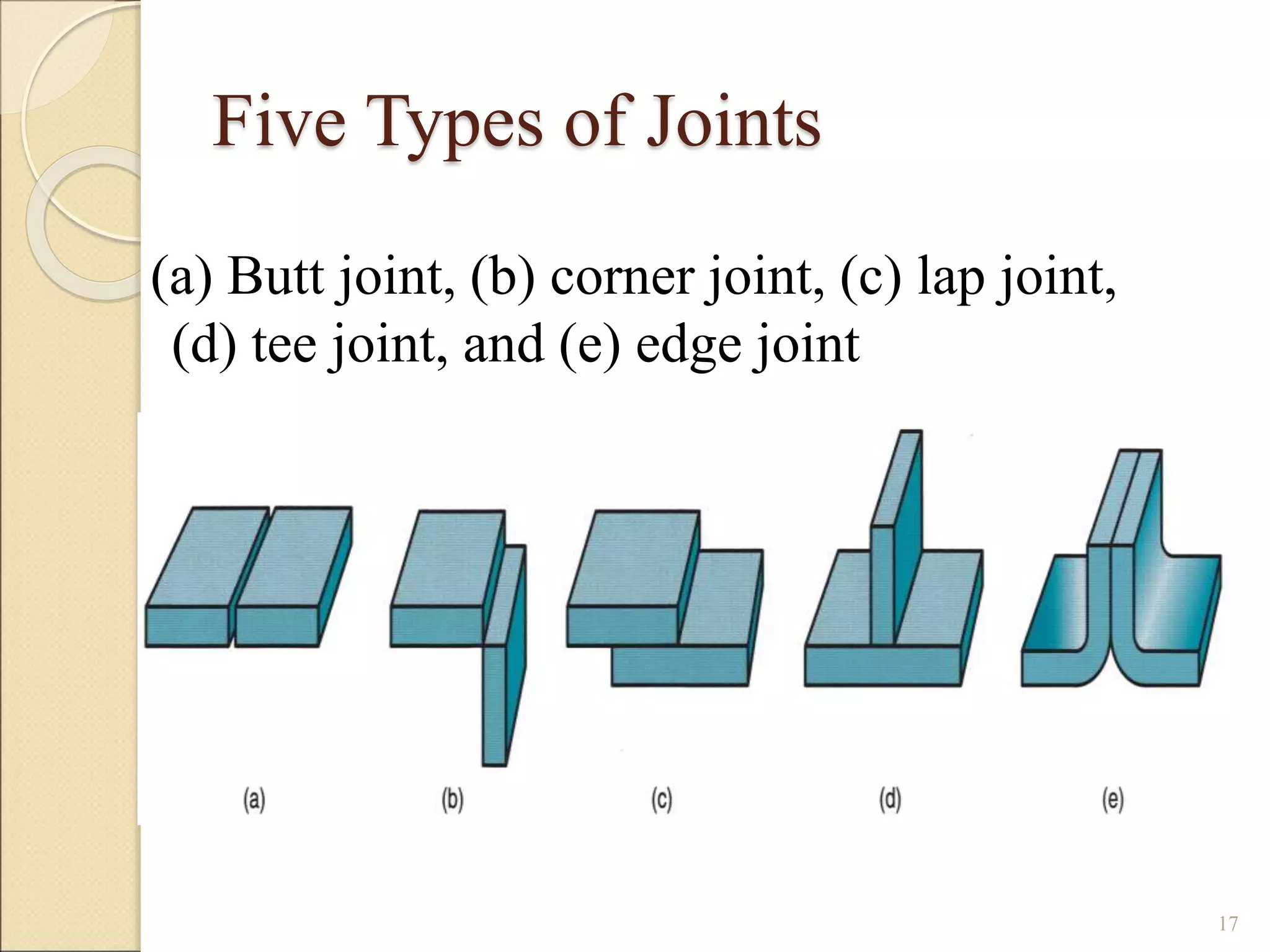
Five Types of Joints
(a) Butt joint, (b) corner joint, (c) lap joint,
(d) tee joint, and (e) edge joint
17
18
(a) Inside single fillet corner joint; (b) outside single fillet
corner joint; (c) double fillet lap joint; (d) double fillet tee
joint (dashed lines show the original part edges)
Types of Welds : 1. Fillet Welds
(a) Square groove weld, one side; (b) single bevel groove weld;
(c) single V-groove weld; (d) single U-groove weld; (e) single
J-groove weld; (f) double V-groove weld for thicker sections
(dashed lines show original part edges)
Types of Welds : 2. Groove Welds
Need to machine a groove to weld
Types of Welds : 3. Plug Weld and
Slot Weld
 (a) Plug weld and (b) slot weld
Both are used to attach plates using one or more holes or
slots in top part and then filling with filler metal to
fuse the two parts together
21
Fused section between surfaces of two sheets or plates: (a) spot weld
and (b) seam weld
 Used for lap joints
 Closely associated with resistance welding
Types of Welds : 4. Spot Weld and Seam
Weld
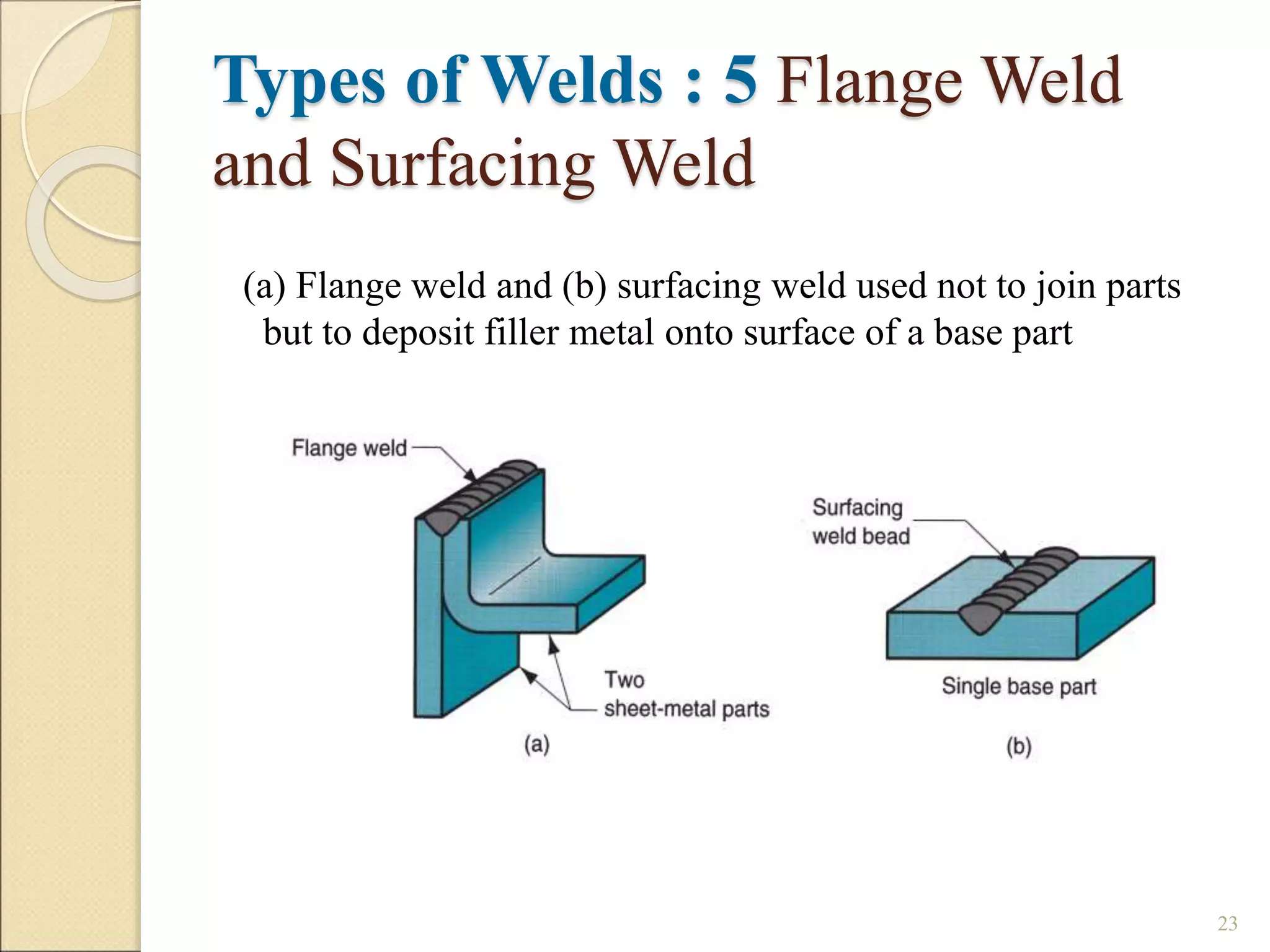
Types of Welds : 5 Flange Weld
and Surfacing Weld
(a) Flange weld and (b) surfacing weld used not to join parts
but to deposit filler metal onto surface of a base part
23
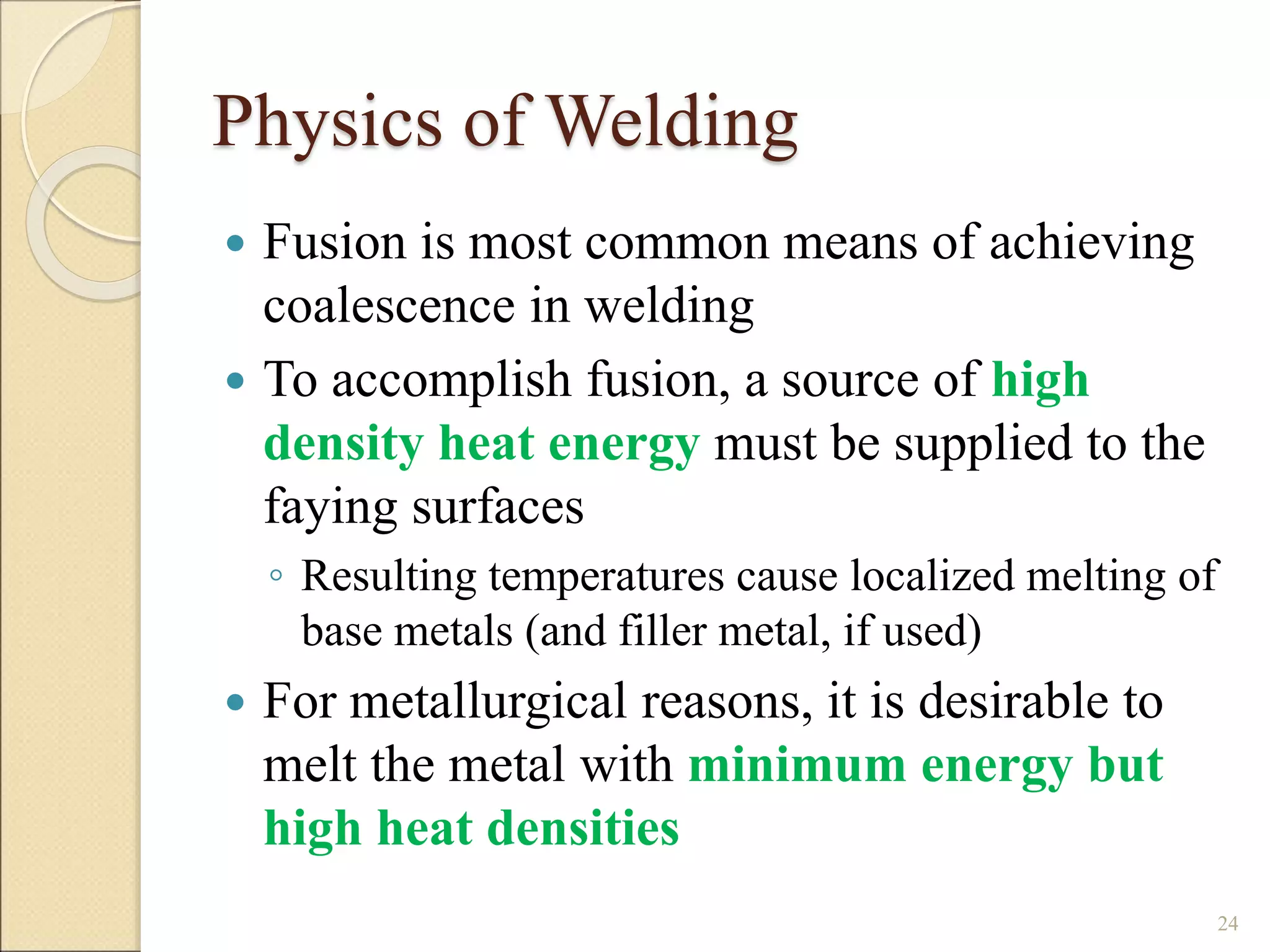
Physics of Welding
 Fusion is most common means of achieving
coalescence in welding
 To accomplish fusion, a source of high
density heat energy must be supplied to the
faying surfaces
◦ Resulting temperatures cause localized melting of
base metals (and filler metal, if used)
 For metallurgical reasons, it is desirable to
melt the metal with minimum energy but
high heat densities
24
Power Density
Power transferred to work per unit surface area,
W/mm2 (Btu/sec-in2)
 If power density is too low, heat is conducted into
work, so melting never occurs
 If power density too high, localized temperatures
vaporize metal in affected region
 There is a practical range of values for heat density
within which welding can be performed
25
Power Density
 Power entering surface divided by
corresponding surface area:
PD = power density, W/mm2 (Btu/sec-in2);
P = power entering surface, W (Btu/sec);
A = surface area over which energy is entering, mm2 (in2)
A
P
PD 
26
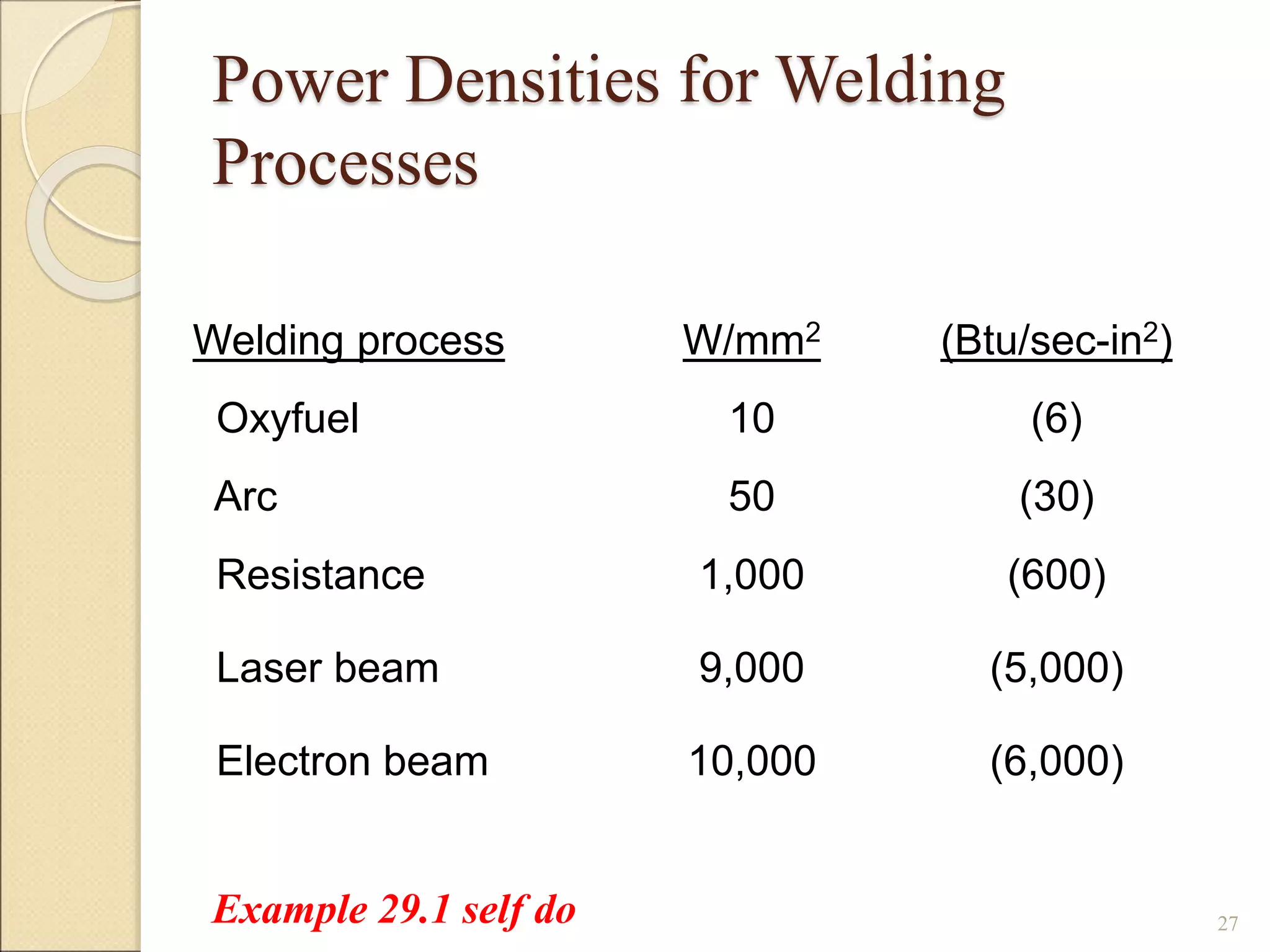
Power Densities for Welding
Processes
Welding process W/mm2 (Btu/sec-in2)
Oxyfuel 10 (6)
Arc 50 (30)
Resistance 1,000 (600)
Laser beam 9,000 (5,000)
Electron beam 10,000 (6,000)
27Example 29.1 self do
Unit Energy for Melting
Quantity of heat required to melt a unit
volume of metal
 Um is the sum of:
◦ Heat to raise temperature of solid metal to
melting point
 Depends on volumetric specific heat
◦ Heat to transform metal from solid to liquid
phase at melting point
 Depends on heat of fusion
28
Heat Transfer Mechanisms in
Welding
 Not all of the input energy is used to melt
the weld metal
1. Heat transfer efficiency f1 - actual heat received
by work piece divided by total heat generated at
source
2. Melting efficiency f2 - proportion of heat
received at work surface used for melting
 The rest is conducted into work metal
29
Heat Available for Welding
Hw = f1 f2 H
where
Hw = net heat available for welding;
f1 = heat transfer efficiency;
f2 = melting efficiency;
H = total heat generated by welding process
30
Energy Balance Equation
 Net heat energy into welding operation
equals heat energy required to melt the
volume of metal welded
Hw = Um V
Hw = net heat energy delivered to operation, J (Btu);
Um = unit energy required to melt the metal, J/mm3 (Btu/in3);
V = volume of metal melted, mm3 (in3)
31
Cross section of a typical fusion welded joint:
(a) principal zones in the joint, and (b)
typical grain structure
Typical Fusion Welded Joint

Fundamentals of Welding

  • 1.
    FUNDAMENTALS OF WELDING 1.Overview of Welding Technology 2. The Weld Joint 3. Physics of Welding 4. Features of a Fusion Welded Joint 1
  • 2.
    Welding Joining process inwhich two (or more) parts are coalesced (bring together to form one mass) at their contacting surfaces by application of heat and/or pressure  Many welding processes use a filler material is added to facilitate coalescence  Weldments The parts being Welded 2
  • 3.
    Why Welding isImportant  Provides a permanent joint ◦ Welded components become a single entity  Usually the most economical way to join parts in terms of material usage and fabrication costs ◦ Mechanical fastening usually requires additional hardware (e.g., screws) and geometric alterations of the assembled parts (e.g., holes)  Not restricted to a factory environment ◦ Welding can be accomplished "in the field" 3
  • 4.
    Limitations and Drawbacksof Welding  Most manual and are expensive in terms of labor cost  Mostly high energy and are inherently dangerous  Inconvenient disassembly  Quality defects that are difficult to detect 4
  • 5.
    Types of WeldingProcesses  Some 50 different types of welding processes have been catalogued by the American Welding Society (AWS)  Welding processes can be divided into two major categories: ◦ Fusion welding ◦ Solid state welding 5
  • 6.
    Fusion Welding Joining processesthat melt the base metals  In many fusion welding operations, a filler metal is added to the molten pool to facilitate the process and provide bulk and added strength to the welded joint  A fusion welding operation in which no filler metal is added is called an autogenous weld 6
  • 7.
    Some Fusion WeldingProcesses  Arc welding (AW) – melting of the metals is accomplished by an electric arc  Resistance welding (RW) - melting is accomplished by heat from resistance to an electrical current between faying surfaces held together under pressure  Oxyfuel gas welding (OFW) - melting is accomplished by an oxyfuel gas such as acetylene 7
  • 8.
    Arc Welding  Basicsof arc welding: (1) before the weld; (2) during the weld, the base metal is melted and filler metal is added to molten pool; and (3) the completed weldment 8
  • 9.
    Solid State Welding Joiningprocesses in which coalescence results from application of pressure alone or a combination of heat and pressure  If heat is used, temperature is below melting point of metals being welded  No filler metal is added in solid state welding 9
  • 10.
    Some Solid StateWelding Processes  Diffusion welding (DFW) –coalescence is by solid state fusion between two surfaces held together under pressure at elevated temperature  Friction welding (FRW) - coalescence by heat of friction between two surfaces 10
  • 11.
    Ultrasonic welding (USW)- coalescence by ultrasonic oscillating motion in a direction parallel to contacting surfaces of two parts held together under pressure 11
  • 12.
    Principal Applications ofWelding  Construction - buildings and bridges  Piping, pressure vessels, boilers, and storage tanks  Shipbuilding  Aircraft and aerospace  Automotive  Railroad 12
  • 13.
    Welder and Fitter Arc welding is performed by a skilled worker called a welder who controls the path or placement of welding gun  Often assisted by second worker, called a fitter, who arranges the parts prior to welding ◦ Welding fixtures and positioners are used to assist in this function 13
  • 14.
    The Safety Issue Welding is inherently dangerous to human workers ◦ High temperatures ◦ In gas welding, fuels (e.g., acetylene) are a fire hazard ◦ Many welding processes use electrical power, so electrical shock is a hazard ◦ UV radiations ◦ Hazardous fumes must be exhausted 14
  • 15.
    Automation in Welding Because of the hazards of manual welding, and to increase productivity and improve quality, various forms of mechanization and automation are used ◦ Machine welding – mechanized welding under supervision and control of human operator ◦ Automatic welding – equipment performs welding without operator control ◦ Robotic welding - automatic welding implemented by industrial robot 15
  • 16.
    The Weld Joint Thejunction of the edges or surfaces of parts that have been joined by welding  Two issues about weld joints: ◦ Types of joints ◦ Types of welds used to join the pieces that form the joints 16
  • 17.
    Five Types ofJoints (a) Butt joint, (b) corner joint, (c) lap joint, (d) tee joint, and (e) edge joint 17
  • 18.
  • 19.
    (a) Inside singlefillet corner joint; (b) outside single fillet corner joint; (c) double fillet lap joint; (d) double fillet tee joint (dashed lines show the original part edges) Types of Welds : 1. Fillet Welds
  • 20.
    (a) Square grooveweld, one side; (b) single bevel groove weld; (c) single V-groove weld; (d) single U-groove weld; (e) single J-groove weld; (f) double V-groove weld for thicker sections (dashed lines show original part edges) Types of Welds : 2. Groove Welds Need to machine a groove to weld
  • 21.
    Types of Welds: 3. Plug Weld and Slot Weld  (a) Plug weld and (b) slot weld Both are used to attach plates using one or more holes or slots in top part and then filling with filler metal to fuse the two parts together 21
  • 22.
    Fused section betweensurfaces of two sheets or plates: (a) spot weld and (b) seam weld  Used for lap joints  Closely associated with resistance welding Types of Welds : 4. Spot Weld and Seam Weld
  • 23.
    Types of Welds: 5 Flange Weld and Surfacing Weld (a) Flange weld and (b) surfacing weld used not to join parts but to deposit filler metal onto surface of a base part 23
  • 24.
    Physics of Welding Fusion is most common means of achieving coalescence in welding  To accomplish fusion, a source of high density heat energy must be supplied to the faying surfaces ◦ Resulting temperatures cause localized melting of base metals (and filler metal, if used)  For metallurgical reasons, it is desirable to melt the metal with minimum energy but high heat densities 24
  • 25.
    Power Density Power transferredto work per unit surface area, W/mm2 (Btu/sec-in2)  If power density is too low, heat is conducted into work, so melting never occurs  If power density too high, localized temperatures vaporize metal in affected region  There is a practical range of values for heat density within which welding can be performed 25
  • 26.
    Power Density  Powerentering surface divided by corresponding surface area: PD = power density, W/mm2 (Btu/sec-in2); P = power entering surface, W (Btu/sec); A = surface area over which energy is entering, mm2 (in2) A P PD  26
  • 27.
    Power Densities forWelding Processes Welding process W/mm2 (Btu/sec-in2) Oxyfuel 10 (6) Arc 50 (30) Resistance 1,000 (600) Laser beam 9,000 (5,000) Electron beam 10,000 (6,000) 27Example 29.1 self do
  • 28.
    Unit Energy forMelting Quantity of heat required to melt a unit volume of metal  Um is the sum of: ◦ Heat to raise temperature of solid metal to melting point  Depends on volumetric specific heat ◦ Heat to transform metal from solid to liquid phase at melting point  Depends on heat of fusion 28
  • 29.
    Heat Transfer Mechanismsin Welding  Not all of the input energy is used to melt the weld metal 1. Heat transfer efficiency f1 - actual heat received by work piece divided by total heat generated at source 2. Melting efficiency f2 - proportion of heat received at work surface used for melting  The rest is conducted into work metal 29
  • 30.
    Heat Available forWelding Hw = f1 f2 H where Hw = net heat available for welding; f1 = heat transfer efficiency; f2 = melting efficiency; H = total heat generated by welding process 30
  • 31.
    Energy Balance Equation Net heat energy into welding operation equals heat energy required to melt the volume of metal welded Hw = Um V Hw = net heat energy delivered to operation, J (Btu); Um = unit energy required to melt the metal, J/mm3 (Btu/in3); V = volume of metal melted, mm3 (in3) 31
  • 32.
    Cross section ofa typical fusion welded joint: (a) principal zones in the joint, and (b) typical grain structure Typical Fusion Welded Joint