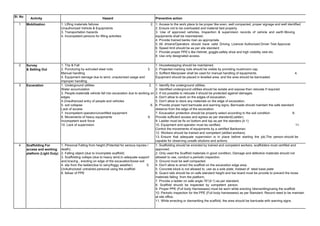
1 Mobilization 1. Lifting materials failures 2.
Unauthorized Vehicle & Equipments
3. Transportation hazards
4. Incompetent persons for lifting activities
1. Access to the work place to be proper like even, well compacted, proper signage and well identified.
2. Ensure not to be overloaded and material tied properly.
3. Use of approved vehicles, Inspection & supervision records of vehicle and earth Moving
equipments shall be manintained.
4. Provide trained banks man as appropriate.
5. All drivers/Operators should have valid Driving Licence/ Authorized Driver Test Approval.
6. Speed limit should be as per site standard
7. Provide proper PPE‘s like Helmet, goggle,safety shoe and high visibility vest etc.
8. Use only designated access.
2 Survey
& Setting Out
1. Trip & Fall
2. Puncturing by extruded steel rods 3.
Manual handling
4. Equipment damage due to wind, unautorized usage and
improper handling
1. Housekeepping should be maintained.
2. Projected marking rods should be visible by providing mushroom cap.
3. Suffient Manpower shall be used for manual handling of equipments. 4.
Equipment should be placed in levelled area, and the area should be barricaded.
3 Excavation 1. Underground utilities 2.
Water accumulation
3. People,material& vehicle fall into excavation due to working on
edges
4.Unautherized entry of people and vehicles
5. soil collapse 6.
Lack of access
7. Incompetent operator/uncertified equipment
8. Movements of heavy equipments 9.
Incompetent work force
10. Lack of supervision
1. Identify the underground utilities.
2. Identified underground utilities should be isolate and expose then relocate if required.
3. If not possible to relocate it should be protected against damages.
4. Don't allow to work on the edges of excavation.
5. Don't allow to store any materials on the edge of excavation.
6. Provide proper hard barricade and warning signs, Barricade should maintain the safe standard
distance from the edge of the excavation.
7. Excavation protection should be properly select according to the soil condition 8.
Provide sufficient access and egress as per standerd(Ladder)
9. Ladder must be fix on bottom and top as per the standers (4:1)
10. Equipment and operator must be certified. 11.
Control the movements of equipments by a certified Banksman.
12. Workers should be trained and competent (skilled workers).
13. Ensure that adequate supervision is in place before starting the job,The person should be
capable for observing unsafe situtions and actions.
4 Scaffolding For
access and working
platform (Light Duty)
1. Personal Falling from height (Potential for serious injuries /
death).
2. Falling object (due to incomplete scaffold)
3. Scaffolding collaps (due to heavy wind,In adequate support
and bracing , erecting on edge of the excavation/loose soil
4. slip from the ladder(due to rainy/foggy weather) 5.
UnAuthorized/ untrained personal using the scaffold
6. failuer of PPE
1. Scaffolding should be errected by trained and competent workers, scaffolders must certified and
approved.
2. Only used the Scaffold materials in good condition, Damage and defective materials should not
allowed to use, conduct a periodic inspection.
3. Ground must be well compacted.
4. Don't allow to errect the scaffold on the excavation edge area.
5. Concrete block is not allowed to use as a sole plate, Instead of steel base plate
6. Guard rails should be on safe standard height and toe board must be provide to prevent the loose
materials falling from the platform.
7. Provide a ladder on safe angle 76°(4:1) as per standard.
8. Scaffold shuold be inspected by competent person.
9. Proper PPE (Full body Harnessess) must be worn while erecting /dismantling/using the scaffold
10. Periodic inspection for the PPE (Full body harnessess) as per Standard. Record need to be maintain
at site office.
11. While errecting or dismantling the scaffold, the area should be barricade with warning signs.
Sl. No
Activity Hazard Preventive action
5 Formation, leveling
and Compaction
1. Vibration 2.
Noise 3.
Dust
4. Equipment moving
5. Environmental pollution due to fumes
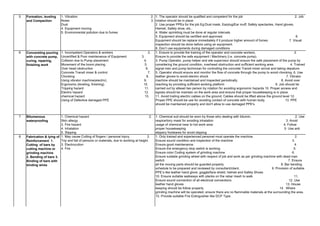
1. The operator should be qualified and competent for the job 2. Job
rotation should be in place
2. Use proper PPEs for the job Eg:Dust mask, Earplug/Ear muff, Safety spectacles, Hand gloves,
Helmet, Safety shoe, etc..
4. Water sprinkling must be done at regular intervals
5. Equipment should be certified and approved. 6.
Equipment should be replace immediately if it produce higher amount of fumes 7. Visual
inspection should be done before using an equipment.
8. Don’t use equipments during damaged conditions
6 Concereting pouring
with concrete pump,
curing, reparing,
finishing work
1. Incompetent Operators & workers 2.
Uncertified & Poor maintenance of Equipment 3.
Collision due to Pump placement 4.
Movement of the boom placing 5.
Over head obstruction 6.
Concrete Transit mixer & control 7.
Chocking 8.
Using vibrator machine(electric) 9.
Ergonomic (leveling, finishing) 10.
Tripping hazard 11.
Electric hazard 12.
chemical hazard 13.
Using of Defective damaged PPE
1. Ensure to provide the training of the operator and concrete workers. 2.
Ensure to provide the safe equipment / Machinery (i.e. concrete pump).
3. Pump Operator, pump helper and site supervisor should ensure the safe placement of the pump by
considering the ground condition, overhead obstruction and sufficient working area. 4. Trained
signal men and pump technician for controlling the concrete Transit mixer arrival and taking depature.
5. Operator should ensure and monitor the flow of concrete through the pump to avoid chocking. 6. Use
leather gloves to avoid electric shock 7. Vibrator
machine should be maintained and inspected periodically. 8. Avoid over
reaching by providing sufficient working platform 9. Job should be
carried out by atleast two person by rotation for avoiding ergonomic hazards 10. Proper access and
egress should be maintain on the work area and ensure that proper housekeeping is in place.
11. Avoid trailing electric cables on the ground, Cables should be lifted above the ground level 12.
Proper PPE should be use for avoiding contact of concrete with human body. 13. PPE
should be maintained properly and don't allow to use damaged PPE's
7 Bitumenous
waterproofing
1. Chemical hazard 2.
Skin allergy
3. Fire hazard
4. Inhalation
5. Slipping
1. Chemical suit should be worn by those who dealing with bitumin. 2. Use
respirartiory mask for avoiding inhalation 3. Avoid
usage of chemical near to hot work area 4. Follow
proper housekeeping 5. Use anti
slippery footwares for avoid slipping
8 Fabrication & lying of
Reinforcement 1.
Cutting of bars by
cutting machine or
grinding machine
2. Bending of bars 3.
Binding of bars with
binding wires
1. May cause Cutting of fingers / personal injury. 2.
Trip and fall of persons or materials, due to working at height.
3. Electrocution
4. Fire
1. Only trained and experienced personel must operate the machine. 2.
Ensure sound condition and inspection of the machine 3.
Ensure good maintenance. 4.
Ensure the emergency stop switch is working. 5.
Ensure color Coding system of grinding machine. 6.
Ensure suitable grinding wheel with respect of job and work as per grinding machine with dead man
switch 7. Ensure
all the moving parts should be guarded properly. 8. Bar bending
schedule to be prepared and reviewed by consultant/client. 9. Provision of suitable
PPE’s like leather hand glove, goggle/face shield, helmet and Safety Shoes
10. Ensure suitable walkways with planks on the rebar mesh to walk. 11.
Ensure sound connection of all electrical connections. 12. Use
leather hand gloves 13. House
keeping should be follow properly. 14. Where
grinding machine will be operated, ensure there are no flammable materials at the surrounding the area.
15. Provide suitable Fire Extinguisher like DCP Type.
9 Form Work 1. May cause cutting of fingers or injury to hand of the personnel
2. Back Injury 3.
Cut Injury 4.
Hit Injury 5.
Crushing Injury 6.
Falling hazard 7.
Awkward posture 8.
Failure of crane 9.
wind speed 10.
Failure of materials during lifting 11.
Damaged, unsuitable and without certified lifting gears may
cause personal injury or property damage.
12. Unsecured suspended materials may cause hit injury.
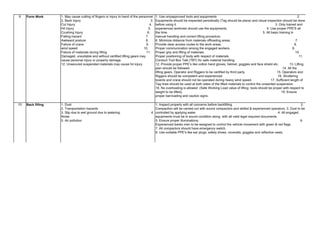
1. Use onlyapproved tools and equipments 2.
Equipments should be inspected periodically (Tag should be place) and visual inspection should be done
before using it. 3. Only trained and
experienced workmen should use the equipments. 4. Use proper PPE'S all
the time. 5. All basic training in
manual handling and correct lifting procedure.
6. Minimize distance from materials offloading areas. 7.
Provide clear access routes to the work areas. 8.
Proper communication among the engaged workers. 9.
Proper grip and lifting of materials. 10.
Proper positioning of body with respect of materials. 11.
Conduct Tool Box Talk (TBT) for safe material handling.
12. Provide proper PPE’s like cotton hand gloves, helmet, goggles and face shield etc. 13. Lifting
plan should be followed. 14. All the
lifting gears, Operator and Riggers to be certified by third party. 15. Operators and
Riggers should be competent and experienced 16. Shuttering
boards and crane should not be operated during heavy wind speed. 17. Sufficient length of
Tag lines should be used at both sides of the lifted materials to control the unwanted suspension.
18. No overloading is allowed (Safe Working Load value of lifting tools should be proper with respect to
weight to be lifted). 19. Ensure
proper barricading and caution signs.
10 Back filling 1. Dust
2. Transportation hazards
3. Slip due to wet ground due to watering. 4.
Noise
5. Air pollution
1. Inspect properly with all concerns before backfilling. 2.
Compaction will be carried out with sound compactors and skilled & experienced operators. 3. Dust to be
controlled by applying water. 4. All engaged
equipments must be in sound condition along with all valid legal required documents.
5. Ensure proper illuminations. 6.
Experienced banks men to be assigned to control the vehicle movement with green & red flags.
7. All compactors should have emergency switch.
8. Use suitable PPE's like ear plugs, safety shoes, coveralls, goggles and reflective vests.
5 Pile head breaking
Rerpairing and debris
removal
1. Vibration
2. Noise
3. Dust
4. Slippage of Jackhammer
5. Injury to workmen
6. Incorrect Manual Handling and Machine handling
7. Personnel fall from height
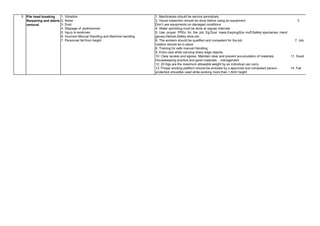
1. Machinaries should be service periodicaly
2. Visual inspection should be done before using an equipment 3.
Don’t use equipments on damaged conditions
4. Water sprinkling must be done at regular intervals
5. Use proper PPEs for the job Eg:Dust mask,Earplug/Ear muff,Safety spectacles, Hand
gloves,Helmet,Safety shoe etc..
6. The workers should be qualified and competent for the job 7. Job
rotation should be in place
8. Training for safe manual Handling.
9. Extra care while carrying sharp edge objects.
10. Clear access and egress. Maintain clear and prevent accumulation of materials. 11. Good
Housekeeping practice and good materials management
12. 20 Kgs are the maximum allowable weight by an individual can carry.
13. Proper working platform should be errected by a approved and competent person 14. Fall
protection shouldbe used while working more than 1.8mtr height

risk assessment - pile cap.pdf

  • 1.
    1 Mobilization 1.Lifting materials failures 2. Unauthorized Vehicle & Equipments 3. Transportation hazards 4. Incompetent persons for lifting activities 1. Access to the work place to be proper like even, well compacted, proper signage and well identified. 2. Ensure not to be overloaded and material tied properly. 3. Use of approved vehicles, Inspection & supervision records of vehicle and earth Moving equipments shall be manintained. 4. Provide trained banks man as appropriate. 5. All drivers/Operators should have valid Driving Licence/ Authorized Driver Test Approval. 6. Speed limit should be as per site standard 7. Provide proper PPE‘s like Helmet, goggle,safety shoe and high visibility vest etc. 8. Use only designated access. 2 Survey & Setting Out 1. Trip & Fall 2. Puncturing by extruded steel rods 3. Manual handling 4. Equipment damage due to wind, unautorized usage and improper handling 1. Housekeepping should be maintained. 2. Projected marking rods should be visible by providing mushroom cap. 3. Suffient Manpower shall be used for manual handling of equipments. 4. Equipment should be placed in levelled area, and the area should be barricaded. 3 Excavation 1. Underground utilities 2. Water accumulation 3. People,material& vehicle fall into excavation due to working on edges 4.Unautherized entry of people and vehicles 5. soil collapse 6. Lack of access 7. Incompetent operator/uncertified equipment 8. Movements of heavy equipments 9. Incompetent work force 10. Lack of supervision 1. Identify the underground utilities. 2. Identified underground utilities should be isolate and expose then relocate if required. 3. If not possible to relocate it should be protected against damages. 4. Don't allow to work on the edges of excavation. 5. Don't allow to store any materials on the edge of excavation. 6. Provide proper hard barricade and warning signs, Barricade should maintain the safe standard distance from the edge of the excavation. 7. Excavation protection should be properly select according to the soil condition 8. Provide sufficient access and egress as per standerd(Ladder) 9. Ladder must be fix on bottom and top as per the standers (4:1) 10. Equipment and operator must be certified. 11. Control the movements of equipments by a certified Banksman. 12. Workers should be trained and competent (skilled workers). 13. Ensure that adequate supervision is in place before starting the job,The person should be capable for observing unsafe situtions and actions. 4 Scaffolding For access and working platform (Light Duty) 1. Personal Falling from height (Potential for serious injuries / death). 2. Falling object (due to incomplete scaffold) 3. Scaffolding collaps (due to heavy wind,In adequate support and bracing , erecting on edge of the excavation/loose soil 4. slip from the ladder(due to rainy/foggy weather) 5. UnAuthorized/ untrained personal using the scaffold 6. failuer of PPE 1. Scaffolding should be errected by trained and competent workers, scaffolders must certified and approved. 2. Only used the Scaffold materials in good condition, Damage and defective materials should not allowed to use, conduct a periodic inspection. 3. Ground must be well compacted. 4. Don't allow to errect the scaffold on the excavation edge area. 5. Concrete block is not allowed to use as a sole plate, Instead of steel base plate 6. Guard rails should be on safe standard height and toe board must be provide to prevent the loose materials falling from the platform. 7. Provide a ladder on safe angle 76°(4:1) as per standard. 8. Scaffold shuold be inspected by competent person. 9. Proper PPE (Full body Harnessess) must be worn while erecting /dismantling/using the scaffold 10. Periodic inspection for the PPE (Full body harnessess) as per Standard. Record need to be maintain at site office. 11. While errecting or dismantling the scaffold, the area should be barricade with warning signs. Sl. No Activity Hazard Preventive action
  • 2.
    5 Formation, leveling andCompaction 1. Vibration 2. Noise 3. Dust 4. Equipment moving 5. Environmental pollution due to fumes 1. The operator should be qualified and competent for the job 2. Job rotation should be in place 2. Use proper PPEs for the job Eg:Dust mask, Earplug/Ear muff, Safety spectacles, Hand gloves, Helmet, Safety shoe, etc.. 4. Water sprinkling must be done at regular intervals 5. Equipment should be certified and approved. 6. Equipment should be replace immediately if it produce higher amount of fumes 7. Visual inspection should be done before using an equipment. 8. Don’t use equipments during damaged conditions 6 Concereting pouring with concrete pump, curing, reparing, finishing work 1. Incompetent Operators & workers 2. Uncertified & Poor maintenance of Equipment 3. Collision due to Pump placement 4. Movement of the boom placing 5. Over head obstruction 6. Concrete Transit mixer & control 7. Chocking 8. Using vibrator machine(electric) 9. Ergonomic (leveling, finishing) 10. Tripping hazard 11. Electric hazard 12. chemical hazard 13. Using of Defective damaged PPE 1. Ensure to provide the training of the operator and concrete workers. 2. Ensure to provide the safe equipment / Machinery (i.e. concrete pump). 3. Pump Operator, pump helper and site supervisor should ensure the safe placement of the pump by considering the ground condition, overhead obstruction and sufficient working area. 4. Trained signal men and pump technician for controlling the concrete Transit mixer arrival and taking depature. 5. Operator should ensure and monitor the flow of concrete through the pump to avoid chocking. 6. Use leather gloves to avoid electric shock 7. Vibrator machine should be maintained and inspected periodically. 8. Avoid over reaching by providing sufficient working platform 9. Job should be carried out by atleast two person by rotation for avoiding ergonomic hazards 10. Proper access and egress should be maintain on the work area and ensure that proper housekeeping is in place. 11. Avoid trailing electric cables on the ground, Cables should be lifted above the ground level 12. Proper PPE should be use for avoiding contact of concrete with human body. 13. PPE should be maintained properly and don't allow to use damaged PPE's 7 Bitumenous waterproofing 1. Chemical hazard 2. Skin allergy 3. Fire hazard 4. Inhalation 5. Slipping 1. Chemical suit should be worn by those who dealing with bitumin. 2. Use respirartiory mask for avoiding inhalation 3. Avoid usage of chemical near to hot work area 4. Follow proper housekeeping 5. Use anti slippery footwares for avoid slipping 8 Fabrication & lying of Reinforcement 1. Cutting of bars by cutting machine or grinding machine 2. Bending of bars 3. Binding of bars with binding wires 1. May cause Cutting of fingers / personal injury. 2. Trip and fall of persons or materials, due to working at height. 3. Electrocution 4. Fire 1. Only trained and experienced personel must operate the machine. 2. Ensure sound condition and inspection of the machine 3. Ensure good maintenance. 4. Ensure the emergency stop switch is working. 5. Ensure color Coding system of grinding machine. 6. Ensure suitable grinding wheel with respect of job and work as per grinding machine with dead man switch 7. Ensure all the moving parts should be guarded properly. 8. Bar bending schedule to be prepared and reviewed by consultant/client. 9. Provision of suitable PPE’s like leather hand glove, goggle/face shield, helmet and Safety Shoes 10. Ensure suitable walkways with planks on the rebar mesh to walk. 11. Ensure sound connection of all electrical connections. 12. Use leather hand gloves 13. House keeping should be follow properly. 14. Where grinding machine will be operated, ensure there are no flammable materials at the surrounding the area. 15. Provide suitable Fire Extinguisher like DCP Type.
  • 3.
    9 Form Work1. May cause cutting of fingers or injury to hand of the personnel 2. Back Injury 3. Cut Injury 4. Hit Injury 5. Crushing Injury 6. Falling hazard 7. Awkward posture 8. Failure of crane 9. wind speed 10. Failure of materials during lifting 11. Damaged, unsuitable and without certified lifting gears may cause personal injury or property damage. 12. Unsecured suspended materials may cause hit injury. 1. Use onlyapproved tools and equipments 2. Equipments should be inspected periodically (Tag should be place) and visual inspection should be done before using it. 3. Only trained and experienced workmen should use the equipments. 4. Use proper PPE'S all the time. 5. All basic training in manual handling and correct lifting procedure. 6. Minimize distance from materials offloading areas. 7. Provide clear access routes to the work areas. 8. Proper communication among the engaged workers. 9. Proper grip and lifting of materials. 10. Proper positioning of body with respect of materials. 11. Conduct Tool Box Talk (TBT) for safe material handling. 12. Provide proper PPE’s like cotton hand gloves, helmet, goggles and face shield etc. 13. Lifting plan should be followed. 14. All the lifting gears, Operator and Riggers to be certified by third party. 15. Operators and Riggers should be competent and experienced 16. Shuttering boards and crane should not be operated during heavy wind speed. 17. Sufficient length of Tag lines should be used at both sides of the lifted materials to control the unwanted suspension. 18. No overloading is allowed (Safe Working Load value of lifting tools should be proper with respect to weight to be lifted). 19. Ensure proper barricading and caution signs. 10 Back filling 1. Dust 2. Transportation hazards 3. Slip due to wet ground due to watering. 4. Noise 5. Air pollution 1. Inspect properly with all concerns before backfilling. 2. Compaction will be carried out with sound compactors and skilled & experienced operators. 3. Dust to be controlled by applying water. 4. All engaged equipments must be in sound condition along with all valid legal required documents. 5. Ensure proper illuminations. 6. Experienced banks men to be assigned to control the vehicle movement with green & red flags. 7. All compactors should have emergency switch. 8. Use suitable PPE's like ear plugs, safety shoes, coveralls, goggles and reflective vests.
  • 4.
    5 Pile headbreaking Rerpairing and debris removal 1. Vibration 2. Noise 3. Dust 4. Slippage of Jackhammer 5. Injury to workmen 6. Incorrect Manual Handling and Machine handling 7. Personnel fall from height 1. Machinaries should be service periodicaly 2. Visual inspection should be done before using an equipment 3. Don’t use equipments on damaged conditions 4. Water sprinkling must be done at regular intervals 5. Use proper PPEs for the job Eg:Dust mask,Earplug/Ear muff,Safety spectacles, Hand gloves,Helmet,Safety shoe etc.. 6. The workers should be qualified and competent for the job 7. Job rotation should be in place 8. Training for safe manual Handling. 9. Extra care while carrying sharp edge objects. 10. Clear access and egress. Maintain clear and prevent accumulation of materials. 11. Good Housekeeping practice and good materials management 12. 20 Kgs are the maximum allowable weight by an individual can carry. 13. Proper working platform should be errected by a approved and competent person 14. Fall protection shouldbe used while working more than 1.8mtr height