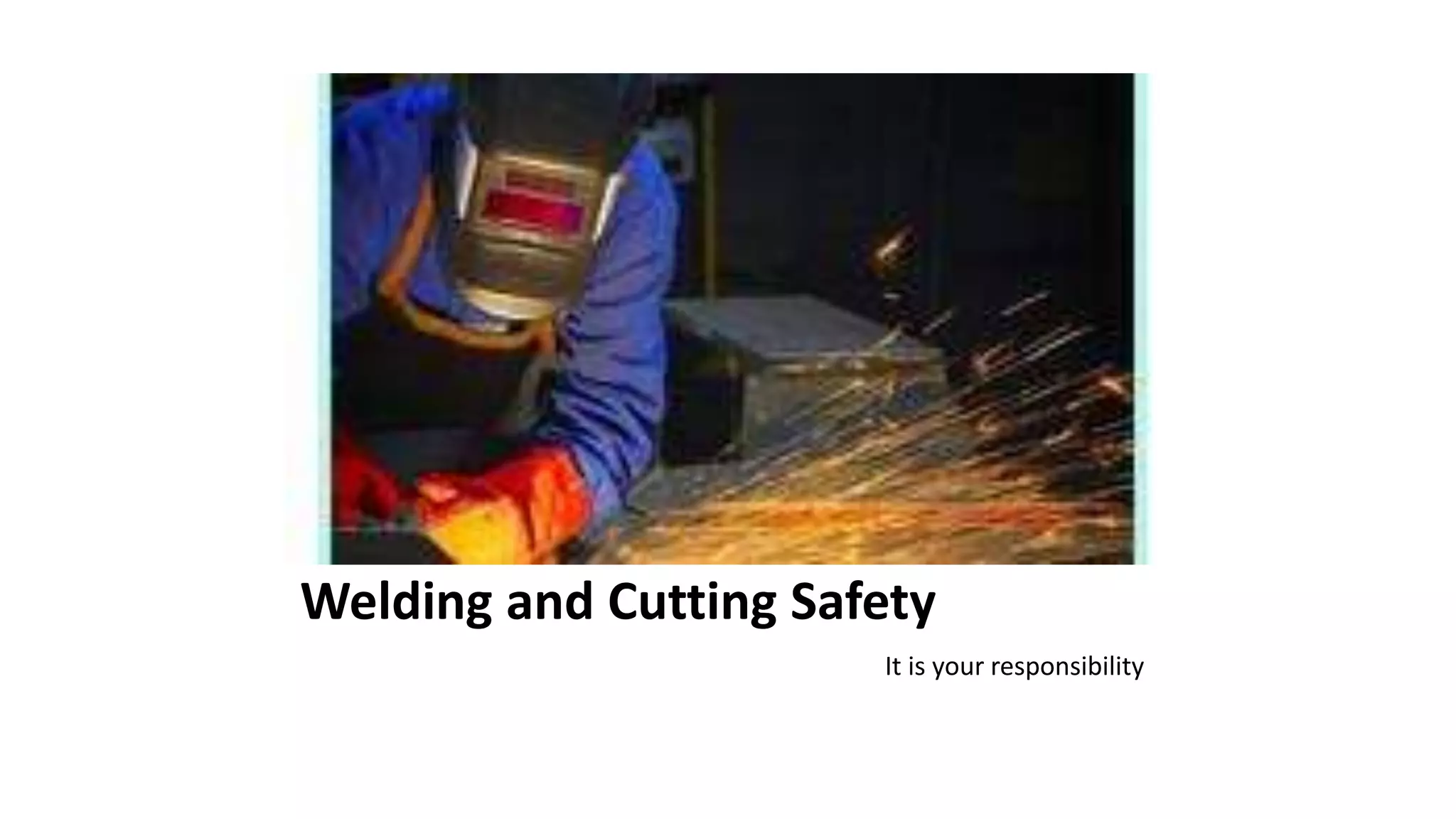
Welding and Cutting Safety
It is your responsibility
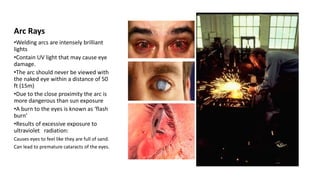
Arc Rays
•Welding arcs are intensely brilliant
lights
•Contain UV light that may cause eye
damage.
•The arc should never be viewed with
the naked eye within a distance of 50
ft (15m)
•Due to the close proximity the arc is
more dangerous than sun exposure
•A burn to the eyes is known as ‘flash
burn’
•Results of excessive exposure to
ultraviolet radiation:
Causes eyes to feel like they are full of sand.
Can lead to premature cataracts of the eyes.
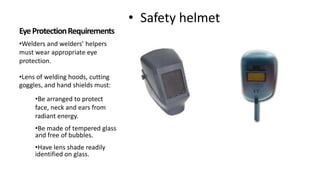
• Safety helmet
•Welders and welders’ helpers
must wear appropriate eye
protection.
•Lens of welding hoods, cutting
goggles, and hand shields must:
•Be arranged to protect
face, neck and ears from
radiant energy.
•Be made of tempered glass
and free of bubbles.
•Have lens shade readily
identified on glass.
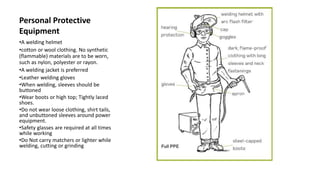
Personal Protective
Equipment
•A welding helmet
•cotton or wool clothing. No synthetic
(flammable) materials are to be worn,
such as nylon, polyester or rayon.
•A welding jacket is preferred
•Leather welding gloves
•When welding, sleeves should be
buttoned
•Wear boots or high top; Tightly laced
shoes.
•Do not wear loose clothing, shirt tails,
and unbuttoned sleeves around power
equipment.
•Safety glasses are required at all times
while working
•Do Not carry matchers or lighter while
welding, cutting or grinding
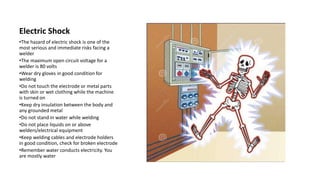
Electric Shock
•The hazard of electric shock is one of the
most serious and immediate risks facing a
welder
•The maximum open circuit voltage for a
welder is 80 volts
•Wear dry gloves in good condition for
welding
•Do not touch the electrode or metal parts
with skin or wet clothing while the machine
is turned on
•Keep dry insulation between the body and
any grounded metal
•Do not stand in water while welding
•Do not place liquids on or above
welders/electrical equipment
•Keep welding cables and electrode holders
in good condition, check for broken electrode
•Remember water conducts electricity. You
are mostly water
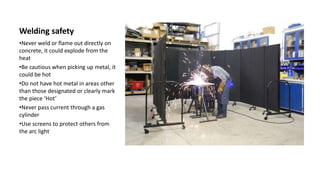
Welding safety
•Never weld or flame out directly on
concrete, it could explode from the
heat
•Be cautious when picking up metal, it
could be hot
•Do not have hot metal in areas other
than those designated or clearly mark
the piece ‘Hot’
•Never pass current through a gas
cylinder
•Use screens to protect others from
the arc light
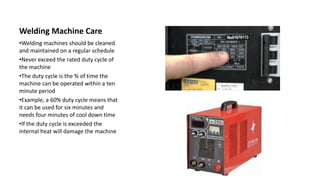
Welding Machine Care
•Welding machines should be cleaned
and maintained on a regular schedule
•Never exceed the rated duty cycle of
the machine
•The duty cycle is the % of time the
machine can be operated within a ten
minute period
•Example, a 60% duty cycle means that
it can be used for six minutes and
needs four minutes of cool down time
•If the duty cycle is exceeded the
internal heat will damage the machine
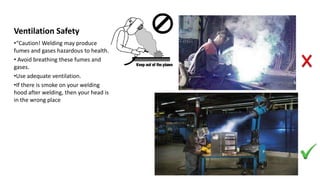
Ventilation Safety
•“Caution! Welding may produce
fumes and gases hazardous to health.
• Avoid breathing these fumes and
gases.
•Use adequate ventilation.
•If there is smoke on your welding
hood after welding, then your head is
in the wrong place
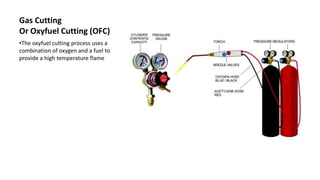
Gas Cutting
Or Oxyfuel Cutting (OFC)
•The oxyfuel cutting process uses a
combination of oxygen and a fuel to
provide a high temperature flame
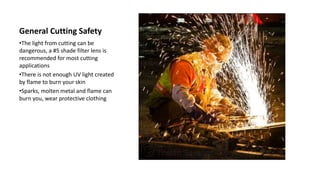
General Cutting Safety
•The light from cutting can be
dangerous, a #5 shade filter lens is
recommended for most cutting
applications
•There is not enough UV light created
by flame to burn your skin
•Sparks, molten metal and flame can
burn you, wear protective clothing
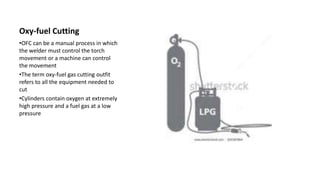
Oxy-fuel Cutting
•OFC can be a manual process in which
the welder must control the torch
movement or a machine can control
the movement
•The term oxy-fuel gas cutting outfit
refers to all the equipment needed to
cut
•Cylinders contain oxygen at extremely
high pressure and a fuel gas at a low
pressure
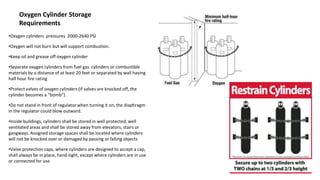
Oxygen Cylinder Storage
Requirements
•Oxygen cylinders pressures 2000-2640 PSI
•Oxygen will not burn but will support combustion.
•Keep oil and grease off oxygen cylinder
•Separate oxygen cylinders from fuel gas cylinders or combustible
materials by a distance of at least 20 feet or separated by wall having
half hour fire rating
•Protect valves of oxygen cylinders (if valves are knocked off, the
cylinder becomes a “bomb”).
•Do not stand in front of regulator when turning it on, the diaphragm
in the regulator could blow outward.
•Inside buildings, cylinders shall be stored in well protected, well
ventilated areas and shall be stored away from elevators, stairs or
gangways. Assigned storage spaces shall be located where cylinders
will not be knocked over or damaged by passing or falling objects
•Valve protection caps, where cylinders are designed to accept a cap,
shall always be in place, hand-tight, except where cylinders are in use
or connected for use
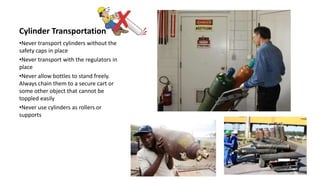
•Never transport cylinders without the
safety caps in place
•Never transport with the regulators in
place
•Never allow bottles to stand freely.
Always chain them to a secure cart or
some other object that cannot be
toppled easily
•Never use cylinders as rollers or
supports
Cylinder Transportation
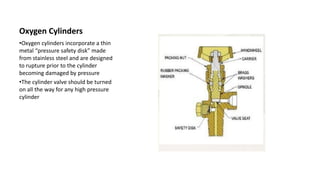
Oxygen Cylinders
•Oxygen cylinders incorporate a thin
metal “pressure safety disk” made
from stainless steel and are designed
to rupture prior to the cylinder
becoming damaged by pressure
•The cylinder valve should be turned
on all the way for any high pressure
cylinder
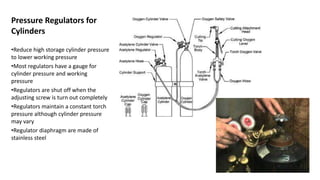
Pressure Regulators for
Cylinders
•Reduce high storage cylinder pressure
to lower working pressure
•Most regulators have a gauge for
cylinder pressure and working
pressure
•Regulators are shut off when the
adjusting screw is turn out completely
•Regulators maintain a constant torch
pressure although cylinder pressure
may vary
•Regulator diaphragm are made of
stainless steel
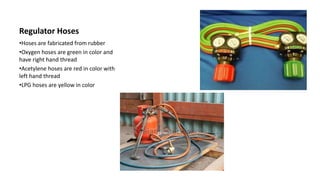
Regulator Hoses
•Hoses are fabricated from rubber
•Oxygen hoses are green in color and
have right hand thread
•Acetylene hoses are red in color with
left hand thread
•LPG hoses are yellow in color
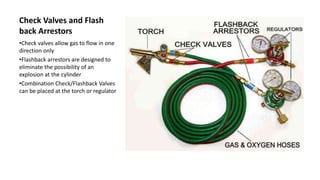
Check Valves and Flash
back Arrestors
•Check valves allow gas to flow in one
direction only
•Flashback arrestors are designed to
eliminate the possibility of an
explosion at the cylinder
•Combination Check/Flashback Valves
can be placed at the torch or regulator
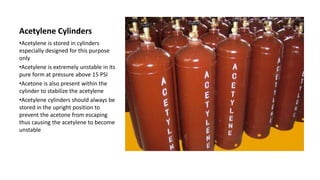
Acetylene Cylinders
•Acetylene is stored in cylinders
especially designed for this purpose
only
•Acetylene is extremely unstable in its
pure form at pressure above 15 PSI
•Acetone is also present within the
cylinder to stabilize the acetylene
•Acetylene cylinders should always be
stored in the upright position to
prevent the acetone from escaping
thus causing the acetylene to become
unstable
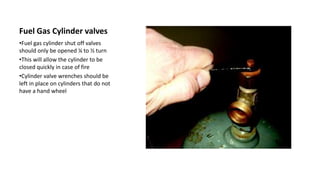
Fuel Gas Cylinder valves
•Fuel gas cylinder shut off valves
should only be opened ¼ to ½ turn
•This will allow the cylinder to be
closed quickly in case of fire
•Cylinder valve wrenches should be
left in place on cylinders that do not
have a hand wheel
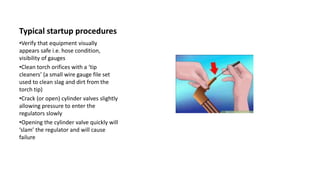
Typical startup procedures
•Verify that equipment visually
appears safe i.e. hose condition,
visibility of gauges
•Clean torch orifices with a ‘tip
cleaners’ (a small wire gauge file set
used to clean slag and dirt from the
torch tip)
•Crack (or open) cylinder valves slightly
allowing pressure to enter the
regulators slowly
•Opening the cylinder valve quickly will
‘slam’ the regulator and will cause
failure
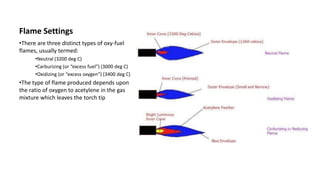
Flame Settings
•There are three distinct types of oxy-fuel
flames, usually termed:
•Neutral (3200 deg C)
•Carburizing (or “excess fuel”) (3000 deg C)
•Oxidizing (or “excess oxygen”) (3400 deg C)
•The type of flame produced depends upon
the ratio of oxygen to acetylene in the gas
mixture which leaves the torch tip
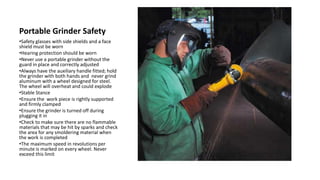
Portable Grinder Safety
•Safety glasses with side shields and a face
shield must be worn
•Hearing protection should be worn
•Never use a portable grinder without the
guard in place and correctly adjusted
•Always have the auxiliary handle fitted; hold
the grinder with both hands and never grind
aluminum with a wheel designed for steel.
The wheel will overheat and could explode
•Stable Stance
•Ensure the work piece is rightly supported
and firmly clamped
•Ensure the grinder is turned off during
plugging it in
•Check to make sure there are no flammable
materials that may be hit by sparks and check
the area for any smoldering material when
the work is completed
•The maximum speed in revolutions per
minute is marked on every wheel. Never
exceed this limit
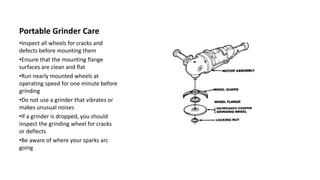
Portable Grinder Care
•Inspect all wheels for cracks and
defects before mounting them
•Ensure that the mounting flange
surfaces are clean and flat
•Run nearly mounted wheels at
operating speed for one minute before
grinding
•Do not use a grinder that vibrates or
makes unusual noises
•If a grinder is dropped, you should
inspect the grinding wheel for cracks
or deflects
•Be aware of where your sparks arc
going
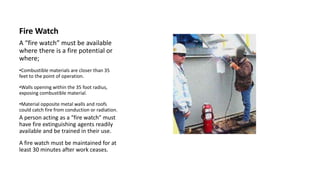
Fire Watch
A “fire watch” must be available
where there is a fire potential or
where;
•Combustible materials are closer than 35
feet to the point of operation.
•Walls opening within the 35 foot radius,
exposing combustible material.
•Material opposite metal walls and roofs
could catch fire from conduction or radiation.
A person acting as a “fire watch” must
have fire extinguishing agents readily
available and be trained in their use.
A fire watch must be maintained for at
least 30 minutes after work ceases.
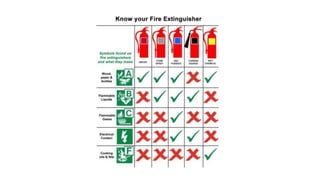
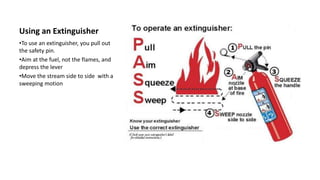
Using an Extinguisher
•To use an extinguisher, you pull out
the safety pin.
•Aim at the fuel, not the flames, and
depress the lever
•Move the stream side to side with a
sweeping motion
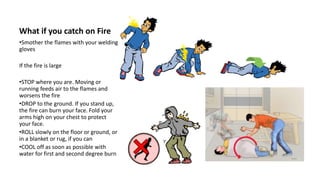
What if you catch on Fire
•Smother the flames with your welding
gloves
If the fire is large
•STOP where you are. Moving or
running feeds air to the flames and
worsens the fire
•DROP to the ground. If you stand up,
the fire can burn your face. Fold your
arms high on your chest to protect
your face.
•ROLL slowly on the floor or ground, or
in a blanket or rug, if you can
•COOL off as soon as possible with
water for first and second degree burn
Hot Work Area
A hot work permit is required for all hot work on site that is not conducted in a
designated area
•Designated areas
•Is a specific area designed and approved for hot work on a continual basis e.g. welding bays
•Hot work permit areas
•Is an area where hot work is permitted provided that they are made fire safe, a Hot Work
Permit has been issued and a job Hazard Analysis (JHA) has been completed
•Prohibited areas
•Is an area where there is a high potential for fire and or explostion or where combustible
hazrds cannot be adequatel controlled.
Thanks

welding safety.pptx

  • 1.
    Welding and CuttingSafety It is your responsibility
  • 2.
    Arc Rays •Welding arcsare intensely brilliant lights •Contain UV light that may cause eye damage. •The arc should never be viewed with the naked eye within a distance of 50 ft (15m) •Due to the close proximity the arc is more dangerous than sun exposure •A burn to the eyes is known as ‘flash burn’ •Results of excessive exposure to ultraviolet radiation: Causes eyes to feel like they are full of sand. Can lead to premature cataracts of the eyes.
  • 3.
    • Safety helmet •Weldersand welders’ helpers must wear appropriate eye protection. •Lens of welding hoods, cutting goggles, and hand shields must: •Be arranged to protect face, neck and ears from radiant energy. •Be made of tempered glass and free of bubbles. •Have lens shade readily identified on glass.
  • 4.
    Personal Protective Equipment •A weldinghelmet •cotton or wool clothing. No synthetic (flammable) materials are to be worn, such as nylon, polyester or rayon. •A welding jacket is preferred •Leather welding gloves •When welding, sleeves should be buttoned •Wear boots or high top; Tightly laced shoes. •Do not wear loose clothing, shirt tails, and unbuttoned sleeves around power equipment. •Safety glasses are required at all times while working •Do Not carry matchers or lighter while welding, cutting or grinding
  • 5.
    Electric Shock •The hazardof electric shock is one of the most serious and immediate risks facing a welder •The maximum open circuit voltage for a welder is 80 volts •Wear dry gloves in good condition for welding •Do not touch the electrode or metal parts with skin or wet clothing while the machine is turned on •Keep dry insulation between the body and any grounded metal •Do not stand in water while welding •Do not place liquids on or above welders/electrical equipment •Keep welding cables and electrode holders in good condition, check for broken electrode •Remember water conducts electricity. You are mostly water
  • 6.
    Welding safety •Never weldor flame out directly on concrete, it could explode from the heat •Be cautious when picking up metal, it could be hot •Do not have hot metal in areas other than those designated or clearly mark the piece ‘Hot’ •Never pass current through a gas cylinder •Use screens to protect others from the arc light
  • 7.
    Welding Machine Care •Weldingmachines should be cleaned and maintained on a regular schedule •Never exceed the rated duty cycle of the machine •The duty cycle is the % of time the machine can be operated within a ten minute period •Example, a 60% duty cycle means that it can be used for six minutes and needs four minutes of cool down time •If the duty cycle is exceeded the internal heat will damage the machine
  • 8.
    Ventilation Safety •“Caution! Weldingmay produce fumes and gases hazardous to health. • Avoid breathing these fumes and gases. •Use adequate ventilation. •If there is smoke on your welding hood after welding, then your head is in the wrong place
  • 9.
    Gas Cutting Or OxyfuelCutting (OFC) •The oxyfuel cutting process uses a combination of oxygen and a fuel to provide a high temperature flame
  • 10.
    General Cutting Safety •Thelight from cutting can be dangerous, a #5 shade filter lens is recommended for most cutting applications •There is not enough UV light created by flame to burn your skin •Sparks, molten metal and flame can burn you, wear protective clothing
  • 11.
    Oxy-fuel Cutting •OFC canbe a manual process in which the welder must control the torch movement or a machine can control the movement •The term oxy-fuel gas cutting outfit refers to all the equipment needed to cut •Cylinders contain oxygen at extremely high pressure and a fuel gas at a low pressure
  • 12.
    Oxygen Cylinder Storage Requirements •Oxygencylinders pressures 2000-2640 PSI •Oxygen will not burn but will support combustion. •Keep oil and grease off oxygen cylinder •Separate oxygen cylinders from fuel gas cylinders or combustible materials by a distance of at least 20 feet or separated by wall having half hour fire rating •Protect valves of oxygen cylinders (if valves are knocked off, the cylinder becomes a “bomb”). •Do not stand in front of regulator when turning it on, the diaphragm in the regulator could blow outward. •Inside buildings, cylinders shall be stored in well protected, well ventilated areas and shall be stored away from elevators, stairs or gangways. Assigned storage spaces shall be located where cylinders will not be knocked over or damaged by passing or falling objects •Valve protection caps, where cylinders are designed to accept a cap, shall always be in place, hand-tight, except where cylinders are in use or connected for use
  • 13.
    •Never transport cylinderswithout the safety caps in place •Never transport with the regulators in place •Never allow bottles to stand freely. Always chain them to a secure cart or some other object that cannot be toppled easily •Never use cylinders as rollers or supports Cylinder Transportation
  • 14.
    Oxygen Cylinders •Oxygen cylindersincorporate a thin metal “pressure safety disk” made from stainless steel and are designed to rupture prior to the cylinder becoming damaged by pressure •The cylinder valve should be turned on all the way for any high pressure cylinder
  • 15.
    Pressure Regulators for Cylinders •Reducehigh storage cylinder pressure to lower working pressure •Most regulators have a gauge for cylinder pressure and working pressure •Regulators are shut off when the adjusting screw is turn out completely •Regulators maintain a constant torch pressure although cylinder pressure may vary •Regulator diaphragm are made of stainless steel
  • 16.
    Regulator Hoses •Hoses arefabricated from rubber •Oxygen hoses are green in color and have right hand thread •Acetylene hoses are red in color with left hand thread •LPG hoses are yellow in color
  • 17.
    Check Valves andFlash back Arrestors •Check valves allow gas to flow in one direction only •Flashback arrestors are designed to eliminate the possibility of an explosion at the cylinder •Combination Check/Flashback Valves can be placed at the torch or regulator
  • 18.
    Acetylene Cylinders •Acetylene isstored in cylinders especially designed for this purpose only •Acetylene is extremely unstable in its pure form at pressure above 15 PSI •Acetone is also present within the cylinder to stabilize the acetylene •Acetylene cylinders should always be stored in the upright position to prevent the acetone from escaping thus causing the acetylene to become unstable
  • 19.
    Fuel Gas Cylindervalves •Fuel gas cylinder shut off valves should only be opened ¼ to ½ turn •This will allow the cylinder to be closed quickly in case of fire •Cylinder valve wrenches should be left in place on cylinders that do not have a hand wheel
  • 20.
    Typical startup procedures •Verifythat equipment visually appears safe i.e. hose condition, visibility of gauges •Clean torch orifices with a ‘tip cleaners’ (a small wire gauge file set used to clean slag and dirt from the torch tip) •Crack (or open) cylinder valves slightly allowing pressure to enter the regulators slowly •Opening the cylinder valve quickly will ‘slam’ the regulator and will cause failure
  • 21.
    Flame Settings •There arethree distinct types of oxy-fuel flames, usually termed: •Neutral (3200 deg C) •Carburizing (or “excess fuel”) (3000 deg C) •Oxidizing (or “excess oxygen”) (3400 deg C) •The type of flame produced depends upon the ratio of oxygen to acetylene in the gas mixture which leaves the torch tip
  • 22.
    Portable Grinder Safety •Safetyglasses with side shields and a face shield must be worn •Hearing protection should be worn •Never use a portable grinder without the guard in place and correctly adjusted •Always have the auxiliary handle fitted; hold the grinder with both hands and never grind aluminum with a wheel designed for steel. The wheel will overheat and could explode •Stable Stance •Ensure the work piece is rightly supported and firmly clamped •Ensure the grinder is turned off during plugging it in •Check to make sure there are no flammable materials that may be hit by sparks and check the area for any smoldering material when the work is completed •The maximum speed in revolutions per minute is marked on every wheel. Never exceed this limit
  • 23.
    Portable Grinder Care •Inspectall wheels for cracks and defects before mounting them •Ensure that the mounting flange surfaces are clean and flat •Run nearly mounted wheels at operating speed for one minute before grinding •Do not use a grinder that vibrates or makes unusual noises •If a grinder is dropped, you should inspect the grinding wheel for cracks or deflects •Be aware of where your sparks arc going
  • 24.
    Fire Watch A “firewatch” must be available where there is a fire potential or where; •Combustible materials are closer than 35 feet to the point of operation. •Walls opening within the 35 foot radius, exposing combustible material. •Material opposite metal walls and roofs could catch fire from conduction or radiation. A person acting as a “fire watch” must have fire extinguishing agents readily available and be trained in their use. A fire watch must be maintained for at least 30 minutes after work ceases.
  • 26.
    Using an Extinguisher •Touse an extinguisher, you pull out the safety pin. •Aim at the fuel, not the flames, and depress the lever •Move the stream side to side with a sweeping motion
  • 27.
    What if youcatch on Fire •Smother the flames with your welding gloves If the fire is large •STOP where you are. Moving or running feeds air to the flames and worsens the fire •DROP to the ground. If you stand up, the fire can burn your face. Fold your arms high on your chest to protect your face. •ROLL slowly on the floor or ground, or in a blanket or rug, if you can •COOL off as soon as possible with water for first and second degree burn
  • 28.
    Hot Work Area Ahot work permit is required for all hot work on site that is not conducted in a designated area •Designated areas •Is a specific area designed and approved for hot work on a continual basis e.g. welding bays •Hot work permit areas •Is an area where hot work is permitted provided that they are made fire safe, a Hot Work Permit has been issued and a job Hazard Analysis (JHA) has been completed •Prohibited areas •Is an area where there is a high potential for fire and or explostion or where combustible hazrds cannot be adequatel controlled.
  • 29.