GROUP ASSIGNMENT
HATCH WAYS
PREPARED BY:
ABDUL JABBAR KHAN
PANDIARAJ A/L RETENAM
HATCH WAYS
AREA LARGE OPENING IN DECK TO PERMIT ACCESS
TO SPACE BELOW SUCH CARGO HOLDS AND STORE
ROOMS ETC STRESS CONCENTRATION IS CAUSED AT
THE CORNER AND LARGE SECTION OF DECK PLATE
AND SUPPORTING BEAM CUT OUT CAUSE
DISCONTINUITY OF STRENGTH .
POSITION OF HATCH WAYS
POSITION 1. HATCHWAYS ON EXPOSED FREE BOARD
DECKAND EXPOSED SUPERSTRUCTURE DECK WITH
IN FWD 0.25L
POSITION 2 . HATCHWAYS ON EXPOSED
SUPERSTRUCTURE DECKS AFT 0.25L
Deck openings are found in both dry cargo spaces and
liquid cargo holds. A deck opening or a hatch opening in a
dry cargo hold is for the purpose of loading and discharging
the cargo. These hatches are made as large as possible to
facilitate the loading and discharging operation. In way of the
hatch corners thicker insert plates are normally fitted to
reduce stress and prevent cracks from developing.
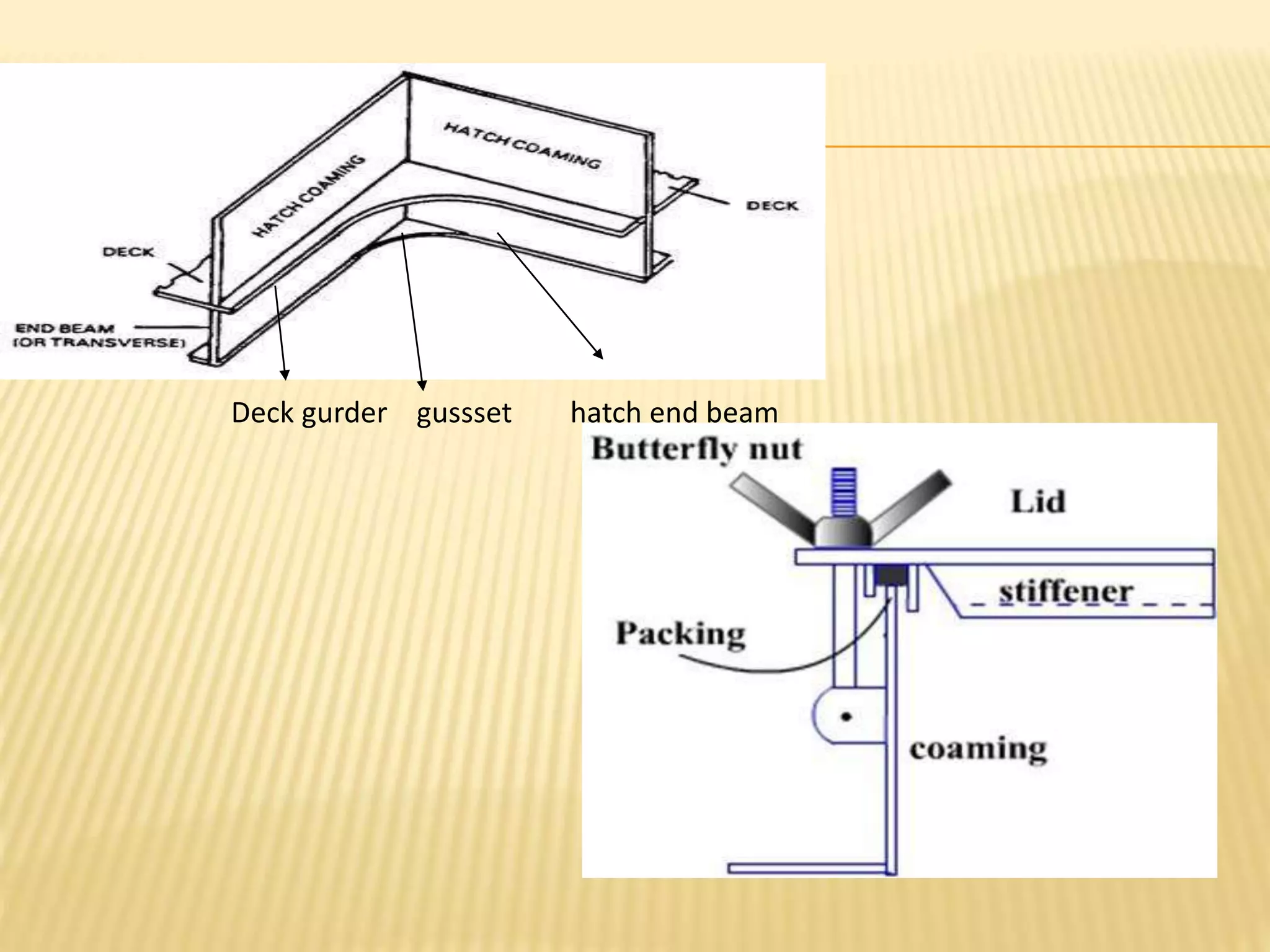
The strengthening of the hatch opening is provided by a
combination of longitudinal members (e.g. hatch side girder
under deck and hatch coaming above deck) and transverse
members (e.g. hatch end beams under: deck and hatch end
coaming above deck). The hatch corners are rounded
elliptically to reduce stress concentrations.
The height of the hatch coaming is specified by
statutory requirements and to be at least 600mm
when located at position 1 (normally the main
weather deck and the forecastle deck) and at least
450mm when located at position 2 (normally the
poop deck and the bridge deck level).
The hatch opening for a tanker is normally made
big enough only for the purpose of man entry. The
diameter of the hatch does not normally exceed
1000mm and the coaming height also complies
with the statutory requirements for dry cargo ships.
Hatchways Closed by Portable Covers and
Secured Weathertight by Tarpaulins and
Battening DevicesHatch closing arrangements incorporating portable covers,
tarpaulins etc. on vessels built to the Merchant Shipping
(Load Line) Regulations 1998 impose a freeboard penalty
and their use is rare on such vessels. Nevertheless, on any
vessel where the hatches are closed by means of portable
covers the steel bars or their equivalent as required by the
regulations should also be fitted in place before the vessel
proceeds to sea.
Owners, Masters and Skippers are also reminded that
proceeding to sea with improperly fitting hatch covers,
defective cleats, wedges, battens or tarpaulins constitutes
non-compliance with the "Conditions of Assignment" and as
such is an offence under Regulation 35(1) of the Merchant
Shipping (Load Lines) Regulations 1998.
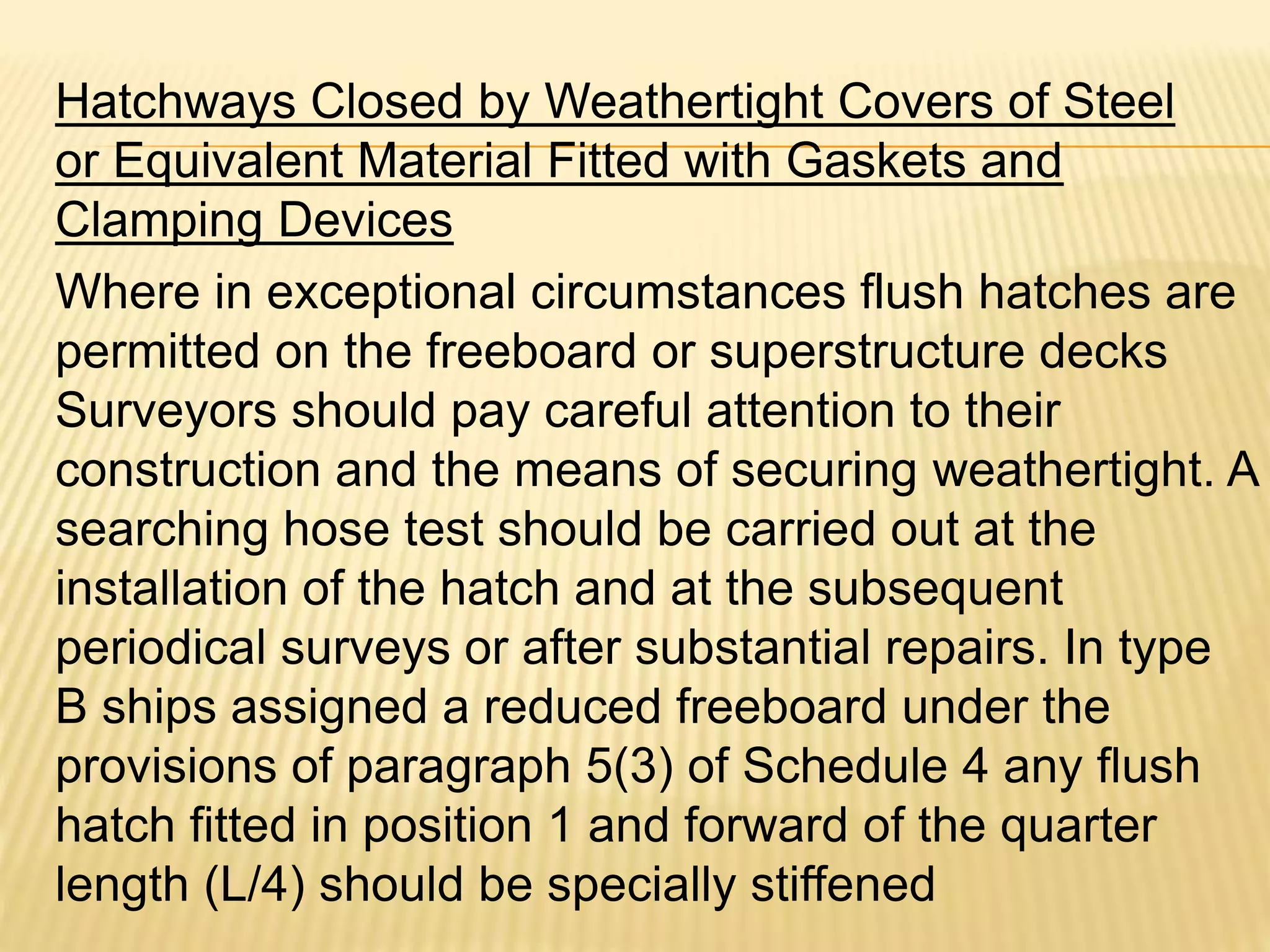
Hatchways Closed by Weathertight Covers of Steel
or Equivalent Material Fitted with Gaskets and
Clamping Devices
Where in exceptional circumstances flush hatches are
permitted on the freeboard or superstructure decks
Surveyors should pay careful attention to their
construction and the means of securing weathertight. A
searching hose test should be carried out at the
installation of the hatch and at the subsequent
periodical surveys or after substantial repairs. In type
B ships assigned a reduced freeboard under the
provisions of paragraph 5(3) of Schedule 4 any flush
hatch fitted in position 1 and forward of the quarter
length (L/4) should be specially stiffened
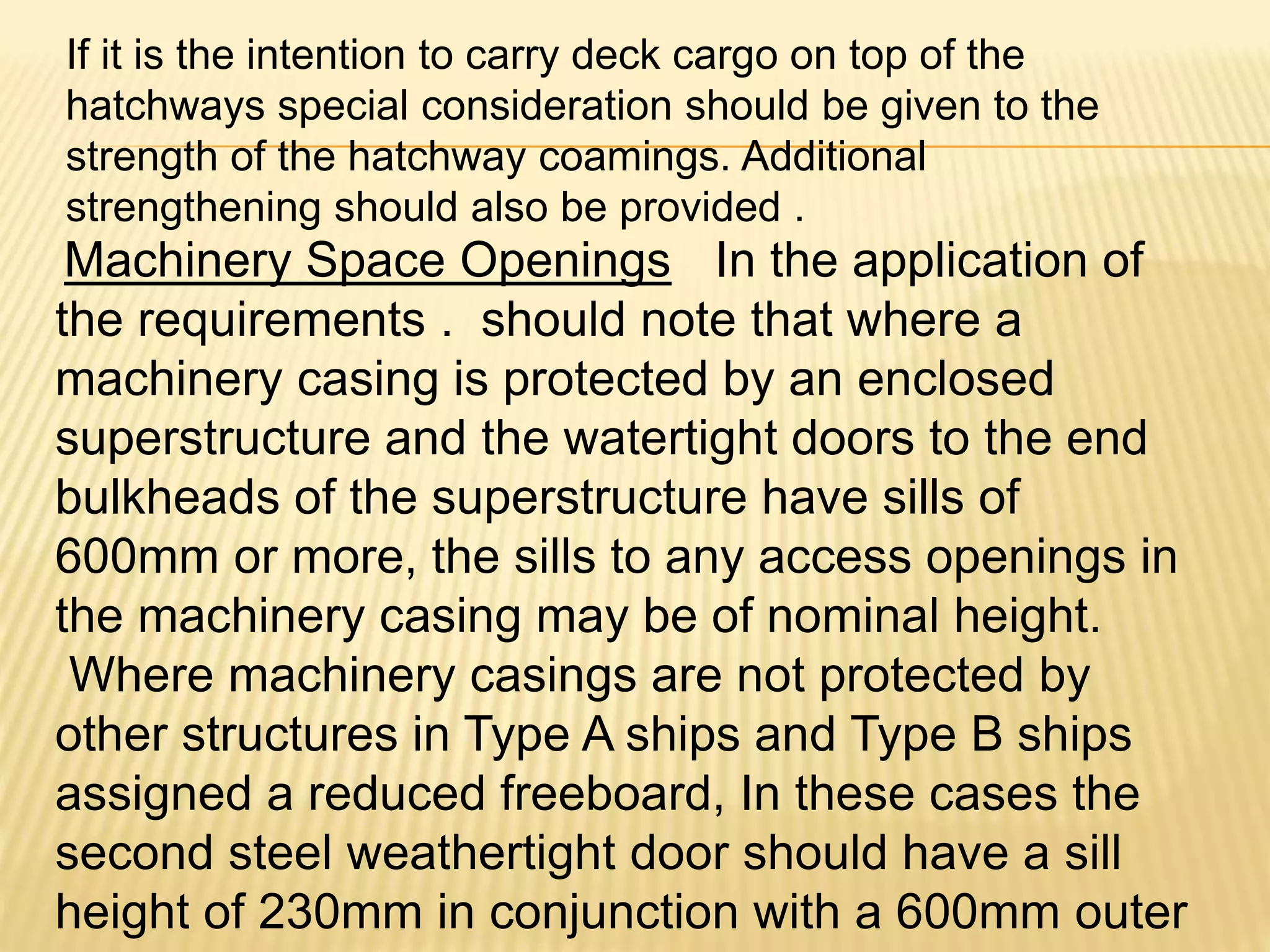
If it is the intention to carry deck cargo on top of the
hatchways special consideration should be given to the
strength of the hatchway coamings. Additional
strengthening should also be provided .
Machinery Space Openings In the application of
the requirements . should note that where a
machinery casing is protected by an enclosed
superstructure and the watertight doors to the end
bulkheads of the superstructure have sills of
600mm or more, the sills to any access openings in
the machinery casing may be of nominal height.
Where machinery casings are not protected by
other structures in Type A ships and Type B ships
assigned a reduced freeboard, In these cases the
second steel weathertight door should have a sill
height of 230mm in conjunction with a 600mm outer
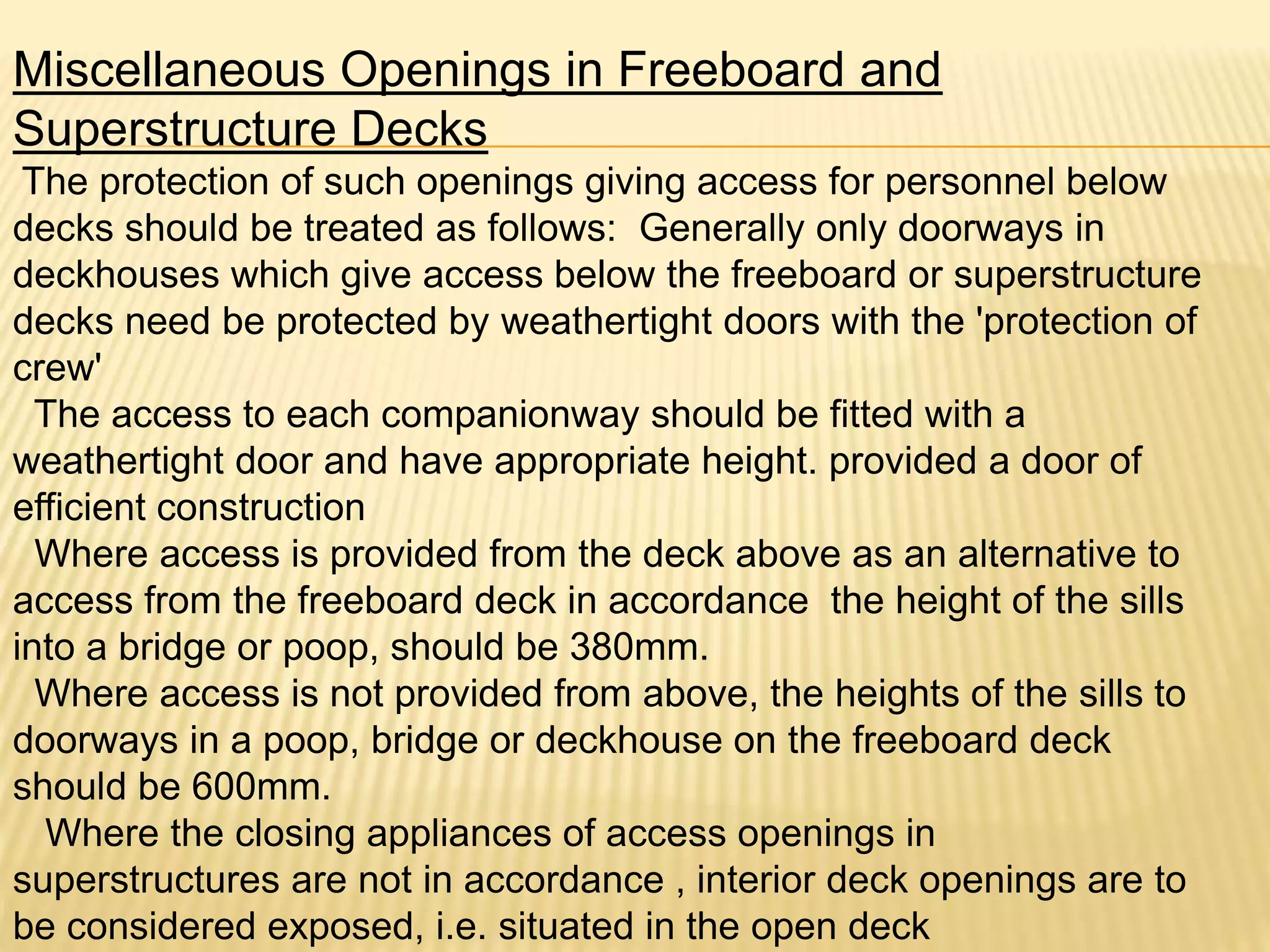
Miscellaneous Openings in Freeboard and
Superstructure Decks
The protection of such openings giving access for personnel below
decks should be treated as follows: Generally only doorways in
deckhouses which give access below the freeboard or superstructure
decks need be protected by weathertight doors with the 'protection of
crew'
The access to each companionway should be fitted with a
weathertight door and have appropriate height. provided a door of
efficient construction
Where access is provided from the deck above as an alternative to
access from the freeboard deck in accordance the height of the sills
into a bridge or poop, should be 380mm.
Where access is not provided from above, the heights of the sills to
doorways in a poop, bridge or deckhouse on the freeboard deck
should be 600mm.
Where the closing appliances of access openings in
superstructures are not in accordance , interior deck openings are to
be considered exposed, i.e. situated in the open deck
Deck gurder gussset hatch end beam
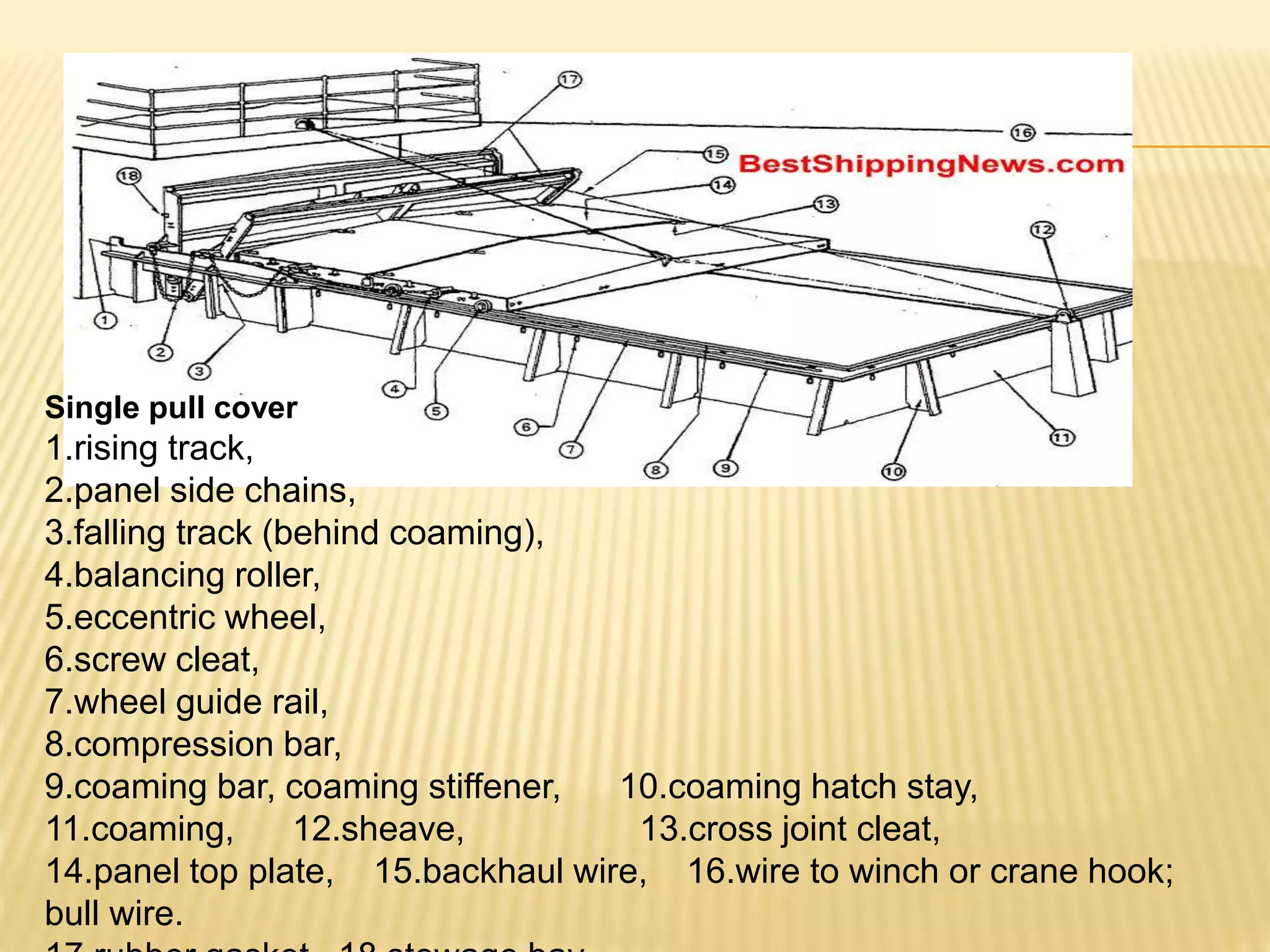
Single pull cover
1.rising track,
2.panel side chains,
3.falling track (behind coaming),
4.balancing roller,
5.eccentric wheel,
6.screw cleat,
7.wheel guide rail,
8.compression bar,
9.coaming bar, coaming stiffener, 10.coaming hatch stay,
11.coaming, 12.sheave, 13.cross joint cleat,
14.panel top plate, 15.backhaul wire, 16.wire to winch or crane hook;
bull wire.
THANK YOU
END OF SLIDE SHOW

Hatch ways

  • 1.
    GROUP ASSIGNMENT HATCH WAYS PREPAREDBY: ABDUL JABBAR KHAN PANDIARAJ A/L RETENAM
  • 2.
    HATCH WAYS AREA LARGEOPENING IN DECK TO PERMIT ACCESS TO SPACE BELOW SUCH CARGO HOLDS AND STORE ROOMS ETC STRESS CONCENTRATION IS CAUSED AT THE CORNER AND LARGE SECTION OF DECK PLATE AND SUPPORTING BEAM CUT OUT CAUSE DISCONTINUITY OF STRENGTH . POSITION OF HATCH WAYS POSITION 1. HATCHWAYS ON EXPOSED FREE BOARD DECKAND EXPOSED SUPERSTRUCTURE DECK WITH IN FWD 0.25L POSITION 2 . HATCHWAYS ON EXPOSED SUPERSTRUCTURE DECKS AFT 0.25L
  • 3.
    Deck openings arefound in both dry cargo spaces and liquid cargo holds. A deck opening or a hatch opening in a dry cargo hold is for the purpose of loading and discharging the cargo. These hatches are made as large as possible to facilitate the loading and discharging operation. In way of the hatch corners thicker insert plates are normally fitted to reduce stress and prevent cracks from developing. The strengthening of the hatch opening is provided by a combination of longitudinal members (e.g. hatch side girder under deck and hatch coaming above deck) and transverse members (e.g. hatch end beams under: deck and hatch end coaming above deck). The hatch corners are rounded elliptically to reduce stress concentrations.
  • 4.
    The height ofthe hatch coaming is specified by statutory requirements and to be at least 600mm when located at position 1 (normally the main weather deck and the forecastle deck) and at least 450mm when located at position 2 (normally the poop deck and the bridge deck level). The hatch opening for a tanker is normally made big enough only for the purpose of man entry. The diameter of the hatch does not normally exceed 1000mm and the coaming height also complies with the statutory requirements for dry cargo ships.
  • 5.
    Hatchways Closed byPortable Covers and Secured Weathertight by Tarpaulins and Battening DevicesHatch closing arrangements incorporating portable covers, tarpaulins etc. on vessels built to the Merchant Shipping (Load Line) Regulations 1998 impose a freeboard penalty and their use is rare on such vessels. Nevertheless, on any vessel where the hatches are closed by means of portable covers the steel bars or their equivalent as required by the regulations should also be fitted in place before the vessel proceeds to sea. Owners, Masters and Skippers are also reminded that proceeding to sea with improperly fitting hatch covers, defective cleats, wedges, battens or tarpaulins constitutes non-compliance with the "Conditions of Assignment" and as such is an offence under Regulation 35(1) of the Merchant Shipping (Load Lines) Regulations 1998.
  • 6.
    Hatchways Closed byWeathertight Covers of Steel or Equivalent Material Fitted with Gaskets and Clamping Devices Where in exceptional circumstances flush hatches are permitted on the freeboard or superstructure decks Surveyors should pay careful attention to their construction and the means of securing weathertight. A searching hose test should be carried out at the installation of the hatch and at the subsequent periodical surveys or after substantial repairs. In type B ships assigned a reduced freeboard under the provisions of paragraph 5(3) of Schedule 4 any flush hatch fitted in position 1 and forward of the quarter length (L/4) should be specially stiffened
  • 7.
    If it isthe intention to carry deck cargo on top of the hatchways special consideration should be given to the strength of the hatchway coamings. Additional strengthening should also be provided . Machinery Space Openings In the application of the requirements . should note that where a machinery casing is protected by an enclosed superstructure and the watertight doors to the end bulkheads of the superstructure have sills of 600mm or more, the sills to any access openings in the machinery casing may be of nominal height. Where machinery casings are not protected by other structures in Type A ships and Type B ships assigned a reduced freeboard, In these cases the second steel weathertight door should have a sill height of 230mm in conjunction with a 600mm outer
  • 8.
    Miscellaneous Openings inFreeboard and Superstructure Decks The protection of such openings giving access for personnel below decks should be treated as follows: Generally only doorways in deckhouses which give access below the freeboard or superstructure decks need be protected by weathertight doors with the 'protection of crew' The access to each companionway should be fitted with a weathertight door and have appropriate height. provided a door of efficient construction Where access is provided from the deck above as an alternative to access from the freeboard deck in accordance the height of the sills into a bridge or poop, should be 380mm. Where access is not provided from above, the heights of the sills to doorways in a poop, bridge or deckhouse on the freeboard deck should be 600mm. Where the closing appliances of access openings in superstructures are not in accordance , interior deck openings are to be considered exposed, i.e. situated in the open deck
  • 9.
    Deck gurder gusssethatch end beam
  • 10.
    Single pull cover 1.risingtrack, 2.panel side chains, 3.falling track (behind coaming), 4.balancing roller, 5.eccentric wheel, 6.screw cleat, 7.wheel guide rail, 8.compression bar, 9.coaming bar, coaming stiffener, 10.coaming hatch stay, 11.coaming, 12.sheave, 13.cross joint cleat, 14.panel top plate, 15.backhaul wire, 16.wire to winch or crane hook; bull wire.
  • 11.
    THANK YOU END OFSLIDE SHOW