WELDING
Part Three
INTRODUCTION
 Welding is a process of joining two similar or
dissimilar metals by fusion, with or without the
application of pressure and with or without the use
of filler metal.
 The fusion of metal takes place by means of heat
 Used as an alternative method for casting and
forging and as a replacement for bolted and
riveted joints.
APPLICATIONS
Construction
Military vehicle and
equipments
Ship building
Off-highway
equipments and
machines
Household furniture
Railroad Construction
CON..
Automobile & bus
construction Piping and pipe lines
Towers
CON..
Aircraft construction
etc.
Bridges construction
Repair of broken & damaged parts Storage tanks
WELDING TYPES
 Arc welding:
 MIG (Metal Inert Gas)
 TIG (Tungsten Inert
Gas)
 SAW (Submerged Arc
Welding)
 SMAW (Shielded Metal
Arc Welding)
 Resistance welding
 Gas welding
 Soldering and brazing
ARC WELDING
• Process that uses an electric arc to join the metals
being welded.
• All arc-welding processes have three things in
common: a heat source, filler metal, and shielding.
• The source of heat produced by the arcing of an
electrical current between two contacts.
• The power source is called a welding machine or
simply, a welder.
SAFETY
• Mishaps/accident frequently occurs in welding
operations.
• Result in serious injury to the welder or other
personnel working in the immediate area.
• In most cases, mishaps occur because of carelessness,
lack of knowledge, and the misuse of available
equipment.
CON…
Safety rules
• Never look at arc with naked eyes
• Always use a shield while welding
• Always wear the safety hand glove, apron and
leather shoes
• Ensure proper insulation and check before opening
• Apply eye drop after welding is over to relieve the
strain on eyes.
CON..
Eye protection devices
CON..
Welders protective clothing
CON..
Welders protective clothing
SHIELDED METAL ARC WELDING(SMAW)
• Is performed by striking an arc between a coated-
metal electrode and the base metal.
• The molten metal from the electrode flows together
with the molten metal from the base metal to form a
sound joint. This process is known as fusion.
• The coating from the electrode forms a covering,
shielding it from contamination; therefore the process
is called shielded metal arc welding.
PRINCIPLES OF SMAW
 The electrode and the work are part of an electric
circuit.
 This circuit begins with the electric power source
and includes the welding cables, an electrode holder,
a workpiece connection, the workpiece (weldment),
and an arc welding electrode.
CON..
Principles of SMAW
CON..
SMAW arc
SELECTING THE TYPE OF CURRENT
 The welding current used for stick welding may
be either alternating current or direct current
depending on the electrode being used.
 Direct current is the most common current
choice for stick welding.
 The current flows in one direction only and has
many advantages over alternating current for the
stick process.
CON..
 These advantages include:
 fewer arc outages,
 less spatter,
 easier arc starting,
 less sticking, and
 better control in out-of-position welds.
CON..
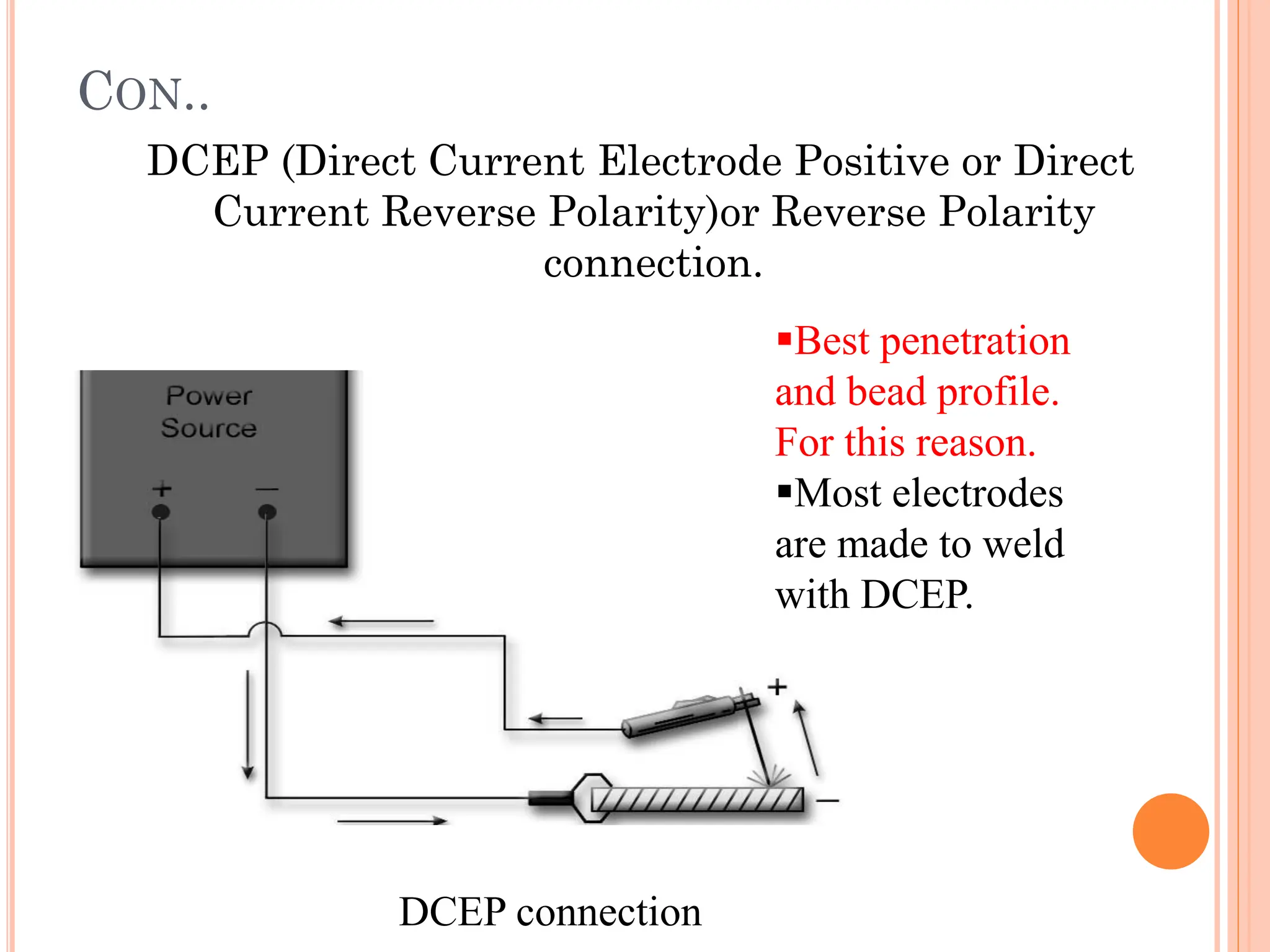
DCEP (Direct Current Electrode Positive or Direct
Current Reverse Polarity)or Reverse Polarity
connection.
DCEP connection
Best penetration
and bead profile.
For this reason.
Most electrodes
are made to weld
with DCEP.
CON..
 Result in a
narrow bead
with little
penetration.
 works well
when welding
on sheet
metal
DCEN connection
DCEN or Straight Polarity Connection
CON..
 Alternating current (AC) is an electrical
current that has both a positive and a negative
half-cycle value (polarities) alternately.
 Is a type of electrical current, in which the
direction of the flow of electrons switches back
and forth at regular intervals or cycles.
 Current flows in a specific direction for one half-
cycle, stops at the "zero" line, then reverses
direction of flow the next half-cycle at regular
intervals.
CON..
AC circuit
EQUIPMENTS AND ACCESSORIES
Welding generator AC/DC
Exhaust fan
Eye Shield
Hand gloves
Apron
Two cables- one for work
and one for electrode
Electrode holder
Electrode
Wire brush
Chipping hammer
WELDING TERMINOLOGY
• Filler metals
 A material used to fill
the space between two
pieces of metals when
welding.
 Two types in common
Welding rods
Welding electrodes
• Welding rod does not
conduct an electric current
during the welding
process. Only supply filler
metal to the joint.
• Electrode conducts the
current from the electrode
holder to the metal being
welded.
CON..
Consumable
Not only provide a path for
the current but they also
supply filler metal to the
joint.
An example is the electrode
used in shielded metal-arc
welding.
Non-consumable.
Only used as a conductor for
the electrical current, such as
in gas tungsten arc welding.
The filler metal for gas
tungsten arc welding is a
hand fed consumable
welding rod.
Electrodes are classified into two groups:
WELDING POSITIONS
Flat welding position
The letters associated
with the numbers
listed below
are F and G. As
mentioned, F is fillet,
and G is groove.
CON..
Horizontal welding position
CON..
Vertical welding position
CON..
Overhead welding position
TYPES OF WELDS
Is a weld deposit produced by a single pass with
one of the welding processes.
Weld bead (bead)
GROOVE WELDS
Welds made in the groove between two members
to be joined.
FILLET WELD
Used to join two surfaces that are at approximately
right angles to each other in a lap, tee, or corner joint.
SURFACING
Used to apply a hard, wear-resistant layer of metal to
surfaces or edges of worn-out parts.
CON..
Made to hold parts of an assembly in
proper alignment temporarily until
the final welds are made.
Tack weld
CON..
Are welds made
through holes or slots
in one member of a
lap joint.
Plug and slot welds
TYPES OF JOINTS
In this type of joint, the
edges of the metal to be
joint should be so made
that it gives a little shape
of ‘V’ at the place of
joint. Now on welding the
‘V’ or ‘U’ shape structure
is filled up giving rise to a
strong joint.
Butt joint
LAP JOINT
• This type of joint is used in joining two overlapping
plates so that the corner of each plate is jointed with
the surface of the plate.
• Common types of lap joints are single lap, double lap
or offset lap joint. Single welded lap joint do not
develop full strength as compare to double welded lap.
CON..
 Here metal pieces are
placed perpendicular
to each other at one
corner.
 Now the welding is
done in the corner.
Such joints are made
in frames, steel
boxes, etc.
Corner joint
CON..
In this type of joint,
the metal pieces are
placed in such a
manner that they
form the shape of ‘T’.
In other words the
angle between
surfaces is kept 900 as
shown in figure.
T-joint
CON..
In this joint two
parallel plates are
welded edge to edge.
Edge joint
BRAZING AND SOLDERING
• Is the process of joining
metal by heating the base
metal to a temperature
above 800°F and adding a
nonferrous filler metal that
melts below the base metal.
• Advantages does not
affect the heat treatment of
the original metal.
• Allows you to join
dissimilar metals.
 It needs source of heat, filler
metals, and flux.
 Heating Devices
 Furnace (mass production)
Or Individual torches
(oxyacetylene welding torch)
 Filler Metals
 Are nonferrous metals or
alloys
Brazing
CON..
• Silver-base alloys
• Aluminum-silicon alloys
• Copper
• Copper-zinc (brass)
alloys
• Copper-phosphorus
alloys
• Gold alloys
• Nickel alloys
• Magnesium alloys
CON..
Soldering
 Soldering is a process in which two or
more metal items are joined together by melting
and flowing a filler metal (solder) into the joint,
the filler metal having a lower melting point than
the workpiece.
CON..
 Extensively in
electronics industry
because of heat
sensitive components
 Jewelry components,
machine tools and
some refrigeration
and plumbing
components are often
assembled and
repaired. etc.
Used
OXYACETYLENE WELDING
 Acetylene is a carbonaceous
combustible gas.
 When it is burnt in presence
of oxygen gas in a controlled
manner the combustion
produces intense heat which
is sufficient to melt a metal.
 The flame is long, smoky
and yellowish in color.
 However when oxygen is
also supplied, the size of
the flame is reduces and it
is not smoky (bluish in
color)
 Heat is produced due to
following exothermic
chemical reaction
 2C2H2 + 5O2 = 4CO2
+H2O + heat
CON..
Oxygen cylinders and
houses
 Painted greenish or blush
most of the time.
Acetylene cylinders and
houses
 Painted reddish in color .
Oxygen cylinder
Acetylene
cylinder
Oxy-acetylene welding outfits
Con..
TYPES OF FLAMES
• Produced when the gas
mixture has equal
volumes of acetylene and
oxygen.
• Has two distinct zones
 Cone and an outer flame
surrounding the cone.
• Used for the welding of
most of the materials like
low carbon steels, cast
steels, cast iron etc.
Neutral flame
CON..
 Produced when the
amount of oxygen is
slightly more than the
acetylene.
 Very short in length and
sharper in shape.
 A hissing sound is
produced at the tip of the
torch.
 Used for welding brasses,
bronzes and cast iron.
Oxidizing flame
CON..
 Produced when the
oxygen is kept slightly
less than acetylene.
 Has three distinct zones.
 Advantageous for non-
ferrous metals, silver
soldering and hard facing.
Reducing or carburizing flame
ገለቶማ !

Welding.pdfggghhhhhhjjjjjjjjjjkjjnnnnnnnnsdgfg

  • 1.
  • 2.
    INTRODUCTION  Welding isa process of joining two similar or dissimilar metals by fusion, with or without the application of pressure and with or without the use of filler metal.  The fusion of metal takes place by means of heat  Used as an alternative method for casting and forging and as a replacement for bolted and riveted joints.
  • 3.
    APPLICATIONS Construction Military vehicle and equipments Shipbuilding Off-highway equipments and machines Household furniture Railroad Construction
  • 4.
    CON.. Automobile & bus constructionPiping and pipe lines Towers
  • 5.
    CON.. Aircraft construction etc. Bridges construction Repairof broken & damaged parts Storage tanks
  • 6.
    WELDING TYPES  Arcwelding:  MIG (Metal Inert Gas)  TIG (Tungsten Inert Gas)  SAW (Submerged Arc Welding)  SMAW (Shielded Metal Arc Welding)  Resistance welding  Gas welding  Soldering and brazing
  • 7.
    ARC WELDING • Processthat uses an electric arc to join the metals being welded. • All arc-welding processes have three things in common: a heat source, filler metal, and shielding. • The source of heat produced by the arcing of an electrical current between two contacts. • The power source is called a welding machine or simply, a welder.
  • 8.
    SAFETY • Mishaps/accident frequentlyoccurs in welding operations. • Result in serious injury to the welder or other personnel working in the immediate area. • In most cases, mishaps occur because of carelessness, lack of knowledge, and the misuse of available equipment.
  • 9.
    CON… Safety rules • Neverlook at arc with naked eyes • Always use a shield while welding • Always wear the safety hand glove, apron and leather shoes • Ensure proper insulation and check before opening • Apply eye drop after welding is over to relieve the strain on eyes.
  • 10.
  • 11.
  • 12.
  • 13.
    SHIELDED METAL ARCWELDING(SMAW) • Is performed by striking an arc between a coated- metal electrode and the base metal. • The molten metal from the electrode flows together with the molten metal from the base metal to form a sound joint. This process is known as fusion. • The coating from the electrode forms a covering, shielding it from contamination; therefore the process is called shielded metal arc welding.
  • 14.
    PRINCIPLES OF SMAW The electrode and the work are part of an electric circuit.  This circuit begins with the electric power source and includes the welding cables, an electrode holder, a workpiece connection, the workpiece (weldment), and an arc welding electrode.
  • 15.
  • 16.
  • 17.
    SELECTING THE TYPEOF CURRENT  The welding current used for stick welding may be either alternating current or direct current depending on the electrode being used.  Direct current is the most common current choice for stick welding.  The current flows in one direction only and has many advantages over alternating current for the stick process.
  • 18.
    CON..  These advantagesinclude:  fewer arc outages,  less spatter,  easier arc starting,  less sticking, and  better control in out-of-position welds.
  • 19.
    CON.. DCEP (Direct CurrentElectrode Positive or Direct Current Reverse Polarity)or Reverse Polarity connection. DCEP connection Best penetration and bead profile. For this reason. Most electrodes are made to weld with DCEP.
  • 20.
    CON..  Result ina narrow bead with little penetration.  works well when welding on sheet metal DCEN connection DCEN or Straight Polarity Connection
  • 21.
    CON..  Alternating current(AC) is an electrical current that has both a positive and a negative half-cycle value (polarities) alternately.  Is a type of electrical current, in which the direction of the flow of electrons switches back and forth at regular intervals or cycles.  Current flows in a specific direction for one half- cycle, stops at the "zero" line, then reverses direction of flow the next half-cycle at regular intervals.
  • 22.
  • 23.
    EQUIPMENTS AND ACCESSORIES Weldinggenerator AC/DC Exhaust fan Eye Shield Hand gloves Apron Two cables- one for work and one for electrode Electrode holder Electrode Wire brush Chipping hammer
  • 24.
    WELDING TERMINOLOGY • Fillermetals  A material used to fill the space between two pieces of metals when welding.  Two types in common Welding rods Welding electrodes • Welding rod does not conduct an electric current during the welding process. Only supply filler metal to the joint. • Electrode conducts the current from the electrode holder to the metal being welded.
  • 25.
    CON.. Consumable Not only providea path for the current but they also supply filler metal to the joint. An example is the electrode used in shielded metal-arc welding. Non-consumable. Only used as a conductor for the electrical current, such as in gas tungsten arc welding. The filler metal for gas tungsten arc welding is a hand fed consumable welding rod. Electrodes are classified into two groups:
  • 26.
    WELDING POSITIONS Flat weldingposition The letters associated with the numbers listed below are F and G. As mentioned, F is fillet, and G is groove.
  • 27.
  • 28.
  • 29.
  • 30.
    TYPES OF WELDS Isa weld deposit produced by a single pass with one of the welding processes. Weld bead (bead)
  • 31.
    GROOVE WELDS Welds madein the groove between two members to be joined.
  • 32.
    FILLET WELD Used tojoin two surfaces that are at approximately right angles to each other in a lap, tee, or corner joint.
  • 33.
    SURFACING Used to applya hard, wear-resistant layer of metal to surfaces or edges of worn-out parts.
  • 34.
    CON.. Made to holdparts of an assembly in proper alignment temporarily until the final welds are made. Tack weld
  • 35.
    CON.. Are welds made throughholes or slots in one member of a lap joint. Plug and slot welds
  • 36.
    TYPES OF JOINTS Inthis type of joint, the edges of the metal to be joint should be so made that it gives a little shape of ‘V’ at the place of joint. Now on welding the ‘V’ or ‘U’ shape structure is filled up giving rise to a strong joint. Butt joint
  • 37.
    LAP JOINT • Thistype of joint is used in joining two overlapping plates so that the corner of each plate is jointed with the surface of the plate. • Common types of lap joints are single lap, double lap or offset lap joint. Single welded lap joint do not develop full strength as compare to double welded lap.
  • 38.
    CON..  Here metalpieces are placed perpendicular to each other at one corner.  Now the welding is done in the corner. Such joints are made in frames, steel boxes, etc. Corner joint
  • 39.
    CON.. In this typeof joint, the metal pieces are placed in such a manner that they form the shape of ‘T’. In other words the angle between surfaces is kept 900 as shown in figure. T-joint
  • 40.
    CON.. In this jointtwo parallel plates are welded edge to edge. Edge joint
  • 41.
    BRAZING AND SOLDERING •Is the process of joining metal by heating the base metal to a temperature above 800°F and adding a nonferrous filler metal that melts below the base metal. • Advantages does not affect the heat treatment of the original metal. • Allows you to join dissimilar metals.  It needs source of heat, filler metals, and flux.  Heating Devices  Furnace (mass production) Or Individual torches (oxyacetylene welding torch)  Filler Metals  Are nonferrous metals or alloys Brazing
  • 42.
    CON.. • Silver-base alloys •Aluminum-silicon alloys • Copper • Copper-zinc (brass) alloys • Copper-phosphorus alloys • Gold alloys • Nickel alloys • Magnesium alloys
  • 43.
    CON.. Soldering  Soldering isa process in which two or more metal items are joined together by melting and flowing a filler metal (solder) into the joint, the filler metal having a lower melting point than the workpiece.
  • 44.
    CON..  Extensively in electronicsindustry because of heat sensitive components  Jewelry components, machine tools and some refrigeration and plumbing components are often assembled and repaired. etc. Used
  • 45.
    OXYACETYLENE WELDING  Acetyleneis a carbonaceous combustible gas.  When it is burnt in presence of oxygen gas in a controlled manner the combustion produces intense heat which is sufficient to melt a metal.  The flame is long, smoky and yellowish in color.  However when oxygen is also supplied, the size of the flame is reduces and it is not smoky (bluish in color)  Heat is produced due to following exothermic chemical reaction  2C2H2 + 5O2 = 4CO2 +H2O + heat
  • 46.
    CON.. Oxygen cylinders and houses Painted greenish or blush most of the time. Acetylene cylinders and houses  Painted reddish in color . Oxygen cylinder Acetylene cylinder
  • 47.
  • 48.
    TYPES OF FLAMES •Produced when the gas mixture has equal volumes of acetylene and oxygen. • Has two distinct zones  Cone and an outer flame surrounding the cone. • Used for the welding of most of the materials like low carbon steels, cast steels, cast iron etc. Neutral flame
  • 49.
    CON..  Produced whenthe amount of oxygen is slightly more than the acetylene.  Very short in length and sharper in shape.  A hissing sound is produced at the tip of the torch.  Used for welding brasses, bronzes and cast iron. Oxidizing flame
  • 50.
    CON..  Produced whenthe oxygen is kept slightly less than acetylene.  Has three distinct zones.  Advantageous for non- ferrous metals, silver soldering and hard facing. Reducing or carburizing flame
  • 51.