WELDING JOINTS AND POSITIONS
Short course
Maxwell Owusu
[BSc., MSc.]
Maxwell.owusu@stu.edu.gh/ +233-261-268565
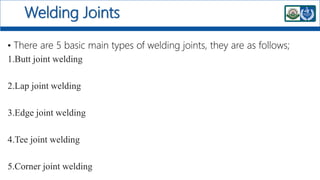
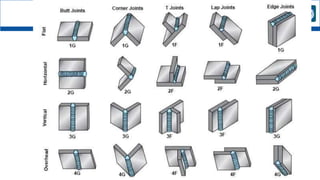
Welding Joints
• There are 5 basic main types of welding joints, they are as follows;
1.Butt joint welding
2.Lap joint welding
3.Edge joint welding
4.Tee joint welding
5.Corner joint welding
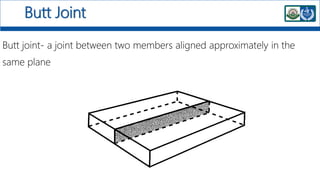
Butt Joint
Butt joint- a joint between two members aligned approximately in the
same plane
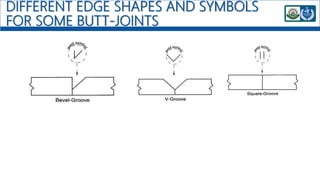
DIFFERENT EDGE SHAPES AND SYMBOLS
FOR SOME BUTT-JOINTS
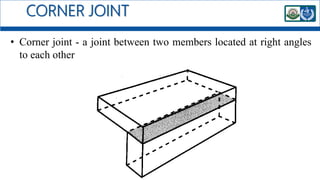
CORNER JOINT
• Corner joint - a joint between two members located at right angles
to each other
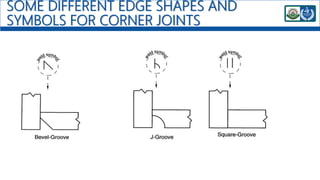
SOME DIFFERENT EDGE SHAPES AND
SYMBOLS FOR CORNER JOINTS
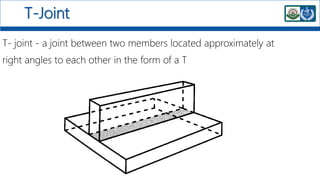
T-Joint
T- joint - a joint between two members located approximately at
right angles to each other in the form of a T
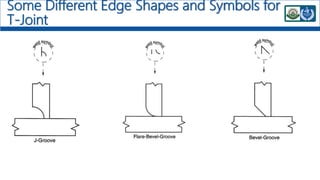
Some Different Edge Shapes and Symbols for
T-Joint
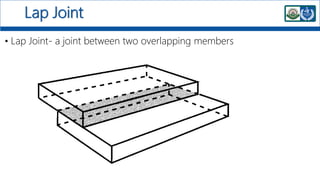
Lap Joint
• Lap Joint- a joint between two overlapping members
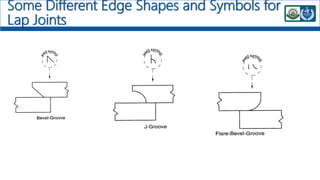
Some Different Edge Shapes and Symbols for
Lap Joints
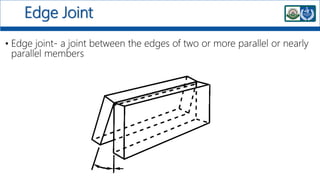
Edge Joint
• Edge joint- a joint between the edges of two or more parallel or nearly
parallel members
Some Different Edge Shapes and Symbols
for Edge Joints
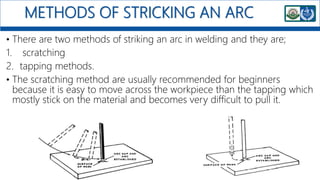
METHODS OF STRICKING AN ARC
• There are two methods of striking an arc in welding and they are;
1. scratching
2. tapping methods.
• The scratching method are usually recommended for beginners
because it is easy to move across the workpiece than the tapping which
mostly stick on the material and becomes very difficult to pull it.
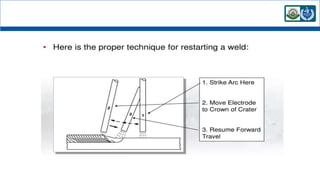
RE- STARTING AN ARC
• You dont always have to strike or peck to get you arc going again.
While your welding, and about to run out of rod, whip the rod back into
the weld pool before you lift off. (this wont leave a crator) When your
getting a new rod, start about an 1/8" inside your crator. (where you left
off) Just get close enough for the arc to start, and go with the constant
speed you had before.
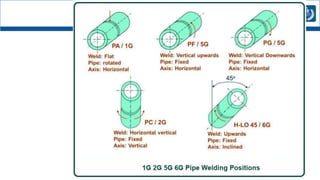
WELDING POSITIONS
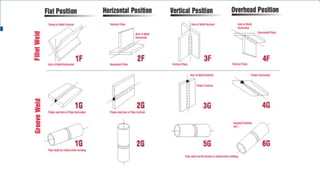
• There are four basic welding positions:
1. flat,
2. horizontal,
3. vertical, and
4. overhead.
• The most common type of weld you will do is a Fillet weld and a
Groove weld, and you can accomplish these welds in all four positions.
• But you also do surface welds in all four positions as well, thought you
will not do this type of weld very often.
• There are numbers that are used to designate the type of welding
position and weld.
• 1 = Flat Position
• 2 = Horizontal Position
• 3 = Vertical Position
• 4 = Overhead Position
• In addition there are letters that designate the type of weld you
will do in that position. For example:
• F = Fillet Weld
• G = Groove Wel
FLAT POSITION
• The flat welding position is the easiest position and most desirable
position to weld in. In the flat position the metal is flat and your welding
torch or rod is going to move in a horizontal direction.
• The other positions are called Out Of Position because the are more
difficult and require more skill to do them well. The out of position
welding positions are: Horizontal, Vertical, and Overhead.
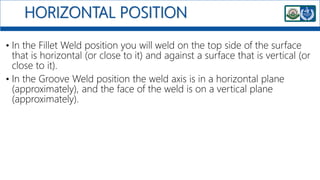
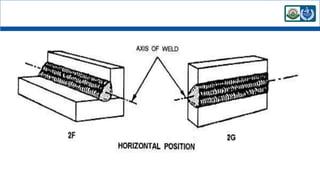
HORIZONTAL POSITION
• In the Fillet Weld position you will weld on the top side of the surface
that is horizontal (or close to it) and against a surface that is vertical (or
close to it).
• In the Groove Weld position the weld axis is in a horizontal plane
(approximately), and the face of the weld is on a vertical plane
(approximately).
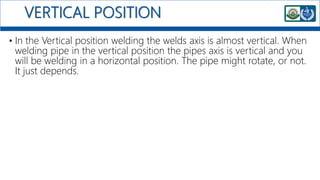
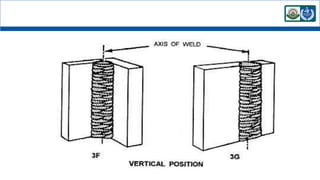
VERTICAL POSITION
• In the Vertical position welding the welds axis is almost vertical. When
welding pipe in the vertical position the pipes axis is vertical and you
will be welding in a horizontal position. The pipe might rotate, or not.
It just depends.
OVERHEAD POSITION
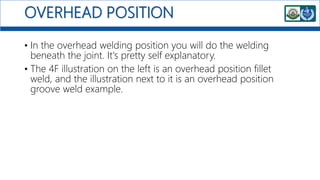
• In the overhead welding position you will do the welding
beneath the joint. It's pretty self explanatory.
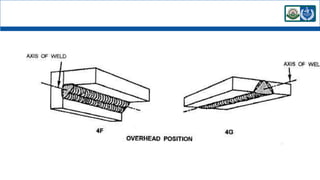
• The 4F illustration on the left is an overhead position fillet
weld, and the illustration next to it is an overhead position
groove weld example.
SAFETY PRECAUTIONS
• Protect yourself and others from injury
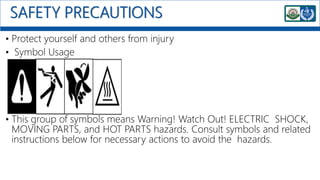
• Symbol Usage
• This group of symbols means Warning! Watch Out! ELECTRIC SHOCK,
MOVING PARTS, and HOT PARTS hazards. Consult symbols and related
instructions below for necessary actions to avoid the hazards.
Arc Welding Hazards
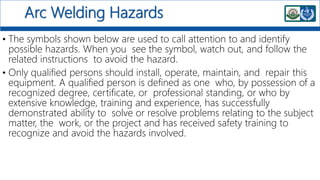
• The symbols shown below are used to call attention to and identify
possible hazards. When you see the symbol, watch out, and follow the
related instructions to avoid the hazard.
• Only qualified persons should install, operate, maintain, and repair this
equipment. A qualified person is defined as one who, by possession of a
recognized degree, certificate, or professional standing, or who by
extensive knowledge, training and experience, has successfully
demonstrated ability to solve or resolve problems relating to the subject
matter, the work, or the project and has received safety training to
recognize and avoid the hazards involved.
ELECTRIC SHOCK
• Touching live electrical parts can cause fatal shocks or severe burns. The
electrode and work circuit is electrically live whenever the output is on.
The input power circuit and machine internal circuits are also live when
power is on. In semiautomatic or automatic wire welding, the wire, wire
reel, drive roll housing, and all metal parts touching the welding wire
are electrically live. Incorrectly installed or improperly grounded
equipment is a hazard.
• Do not touch live electrical parts.
• Wear dry, hole-free insulating gloves and body protection.
• Insulate yourself from work and ground using dry insulating mats or covers big
enough to prevent any physical contact with the work or ground.
• Do not use AC weld output in damp, wet, or confined spaces, or if there is a danger of
falling.
• Use AC output ONLY if required for the welding process.
• Additional safety precautions are required when any of the following electrically
hazardous conditions are present: in damp locations or while wearing wet clothing; on
metal structures such as floors, gratings, or scaffolds; when in cramped positions such
as sitting, kneeling, or lying; or when there is a high risk of unavoidable or accidental
contact with the workpiece or ground. For these conditions, use the following
equipment in order presented: 1) a semiautomatic DC constant voltage (wire) welder,
2) a DC manual (stick) welder, or 3) an AC welder with reduced open-circuit volt- age.
In most situations, use of a DC, constant voltage wire welder is recommended. And, do
not work alone!
• Disconnect input power or stop engine before installing or servicing this equipment.
HOT PARTS
• Do not touch hot parts bare handed.
• Allow cooling period before working on equipment.
• To handle hot parts, use proper tools and/or wear heavy,
insulated welding gloves and clothing to prevent burns.
FUMES AND GASES
• Welding produces fumes and gases. Breathing these fumes and gases can be
hazardous to your health.
• Keep your head out of the fumes. Do not breathe the fumes.
• Ventilate the work area and/or use local forced ventilation at the arc to remove
welding fumes and gases.
• If ventilation is poor, wear an approved air-supplied respirator.
• Work in a confined space only if it is well ventilated, or while wearing an air-supplied
respirator. Welding fumes and gases can displace air and lower the oxygen level
causing injury or death. Be sure the breathing air is safe.
• Do not weld in locations near degreasing, cleaning, or spraying operations. The heat
and rays of the arc can react with vapors to form highly toxic and irritating gases.
• Do not weld on coated metals, such as galvanized, lead, or cadmium plated steel,
unless the coating is removed from the weld area, the area is well ventilated, and
while wearing an air-supplied respirator. The coatings and any metals containing
these elements can give off toxic fumes if welded.
ARC RAYS
• Arc rays from the welding process produce intense visible and invisible
(ultraviolet and infrared) rays that can burn eyes and skin. Sparks fly off
from the weld.
• Wear an approved welding helmet fitted with a proper shade of filter
lenses to protect your face and eyes from arc rays and sparks when
welding or watching.
• Wear approved safety glasses with side shields under your helmet.
• Use protective screens or barriers to protect others from flash, glare and
sparks; warn others not to watch the arc.
• Wear body protection made from durable, flame−resistant material
(leather, heavy cotton, wool). Body protection includes oil-free clothing
such as leather gloves, heavy shirt, cuffless trousers, high shoes, and a
cap.
FIRE OR EXPLOSION
• Remove all flammables within 35 ft (10.7 m) of the welding arc. If this is
not possible, tightly cover them with approved covers.
• Do not weld where flying sparks can strike flammable material.
• Protect yourself and others from flying sparks and hot metal.
• Be alert that welding sparks and hot materials from welding can easily
go through small cracks and openings to adjacent areas.
• Watch for fire, and keep a fire extinguisher nearby.
• Be aware that welding on a ceiling, floor, bulkhead, or partition can
cause fire on the hidden side.
FLYING METAL AND NOISE
• Welding, chipping, wire brushing, and grinding cause sparks and flying
metal. As welds cool, they can throw off slag.
• Wear approved safety glasses with side shields even under your welding
helmet.
• NOISE
• damage hearing.
• Wear approved ear protection if noise lev- el is high.
WELDING JOINTS AND POSITIONS.pptx

WELDING JOINTS AND POSITIONS.pptx

  • 1.
    WELDING JOINTS ANDPOSITIONS Short course Maxwell Owusu [BSc., MSc.] Maxwell.owusu@stu.edu.gh/ +233-261-268565
  • 2.
    Welding Joints • Thereare 5 basic main types of welding joints, they are as follows; 1.Butt joint welding 2.Lap joint welding 3.Edge joint welding 4.Tee joint welding 5.Corner joint welding
  • 3.
    Butt Joint Butt joint-a joint between two members aligned approximately in the same plane
  • 4.
    DIFFERENT EDGE SHAPESAND SYMBOLS FOR SOME BUTT-JOINTS
  • 5.
    CORNER JOINT • Cornerjoint - a joint between two members located at right angles to each other
  • 6.
    SOME DIFFERENT EDGESHAPES AND SYMBOLS FOR CORNER JOINTS
  • 7.
    T-Joint T- joint -a joint between two members located approximately at right angles to each other in the form of a T
  • 8.
    Some Different EdgeShapes and Symbols for T-Joint
  • 9.
    Lap Joint • LapJoint- a joint between two overlapping members
  • 10.
    Some Different EdgeShapes and Symbols for Lap Joints
  • 11.
    Edge Joint • Edgejoint- a joint between the edges of two or more parallel or nearly parallel members
  • 12.
    Some Different EdgeShapes and Symbols for Edge Joints
  • 13.
    METHODS OF STRICKINGAN ARC • There are two methods of striking an arc in welding and they are; 1. scratching 2. tapping methods. • The scratching method are usually recommended for beginners because it is easy to move across the workpiece than the tapping which mostly stick on the material and becomes very difficult to pull it.
  • 14.
    RE- STARTING ANARC • You dont always have to strike or peck to get you arc going again. While your welding, and about to run out of rod, whip the rod back into the weld pool before you lift off. (this wont leave a crator) When your getting a new rod, start about an 1/8" inside your crator. (where you left off) Just get close enough for the arc to start, and go with the constant speed you had before.
  • 16.
    WELDING POSITIONS • Thereare four basic welding positions: 1. flat, 2. horizontal, 3. vertical, and 4. overhead. • The most common type of weld you will do is a Fillet weld and a Groove weld, and you can accomplish these welds in all four positions. • But you also do surface welds in all four positions as well, thought you will not do this type of weld very often. • There are numbers that are used to designate the type of welding position and weld.
  • 17.
    • 1 =Flat Position • 2 = Horizontal Position • 3 = Vertical Position • 4 = Overhead Position • In addition there are letters that designate the type of weld you will do in that position. For example: • F = Fillet Weld • G = Groove Wel
  • 18.
    FLAT POSITION • Theflat welding position is the easiest position and most desirable position to weld in. In the flat position the metal is flat and your welding torch or rod is going to move in a horizontal direction. • The other positions are called Out Of Position because the are more difficult and require more skill to do them well. The out of position welding positions are: Horizontal, Vertical, and Overhead.
  • 20.
    HORIZONTAL POSITION • Inthe Fillet Weld position you will weld on the top side of the surface that is horizontal (or close to it) and against a surface that is vertical (or close to it). • In the Groove Weld position the weld axis is in a horizontal plane (approximately), and the face of the weld is on a vertical plane (approximately).
  • 22.
    VERTICAL POSITION • Inthe Vertical position welding the welds axis is almost vertical. When welding pipe in the vertical position the pipes axis is vertical and you will be welding in a horizontal position. The pipe might rotate, or not. It just depends.
  • 24.
    OVERHEAD POSITION • Inthe overhead welding position you will do the welding beneath the joint. It's pretty self explanatory. • The 4F illustration on the left is an overhead position fillet weld, and the illustration next to it is an overhead position groove weld example.
  • 29.
    SAFETY PRECAUTIONS • Protectyourself and others from injury • Symbol Usage • This group of symbols means Warning! Watch Out! ELECTRIC SHOCK, MOVING PARTS, and HOT PARTS hazards. Consult symbols and related instructions below for necessary actions to avoid the hazards.
  • 30.
    Arc Welding Hazards •The symbols shown below are used to call attention to and identify possible hazards. When you see the symbol, watch out, and follow the related instructions to avoid the hazard. • Only qualified persons should install, operate, maintain, and repair this equipment. A qualified person is defined as one who, by possession of a recognized degree, certificate, or professional standing, or who by extensive knowledge, training and experience, has successfully demonstrated ability to solve or resolve problems relating to the subject matter, the work, or the project and has received safety training to recognize and avoid the hazards involved.
  • 31.
    ELECTRIC SHOCK • Touchinglive electrical parts can cause fatal shocks or severe burns. The electrode and work circuit is electrically live whenever the output is on. The input power circuit and machine internal circuits are also live when power is on. In semiautomatic or automatic wire welding, the wire, wire reel, drive roll housing, and all metal parts touching the welding wire are electrically live. Incorrectly installed or improperly grounded equipment is a hazard. • Do not touch live electrical parts.
  • 32.
    • Wear dry,hole-free insulating gloves and body protection. • Insulate yourself from work and ground using dry insulating mats or covers big enough to prevent any physical contact with the work or ground. • Do not use AC weld output in damp, wet, or confined spaces, or if there is a danger of falling. • Use AC output ONLY if required for the welding process. • Additional safety precautions are required when any of the following electrically hazardous conditions are present: in damp locations or while wearing wet clothing; on metal structures such as floors, gratings, or scaffolds; when in cramped positions such as sitting, kneeling, or lying; or when there is a high risk of unavoidable or accidental contact with the workpiece or ground. For these conditions, use the following equipment in order presented: 1) a semiautomatic DC constant voltage (wire) welder, 2) a DC manual (stick) welder, or 3) an AC welder with reduced open-circuit volt- age. In most situations, use of a DC, constant voltage wire welder is recommended. And, do not work alone! • Disconnect input power or stop engine before installing or servicing this equipment.
  • 33.
    HOT PARTS • Donot touch hot parts bare handed. • Allow cooling period before working on equipment. • To handle hot parts, use proper tools and/or wear heavy, insulated welding gloves and clothing to prevent burns.
  • 34.
    FUMES AND GASES •Welding produces fumes and gases. Breathing these fumes and gases can be hazardous to your health. • Keep your head out of the fumes. Do not breathe the fumes. • Ventilate the work area and/or use local forced ventilation at the arc to remove welding fumes and gases. • If ventilation is poor, wear an approved air-supplied respirator. • Work in a confined space only if it is well ventilated, or while wearing an air-supplied respirator. Welding fumes and gases can displace air and lower the oxygen level causing injury or death. Be sure the breathing air is safe. • Do not weld in locations near degreasing, cleaning, or spraying operations. The heat and rays of the arc can react with vapors to form highly toxic and irritating gases. • Do not weld on coated metals, such as galvanized, lead, or cadmium plated steel, unless the coating is removed from the weld area, the area is well ventilated, and while wearing an air-supplied respirator. The coatings and any metals containing these elements can give off toxic fumes if welded.
  • 35.
    ARC RAYS • Arcrays from the welding process produce intense visible and invisible (ultraviolet and infrared) rays that can burn eyes and skin. Sparks fly off from the weld. • Wear an approved welding helmet fitted with a proper shade of filter lenses to protect your face and eyes from arc rays and sparks when welding or watching. • Wear approved safety glasses with side shields under your helmet. • Use protective screens or barriers to protect others from flash, glare and sparks; warn others not to watch the arc. • Wear body protection made from durable, flame−resistant material (leather, heavy cotton, wool). Body protection includes oil-free clothing such as leather gloves, heavy shirt, cuffless trousers, high shoes, and a cap.
  • 36.
    FIRE OR EXPLOSION •Remove all flammables within 35 ft (10.7 m) of the welding arc. If this is not possible, tightly cover them with approved covers. • Do not weld where flying sparks can strike flammable material. • Protect yourself and others from flying sparks and hot metal. • Be alert that welding sparks and hot materials from welding can easily go through small cracks and openings to adjacent areas. • Watch for fire, and keep a fire extinguisher nearby. • Be aware that welding on a ceiling, floor, bulkhead, or partition can cause fire on the hidden side.
  • 37.
    FLYING METAL ANDNOISE • Welding, chipping, wire brushing, and grinding cause sparks and flying metal. As welds cool, they can throw off slag. • Wear approved safety glasses with side shields even under your welding helmet. • NOISE • damage hearing. • Wear approved ear protection if noise lev- el is high.