Classical Conditioning
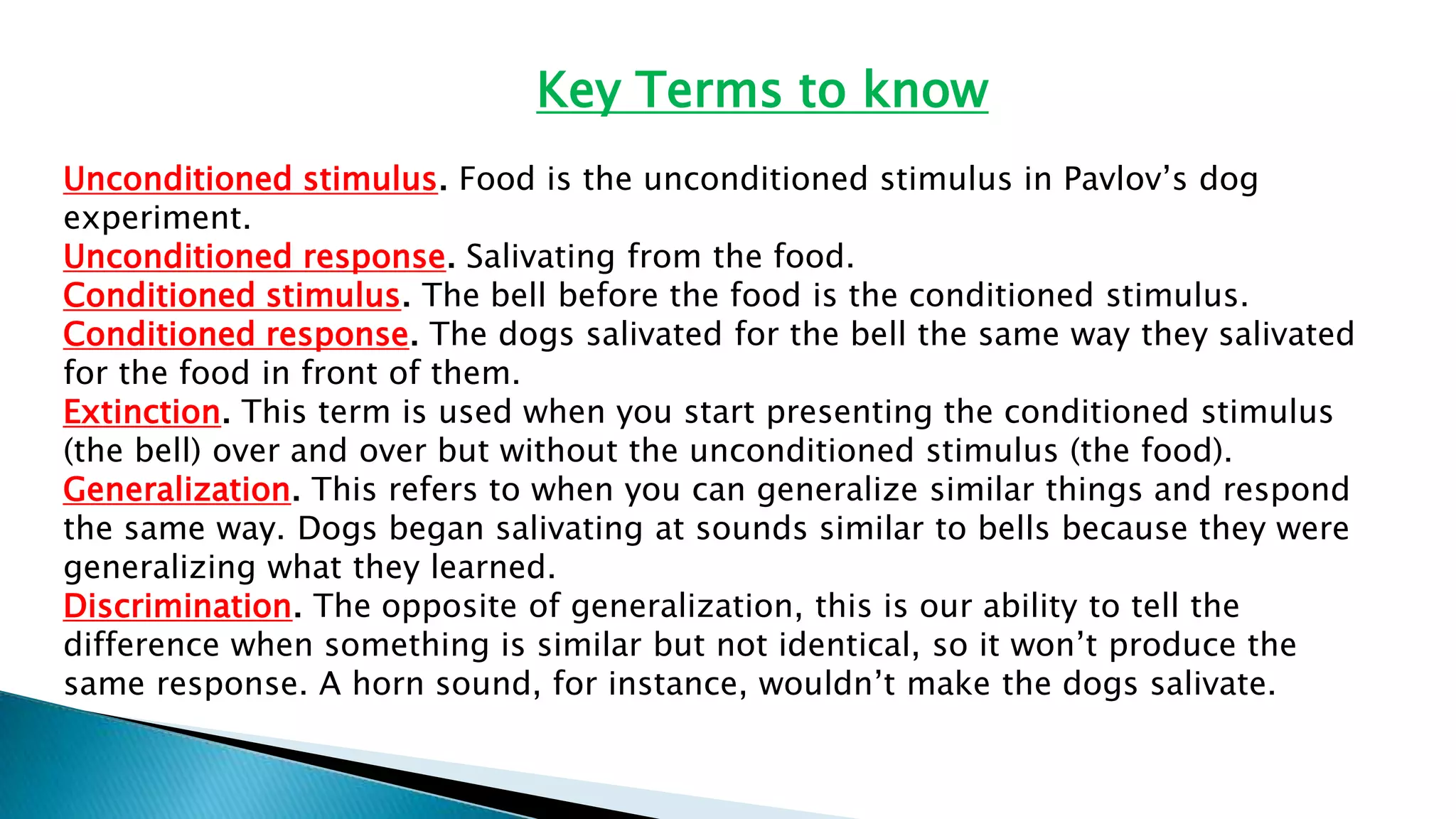
Discovered by Russian physiologist Ivan Pavlov (1849-1936)
Experimented with dogs.
Won the Nobel Prize in 1904
# Pavlov’s work was popularized in psychology by
John B. Watson.
# Watson made classical conditioning the
foundation of his ideas.
Sanjoy Mudi
Key Terms to know
Unconditioned stimulus. Food is the unconditioned stimulus in Pavlov’s dog
experiment.
Unconditioned response. Salivating from the food.
Conditioned stimulus. The bell before the food is the conditioned stimulus.
Conditioned response. The dogs salivated for the bell the same way they salivated
for the food in front of them.
Extinction. This term is used when you start presenting the conditioned stimulus
(the bell) over and over but without the unconditioned stimulus (the food).
Generalization. This refers to when you can generalize similar things and respond
the same way. Dogs began salivating at sounds similar to bells because they were
generalizing what they learned.
Discrimination. The opposite of generalization, this is our ability to tell the
difference when something is similar but not identical, so it won’t produce the
same response. A horn sound, for instance, wouldn’t make the dogs salivate.
Types of Stimuli and Responses
Each of the stimuli and responses in classical conditioning is referred to by specific
terms.
1. The presentation of food to the dog is referred to as the unconditioned stimulus
(UCS) because the dog’s response to the food occurs naturally.
2. The bell is the conditioned stimulus(CS) because the dog must learn to associate
it with the desired response.
3. Salivation in response to the food is called the unconditioned response(UCR)
4. Salivation to the light or bell is the conditioned response (CR) because the dog
learns to associate that response with the conditioned stimulus.
How classical conditioning works?
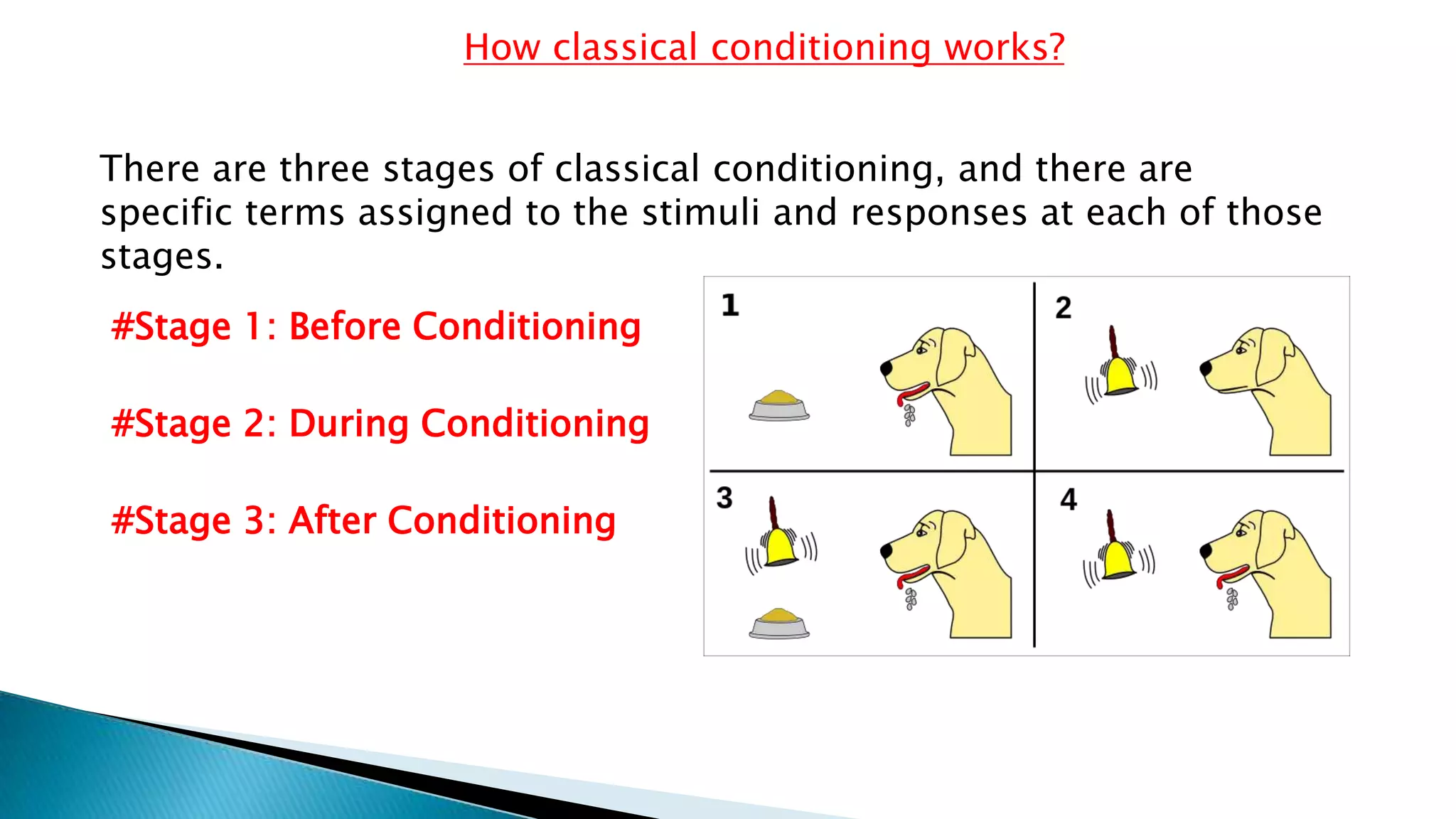
There are three stages of classical conditioning, and there are
specific terms assigned to the stimuli and responses at each of those
stages.
#Stage 1: Before Conditioning
#Stage 2: During Conditioning
#Stage 3: After Conditioning
Stage 1: Before Conditioning
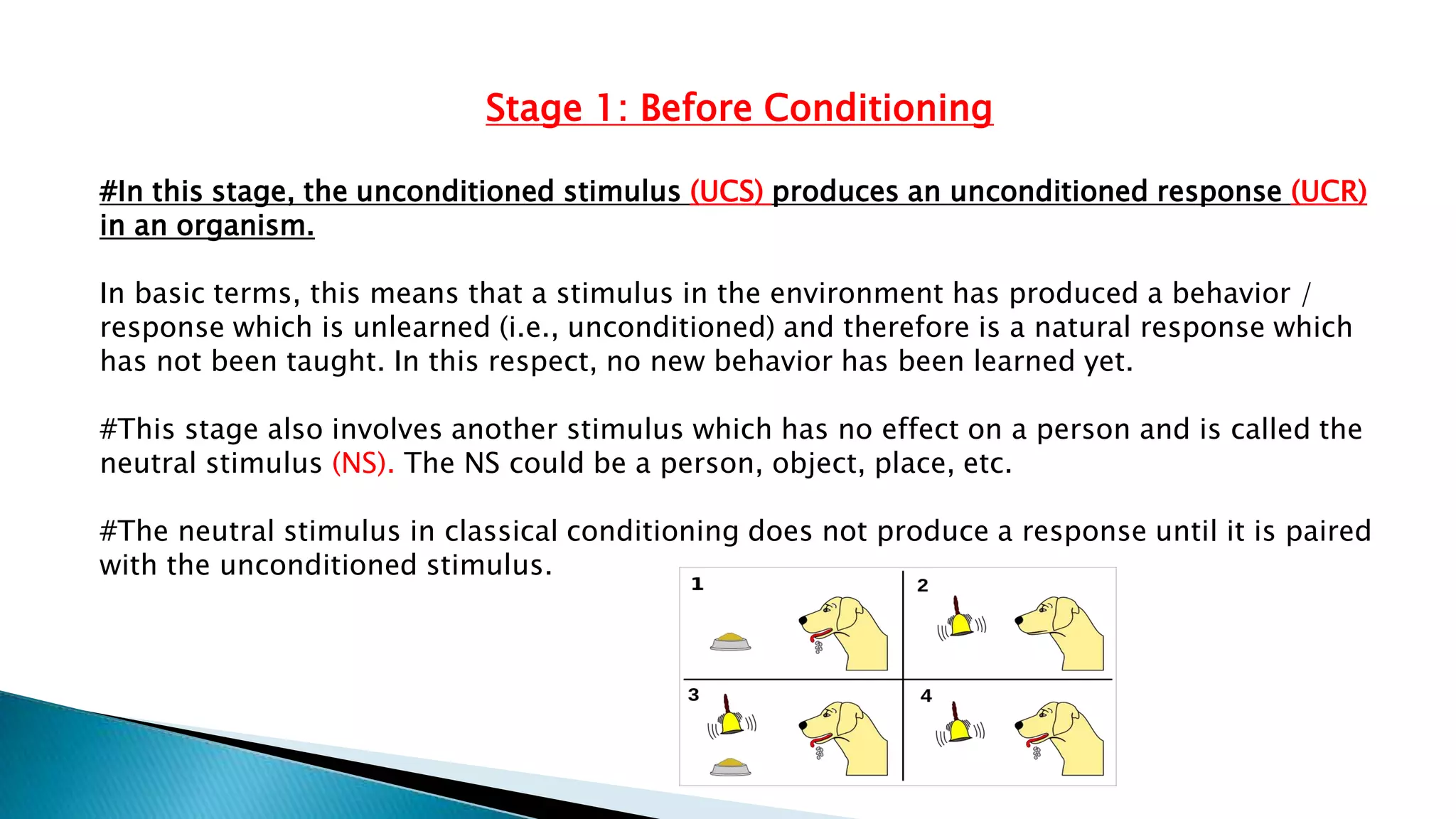
#In this stage, the unconditioned stimulus (UCS) produces an unconditioned response (UCR)
in an organism.
In basic terms, this means that a stimulus in the environment has produced a behavior /
response which is unlearned (i.e., unconditioned) and therefore is a natural response which
has not been taught. In this respect, no new behavior has been learned yet.
#This stage also involves another stimulus which has no effect on a person and is called the
neutral stimulus (NS). The NS could be a person, object, place, etc.
#The neutral stimulus in classical conditioning does not produce a response until it is paired
with the unconditioned stimulus.
Stage 2: During Conditioning
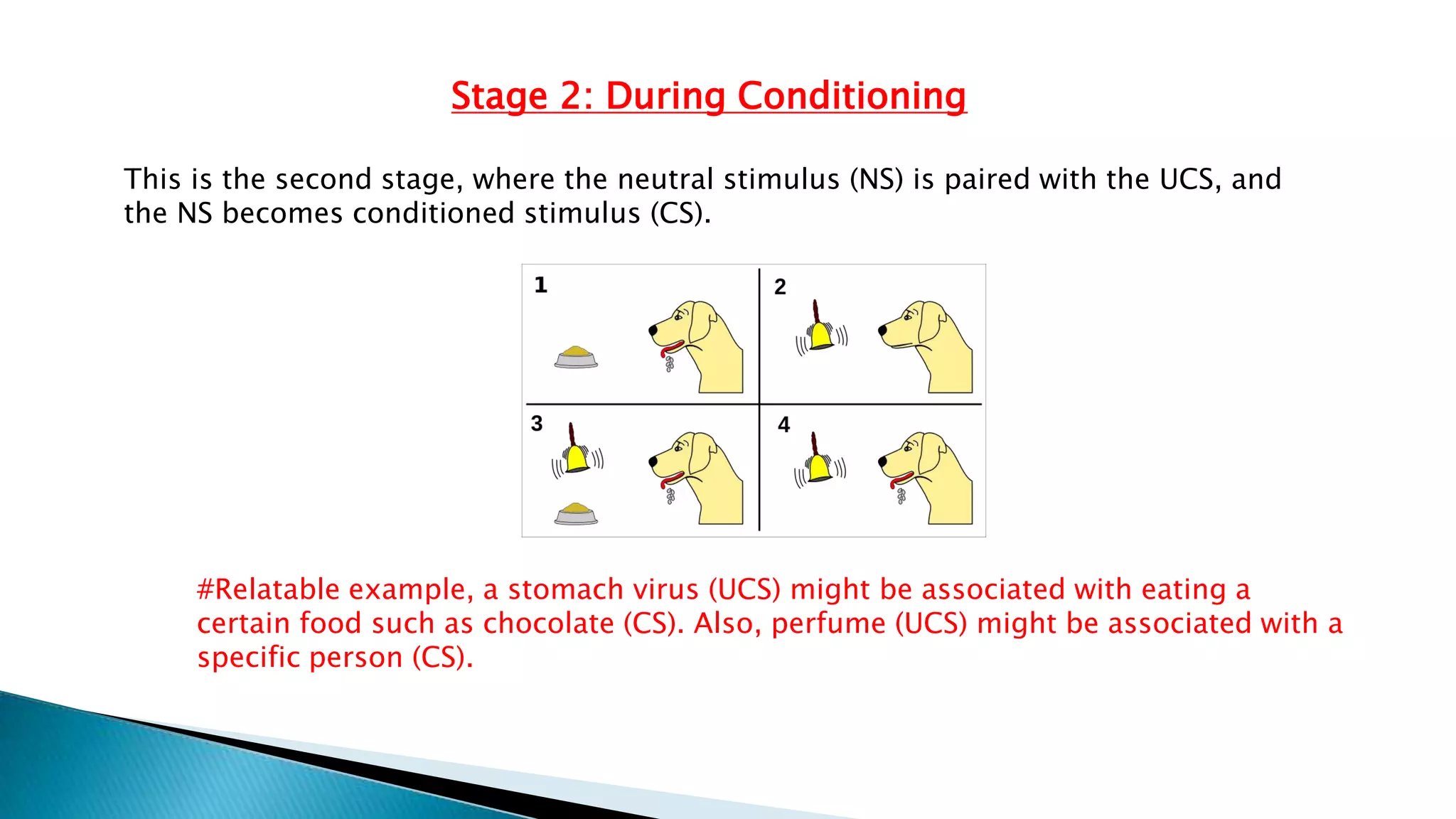
This is the second stage, where the neutral stimulus (NS) is paired with the UCS, and
the NS becomes conditioned stimulus (CS).
#Relatable example, a stomach virus (UCS) might be associated with eating a
certain food such as chocolate (CS). Also, perfume (UCS) might be associated with a
specific person (CS).
Stage 3: After Conditioning
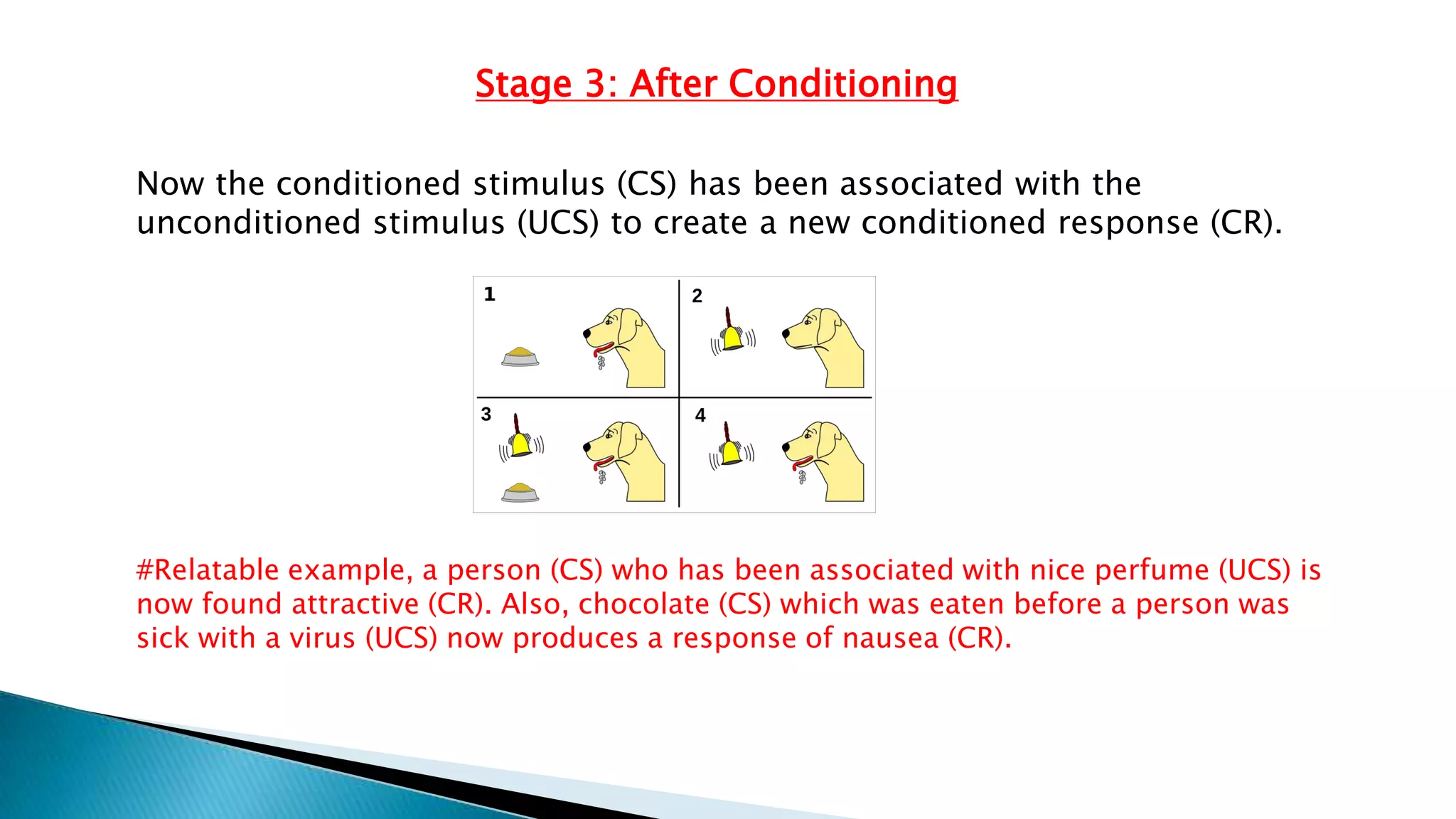
Now the conditioned stimulus (CS) has been associated with the
unconditioned stimulus (UCS) to create a new conditioned response (CR).
#Relatable example, a person (CS) who has been associated with nice perfume (UCS) is
now found attractive (CR). Also, chocolate (CS) which was eaten before a person was
sick with a virus (UCS) now produces a response of nausea (CR).
Educational implications of this theory
1. Theory of Reward and Punishment
2. Useful in Language Learning
3. Helpful in Removal of Superstitions
4. Development of Attitudes
5. Helpful in Adjustment
6. Use of Audio-Visual Aids
7. Arousal of Fear, Love and Jealousy
Critical Evaluation
Classical conditioning

Classical conditioning

  • 1.
    Classical Conditioning Discovered byRussian physiologist Ivan Pavlov (1849-1936) Experimented with dogs. Won the Nobel Prize in 1904 # Pavlov’s work was popularized in psychology by John B. Watson. # Watson made classical conditioning the foundation of his ideas. Sanjoy Mudi
  • 3.
    Key Terms toknow Unconditioned stimulus. Food is the unconditioned stimulus in Pavlov’s dog experiment. Unconditioned response. Salivating from the food. Conditioned stimulus. The bell before the food is the conditioned stimulus. Conditioned response. The dogs salivated for the bell the same way they salivated for the food in front of them. Extinction. This term is used when you start presenting the conditioned stimulus (the bell) over and over but without the unconditioned stimulus (the food). Generalization. This refers to when you can generalize similar things and respond the same way. Dogs began salivating at sounds similar to bells because they were generalizing what they learned. Discrimination. The opposite of generalization, this is our ability to tell the difference when something is similar but not identical, so it won’t produce the same response. A horn sound, for instance, wouldn’t make the dogs salivate.
  • 4.
    Types of Stimuliand Responses Each of the stimuli and responses in classical conditioning is referred to by specific terms. 1. The presentation of food to the dog is referred to as the unconditioned stimulus (UCS) because the dog’s response to the food occurs naturally. 2. The bell is the conditioned stimulus(CS) because the dog must learn to associate it with the desired response. 3. Salivation in response to the food is called the unconditioned response(UCR) 4. Salivation to the light or bell is the conditioned response (CR) because the dog learns to associate that response with the conditioned stimulus.
  • 5.
    How classical conditioningworks? There are three stages of classical conditioning, and there are specific terms assigned to the stimuli and responses at each of those stages. #Stage 1: Before Conditioning #Stage 2: During Conditioning #Stage 3: After Conditioning
  • 6.
    Stage 1: BeforeConditioning #In this stage, the unconditioned stimulus (UCS) produces an unconditioned response (UCR) in an organism. In basic terms, this means that a stimulus in the environment has produced a behavior / response which is unlearned (i.e., unconditioned) and therefore is a natural response which has not been taught. In this respect, no new behavior has been learned yet. #This stage also involves another stimulus which has no effect on a person and is called the neutral stimulus (NS). The NS could be a person, object, place, etc. #The neutral stimulus in classical conditioning does not produce a response until it is paired with the unconditioned stimulus.
  • 7.
    Stage 2: DuringConditioning This is the second stage, where the neutral stimulus (NS) is paired with the UCS, and the NS becomes conditioned stimulus (CS). #Relatable example, a stomach virus (UCS) might be associated with eating a certain food such as chocolate (CS). Also, perfume (UCS) might be associated with a specific person (CS).
  • 8.
    Stage 3: AfterConditioning Now the conditioned stimulus (CS) has been associated with the unconditioned stimulus (UCS) to create a new conditioned response (CR). #Relatable example, a person (CS) who has been associated with nice perfume (UCS) is now found attractive (CR). Also, chocolate (CS) which was eaten before a person was sick with a virus (UCS) now produces a response of nausea (CR).
  • 9.
    Educational implications ofthis theory 1. Theory of Reward and Punishment 2. Useful in Language Learning 3. Helpful in Removal of Superstitions 4. Development of Attitudes 5. Helpful in Adjustment 6. Use of Audio-Visual Aids 7. Arousal of Fear, Love and Jealousy
  • 10.