Classical Conditioning
Description:
•If a stimulus that results in an emotional
response is repeated alongside another
stimulus which does not cause an
emotional response, eventually the
second stimulus will result in the same
emotional response. Classical
Conditioning is thus “learning by
association.”
The beginning
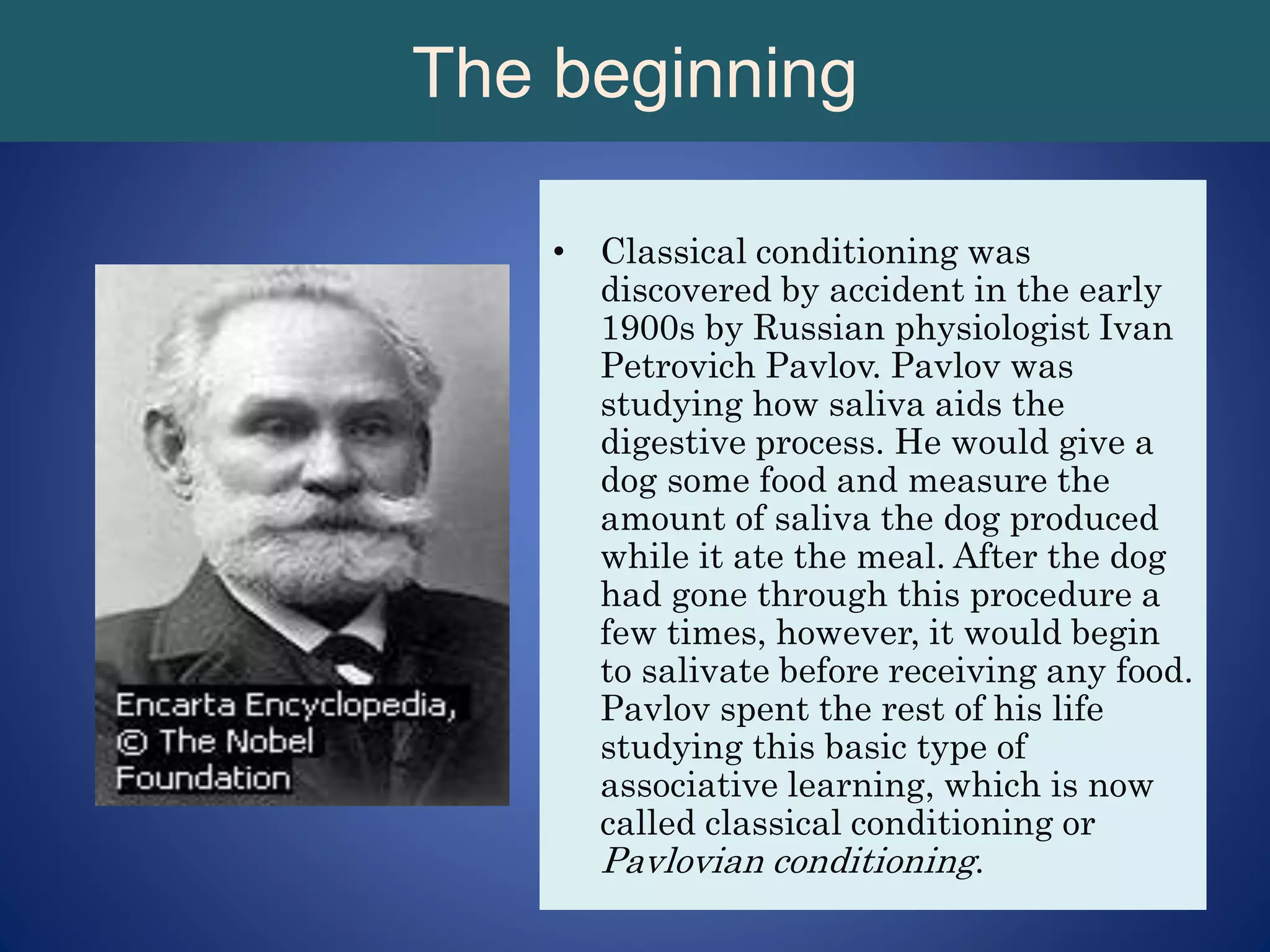
• Classical conditioning was
discovered by accident in the early
1900s by Russian physiologist Ivan
Petrovich Pavlov. Pavlov was
studying how saliva aids the
digestive process. He would give a
dog some food and measure the
amount of saliva the dog produced
while it ate the meal. After the dog
had gone through this procedure a
few times, however, it would begin
to salivate before receiving any food.
Pavlov spent the rest of his life
studying this basic type of
associative learning, which is now
called classical conditioning or
Pavlovian conditioning.
Classical Conditioning
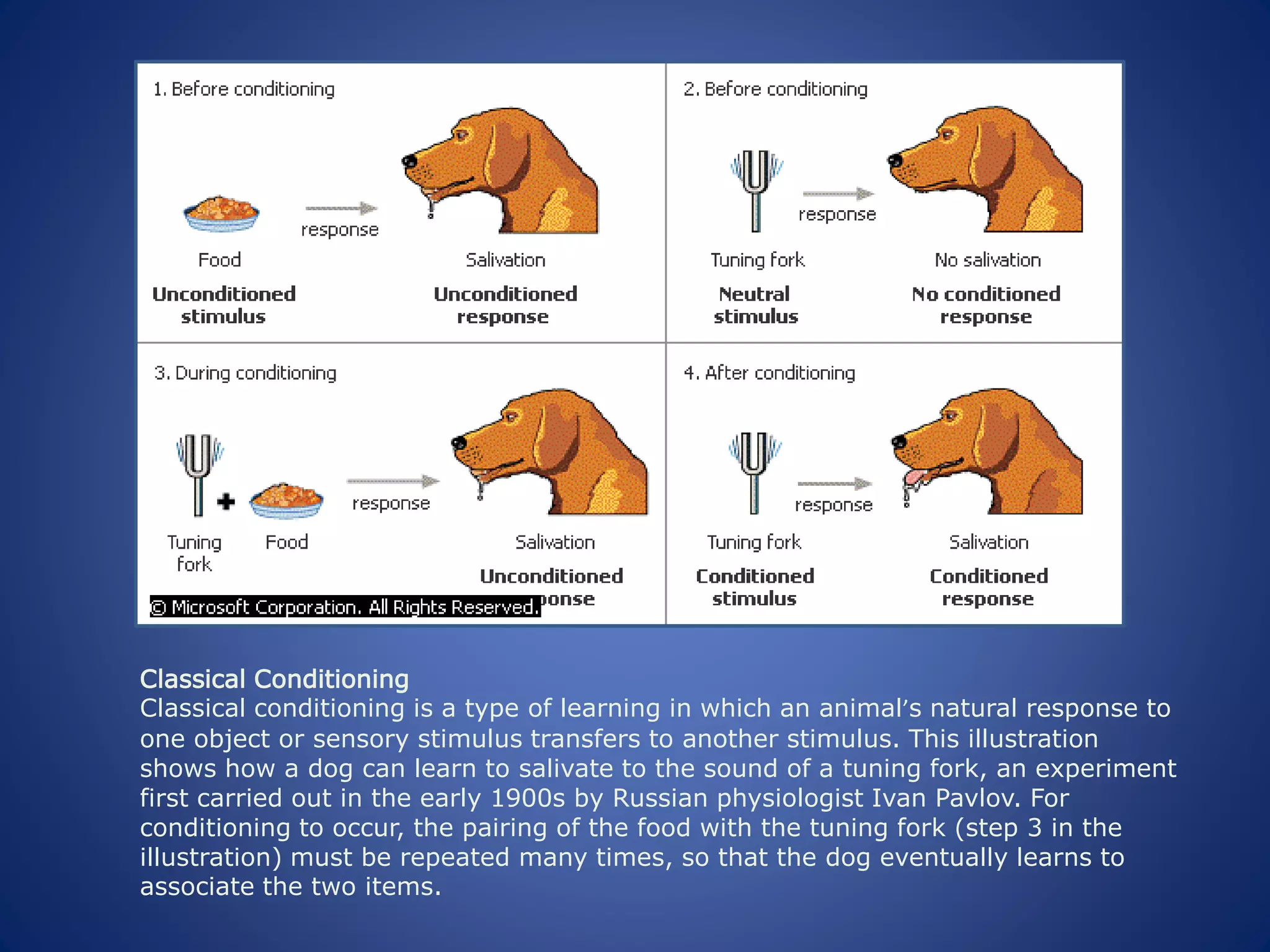
Classical conditioning is a type of learning in which an animal’s natural response to
one object or sensory stimulus transfers to another stimulus. This illustration
shows how a dog can learn to salivate to the sound of a tuning fork, an experiment
first carried out in the early 1900s by Russian physiologist Ivan Pavlov. For
conditioning to occur, the pairing of the food with the tuning fork (step 3 in the
illustration) must be repeated many times, so that the dog eventually learns to
associate the two items.
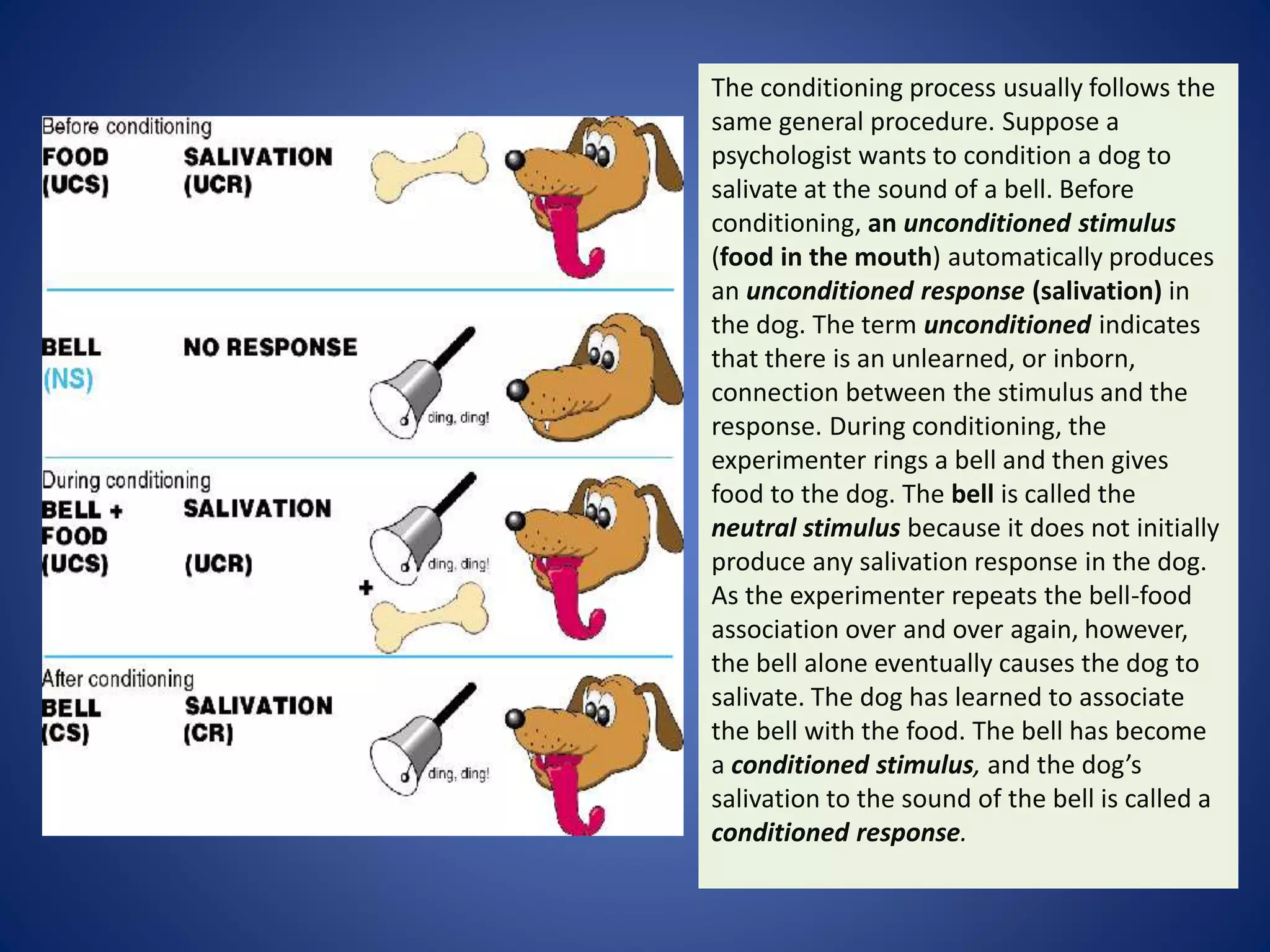
The conditioning process usually follows the
same general procedure. Suppose a
psychologist wants to condition a dog to
salivate at the sound of a bell. Before
conditioning, an unconditioned stimulus
(food in the mouth) automatically produces
an unconditioned response (salivation) in
the dog. The term unconditioned indicates
that there is an unlearned, or inborn,
connection between the stimulus and the
response. During conditioning, the
experimenter rings a bell and then gives
food to the dog. The bell is called the
neutral stimulus because it does not initially
produce any salivation response in the dog.
As the experimenter repeats the bell-food
association over and over again, however,
the bell alone eventually causes the dog to
salivate. The dog has learned to associate
the bell with the food. The bell has become
a conditioned stimulus, and the dog’s
salivation to the sound of the bell is called a
conditioned response.
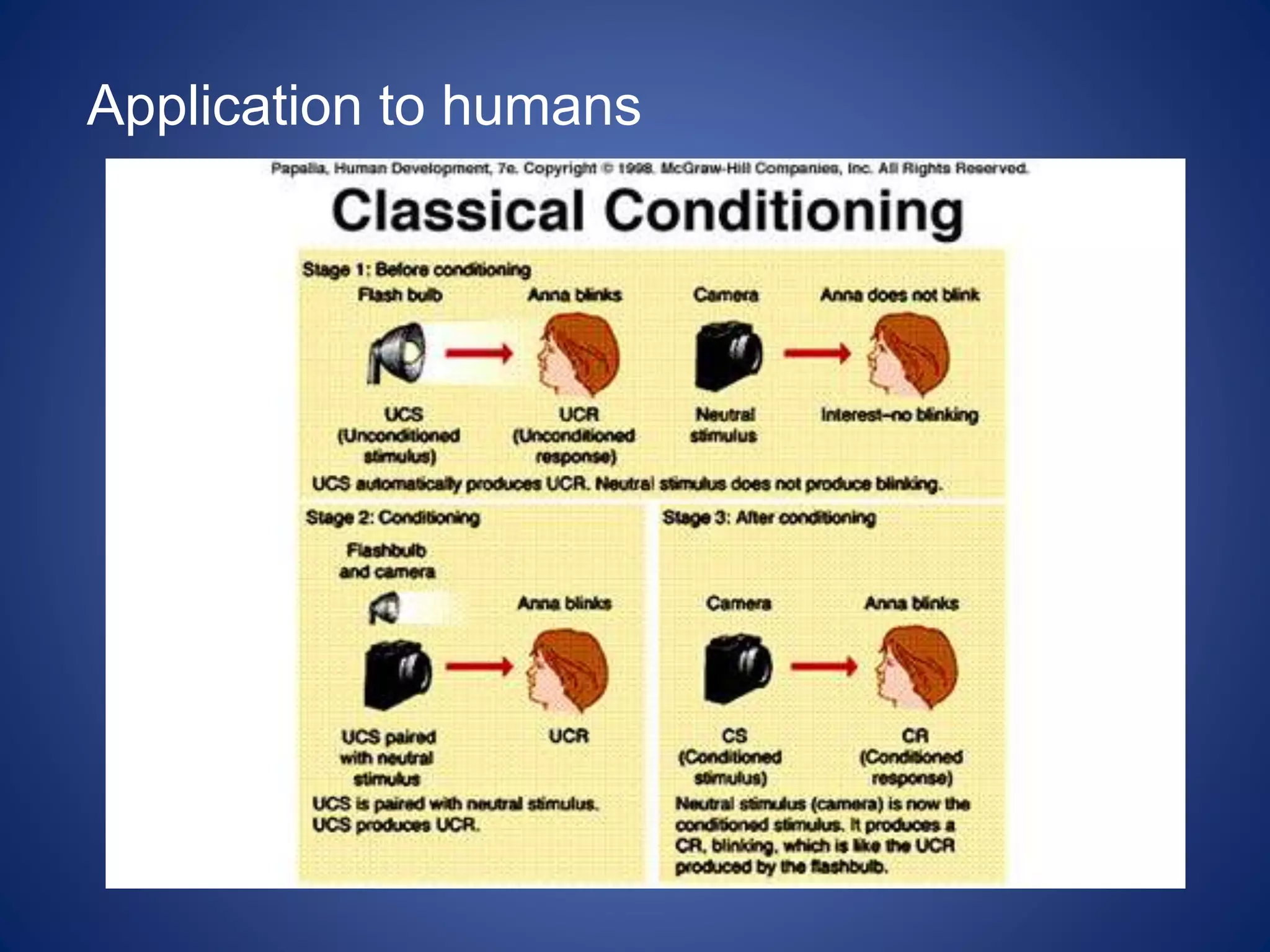
Application to humans
Thank you
for your time!

Presentation on classical conditioning

  • 1.
  • 2.
    Description: •If a stimulusthat results in an emotional response is repeated alongside another stimulus which does not cause an emotional response, eventually the second stimulus will result in the same emotional response. Classical Conditioning is thus “learning by association.”
  • 3.
    The beginning • Classicalconditioning was discovered by accident in the early 1900s by Russian physiologist Ivan Petrovich Pavlov. Pavlov was studying how saliva aids the digestive process. He would give a dog some food and measure the amount of saliva the dog produced while it ate the meal. After the dog had gone through this procedure a few times, however, it would begin to salivate before receiving any food. Pavlov spent the rest of his life studying this basic type of associative learning, which is now called classical conditioning or Pavlovian conditioning.
  • 4.
    Classical Conditioning Classical conditioningis a type of learning in which an animal’s natural response to one object or sensory stimulus transfers to another stimulus. This illustration shows how a dog can learn to salivate to the sound of a tuning fork, an experiment first carried out in the early 1900s by Russian physiologist Ivan Pavlov. For conditioning to occur, the pairing of the food with the tuning fork (step 3 in the illustration) must be repeated many times, so that the dog eventually learns to associate the two items.
  • 5.
    The conditioning processusually follows the same general procedure. Suppose a psychologist wants to condition a dog to salivate at the sound of a bell. Before conditioning, an unconditioned stimulus (food in the mouth) automatically produces an unconditioned response (salivation) in the dog. The term unconditioned indicates that there is an unlearned, or inborn, connection between the stimulus and the response. During conditioning, the experimenter rings a bell and then gives food to the dog. The bell is called the neutral stimulus because it does not initially produce any salivation response in the dog. As the experimenter repeats the bell-food association over and over again, however, the bell alone eventually causes the dog to salivate. The dog has learned to associate the bell with the food. The bell has become a conditioned stimulus, and the dog’s salivation to the sound of the bell is called a conditioned response.
  • 6.
  • 7.