Conditioning and Learning Grant Heller [email_address]
Conditioning & Learning Chapter Know the following: 1. Differences between classical and instrumental conditioning 2. Model for classical conditioning: CS, UCS, UCR, and CR. Be able to apply this model and KNOW THESE TERMS! 3. Contingency 4. Shaping 5. Controls in conditioning experiments 6. Types of designs in conditioning experiments and advantages and disadvantages of repeated measures designs.
Two Types of Conditioning: Classical Conditioning (Respondent, Pavlovian) Operant Conditioning (Instrumental Conditioning or Skinnarian conditioning) Classical Conditioning:  A basic form of learning, in which stimuli initially incapable of evoking certain responses acquire the ability to do so through repeated pairing with other stimuli (unconditioned stimuli) that are able to elicit such responses.
Conditioning Terms Unconditioned Stimulus (UCS or US) The biologically significant stimulus that follows a conditioned stimulus (CS) Unconditioned Response (UCR or UR) The response that the US naturally evokes Conditioned Stimulus (CS) The stimulus that  signals  the US  Conditioned Response (CR) The response the organism learns to make to the CS (same as the UR)
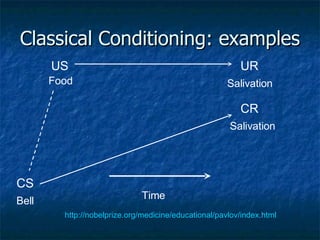
Classical Conditioning: examples US UR CS CR Food Salivation Salivation Bell Time http:// nobelprize.org/medicine/educational/pavlov/index.html
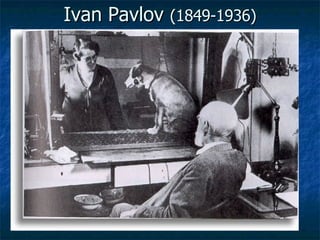
Ivan Pavlov  (1849-1936)
The Importance of Contingency In order to be effective, the CS must serve to accurately predict the onset of the US. A CS will usually be ineffective if it does not provide some sort of additional information about the US. Contiguity: the occurrence of two items close together in time and space. (also useful in conditioning)
 
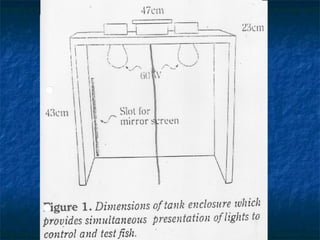
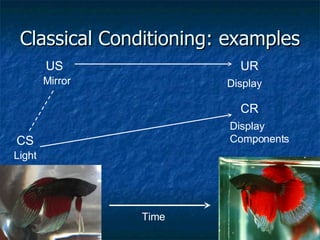
Classical Conditioning: examples US UR CS CR Mirror Display Display Components Light Time
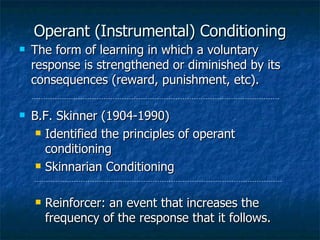
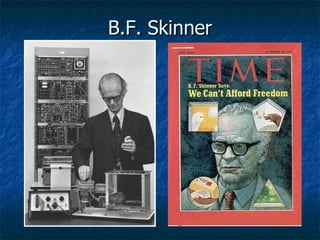
Operant (Instrumental) Conditioning The form of learning in which a voluntary response is strengthened or diminished by its consequences (reward, punishment, etc). B.F. Skinner (1904-1990) Identified the principles of operant conditioning Skinnarian Conditioning Reinforcer: an event that increases the frequency of the response that it follows.
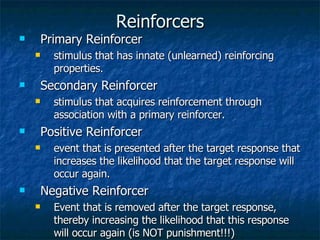
Reinforcers Primary Reinforcer stimulus that has innate (unlearned) reinforcing properties. Secondary Reinforcer stimulus that acquires reinforcement through association with a primary reinforcer. Positive Reinforcer event that is presented after the target response that increases the likelihood that the target response will occur again. Negative Reinforcer Event that is removed after the target response, thereby increasing the likelihood that this response will occur again (is NOT punishment!!!)
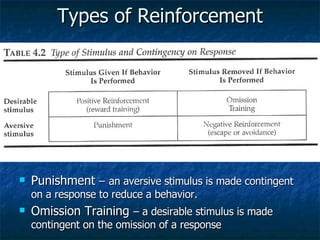
Types of Reinforcement Punishment  –   an aversive stimulus is made contingent on a response to reduce a behavior. Omission Training  – a desirable stimulus is made contingent on the omission of a response
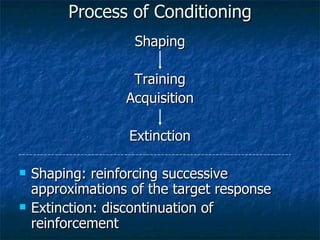
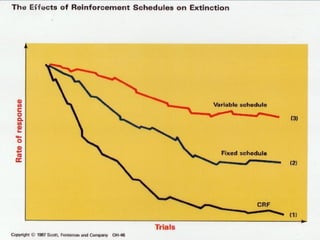
Process of Conditioning Shaping Training Acquisition Extinction Shaping: reinforcing successive approximations of the target response Extinction: discontinuation of reinforcement
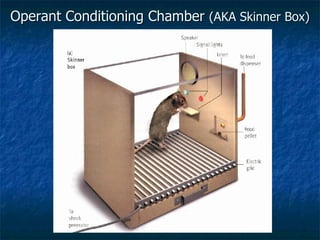
Operant Conditioning Chamber  (AKA Skinner Box)
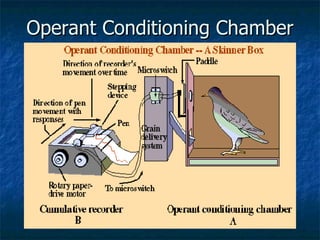
Operant Conditioning Chamber
B.F. Skinner
 
Types of Reinforcement Continuous Reinforcement Reinforcement follows each target response Intermittent or Partial Reinforcement Reinforcement follows some target responses Reinforcement Schedule A pattern or plan for delivering reinforcement
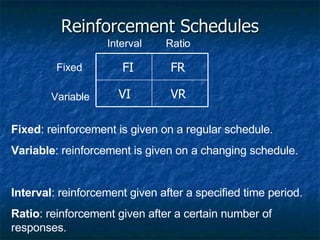
Reinforcement Schedules Fixed : reinforcement is given on a regular schedule. Variable : reinforcement is given on a changing schedule. Interval : reinforcement given after a specified time period. Ratio : reinforcement given after a certain number of responses. Interval Ratio Fixed Variable VR VI FR FI
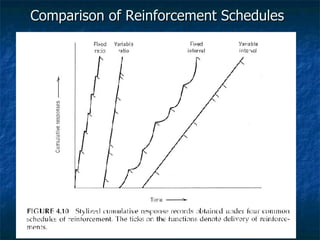
Comparison of Reinforcement Schedules
 
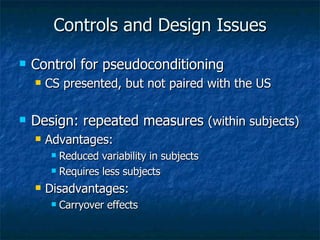
Controls and Design Issues Control for pseudoconditioning CS presented, but not paired with the US Design: repeated measures  (within subjects) Advantages:  Reduced variability in subjects Requires less subjects Disadvantages: Carryover effects
 

Conditioning And Learning Lecture

  • 1.
    Conditioning and LearningGrant Heller [email_address]
  • 2.
    Conditioning & LearningChapter Know the following: 1. Differences between classical and instrumental conditioning 2. Model for classical conditioning: CS, UCS, UCR, and CR. Be able to apply this model and KNOW THESE TERMS! 3. Contingency 4. Shaping 5. Controls in conditioning experiments 6. Types of designs in conditioning experiments and advantages and disadvantages of repeated measures designs.
  • 3.
    Two Types ofConditioning: Classical Conditioning (Respondent, Pavlovian) Operant Conditioning (Instrumental Conditioning or Skinnarian conditioning) Classical Conditioning: A basic form of learning, in which stimuli initially incapable of evoking certain responses acquire the ability to do so through repeated pairing with other stimuli (unconditioned stimuli) that are able to elicit such responses.
  • 4.
    Conditioning Terms UnconditionedStimulus (UCS or US) The biologically significant stimulus that follows a conditioned stimulus (CS) Unconditioned Response (UCR or UR) The response that the US naturally evokes Conditioned Stimulus (CS) The stimulus that signals the US Conditioned Response (CR) The response the organism learns to make to the CS (same as the UR)
  • 5.
    Classical Conditioning: examplesUS UR CS CR Food Salivation Salivation Bell Time http:// nobelprize.org/medicine/educational/pavlov/index.html
  • 6.
    Ivan Pavlov (1849-1936)
  • 7.
    The Importance ofContingency In order to be effective, the CS must serve to accurately predict the onset of the US. A CS will usually be ineffective if it does not provide some sort of additional information about the US. Contiguity: the occurrence of two items close together in time and space. (also useful in conditioning)
  • 8.
  • 9.
    Classical Conditioning: examplesUS UR CS CR Mirror Display Display Components Light Time
  • 10.
    Operant (Instrumental) ConditioningThe form of learning in which a voluntary response is strengthened or diminished by its consequences (reward, punishment, etc). B.F. Skinner (1904-1990) Identified the principles of operant conditioning Skinnarian Conditioning Reinforcer: an event that increases the frequency of the response that it follows.
  • 11.
    Reinforcers Primary Reinforcerstimulus that has innate (unlearned) reinforcing properties. Secondary Reinforcer stimulus that acquires reinforcement through association with a primary reinforcer. Positive Reinforcer event that is presented after the target response that increases the likelihood that the target response will occur again. Negative Reinforcer Event that is removed after the target response, thereby increasing the likelihood that this response will occur again (is NOT punishment!!!)
  • 12.
    Types of ReinforcementPunishment – an aversive stimulus is made contingent on a response to reduce a behavior. Omission Training – a desirable stimulus is made contingent on the omission of a response
  • 13.
    Process of ConditioningShaping Training Acquisition Extinction Shaping: reinforcing successive approximations of the target response Extinction: discontinuation of reinforcement
  • 14.
    Operant Conditioning Chamber (AKA Skinner Box)
  • 15.
  • 16.
  • 17.
  • 18.
    Types of ReinforcementContinuous Reinforcement Reinforcement follows each target response Intermittent or Partial Reinforcement Reinforcement follows some target responses Reinforcement Schedule A pattern or plan for delivering reinforcement
  • 19.
    Reinforcement Schedules Fixed: reinforcement is given on a regular schedule. Variable : reinforcement is given on a changing schedule. Interval : reinforcement given after a specified time period. Ratio : reinforcement given after a certain number of responses. Interval Ratio Fixed Variable VR VI FR FI
  • 20.
  • 21.
  • 22.
    Controls and DesignIssues Control for pseudoconditioning CS presented, but not paired with the US Design: repeated measures (within subjects) Advantages: Reduced variability in subjects Requires less subjects Disadvantages: Carryover effects
  • 23.