By wilsontom.blogspot.com
After the class students will be able to Define growth &development Discuss factors affecting growth  &development Enlist  laws of growth Discuss assessment of physical growth Enumerate the theories of development
Denotes a net increase in the size or mass of tissues. It is largely attributed to multiplication of cells and increase in the intracellular  substance DEVELOPMENT Development-specifies  maturation of functions. It is related to the maturaration and myelination of the  nervous system and indicates the acquisition of a variety of skills for optimal functioning of the individual.
 
"Operation" - Forms of  mental action  through which older children solve problems and reason logically  Key feature of stage is extensive representation Pre-op kids develop “theory of mind” (understanding of mental processes)   Preoperational Stage (2 to 7 years)
The children are now able to  conserve , They understand that although the appearance has changed the thing it self does not.
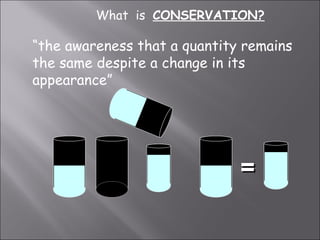
= What  is  CONSERVATION? “ the awareness that a quantity remains the same despite a change in its appearance”
Do you have more blocks or do I have more blocks or do we have the same amount of blocks? Make sure that the children do not fail to conserve because they do not understand the terms used in the questions- Piaget has been criticized for using difficult questions.
Underestimated the importance of knowledge   Gagne: Complex skills can be acquired easily once simpler prerequisite skills have been learned. Development is based on LEARNING new skills -  continuous  not  discontinuous . Underestimated the ability of children   Tasks were methodologically flawed Underestimated the impact of CULTURE :  Piaget’s tasks are culturally biased  Schooling and literacy affect rates of development   This suggest that there were design flaws with Piagets original study .
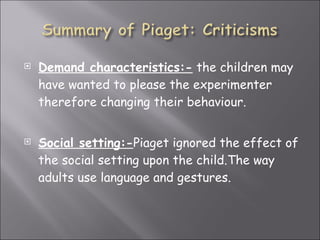
Demand characteristics:-  the children may have wanted to please the experimenter therefore changing their behaviour. Social setting:- Piaget ignored the effect of the social setting upon the child.The way adults use language and gestures.
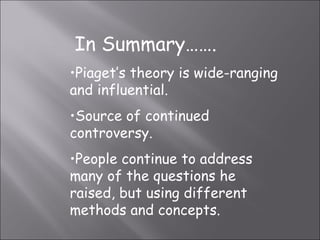
In Summary……. Piaget’s theory is wide-ranging and influential. Source of continued controversy. People continue to address many of the questions he raised, but using different methods and concepts.
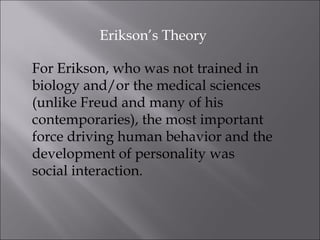
Erikson’s Theory For Erikson, who was not trained in biology and/or the medical sciences (unlike Freud and many of his contemporaries), the most important force driving human behavior and the development of personality was social interaction.
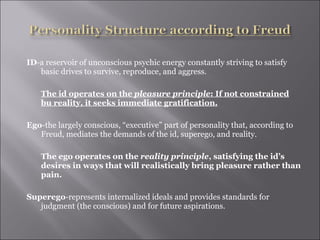
ID -a reservoir of unconscious psychic energy constantly striving to satisfy basic drives to survive, reproduce, and aggress. The id operates on the  pleasure principle : If not constrained bu reality, it seeks immediate gratification. Ego -the largely conscious, “executive” part of personality that, according to Freud, mediates the demands of the id, superego, and reality. The ego operates on the  reality principle , satisfying the id’s desires in ways that will realistically bring pleasure rather than pain. Superego -represents internalized ideals and provides standards for judgment (the conscious) and for future aspirations.
Oedipus complex -a boy’s sexual desires toward his mother and feelings of jealousy and hatred for the rival father Identification -the process by which, children incorporate their parents’ values into their developing superegos Fixation -a lingering focus of pleasure-seeking energies at an earlier psychosexual stage, where conflicts were unresolved.
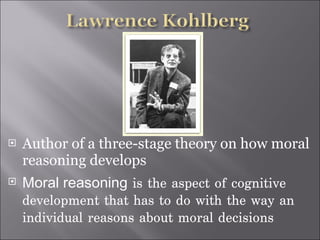
Author of a three-stage theory on how moral reasoning develops Moral reasoning  is the aspect of cognitive development that has to do with the way an individual reasons about moral decisions
In Europe, a woman was near death from a special kind of cancer. There was one drug that the doctors thought might save her. It was a form of radium that a druggist in the same town had recently discovered. the drug was expensive to make, but the druggist was charging ten times what the drug cost him to make. He paid $400 for the radium and charged $4,000 for a small dose of the drug. The sick woman's husband, Heinz, went to everyone he knew to borrow the money and tried every legal means, but he could only get together about $2,000, which is half of what it cost. He told the druggist that his wife was dying, and asked him to sell it cheaper or let him pay later. But the druggist said, "No, I discovered the drug and I'm going to make money from it." So, having tried every legal means, Heinz gets desperate and considers breaking into the man's store to steal the drug for his wife. Should Heinz steal the drug? Why or why not?
Primary concern is to fit in and play the role of a good citizen People have a strong desire to follow the rules and laws. Typical of most adults
Characterized by references to universal ethical principles that represent protecting the rights or of  all  people Most adults do not reach this level.
THANK YOU wilsontom.blogspot.com

Theories of growth & development

  • 1.
  • 2.
    After the classstudents will be able to Define growth &development Discuss factors affecting growth &development Enlist laws of growth Discuss assessment of physical growth Enumerate the theories of development
  • 3.
    Denotes a netincrease in the size or mass of tissues. It is largely attributed to multiplication of cells and increase in the intracellular substance DEVELOPMENT Development-specifies maturation of functions. It is related to the maturaration and myelination of the nervous system and indicates the acquisition of a variety of skills for optimal functioning of the individual.
  • 4.
  • 5.
    "Operation" - Formsof mental action through which older children solve problems and reason logically Key feature of stage is extensive representation Pre-op kids develop “theory of mind” (understanding of mental processes) Preoperational Stage (2 to 7 years)
  • 6.
    The children arenow able to conserve , They understand that although the appearance has changed the thing it self does not.
  • 7.
    = What is CONSERVATION? “ the awareness that a quantity remains the same despite a change in its appearance”
  • 8.
    Do you havemore blocks or do I have more blocks or do we have the same amount of blocks? Make sure that the children do not fail to conserve because they do not understand the terms used in the questions- Piaget has been criticized for using difficult questions.
  • 9.
    Underestimated the importanceof knowledge Gagne: Complex skills can be acquired easily once simpler prerequisite skills have been learned. Development is based on LEARNING new skills - continuous not discontinuous . Underestimated the ability of children Tasks were methodologically flawed Underestimated the impact of CULTURE : Piaget’s tasks are culturally biased Schooling and literacy affect rates of development This suggest that there were design flaws with Piagets original study .
  • 10.
    Demand characteristics:- the children may have wanted to please the experimenter therefore changing their behaviour. Social setting:- Piaget ignored the effect of the social setting upon the child.The way adults use language and gestures.
  • 11.
    In Summary……. Piaget’stheory is wide-ranging and influential. Source of continued controversy. People continue to address many of the questions he raised, but using different methods and concepts.
  • 12.
    Erikson’s Theory ForErikson, who was not trained in biology and/or the medical sciences (unlike Freud and many of his contemporaries), the most important force driving human behavior and the development of personality was social interaction.
  • 13.
    ID -a reservoirof unconscious psychic energy constantly striving to satisfy basic drives to survive, reproduce, and aggress. The id operates on the pleasure principle : If not constrained bu reality, it seeks immediate gratification. Ego -the largely conscious, “executive” part of personality that, according to Freud, mediates the demands of the id, superego, and reality. The ego operates on the reality principle , satisfying the id’s desires in ways that will realistically bring pleasure rather than pain. Superego -represents internalized ideals and provides standards for judgment (the conscious) and for future aspirations.
  • 14.
    Oedipus complex -aboy’s sexual desires toward his mother and feelings of jealousy and hatred for the rival father Identification -the process by which, children incorporate their parents’ values into their developing superegos Fixation -a lingering focus of pleasure-seeking energies at an earlier psychosexual stage, where conflicts were unresolved.
  • 15.
    Author of athree-stage theory on how moral reasoning develops Moral reasoning is the aspect of cognitive development that has to do with the way an individual reasons about moral decisions
  • 16.
    In Europe, awoman was near death from a special kind of cancer. There was one drug that the doctors thought might save her. It was a form of radium that a druggist in the same town had recently discovered. the drug was expensive to make, but the druggist was charging ten times what the drug cost him to make. He paid $400 for the radium and charged $4,000 for a small dose of the drug. The sick woman's husband, Heinz, went to everyone he knew to borrow the money and tried every legal means, but he could only get together about $2,000, which is half of what it cost. He told the druggist that his wife was dying, and asked him to sell it cheaper or let him pay later. But the druggist said, "No, I discovered the drug and I'm going to make money from it." So, having tried every legal means, Heinz gets desperate and considers breaking into the man's store to steal the drug for his wife. Should Heinz steal the drug? Why or why not?
  • 17.
    Primary concern isto fit in and play the role of a good citizen People have a strong desire to follow the rules and laws. Typical of most adults
  • 18.
    Characterized by referencesto universal ethical principles that represent protecting the rights or of all people Most adults do not reach this level.
  • 19.