PREPARED BY,
PRAVEENA P V
2nd Bed PHYSICAL SCIENCE
KEYI SAHIB TRAINING
COLLEGE ,TALIPARAMBA
Development describes the growth of humans throughout the
lifespan ,from conception to death. The scientific study of human development
seeks to understand and explain how and why people change throughout life.
This includes all aspects of human growth, including physical, emotional,
intellectual, social, perceptual and personality development.
Development does not just involve the biological and physical
aspects of growth , but also the cognitive and social aspects associated with
development throughout life.
The study of human development important in a number of subjects,
including biology , anthropology, sociology, education , history and
psychology. However, most important are the practical applications of
studying human development.
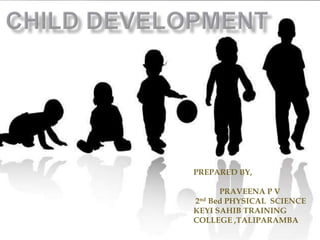
Child development is the field that involves
the scientific study of the patterns of growth
,change and stability that occur from conception
through adolescence
1. To make us aware that the child is developing normally
2. To enable us to identify a child, who for the some reason, may not be following the
normative stages.
3. To enable us to build up a picture of a child’s progress for a particular period of
time.
4. To enable us to look forward to respond to age-related behaviour which is an
individual source of guidance is providing for your child’s developmental needs.
5. To help to consider the fact that every child is different from each-other in quite
normal ways.
6. To make us aware that every child follows the same sequence of growth and
development as other children but the speed varies.
7. To help us to be concerned about the developmental stages of a child, such as
sitting up , crawling and walking or so on.
8. To help us to understand that what should be expected from a child at each
development stage.
9. To provide the right environment and age appropriate resources to the children.
10. To help in understanding the needs of a child and fulfilling them and allow him to
reach his full potential.
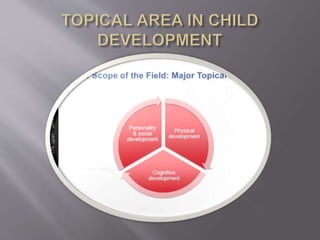
1. PHYISICAL DEVELOPMENT :
Examines how
brain, nervous
system, muscles,
sensory
capabilities and
needs for food,
drink and sleep
affect behaviour
Examines
intellectual
abilities,
including
learning ,
memory,
problem solving
and intelligence
3. PERSONALITY AND SOCIAL
DEVELOPMENT :
Examines
enduring
characteristics
that differentiate
one person from
another and how
interactions with
others and social
relationships
grow and change
over the lifetime
1. Development proceeds from top to bottom
This is called the “
Cephalocaudle principle”. It
describes the direction of growth
and development. According to
this principle, the child gains
control of the head first , then the
arms and then the legs.
2. Development proceeds from the centre to the
outward of the body
This the principle of
proximodistal development
that also describes the
direction of development. This
means that the spinal cord
develops before outer parts of
the body.
3. Development depends upon maturation and
learning
Maturation depends upon the sequential
characteristics of biological growth and
development. The biological changes occur
in sequential order and give children new
abilities changes in the brain and nervous
system account largely for maturation .
These changes in children to improve in
thinking (cognitive) and motor ( physical)
skills.
4. Development proceeds from the simple to more
complex
Children use their cognitive and
language skills to reason and solve
problems.
5. Growth and development is a continuous process
As a child develop, he or she adds to
the skills already acquired and the new
skills become the basis for further
achievement and mastery of skills.
Most children follow a similar pattern.
Also one stage of development lays the
foundation for the next stage of
development.
6. Growth and development proceeds from
general to specific
In motor development , the infant is
able to grasp an object with the
whole hand just after birth before
using only the thumb and
forefinger. Growth occurs from
large muscle movements to more
refined (smaller) muscle
movements.
7. There are individual rates of growth and
development
Each child is different and so the
rates at which individual children
grow is also different. Although the
patterns and sequences for growth
and development are usually the
same for all children, the rates at
which children reach developmental
stages are different.
child development

child development

  • 1.
    PREPARED BY, PRAVEENA PV 2nd Bed PHYSICAL SCIENCE KEYI SAHIB TRAINING COLLEGE ,TALIPARAMBA
  • 2.
    Development describes thegrowth of humans throughout the lifespan ,from conception to death. The scientific study of human development seeks to understand and explain how and why people change throughout life. This includes all aspects of human growth, including physical, emotional, intellectual, social, perceptual and personality development. Development does not just involve the biological and physical aspects of growth , but also the cognitive and social aspects associated with development throughout life. The study of human development important in a number of subjects, including biology , anthropology, sociology, education , history and psychology. However, most important are the practical applications of studying human development.
  • 3.
    Child development isthe field that involves the scientific study of the patterns of growth ,change and stability that occur from conception through adolescence
  • 4.
    1. To makeus aware that the child is developing normally 2. To enable us to identify a child, who for the some reason, may not be following the normative stages. 3. To enable us to build up a picture of a child’s progress for a particular period of time. 4. To enable us to look forward to respond to age-related behaviour which is an individual source of guidance is providing for your child’s developmental needs. 5. To help to consider the fact that every child is different from each-other in quite normal ways. 6. To make us aware that every child follows the same sequence of growth and development as other children but the speed varies. 7. To help us to be concerned about the developmental stages of a child, such as sitting up , crawling and walking or so on. 8. To help us to understand that what should be expected from a child at each development stage. 9. To provide the right environment and age appropriate resources to the children. 10. To help in understanding the needs of a child and fulfilling them and allow him to reach his full potential.
  • 6.
    1. PHYISICAL DEVELOPMENT: Examines how brain, nervous system, muscles, sensory capabilities and needs for food, drink and sleep affect behaviour
  • 7.
  • 8.
    3. PERSONALITY ANDSOCIAL DEVELOPMENT : Examines enduring characteristics that differentiate one person from another and how interactions with others and social relationships grow and change over the lifetime
  • 10.
    1. Development proceedsfrom top to bottom This is called the “ Cephalocaudle principle”. It describes the direction of growth and development. According to this principle, the child gains control of the head first , then the arms and then the legs.
  • 11.
    2. Development proceedsfrom the centre to the outward of the body This the principle of proximodistal development that also describes the direction of development. This means that the spinal cord develops before outer parts of the body.
  • 12.
    3. Development dependsupon maturation and learning Maturation depends upon the sequential characteristics of biological growth and development. The biological changes occur in sequential order and give children new abilities changes in the brain and nervous system account largely for maturation . These changes in children to improve in thinking (cognitive) and motor ( physical) skills.
  • 13.
    4. Development proceedsfrom the simple to more complex Children use their cognitive and language skills to reason and solve problems.
  • 14.
    5. Growth anddevelopment is a continuous process As a child develop, he or she adds to the skills already acquired and the new skills become the basis for further achievement and mastery of skills. Most children follow a similar pattern. Also one stage of development lays the foundation for the next stage of development.
  • 15.
    6. Growth anddevelopment proceeds from general to specific In motor development , the infant is able to grasp an object with the whole hand just after birth before using only the thumb and forefinger. Growth occurs from large muscle movements to more refined (smaller) muscle movements.
  • 16.
    7. There areindividual rates of growth and development Each child is different and so the rates at which individual children grow is also different. Although the patterns and sequences for growth and development are usually the same for all children, the rates at which children reach developmental stages are different.