CHILD
DEVELOPMENT IN
DIFFERENT DOMAIN
Presented by: Kaosar khan
Zannatul Mawa Bristy
Adita Azhar Arthi
CHILD DEVELOPMENT
• CHILD DEVELOPMENT refers to change or growth
that occurs in a child during the life span from birth to
adolescence.
• This change occurs in a orderly sequence involving,
• BIOLOGICAL
PHYSICAL
COGNITIVE
EMOTIONAL development.
• It is the individual progresses from dependency to increasing
autonomy.
• The first 5years of life are a time of incredible growth and
learning.
• About 95% of the development is completed before 5 years
• Developmental change is a basic fact of human existence and
each person is developmentally unique.
Difference between growth and
development
• Growth refers to the physical changes in child’s size,
height, weight, face, shoe size, length of arms and
legs and body shape.
• Development refers to the continuous progression
whereby a children gains more complex knowledge.
• NEW BORN(0-4weeks)
• INFANT (weeks 4-1year)
• TODDLER(1-3years)
• PRESCHOOLER(4-6years)
• SCHOOL –AGED CHILD(6-11years)
• ADOLECENT(12-19years)
PEDIATRIC AGE GROUP
CLASSIFICATION
Characteristics
• Young infants (six weeks – 12 months)
Social development, developing trust
Responds interactively to faces, talking, cooing
 Standing, walking
• Mobile young toddlers (13 months-23 months)
 Judgement obased on perception rather than logic
Expresses feelings through crying,body language
Color by moving the entire arm
 Older active toddlers (24 months- 35 months)
 Working on physical skills,less clumsy.
 Empathetic if others hurt
 Verbal, rapidly learning words
 Preschoolers (36 months- 5 years 11 months)
 Good vocabulary; application of grammer
 Trying to find reasons and meaning
 Can jump on foot,walk backwards
 Early elementary (6- 11 years)
 Sense of justice, judgement based on reasoning.
 Acquiring skills, physical as well as learning
 Young teens (12- 19 years)
 Potentially habe strong skills, interest,skills
 Self conscious: beginning to be emotional
 Can do all physical task
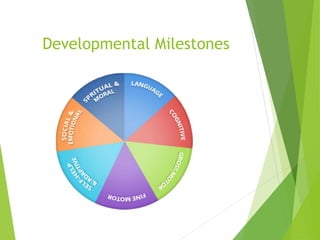
Developmental Milestones
5 DOMAINS OF
DEVEOLPMENT
• PHYSICAL : Biological growth,acquisition of fine
motor(small muscle) skill and gross(large muscle)
motor skill.
Gross motor skills: This skills are the use of large
muscles in arms, legs.
Fine motor skills: This skills are the use of small
muscles as fingers wrists
• COGNITIVE: It refers skills such as learning,
remembering, thinking, intelligence.
5 DOMAINS OF
DEVEOLPMENT
• SOCIAL & EMOTIONAL :It refeses to the abilities
to establish positive attitude and maintain
relationship with peers and the ability to regulate and
express feelings in an appropriate way
• SPEECH AND LANGUAGE: It involves gaining
skills neded to understand and use a language.
• SELF HELP & ADAPTIVE: It refers to the skills
used for daily living such as dressing, eating etc
Lets talk about
development theory
COGNITIVE
DEVELOPMENTAL THEORY
• Piagets constructivist theory explained how children
learn by constructing their own knowledge through
their experiences.
• The SCHEMA goes through periods of
ADAPTATION either by ASSIMILATING OR
ACCOMODATING
SOCIAL AND EMOTION BASE
DEVELOPMENTAL THEORY
This theory is given by ERIK ERIKSON and its based
on social,cultural,experiences shaping development.
This theory emphasizes the impact of the sociocultural
environment where a child experiences each stages
of the challenge.
SOME
THEORIES
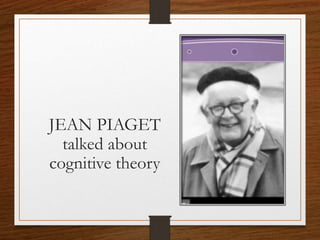
JEAN PIAGET
talked about
cognitive theory
PIAGETS THEORY
JEAN PIAGET believed biology affected cognitive
development in 4stages that every child will go
through.
Sensorimotor(birth-2)
Preoperational(2-7)
Concrete Operational(7-11)
Formal Operational(11-adult)
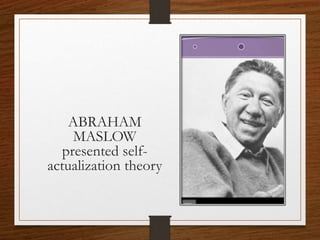
ABRAHAM
MASLOW
presented self-
actualization theory
Maslows theory
Maslows hierarchy of humans needs shows that needs
motivates behavior and goals and his discovered
pyramid shows our basic needs and growth needs.
This theory helps us understand how children are
motivated .Basic needs of foods,shelter,security and
belongings etc.
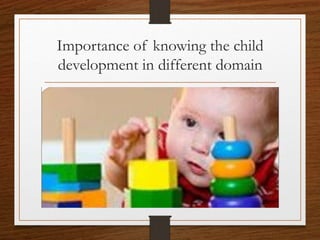
Importance of knowing the child
development in different domain
Hazards
 MOTOR DEVELOPMENT
 SOCIAL
 SPEECH
 PHYSICAL
 PERSONALITY
 ASSOCIATED WITH BIRTH
 PRENATAL PERIOD
WINDOWS OF
OPPORTUNITY(0-10age)
• Young childs brain are much more ACTIVE
,CONNECTED and FLEXIBLE than an adults
brain
• During the early childhood years,the brain is the
most receptive and responsive to experiences
• (+)and(-)experiences,especially those most
emotionally intense will have lasting effects.
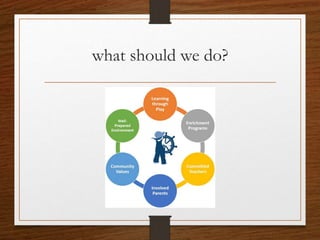
what should we do?
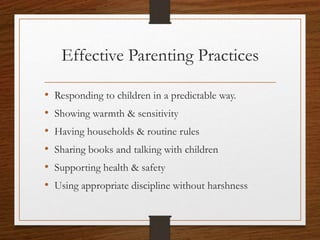
Effective Parenting Practices
• Responding to children in a predictable way.
• Showing warmth & sensitivity
• Having households & routine rules
• Sharing books and talking with children
• Supporting health & safety
• Using appropriate discipline without harshness
Refferences
• http:://www.healthychildren.org
• www.floridahealth.gov
• www.openculture.com
Child development-in-different-domain

Child development-in-different-domain

  • 1.
    CHILD DEVELOPMENT IN DIFFERENT DOMAIN Presentedby: Kaosar khan Zannatul Mawa Bristy Adita Azhar Arthi
  • 2.
    CHILD DEVELOPMENT • CHILDDEVELOPMENT refers to change or growth that occurs in a child during the life span from birth to adolescence. • This change occurs in a orderly sequence involving, • BIOLOGICAL PHYSICAL COGNITIVE EMOTIONAL development.

  • 3.
    • It isthe individual progresses from dependency to increasing autonomy. • The first 5years of life are a time of incredible growth and learning. • About 95% of the development is completed before 5 years • Developmental change is a basic fact of human existence and each person is developmentally unique.
  • 4.
    Difference between growthand development • Growth refers to the physical changes in child’s size, height, weight, face, shoe size, length of arms and legs and body shape. • Development refers to the continuous progression whereby a children gains more complex knowledge.
  • 5.
    • NEW BORN(0-4weeks) •INFANT (weeks 4-1year) • TODDLER(1-3years) • PRESCHOOLER(4-6years) • SCHOOL –AGED CHILD(6-11years) • ADOLECENT(12-19years) PEDIATRIC AGE GROUP CLASSIFICATION
  • 6.
    Characteristics • Young infants(six weeks – 12 months) Social development, developing trust Responds interactively to faces, talking, cooing  Standing, walking • Mobile young toddlers (13 months-23 months)  Judgement obased on perception rather than logic Expresses feelings through crying,body language Color by moving the entire arm
  • 7.
     Older activetoddlers (24 months- 35 months)  Working on physical skills,less clumsy.  Empathetic if others hurt  Verbal, rapidly learning words  Preschoolers (36 months- 5 years 11 months)  Good vocabulary; application of grammer  Trying to find reasons and meaning  Can jump on foot,walk backwards
  • 8.
     Early elementary(6- 11 years)  Sense of justice, judgement based on reasoning.  Acquiring skills, physical as well as learning  Young teens (12- 19 years)  Potentially habe strong skills, interest,skills  Self conscious: beginning to be emotional  Can do all physical task
  • 9.
  • 10.
    5 DOMAINS OF DEVEOLPMENT •PHYSICAL : Biological growth,acquisition of fine motor(small muscle) skill and gross(large muscle) motor skill. Gross motor skills: This skills are the use of large muscles in arms, legs. Fine motor skills: This skills are the use of small muscles as fingers wrists • COGNITIVE: It refers skills such as learning, remembering, thinking, intelligence.
  • 11.
    5 DOMAINS OF DEVEOLPMENT •SOCIAL & EMOTIONAL :It refeses to the abilities to establish positive attitude and maintain relationship with peers and the ability to regulate and express feelings in an appropriate way • SPEECH AND LANGUAGE: It involves gaining skills neded to understand and use a language. • SELF HELP & ADAPTIVE: It refers to the skills used for daily living such as dressing, eating etc
  • 12.
  • 13.
    COGNITIVE DEVELOPMENTAL THEORY • Piagetsconstructivist theory explained how children learn by constructing their own knowledge through their experiences. • The SCHEMA goes through periods of ADAPTATION either by ASSIMILATING OR ACCOMODATING
  • 14.
    SOCIAL AND EMOTIONBASE DEVELOPMENTAL THEORY This theory is given by ERIK ERIKSON and its based on social,cultural,experiences shaping development. This theory emphasizes the impact of the sociocultural environment where a child experiences each stages of the challenge.

  • 15.
  • 16.
  • 17.
    PIAGETS THEORY JEAN PIAGETbelieved biology affected cognitive development in 4stages that every child will go through. Sensorimotor(birth-2) Preoperational(2-7) Concrete Operational(7-11) Formal Operational(11-adult)
  • 19.
  • 20.
    Maslows theory Maslows hierarchyof humans needs shows that needs motivates behavior and goals and his discovered pyramid shows our basic needs and growth needs. This theory helps us understand how children are motivated .Basic needs of foods,shelter,security and belongings etc.
  • 21.
    Importance of knowingthe child development in different domain
  • 23.
    Hazards  MOTOR DEVELOPMENT SOCIAL  SPEECH  PHYSICAL  PERSONALITY  ASSOCIATED WITH BIRTH  PRENATAL PERIOD
  • 24.
    WINDOWS OF OPPORTUNITY(0-10age) • Youngchilds brain are much more ACTIVE ,CONNECTED and FLEXIBLE than an adults brain • During the early childhood years,the brain is the most receptive and responsive to experiences • (+)and(-)experiences,especially those most emotionally intense will have lasting effects.
  • 25.
  • 26.
    Effective Parenting Practices •Responding to children in a predictable way. • Showing warmth & sensitivity • Having households & routine rules • Sharing books and talking with children • Supporting health & safety • Using appropriate discipline without harshness
  • 27.