 Factors affecting on growth and
development
 Social Learning Theory By Albert
Bandura
Growth
• Refers to quantitative changes
in size, include physical
changes, in height, weight,
internal organs, etc
Development
• Refers to qualitative changes taking
place simultaneously with quantitative
changes of growth.
• Such as Gross and fine motor development,
capacity to speak, able to eat, draw picture,
cognitive and thinking ability, understanding
and problem solving capacity, social interaction
with others, making new friends, having sympathy
for others etc.
Factors affecting on
Growth and Development
Heredity
Environment
o Heredity is a biological process through which the transmission of
physical and social characteristics takes place from parents to offspring.
o It greatly influences the different aspects of growth and development,
i.e. height, weight and structure of the body, color of hair and eye,
intelligence and aptitude.
oIt is the sum total of all the traits present in an individual at the time of
birth.
Hereditary Disorders
Hemophilia:
A condition in which blood does not clot
normally. This results in severe bleeding from
minor wounds.
It is always associated with a defective gene.
An inherited disorder resulting from an
extra chromosomal material on pair number
twenty one, which causes mental retardation
and distinct physical features
Myopia or Short-Sightedness:
Myopia is an eye condition that causes distant
object appearing blurred, while close objects
seen clearly.
Diabetes:
It is a metabolic disorder in which the person has high blood
glucose either because insulin production is inadequate or
because the body’s cells do not respond properly to insulin or
both
 Muscular dystrophy (MD) is a group of
more than 30 inherited diseases.
 They all cause muscle weakness and
muscle loss.
 All forms of muscular dystrophy
grow worse as the person’s muscles get
weaker.
 Most people with muscular dystrophy
eventually lose the ability to walk.
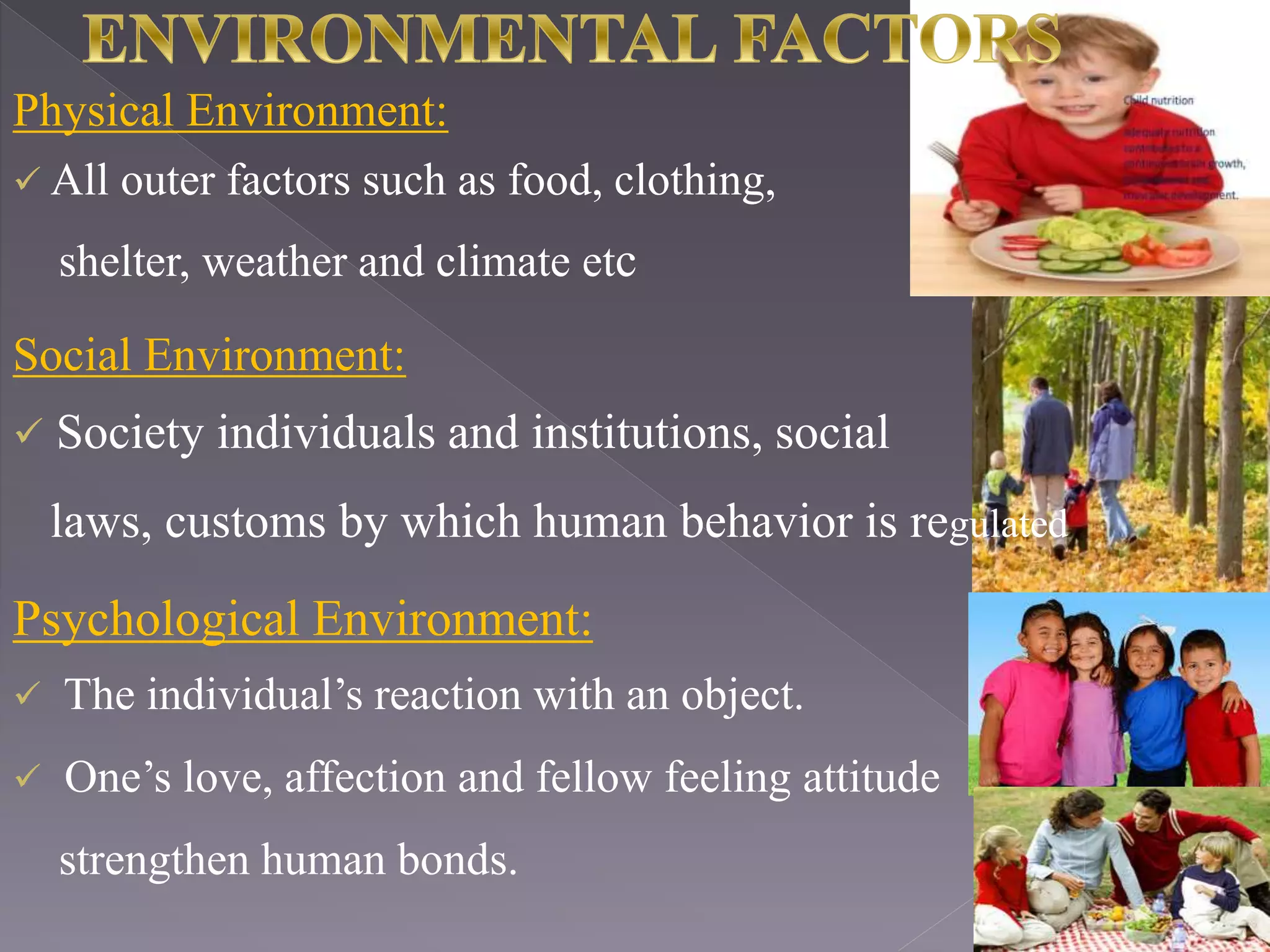
Physical Environment:
 All outer factors such as food, clothing,
shelter, weather and climate etc
Social Environment:
 Society individuals and institutions, social
laws, customs by which human behavior is regulated
Psychological Environment:
 The individual’s reaction with an object.
 One’s love, affection and fellow feeling attitude
strengthen human bonds.
Emotional factors:
• Emotional disturbances, insecurity,
sibling rivalry, jealousy, loss of parents,
inadequate schooling etc. have a negative
effect on growth and development
• Some of these factors coming under
environmental factors are hereditary or
with the nature of both hereditary and
environmental..
Nutrition:
Growth and Development of the child mainly
depend on his food habits & nutrition.
The malnutrition has adverse effect on the
structural and functional development of the child.
This condition cannot be rectified with quality diet
in later
period of life.
 Physiological substances having the power to raise or lower
the activity level of the body or certain organs of the body.
For instance: Thyroxin produced by the thyroid gland is
essential for the physical and mental development,
Deficiency during the growing years results in stunted growth
(cretinism).
The second, third or
fourth child within
a family generally
develops more quickly
than the first born,
because of the fact that
the younger children
learn from imitating their
elder brothers and sisters.
Sex acts as an important factor of growth and
development.
There is difference in growth and development of boys
and girls.
 The boys in general taller, courageous than the girls but
Girls show rapid physical growth in adolescence and excel
boys.
 In general the body constitution and structural growth of
girls are different from boys.
 Physical defects like visual,
auditory defects and orthopedic
disabilities affect the normal
development of children.
The developmental status of a
child suffering from a physical
defect child is usually below that
of the normal child.
 Canadian psychologist Albert Bandura proposed
one of the most influential theory of “SLT”.(Bandura, 2007, p.69).
It is often referred to as a bridge
behaviorist and cognitive learning
theories because it encompasses attention,
memory and motivation.
KEY CONCEPTS
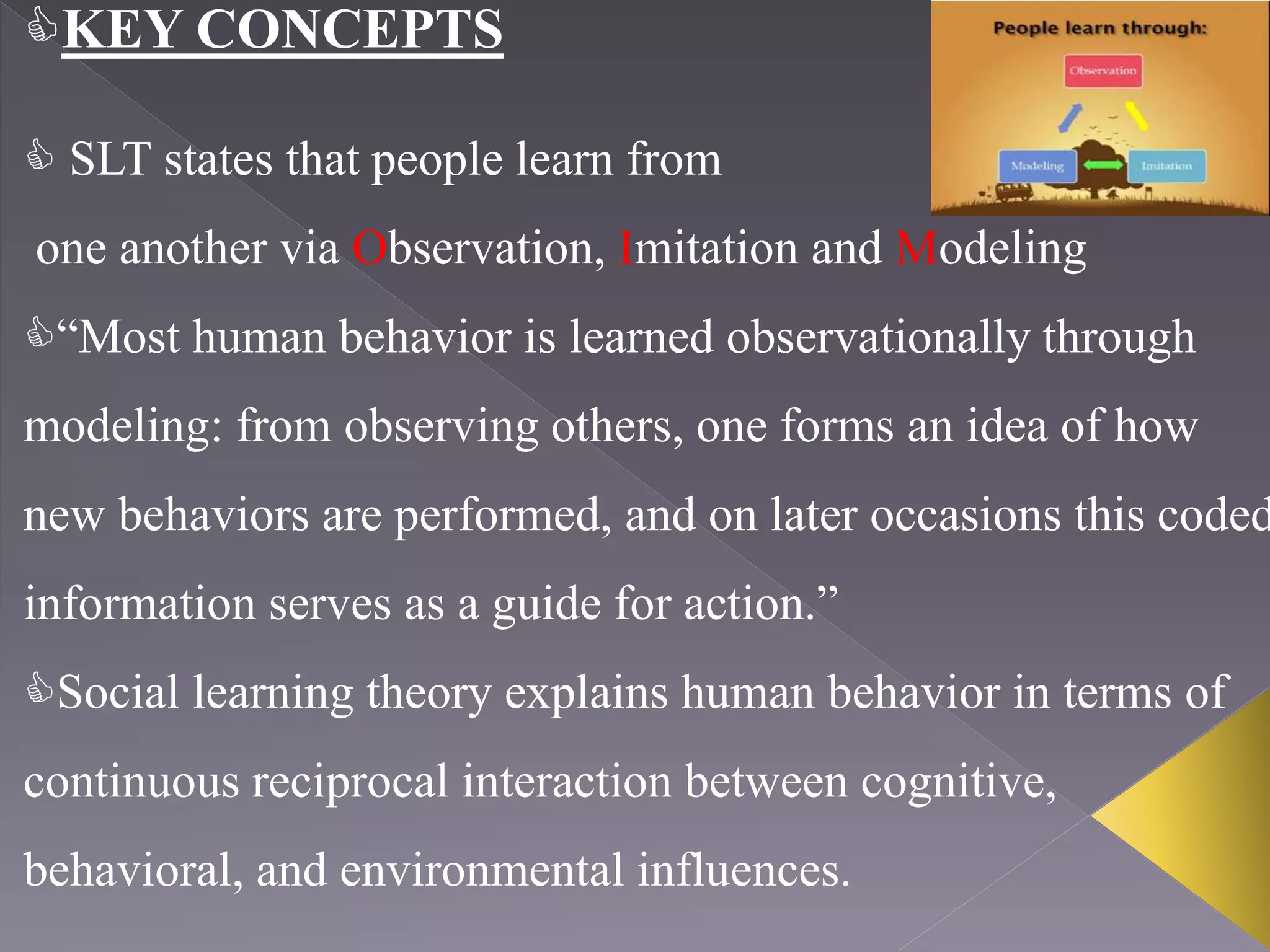
 SLT states that people learn from
one another via Observation, Imitation and Modeling
“Most human behavior is learned observationally through
modeling: from observing others, one forms an idea of how
new behaviors are performed, and on later occasions this coded
information serves as a guide for action.”
Social learning theory explains human behavior in terms of
continuous reciprocal interaction between cognitive,
behavioral, and environmental influences.
Social learning
theory explains human
behavior in terms of
continuous reciprocal
interaction between
cognitive, behavioral,
and environmental
influences.
Bandura demonstrated that children learn and imitate
behaviors they have observed in other people.
The children in Bandura’s studies observed an adult acting
violently toward a Bobo doll. When the children were later
allowed to play in a room with the
Bobo doll, they began to imitate the
aggressive actions they had previously
observed.As shown in video
It also known as:
 Social Cognitive Theory (SCT)
or
 Social Learning Theory (SLT)
or
 Observational Learning Theory
or
 Modeling Theory
Albert Bandura SLT :
Attention:
For behaviors to be successfully
learned, the individual/learner must pay
sufficient attention.
If the model is interesting or there is a
novel aspect of the situation,
individuals are more likely to dedicate
full attention to learning.
 Retention:
• Storing the information so that it may be used at a later date is
important to the observational learning process.
• Retention can be affected by a number of factors, but the ability to pull
up information later and act on it is vital to observational learning.
 Reproduction
• Once a learner paid attention to the model and retained the
information, it is time to actually perform the behavior which observed.
• Practice of the learned behavior leads to improvement and skill skills
 Motivation:
 The individual must be motivated
to repeat the learned behavior.
• Finally, in order for observational learning to be
successful, individual must be motivated to imitate the
learned behavior that has been modeled.
• Reinforcement and punishment play an important
role in motivation.
Factors affecting growth and development

Factors affecting growth and development

  • 2.
     Factors affectingon growth and development  Social Learning Theory By Albert Bandura
  • 4.
    Growth • Refers toquantitative changes in size, include physical changes, in height, weight, internal organs, etc
  • 5.
    Development • Refers toqualitative changes taking place simultaneously with quantitative changes of growth. • Such as Gross and fine motor development, capacity to speak, able to eat, draw picture, cognitive and thinking ability, understanding and problem solving capacity, social interaction with others, making new friends, having sympathy for others etc.
  • 6.
    Factors affecting on Growthand Development Heredity Environment
  • 7.
    o Heredity isa biological process through which the transmission of physical and social characteristics takes place from parents to offspring. o It greatly influences the different aspects of growth and development, i.e. height, weight and structure of the body, color of hair and eye, intelligence and aptitude. oIt is the sum total of all the traits present in an individual at the time of birth. Hereditary Disorders Hemophilia: A condition in which blood does not clot normally. This results in severe bleeding from minor wounds. It is always associated with a defective gene.
  • 8.
    An inherited disorderresulting from an extra chromosomal material on pair number twenty one, which causes mental retardation and distinct physical features Myopia or Short-Sightedness: Myopia is an eye condition that causes distant object appearing blurred, while close objects seen clearly. Diabetes: It is a metabolic disorder in which the person has high blood glucose either because insulin production is inadequate or because the body’s cells do not respond properly to insulin or both
  • 9.
     Muscular dystrophy(MD) is a group of more than 30 inherited diseases.  They all cause muscle weakness and muscle loss.  All forms of muscular dystrophy grow worse as the person’s muscles get weaker.  Most people with muscular dystrophy eventually lose the ability to walk.
  • 10.
    Physical Environment:  Allouter factors such as food, clothing, shelter, weather and climate etc Social Environment:  Society individuals and institutions, social laws, customs by which human behavior is regulated Psychological Environment:  The individual’s reaction with an object.  One’s love, affection and fellow feeling attitude strengthen human bonds.
  • 11.
    Emotional factors: • Emotionaldisturbances, insecurity, sibling rivalry, jealousy, loss of parents, inadequate schooling etc. have a negative effect on growth and development • Some of these factors coming under environmental factors are hereditary or with the nature of both hereditary and environmental..
  • 12.
    Nutrition: Growth and Developmentof the child mainly depend on his food habits & nutrition. The malnutrition has adverse effect on the structural and functional development of the child. This condition cannot be rectified with quality diet in later period of life.
  • 13.
     Physiological substanceshaving the power to raise or lower the activity level of the body or certain organs of the body. For instance: Thyroxin produced by the thyroid gland is essential for the physical and mental development, Deficiency during the growing years results in stunted growth (cretinism).
  • 14.
    The second, thirdor fourth child within a family generally develops more quickly than the first born, because of the fact that the younger children learn from imitating their elder brothers and sisters.
  • 15.
    Sex acts asan important factor of growth and development. There is difference in growth and development of boys and girls.  The boys in general taller, courageous than the girls but Girls show rapid physical growth in adolescence and excel boys.  In general the body constitution and structural growth of girls are different from boys.
  • 16.
     Physical defectslike visual, auditory defects and orthopedic disabilities affect the normal development of children. The developmental status of a child suffering from a physical defect child is usually below that of the normal child.
  • 17.
     Canadian psychologistAlbert Bandura proposed one of the most influential theory of “SLT”.(Bandura, 2007, p.69). It is often referred to as a bridge behaviorist and cognitive learning theories because it encompasses attention, memory and motivation.
  • 18.
    KEY CONCEPTS  SLTstates that people learn from one another via Observation, Imitation and Modeling “Most human behavior is learned observationally through modeling: from observing others, one forms an idea of how new behaviors are performed, and on later occasions this coded information serves as a guide for action.” Social learning theory explains human behavior in terms of continuous reciprocal interaction between cognitive, behavioral, and environmental influences.
  • 19.
    Social learning theory explainshuman behavior in terms of continuous reciprocal interaction between cognitive, behavioral, and environmental influences.
  • 23.
    Bandura demonstrated thatchildren learn and imitate behaviors they have observed in other people. The children in Bandura’s studies observed an adult acting violently toward a Bobo doll. When the children were later allowed to play in a room with the Bobo doll, they began to imitate the aggressive actions they had previously observed.As shown in video
  • 24.
    It also knownas:  Social Cognitive Theory (SCT) or  Social Learning Theory (SLT) or  Observational Learning Theory or  Modeling Theory Albert Bandura SLT :
  • 25.
    Attention: For behaviors tobe successfully learned, the individual/learner must pay sufficient attention. If the model is interesting or there is a novel aspect of the situation, individuals are more likely to dedicate full attention to learning.
  • 26.
     Retention: • Storingthe information so that it may be used at a later date is important to the observational learning process. • Retention can be affected by a number of factors, but the ability to pull up information later and act on it is vital to observational learning.  Reproduction • Once a learner paid attention to the model and retained the information, it is time to actually perform the behavior which observed. • Practice of the learned behavior leads to improvement and skill skills
  • 27.
     Motivation:  Theindividual must be motivated to repeat the learned behavior. • Finally, in order for observational learning to be successful, individual must be motivated to imitate the learned behavior that has been modeled. • Reinforcement and punishment play an important role in motivation.

Editor's Notes

  • #15 The position of the child within the family may influence his development more through environmental than through natural factors.
  • #26 IN ORDER FOR SLT TO OCCUR THERE MUST BE …  Attention: Pay attention to the Model  Retention: Remember the Model’s action  Motor Reproduction: Copy the Model’s action  Motivation: Want to demonstrate what they have learned
  • #27 1. Attention - In order to learn, you need to be paying attention.     2. Retention - The ability to store information is an important part of the learning process.   3. Motor Reproduction - Once you have paid attention to the model and retained the information,  it is time to actually perform the behavior you observed.   4. Motivation -In order for for observational learning to be successful, you have to be motivated to imitate the behavior that has been modeled