PRINCIPLES OF
PLANNING OF BUILDING
Prof. Mrs. D. A. Latthe
Assistant Professor
Dr. J. J. Magdum College of Engineering, Jaysingpur
Syllabus
• Site selection criteria:
 Principles of planning, significance of sun path diagram
 Wind diagram
 Orientation
 Factors affecting,
 Criteria under Indian conditions
•“The concept of positioning all the
elements and units of a building in a
systematic and practical manner to
have the maximum and best utilization
of the available space, area and
facilities is termed as Principles of
Building Planning.”
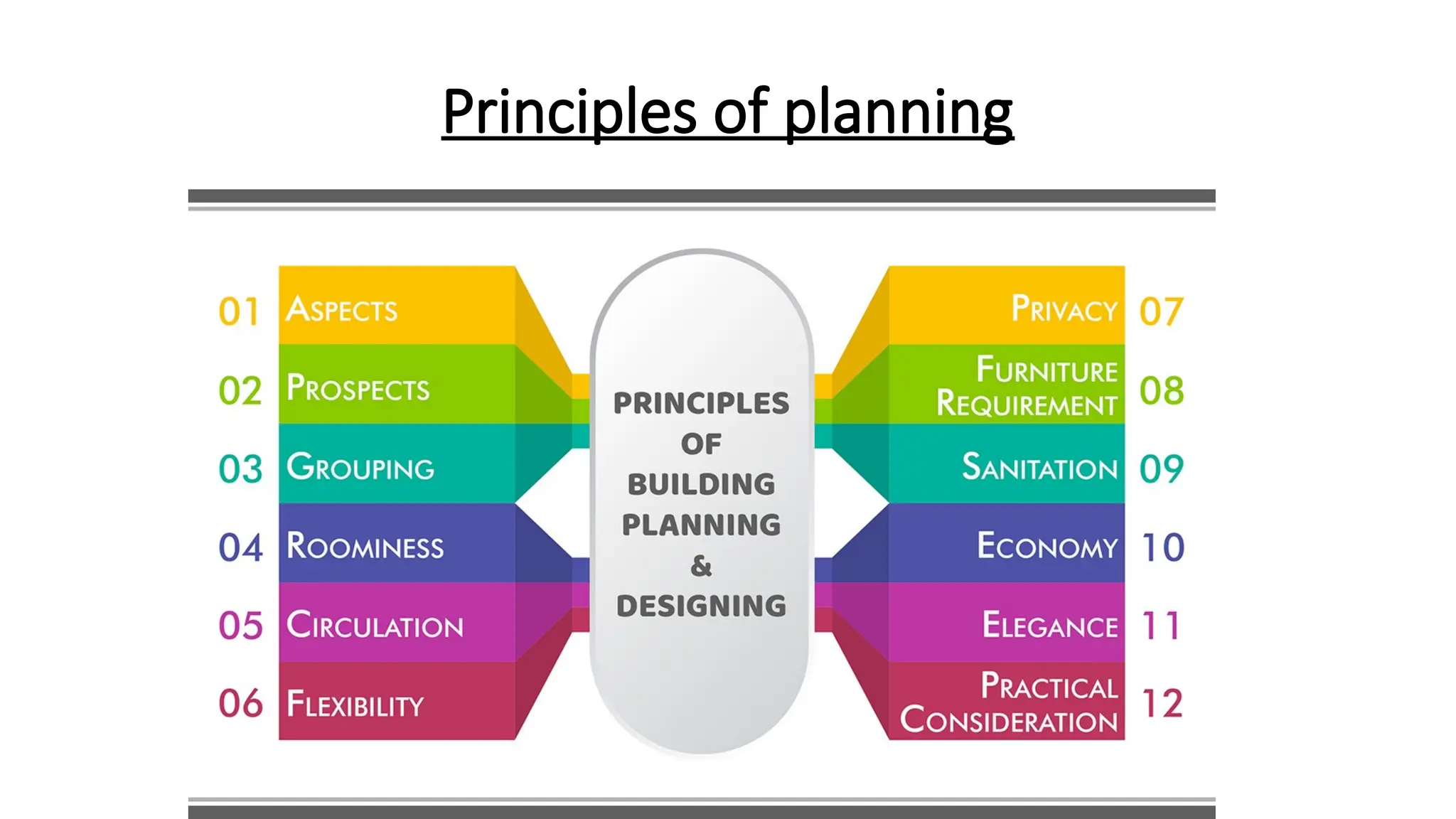
Principles of planning
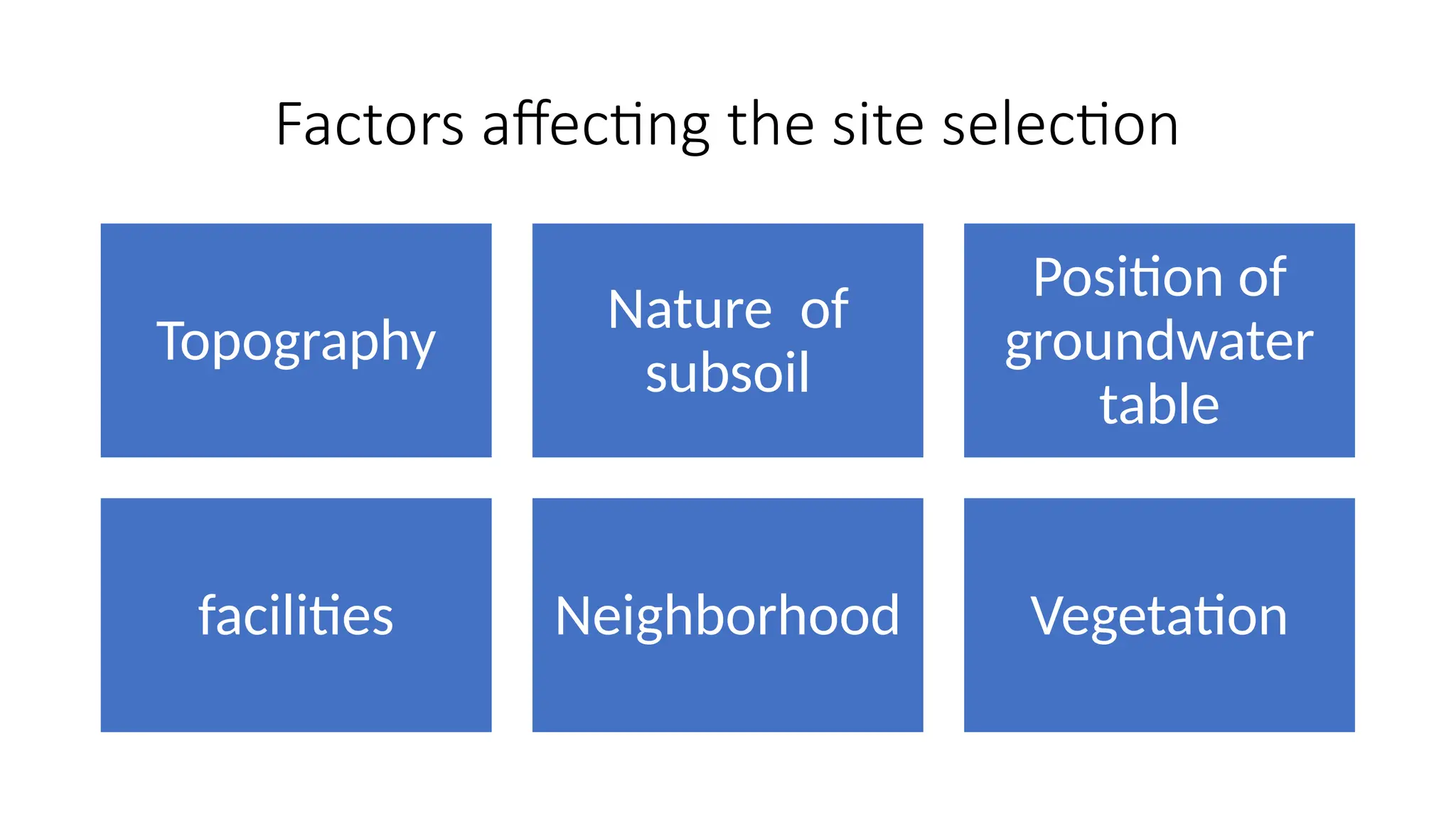
Factors affecting the site selection
Topography
Nature of
subsoil
Position of
groundwater
table
facilities Neighborhood Vegetation
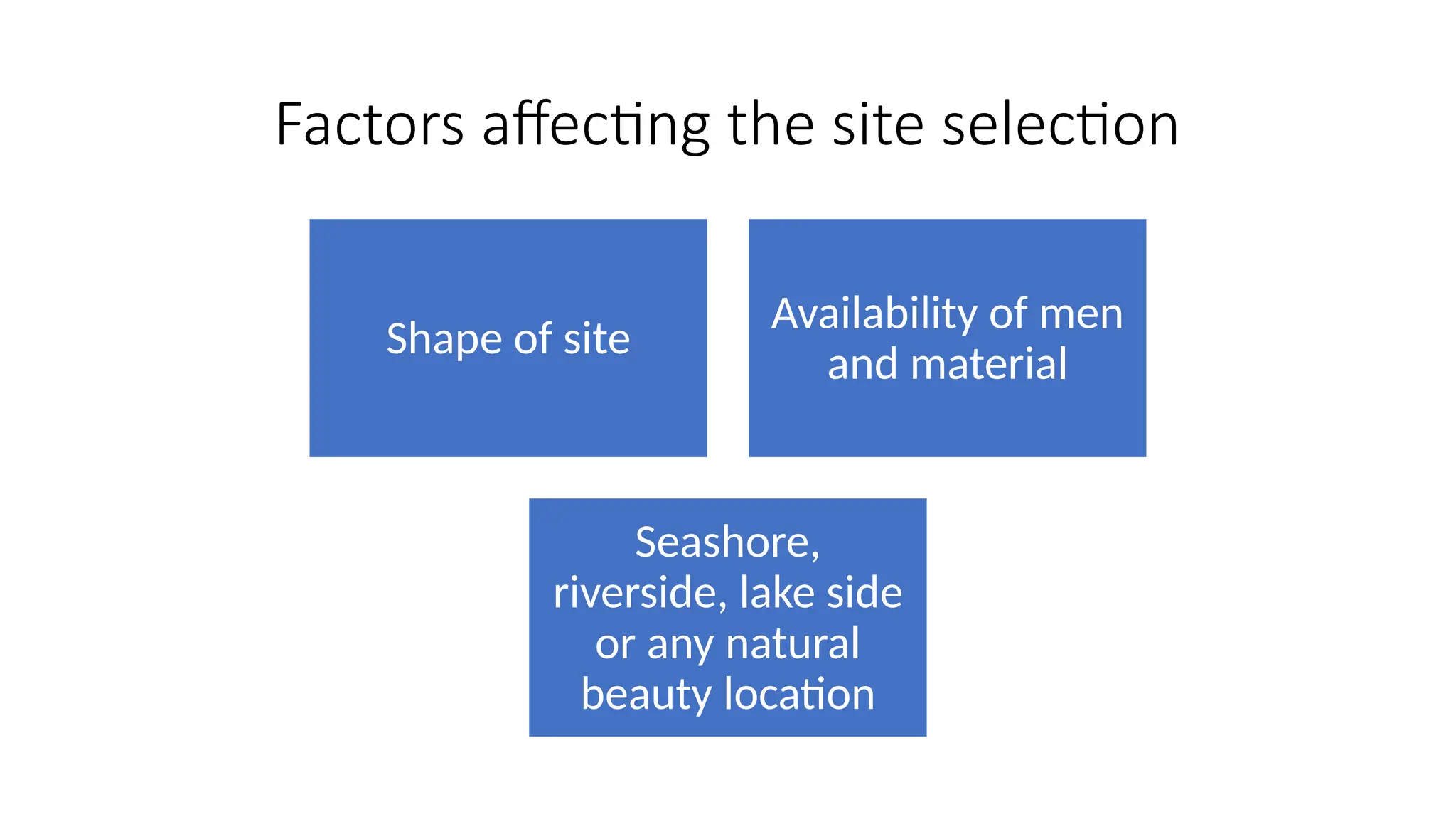
Shape of site
Availability of men
and material
Seashore,
riverside, lake side
or any natural
beauty location
Factors affecting the site selection
Effect of Climatic Condition
• Before planning a building or starting any
construction, architects and planner must ensure
the climatic condition of the particular location.
• Usually, local climate plays important role in the
construction. Mainly, temperature (i.e. cold and hot),
humidity, rain, snow, wind, and sunlight are the
climatic factors that affect the building.
• All these notable factors play an important role in
choosing the position of rooms, doors, windows,
ventilation, balconies, and all other units of a
building.
01. What is an ASPECT in building
planning?
• A building is a complete constitute of different rooms and blocks in
it. All the rooms are located according to the standard use of
components considering the proper access of natural resources, i.e.,
sunlight and wind.
• According to the research paper “
Planning, Designing and Estimation of High Ceiling Residential B
uilding (G+1)
” presented by ‘J.Vengadesh Marshall Raman’&’ P.Soundarya’, ASPECT
is defined as a significant arrangement of doors and windows in
abuilding, which are enough and efficient to provide sunlight,
hygiene, wind, and eco-friendly environment. There must be
sufficient light and ventilation in each room and across the house.
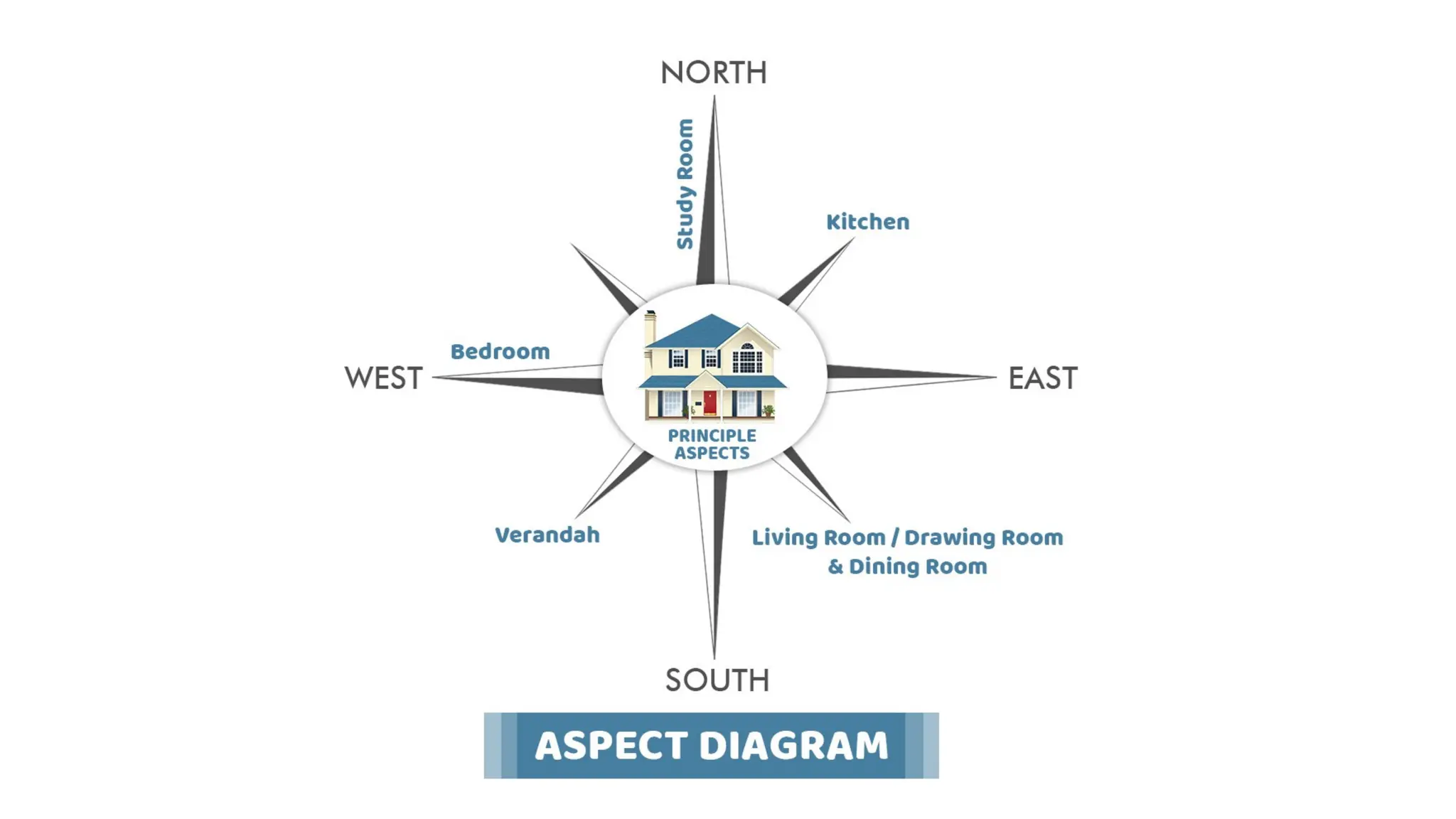
• The aspect of building can be achieved by arranging the rooms,
kitchen, veranda, and many other components in proper directions.
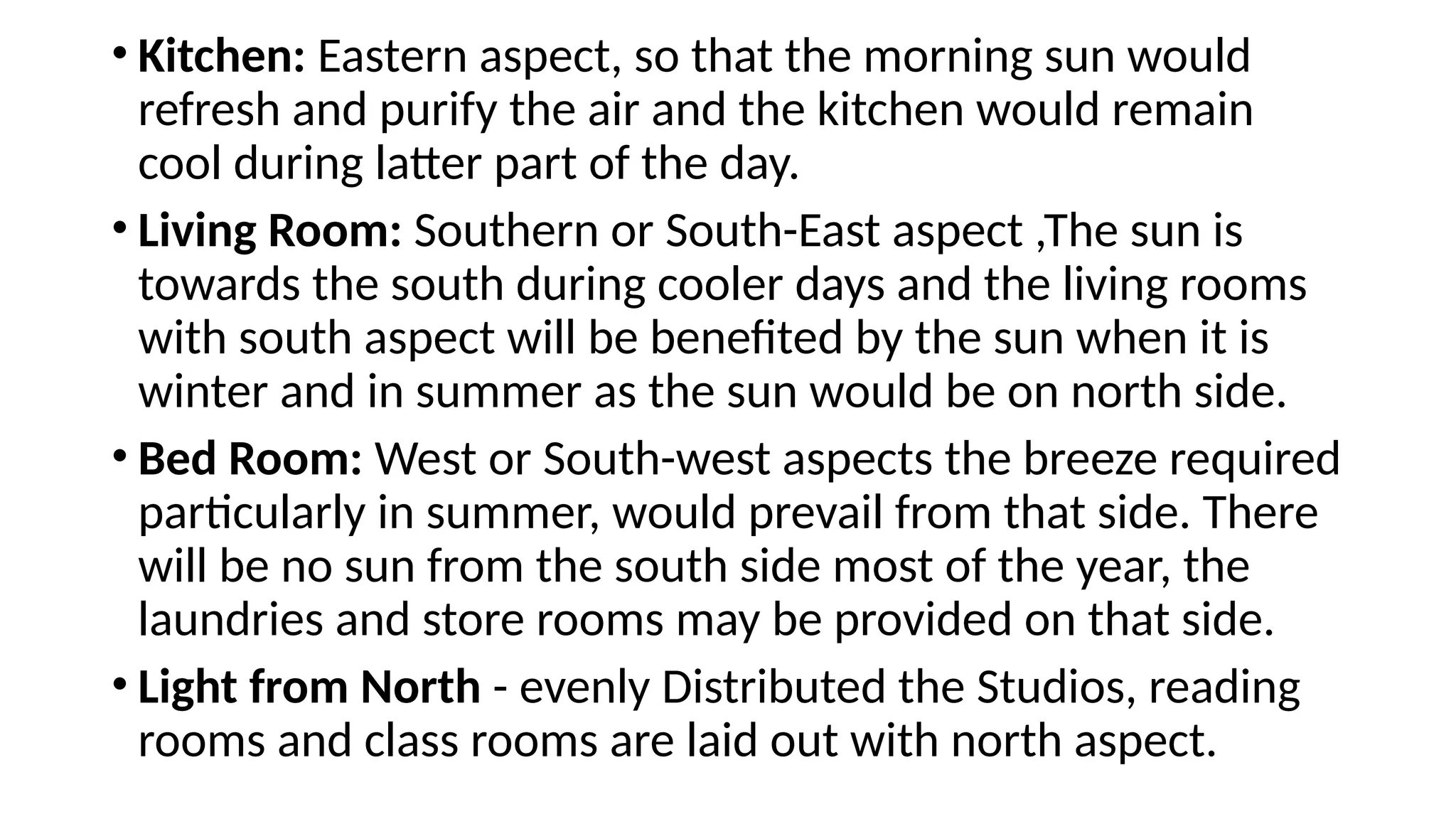
• Kitchen: Eastern aspect, so that the morning sun would
refresh and purify the air and the kitchen would remain
cool during latter part of the day.
• Living Room: Southern or South-East aspect ,The sun is
towards the south during cooler days and the living rooms
with south aspect will be benefited by the sun when it is
winter and in summer as the sun would be on north side.
• Bed Room: West or South-west aspects the breeze required
particularly in summer, would prevail from that side. There
will be no sun from the south side most of the year, the
laundries and store rooms may be provided on that side.
• Light from North - evenly Distributed the Studios, reading
rooms and class rooms are laid out with north aspect.
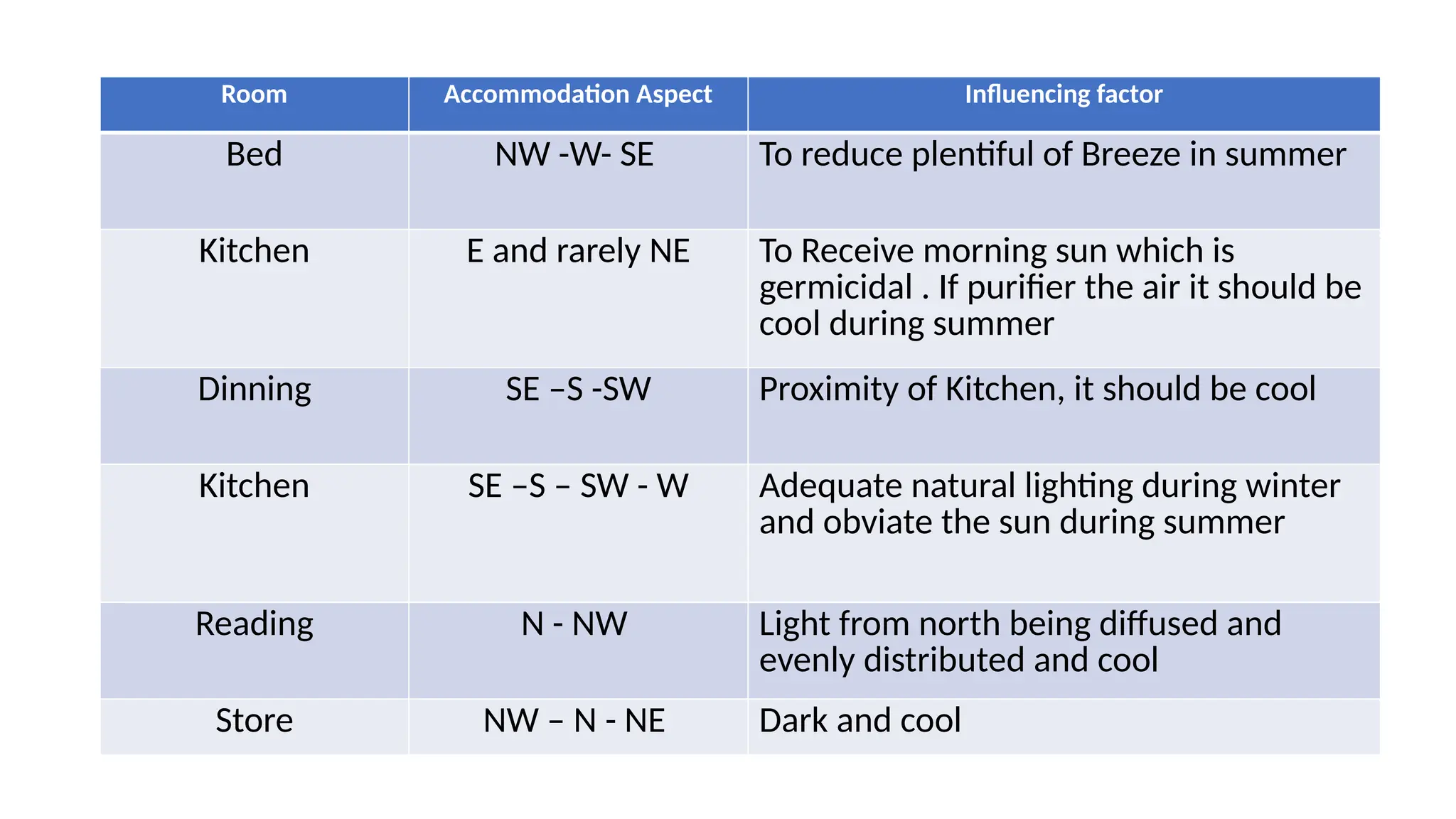
Room Accommodation Aspect Influencing factor
Bed NW -W- SE To reduce plentiful of Breeze in summer
Kitchen E and rarely NE To Receive morning sun which is
germicidal . If purifier the air it should be
cool during summer
Dinning SE –S -SW Proximity of Kitchen, it should be cool
Kitchen SE –S – SW - W Adequate natural lighting during winter
and obviate the sun during summer
Reading N - NW Light from north being diffused and
evenly distributed and cool
Store NW – N - NE Dark and cool
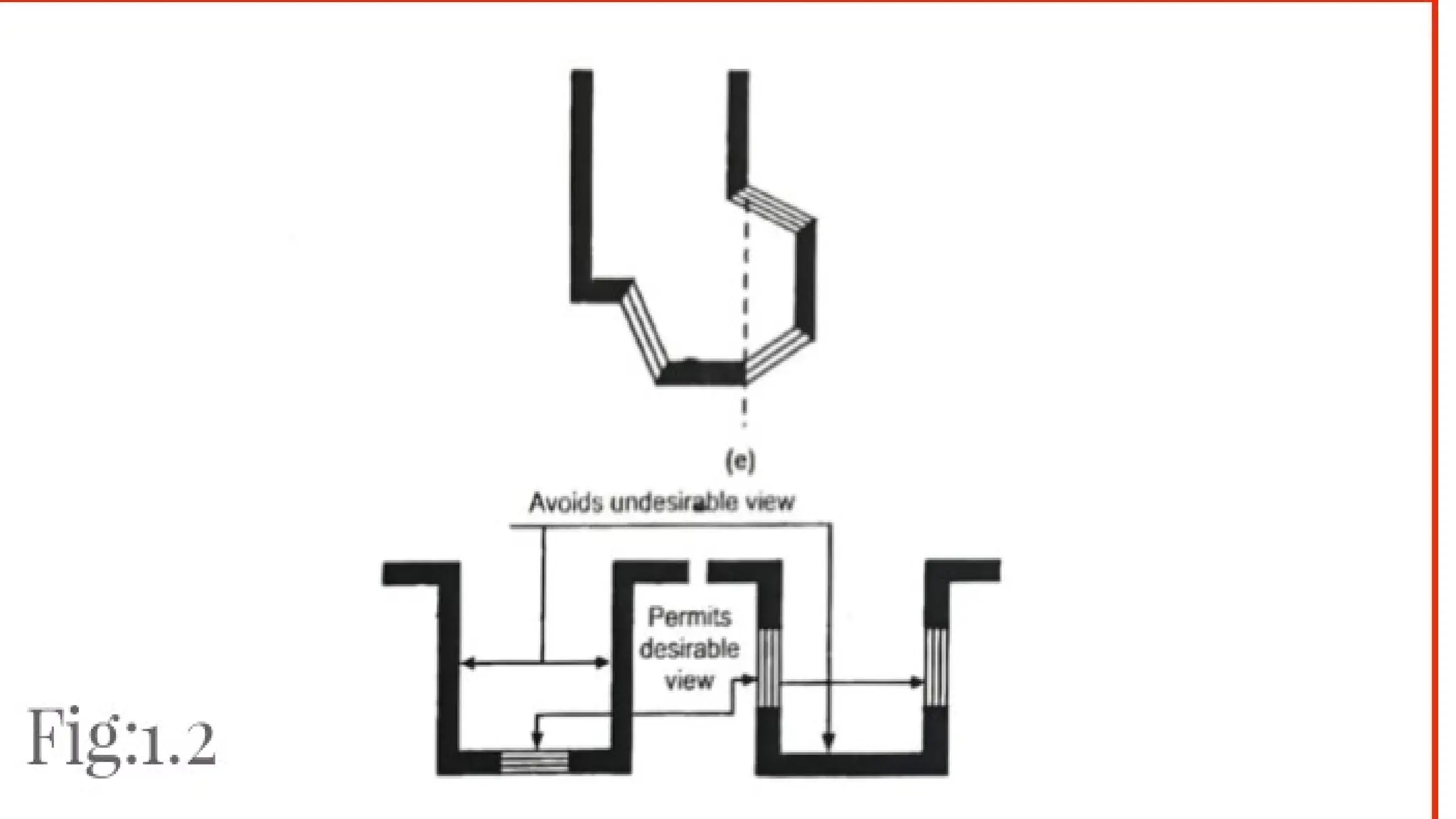
02. What are the PROSPECT principles in building
planning?
• The appearance of a house or a building is defined
as PROSPECT.
• The standards are raised to accomplish the
building’s pleasant look by locating doors and
windows at an accurate location to view nature’s
beauty and avoid unwanted attributes from getting
entry into the house.
• Can be do= planning, proper place of door and
window, landscapes
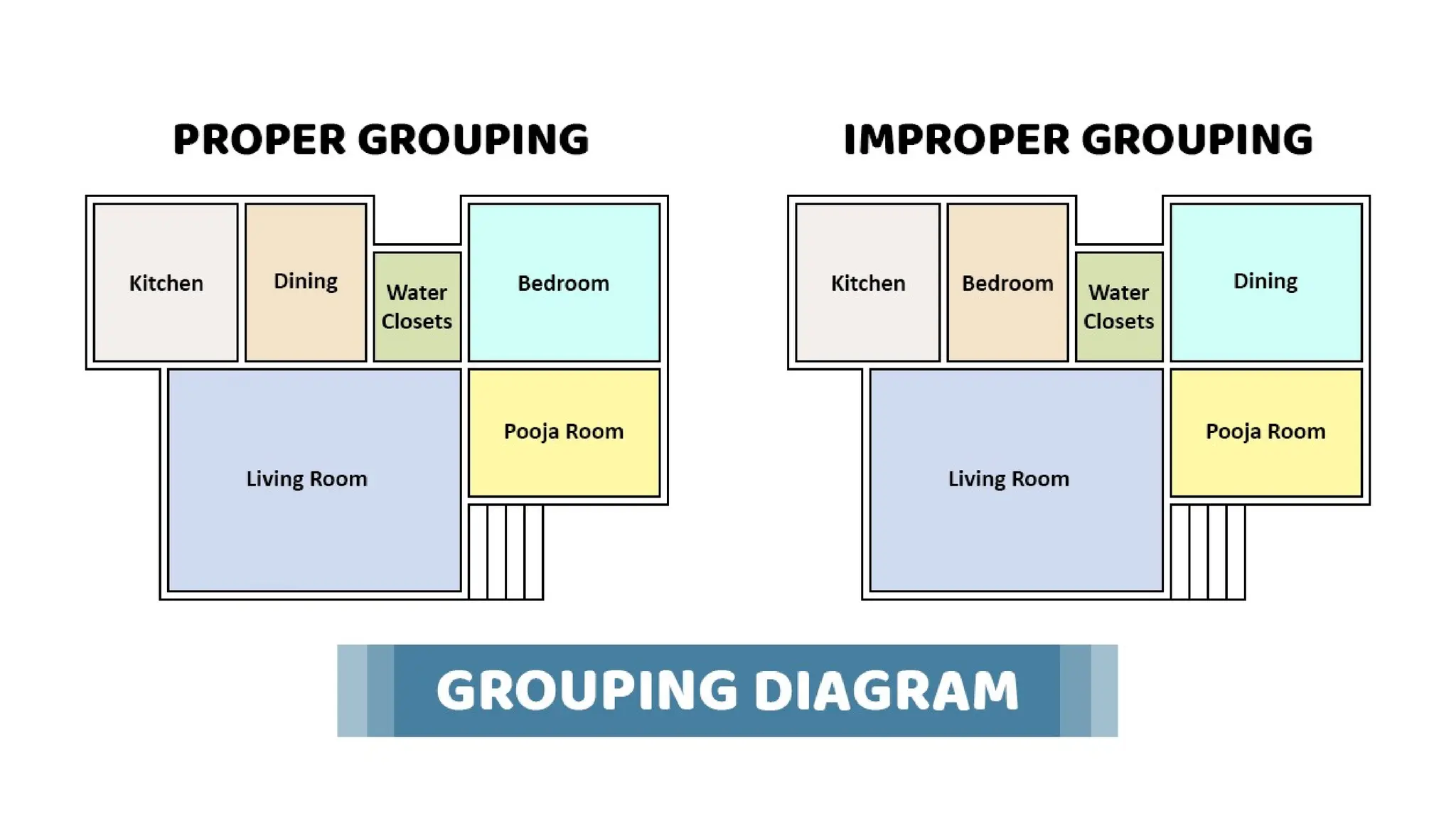
What does the GROUPING mean in building planning?
•It is to organize the different rooms in such a
way that they are adequately interconnected
with each other to form a functional and
practical layout of the house.
•The accessibility of all the rooms is interlinked
with each other, and this provision can be
satisfied by grouping.
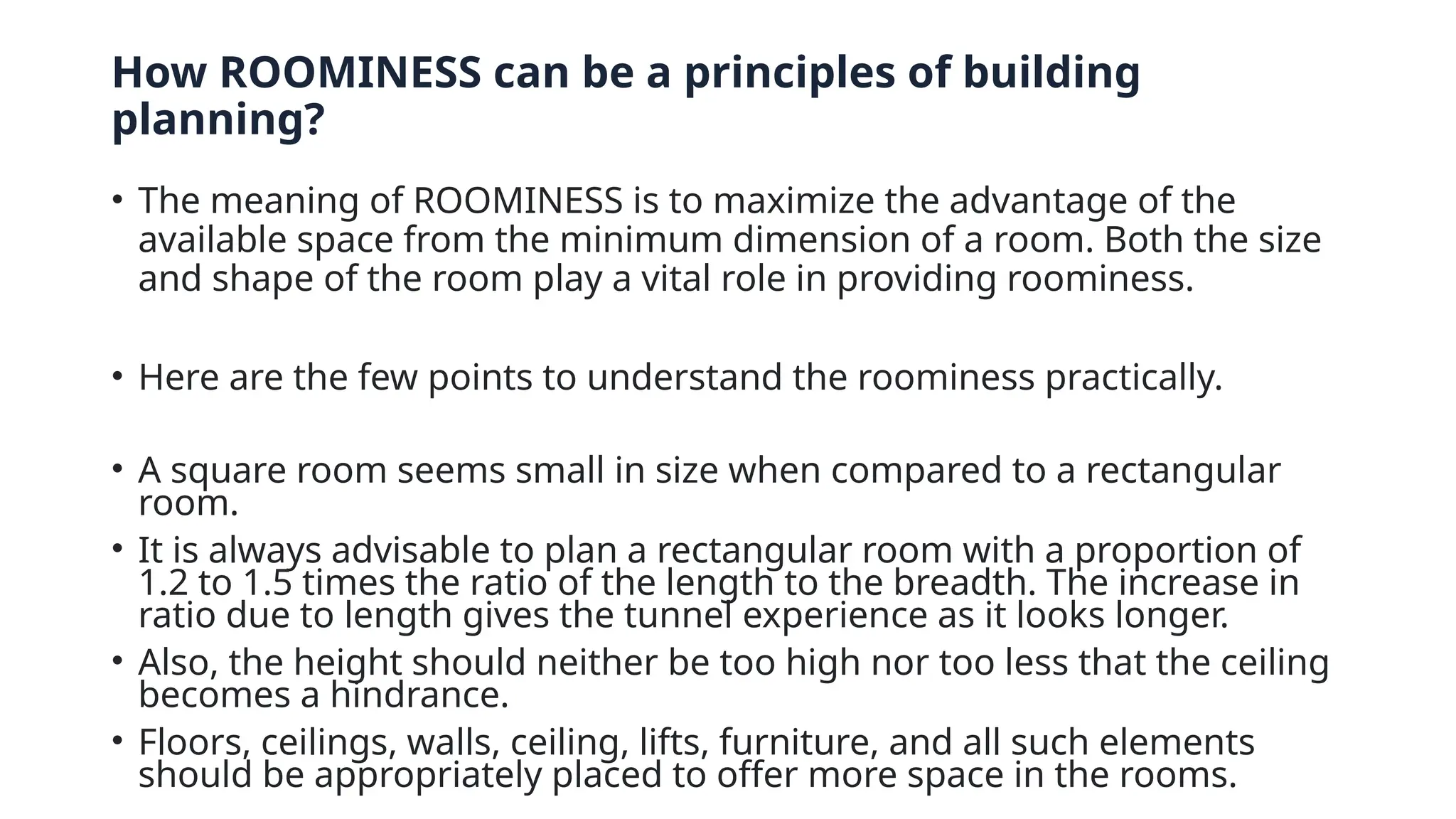
How ROOMINESS can be a principles of building
planning?
• The meaning of ROOMINESS is to maximize the advantage of the
available space from the minimum dimension of a room. Both the size
and shape of the room play a vital role in providing roominess.
• Here are the few points to understand the roominess practically.
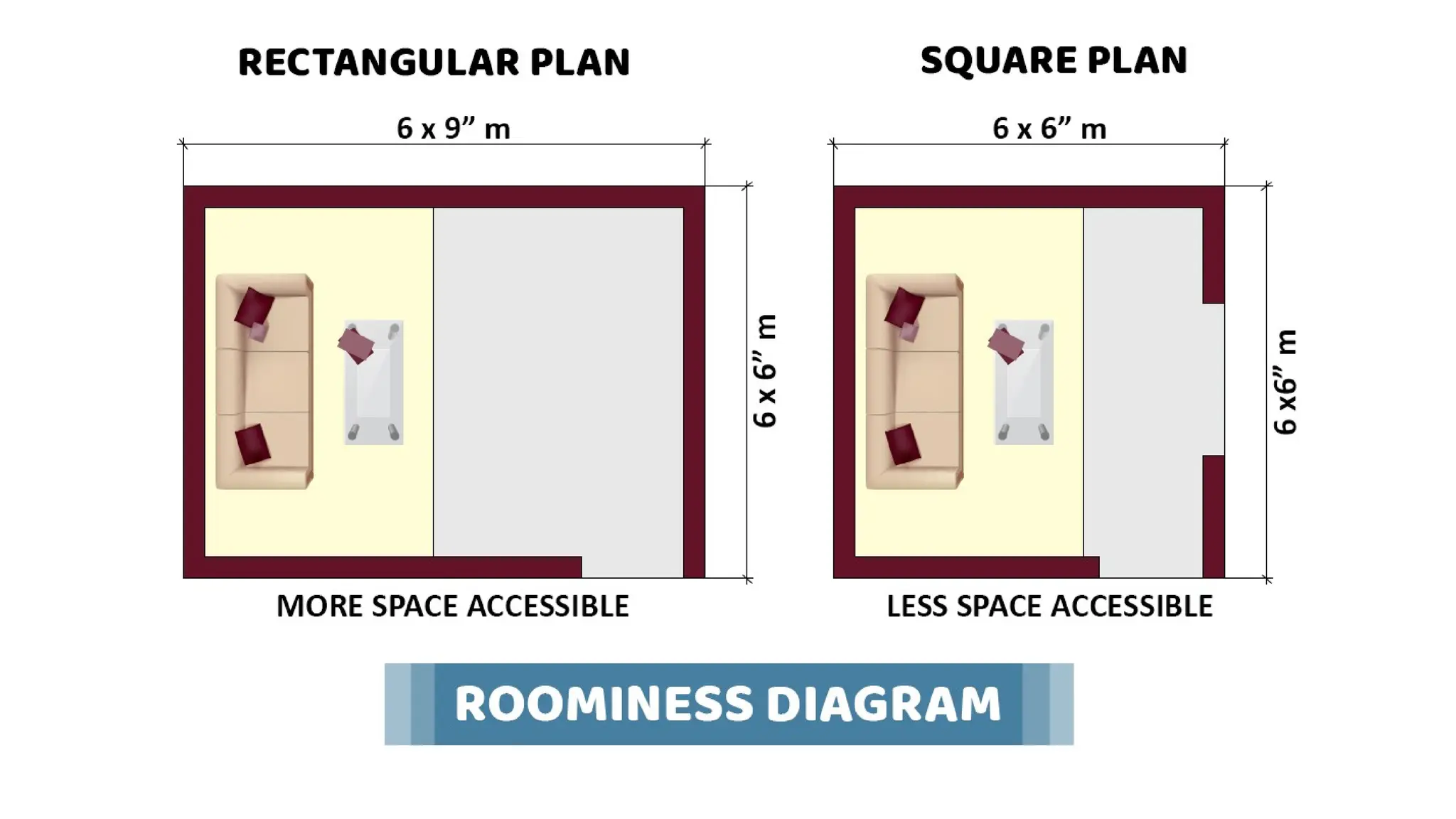
• A square room seems small in size when compared to a rectangular
room.
• It is always advisable to plan a rectangular room with a proportion of
1.2 to 1.5 times the ratio of the length to the breadth. The increase in
ratio due to length gives the tunnel experience as it looks longer.
• Also, the height should neither be too high nor too less that the ceiling
becomes a hindrance.
• Floors, ceilings, walls, ceiling, lifts, furniture, and all such elements
should be appropriately placed to offer more space in the rooms.
1)Roominess can be affected by carefully adjusting the
length, breadth, and height of the building: Consider the
dimensions of a living room.
L: B ratio is more than 2. A person in this room will feel
like moving through a long tunnel. L: B ratio is less than
1.5.
Here more comfort is experienced; illustrating
roominess. It is advisable to keep the L: B ratio between
1.2 to 1.5.
In public buildings such as clubs, the minimum height
specified by bye-laws may be provided to create
awareness whereas, in badminton halls, foyers,
churches, museums, etc., an increased height gives a
monumental effect.
• 2) Colour: From an aesthetic point of view, light colors. the
illuminate the room thus enhancing its appearance,
whereas dark color conveys a gloomy feeling. Also use of
varying colors on walls depending on light direction,
reflection, and proportion of the room is required to be
made.
• 3)Interior Arrangement: Planning and positioning of
interior cupboards, table sets, etc. play a very important in
effective roominess. A cupboard projecting out reduces
the useful size of the room. Therefore, it is good planning
if offsets in the wall are provided originally to
accommodate cupboards later on. Recently, the emphasis
on interior designing is related to making very small areas
roomy.
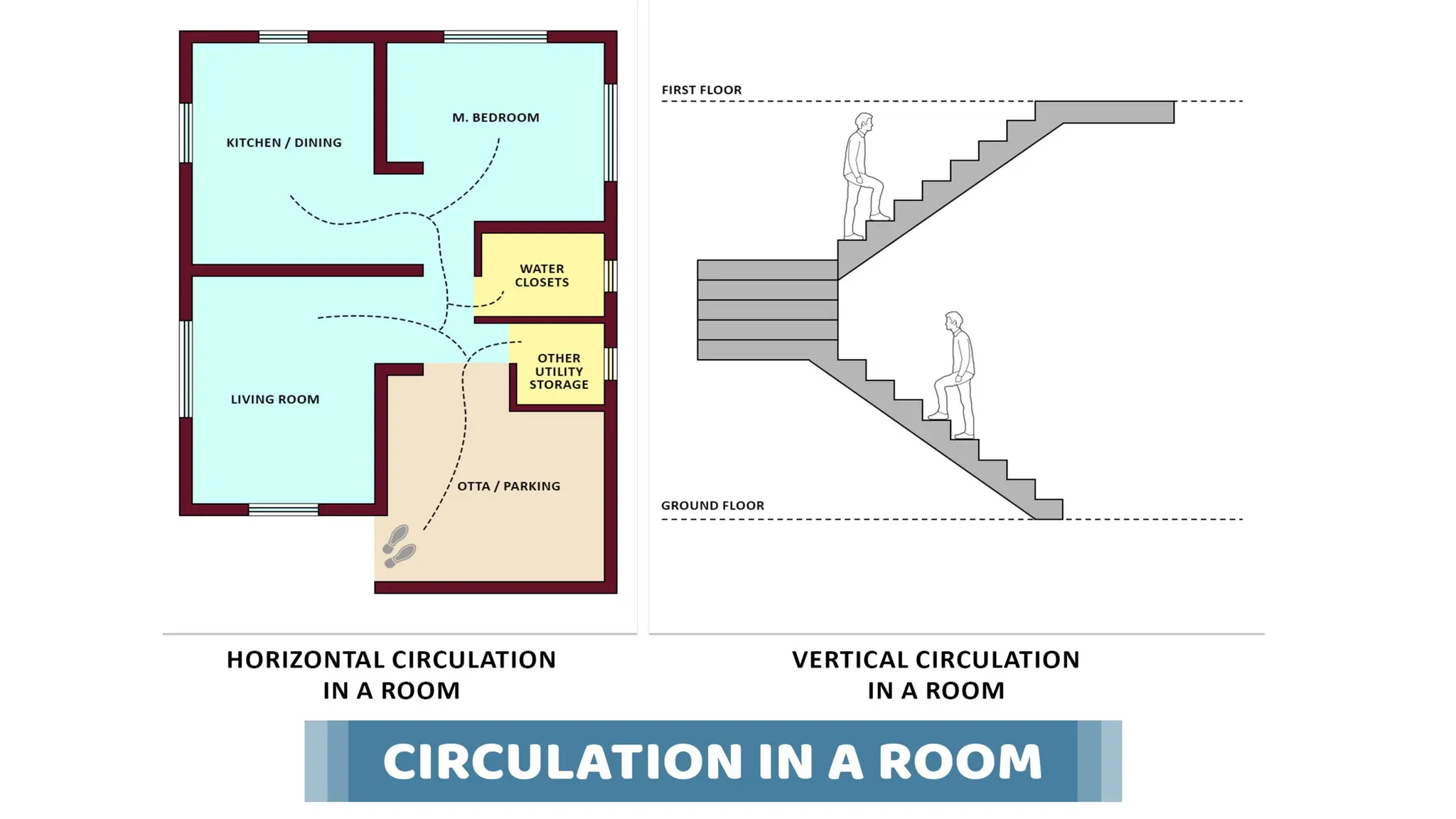
How CIRCULATION act as a principle of building planning?
• Horizontal and vertical directions of a building is defined as
CIRCULATION
• The movement from one room to another on the same floor
can be described as horizontal circulation.
• Likely, the movement from one floor to the other floor is
termed as vertical circulation.
• To have the efficient circulation in a building, passages,
corridors and foyer etc should be provided in such a way
that these elements are neither too narrow nor too large.
• They must have good lighting and ventilation.
• Some better options are highlighted in the diagram which
reflects the ways of good circulation in a house.
What is Flexibility in building
planning?
• Flexibility means “to allow use of the particular element in
another way possible to fulfil a specific purpose. An element is
initially designed for one particular reason, but later the same
element is used differently.”
• Let us take an example to understand the concept of the
flexibility. One story residential house has a dining and drawing
hall on the ground floor, separated with a fibre partition wall in it.
For various events and gatherings, both dining and drawing hall
can be combined and converted into a banquet hall by removing
partition wall.
• Also, future expansions of converting one unit to another must
be kept in mind as it is one of the basic principles of construction.
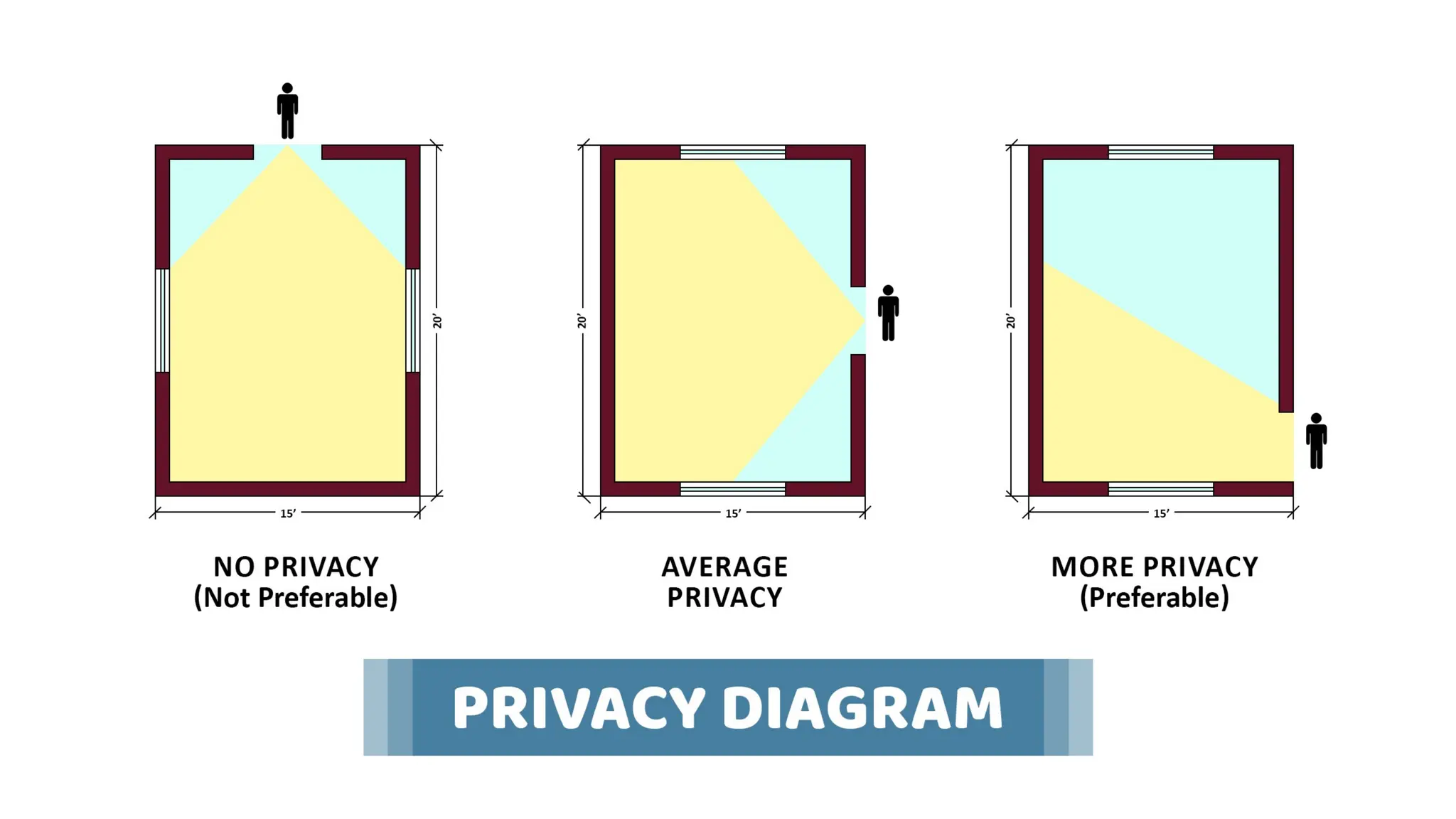
What does Privacy means in building planning?
01. Internal Privacy: This deals with the privacy inside a
house, amongst the rooms. It covers the privacy between
rooms and water closets, corridors, passage lobbies etc.
02. External Privacy: Privacy of a building with respect to
other buildings and the things outside the building- such as
streets, roads, etc., is external privacy.
Internal privacy
1. Proper grouping- as dressing, bed room,
toilet, kitchen and dining
2. Careful planning of entrance and circular
space
3. Better location – door and windows
4. Providing buffer space
External Privacy:
1. Having compound wall- height 1.35 – 1.5 m
2. Having construction of porch to main
entrance
3. Tree plantation around compound wall =
can sound barrier and sight barrier
4. Glass windows & ventilation
5. Curtain walls on verandah
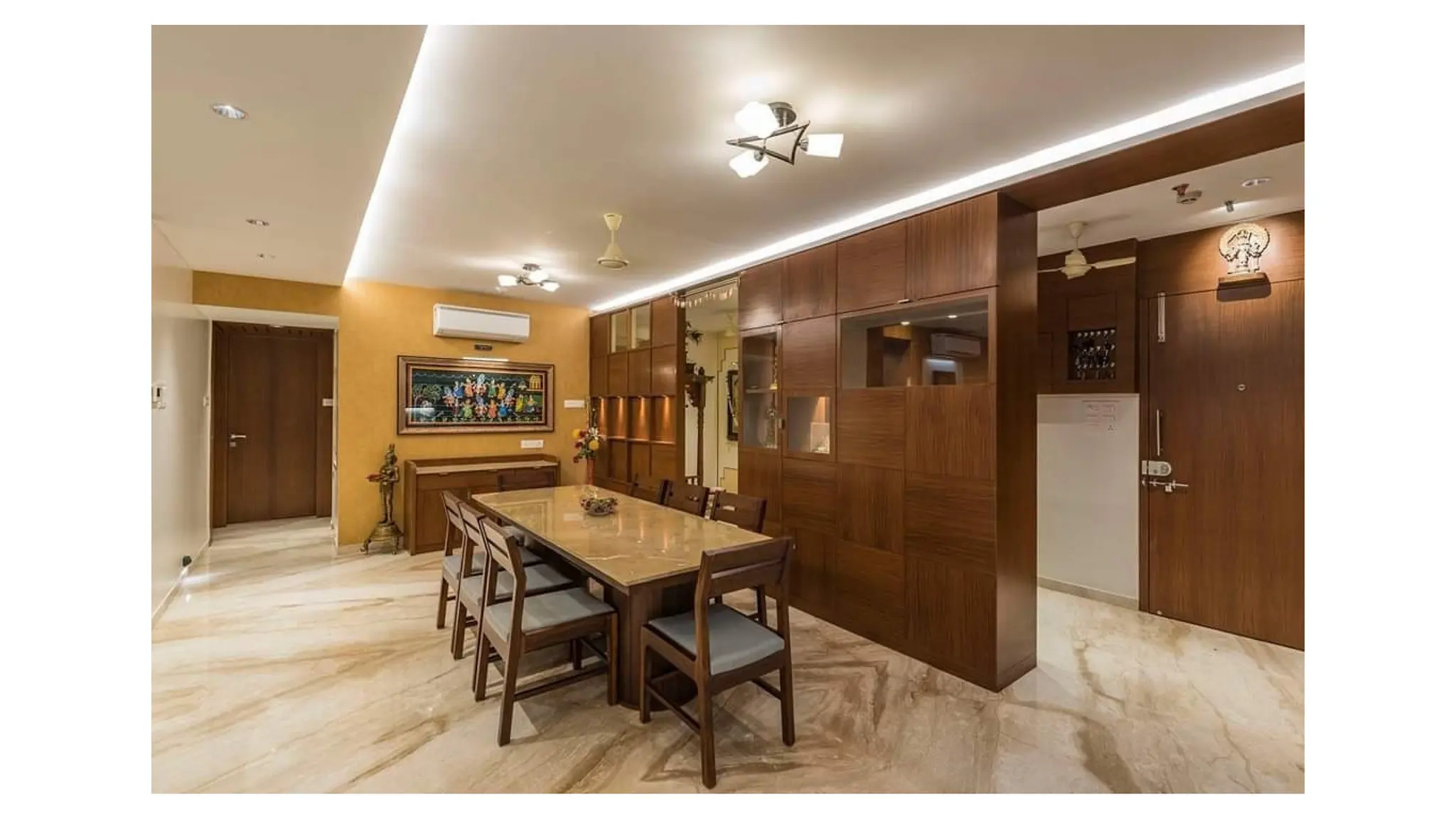
How FURNITURE influence principles of building
planning?
•According to room’s functions, the type of
furniture varies.
• The architects and planner must consider the
furniture’s relative positions to avoid the
congestion of space.
•The furniture should match the purpose of the
room and justify the effective use of a room
and furniture as well.
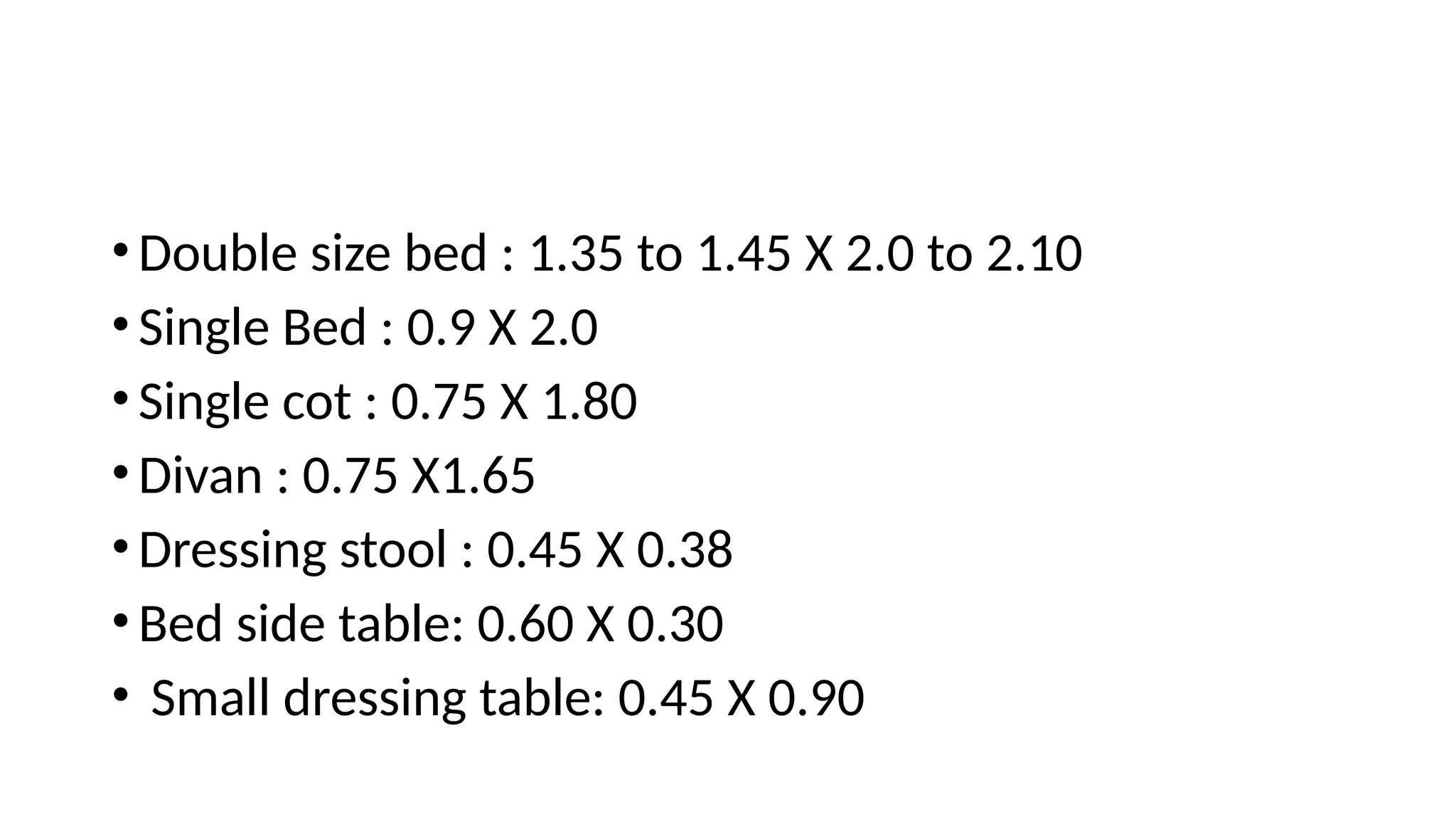
•Double size bed : 1.35 to 1.45 X 2.0 to 2.10
•Single Bed : 0.9 X 2.0
•Single cot : 0.75 X 1.80
•Divan : 0.75 X1.65
•Dressing stool : 0.45 X 0.38
•Bed side table: 0.60 X 0.30
• Small dressing table: 0.45 X 0.90
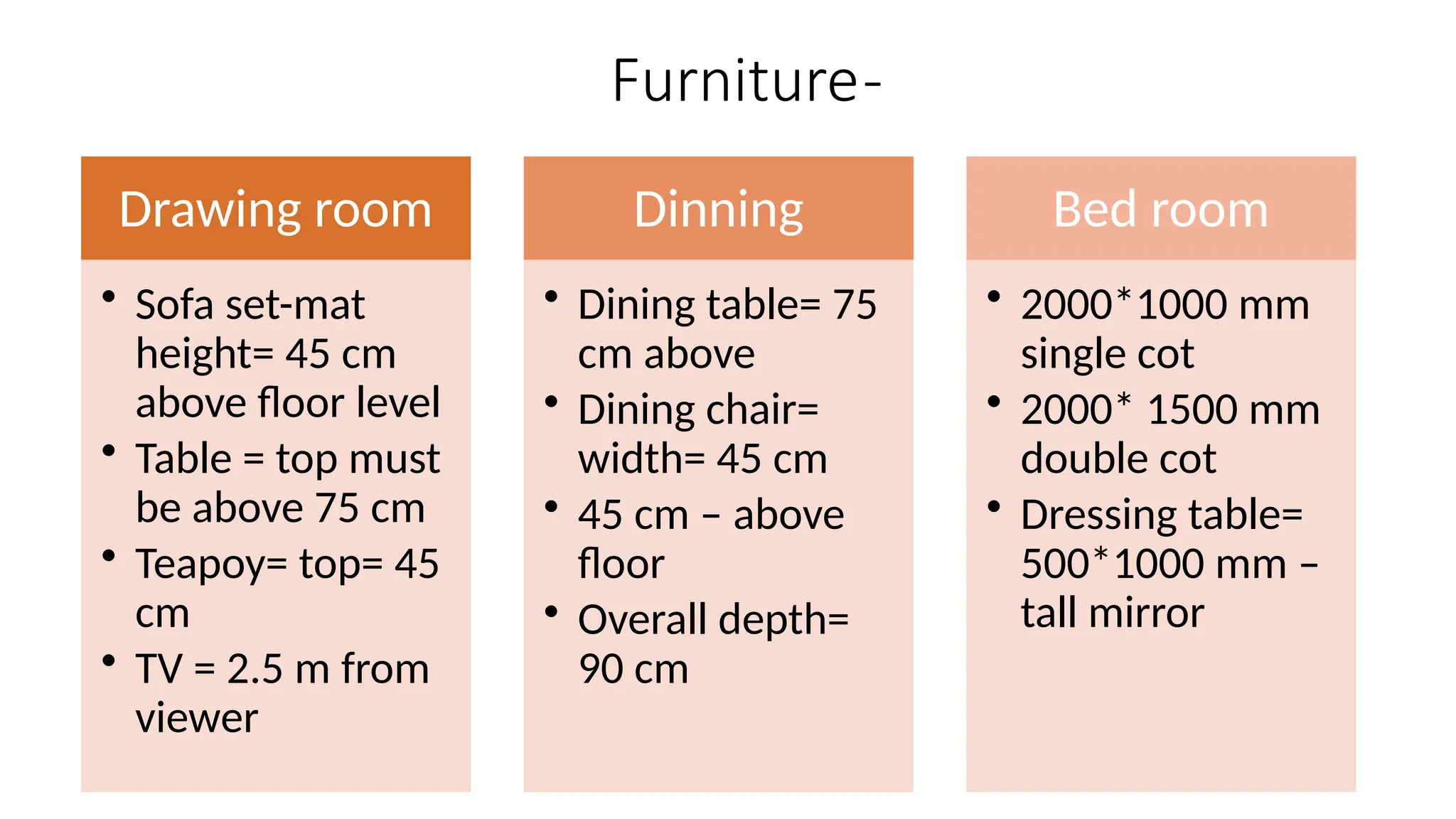
Furniture-
Drawing room
• Sofa set-mat
height= 45 cm
above floor level
• Table = top must
be above 75 cm
• Teapoy= top= 45
cm
• TV = 2.5 m from
viewer
Dinning
• Dining table= 75
cm above
• Dining chair=
width= 45 cm
• 45 cm – above
floor
• Overall depth=
90 cm
Bed room
• 2000*1000 mm
single cot
• 2000* 1500 mm
double cot
• Dressing table=
500*1000 mm –
tall mirror
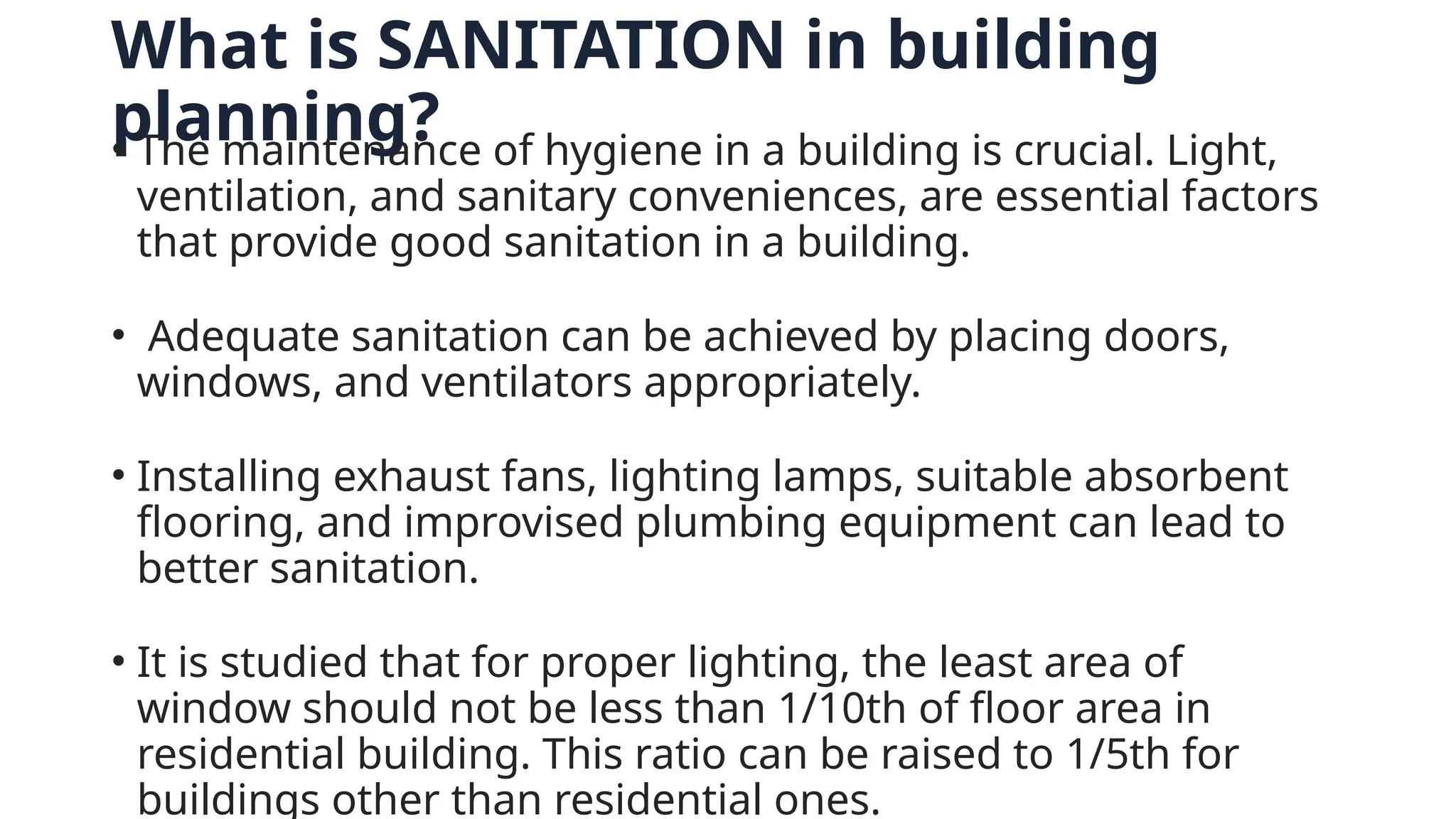
What is SANITATION in building
planning?
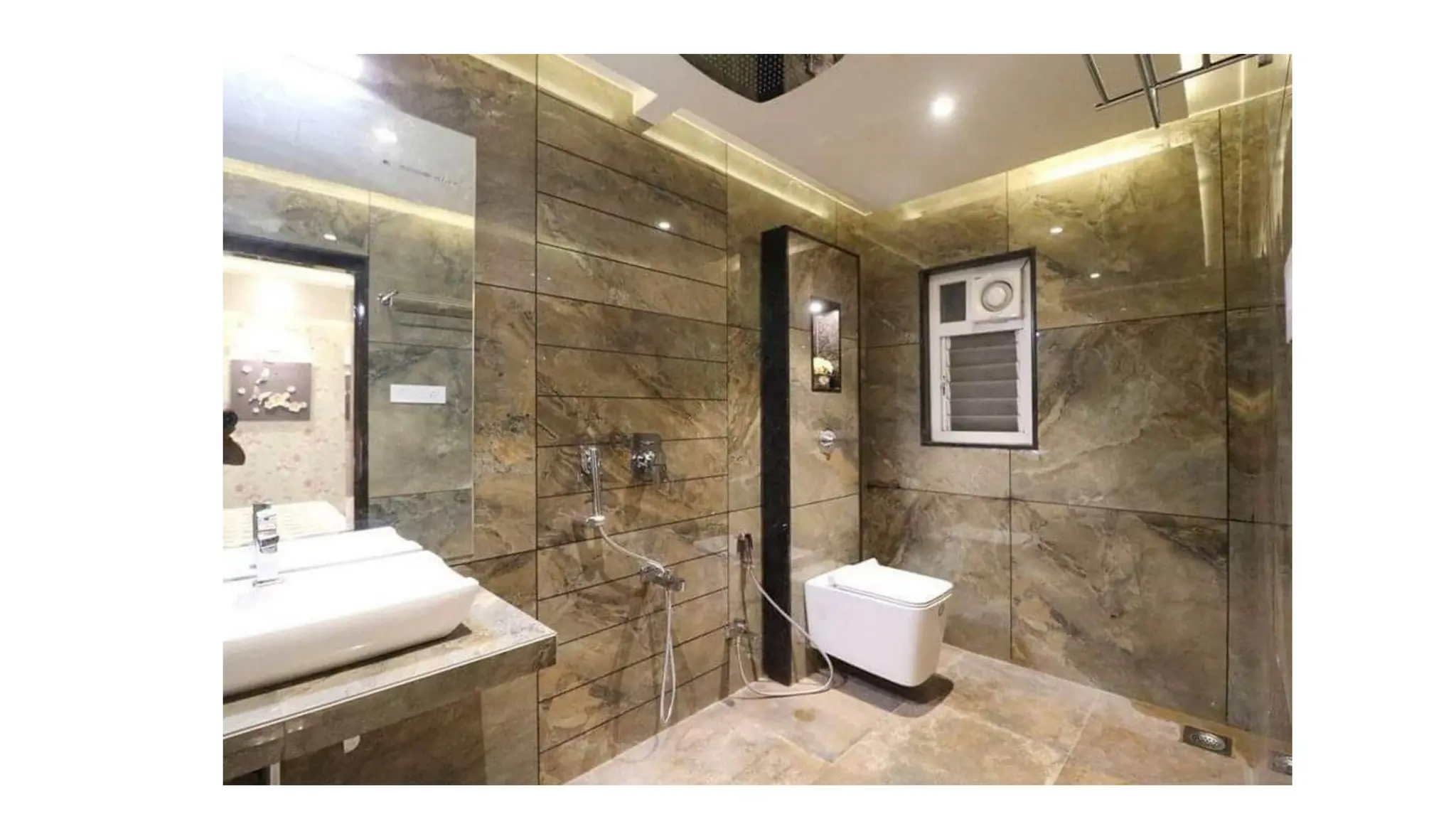
• The maintenance of hygiene in a building is crucial. Light,
ventilation, and sanitary conveniences, are essential factors
that provide good sanitation in a building.
• Adequate sanitation can be achieved by placing doors,
windows, and ventilators appropriately.
• Installing exhaust fans, lighting lamps, suitable absorbent
flooring, and improvised plumbing equipment can lead to
better sanitation.
• It is studied that for proper lighting, the least area of
window should not be less than 1/10th of floor area in
residential building. This ratio can be raised to 1/5th for
buildings other than residential ones.
What is the importance of ECONOMY in building planning?
•The economy is also one of the major factors
to keep in mind while planning a structure.
•The building should not be too expensive.
However, having said that, the cost cutting
should not happen by compromising on the
safety and the building principles
• Often, the cost of the construction at the
initial stage is higher as standard designs
and materials are used, but it reduces the
cost of maintenance and repair in the future.
What is ELEGANCE in building
planning?
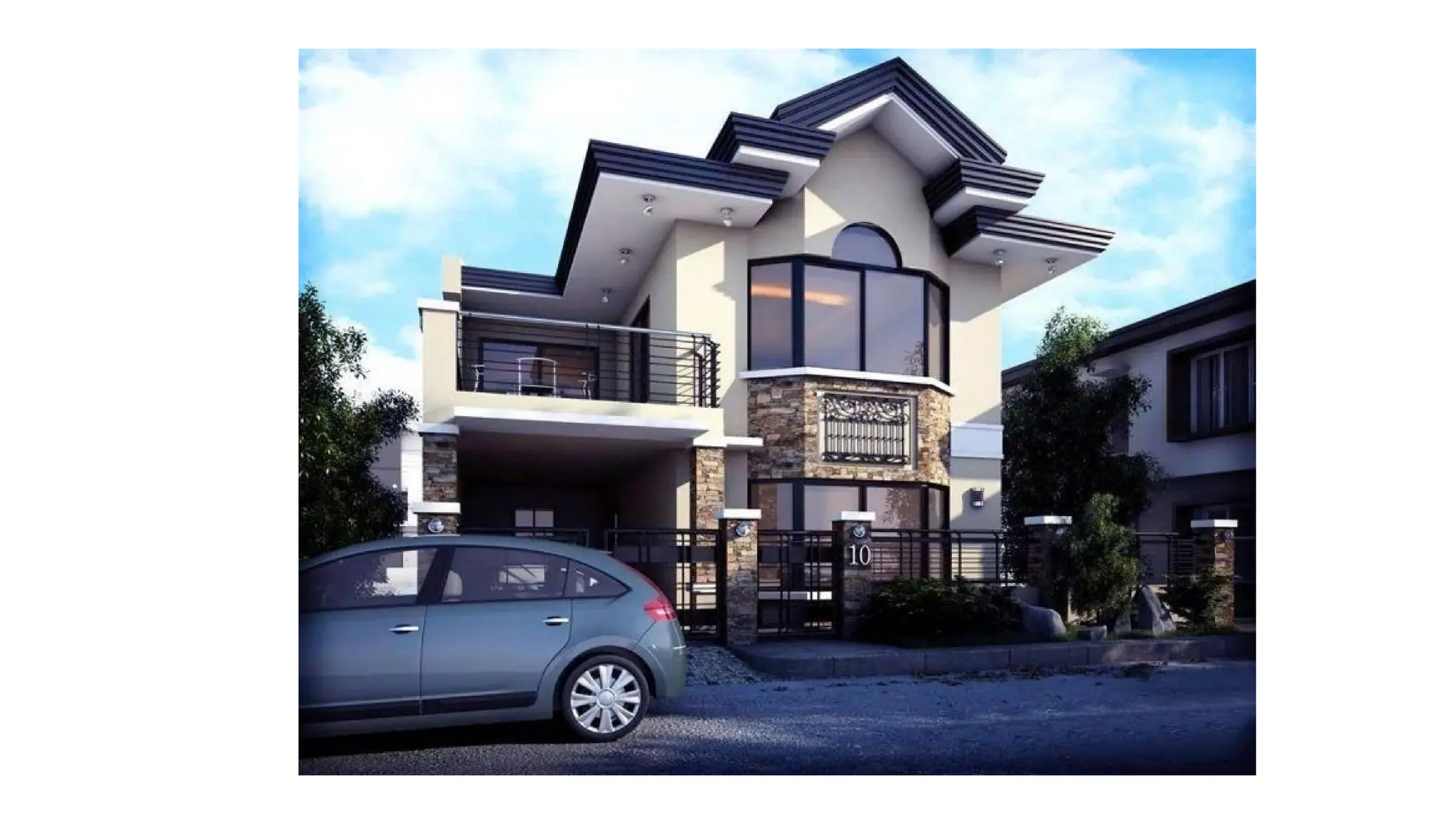
• The elegance has a direct connection with the appearance
and layout of a plan.
• It has become a trend nowadays to construct attractive
elevations, which gives a pleasant sense of visibility.
• Straight, it depends on the materials used for construction
in the exterior portion and relies on the positions of the
door, windows, chhajja, balconies, and many such factors.
• All these components aim to enhance the look and thus it
is necessary to give more footage to it while building
planning
● A functionally well-planned structure may
not necessarily invite the attention of the user
due to a lack of elegance.
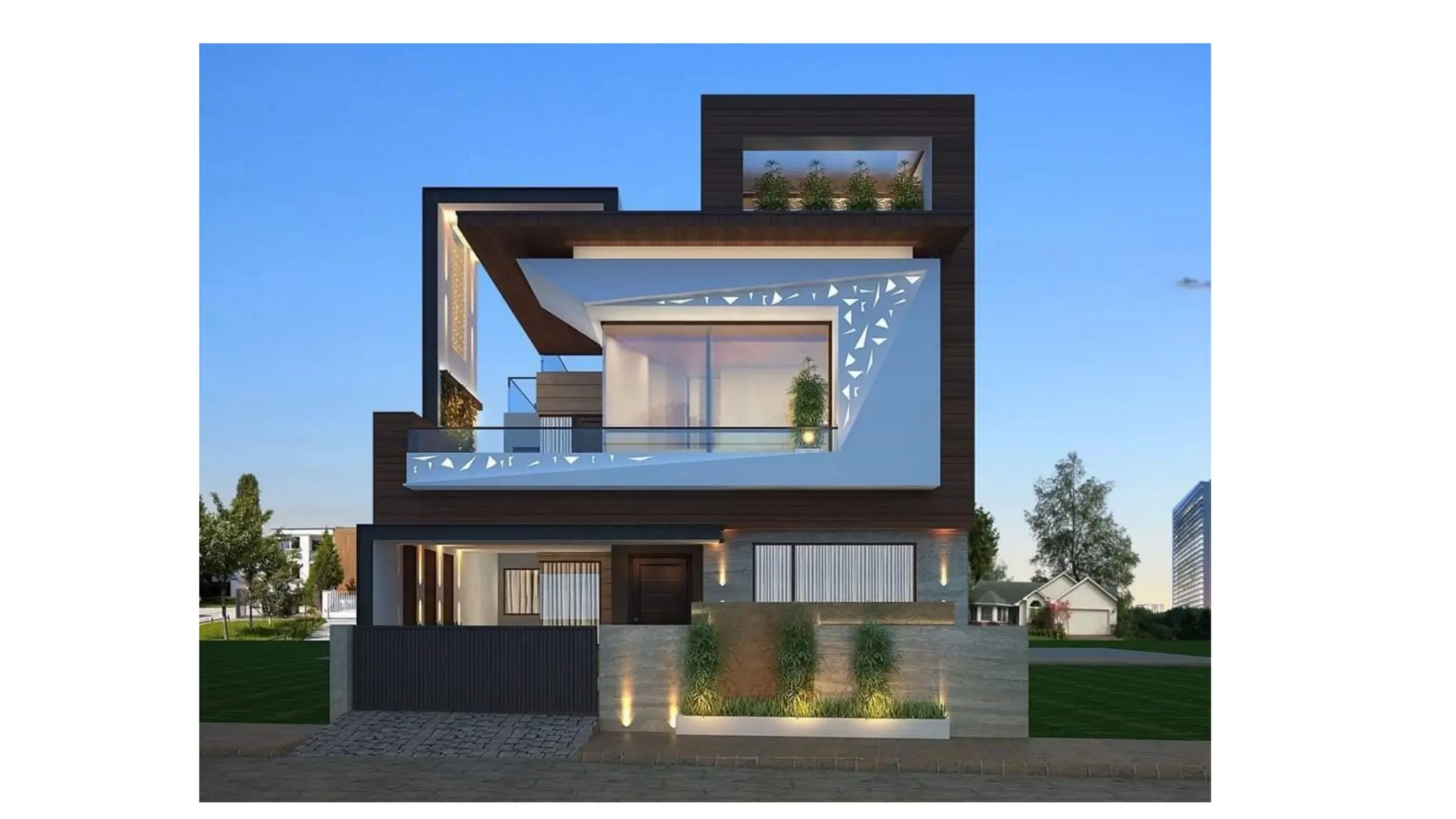
● Thus, the principle of elegance deals with
beautifying the structure outwardly thereby
integrating it with the surrounding.
● Elegance may be improved by composition
by the following depending on the economy.
● Increasing the plinth height of the
structure.
● Use of arches for windows, door openings,
decorative grills, etc.
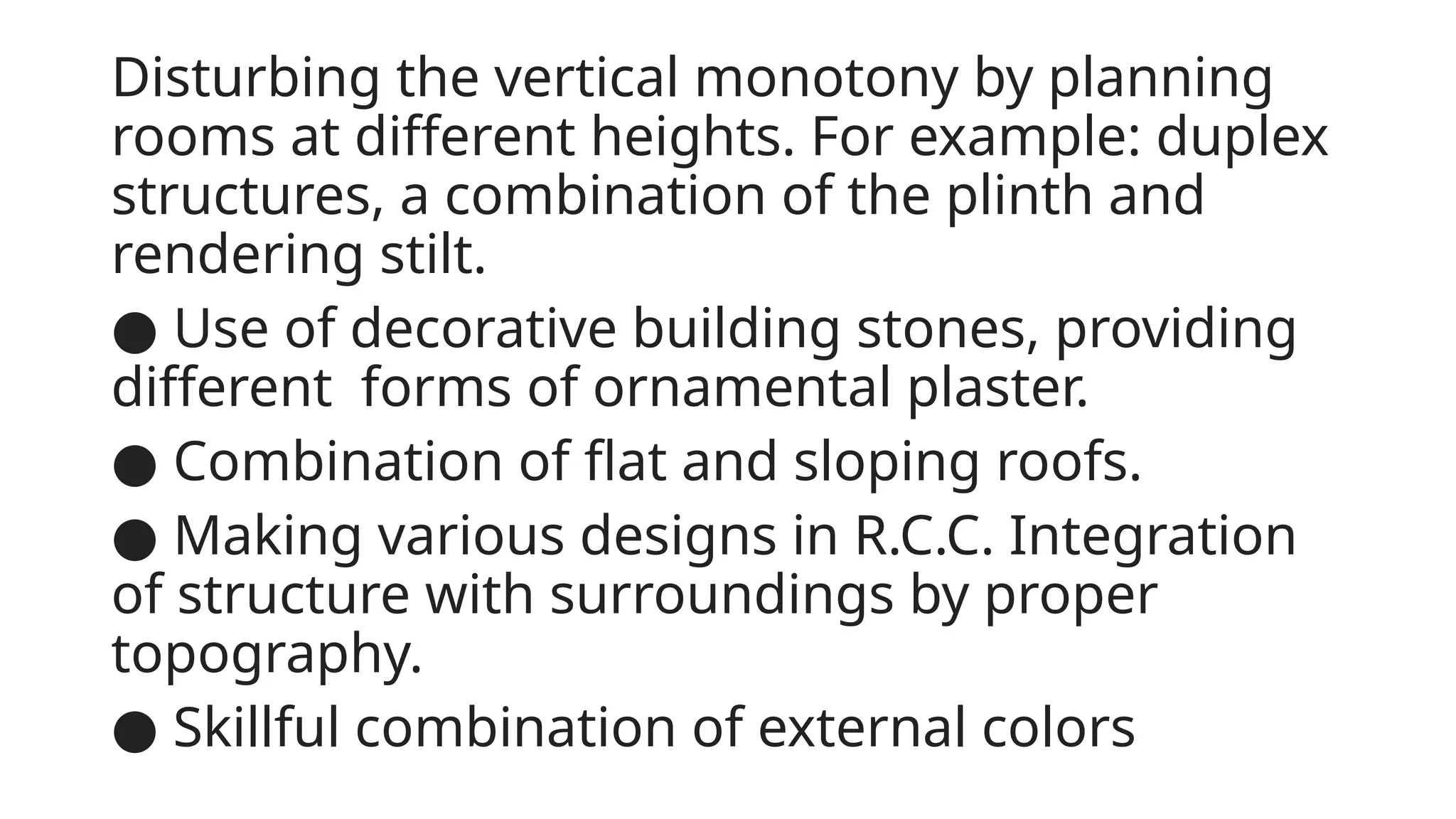
Disturbing the vertical monotony by planning
rooms at different heights. For example: duplex
structures, a combination of the plinth and
rendering stilt.
● Use of decorative building stones, providing
different forms of ornamental plaster.
● Combination of flat and sloping roofs.
● Making various designs in R.C.C. Integration
of structure with surroundings by proper
topography.
● Skillful combination of external colors
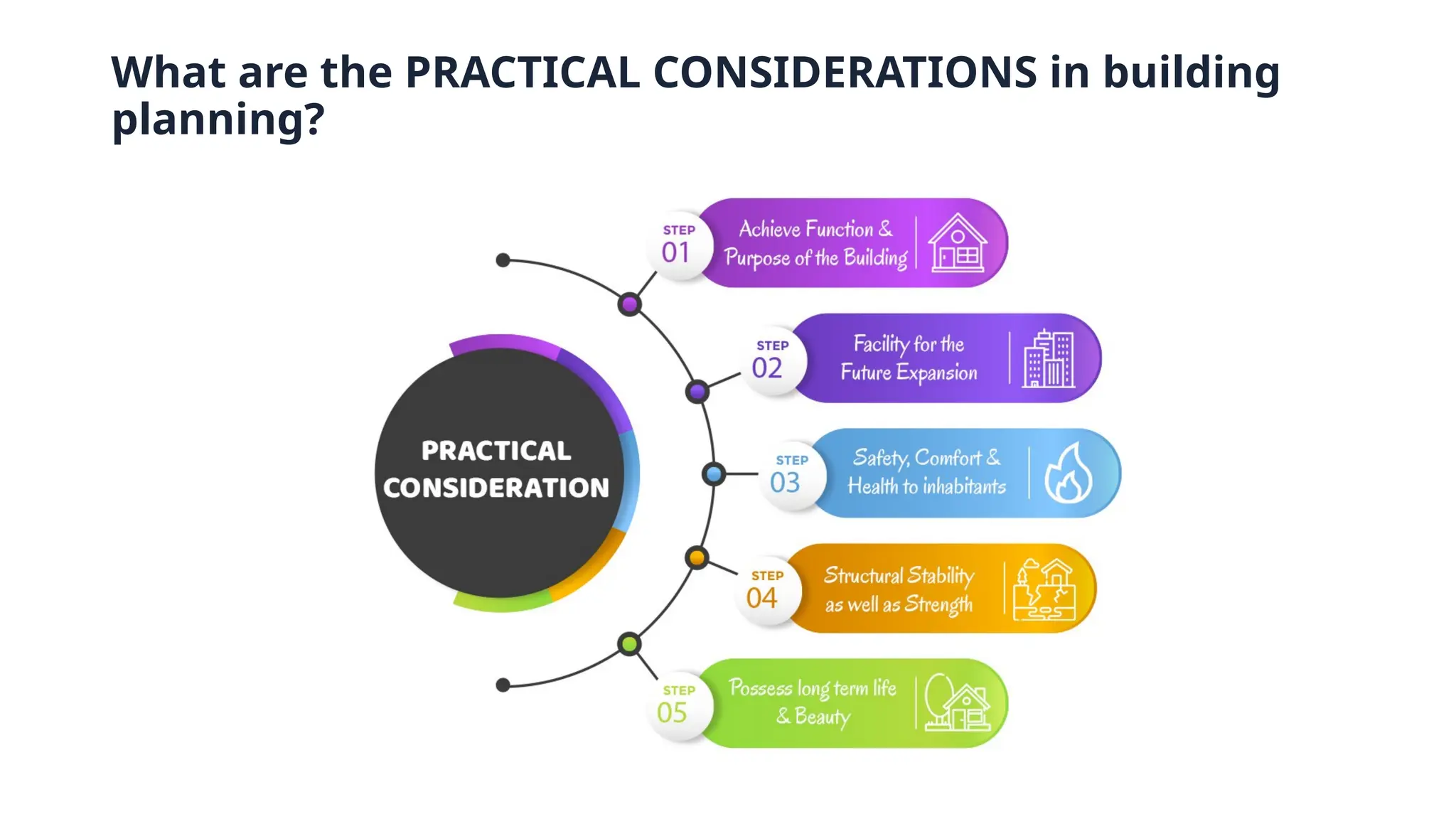
What are the PRACTICAL CONSIDERATIONS in building
planning?
Thank You
There are two more factors which are important
to consider while planning a building. They are
as follows:
•Local Bye-Laws
•Strength, Material and Life of a Building
Local Bye-Laws:
• It should be noted that every state and city has its own local bye-laws.
• The building bye-laws provide standards to implement such as minimum plot
size, carpet area, built-up area, the minimum height of the building, distance
from the main road, safety measures, water supply, drainage, sanitary facilities,
lights and ventilation, outdoor and street parking, structural designs.
• It should be noted that the bye-laws are in tune with the recommendations
provided by the National Building Code (NBC).
• Thus, the authorizations of bye-laws should be obeyed in order to get approval
and permission for the construction and avoid future complication.
• Local bye-laws do not only deal with the new constructions but also guides
renovation, alteration, demolition, changing occupation, development of the
land.
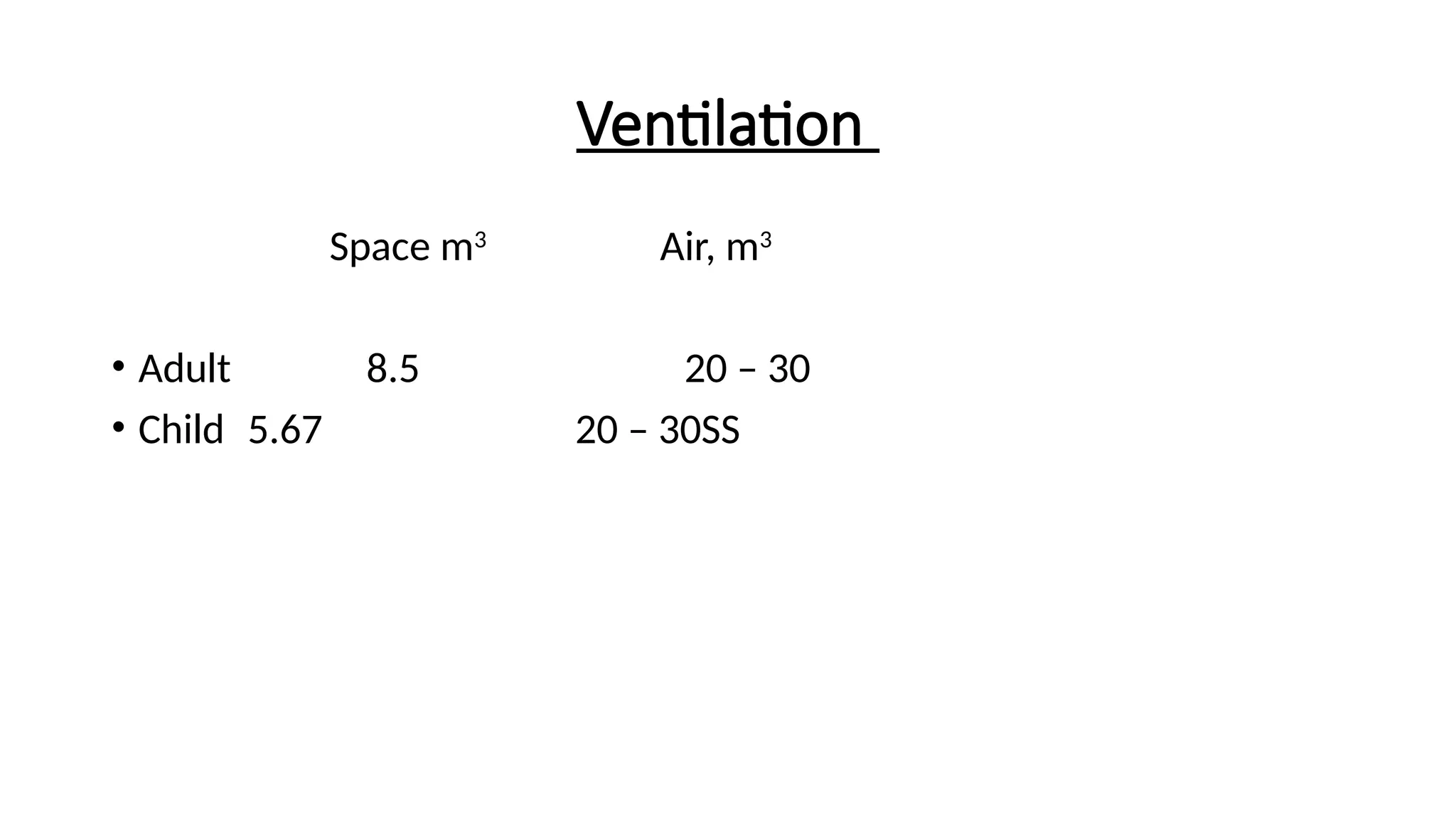
Ventilation
Space m3
Air, m3
• Adult 8.5 20 – 30
• Child 5.67 20 – 30SS
Thank You !

Principles of building planning (Civil Engineering))

  • 1.
    PRINCIPLES OF PLANNING OFBUILDING Prof. Mrs. D. A. Latthe Assistant Professor Dr. J. J. Magdum College of Engineering, Jaysingpur
  • 2.
    Syllabus • Site selectioncriteria:  Principles of planning, significance of sun path diagram  Wind diagram  Orientation  Factors affecting,  Criteria under Indian conditions
  • 3.
    •“The concept ofpositioning all the elements and units of a building in a systematic and practical manner to have the maximum and best utilization of the available space, area and facilities is termed as Principles of Building Planning.”
  • 4.
  • 5.
    Factors affecting thesite selection Topography Nature of subsoil Position of groundwater table facilities Neighborhood Vegetation
  • 6.
    Shape of site Availabilityof men and material Seashore, riverside, lake side or any natural beauty location Factors affecting the site selection
  • 7.
    Effect of ClimaticCondition • Before planning a building or starting any construction, architects and planner must ensure the climatic condition of the particular location. • Usually, local climate plays important role in the construction. Mainly, temperature (i.e. cold and hot), humidity, rain, snow, wind, and sunlight are the climatic factors that affect the building. • All these notable factors play an important role in choosing the position of rooms, doors, windows, ventilation, balconies, and all other units of a building.
  • 8.
    01. What isan ASPECT in building planning? • A building is a complete constitute of different rooms and blocks in it. All the rooms are located according to the standard use of components considering the proper access of natural resources, i.e., sunlight and wind. • According to the research paper “ Planning, Designing and Estimation of High Ceiling Residential B uilding (G+1) ” presented by ‘J.Vengadesh Marshall Raman’&’ P.Soundarya’, ASPECT is defined as a significant arrangement of doors and windows in abuilding, which are enough and efficient to provide sunlight, hygiene, wind, and eco-friendly environment. There must be sufficient light and ventilation in each room and across the house. • The aspect of building can be achieved by arranging the rooms, kitchen, veranda, and many other components in proper directions.
  • 10.
    • Kitchen: Easternaspect, so that the morning sun would refresh and purify the air and the kitchen would remain cool during latter part of the day. • Living Room: Southern or South-East aspect ,The sun is towards the south during cooler days and the living rooms with south aspect will be benefited by the sun when it is winter and in summer as the sun would be on north side. • Bed Room: West or South-west aspects the breeze required particularly in summer, would prevail from that side. There will be no sun from the south side most of the year, the laundries and store rooms may be provided on that side. • Light from North - evenly Distributed the Studios, reading rooms and class rooms are laid out with north aspect.
  • 11.
    Room Accommodation AspectInfluencing factor Bed NW -W- SE To reduce plentiful of Breeze in summer Kitchen E and rarely NE To Receive morning sun which is germicidal . If purifier the air it should be cool during summer Dinning SE –S -SW Proximity of Kitchen, it should be cool Kitchen SE –S – SW - W Adequate natural lighting during winter and obviate the sun during summer Reading N - NW Light from north being diffused and evenly distributed and cool Store NW – N - NE Dark and cool
  • 12.
    02. What arethe PROSPECT principles in building planning? • The appearance of a house or a building is defined as PROSPECT. • The standards are raised to accomplish the building’s pleasant look by locating doors and windows at an accurate location to view nature’s beauty and avoid unwanted attributes from getting entry into the house. • Can be do= planning, proper place of door and window, landscapes
  • 15.
    What does theGROUPING mean in building planning? •It is to organize the different rooms in such a way that they are adequately interconnected with each other to form a functional and practical layout of the house. •The accessibility of all the rooms is interlinked with each other, and this provision can be satisfied by grouping.
  • 17.
    How ROOMINESS canbe a principles of building planning? • The meaning of ROOMINESS is to maximize the advantage of the available space from the minimum dimension of a room. Both the size and shape of the room play a vital role in providing roominess. • Here are the few points to understand the roominess practically. • A square room seems small in size when compared to a rectangular room. • It is always advisable to plan a rectangular room with a proportion of 1.2 to 1.5 times the ratio of the length to the breadth. The increase in ratio due to length gives the tunnel experience as it looks longer. • Also, the height should neither be too high nor too less that the ceiling becomes a hindrance. • Floors, ceilings, walls, ceiling, lifts, furniture, and all such elements should be appropriately placed to offer more space in the rooms.
  • 19.
    1)Roominess can beaffected by carefully adjusting the length, breadth, and height of the building: Consider the dimensions of a living room. L: B ratio is more than 2. A person in this room will feel like moving through a long tunnel. L: B ratio is less than 1.5. Here more comfort is experienced; illustrating roominess. It is advisable to keep the L: B ratio between 1.2 to 1.5. In public buildings such as clubs, the minimum height specified by bye-laws may be provided to create awareness whereas, in badminton halls, foyers, churches, museums, etc., an increased height gives a monumental effect.
  • 20.
    • 2) Colour:From an aesthetic point of view, light colors. the illuminate the room thus enhancing its appearance, whereas dark color conveys a gloomy feeling. Also use of varying colors on walls depending on light direction, reflection, and proportion of the room is required to be made. • 3)Interior Arrangement: Planning and positioning of interior cupboards, table sets, etc. play a very important in effective roominess. A cupboard projecting out reduces the useful size of the room. Therefore, it is good planning if offsets in the wall are provided originally to accommodate cupboards later on. Recently, the emphasis on interior designing is related to making very small areas roomy.
  • 21.
    How CIRCULATION actas a principle of building planning? • Horizontal and vertical directions of a building is defined as CIRCULATION • The movement from one room to another on the same floor can be described as horizontal circulation. • Likely, the movement from one floor to the other floor is termed as vertical circulation. • To have the efficient circulation in a building, passages, corridors and foyer etc should be provided in such a way that these elements are neither too narrow nor too large. • They must have good lighting and ventilation. • Some better options are highlighted in the diagram which reflects the ways of good circulation in a house.
  • 23.
    What is Flexibilityin building planning? • Flexibility means “to allow use of the particular element in another way possible to fulfil a specific purpose. An element is initially designed for one particular reason, but later the same element is used differently.” • Let us take an example to understand the concept of the flexibility. One story residential house has a dining and drawing hall on the ground floor, separated with a fibre partition wall in it. For various events and gatherings, both dining and drawing hall can be combined and converted into a banquet hall by removing partition wall. • Also, future expansions of converting one unit to another must be kept in mind as it is one of the basic principles of construction.
  • 24.
    What does Privacymeans in building planning? 01. Internal Privacy: This deals with the privacy inside a house, amongst the rooms. It covers the privacy between rooms and water closets, corridors, passage lobbies etc. 02. External Privacy: Privacy of a building with respect to other buildings and the things outside the building- such as streets, roads, etc., is external privacy.
  • 26.
    Internal privacy 1. Propergrouping- as dressing, bed room, toilet, kitchen and dining 2. Careful planning of entrance and circular space 3. Better location – door and windows 4. Providing buffer space
  • 27.
    External Privacy: 1. Havingcompound wall- height 1.35 – 1.5 m 2. Having construction of porch to main entrance 3. Tree plantation around compound wall = can sound barrier and sight barrier 4. Glass windows & ventilation 5. Curtain walls on verandah
  • 28.
    How FURNITURE influenceprinciples of building planning? •According to room’s functions, the type of furniture varies. • The architects and planner must consider the furniture’s relative positions to avoid the congestion of space. •The furniture should match the purpose of the room and justify the effective use of a room and furniture as well.
  • 30.
    •Double size bed: 1.35 to 1.45 X 2.0 to 2.10 •Single Bed : 0.9 X 2.0 •Single cot : 0.75 X 1.80 •Divan : 0.75 X1.65 •Dressing stool : 0.45 X 0.38 •Bed side table: 0.60 X 0.30 • Small dressing table: 0.45 X 0.90
  • 31.
    Furniture- Drawing room • Sofaset-mat height= 45 cm above floor level • Table = top must be above 75 cm • Teapoy= top= 45 cm • TV = 2.5 m from viewer Dinning • Dining table= 75 cm above • Dining chair= width= 45 cm • 45 cm – above floor • Overall depth= 90 cm Bed room • 2000*1000 mm single cot • 2000* 1500 mm double cot • Dressing table= 500*1000 mm – tall mirror
  • 32.
    What is SANITATIONin building planning? • The maintenance of hygiene in a building is crucial. Light, ventilation, and sanitary conveniences, are essential factors that provide good sanitation in a building. • Adequate sanitation can be achieved by placing doors, windows, and ventilators appropriately. • Installing exhaust fans, lighting lamps, suitable absorbent flooring, and improvised plumbing equipment can lead to better sanitation. • It is studied that for proper lighting, the least area of window should not be less than 1/10th of floor area in residential building. This ratio can be raised to 1/5th for buildings other than residential ones.
  • 34.
    What is theimportance of ECONOMY in building planning? •The economy is also one of the major factors to keep in mind while planning a structure. •The building should not be too expensive. However, having said that, the cost cutting should not happen by compromising on the safety and the building principles • Often, the cost of the construction at the initial stage is higher as standard designs and materials are used, but it reduces the cost of maintenance and repair in the future.
  • 35.
    What is ELEGANCEin building planning? • The elegance has a direct connection with the appearance and layout of a plan. • It has become a trend nowadays to construct attractive elevations, which gives a pleasant sense of visibility. • Straight, it depends on the materials used for construction in the exterior portion and relies on the positions of the door, windows, chhajja, balconies, and many such factors. • All these components aim to enhance the look and thus it is necessary to give more footage to it while building planning
  • 37.
    ● A functionallywell-planned structure may not necessarily invite the attention of the user due to a lack of elegance. ● Thus, the principle of elegance deals with beautifying the structure outwardly thereby integrating it with the surrounding. ● Elegance may be improved by composition by the following depending on the economy. ● Increasing the plinth height of the structure. ● Use of arches for windows, door openings, decorative grills, etc.
  • 38.
    Disturbing the verticalmonotony by planning rooms at different heights. For example: duplex structures, a combination of the plinth and rendering stilt. ● Use of decorative building stones, providing different forms of ornamental plaster. ● Combination of flat and sloping roofs. ● Making various designs in R.C.C. Integration of structure with surroundings by proper topography. ● Skillful combination of external colors
  • 39.
    What are thePRACTICAL CONSIDERATIONS in building planning?
  • 40.
  • 44.
    There are twomore factors which are important to consider while planning a building. They are as follows: •Local Bye-Laws •Strength, Material and Life of a Building
  • 45.
    Local Bye-Laws: • Itshould be noted that every state and city has its own local bye-laws. • The building bye-laws provide standards to implement such as minimum plot size, carpet area, built-up area, the minimum height of the building, distance from the main road, safety measures, water supply, drainage, sanitary facilities, lights and ventilation, outdoor and street parking, structural designs. • It should be noted that the bye-laws are in tune with the recommendations provided by the National Building Code (NBC). • Thus, the authorizations of bye-laws should be obeyed in order to get approval and permission for the construction and avoid future complication. • Local bye-laws do not only deal with the new constructions but also guides renovation, alteration, demolition, changing occupation, development of the land.
  • 46.
    Ventilation Space m3 Air, m3 •Adult 8.5 20 – 30 • Child 5.67 20 – 30SS
  • 47.