BUILIDING PLANNING &
DRAWING
What is planning and building planning?
 It is the process of thinking about the
organization of different activities
required to achieve a desired goal.
 Building planning is the arrangement of
various component or unit of a building in
a systematic manner so as to form a
meaningful and homogeneous structure
to meet its functional purpose.
Factors affecting the planning of building
 Functions of building
 Shape and size of the plot
 Topography
 Climatic condition
 Building bye-laws, etc..
Orientation
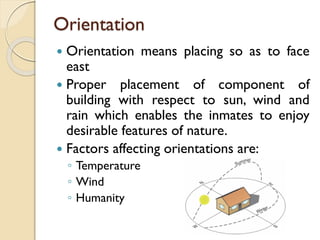
 Orientation means placing so as to face
east
 Proper placement of component of
building with respect to sun, wind and
rain which enables the inmates to enjoy
desirable features of nature.
 Factors affecting orientations are:
◦ Temperature
◦ Wind
◦ Humanity
Orientation
 Orientation is the positioning of
a building in relation to seasonal variations
in the sun's path as well as prevailing wind
patterns. Good orientation can increase
the energy efficiency of your home, making
it more comfortable to live in and cheaper
to run.
CBRI suggestions for orientation
 The building should receive maximum solar radiation
in winter and minimum in summer.
 In hot climates living rooms on the south and west
sides should be protected by verandah , bathroom,
store etc.
 For hot and humid zones the orientation is governed
by the direction of the breeze.
 Exposure to sun can be reduced by shady trees on
sunny side and also be keeping the shorter walls on
east and west.
 All the rooms which are occupied in the day time
should preferably be placed on north and east side.
 The bed rooms should be placed in the direction of
prevailing wind and at the same time protected by
verandah from the heat of afternoon sun.
Main consideration of planning are:
 Human habitation and their requirement
 Climatic condition and effects
 Bye-laws (rules and regulation) for
planning and construction
 Material and method of construction
 Available finance
 Comfort, safety and economy.
Principle of planning
1) Aspect
2) Prospect
3) Privacy
4) Grouping
5) Roominess
6) Flexibility
7) Furniture requirement
8) Circulation
9) Lighting
10) Elegance
11) Economy
12) Sanitation
13) Practical Consideration
ASPECT
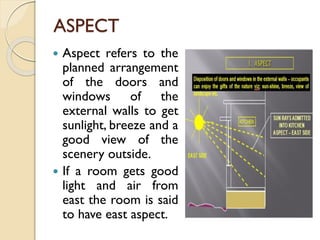
 Aspect refers to the
planned arrangement
of the doors and
windows of the
external walls to get
sunlight, breeze and a
good view of the
scenery outside.
 If a room gets good
light and air from
east the room is said
to have east aspect.
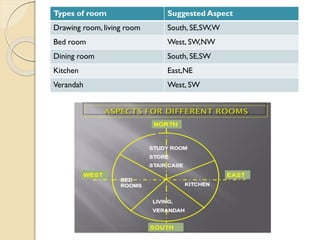
Types of room Suggested Aspect
Drawing room, living room South, SE,SW,W
Bed room West, SW,NW
Dining room South, SE,SW
Kitchen East,NE
Verandah West, SW
 Proper aspect can take advantage of
natural resources which is important for
hygienic condition inside the building.
 Suggested aspect for kitchen is east
direction. Sun rises in east in early
morning.
 We have works like tea, breakfast,
cooking, etc in kitchen from early
morning. Hence east aspect for kitchen
can give advantage of natural sunlight. Sun
rays are helpful to kill bacteria and germs.
 Sunlight can remove dampness.
PROSPECT
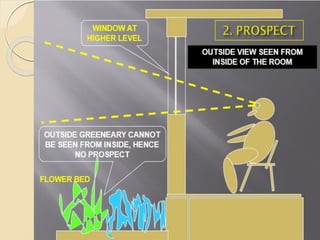
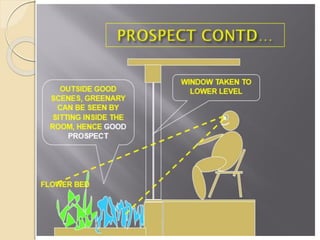
 A building is said to have prospect when it present a
good and pleasing appearance when seen from outside.
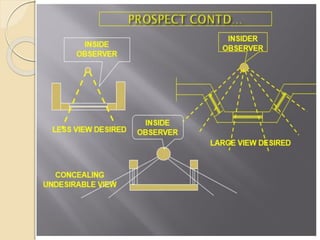
 It is used to mean the external views as seen from
certain rooms of the building.
 It also includes the concealment of some undesirable
views in a given outlook.
 To get good prospect, the doors and windows should
be provided in an attractive manner.
 Exterior wall painting, pattern cladding work etc.
increase prospect of the building.
 Shape of balcony, canopy, ornamental grill etc. present
good prospect.
 RWP and other pipes should be concealed.
 Projected windows permit more light and air inside the
rooms.
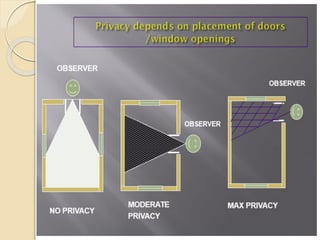
PRIVACY
 For residential building planning privacy is
important consideration. There should be privacy
from one room to another room and also from
neighbor building and public building and streets.
 Privacy is necessary in the bedroom, bathroom,
WC and urinals.
 Position of doors and sill height of windows and
ventilations are decided as per privacy principle in
building planning.
 Doors provided in corners of rooms permits
proper privacy. At center door location should be
avoided.
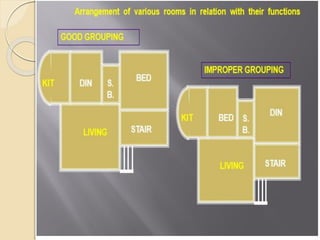
GROUPING
 Grouping refers to easy communication and utility of
various rooms.
 Kitchen and dinning room should be close to each
other. Store room should be adjacent to kitchen.
 WC and urinals should be far away from the kitchen.
Kitchen and toilet block should not exposed to
drawing room.
 Passage should be provided in such a way that meant
for the purpose and should not be too long and
should not be passed through drawing rooms.
 Bedroom should be connected to bath by direct
passage. Bedroom should be less exposed to drawing
room.
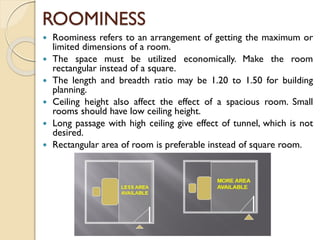
ROOMINESS
 Roominess refers to an arrangement of getting the maximum or
limited dimensions of a room.
 The space must be utilized economically. Make the room
rectangular instead of a square.
 The length and breadth ratio may be 1.20 to 1.50 for building
planning.
 Ceiling height also affect the effect of a spacious room. Small
rooms should have low ceiling height.
 Long passage with high ceiling give effect of tunnel, which is not
desired.
 Rectangular area of room is preferable instead of square room.
FLEXIBILITY
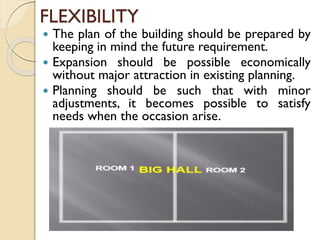
 The plan of the building should be prepared by
keeping in mind the future requirement.
 Expansion should be possible economically
without major attraction in existing planning.
 Planning should be such that with minor
adjustments, it becomes possible to satisfy
needs when the occasion arise.
FURNITURE REQUIREMENT
 During building planning the sizes of furniture to be required
for functional utility of the rooms should be considered.
 The size of the rooms should be decided by considering easy
accommodation of required furniture.
 By proper discussion with owner about family size and the
facilities requires, an engineer can plan the building in good
manner.
 Kitchen size should accommodate platform, cupboard,
dinning table, refrigerator, mill etc.
 Bedroom size should accommodate bed, cupboard, side
tables, dressing table etc.
 Children's bedroom should accommodate bed, study table,
cupboard, dressing etc. as per furniture requirements of
owner.
CIRCULATION
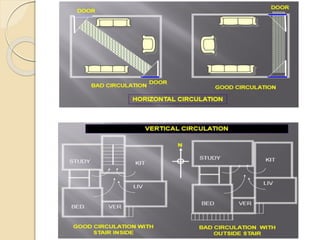
 Circulation refers to providing through
passages between rooms in a building.
 It is necessary to permit horizontal
circulation through passages, corridors
and lobbies and vertical circulation
through staircases, lifts and ramps in
building.
 Passage should be provided along shorter
wall, not proper along longer walls,
passage should not cross the rooms.
LIGHTING
 Natural and artificial lighting is provided in
building planning.
 By proper ventilation sunlight can give
good lighting.
 By using various electrical appliances
artificial lighting is provided. Glare should
be avoided.
ELEGANCE
 Elegance refers to the planning of
elevation and layout of the plan to give an
impressive appearance to the building.
 The proper width, height, location of
doors and windows, materials employed
in construction of exterior walls etc.
create elegance.
 The result of elegance is aesthetics of
building.
ECONOMY
 Building planning should be carried out in
the financial limit of the client.
 An engineer should know in advance, the
client intends to spend for the building and
accordingly material of construction, finishing
items, stage construction should be
suggested.
 By estimation proposed amount should be
derived and as per that work progress
should be followed to avoid miserable failure
of building construction project.
SANITATION
 Provision for cleanliness, lighting, and ventilation in
sanitary units avoid the growth of the bacteria and
spread of disease and give hygienic condition.
 In bath and w.c. glazed tiles dedo should be provided
on walls to maintain clean condition.
 The ventilators in bath, w.c. permit sunlight and air
circulation to maintain hygienic condition.
 The kitchen should have glazed tiles dedo.
 The flooring material should be easy to clean.
 Skirting should be provided in rooms.
 Bath tubs, urinals, w.c. pans, wash basins, kitchen sink
should be of ceramic material to maintain them clean
easy.
Practical consideration
 After the all fundamental some practical points
should be additionally considered:
◦ Provision for future extensions without dismantling
should be made while planning.
◦ Strength, stability, convenience and comfort of
occupants, should be the first consideration while
planning.
◦ As far as possible sizes of rooms should be kept large.
Large room can be shortened by providing movable
partition but smaller room cannot be enlarge easily.
◦ The number of door and window should be minimum
provisions for built in furniture at proper places are
useful from point of view of utility.
REQUIREMENTS OF A BUILDING
 STRENGTH & STABILIT
 RESISTANCE TO FIRE
 RESISTANCE TO DAMPNESS
 DURABILITY
 HEAT INSULATION
 SOUND INSULATION
 LIGHTING &VENTILATION
 PROTECTION AGAINST TERMITE
 SECURITY AGAINST BURGLAR
 COMFORT AND CONVENIENCE
 ECONOMY
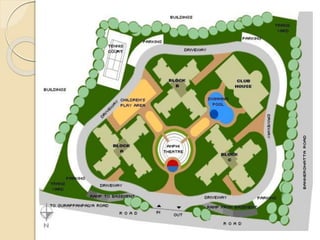
SITE PLAN AND KEY PLAN
 SITE PLAN :- The Plan Showing The Boundary
of Plot Is Known As Site Plane.
 KEY PLAN :-The Plan Showing Important
Features Surrounding The Property Is Known As
Key Plane.
 USE :- Its Provide Guideline By Showing Major
Road Intersection To Minor Road Of An Area And
ultimately ReachTo The Site.
 It Give Location Of Property With Reference To
Temple , Garden, Major Road, Street, etc.
Site selection for Residential Building
 Every human being likes to work and live in
a comfortable and pleasant surroundings.
 The site for a residential building should,
present a peaceful environment, good
landscape, sun for the most part of the day
and uninterrupted flow of natural air.
 If there are more than one alternative site,
the following factors need to be studied in
depth, while selecting the site for a
residential building.
Factors affecting the selection of site
 Topography
 Nature of subsoil
 Position of ground water table
 Facilities
 Neighborhood
 Certain things those should not be near the site
 Vegetation
 Shape of the site
 Availability of men and materials
 Proximity to sea-shore, river or lake or the
place of natural beauty.
Principles of Architect
 Axis
 Symmetry
 Hierarchy
 Rhythm
 Datum
 Transformation
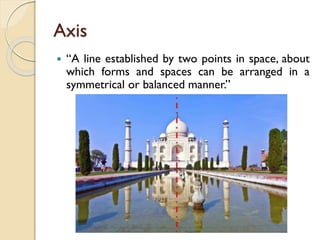
Axis
 “A line established by two points in space, about
which forms and spaces can be arranged in a
symmetrical or balanced manner.”
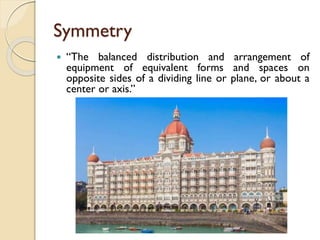
Symmetry
 “The balanced distribution and arrangement of
equipment of equivalent forms and spaces on
opposite sides of a dividing line or plane, or about a
center or axis.”
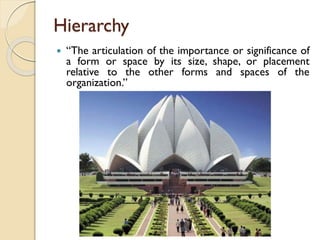
Hierarchy
 “The articulation of the importance or significance of
a form or space by its size, shape, or placement
relative to the other forms and spaces of the
organization.”
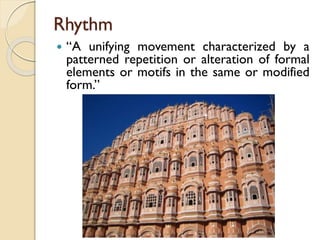
Rhythm
 “A unifying movement characterized by a
patterned repetition or alteration of formal
elements or motifs in the same or modified
form.”
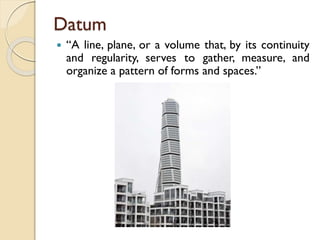
Datum
 “A line, plane, or a volume that, by its continuity
and regularity, serves to gather, measure, and
organize a pattern of forms and spaces.”
Transformation
 “The principle that an architectural concept,
structure, or organization can be altered through a
series of discrete manipulations and permutations in
response to a specific context or set of conditions
without a loss of identity or concept.”
Principle of Architecture Composition
 Unity
 Mass composition
 Contrast
 Proportion
 Scale
 Accentuation and rhythm
 Character
 Balance and symmetry
Unity
 The unity is oneness. but here it means harmony
among elements which can not be split from each
other.
 A rectangle with longer side is twice the shorter is
divided into two equal parts gives a two square on
joint position. its destroyed the unity of original
rectangle and has generate “duality”.
 To maintain unity and architectural composition,
some central or focal idea providing an interesting
accent should be clearly apparent to establish
relationship.
 The focal idea may be a major mass placed either
centrally.
 It may be a lavishly treated main entrance, a tower or
vertical element dominating the rest of the sublime
composition
Mass Composition
 Mass is three dimensional shape having definite
width, length and height.
 Masses may be small or big, horizontal and
vertical when viewed in relation of one another.
 The arrangement of these masses in a building are
made as per function requirement.
 However the mass arrangement is to be done in
such a way that harmonious unity of structure is
maintained.
 This is possible by proper balance in
compositional harmony among different masses
and weighted adjustment of masses.
Contrast
 Contrast means absence of monotony.
 Perception through five senses by human
is also a matter of contrast. There
contrast between sound and silence,
shade and light, smooth and rough, sweet
and sore and smell and scent.
 Contrast is required not only for
achieving proportion without monotony
but for creating interest and exhibiting
variety.
Proportion
 The length and width constitute the area
whereas length , width and height will
constitute the mass.
 The dimension of length , width and height
with respect to one another will give the
pleasing effect due to proportion maintained
among them. The sense of proportion felt by
just viewing the area or mass.
 A child is easily distinguished from a man
though the photograph of a child
photograph.
Scale
 In architecture scale means the proper
relation of several parts to one another and
to the whole from the aspect of size. Proper
scale is not only essential for better result of
proportion but is considered as a desirable
quality in architecture and better means
towards unity.
 This scaled relationship is established
because of the comparison of the size of
building and object near the building about
which we have definite conception of their
actual size.
Accentuation and Rhythm
 Accentuation literally means emphasis and
is created by different combination
element in the architectural composition.
 The element are classified as positive and
negative elements. The element which
create the impression of decision, rigidity
and function are called positive elements.
Ex. Column in building
 The elements which create the effect of
hesitation, flexibility and decoration are
called negative elements. Ex.Arch or lintel
Character
 Character is sometime, referred as a style.
 The character in architecture may be
divided into three categories:
◦ Functional
◦ Associated
◦ Personal
Functional Character
 A building having no window and
arrangements for sky lighting indicates the
building as a museum.
 Very tall and wide are suggestive of a
library.
 A long wall having numerous windows in
particular order indicates it to be some
institutional building.
Associated Character
 The character develop from the influence
of ideas and impression related to or
growing out of past experience .
 A spire on a tower by the sides of a
spacious building is indicative of the
church.
Personal Character
 Window opening with vertical proportion
often produce an effect of grace and
elegance.
 Even more taller windows may develop an
expression of aspiration.
Balance Symmetry
 Balance is equality of mass about the axis
of reference. There must be balance about
the axis of reference.
 The balance may be either symmetrical,
nearly symmetrical and unsymmetrical.
Building Information Modelling
 Building Information Modeling (BIM) is an intelligent
3D model-based process that gives architecture,
engineering, and construction (AEC) professionals
the insight and tools to more efficiently plan, design,
construct, and manage buildings and infrastructure.
 The US National Building Information
Model Standard Project Committee has the
following definition: Building Information
Modeling (BIM) is a digital representation of
physical and functional characteristics of a facility.
 BIM is used exclusively in the design and
construction of commercial buildings such as
airports, office towers or schools and has more
increasingly become the new industry standard.
 The American Institute of Architects (AIA)
defines BIM as “a model-based technology
linked with a data base of project
information”
◦ Three-dimensional, virtual representation of a
design project
◦ It adds 4th dimension of time and 5th dimension
of cost to the 3D model
 It covers
◦ Geometry
◦ Spatial relationships
◦ Geographic information
◦ Quantities and
◦ Properties of building components.
History of BIM
 First conceptual idea by Douglas C. Englebart in
1962.
 Earlier modeling software created based on
graphical interface and Ivan Sutherland’s
Sketchpad program in 1963
 Main solid modeling methods of 1970s and 1980s
◦ Constructive Solid Geometry (CSG)
◦ Boundary Representation (BRep)
 ArchiCAD developed in 1982 is the first BIM
software made available in personal computer
 Building Design Advisor, developed at Lawrence
Berkeley National Lab in1993.
 Revit – First developed in 2000 by Charles River
Software in Cambridge
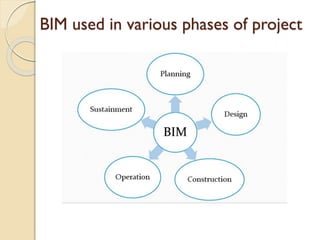
BIM used in various phases of project
Advantages of using BIM
 Interoperability is the ability of different systems,
devices, applications or products to connect and
communicate in a coordinated way, without effort
from the end user.
 Improved visualization
 Improved productivity and quality
 Increased coordination of construction documents
 Embedding and linking of vital information such as
Vendors for specific materials, location of details and
Quantities required for estimation and tendering
 Increased speed of delivery
 Reduced costs
1.Building & Town Planning ྀིྀིྀིྀིྀིྀིྀིྀི  ྀིྀིྀིྀིྀིྀིྀིྀི

1.Building & Town Planning ྀིྀིྀིྀིྀིྀིྀིྀི ྀིྀིྀིྀིྀིྀིྀིྀི

  • 1.
  • 2.
    What is planningand building planning?  It is the process of thinking about the organization of different activities required to achieve a desired goal.  Building planning is the arrangement of various component or unit of a building in a systematic manner so as to form a meaningful and homogeneous structure to meet its functional purpose.
  • 3.
    Factors affecting theplanning of building  Functions of building  Shape and size of the plot  Topography  Climatic condition  Building bye-laws, etc..
  • 4.
    Orientation  Orientation meansplacing so as to face east  Proper placement of component of building with respect to sun, wind and rain which enables the inmates to enjoy desirable features of nature.  Factors affecting orientations are: ◦ Temperature ◦ Wind ◦ Humanity
  • 5.
    Orientation  Orientation isthe positioning of a building in relation to seasonal variations in the sun's path as well as prevailing wind patterns. Good orientation can increase the energy efficiency of your home, making it more comfortable to live in and cheaper to run.
  • 6.
    CBRI suggestions fororientation  The building should receive maximum solar radiation in winter and minimum in summer.  In hot climates living rooms on the south and west sides should be protected by verandah , bathroom, store etc.  For hot and humid zones the orientation is governed by the direction of the breeze.  Exposure to sun can be reduced by shady trees on sunny side and also be keeping the shorter walls on east and west.  All the rooms which are occupied in the day time should preferably be placed on north and east side.  The bed rooms should be placed in the direction of prevailing wind and at the same time protected by verandah from the heat of afternoon sun.
  • 7.
    Main consideration ofplanning are:  Human habitation and their requirement  Climatic condition and effects  Bye-laws (rules and regulation) for planning and construction  Material and method of construction  Available finance  Comfort, safety and economy.
  • 8.
    Principle of planning 1)Aspect 2) Prospect 3) Privacy 4) Grouping 5) Roominess 6) Flexibility 7) Furniture requirement 8) Circulation 9) Lighting 10) Elegance 11) Economy 12) Sanitation 13) Practical Consideration
  • 9.
    ASPECT  Aspect refersto the planned arrangement of the doors and windows of the external walls to get sunlight, breeze and a good view of the scenery outside.  If a room gets good light and air from east the room is said to have east aspect.
  • 10.
    Types of roomSuggested Aspect Drawing room, living room South, SE,SW,W Bed room West, SW,NW Dining room South, SE,SW Kitchen East,NE Verandah West, SW
  • 11.
     Proper aspectcan take advantage of natural resources which is important for hygienic condition inside the building.  Suggested aspect for kitchen is east direction. Sun rises in east in early morning.  We have works like tea, breakfast, cooking, etc in kitchen from early morning. Hence east aspect for kitchen can give advantage of natural sunlight. Sun rays are helpful to kill bacteria and germs.  Sunlight can remove dampness.
  • 12.
    PROSPECT  A buildingis said to have prospect when it present a good and pleasing appearance when seen from outside.  It is used to mean the external views as seen from certain rooms of the building.  It also includes the concealment of some undesirable views in a given outlook.  To get good prospect, the doors and windows should be provided in an attractive manner.  Exterior wall painting, pattern cladding work etc. increase prospect of the building.  Shape of balcony, canopy, ornamental grill etc. present good prospect.  RWP and other pipes should be concealed.  Projected windows permit more light and air inside the rooms.
  • 16.
    PRIVACY  For residentialbuilding planning privacy is important consideration. There should be privacy from one room to another room and also from neighbor building and public building and streets.  Privacy is necessary in the bedroom, bathroom, WC and urinals.  Position of doors and sill height of windows and ventilations are decided as per privacy principle in building planning.  Doors provided in corners of rooms permits proper privacy. At center door location should be avoided.
  • 18.
    GROUPING  Grouping refersto easy communication and utility of various rooms.  Kitchen and dinning room should be close to each other. Store room should be adjacent to kitchen.  WC and urinals should be far away from the kitchen. Kitchen and toilet block should not exposed to drawing room.  Passage should be provided in such a way that meant for the purpose and should not be too long and should not be passed through drawing rooms.  Bedroom should be connected to bath by direct passage. Bedroom should be less exposed to drawing room.
  • 20.
    ROOMINESS  Roominess refersto an arrangement of getting the maximum or limited dimensions of a room.  The space must be utilized economically. Make the room rectangular instead of a square.  The length and breadth ratio may be 1.20 to 1.50 for building planning.  Ceiling height also affect the effect of a spacious room. Small rooms should have low ceiling height.  Long passage with high ceiling give effect of tunnel, which is not desired.  Rectangular area of room is preferable instead of square room.
  • 21.
    FLEXIBILITY  The planof the building should be prepared by keeping in mind the future requirement.  Expansion should be possible economically without major attraction in existing planning.  Planning should be such that with minor adjustments, it becomes possible to satisfy needs when the occasion arise.
  • 22.
    FURNITURE REQUIREMENT  Duringbuilding planning the sizes of furniture to be required for functional utility of the rooms should be considered.  The size of the rooms should be decided by considering easy accommodation of required furniture.  By proper discussion with owner about family size and the facilities requires, an engineer can plan the building in good manner.  Kitchen size should accommodate platform, cupboard, dinning table, refrigerator, mill etc.  Bedroom size should accommodate bed, cupboard, side tables, dressing table etc.  Children's bedroom should accommodate bed, study table, cupboard, dressing etc. as per furniture requirements of owner.
  • 23.
    CIRCULATION  Circulation refersto providing through passages between rooms in a building.  It is necessary to permit horizontal circulation through passages, corridors and lobbies and vertical circulation through staircases, lifts and ramps in building.  Passage should be provided along shorter wall, not proper along longer walls, passage should not cross the rooms.
  • 25.
    LIGHTING  Natural andartificial lighting is provided in building planning.  By proper ventilation sunlight can give good lighting.  By using various electrical appliances artificial lighting is provided. Glare should be avoided.
  • 26.
    ELEGANCE  Elegance refersto the planning of elevation and layout of the plan to give an impressive appearance to the building.  The proper width, height, location of doors and windows, materials employed in construction of exterior walls etc. create elegance.  The result of elegance is aesthetics of building.
  • 27.
    ECONOMY  Building planningshould be carried out in the financial limit of the client.  An engineer should know in advance, the client intends to spend for the building and accordingly material of construction, finishing items, stage construction should be suggested.  By estimation proposed amount should be derived and as per that work progress should be followed to avoid miserable failure of building construction project.
  • 28.
    SANITATION  Provision forcleanliness, lighting, and ventilation in sanitary units avoid the growth of the bacteria and spread of disease and give hygienic condition.  In bath and w.c. glazed tiles dedo should be provided on walls to maintain clean condition.  The ventilators in bath, w.c. permit sunlight and air circulation to maintain hygienic condition.  The kitchen should have glazed tiles dedo.  The flooring material should be easy to clean.  Skirting should be provided in rooms.  Bath tubs, urinals, w.c. pans, wash basins, kitchen sink should be of ceramic material to maintain them clean easy.
  • 29.
    Practical consideration  Afterthe all fundamental some practical points should be additionally considered: ◦ Provision for future extensions without dismantling should be made while planning. ◦ Strength, stability, convenience and comfort of occupants, should be the first consideration while planning. ◦ As far as possible sizes of rooms should be kept large. Large room can be shortened by providing movable partition but smaller room cannot be enlarge easily. ◦ The number of door and window should be minimum provisions for built in furniture at proper places are useful from point of view of utility.
  • 30.
    REQUIREMENTS OF ABUILDING  STRENGTH & STABILIT  RESISTANCE TO FIRE  RESISTANCE TO DAMPNESS  DURABILITY  HEAT INSULATION  SOUND INSULATION  LIGHTING &VENTILATION  PROTECTION AGAINST TERMITE  SECURITY AGAINST BURGLAR  COMFORT AND CONVENIENCE  ECONOMY
  • 31.
    SITE PLAN ANDKEY PLAN  SITE PLAN :- The Plan Showing The Boundary of Plot Is Known As Site Plane.  KEY PLAN :-The Plan Showing Important Features Surrounding The Property Is Known As Key Plane.  USE :- Its Provide Guideline By Showing Major Road Intersection To Minor Road Of An Area And ultimately ReachTo The Site.  It Give Location Of Property With Reference To Temple , Garden, Major Road, Street, etc.
  • 33.
    Site selection forResidential Building  Every human being likes to work and live in a comfortable and pleasant surroundings.  The site for a residential building should, present a peaceful environment, good landscape, sun for the most part of the day and uninterrupted flow of natural air.  If there are more than one alternative site, the following factors need to be studied in depth, while selecting the site for a residential building.
  • 34.
    Factors affecting theselection of site  Topography  Nature of subsoil  Position of ground water table  Facilities  Neighborhood  Certain things those should not be near the site  Vegetation  Shape of the site  Availability of men and materials  Proximity to sea-shore, river or lake or the place of natural beauty.
  • 35.
    Principles of Architect Axis  Symmetry  Hierarchy  Rhythm  Datum  Transformation
  • 36.
    Axis  “A lineestablished by two points in space, about which forms and spaces can be arranged in a symmetrical or balanced manner.”
  • 37.
    Symmetry  “The balanceddistribution and arrangement of equipment of equivalent forms and spaces on opposite sides of a dividing line or plane, or about a center or axis.”
  • 38.
    Hierarchy  “The articulationof the importance or significance of a form or space by its size, shape, or placement relative to the other forms and spaces of the organization.”
  • 39.
    Rhythm  “A unifyingmovement characterized by a patterned repetition or alteration of formal elements or motifs in the same or modified form.”
  • 40.
    Datum  “A line,plane, or a volume that, by its continuity and regularity, serves to gather, measure, and organize a pattern of forms and spaces.”
  • 41.
    Transformation  “The principlethat an architectural concept, structure, or organization can be altered through a series of discrete manipulations and permutations in response to a specific context or set of conditions without a loss of identity or concept.”
  • 42.
    Principle of ArchitectureComposition  Unity  Mass composition  Contrast  Proportion  Scale  Accentuation and rhythm  Character  Balance and symmetry
  • 43.
    Unity  The unityis oneness. but here it means harmony among elements which can not be split from each other.  A rectangle with longer side is twice the shorter is divided into two equal parts gives a two square on joint position. its destroyed the unity of original rectangle and has generate “duality”.  To maintain unity and architectural composition, some central or focal idea providing an interesting accent should be clearly apparent to establish relationship.  The focal idea may be a major mass placed either centrally.  It may be a lavishly treated main entrance, a tower or vertical element dominating the rest of the sublime composition
  • 44.
    Mass Composition  Massis three dimensional shape having definite width, length and height.  Masses may be small or big, horizontal and vertical when viewed in relation of one another.  The arrangement of these masses in a building are made as per function requirement.  However the mass arrangement is to be done in such a way that harmonious unity of structure is maintained.  This is possible by proper balance in compositional harmony among different masses and weighted adjustment of masses.
  • 45.
    Contrast  Contrast meansabsence of monotony.  Perception through five senses by human is also a matter of contrast. There contrast between sound and silence, shade and light, smooth and rough, sweet and sore and smell and scent.  Contrast is required not only for achieving proportion without monotony but for creating interest and exhibiting variety.
  • 46.
    Proportion  The lengthand width constitute the area whereas length , width and height will constitute the mass.  The dimension of length , width and height with respect to one another will give the pleasing effect due to proportion maintained among them. The sense of proportion felt by just viewing the area or mass.  A child is easily distinguished from a man though the photograph of a child photograph.
  • 47.
    Scale  In architecturescale means the proper relation of several parts to one another and to the whole from the aspect of size. Proper scale is not only essential for better result of proportion but is considered as a desirable quality in architecture and better means towards unity.  This scaled relationship is established because of the comparison of the size of building and object near the building about which we have definite conception of their actual size.
  • 48.
    Accentuation and Rhythm Accentuation literally means emphasis and is created by different combination element in the architectural composition.  The element are classified as positive and negative elements. The element which create the impression of decision, rigidity and function are called positive elements. Ex. Column in building  The elements which create the effect of hesitation, flexibility and decoration are called negative elements. Ex.Arch or lintel
  • 49.
    Character  Character issometime, referred as a style.  The character in architecture may be divided into three categories: ◦ Functional ◦ Associated ◦ Personal
  • 50.
    Functional Character  Abuilding having no window and arrangements for sky lighting indicates the building as a museum.  Very tall and wide are suggestive of a library.  A long wall having numerous windows in particular order indicates it to be some institutional building.
  • 51.
    Associated Character  Thecharacter develop from the influence of ideas and impression related to or growing out of past experience .  A spire on a tower by the sides of a spacious building is indicative of the church.
  • 52.
    Personal Character  Windowopening with vertical proportion often produce an effect of grace and elegance.  Even more taller windows may develop an expression of aspiration.
  • 53.
    Balance Symmetry  Balanceis equality of mass about the axis of reference. There must be balance about the axis of reference.  The balance may be either symmetrical, nearly symmetrical and unsymmetrical.
  • 54.
    Building Information Modelling Building Information Modeling (BIM) is an intelligent 3D model-based process that gives architecture, engineering, and construction (AEC) professionals the insight and tools to more efficiently plan, design, construct, and manage buildings and infrastructure.  The US National Building Information Model Standard Project Committee has the following definition: Building Information Modeling (BIM) is a digital representation of physical and functional characteristics of a facility.  BIM is used exclusively in the design and construction of commercial buildings such as airports, office towers or schools and has more increasingly become the new industry standard.
  • 55.
     The AmericanInstitute of Architects (AIA) defines BIM as “a model-based technology linked with a data base of project information” ◦ Three-dimensional, virtual representation of a design project ◦ It adds 4th dimension of time and 5th dimension of cost to the 3D model  It covers ◦ Geometry ◦ Spatial relationships ◦ Geographic information ◦ Quantities and ◦ Properties of building components.
  • 56.
    History of BIM First conceptual idea by Douglas C. Englebart in 1962.  Earlier modeling software created based on graphical interface and Ivan Sutherland’s Sketchpad program in 1963  Main solid modeling methods of 1970s and 1980s ◦ Constructive Solid Geometry (CSG) ◦ Boundary Representation (BRep)  ArchiCAD developed in 1982 is the first BIM software made available in personal computer  Building Design Advisor, developed at Lawrence Berkeley National Lab in1993.  Revit – First developed in 2000 by Charles River Software in Cambridge
  • 57.
    BIM used invarious phases of project
  • 58.
    Advantages of usingBIM  Interoperability is the ability of different systems, devices, applications or products to connect and communicate in a coordinated way, without effort from the end user.  Improved visualization  Improved productivity and quality  Increased coordination of construction documents  Embedding and linking of vital information such as Vendors for specific materials, location of details and Quantities required for estimation and tendering  Increased speed of delivery  Reduced costs