TRAPS
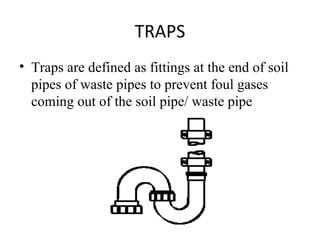
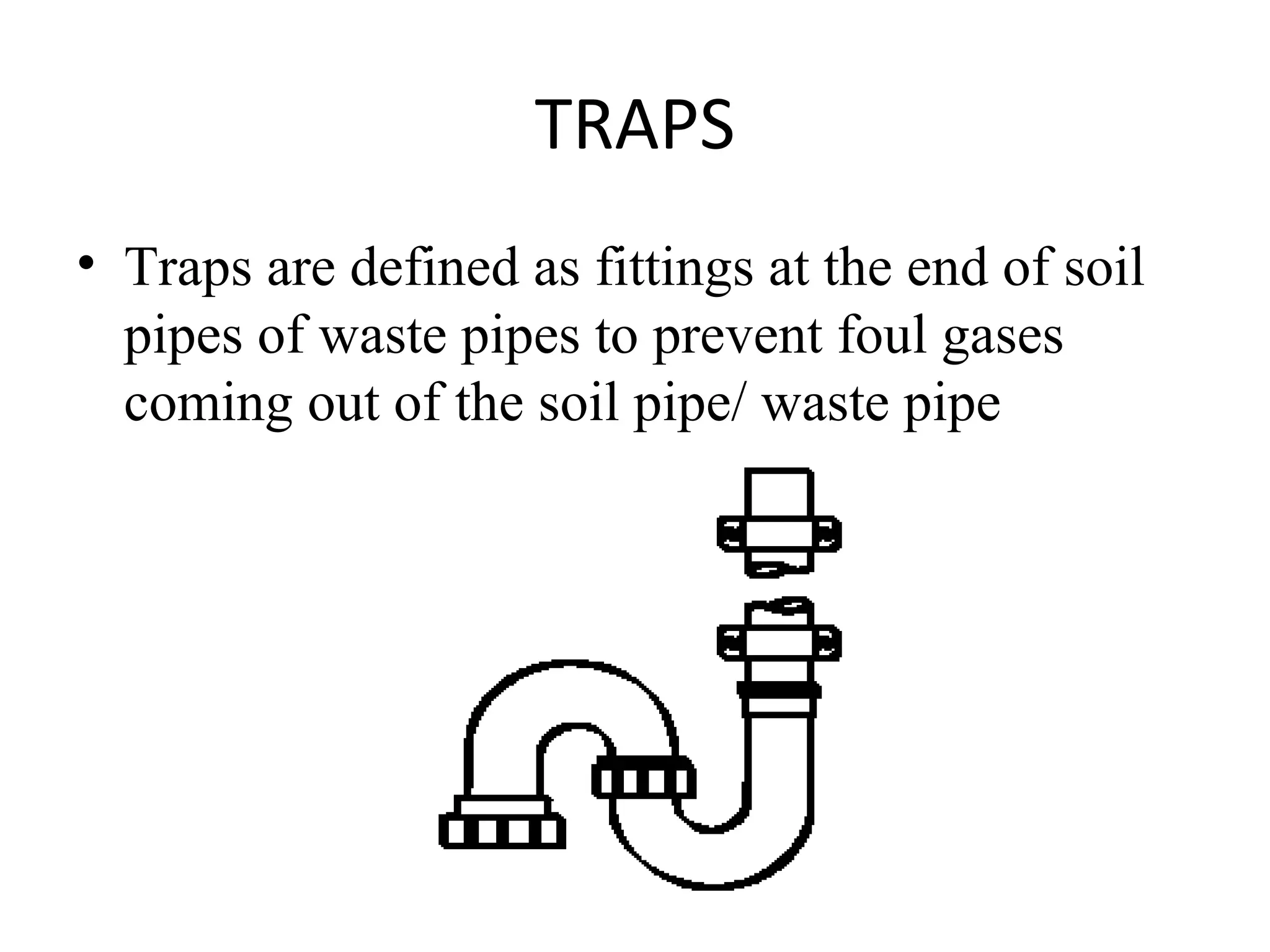
• Traps are defined as fittings at the end of soil
  pipes of waste pipes to prevent foul gases
  coming out of the soil pipe/ waste pipe
TRAPS
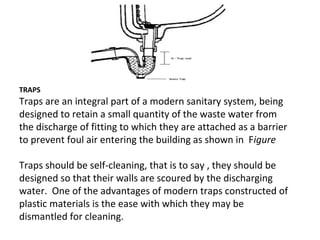
Traps are an integral part of a modern sanitary system, being
designed to retain a small quantity of the waste water from
the discharge of fitting to which they are attached as a barrier
to prevent foul air entering the building as shown in Figure

Traps should be self-cleaning, that is to say , they should be
designed so that their walls are scoured by the discharging
water. One of the advantages of modern traps constructed of
plastic materials is the ease with which they may be
dismantled for cleaning.
Traps And Pipes and other components
       of house Drainage System
• Following are the main components of House drainage
  system.
• Traps: Good Traps should have following Qualities:
• Should provide enough water seal ( around 50 mm)
  with large surface area.
• Interiors surface should be smooth so that the flow is
  not obstructed which enables self cleansing.
• An assess door should be provided for cleaning the
  trap.
• It should be made of non- adsorbent material.
Classification of Traps
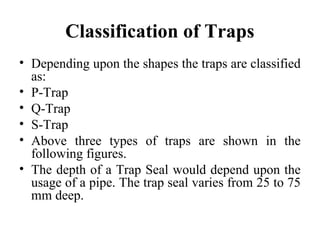
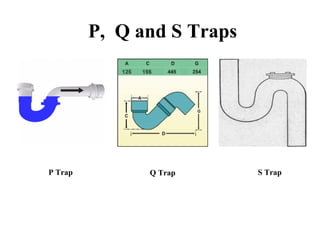
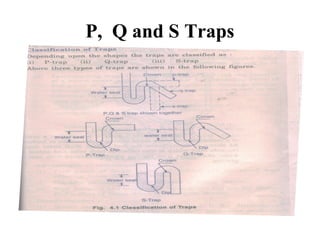
• Depending upon the shapes the traps are classified
  as:
• P-Trap
• Q-Trap
• S-Trap
• Above three types of traps are shown in the
  following figures.
• The depth of a Trap Seal would depend upon the
  usage of a pipe. The trap seal varies from 25 to 75
  mm deep.
P, Q and S Traps


P Trap         Q Trap       S Trap
P, Q and S Traps
Nahni Trap
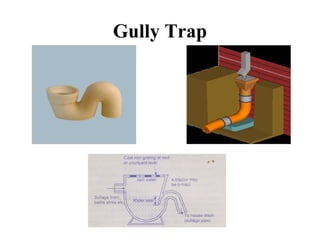
Gully Trap
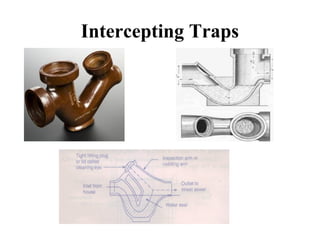
Intercepting Traps
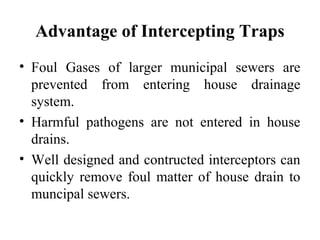
Advantage of Intercepting Traps
• Foul Gases of larger municipal sewers are
  prevented from entering house drainage
  system.
• Harmful pathogens are not entered in house
  drains.
• Well designed and contructed interceptors can
  quickly remove foul matter of house drain to
  muncipal sewers.
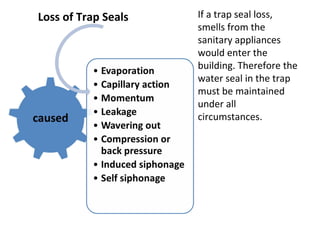
Loss of Trap Seals   If a trap seal loss,
                     smells from the
                     sanitary appliances
                     would enter the
                     building. Therefore the
                     water seal in the trap
                     must be maintained
                     under all
                     circumstances.
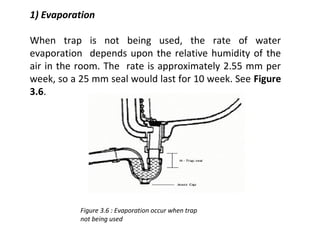
1) Evaporation

When trap is not being used, the rate of water
evaporation depends upon the relative humidity of the
air in the room. The rate is approximately 2.55 mm per
week, so a 25 mm seal would last for 10 week. See Figure
3.6.


           Figure 3.6 : Evaporation occur when trap
           not being used
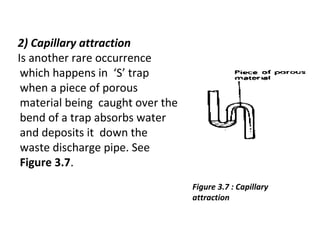
2) Capillary attraction
Is another rare occurrence
 which happens in ‘S’ trap
 when a piece of porous
 material being caught over the
 bend of a trap absorbs water
 and deposits it down the
 waste discharge pipe. See
 Figure 3.7.
                                  Figure 3.7 : Capillary
                                  attraction
3) Momentum                       4) Leakage
This is caused by a sudden        It is caused by a fault in the
discharge of water from a         trap or plumbing installation
bucket. Due to velocity water     and water on the floor would
is discharged and it shoots       be apparent.
around the trap bend and
goes down the waste pipe,
leaving no seal.

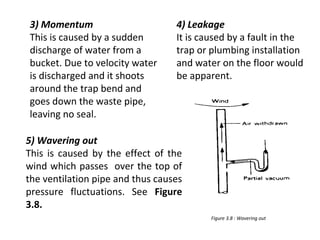
5) Wavering out
This is caused by the effect of the
wind which passes over the top of
the ventilation pipe and thus causes
pressure fluctuations. See Figure
3.8.
                                          Figure 3.8 : Wavering out
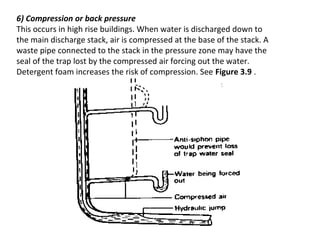
6) Compression or back pressure
This occurs in high rise buildings. When water is discharged down to
the main discharge stack, air is compressed at the base of the stack. A
waste pipe connected to the stack in the pressure zone may have the
seal of the trap lost by the compressed air forcing out the water.
Detergent foam increases the risk of compression. See Figure 3.9 .
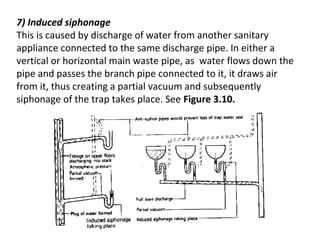
7) Induced siphonage
This is caused by discharge of water from another sanitary
appliance connected to the same discharge pipe. In either a
vertical or horizontal main waste pipe, as water flows down the
pipe and passes the branch pipe connected to it, it draws air
from it, thus creating a partial vacuum and subsequently
siphonage of the trap takes place. See Figure 3.10.
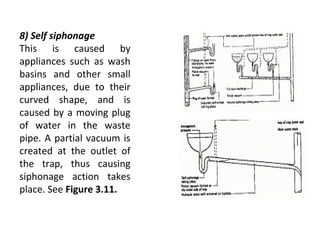
8) Self siphonage
This is caused by
appliances such as wash
basins and other small
appliances, due to their
curved shape, and is
caused by a moving plug
of water in the waste
pipe. A partial vacuum is
created at the outlet of
the trap, thus causing
siphonage action takes
place. See Figure 3.11.
Thank you

Traps

  • 1.
    TRAPS • Traps aredefined as fittings at the end of soil pipes of waste pipes to prevent foul gases coming out of the soil pipe/ waste pipe
  • 2.
    TRAPS Traps are anintegral part of a modern sanitary system, being designed to retain a small quantity of the waste water from the discharge of fitting to which they are attached as a barrier to prevent foul air entering the building as shown in Figure Traps should be self-cleaning, that is to say , they should be designed so that their walls are scoured by the discharging water. One of the advantages of modern traps constructed of plastic materials is the ease with which they may be dismantled for cleaning.
  • 3.
    Traps And Pipesand other components of house Drainage System • Following are the main components of House drainage system. • Traps: Good Traps should have following Qualities: • Should provide enough water seal ( around 50 mm) with large surface area. • Interiors surface should be smooth so that the flow is not obstructed which enables self cleansing. • An assess door should be provided for cleaning the trap. • It should be made of non- adsorbent material.
  • 4.
    Classification of Traps •Depending upon the shapes the traps are classified as: • P-Trap • Q-Trap • S-Trap • Above three types of traps are shown in the following figures. • The depth of a Trap Seal would depend upon the usage of a pipe. The trap seal varies from 25 to 75 mm deep.
  • 5.
    P, Q andS Traps P Trap Q Trap S Trap
  • 6.
    P, Q andS Traps
  • 7.
  • 8.
  • 9.
  • 10.
    Advantage of InterceptingTraps • Foul Gases of larger municipal sewers are prevented from entering house drainage system. • Harmful pathogens are not entered in house drains. • Well designed and contructed interceptors can quickly remove foul matter of house drain to muncipal sewers.
  • 11.
    Loss of TrapSeals If a trap seal loss, smells from the sanitary appliances would enter the building. Therefore the water seal in the trap must be maintained under all circumstances.
  • 12.
    1) Evaporation When trapis not being used, the rate of water evaporation depends upon the relative humidity of the air in the room. The rate is approximately 2.55 mm per week, so a 25 mm seal would last for 10 week. See Figure 3.6. Figure 3.6 : Evaporation occur when trap not being used
  • 13.
    2) Capillary attraction Isanother rare occurrence which happens in ‘S’ trap when a piece of porous material being caught over the bend of a trap absorbs water and deposits it down the waste discharge pipe. See Figure 3.7. Figure 3.7 : Capillary attraction
  • 14.
    3) Momentum 4) Leakage This is caused by a sudden It is caused by a fault in the discharge of water from a trap or plumbing installation bucket. Due to velocity water and water on the floor would is discharged and it shoots be apparent. around the trap bend and goes down the waste pipe, leaving no seal. 5) Wavering out This is caused by the effect of the wind which passes over the top of the ventilation pipe and thus causes pressure fluctuations. See Figure 3.8. Figure 3.8 : Wavering out
  • 15.
    6) Compression orback pressure This occurs in high rise buildings. When water is discharged down to the main discharge stack, air is compressed at the base of the stack. A waste pipe connected to the stack in the pressure zone may have the seal of the trap lost by the compressed air forcing out the water. Detergent foam increases the risk of compression. See Figure 3.9 .
  • 16.
    7) Induced siphonage Thisis caused by discharge of water from another sanitary appliance connected to the same discharge pipe. In either a vertical or horizontal main waste pipe, as water flows down the pipe and passes the branch pipe connected to it, it draws air from it, thus creating a partial vacuum and subsequently siphonage of the trap takes place. See Figure 3.10.
  • 17.
    8) Self siphonage Thisis caused by appliances such as wash basins and other small appliances, due to their curved shape, and is caused by a moving plug of water in the waste pipe. A partial vacuum is created at the outlet of the trap, thus causing siphonage action takes place. See Figure 3.11.
  • 18.