PRINCIPLES OF CIVIL
ENGINEERING PLANNING
1
Principles of Building planning: Why???
• Planning in construction is the first thing to do.
• Proper orientation, healthy, beautiful, economical etc. is our target.
• An engineer or architect should prepare the building plan according to
the demand, economic status & taste of the owner.
• The design of the building should be compatible with the surrounding
structures & the weather.
2
Cont’d…
• Privacy must be maintained especially in residential building planning.
• Sufficient air and sunlight should be allowed to the building for healthy
building environment.
• Proper security system should be introduced for safety and reliability.
• Fire safety alarm and fire fighting materials should be provided.
• Follow the associated building codes closely for proper building
construction. Example: Civil Engineering Codes, NBC etc.
3
Outline
• Aspect
• Prospect
• Grouping
• Economy
• Roominess
• Circulation
• Flexibility
• Furniture requirement
• Elegance
• Privacy
• Sanitation
4
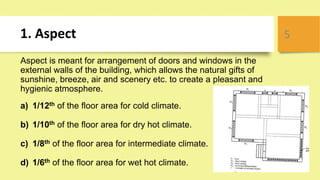
1. Aspect
Aspect is meant for arrangement of doors and windows in the
external walls of the building, which allows the natural gifts of
sunshine, breeze, air and scenery etc. to create a pleasant and
hygienic atmosphere.
a) 1/12th of the floor area for cold climate.
b) 1/10th of the floor area for dry hot climate.
c) 1/8th of the floor area for intermediate climate.
d) 1/6th of the floor area for wet hot climate.
5
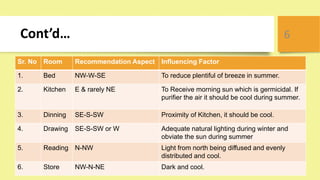
Sr. No Room Recommendation Aspect Influencing Factor
1. Bed NW-W-SE To reduce plentiful of breeze in summer.
2. Kitchen E & rarely NE To Receive morning sun which is germicidal. If
purifier the air it should be cool during summer.
3. Dinning SE-S-SW Proximity of Kitchen, it should be cool.
4. Drawing SE-S-SW or W Adequate natural lighting during winter and
obviate the sun during summer
5. Reading N-NW Light from north being diffused and evenly
distributed and cool.
6. Store NW-N-NE Dark and cool.
6Cont’d…
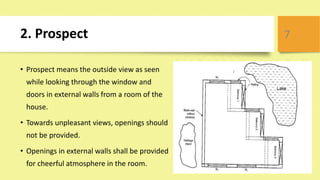
2. Prospect
• Prospect means the outside view as seen
while looking through the window and
doors in external walls from a room of the
house.
• Towards unpleasant views, openings should
not be provided.
• Openings in external walls shall be provided
for cheerful atmosphere in the room.
7
3. Grouping
It is the arrangement of various rooms with reference to their
function.
For residential building planning should be grouped as:
a) Living area
b) Sleeping area
c) Service area
d) Circulation area
e) Other areas
8
4. Economy
Building should have min floor area with max utility.
• Can be achieved by:
1. Simple elevation
2. Proper planning and utility of space being
maximized (passage being minimized).
3. Reducing storey height
4. Reducing no of steps of stairs
5. Standardization of sizes of various components
and materials
9
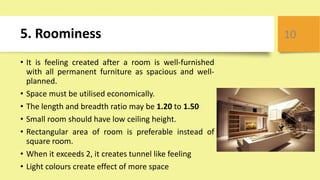
5. Roominess
• It is feeling created after a room is well-furnished
with all permanent furniture as spacious and well-
planned.
• Space must be utilised economically.
• The length and breadth ratio may be 1.20 to 1.50
• Small room should have low ceiling height.
• Rectangular area of room is preferable instead of
square room.
• When it exceeds 2, it creates tunnel like feeling
• Light colours create effect of more space
10
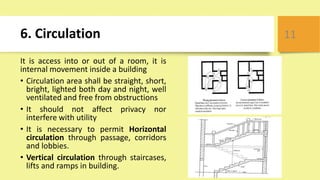
6. Circulation
It is access into or out of a room, it is
internal movement inside a building
• Circulation area shall be straight, short,
bright, lighted both day and night, well
ventilated and free from obstructions
• It should not affect privacy nor
interfere with utility
• It is necessary to permit Horizontal
circulation through passage, corridors
and lobbies.
• Vertical circulation through staircases,
lifts and ramps in building.
11
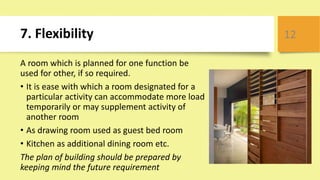
7. Flexibility
A room which is planned for one function be
used for other, if so required.
• It is ease with which a room designated for a
particular activity can accommodate more load
temporarily or may supplement activity of
another room
• As drawing room used as guest bed room
• Kitchen as additional dining room etc.
The plan of building should be prepared by
keeping mind the future requirement
12
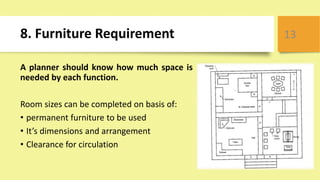
8. Furniture Requirement
A planner should know how much space is
needed by each function.
Room sizes can be completed on basis of:
• permanent furniture to be used
• It’s dimensions and arrangement
• Clearance for circulation
13
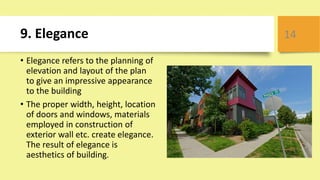
9. Elegance
• Elegance refers to the planning of
elevation and layout of the plan
to give an impressive appearance
to the building
• The proper width, height, location
of doors and windows, materials
employed in construction of
exterior wall etc. create elegance.
The result of elegance is
aesthetics of building.
14
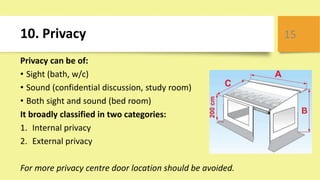
10. Privacy
Privacy can be of:
• Sight (bath, w/c)
• Sound (confidential discussion, study room)
• Both sight and sound (bed room)
It broadly classified in two categories:
1. Internal privacy
2. External privacy
For more privacy centre door location should be avoided.
15
11. Sanitation
It is provision and upkeep of various components of
house to keep inmates cheerful and free from disease
Factors influence sanitation are:
1. Lighting
2. Ventilation
3. Cleanliness
16
1. Lighting:
Natural sunlight or Artificial
• Intensity of natural light is affected by pollutants like
smoke, dirt, dust, gases and clouds
• Min window area = 1/7th floor area (hot-humid climate)
• Min window area = 1/10th floor area (dry climate)
17
2. Ventilation:
A system of supplying or removing air by natural or mechanical
means to or from any enclosed space to create and maintain
comfortable condition
Basic requirements in ventilation
• Sensation of comfort
• Reduction in humidity
• Removal of heat
• Proper supply of oxygen
• Reduction of dust
18
3. Cleanliness:
Dust:
• Harbours bacteria
• Creates health problems
• Makes surfaces dull
• Floors shall be smooth,
impervious, non-absorbing,
uniformly sloping
19
Dampness:
• Root cause of infection
• Walls and floors shall be damp-proof
• Kitchen, bath and w/c shall be
drained off quickly

Lecture5 principles of planning

  • 1.
  • 2.
    Principles of Buildingplanning: Why??? • Planning in construction is the first thing to do. • Proper orientation, healthy, beautiful, economical etc. is our target. • An engineer or architect should prepare the building plan according to the demand, economic status & taste of the owner. • The design of the building should be compatible with the surrounding structures & the weather. 2
  • 3.
    Cont’d… • Privacy mustbe maintained especially in residential building planning. • Sufficient air and sunlight should be allowed to the building for healthy building environment. • Proper security system should be introduced for safety and reliability. • Fire safety alarm and fire fighting materials should be provided. • Follow the associated building codes closely for proper building construction. Example: Civil Engineering Codes, NBC etc. 3
  • 4.
    Outline • Aspect • Prospect •Grouping • Economy • Roominess • Circulation • Flexibility • Furniture requirement • Elegance • Privacy • Sanitation 4
  • 5.
    1. Aspect Aspect ismeant for arrangement of doors and windows in the external walls of the building, which allows the natural gifts of sunshine, breeze, air and scenery etc. to create a pleasant and hygienic atmosphere. a) 1/12th of the floor area for cold climate. b) 1/10th of the floor area for dry hot climate. c) 1/8th of the floor area for intermediate climate. d) 1/6th of the floor area for wet hot climate. 5
  • 6.
    Sr. No RoomRecommendation Aspect Influencing Factor 1. Bed NW-W-SE To reduce plentiful of breeze in summer. 2. Kitchen E & rarely NE To Receive morning sun which is germicidal. If purifier the air it should be cool during summer. 3. Dinning SE-S-SW Proximity of Kitchen, it should be cool. 4. Drawing SE-S-SW or W Adequate natural lighting during winter and obviate the sun during summer 5. Reading N-NW Light from north being diffused and evenly distributed and cool. 6. Store NW-N-NE Dark and cool. 6Cont’d…
  • 7.
    2. Prospect • Prospectmeans the outside view as seen while looking through the window and doors in external walls from a room of the house. • Towards unpleasant views, openings should not be provided. • Openings in external walls shall be provided for cheerful atmosphere in the room. 7
  • 8.
    3. Grouping It isthe arrangement of various rooms with reference to their function. For residential building planning should be grouped as: a) Living area b) Sleeping area c) Service area d) Circulation area e) Other areas 8
  • 9.
    4. Economy Building shouldhave min floor area with max utility. • Can be achieved by: 1. Simple elevation 2. Proper planning and utility of space being maximized (passage being minimized). 3. Reducing storey height 4. Reducing no of steps of stairs 5. Standardization of sizes of various components and materials 9
  • 10.
    5. Roominess • Itis feeling created after a room is well-furnished with all permanent furniture as spacious and well- planned. • Space must be utilised economically. • The length and breadth ratio may be 1.20 to 1.50 • Small room should have low ceiling height. • Rectangular area of room is preferable instead of square room. • When it exceeds 2, it creates tunnel like feeling • Light colours create effect of more space 10
  • 11.
    6. Circulation It isaccess into or out of a room, it is internal movement inside a building • Circulation area shall be straight, short, bright, lighted both day and night, well ventilated and free from obstructions • It should not affect privacy nor interfere with utility • It is necessary to permit Horizontal circulation through passage, corridors and lobbies. • Vertical circulation through staircases, lifts and ramps in building. 11
  • 12.
    7. Flexibility A roomwhich is planned for one function be used for other, if so required. • It is ease with which a room designated for a particular activity can accommodate more load temporarily or may supplement activity of another room • As drawing room used as guest bed room • Kitchen as additional dining room etc. The plan of building should be prepared by keeping mind the future requirement 12
  • 13.
    8. Furniture Requirement Aplanner should know how much space is needed by each function. Room sizes can be completed on basis of: • permanent furniture to be used • It’s dimensions and arrangement • Clearance for circulation 13
  • 14.
    9. Elegance • Elegancerefers to the planning of elevation and layout of the plan to give an impressive appearance to the building • The proper width, height, location of doors and windows, materials employed in construction of exterior wall etc. create elegance. The result of elegance is aesthetics of building. 14
  • 15.
    10. Privacy Privacy canbe of: • Sight (bath, w/c) • Sound (confidential discussion, study room) • Both sight and sound (bed room) It broadly classified in two categories: 1. Internal privacy 2. External privacy For more privacy centre door location should be avoided. 15
  • 16.
    11. Sanitation It isprovision and upkeep of various components of house to keep inmates cheerful and free from disease Factors influence sanitation are: 1. Lighting 2. Ventilation 3. Cleanliness 16
  • 17.
    1. Lighting: Natural sunlightor Artificial • Intensity of natural light is affected by pollutants like smoke, dirt, dust, gases and clouds • Min window area = 1/7th floor area (hot-humid climate) • Min window area = 1/10th floor area (dry climate) 17
  • 18.
    2. Ventilation: A systemof supplying or removing air by natural or mechanical means to or from any enclosed space to create and maintain comfortable condition Basic requirements in ventilation • Sensation of comfort • Reduction in humidity • Removal of heat • Proper supply of oxygen • Reduction of dust 18
  • 19.
    3. Cleanliness: Dust: • Harboursbacteria • Creates health problems • Makes surfaces dull • Floors shall be smooth, impervious, non-absorbing, uniformly sloping 19 Dampness: • Root cause of infection • Walls and floors shall be damp-proof • Kitchen, bath and w/c shall be drained off quickly