Composting
Prof. Mrs. D. A. Latthe
Assistant Professor
Dr. JJMCOE, Jaysingpur
Composting
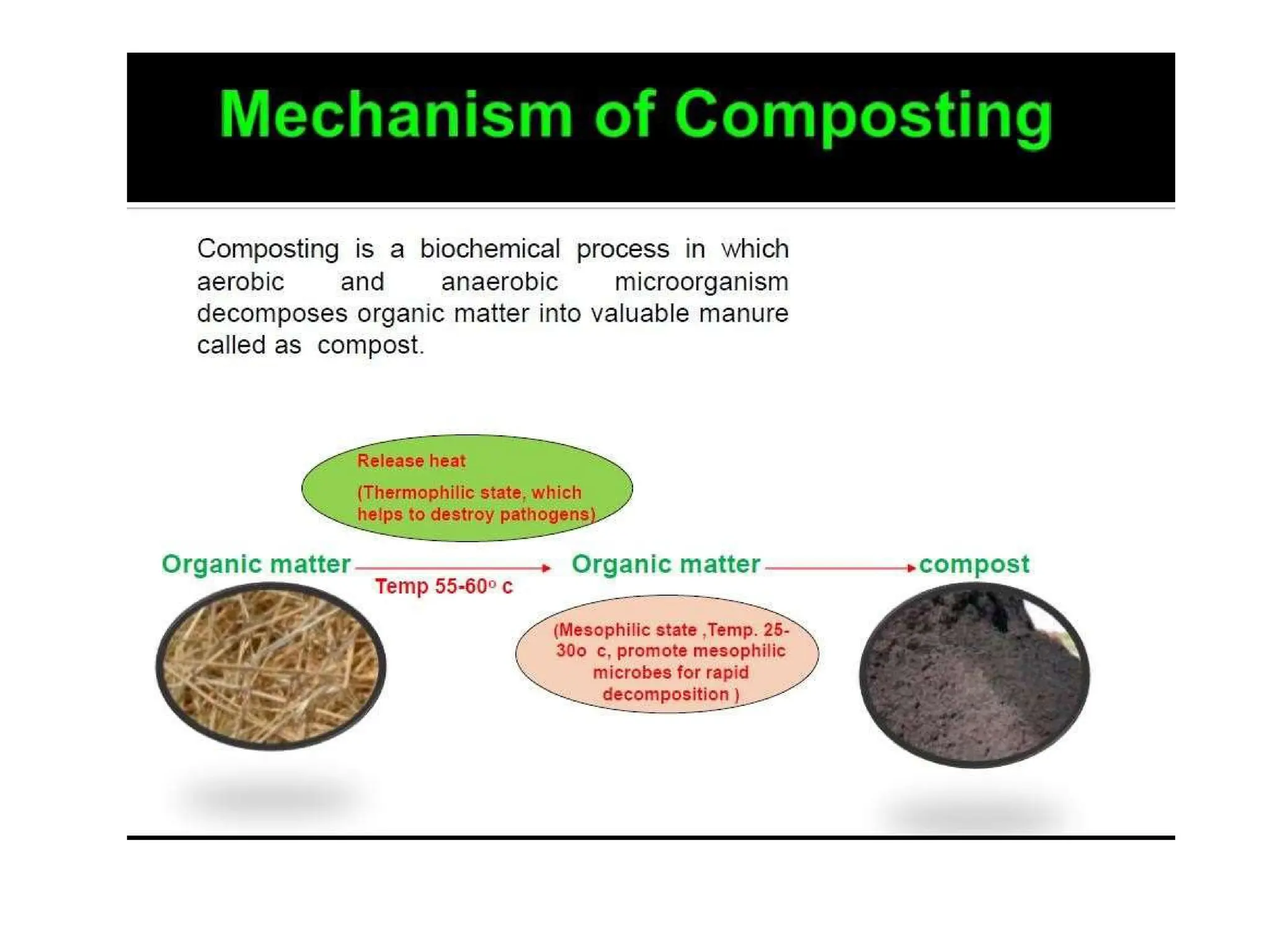
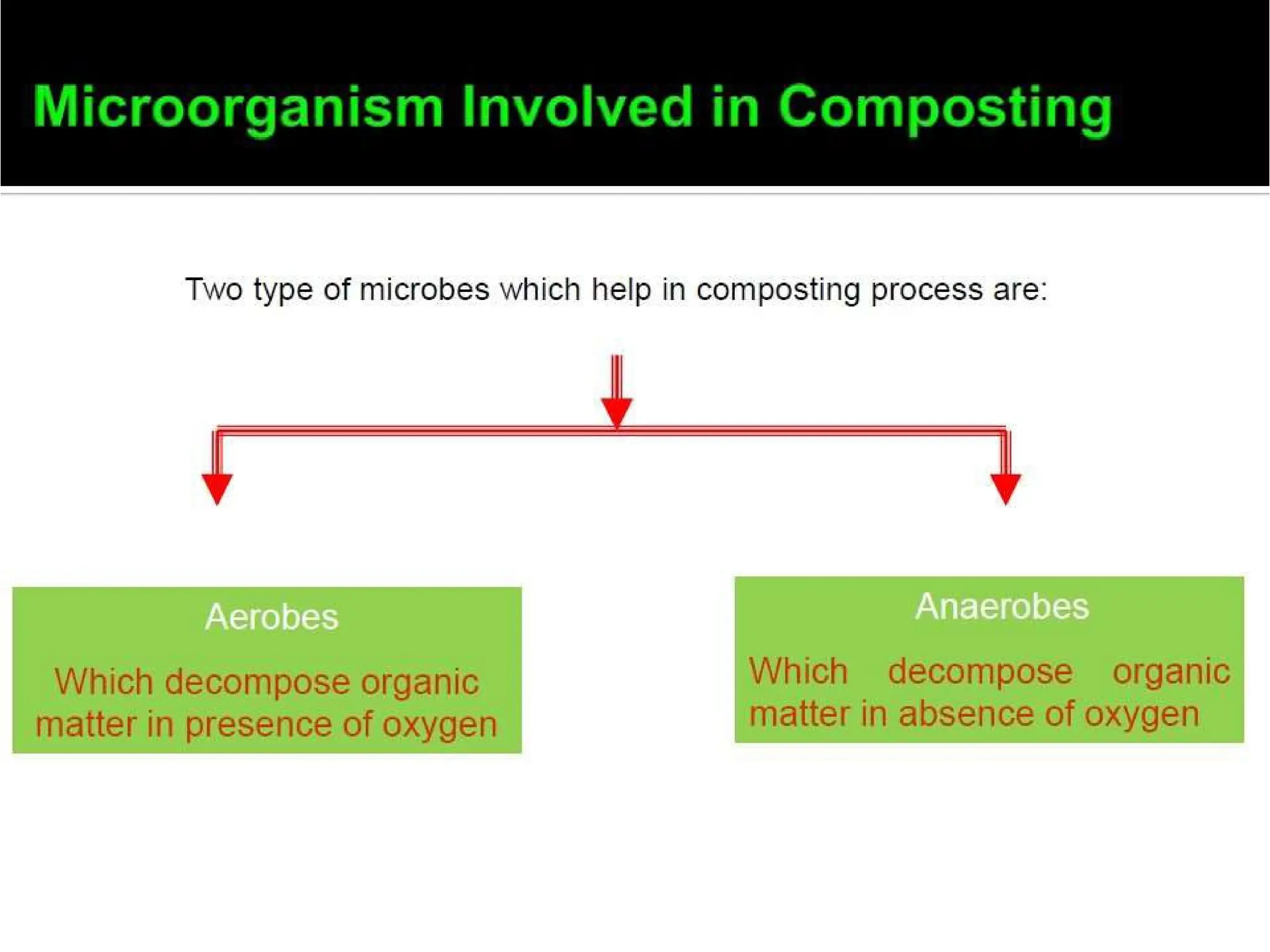
• Composting is the managed, aerobic (oxygen-
required) biological decomposition of organic
materials by microorganisms. Organic (carbon-
based) materials include grass clippings,
leaves, yard and tree trimmings, and food
scraps.
• To derive the maximum benefit from the
natural, but typically slow decomposition
process (e.g., grass clippings left in the lawn or
food scraps rotting in dustbins, etc.), it is
necessary to control the environmental
conditions during the composting process.
• The overall composting process can be
explained as follows:
• Organic matter + O2 + aerobic bacteria CO2 +
NH3 + H2O + other end products + energy
• Compost is the end product of the composting
process
• Compost is peaty humus, dark in colour and has a
crumbly texture, an earthy odour, and resembles
rich topsoil.
• Composts will not have any resemblance in the
physical form to the original waste from which it
was derived.
• High-quality compost is devoid of weed seeds and
organisms that may be pathogenic to humans,
animals, or plants.
• Cured compost is also relatively stable and
resistant to further decomposition by
microorganisms.
Benefits Composting
• It is a form of source reduction or waste
prevention, as the materials are completely
diverted from the disposal facilities and
require no management or transportation.
• A major portion of municipal solid wastes in
India contain up to 70% by weight of organic
materials.
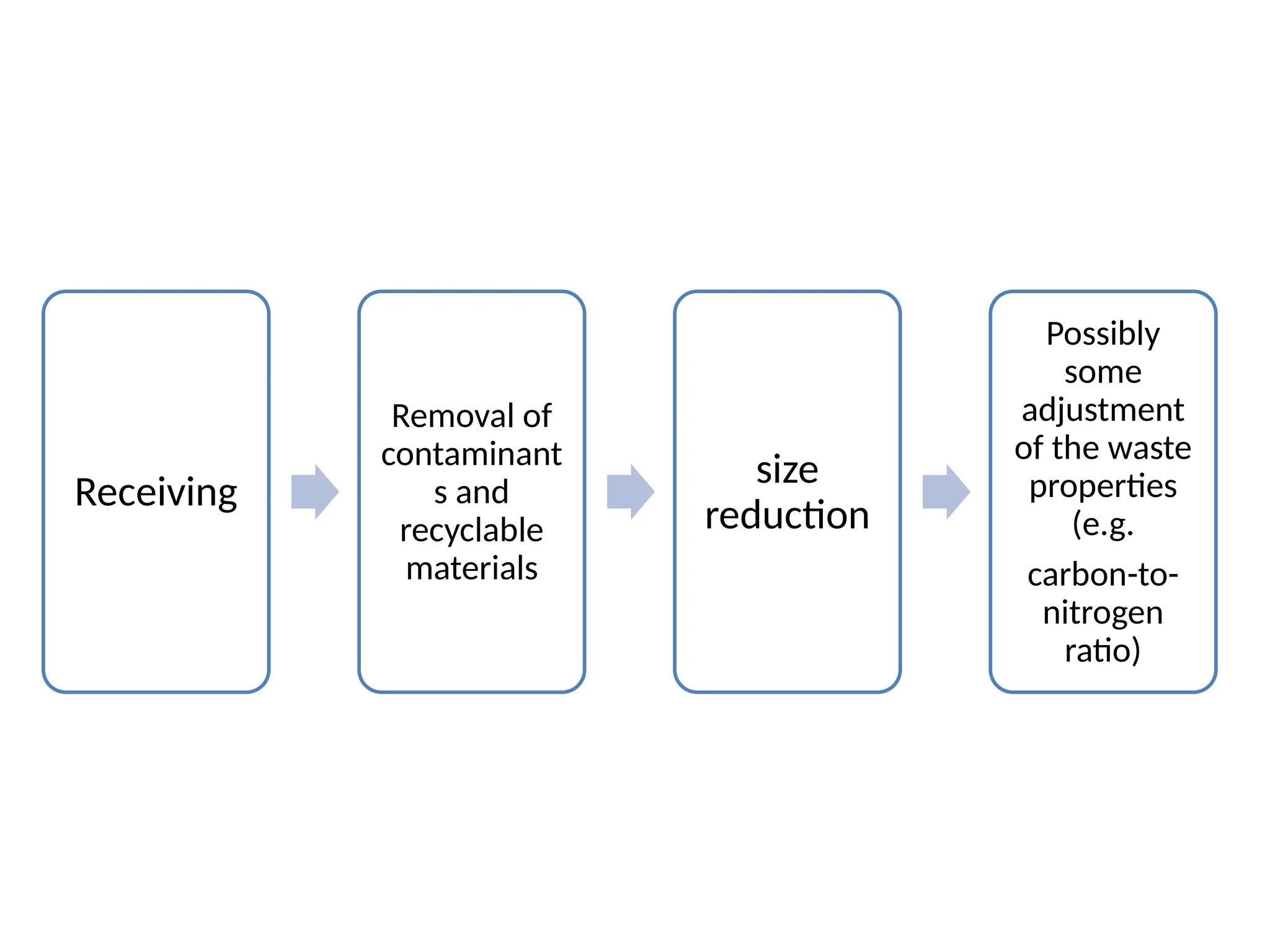
Receiving
Removal of
contaminant
s and
recyclable
materials
size
reduction
Possibly
some
adjustment
of the waste
properties
(e.g.
carbon-to-
nitrogen
ratio)
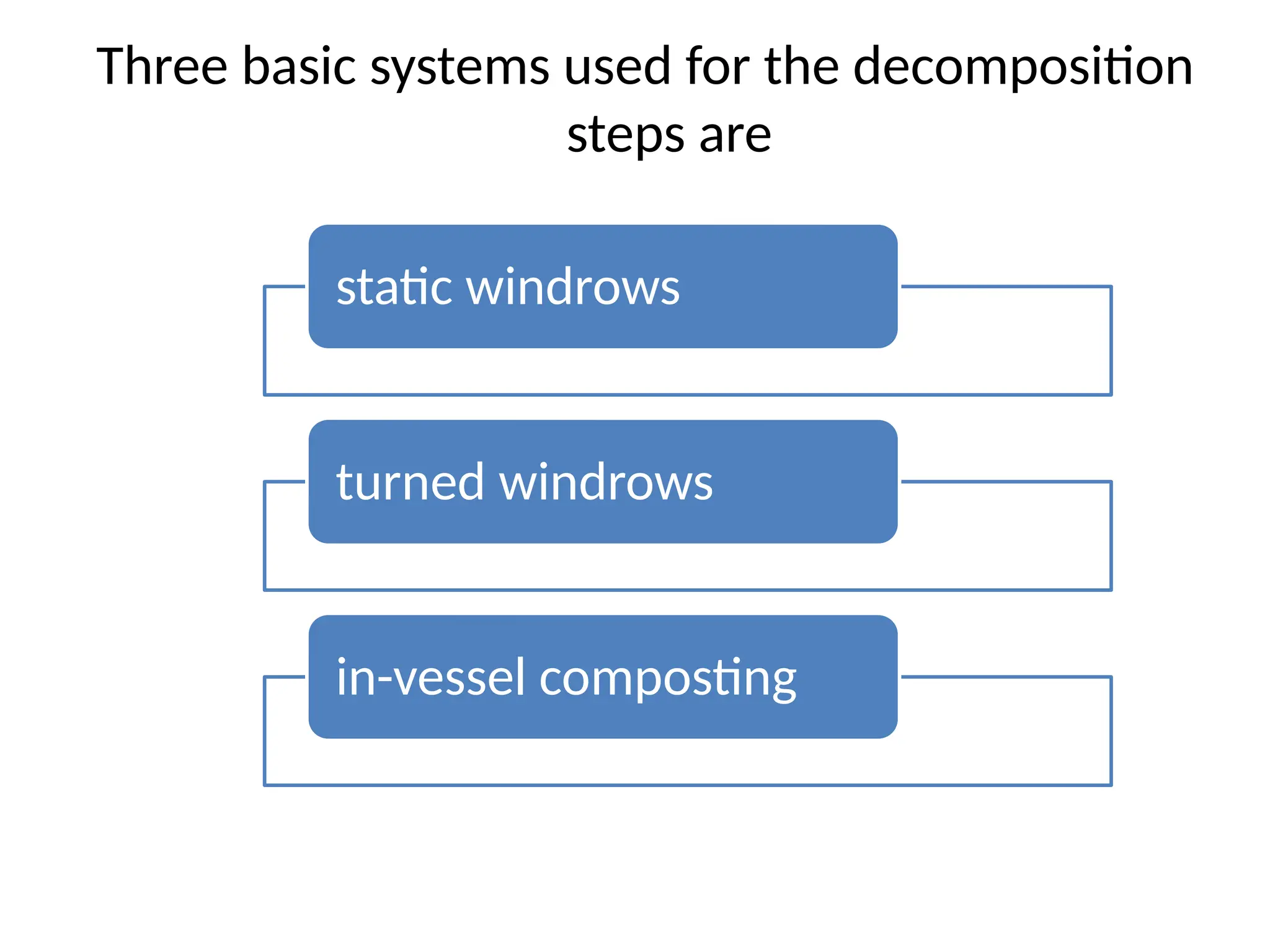
Three basic systems used for the decomposition
steps are
static windrows
turned windrows
in-vessel composting
Classification
• The compost process can be classified in terms
of -
1. Distinguishing and in terms oftechnology.
2. Cultural conditions
Aerobic Vs. Anaerobic
Mesophylic Vs. Thermophylic.
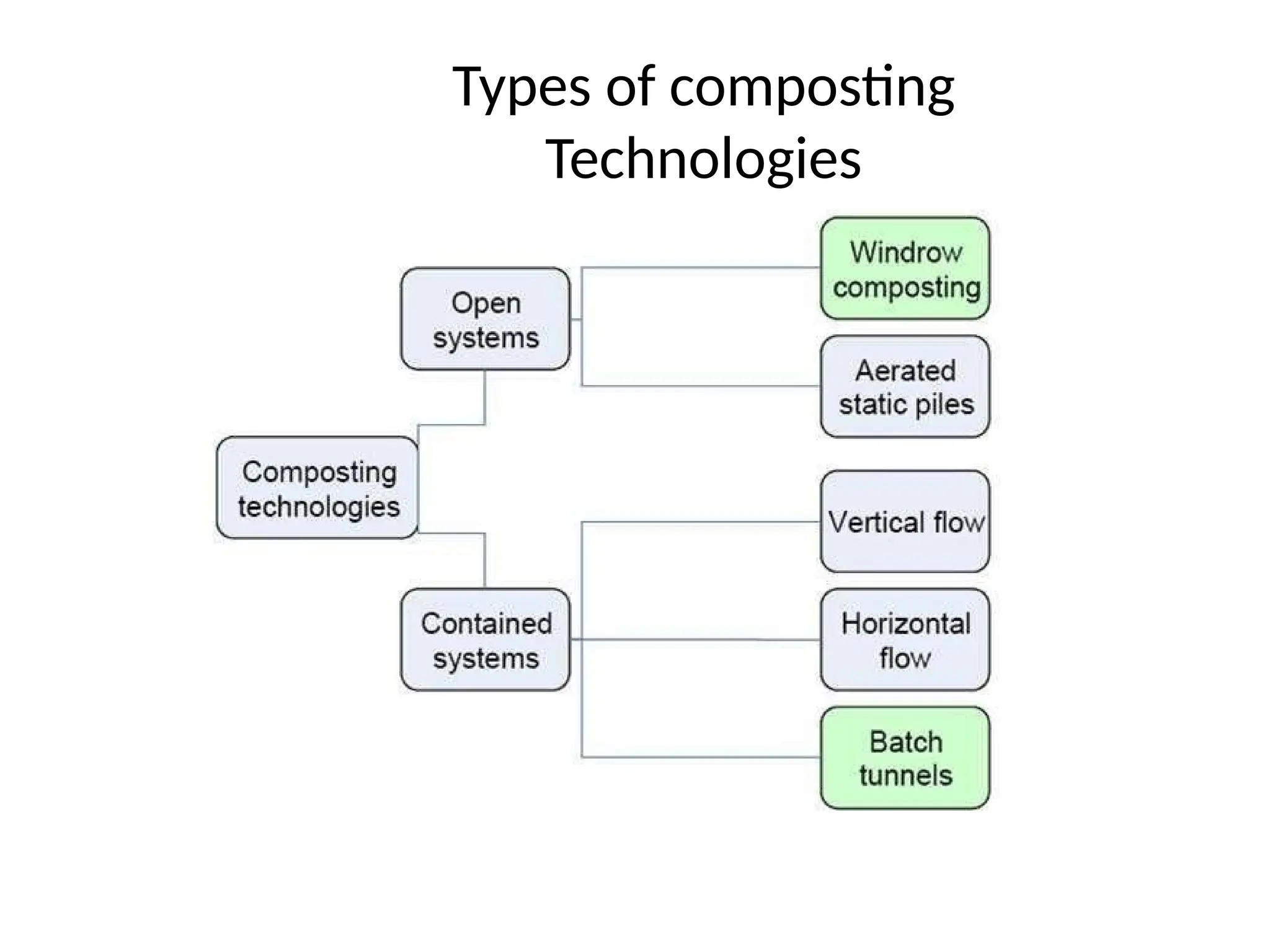
Types of composting
Technologies
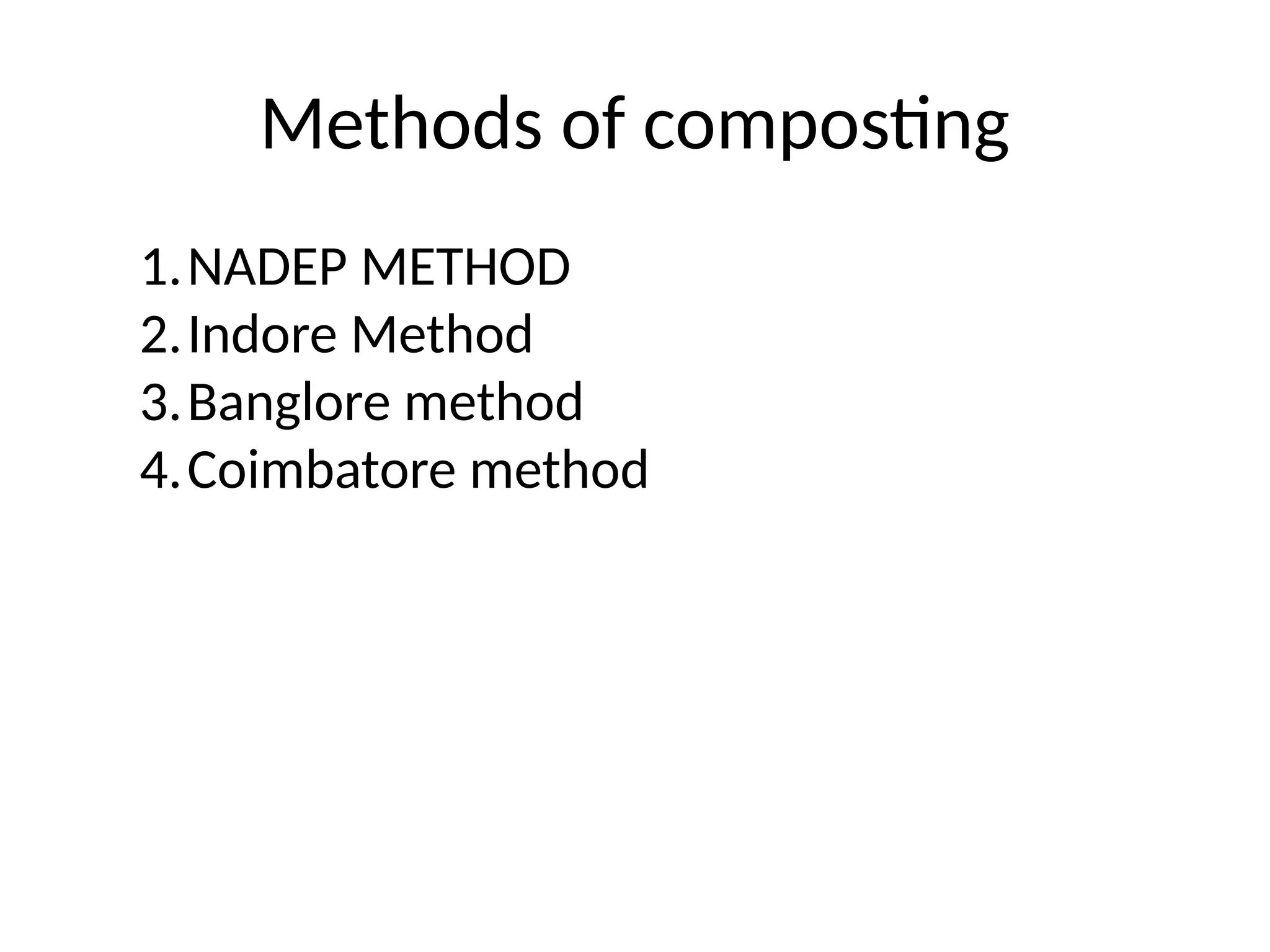
Methods of composting
1.NADEP METHOD
2.Indore Method
3.Banglore method
4.Coimbatore method
Classification of Compost Systems.
Compost systems fall into two verybroad groups,
(1) windrow and
(2) in-vessel
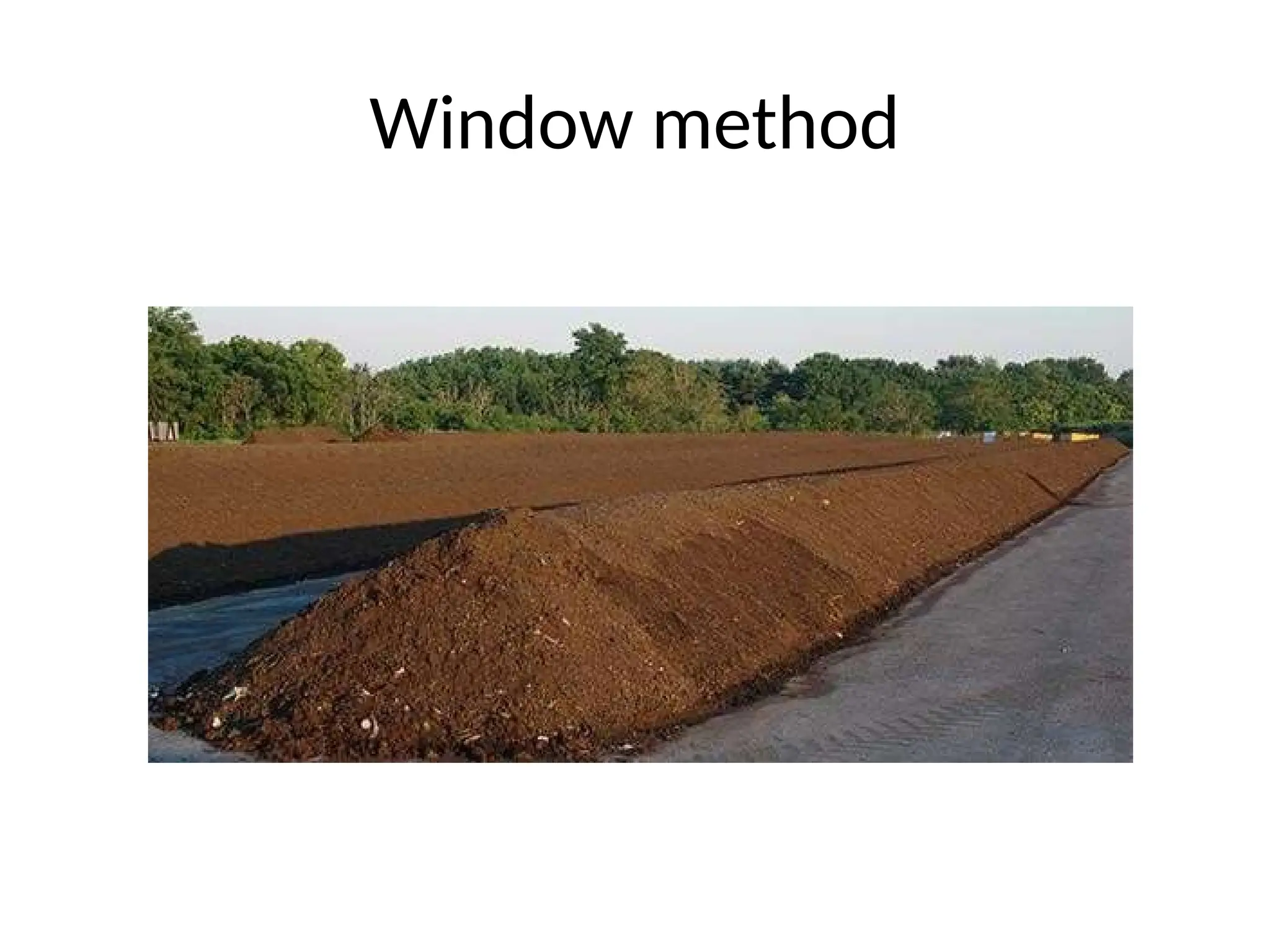
Window method
Windraw composting-Aerated
• At its simplest, shredded and/or screened refuse or source
separated organic waste is placed in long parallel piles,
called windrows,
moisture content is maintained near 50%.
• The piles are periodically aerated by fluffing and moving the
material around.
• After several weeks, such accelerated aerobic
decomposition results in a dark brown earthy- smelling
material that has low nutrient value but is an excellent soil
conditioner.
Typically, windrows are constructed of sorted and shredded MSW,
mixed with wastewater sludge, and laid in long rows of about 4 to
6 ft (1.2 to 2 m) high. Because the reaction is aerobic, oxygen must
be made available to the microorganisms, and this is done either
by turning the pile with a specially constructed agitator or by
placing the pile on PVC pipes so that air can be pulled through the
pile. This is called the aerated static pile composting method.
Both of these operations offer the advantage of-
• low capital cost and the simultaneous use of wastewater
sludge,
• but the operating cost can be high, and odor problems can be
serious if the piles are not sufficiently well aerated
In-vessel composting
More sophisticated are the in-vessel composting plants.
• In one in-vessel process, the shredded and sorted refuse is mixed in an
aerobic
digester with air being injected through hollow augers.
• The residence time within such a unit is short—often as little as 24 hours
but usually more like 5 days—and the rate of decomposition is quite rapid.
• Typically, the composted material is removed from the aerobic digester and
allowed to cure in windrows for several weeks prior to sale or disposal.
• A different mechanical technique uses a long rotary drum in which the
MSW is slowly turned in a long barrel during a 24-hour detention time.
• Some of these units use refuse in the unshredded and unsorted state with
perhaps only a bag opener preceding the composting barrel and screens
following digestion.
• As before, the screened fines must then be stored in windrows for several
weeks prior to use. The rejects from the screens are sent to a landfill
Indore method
• Waste materials are chopped into 5-10 cm pieces and
dried to 40-50 % moisture level. They are spread in
layers of 10-15 cm thickness either in pits or in heaps
of 1 m width, 4-5 m length and 1 m depth. The heap is
properly moistened with dung using earth or night soil.
• Sufficient quantity of water is sprinkled over the heap
to wet the composting materials to the level of 50 %
moisture.
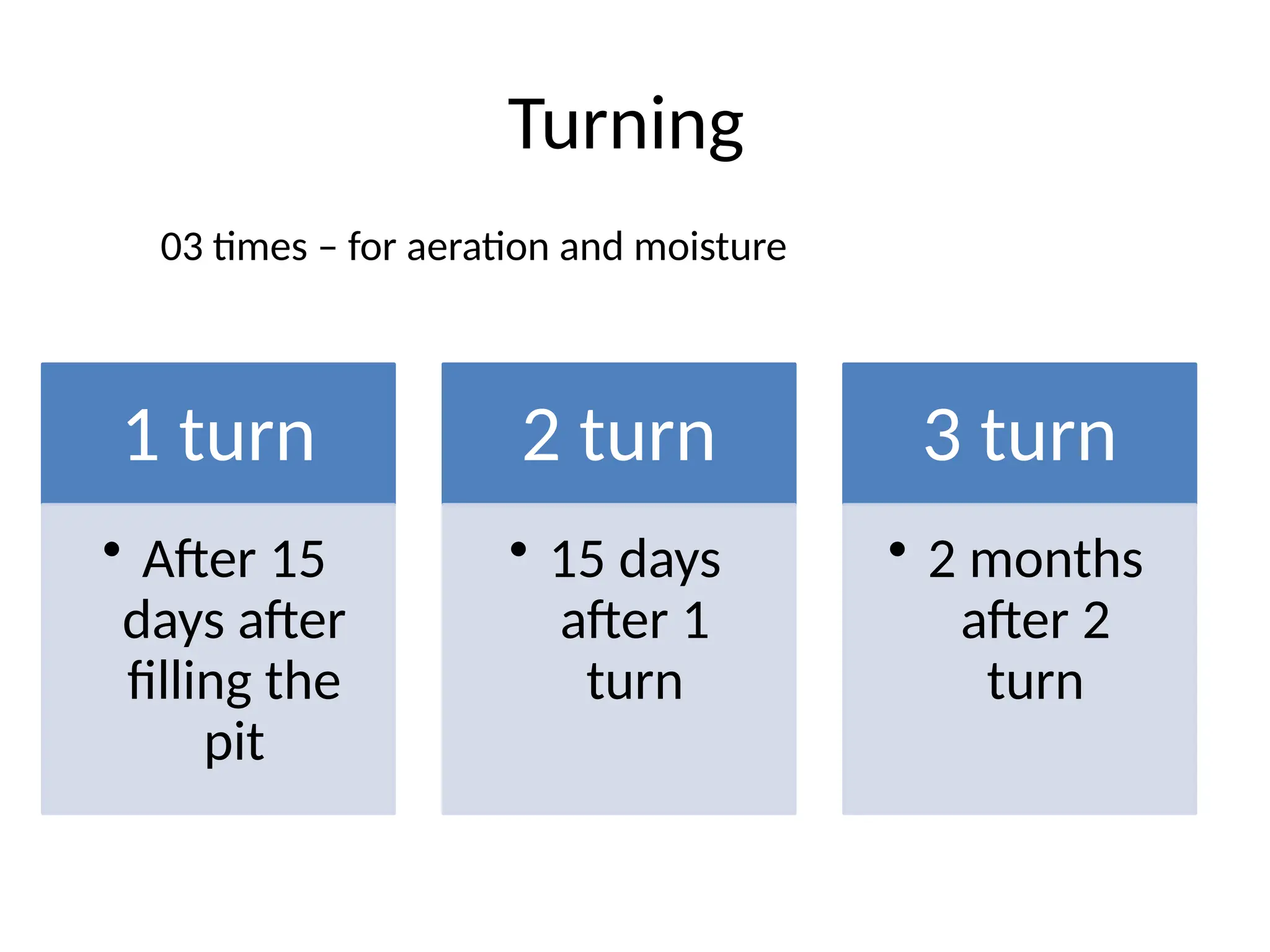
• Periodical turnings (15, 30 and 60 days) are given to
aerate and material is covered with a thin layer of soil
(2-3 thickness).
• The average composition of manure: 0.8% N, 0.3% P2O
and 1.5 % K2O, respectively.
Disadvantages
1. Requires labor for turning
2. Not practicable if large quantity of material is
there Site should be at elevated level
3. Near a cattle shed and water source.
Benefits
• Reduced cash expenses on chemical fertilizer,
improved soil fertility, increased crop yield.
• Supports organic crop production, reduced
dependence on outside inputs.
• From each NADEP tank approximately 2.5 tons of
compost is prepared with in 90-120 days.
• The use of compost reduced the need for mineral
fertilizer thus reducing production costs and outside
dependence.
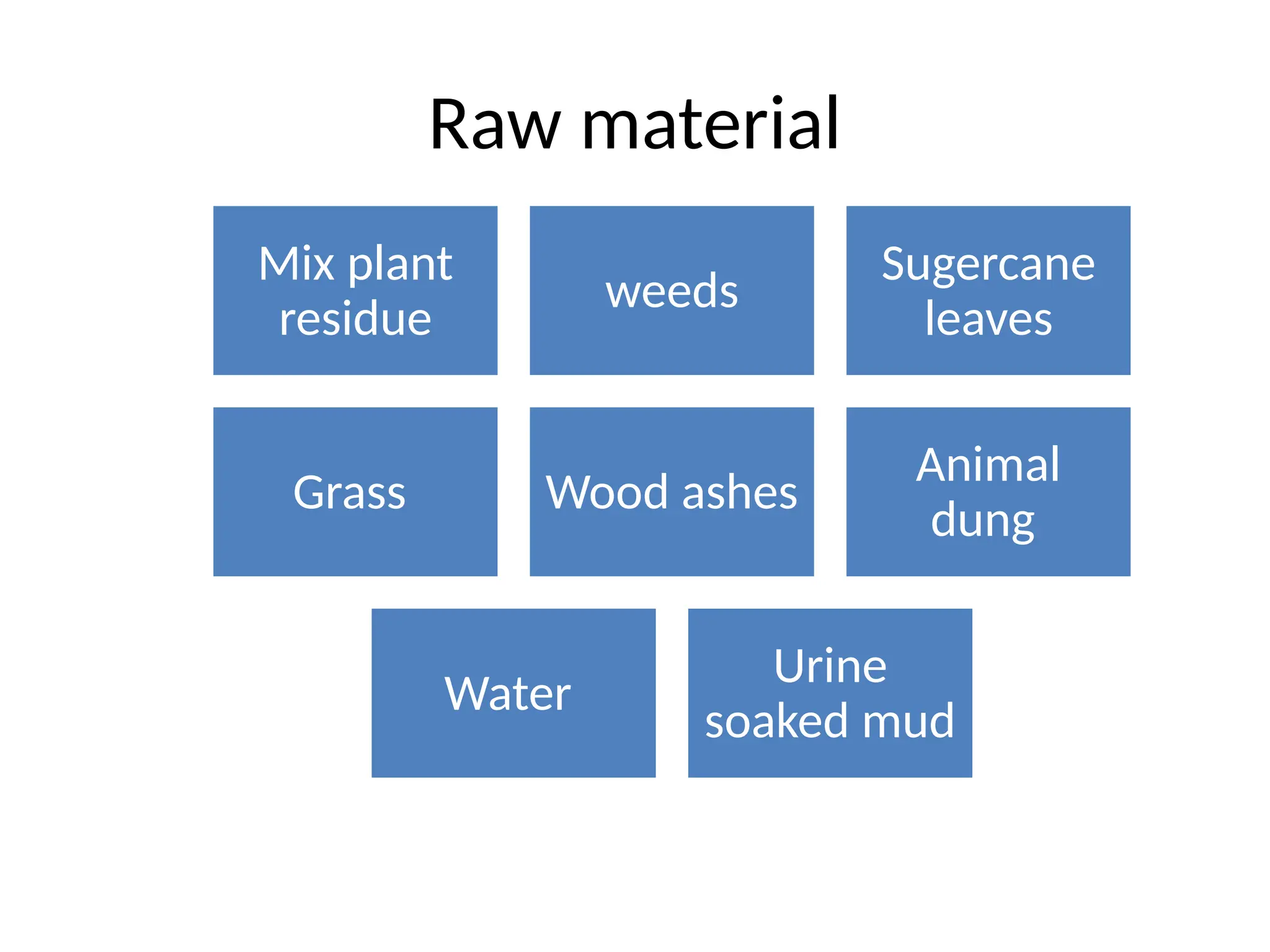
Raw material
Mix plant
residue
weeds
Sugercane
leaves
Grass Wood ashes
Animal
dung
Water
Urine
soaked mud
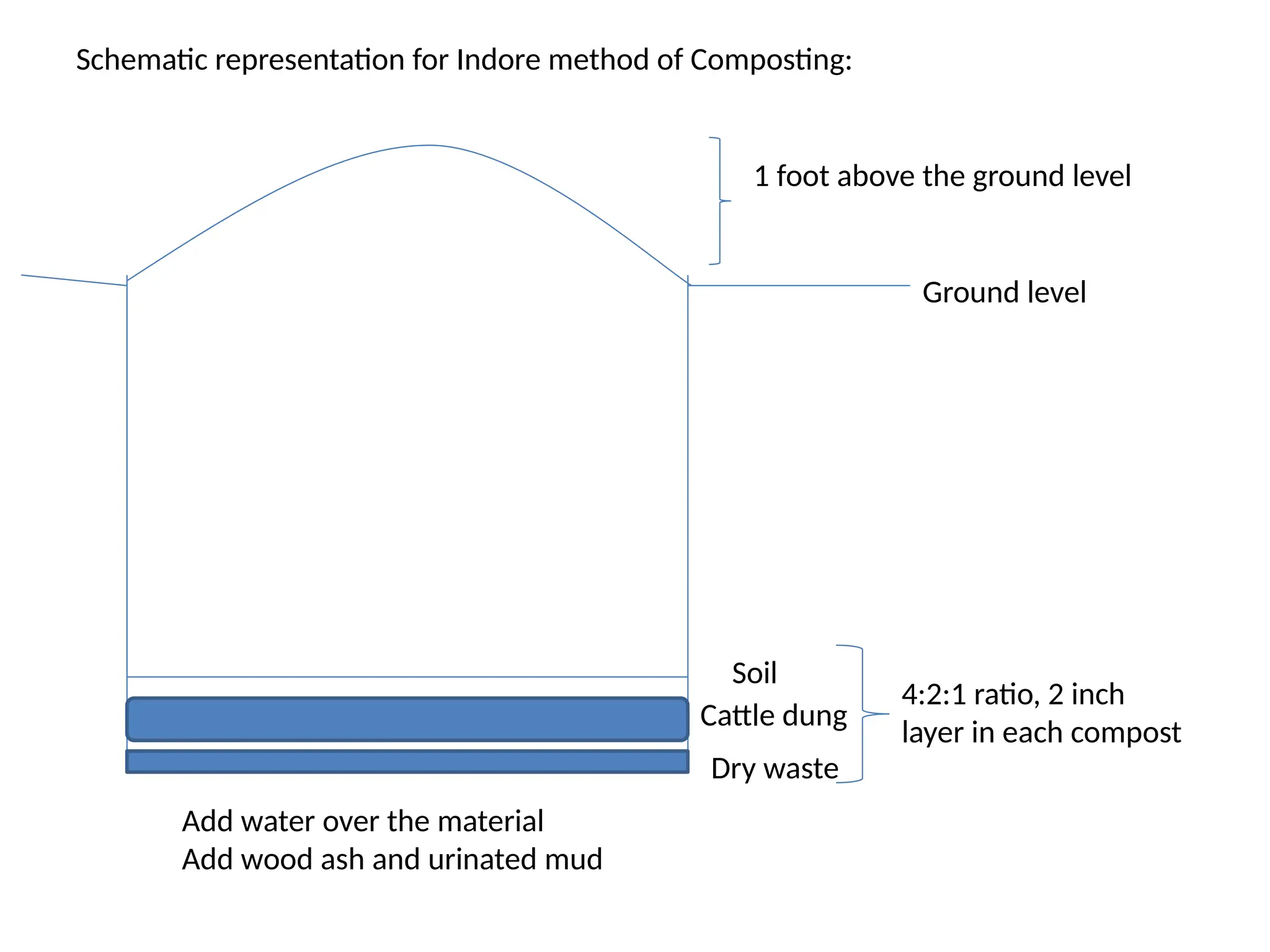
Dry waste
Cattle dung
Soil
4:2:1 ratio, 2 inch
layer in each compost
1 foot above the ground level
Add water over the material
Add wood ash and urinated mud
Schematic representation for Indore method of Composting:
Ground level
Turning
03 times – for aeration and moisture
1 turn
• After 15
days after
filling the
pit
2 turn
• 15 days
after 1
turn
3 turn
• 2 months
after 2
turn
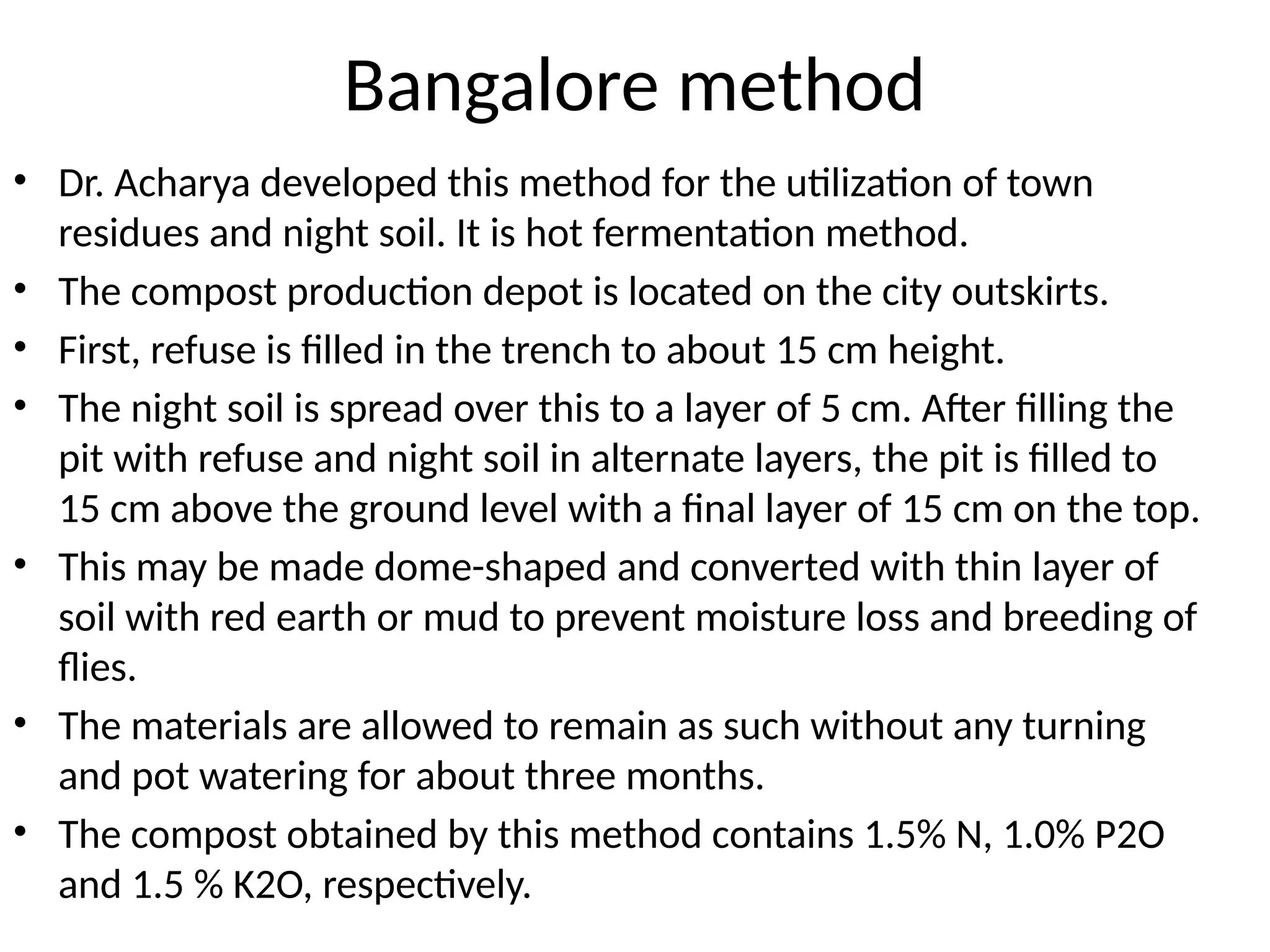
Bangalore method
• Dr. Acharya developed this method for the utilization of town
residues and night soil. It is hot fermentation method.
• The compost production depot is located on the city outskirts.
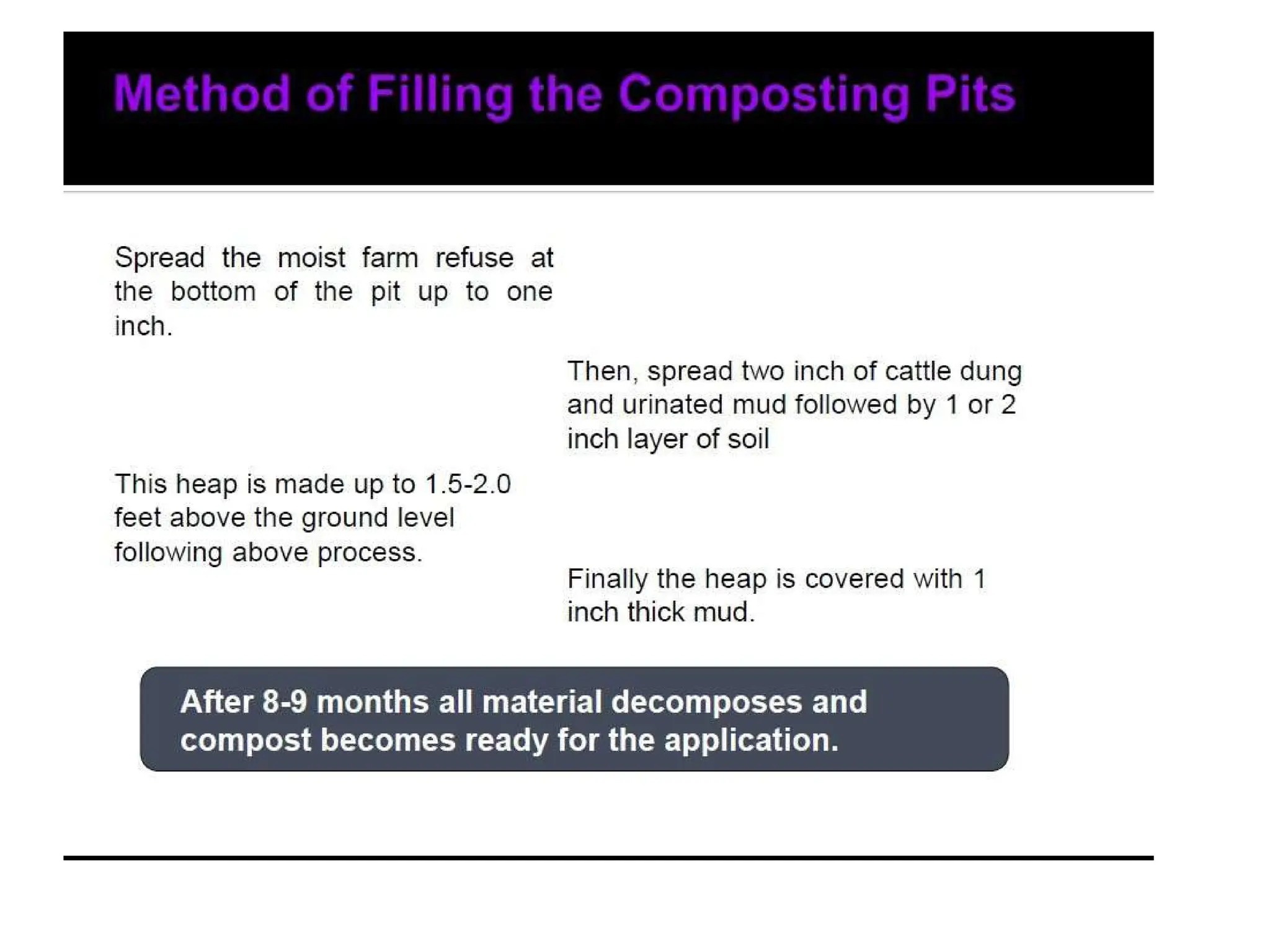
• First, refuse is filled in the trench to about 15 cm height.
• The night soil is spread over this to a layer of 5 cm. After filling the
pit with refuse and night soil in alternate layers, the pit is filled to
15 cm above the ground level with a final layer of 15 cm on the top.
• This may be made dome-shaped and converted with thin layer of
soil with red earth or mud to prevent moisture loss and breeding of
flies.
• The materials are allowed to remain as such without any turning
and pot watering for about three months.
• The compost obtained by this method contains 1.5% N, 1.0% P2O
and 1.5 % K2O, respectively.
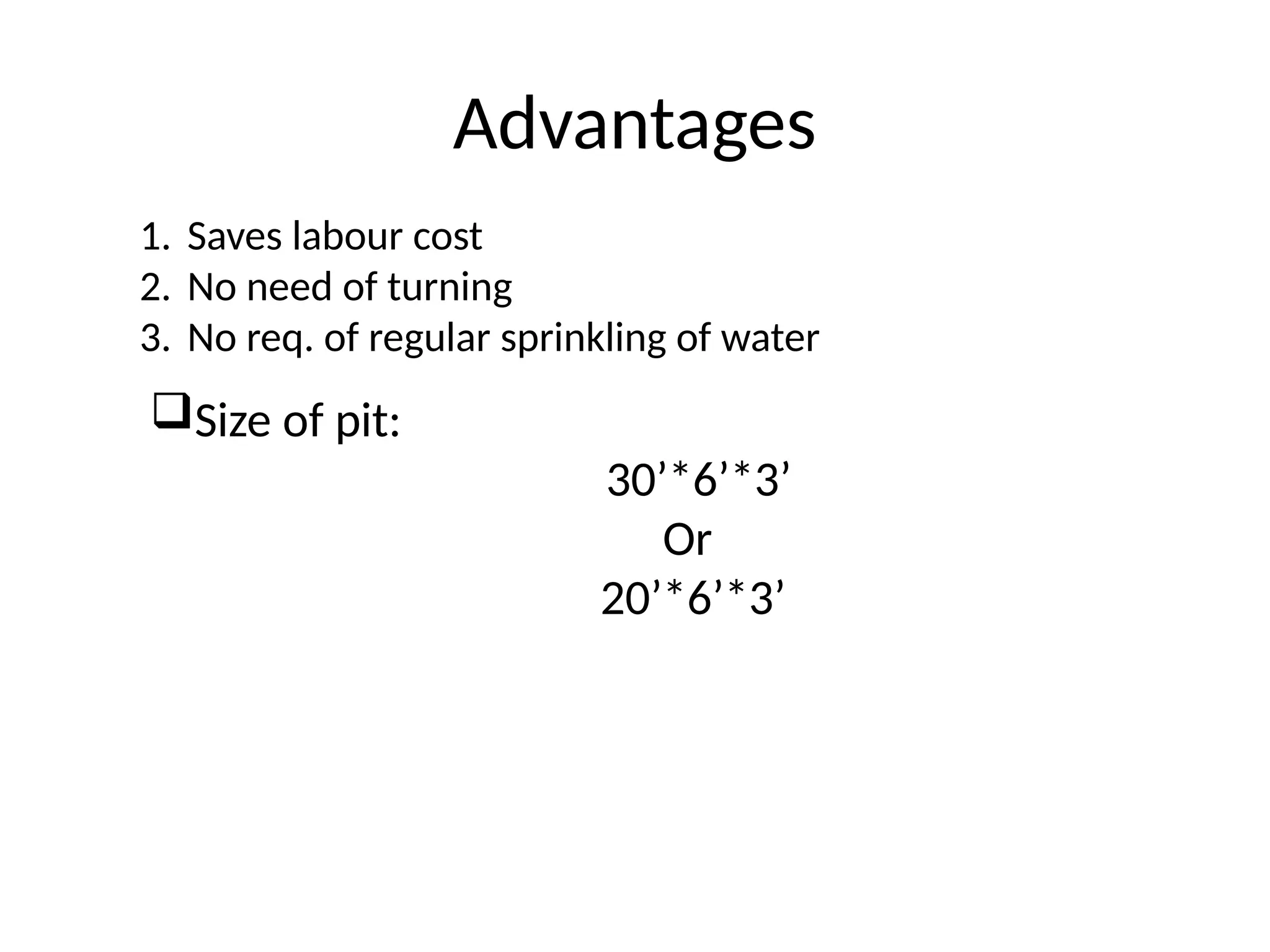
Advantages
1. Saves labour cost
2. No need of turning
3. No req. of regular sprinkling of water
Size of pit:
30’*6’*3’
Or
20’*6’*3’
NADEP method
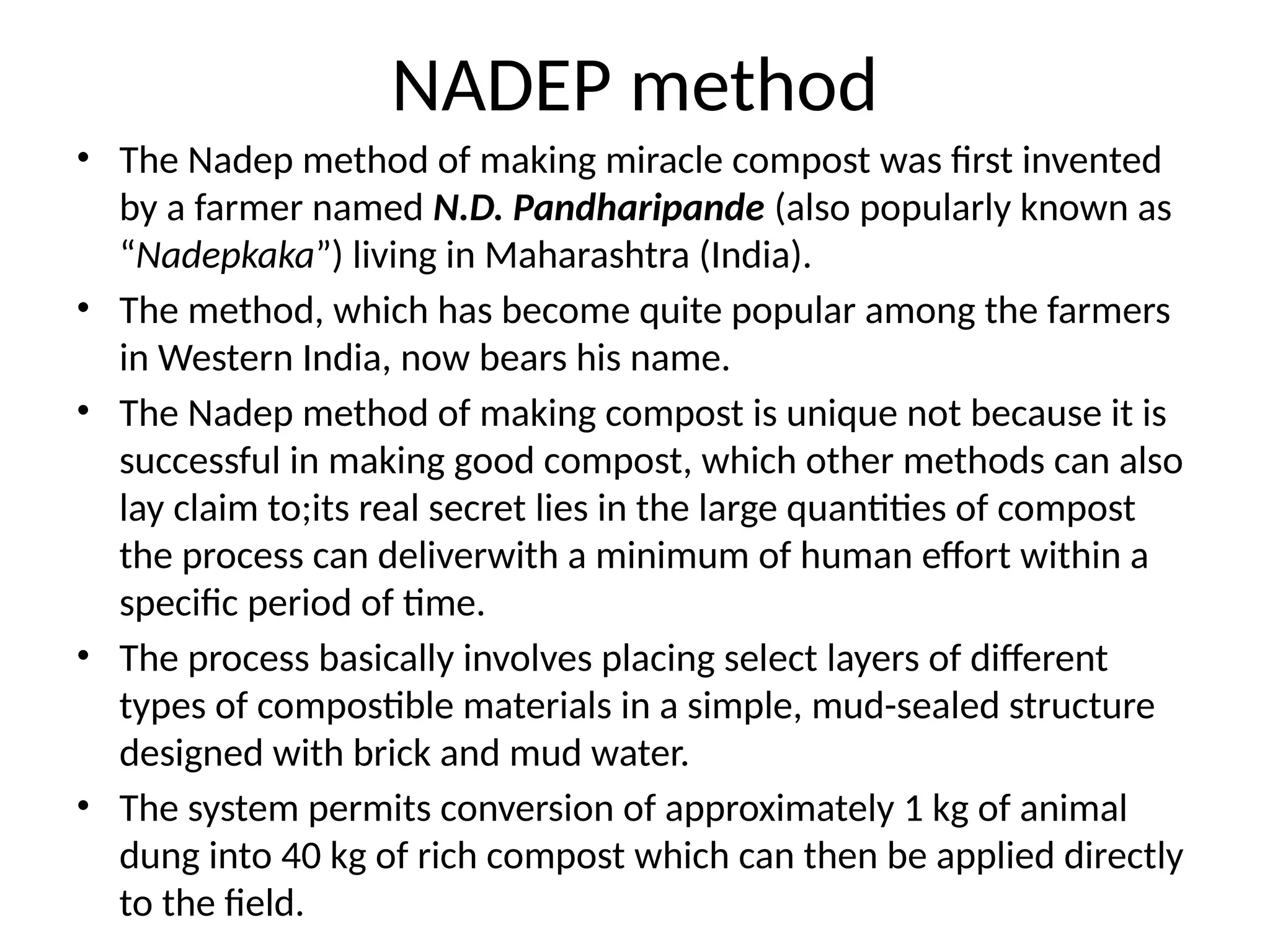
• The Nadep method of making miracle compost was first invented
by a farmer named N.D. Pandharipande (also popularly known as
“Nadepkaka”) living in Maharashtra (India).
• The method, which has become quite popular among the farmers
in Western India, now bears his name.
• The Nadep method of making compost is unique not because it is
successful in making good compost, which other methods can also
lay claim to;its real secret lies in the large quantities of compost
the process can deliverwith a minimum of human effort within a
specific period of time.
• The process basically involves placing select layers of different
types of compostible materials in a simple, mud-sealed structure
designed with brick and mud water.
• The system permits conversion of approximately 1 kg of animal
dung into 40 kg of rich compost which can then be applied directly
to the field.
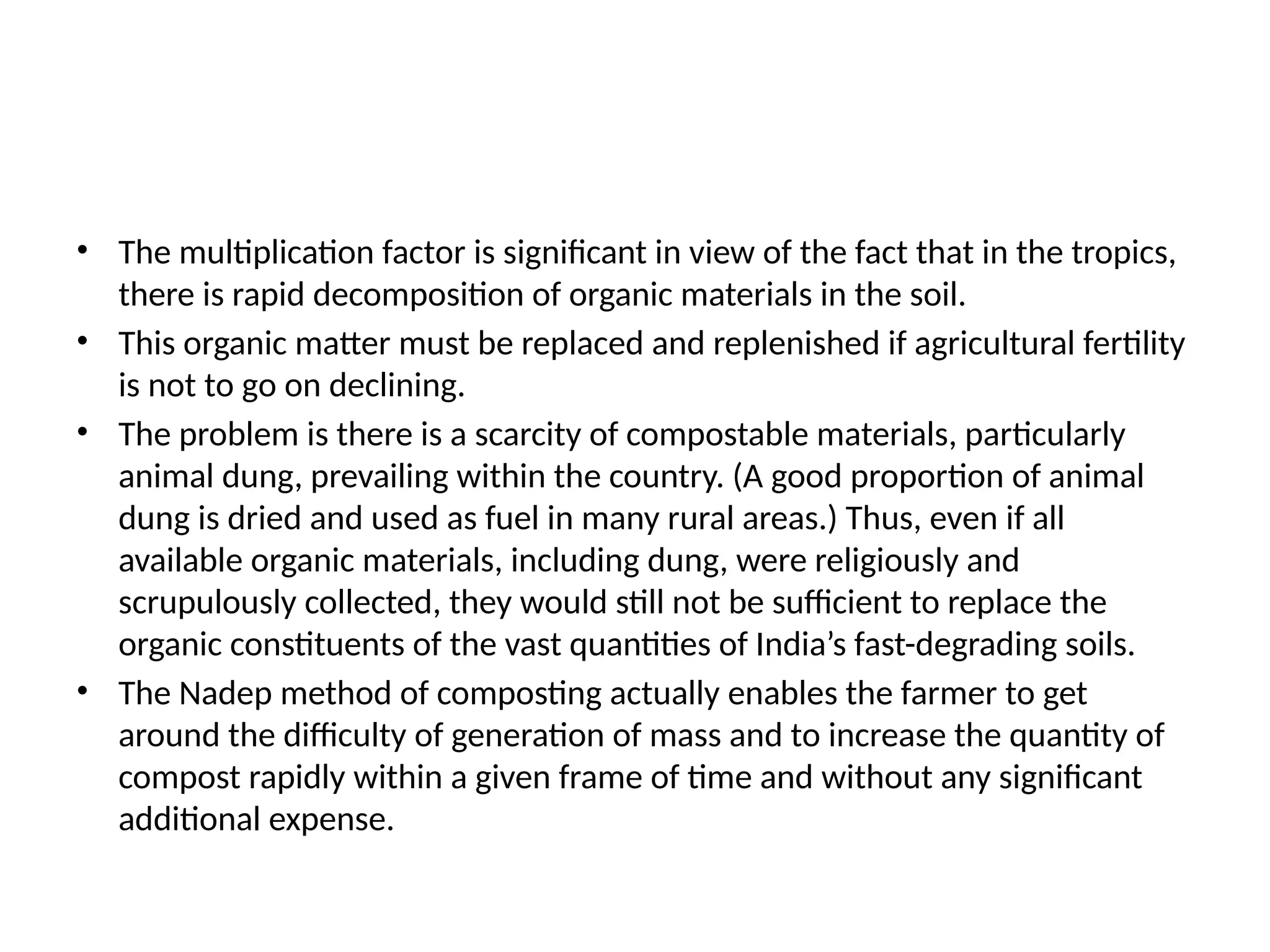
• The multiplication factor is significant in view of the fact that in the tropics,
there is rapid decomposition of organic materials in the soil.
• This organic matter must be replaced and replenished if agricultural fertility
is not to go on declining.
• The problem is there is a scarcity of compostable materials, particularly
animal dung, prevailing within the country. (A good proportion of animal
dung is dried and used as fuel in many rural areas.) Thus, even if all
available organic materials, including dung, were religiously and
scrupulously collected, they would still not be sufficient to replace the
organic constituents of the vast quantities of India’s fast-degrading soils.
• The Nadep method of composting actually enables the farmer to get
around the difficulty of generation of mass and to increase the quantity of
compost rapidly within a given frame of time and without any significant
additional expense.
Description
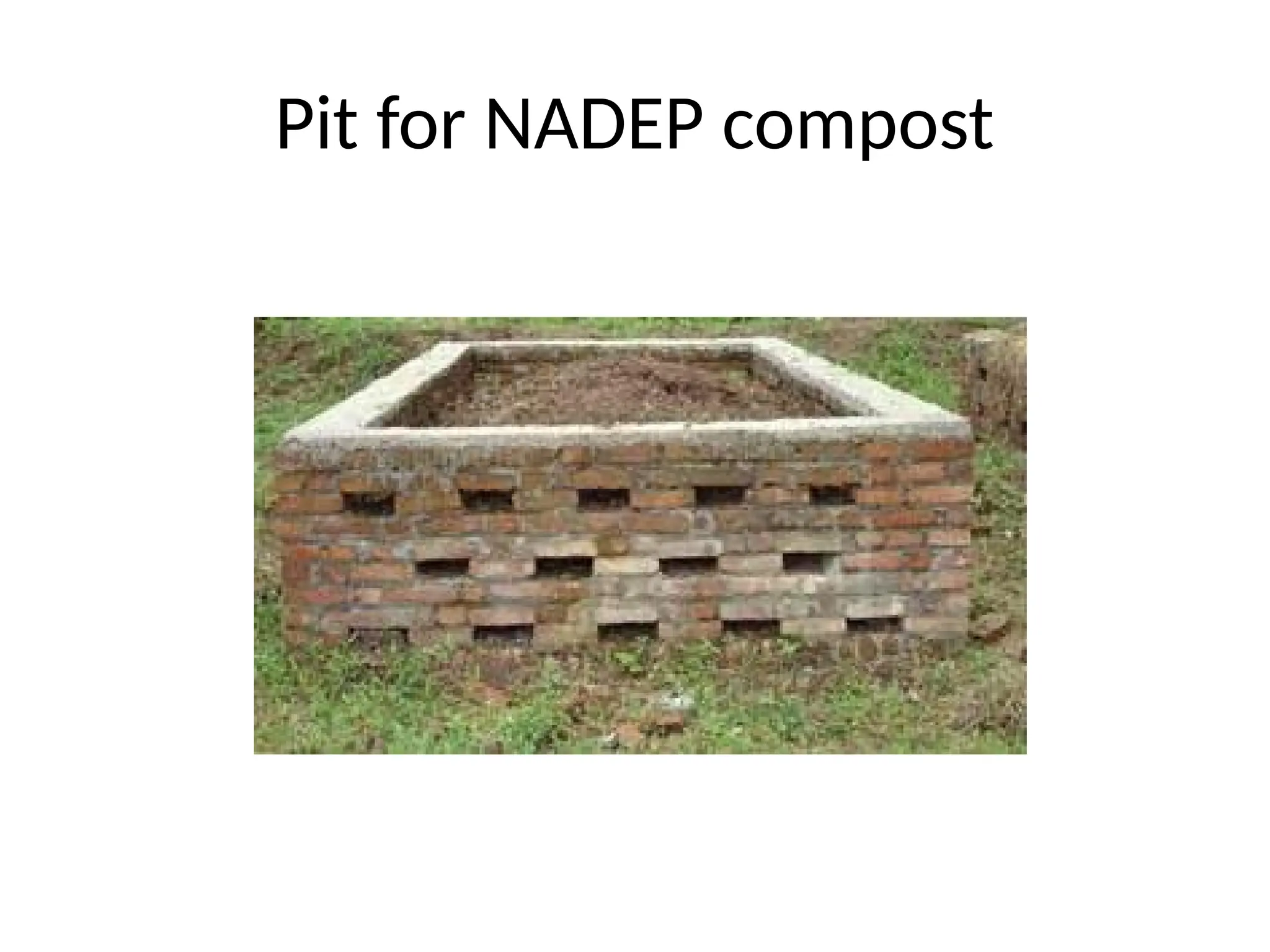
• This method of making compost involves the construction
of a simple, rectangular brick tank with enough spaces
maintained between the bricks for necessary aeration.
• The recommended size of the tank is 10 ft (length) x 5 ft
(breadth) x 3 ft (height).
• All the four walls of NADEP tank are provided with 6//
vents by removing every alternate brick after the height
of 1ft. from bottom for aeration.
• Tank can be constructed in mud mortar or cement mortar.
Raw materials required for filling NADEP
tank
• Raw materials required for filling NADEP tank
• Agricultural waste (Dry & green) – 1350-1400 kgs.
• Cattle dung or biogas slurry – 98 – 100 kgs.
• Fine sieved soil – 1675 kgs.
• Water – 1350-1400 litres.
• The important technique in the manufacture of Nadep compost is that
the entire tank should be filled in one go, within 24 hours and should
not go beyond 48 hours, as this would affect the quality of the compost.
• Thatched roof, Brick Wall Flooring, Air Vents, Green-farm technologies
for small and marginal farms Resources Center for Sustainable
Development
• Before filling: the tank is plastered by dilute cattle dung slurry to
facilitate bacterial activity from all four sides. It is also filled in definite
layers each layer consisting of the following sub layers.
Sub-layer-1
• 4 to 6// thick layer of fine sticks, stems, (To facilitate aeration) followed by
4 to 6// layer of dry and green biomass.
Sub-layer-2
• 4 kgs. Cow dung is mixed with 100 liters of water and sprinkled thoroughly
on the agricultural waste to facilitate microbial activity.'
Sub-layer-3
• 60 kgs. of fine dry soil is spread uniformly over the soaked biomass for
moisture retention and acts as a buffer during biodegradation. Thus the
proportion of organic materials for each layer is 100 kgs. Organic biomass:
4kgs.cowdung + 100 liters water+60 kgs soil. In this way, approximately 10
-12 layers are filled in each tank. After filling the tank, biomass is covered
with 3// thick layer of soil and sealed with cow dung +mud plaster.
Maintenance
• After 15-30 days of filling the organic biomass in the tank gets
automatically pressed down to 2 ft.
• The tank is refilled by giving 2-3 layers over it and is resealed.
• After this filling the tank is not disturbed for 3 months except
that it is moistened at intervals of every 6-15 days.
• The entire tank is covered with a thatched roof to prevent
excessive evaporation of moisture.
• Under no circumstances should any cracks be allowed to
develop. If they do, they should be promptly filled up with
slurry.
Pit for NADEP compost
The Coimbatore method
• The Coimbatore method of composting is a
method of making compost from farm waste
using anaerobic decomposition and aerobic
fermentation.
• It was developed by Manickam in 1967
Steps
• Dig a pit in a shaded area
• Spread a layer of waste material, such as straw, leaves,
weeds, or vegetable refuse
• Moisten the layer with a suspension of cow dung and
water
• Sprinkle bone meal over the layer
• Repeat the layers until the material is 0.75 meters above
ground
• Cover the material with wet mud
• Leave the material undisturbed for 8–10 weeks
• Remove the mud and turn the material
• Moisten the material with water and make a rectangular
heap in the shade
• Leave the heap undisturbed until it's ready for use
Advantages
• Environmentally friendly
• Odorless.
Disadvantages
• Requires regular turning to ensure proper
aeration and
• Requires manpower for turning.
Thank You

Composting - a mixture that consists largely of decayed organic matter and is used for fertilizing and conditioning land

  • 1.
    Composting Prof. Mrs. D.A. Latthe Assistant Professor Dr. JJMCOE, Jaysingpur
  • 2.
    Composting • Composting isthe managed, aerobic (oxygen- required) biological decomposition of organic materials by microorganisms. Organic (carbon- based) materials include grass clippings, leaves, yard and tree trimmings, and food scraps.
  • 3.
    • To derivethe maximum benefit from the natural, but typically slow decomposition process (e.g., grass clippings left in the lawn or food scraps rotting in dustbins, etc.), it is necessary to control the environmental conditions during the composting process. • The overall composting process can be explained as follows: • Organic matter + O2 + aerobic bacteria CO2 + NH3 + H2O + other end products + energy • Compost is the end product of the composting process
  • 4.
    • Compost ispeaty humus, dark in colour and has a crumbly texture, an earthy odour, and resembles rich topsoil. • Composts will not have any resemblance in the physical form to the original waste from which it was derived. • High-quality compost is devoid of weed seeds and organisms that may be pathogenic to humans, animals, or plants. • Cured compost is also relatively stable and resistant to further decomposition by microorganisms.
  • 5.
    Benefits Composting • Itis a form of source reduction or waste prevention, as the materials are completely diverted from the disposal facilities and require no management or transportation. • A major portion of municipal solid wastes in India contain up to 70% by weight of organic materials.
  • 6.
  • 7.
    Three basic systemsused for the decomposition steps are static windrows turned windrows in-vessel composting
  • 8.
    Classification • The compostprocess can be classified in terms of - 1. Distinguishing and in terms oftechnology. 2. Cultural conditions Aerobic Vs. Anaerobic Mesophylic Vs. Thermophylic.
  • 9.
  • 12.
    Methods of composting 1.NADEPMETHOD 2.Indore Method 3.Banglore method 4.Coimbatore method
  • 13.
    Classification of CompostSystems. Compost systems fall into two verybroad groups, (1) windrow and (2) in-vessel
  • 14.
  • 15.
    Windraw composting-Aerated • Atits simplest, shredded and/or screened refuse or source separated organic waste is placed in long parallel piles, called windrows, moisture content is maintained near 50%. • The piles are periodically aerated by fluffing and moving the material around. • After several weeks, such accelerated aerobic decomposition results in a dark brown earthy- smelling material that has low nutrient value but is an excellent soil conditioner.
  • 16.
    Typically, windrows areconstructed of sorted and shredded MSW, mixed with wastewater sludge, and laid in long rows of about 4 to 6 ft (1.2 to 2 m) high. Because the reaction is aerobic, oxygen must be made available to the microorganisms, and this is done either by turning the pile with a specially constructed agitator or by placing the pile on PVC pipes so that air can be pulled through the pile. This is called the aerated static pile composting method. Both of these operations offer the advantage of- • low capital cost and the simultaneous use of wastewater sludge, • but the operating cost can be high, and odor problems can be serious if the piles are not sufficiently well aerated
  • 17.
    In-vessel composting More sophisticatedare the in-vessel composting plants. • In one in-vessel process, the shredded and sorted refuse is mixed in an aerobic digester with air being injected through hollow augers. • The residence time within such a unit is short—often as little as 24 hours but usually more like 5 days—and the rate of decomposition is quite rapid. • Typically, the composted material is removed from the aerobic digester and allowed to cure in windrows for several weeks prior to sale or disposal. • A different mechanical technique uses a long rotary drum in which the MSW is slowly turned in a long barrel during a 24-hour detention time. • Some of these units use refuse in the unshredded and unsorted state with perhaps only a bag opener preceding the composting barrel and screens following digestion. • As before, the screened fines must then be stored in windrows for several weeks prior to use. The rejects from the screens are sent to a landfill
  • 18.
    Indore method • Wastematerials are chopped into 5-10 cm pieces and dried to 40-50 % moisture level. They are spread in layers of 10-15 cm thickness either in pits or in heaps of 1 m width, 4-5 m length and 1 m depth. The heap is properly moistened with dung using earth or night soil. • Sufficient quantity of water is sprinkled over the heap to wet the composting materials to the level of 50 % moisture. • Periodical turnings (15, 30 and 60 days) are given to aerate and material is covered with a thin layer of soil (2-3 thickness). • The average composition of manure: 0.8% N, 0.3% P2O and 1.5 % K2O, respectively.
  • 19.
    Disadvantages 1. Requires laborfor turning 2. Not practicable if large quantity of material is there Site should be at elevated level 3. Near a cattle shed and water source.
  • 20.
    Benefits • Reduced cashexpenses on chemical fertilizer, improved soil fertility, increased crop yield. • Supports organic crop production, reduced dependence on outside inputs. • From each NADEP tank approximately 2.5 tons of compost is prepared with in 90-120 days. • The use of compost reduced the need for mineral fertilizer thus reducing production costs and outside dependence.
  • 21.
    Raw material Mix plant residue weeds Sugercane leaves GrassWood ashes Animal dung Water Urine soaked mud
  • 22.
    Dry waste Cattle dung Soil 4:2:1ratio, 2 inch layer in each compost 1 foot above the ground level Add water over the material Add wood ash and urinated mud Schematic representation for Indore method of Composting: Ground level
  • 23.
    Turning 03 times –for aeration and moisture 1 turn • After 15 days after filling the pit 2 turn • 15 days after 1 turn 3 turn • 2 months after 2 turn
  • 24.
    Bangalore method • Dr.Acharya developed this method for the utilization of town residues and night soil. It is hot fermentation method. • The compost production depot is located on the city outskirts. • First, refuse is filled in the trench to about 15 cm height. • The night soil is spread over this to a layer of 5 cm. After filling the pit with refuse and night soil in alternate layers, the pit is filled to 15 cm above the ground level with a final layer of 15 cm on the top. • This may be made dome-shaped and converted with thin layer of soil with red earth or mud to prevent moisture loss and breeding of flies. • The materials are allowed to remain as such without any turning and pot watering for about three months. • The compost obtained by this method contains 1.5% N, 1.0% P2O and 1.5 % K2O, respectively.
  • 25.
    Advantages 1. Saves labourcost 2. No need of turning 3. No req. of regular sprinkling of water Size of pit: 30’*6’*3’ Or 20’*6’*3’
  • 27.
    NADEP method • TheNadep method of making miracle compost was first invented by a farmer named N.D. Pandharipande (also popularly known as “Nadepkaka”) living in Maharashtra (India). • The method, which has become quite popular among the farmers in Western India, now bears his name. • The Nadep method of making compost is unique not because it is successful in making good compost, which other methods can also lay claim to;its real secret lies in the large quantities of compost the process can deliverwith a minimum of human effort within a specific period of time. • The process basically involves placing select layers of different types of compostible materials in a simple, mud-sealed structure designed with brick and mud water. • The system permits conversion of approximately 1 kg of animal dung into 40 kg of rich compost which can then be applied directly to the field.
  • 28.
    • The multiplicationfactor is significant in view of the fact that in the tropics, there is rapid decomposition of organic materials in the soil. • This organic matter must be replaced and replenished if agricultural fertility is not to go on declining. • The problem is there is a scarcity of compostable materials, particularly animal dung, prevailing within the country. (A good proportion of animal dung is dried and used as fuel in many rural areas.) Thus, even if all available organic materials, including dung, were religiously and scrupulously collected, they would still not be sufficient to replace the organic constituents of the vast quantities of India’s fast-degrading soils. • The Nadep method of composting actually enables the farmer to get around the difficulty of generation of mass and to increase the quantity of compost rapidly within a given frame of time and without any significant additional expense.
  • 29.
    Description • This methodof making compost involves the construction of a simple, rectangular brick tank with enough spaces maintained between the bricks for necessary aeration. • The recommended size of the tank is 10 ft (length) x 5 ft (breadth) x 3 ft (height). • All the four walls of NADEP tank are provided with 6// vents by removing every alternate brick after the height of 1ft. from bottom for aeration. • Tank can be constructed in mud mortar or cement mortar.
  • 30.
    Raw materials requiredfor filling NADEP tank • Raw materials required for filling NADEP tank • Agricultural waste (Dry & green) – 1350-1400 kgs. • Cattle dung or biogas slurry – 98 – 100 kgs. • Fine sieved soil – 1675 kgs. • Water – 1350-1400 litres. • The important technique in the manufacture of Nadep compost is that the entire tank should be filled in one go, within 24 hours and should not go beyond 48 hours, as this would affect the quality of the compost. • Thatched roof, Brick Wall Flooring, Air Vents, Green-farm technologies for small and marginal farms Resources Center for Sustainable Development • Before filling: the tank is plastered by dilute cattle dung slurry to facilitate bacterial activity from all four sides. It is also filled in definite layers each layer consisting of the following sub layers.

  • 31.
    Sub-layer-1 • 4 to6// thick layer of fine sticks, stems, (To facilitate aeration) followed by 4 to 6// layer of dry and green biomass. Sub-layer-2 • 4 kgs. Cow dung is mixed with 100 liters of water and sprinkled thoroughly on the agricultural waste to facilitate microbial activity.' Sub-layer-3 • 60 kgs. of fine dry soil is spread uniformly over the soaked biomass for moisture retention and acts as a buffer during biodegradation. Thus the proportion of organic materials for each layer is 100 kgs. Organic biomass: 4kgs.cowdung + 100 liters water+60 kgs soil. In this way, approximately 10 -12 layers are filled in each tank. After filling the tank, biomass is covered with 3// thick layer of soil and sealed with cow dung +mud plaster.
  • 32.
    Maintenance • After 15-30days of filling the organic biomass in the tank gets automatically pressed down to 2 ft. • The tank is refilled by giving 2-3 layers over it and is resealed. • After this filling the tank is not disturbed for 3 months except that it is moistened at intervals of every 6-15 days. • The entire tank is covered with a thatched roof to prevent excessive evaporation of moisture. • Under no circumstances should any cracks be allowed to develop. If they do, they should be promptly filled up with slurry.
  • 33.
  • 34.
    The Coimbatore method •The Coimbatore method of composting is a method of making compost from farm waste using anaerobic decomposition and aerobic fermentation. • It was developed by Manickam in 1967
  • 35.
    Steps • Dig apit in a shaded area • Spread a layer of waste material, such as straw, leaves, weeds, or vegetable refuse • Moisten the layer with a suspension of cow dung and water • Sprinkle bone meal over the layer • Repeat the layers until the material is 0.75 meters above ground • Cover the material with wet mud • Leave the material undisturbed for 8–10 weeks • Remove the mud and turn the material • Moisten the material with water and make a rectangular heap in the shade • Leave the heap undisturbed until it's ready for use
  • 36.
  • 37.
    Disadvantages • Requires regularturning to ensure proper aeration and • Requires manpower for turning.
  • 38.