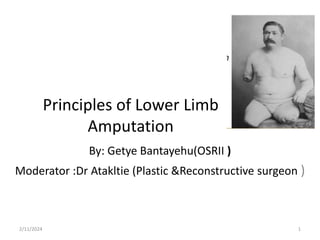
Principles of Lower Limb
Amputation
By: Getye Bantayehu(OSRII )
Moderator :Dr Atakltie (Plastic &Reconstructive surgeon )
2/11/2024 1
Out lines
 Objective
 Introduction
 Epidemiology
 Anatomy of Lower Limb
 Indication /Contra indication
 Pre op evaluation
 Principles of amputation &post op management
 Summary
2/11/2024 2
Objective of Seminar
• At the end of this seminar we are expected to know
-Anatomy of lower Limb
-Indication & Contraindication of amputation
-Pre op preparation of patient for amputation
-Different intra op techniques &Level of amputation
-How to rehabilitate a patient with amputation
2/11/2024 3
Introduction
• Amputation is trans osseous removal of a limb or part
of it
• Is the most ancient surgical procedure.
• The procedure was associated with high mortality
rates
• The stump was poorly suited for prosthetic fitting.
• Know a days improvement in surgical technique&
availability of prosthesis decrease complication
2/11/2024 4
Epidemiology
• More than two million patients with amputations live
in the United States.
• > 185,000 amputations performed each year .
• More than 90% of amputations performed in the
Western world are 2nd to PAD
• In younger patients, trauma is the leading cause,
followed by malignancy.
2/11/2024 5
Anatomy of Thigh
2/11/2024 6
Anatomy of Knee
2/11/2024 7
Anatomy of Leg
2/11/2024 8
Anatomy of Ankle & Foot
2/11/2024 9
Pathophysiology
• Indication
Dead limp
• PAD
• Frost bite
• Burn
• Sever trauma
Dangerous limb
• Malignancy
• Uncontrolled infection
Damned nuisance
• Gross deformity
• Loss of function
• Contra Indication
-surgically unfit patient
2/11/2024 10
Pre op evaluation& Preparation
• ABC of life
• History
- Etiologies
- comorbidities
• Physical examination
-CVS, MSS ,CNS
• Investigation
-CBC, x ray , RBS
-TLC, serum albumen
-trans cutaneous oxygen
level,
-Doppler ultrasound,MRI
• Maximize medical
management
• Consult different
multidisciplinery team
2/11/2024 11
Surgical Principles of amputation
• Select level of amputation
• Follow intra op surgical techniques
• Reduce post op complications
• Is remaining limb fit for prostheses or not
• Make early return of patient to work and recreation
2/11/2024 12
Determine Level of Amputation
Preoperative assessment
of
skin color & Sensation
hair growth
 skin temperature
Trans cutaneous oxygen
level
Great toe pressure
Soft tissue status
 Ankle-brachial index
Metabolic demand
2/11/2024 13
Amputation vs Reconstruction
• LEAP study
- severe soft tissue injury
- plantar sensation
• SIP (sickness impact profile)
- Mangled foot and ankle injuries requiring free tissue
transfer have a worse SIP than BKA
• MESS score
• Surgeon decision &clinical experience
2/11/2024 14
Amputation Versus Reconstruction in Traumatic Defects of the Leg: Outcome and Costs
Hertel, R.; Strebel, N.; Ganz, R.
Author InformationJournal of Orthopaedic Trauma: May 1996 - Volume 10 - Issue 4 - p 223-229
BUY
Abstract
Summary
This retrospective study on reconstructive efforts to salvage severely injured legs.
18 lower leg amputation were compared to 21 patients microvascular reconstruction.
number of interventions was 3.5 for amputation and 8 for reconstruction (p < 0.009).
Total rehabilitation time was 12 months for amputation and 30 months for reconstruction
56 % amputees and 19% of the reconstructed patients were retrained to a different profession
44% amputees and 16% of the reconstructed patients were drawing an extremely costly and lifelong
invalidity pension.
there was no permanent social disintegration due to the long treatment.
Total costs (including pensions) for reconstruction were far lower than for amputation.
We conclude that for potentially salvageable legs reconstruction is advisable
2/11/2024 15
Metabolic Demand
• Consider Metabolic cost of walking preoperatively
- increases with more proximal amputations
-Inversely proportional to length of remaining limb
-Except Syme amputation which is more efficient
than midfoot amputation
-Higher in vascular &Bilateral amputation
2/11/2024 16
Intra operative surgical techniques
• Gentle handling of soft
tissues
• Remove necrotic tissue
• Harvest flap& Graft
from the amputated part
2/11/2024 17
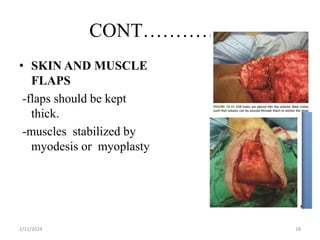
CONT…………..
• SKIN AND MUSCLE
FLAPS
-flaps should be kept
thick.
-muscles stabilized by
myodesis or myoplasty
2/11/2024 18
HEMOSTASIS
• we have to use the a tourniquet .
-Except ischemic limbs
• have to exsanguinated the limb
- except for infections or malignancy.
• double ligate main vessels.
• Arteries and veins should be ligated separately
• deflate the tourniquet before closure
• Place a drain in most cases for 48 to 72 hours.
2/11/2024 19
NERVES
• A neuroma formation is inevitable after transaction
• Nerves should be isolated, pulled distally
divided with a sharp knife
• Large nerve should be ligated.
2/11/2024 20
Types of amputation
• Closed
• Open ( guillotine) types
of amputation
-For patent with septic
shock
- For mangled limb
• Approach depends on
the clinical status of the
patient and the quality
of the soft tissue
2/11/2024 21
BONE
• Avoid Excessive periosteal stripping .
• respected bone end should be rasped to form a
smooth contour.
• important in anterior aspect of the tibia, lateral
aspect of the femur.
2/11/2024 22
Different level of amputation in lower limb
• Hemipelvectomy
• Hip disarticulation
• AKA
• Knee disarticulation
• BKA
• Symes ,
• Boyd,Chopart,Lisfranc
2/11/2024 23
SYME AMPUTATON
• A weight-bearing
amputation through the
ankle
• involves removal of all
of the bones of the foot
• patent tibialis posterior
artery is required
• stable heel pad is most
important factor
• used successfully to
treat forefoot gangrene
2/11/2024 24
BKA For Non Ischemic Limb
• Equal anterior
&posterior flap
• We incise using fish
mouth technique
• We use it For non
ischemic limb
2/11/2024 25
BKA for Ischemic limb
• Long posterior flap and
a short anterior
one(BURGESS FLAP)
• Used for ischemic limb
2/11/2024 26
SKEW FLAP
• It uses Anteromedal
&PosteroLateral Flap
• Used for ischemic limb
2/11/2024 27
ERTL TECHNQUE
2/11/2024 28
Knee disarticulation
• Ambulatory patients
who cannot have a
trans tibial amputation
• Non-ambulatory
patients
2/11/2024 29
AKA FOR LIMB
• Ideal cut is 12 cm (10-
15cm) above knee joint
• 5-10 degrees of
adduction
• We can do adductor
myodesis
2/11/2024 30
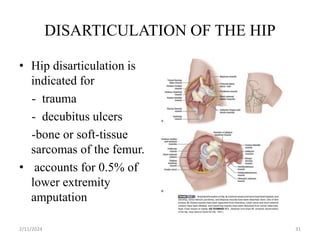
DISARTICULATION OF THE HIP
• Hip disarticulation is
indicated for
- trauma
- decubitus ulcers
-bone or soft-tissue
sarcomas of the femur.
• accounts for 0.5% of
lower extremity
amputation
2/11/2024 31
Postoperative Care
• Requires a multidisciplinary team approach.
• Post op pain management
• Dressing(Soft vs Hard)?
• Positioning
• Drains usually are removed at 48 hours
• muscle-setting exercises to mobilize the joints
2/11/2024 32
complication
• Early
-Bleeding, hematoma formation, infection
-Dehiscence
-Skin necrosis
• Late
-Neuroma
-Contracture
-Phantom limb sensation
-Phantom limb pain
2/11/2024 33
INFECTION
• Should be treated with
debridement and
irrigation
• Antibiotics should be
started
• Follow Smith and
Burgess suggest closure
technique
2/11/2024 34
HEMATOMA
• Meticulous hemostasis before closure
• Put a drain and apply rigid dressing
• A hematoma serve as medium for bacterial infection.
• If a hematoma does form, it should be treated with a
compressive dressing.
2/11/2024 35
Wound necrosis
• Pre op evaluation of
-serum albumin level
and
- total lymphocyte count
• Avoid smoking tobacco
• If necrosis >1cm do
wedge resection
2/11/2024 36
Causes of post operative pain
• Residual limb pain
-Unfit prosthesis,
-Choking
- Neuroma
• Phantom limb pain
• Phantom limb sensation (it will be telescoped)
2/11/2024 37
Phantom limb pain
• Is the pain that persists
after complete tissue
healing
• Is characterized by
dysesthesia at the level of
the absent limb
• The most effective
treatments is mirror
therapy.
• We can give narcotic
drugs, anti-epileptic
medications
2/11/2024 38
Residual limb pain
2/11/2024 39
Phantom limb pain
2/11/2024 40
Post amputation Neuroma
• Occurs in 20-30% of amputees
• Proper nerve handling at the time of procedure
• Targeted muscle reinnervation
• If not neuroma excision
2/11/2024 41
AMPUTATIONS IN CHILDREN
• Amputations in children may be divided into two
general categories: congenital and acquired
• 60% of amputations are secondary to congenital and
40% are secondary to acquired conditions
• Considering general body growth and stump growth
are significant factors
2/11/2024 42
general principles of childhood
amputation surgery
• Preserve length,
• Preserve important growth plates,
• Perform disarticulation rather than transosseous
amputation
• Preserve the knee joint whenever possible
• Deal with issues in addition to limb deficiency in
children
2/11/2024 43
Post op rehabilitation
• Goal is to return the patient to a functional status
• Acute phase physical therapy includes
-pain &swelling control , joint mobilization
-isometric muscle training of the residual limb
• fabrication and application of prosthesis, usually
about 6 weeks after surgery
• occupational therapy for ADL
• cognitive therapy and psychological support
2/11/2024 44
Prosthesis
• Artificial substitute for a
missing part of the
body.
• Had different parts
• commonly used
prosthesis
-Quadrilateral socket
-Patellar tendon bearing
-Canadian syme prosthesis
2/11/2024 45
summary
• Pre op evaluation of patient important for
amputation
• We have to know anatomy of limb& Criteria for level
of amputation
• We have to follow important intra op surgical
techniques to decrease post op complication
• Rehabilitation is important after doing amputation
• Amputation is not a failure of treatment but saves life
of a patient’s &return a patient to a more comfortable
and productive life”
2/11/2024 46
References
Amputation Versus Reconstruction in Traumatic Defects of the
Leg: Outcome and Costs
Hertel, R.; Strebel, N.; Ganz, R.
Author InformationJournal of Orthopaedic Trauma: May 1996 -
Volume 10 - Issue 4 - p 223-229
2/11/2024 47
2/11/2024 48
THANK YOU

Lower limb Amputation.pptx

  • 1.
    Principles of LowerLimb Amputation By: Getye Bantayehu(OSRII ) Moderator :Dr Atakltie (Plastic &Reconstructive surgeon ) 2/11/2024 1
  • 2.
    Out lines  Objective Introduction  Epidemiology  Anatomy of Lower Limb  Indication /Contra indication  Pre op evaluation  Principles of amputation &post op management  Summary 2/11/2024 2
  • 3.
    Objective of Seminar •At the end of this seminar we are expected to know -Anatomy of lower Limb -Indication & Contraindication of amputation -Pre op preparation of patient for amputation -Different intra op techniques &Level of amputation -How to rehabilitate a patient with amputation 2/11/2024 3
  • 4.
    Introduction • Amputation istrans osseous removal of a limb or part of it • Is the most ancient surgical procedure. • The procedure was associated with high mortality rates • The stump was poorly suited for prosthetic fitting. • Know a days improvement in surgical technique& availability of prosthesis decrease complication 2/11/2024 4
  • 5.
    Epidemiology • More thantwo million patients with amputations live in the United States. • > 185,000 amputations performed each year . • More than 90% of amputations performed in the Western world are 2nd to PAD • In younger patients, trauma is the leading cause, followed by malignancy. 2/11/2024 5
  • 6.
  • 7.
  • 8.
  • 9.
    Anatomy of Ankle& Foot 2/11/2024 9
  • 10.
    Pathophysiology • Indication Dead limp •PAD • Frost bite • Burn • Sever trauma Dangerous limb • Malignancy • Uncontrolled infection Damned nuisance • Gross deformity • Loss of function • Contra Indication -surgically unfit patient 2/11/2024 10
  • 11.
    Pre op evaluation&Preparation • ABC of life • History - Etiologies - comorbidities • Physical examination -CVS, MSS ,CNS • Investigation -CBC, x ray , RBS -TLC, serum albumen -trans cutaneous oxygen level, -Doppler ultrasound,MRI • Maximize medical management • Consult different multidisciplinery team 2/11/2024 11
  • 12.
    Surgical Principles ofamputation • Select level of amputation • Follow intra op surgical techniques • Reduce post op complications • Is remaining limb fit for prostheses or not • Make early return of patient to work and recreation 2/11/2024 12
  • 13.
    Determine Level ofAmputation Preoperative assessment of skin color & Sensation hair growth  skin temperature Trans cutaneous oxygen level Great toe pressure Soft tissue status  Ankle-brachial index Metabolic demand 2/11/2024 13
  • 14.
    Amputation vs Reconstruction •LEAP study - severe soft tissue injury - plantar sensation • SIP (sickness impact profile) - Mangled foot and ankle injuries requiring free tissue transfer have a worse SIP than BKA • MESS score • Surgeon decision &clinical experience 2/11/2024 14
  • 15.
    Amputation Versus Reconstructionin Traumatic Defects of the Leg: Outcome and Costs Hertel, R.; Strebel, N.; Ganz, R. Author InformationJournal of Orthopaedic Trauma: May 1996 - Volume 10 - Issue 4 - p 223-229 BUY Abstract Summary This retrospective study on reconstructive efforts to salvage severely injured legs. 18 lower leg amputation were compared to 21 patients microvascular reconstruction. number of interventions was 3.5 for amputation and 8 for reconstruction (p < 0.009). Total rehabilitation time was 12 months for amputation and 30 months for reconstruction 56 % amputees and 19% of the reconstructed patients were retrained to a different profession 44% amputees and 16% of the reconstructed patients were drawing an extremely costly and lifelong invalidity pension. there was no permanent social disintegration due to the long treatment. Total costs (including pensions) for reconstruction were far lower than for amputation. We conclude that for potentially salvageable legs reconstruction is advisable 2/11/2024 15
  • 16.
    Metabolic Demand • ConsiderMetabolic cost of walking preoperatively - increases with more proximal amputations -Inversely proportional to length of remaining limb -Except Syme amputation which is more efficient than midfoot amputation -Higher in vascular &Bilateral amputation 2/11/2024 16
  • 17.
    Intra operative surgicaltechniques • Gentle handling of soft tissues • Remove necrotic tissue • Harvest flap& Graft from the amputated part 2/11/2024 17
  • 18.
    CONT………….. • SKIN ANDMUSCLE FLAPS -flaps should be kept thick. -muscles stabilized by myodesis or myoplasty 2/11/2024 18
  • 19.
    HEMOSTASIS • we haveto use the a tourniquet . -Except ischemic limbs • have to exsanguinated the limb - except for infections or malignancy. • double ligate main vessels. • Arteries and veins should be ligated separately • deflate the tourniquet before closure • Place a drain in most cases for 48 to 72 hours. 2/11/2024 19
  • 20.
    NERVES • A neuromaformation is inevitable after transaction • Nerves should be isolated, pulled distally divided with a sharp knife • Large nerve should be ligated. 2/11/2024 20
  • 21.
    Types of amputation •Closed • Open ( guillotine) types of amputation -For patent with septic shock - For mangled limb • Approach depends on the clinical status of the patient and the quality of the soft tissue 2/11/2024 21
  • 22.
    BONE • Avoid Excessiveperiosteal stripping . • respected bone end should be rasped to form a smooth contour. • important in anterior aspect of the tibia, lateral aspect of the femur. 2/11/2024 22
  • 23.
    Different level ofamputation in lower limb • Hemipelvectomy • Hip disarticulation • AKA • Knee disarticulation • BKA • Symes , • Boyd,Chopart,Lisfranc 2/11/2024 23
  • 24.
    SYME AMPUTATON • Aweight-bearing amputation through the ankle • involves removal of all of the bones of the foot • patent tibialis posterior artery is required • stable heel pad is most important factor • used successfully to treat forefoot gangrene 2/11/2024 24
  • 25.
    BKA For NonIschemic Limb • Equal anterior &posterior flap • We incise using fish mouth technique • We use it For non ischemic limb 2/11/2024 25
  • 26.
    BKA for Ischemiclimb • Long posterior flap and a short anterior one(BURGESS FLAP) • Used for ischemic limb 2/11/2024 26
  • 27.
    SKEW FLAP • Ituses Anteromedal &PosteroLateral Flap • Used for ischemic limb 2/11/2024 27
  • 28.
  • 29.
    Knee disarticulation • Ambulatorypatients who cannot have a trans tibial amputation • Non-ambulatory patients 2/11/2024 29
  • 30.
    AKA FOR LIMB •Ideal cut is 12 cm (10- 15cm) above knee joint • 5-10 degrees of adduction • We can do adductor myodesis 2/11/2024 30
  • 31.
    DISARTICULATION OF THEHIP • Hip disarticulation is indicated for - trauma - decubitus ulcers -bone or soft-tissue sarcomas of the femur. • accounts for 0.5% of lower extremity amputation 2/11/2024 31
  • 32.
    Postoperative Care • Requiresa multidisciplinary team approach. • Post op pain management • Dressing(Soft vs Hard)? • Positioning • Drains usually are removed at 48 hours • muscle-setting exercises to mobilize the joints 2/11/2024 32
  • 33.
    complication • Early -Bleeding, hematomaformation, infection -Dehiscence -Skin necrosis • Late -Neuroma -Contracture -Phantom limb sensation -Phantom limb pain 2/11/2024 33
  • 34.
    INFECTION • Should betreated with debridement and irrigation • Antibiotics should be started • Follow Smith and Burgess suggest closure technique 2/11/2024 34
  • 35.
    HEMATOMA • Meticulous hemostasisbefore closure • Put a drain and apply rigid dressing • A hematoma serve as medium for bacterial infection. • If a hematoma does form, it should be treated with a compressive dressing. 2/11/2024 35
  • 36.
    Wound necrosis • Preop evaluation of -serum albumin level and - total lymphocyte count • Avoid smoking tobacco • If necrosis >1cm do wedge resection 2/11/2024 36
  • 37.
    Causes of postoperative pain • Residual limb pain -Unfit prosthesis, -Choking - Neuroma • Phantom limb pain • Phantom limb sensation (it will be telescoped) 2/11/2024 37
  • 38.
    Phantom limb pain •Is the pain that persists after complete tissue healing • Is characterized by dysesthesia at the level of the absent limb • The most effective treatments is mirror therapy. • We can give narcotic drugs, anti-epileptic medications 2/11/2024 38
  • 39.
  • 40.
  • 41.
    Post amputation Neuroma •Occurs in 20-30% of amputees • Proper nerve handling at the time of procedure • Targeted muscle reinnervation • If not neuroma excision 2/11/2024 41
  • 42.
    AMPUTATIONS IN CHILDREN •Amputations in children may be divided into two general categories: congenital and acquired • 60% of amputations are secondary to congenital and 40% are secondary to acquired conditions • Considering general body growth and stump growth are significant factors 2/11/2024 42
  • 43.
    general principles ofchildhood amputation surgery • Preserve length, • Preserve important growth plates, • Perform disarticulation rather than transosseous amputation • Preserve the knee joint whenever possible • Deal with issues in addition to limb deficiency in children 2/11/2024 43
  • 44.
    Post op rehabilitation •Goal is to return the patient to a functional status • Acute phase physical therapy includes -pain &swelling control , joint mobilization -isometric muscle training of the residual limb • fabrication and application of prosthesis, usually about 6 weeks after surgery • occupational therapy for ADL • cognitive therapy and psychological support 2/11/2024 44
  • 45.
    Prosthesis • Artificial substitutefor a missing part of the body. • Had different parts • commonly used prosthesis -Quadrilateral socket -Patellar tendon bearing -Canadian syme prosthesis 2/11/2024 45
  • 46.
    summary • Pre opevaluation of patient important for amputation • We have to know anatomy of limb& Criteria for level of amputation • We have to follow important intra op surgical techniques to decrease post op complication • Rehabilitation is important after doing amputation • Amputation is not a failure of treatment but saves life of a patient’s &return a patient to a more comfortable and productive life” 2/11/2024 46
  • 47.
    References Amputation Versus Reconstructionin Traumatic Defects of the Leg: Outcome and Costs Hertel, R.; Strebel, N.; Ganz, R. Author InformationJournal of Orthopaedic Trauma: May 1996 - Volume 10 - Issue 4 - p 223-229 2/11/2024 47
  • 48.

Editor's Notes

  • #19 They may be stabilized by myodesis (suturing muscle or tendon to bone) or by myoplasty (suturing muscle to the periosteum or the fascia of opposing musculature Meticulous attention to gentle handling of soft tissues for well-healed and functional amputation stump.
  • #23 AvoaExcessive periosteal stripping is contraindicated and may result in the formation of ring sequestra or bony overgrowth
  • #35 . Delayed closure may be difficult because of edema and retraction of the flapsThis method allows for continued open wound management while maintaining adequate flaps for distal bone coverage. 
  • #39 risk factors for PLP, which include: the - presence of pre-amputation pain - female gender - upper extremity amputations, and -bilateral amputation
  • #42 proper nerve handling at the time of procedure targeted muscle reinnervation  a method of guiding neuronal regeneration to prevent or treat post-amputation neuroma pain and improve patient use of myoelectric prosthe