Dr. Chinmoy Mazumder
Indoor medical Officer
Department of Orthopaedics
Many thousands year ago the Egyptians
immobilised fractures by linlen stiffen with gum
or plaster,also starch,clay and egg albumin
Plaster of Paris bandages were first used by
Antonius Matthysen,A Dutch military surgeon in
1852
The name of the plaster of paris derived from an
accident to a house built on a deposit of
Gypsum,Near Paris.The house burnt down.When
rain fall on baked mud of the floors it was noted
that footprints in mud set rock hard.
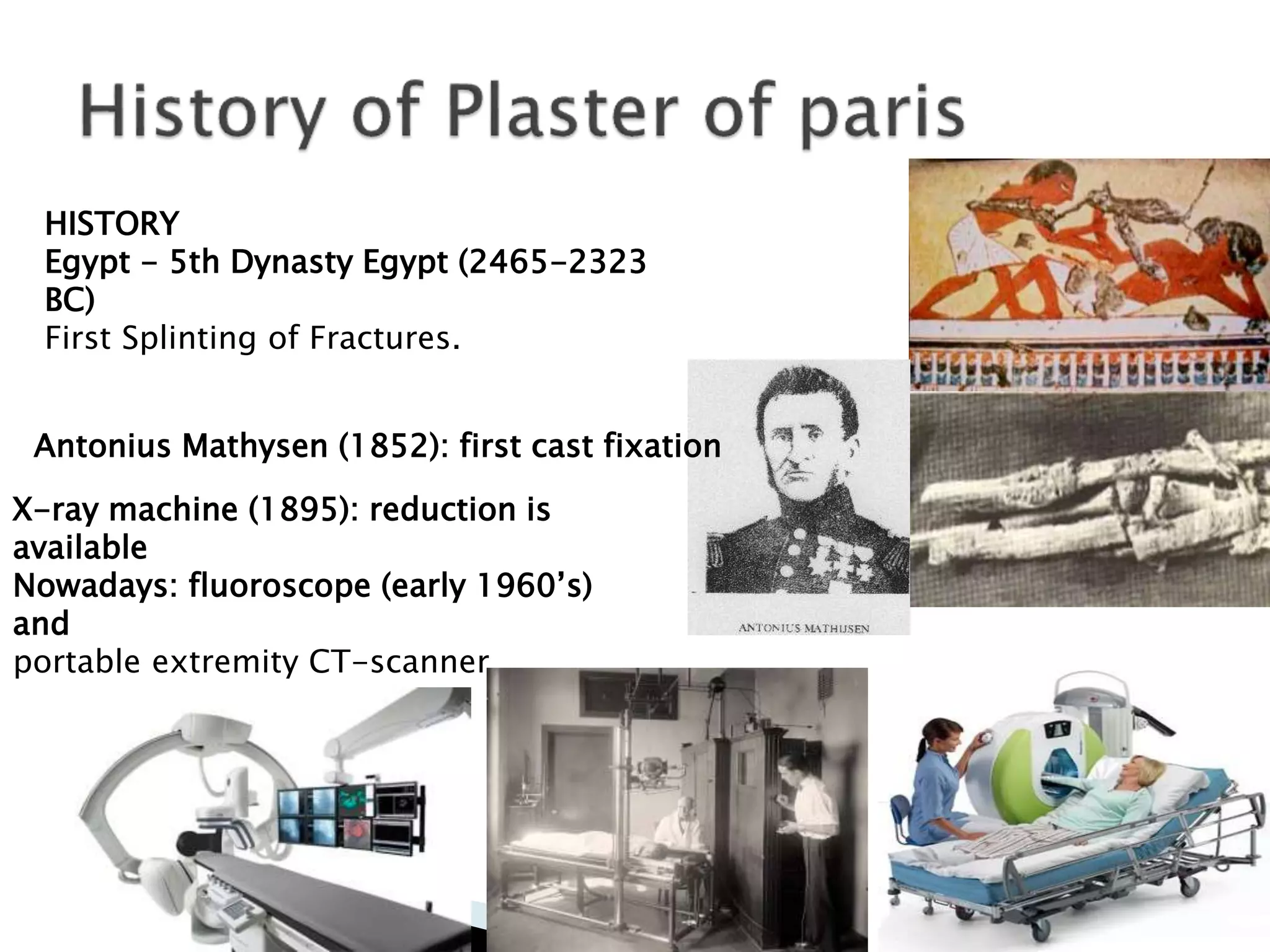
HISTORY
Egypt - 5th Dynasty Egypt (2465-2323
BC)
First Splinting of Fractures.
X-ray machine (1895): reduction is
available
Nowadays: fluoroscope (early 1960’s)
and
portable extremity CT-scanner
Antonius Mathysen (1852): first cast fixation
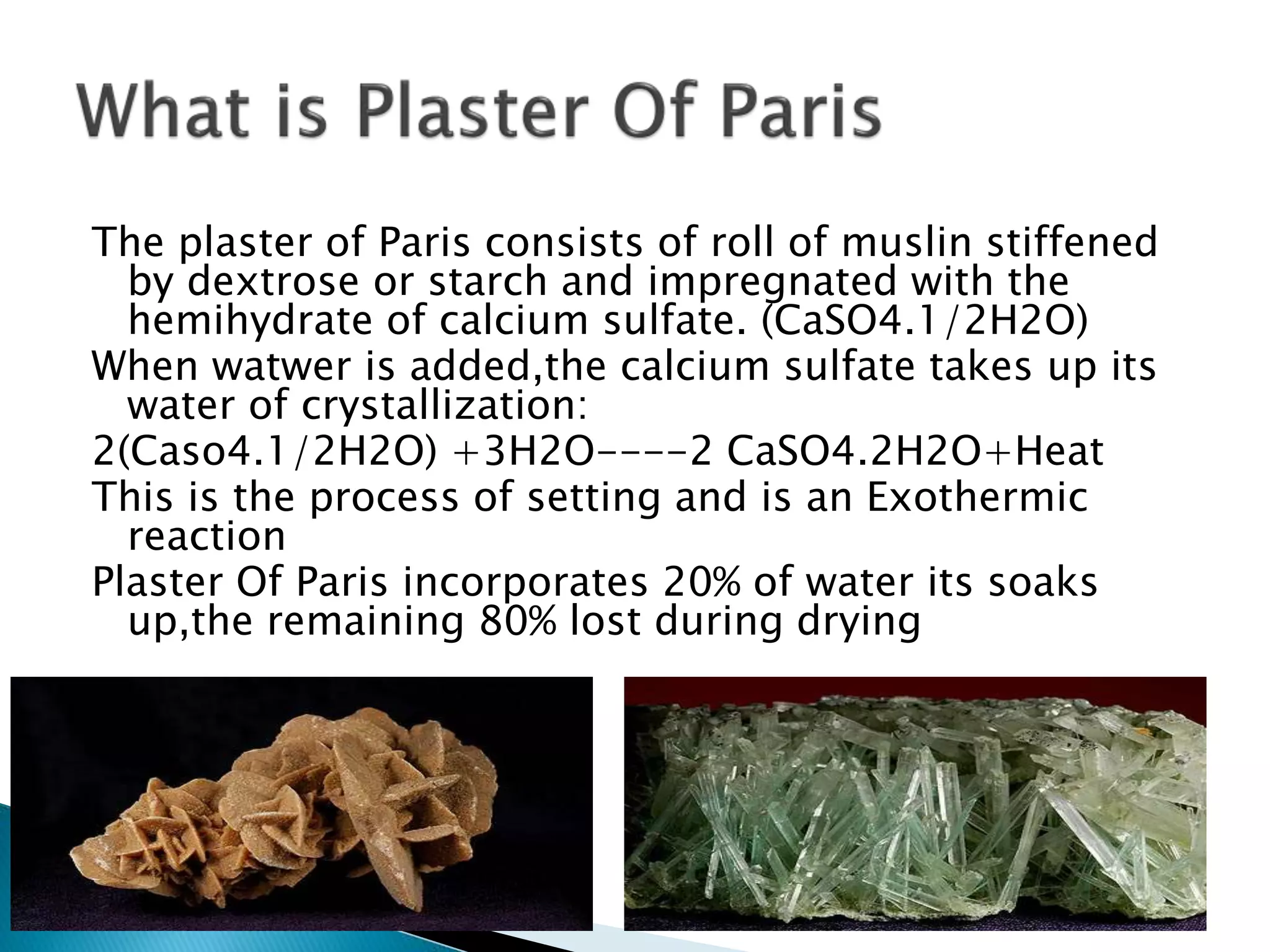
The plaster of Paris consists of roll of muslin stiffened
by dextrose or starch and impregnated with the
hemihydrate of calcium sulfate. (CaSO4.1/2H2O)
When watwer is added,the calcium sulfate takes up its
water of crystallization:
2(Caso4.1/2H2O) +3H2O----2 CaSO4.2H2O+Heat
This is the process of setting and is an Exothermic
reaction
Plaster Of Paris incorporates 20% of water its soaks
up,the remaining 80% lost during drying
The best plaster should be a fairly wide mesh starch free
crioline or muslin bandage,6 inches(15.2cm) wide and
4.6 meter long.The completed plaster bandage should
be elastic and springy.An average 4 meter plaster
bandage should weigh 8 ounces(224gm)and contain 85
to 90 percent by weight of plaster.
Note: the setting of unmodified plaster starts about 10 minutes
after mixing
and is complete in about 45 minutes; however, the cast is not
fully dry for
72 hours.
Setting time – Time taken to convert from powder form to
crystalline form
Average time is 3-10 minutes
Reduced by-
High Temperature
Salt solution
Borax Solution
Addition Of Resin
Increased by
Low temperature
Sugar solution
Setting time is three times longer at 5 C than at 50 C
Movement of plaster while it is setting will cause gross
weakening
Drying time – Time taken for Plaster of Paris to
convert from crystalline from to anhydrous
form
Influenced by ambient temperature and
humidity
The optimum strength is achieved when it is
completely dry.
 To Support fractured bones,controlling
movement of fragments and resting the
damaged tissues
 To stabilise and rest joints in ligamentous
injury
 To support and immobilize joints and limbs
post operatively until healing has occurred
 To corresct a deformity
 To ensure rest of infected tissues
 To make negative mould of a part of body
 Plaster of Paris
 Plaster Of Paris with Melanin Resin
 Materials which undergo Polymerisation
Water Activated
Non water activated
 Materials which undergo Polymerisation
Advantages
 Slower setting
 Infinitely moldable when wet
 cheap
Disadvantages
 Heavy
 Messy
 Significantly weakened if cast is wet
 Partially radio-opaque
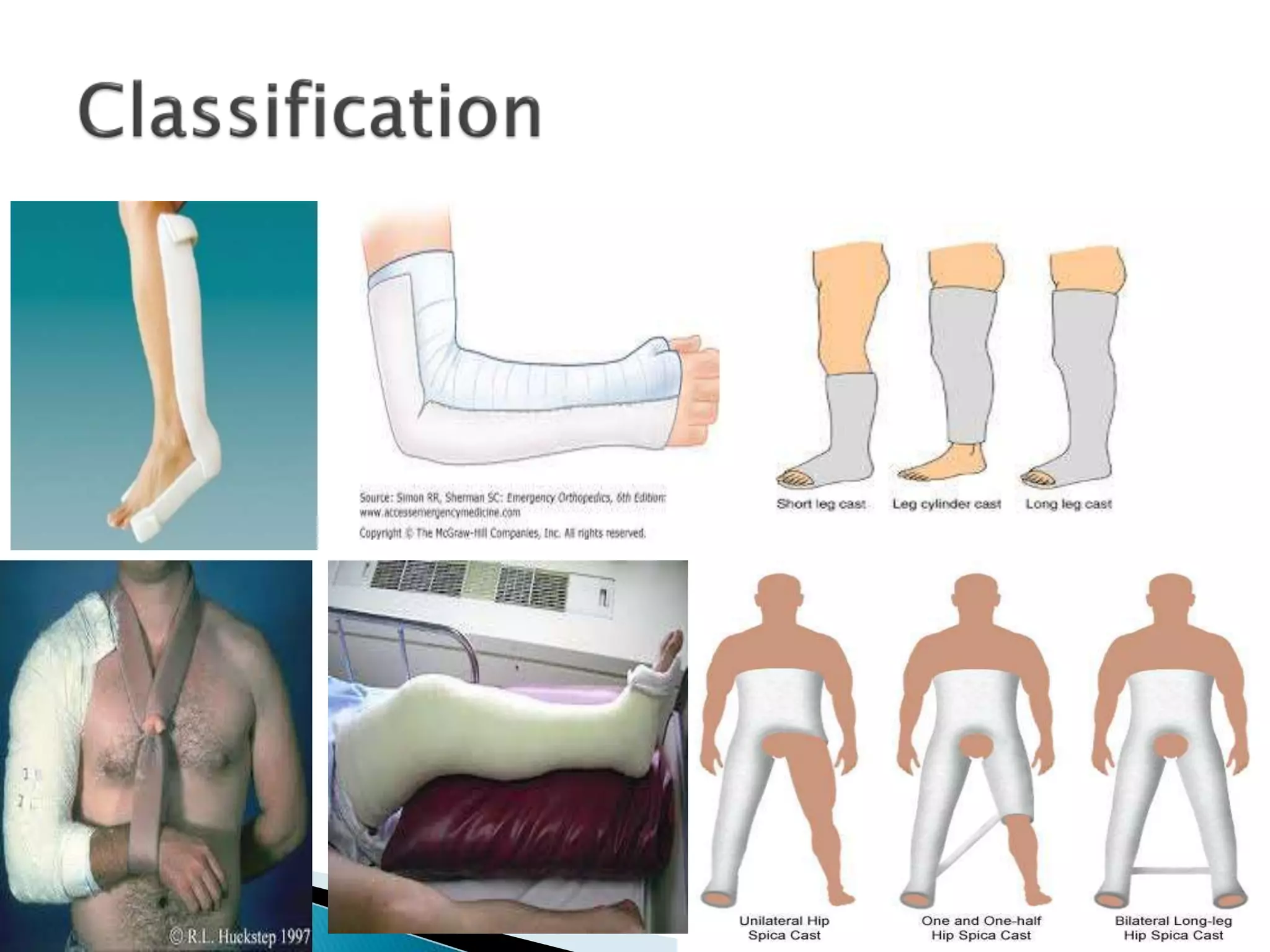
Based on Pattern Of Application
-Slab: POP encloses partial circumference ex:Short arm back Slab
-Cast :POP encloses full circumference ex Short leg full Plaster
-Spica: includes trunk and one or more limbs ex : Hip Spica
-Brace: Splintage which can allow motion at adjacent joints
Based on interposition of Material
Unpadded-No material interposed in between Plaster Of Paris
and skin
A practice in antiquity
Padded-Interposed material may be stokinette and wool or
wool Alone
This is current practice
A. Plaster Of Paris with melamine resin
B. Fibreglass
– Advantages
 Lighter
 Three times stronger than POP
 Impervious to water
 Radiolucent
– Disadvantages
 Costly
 Less pliable
 Requires gloves
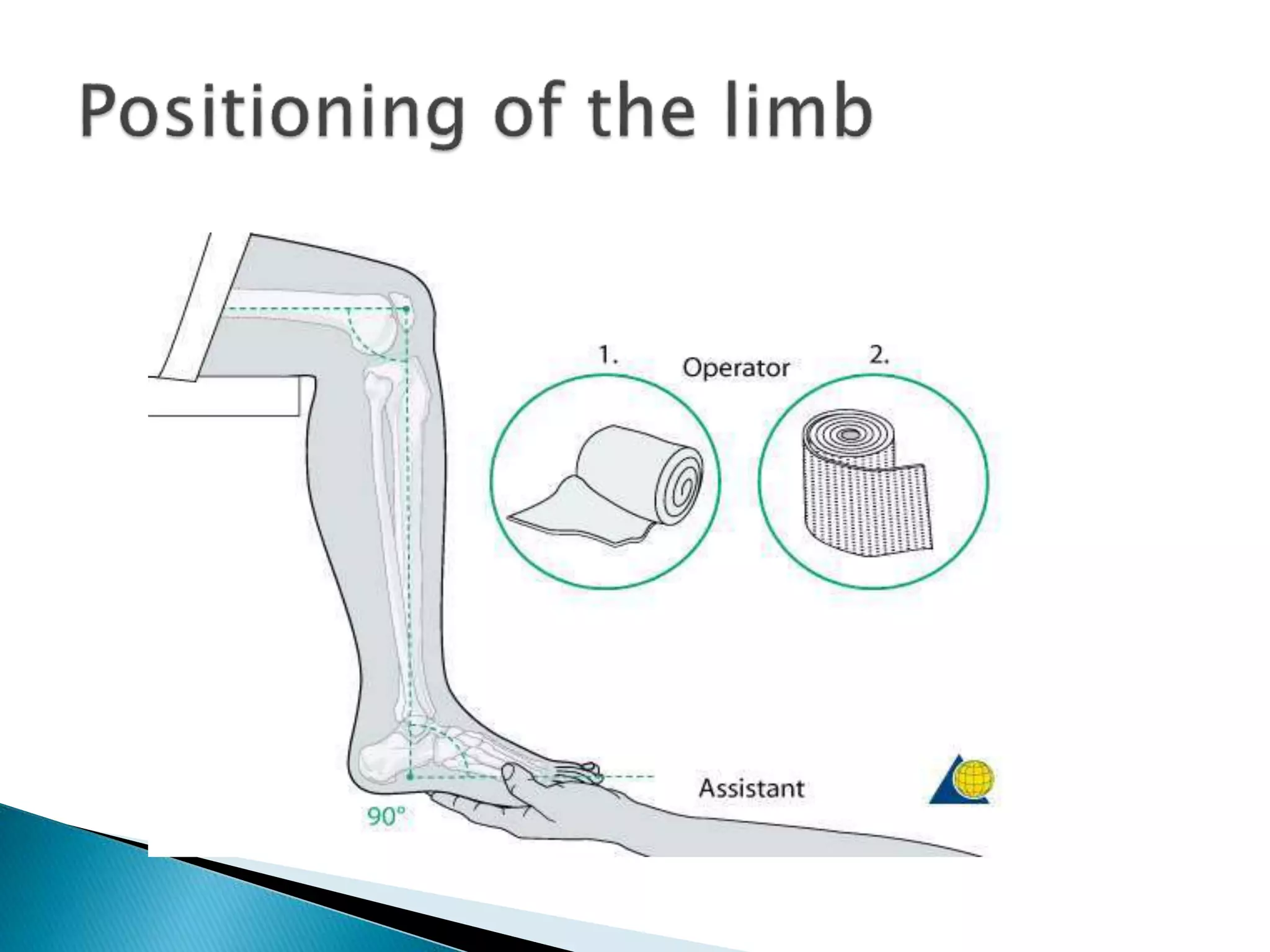
1.Examination and rehearsal
2. Plastering and molding
3. Reduction
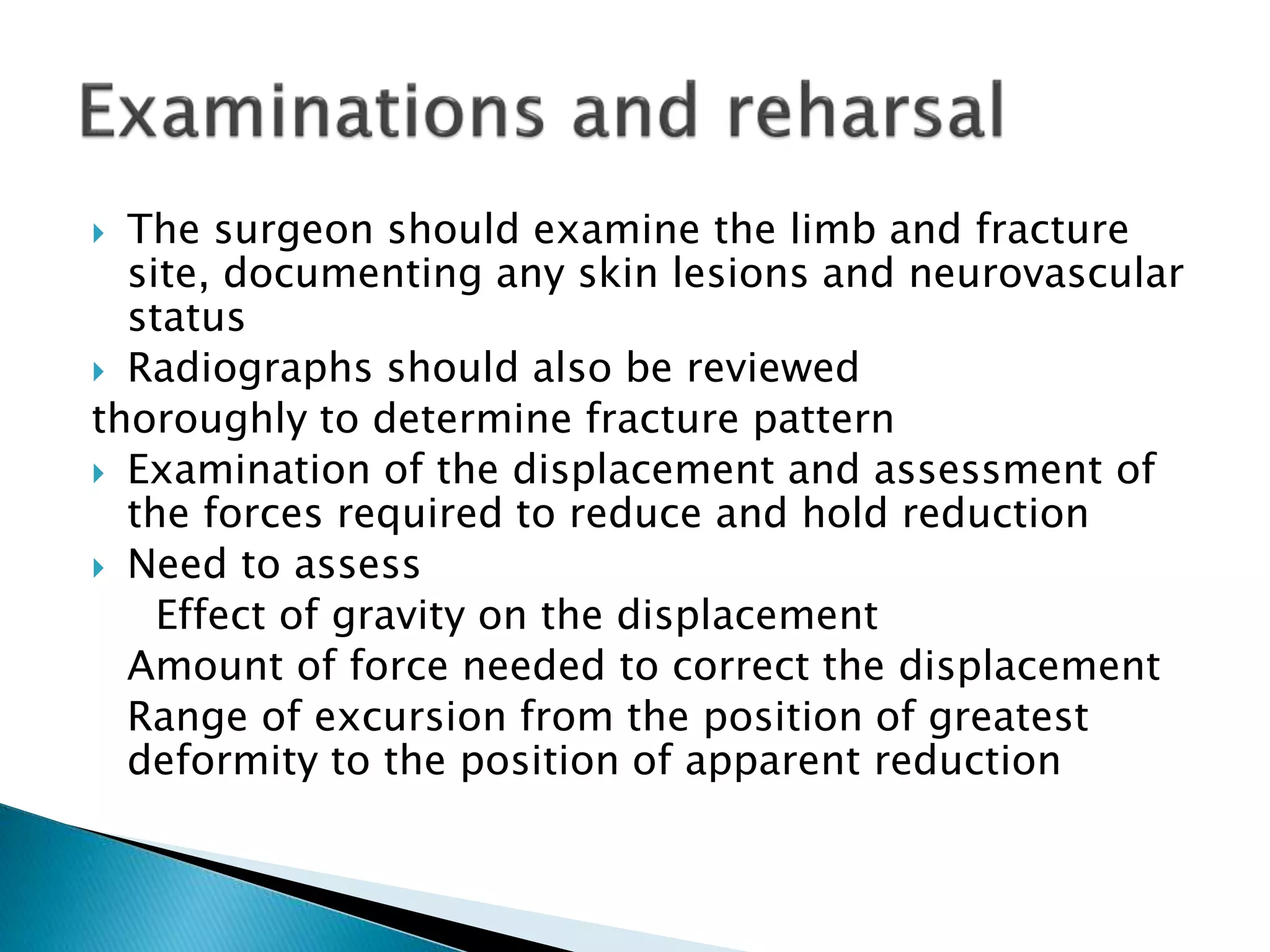
 The surgeon should examine the limb and fracture
site, documenting any skin lesions and neurovascular
status
 Radiographs should also be reviewed
thoroughly to determine fracture pattern
 Examination of the displacement and assessment of
the forces required to reduce and hold reduction
 Need to assess
Effect of gravity on the displacement
Amount of force needed to correct the displacement
Range of excursion from the position of greatest
deformity to the position of apparent reduction
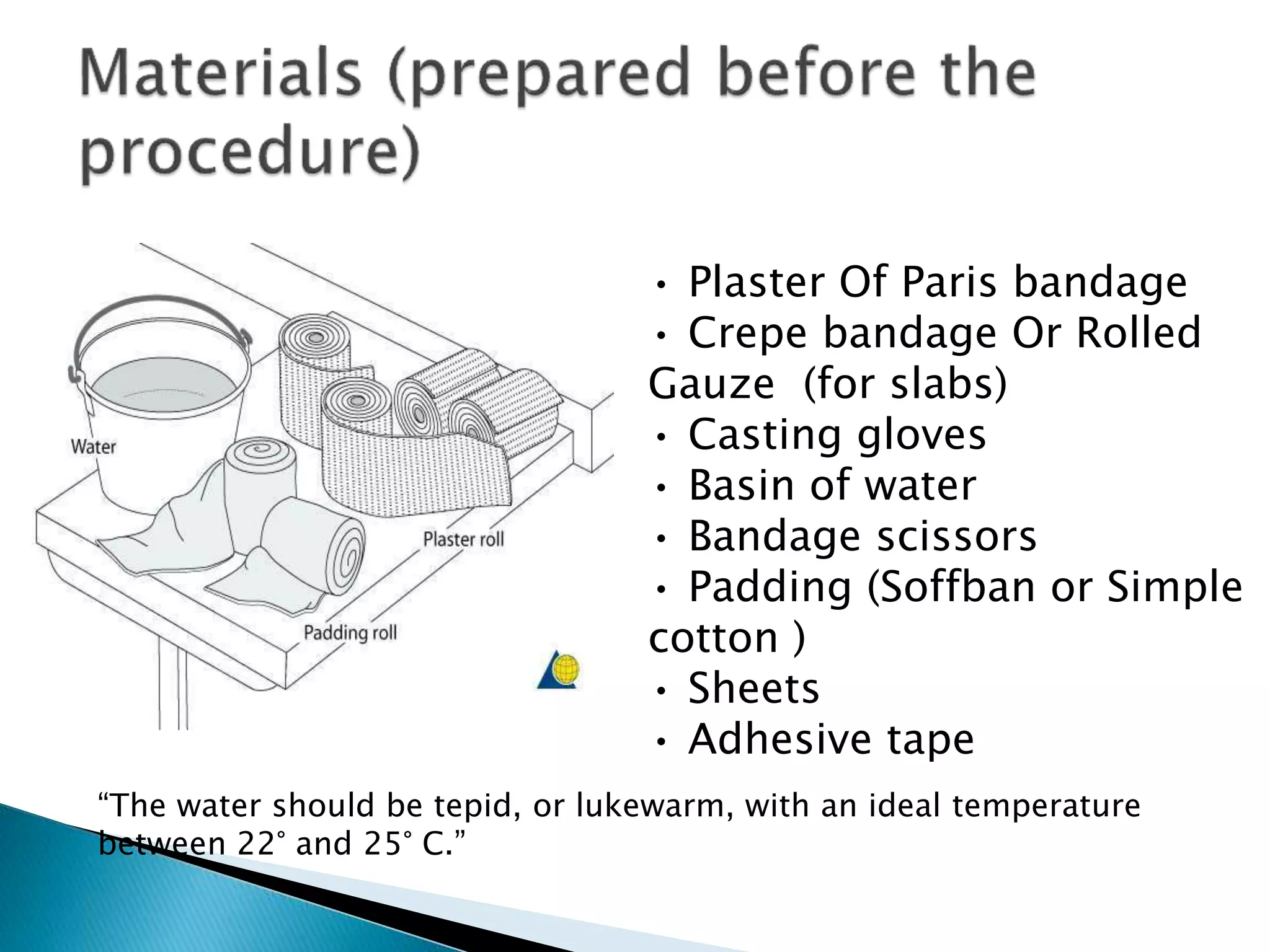
• Plaster Of Paris bandage
• Crepe bandage Or Rolled
Gauze (for slabs)
• Casting gloves
• Basin of water
• Bandage scissors
• Padding (Soffban or Simple
cotton )
• Sheets
• Adhesive tape
“The water should be tepid, or lukewarm, with an ideal temperature
between 22° and 25° C.”
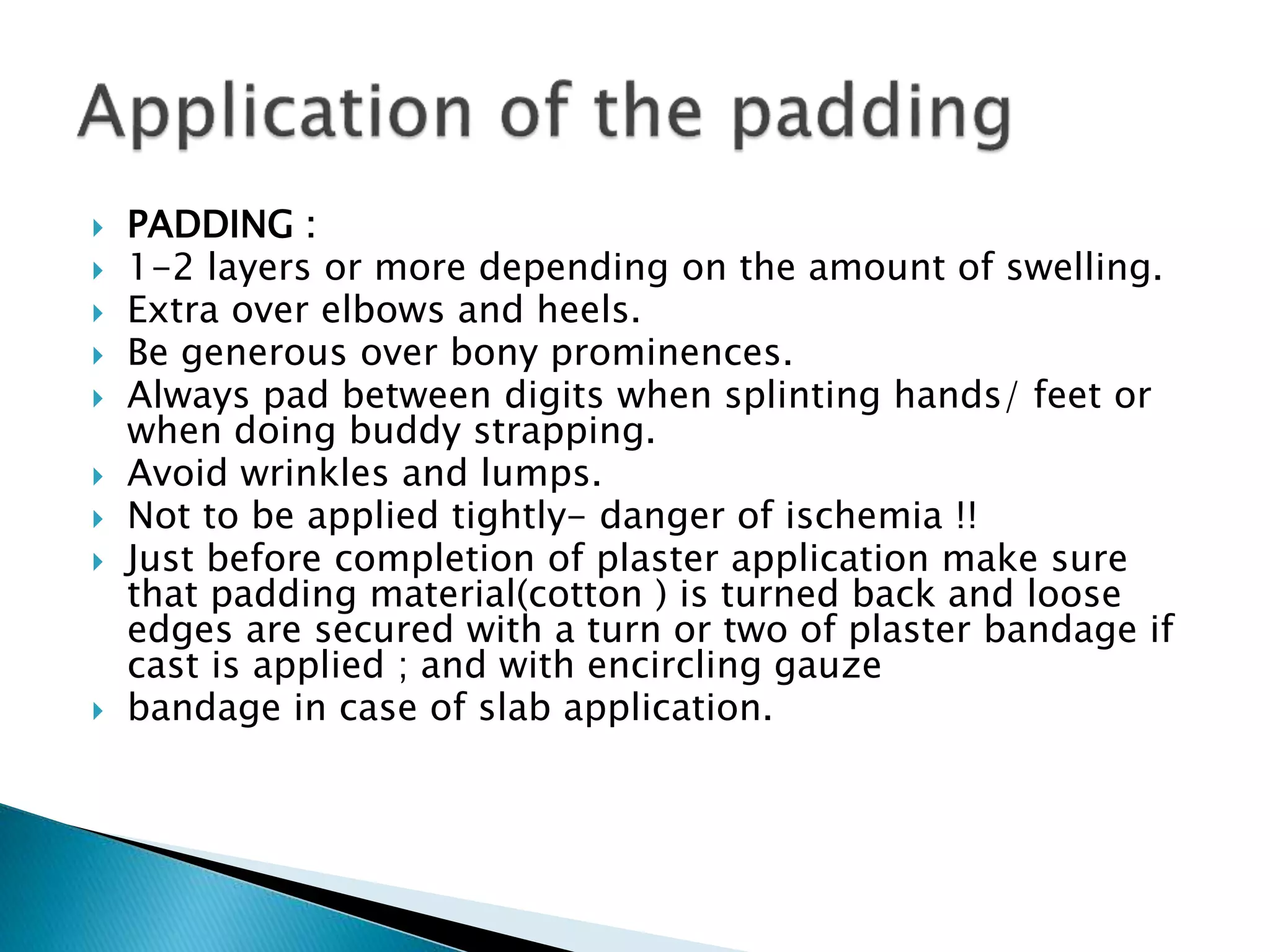
 PADDING :
 1-2 layers or more depending on the amount of swelling.
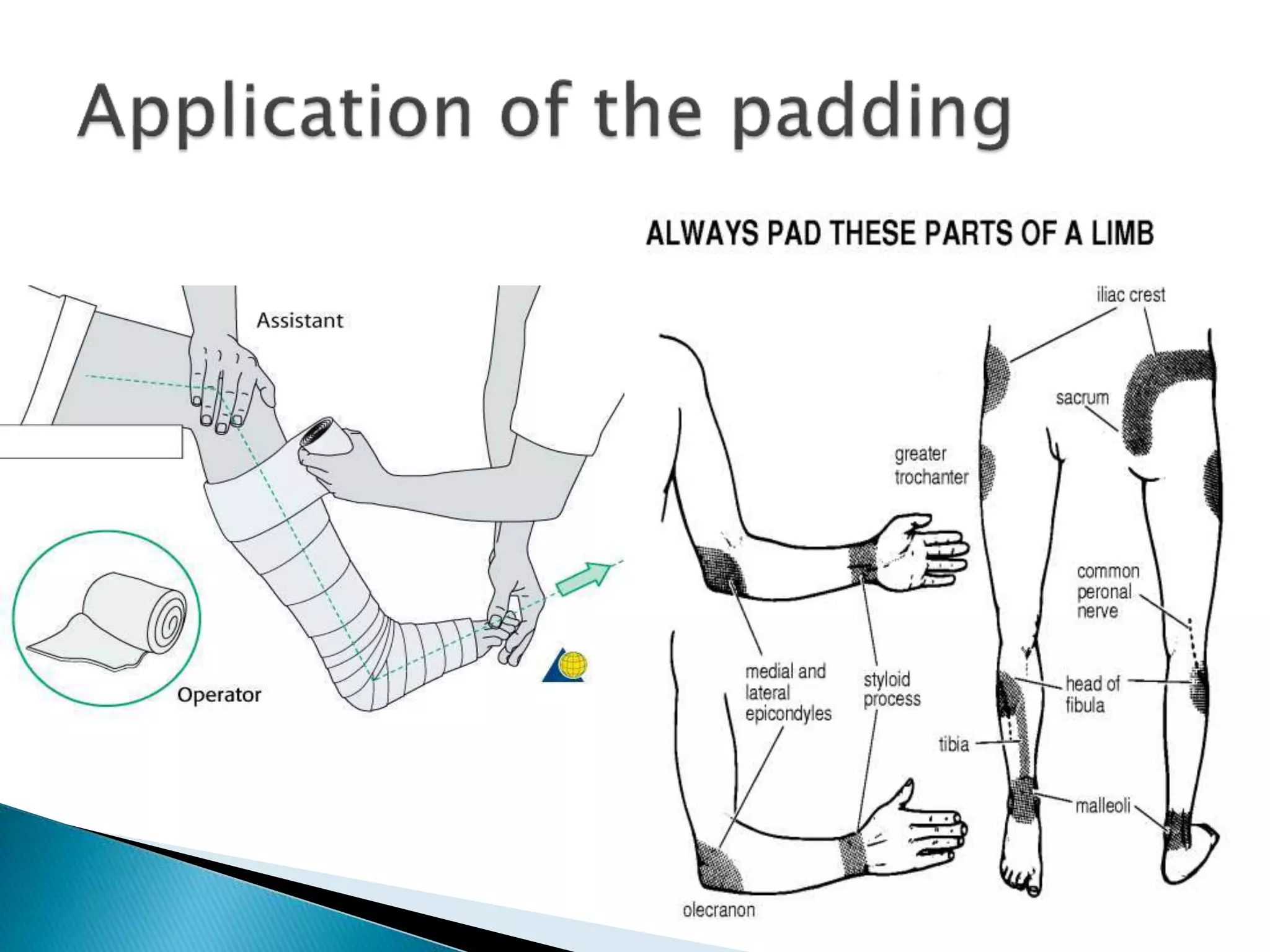
 Extra over elbows and heels.
 Be generous over bony prominences.
 Always pad between digits when splinting hands/ feet or
when doing buddy strapping.
 Avoid wrinkles and lumps.
 Not to be applied tightly- danger of ischemia !!
 Just before completion of plaster application make sure
that padding material(cotton ) is turned back and loose
edges are secured with a turn or two of plaster bandage if
cast is applied ; and with encircling gauze
 bandage in case of slab application.
 Plaster to be used is dipped completely with both
hands into tepid or slightly warm water and held
there till bubbling stops
 Prior to this, for slabs, the required length is
measured and layered. On average 10-12 layers
for upper limb and 12-16 layers for lower limb
would suffice
 Lift out and momentarily bunch up at an angle to
expel excess water.
 If a slab is to be created, the wet plaster is kept
on a flat surface and the hand is run from one
end to another to get rid of air bubbles which
may cause slab to be brittle and the layers to
separate when dry
 Slab is measured into required length
 For upper extremities use 8-10 layers and
for lower extremities use 12-15 layers or
upto 20 depending on size of the person
 One joint above and one joint below.
 Joints should be immobilized in functional
position.
 Not too tight or too loose i.e. adequate
padding
 Uniform thickness of plaster is preferred.
 Trimmed to the requirement of of the area
of application.
 Molded with palm and not with fingers to avoid
indentation.
 Consolidate the layers of the slab to remove
excess of air as retained air causes reduction of
plaster strength.
 Slab is positioned and smoothened out with the
hands so that the slab fits closely to the contours
of the limb.
 Wet bandage is applied to avoid tightening from
shrinkage after coming in contact with the slab.
 A layer of cotton-wool is interposed between the skin and
plaster, which is firmly compressed against the limb by
applying wet plaster bandage under tension.
 The elastic pressure of the cotton enhances the fixation of
limb by compensating for shrinkage in tissues.
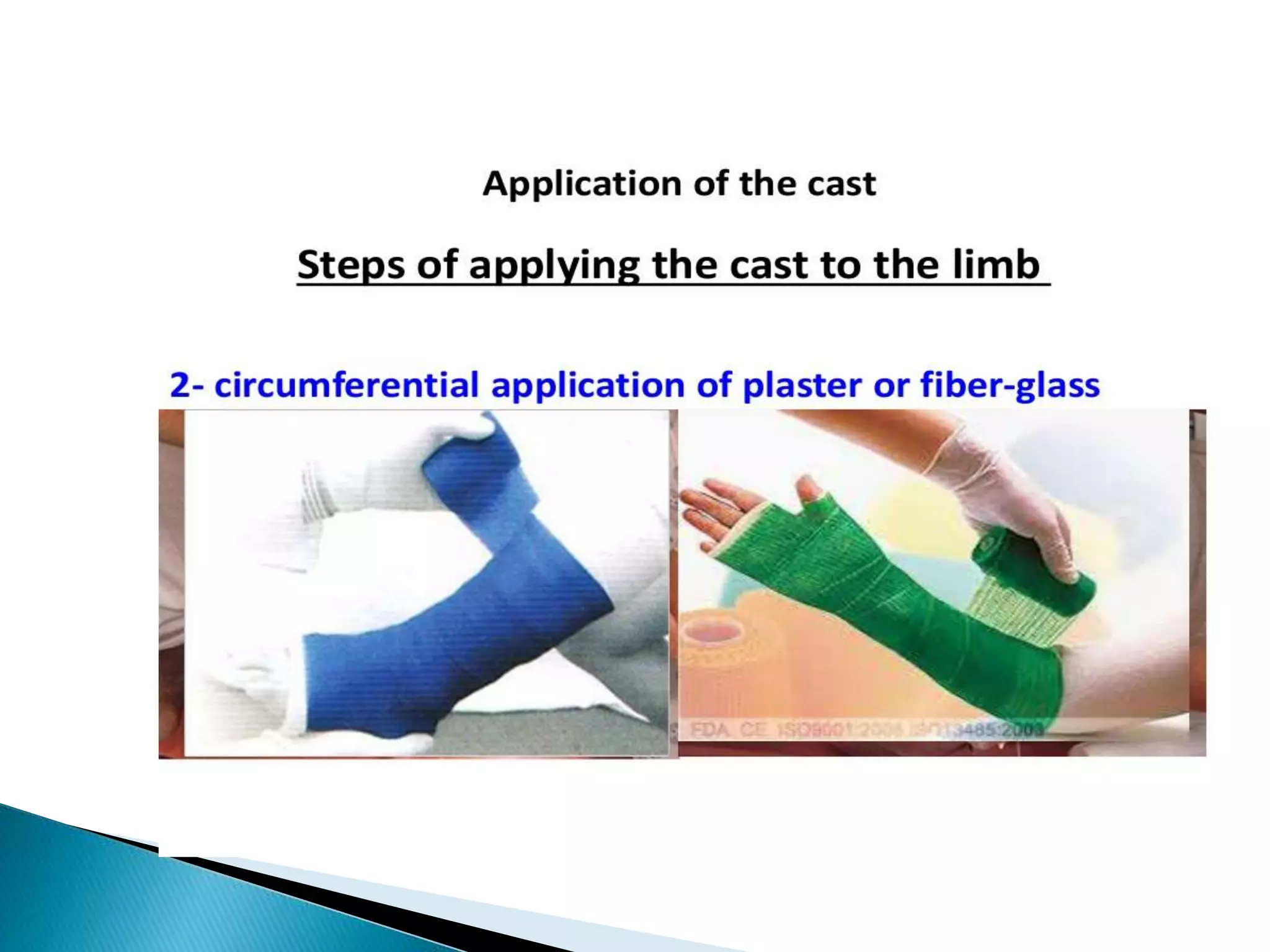
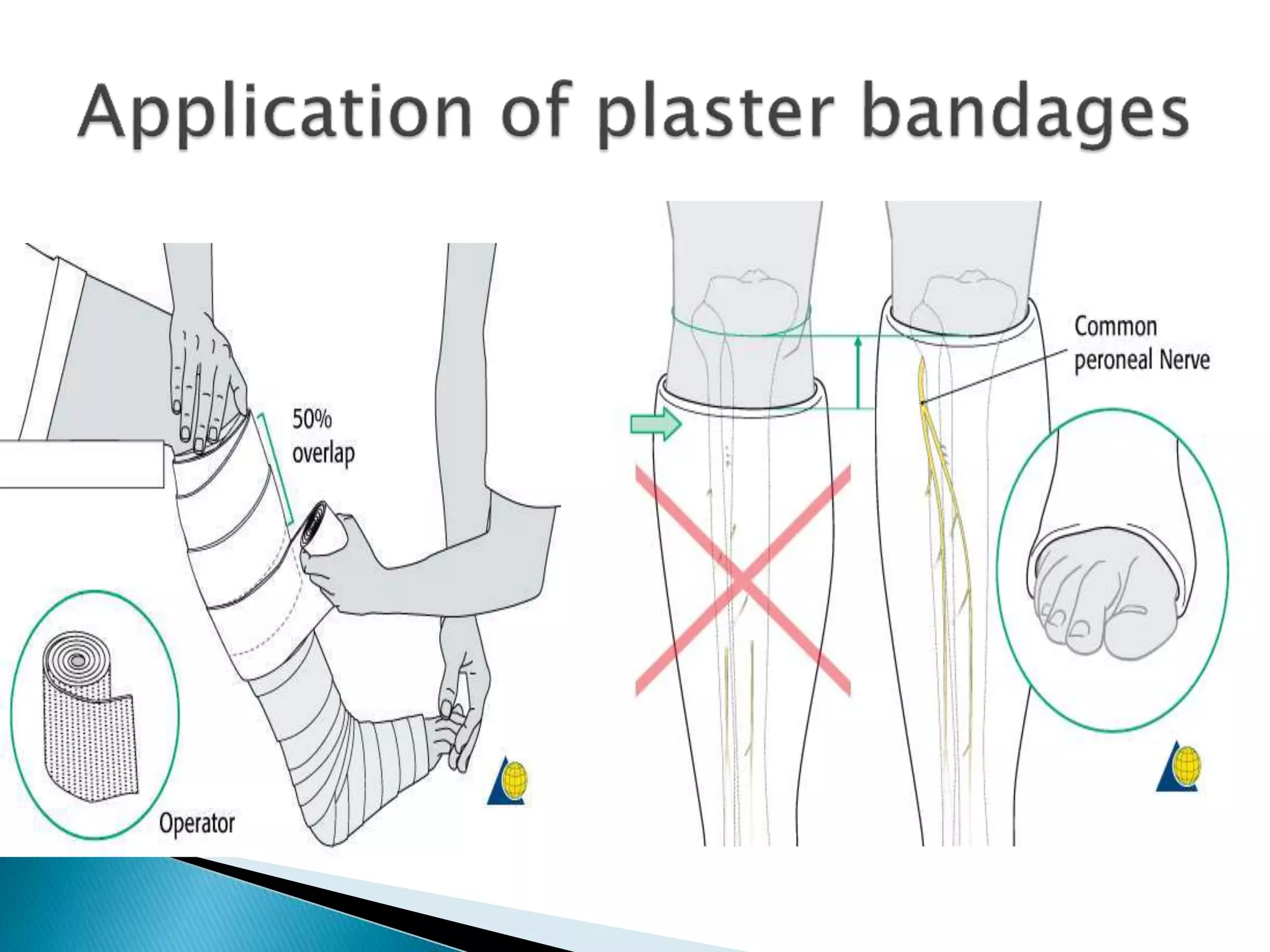
 Plaster is applied in distal to proximal with 50% overlap
 Plaster is applied gently, compressing padding thickness
by 50%
 The padding is rolled over and the final turns of Plaster
are rolled over it
 Bandage is pressed and pushed round the limb by the
pressure of thenar eminence under a strong pushing force
directed in length of surgeon’s forearm.
 Pressure is applied at the middle of width of bandage so
that no excess of pressure can fall on either edge .
 Above Elbow
An above elbow plaster cast or slab is applied
from knuckles of hand (distal palmar crease
anteriorly] and covers lower two thirds of arm
 Below Elbow
While distal extent is same as above, proximally
the plaster ends below elbow crease.
 Above Knee
Distal extent is up to metatarsophalangeal joints
and proximally it covers lower two thirds of
thigh.
• Below Knee
Distal extent is same, proximal extent ends below
knee.
 After applying sufficient plaster,surgeon
prepares to apply the rehearsed movement of
reduction
 Should be able to clearly recognize sensation
of reduction
 After applying rehearsed reduction, surgeon
holds on, without further movement to allow
put cast
 Patient should inform about thermal changes after
application of plaster.
 When a plaster has been applied over a fresh fracture or
after operation upon a limb,careful watch must always be
kept for possible impairment of the circulation.Undue
swelling within a closely fitting plaster or splint may be
sufficient to impede the arterial flow to the distal part of
the limb.So Must check the vascular supply distal to the
slab or cast.
 Whenever possible,the injured limb should be elevated.In
case of arm and forearm a sling may be used,provided the
arm the arm is kept high enough.In case of lower limb the
leg may be elevated on pillows and the end of the bed
raised
 Check X Ray should be done after application of each cast
to confirm the acceptability of reduction.
 Attempting to plaster at the same time as
attempting to hold a precise reduction.
 Applying wool carelessly in shapeless
lumps
 Loose bandaging
 Failing to recognize sensation of reduction
through the plaster
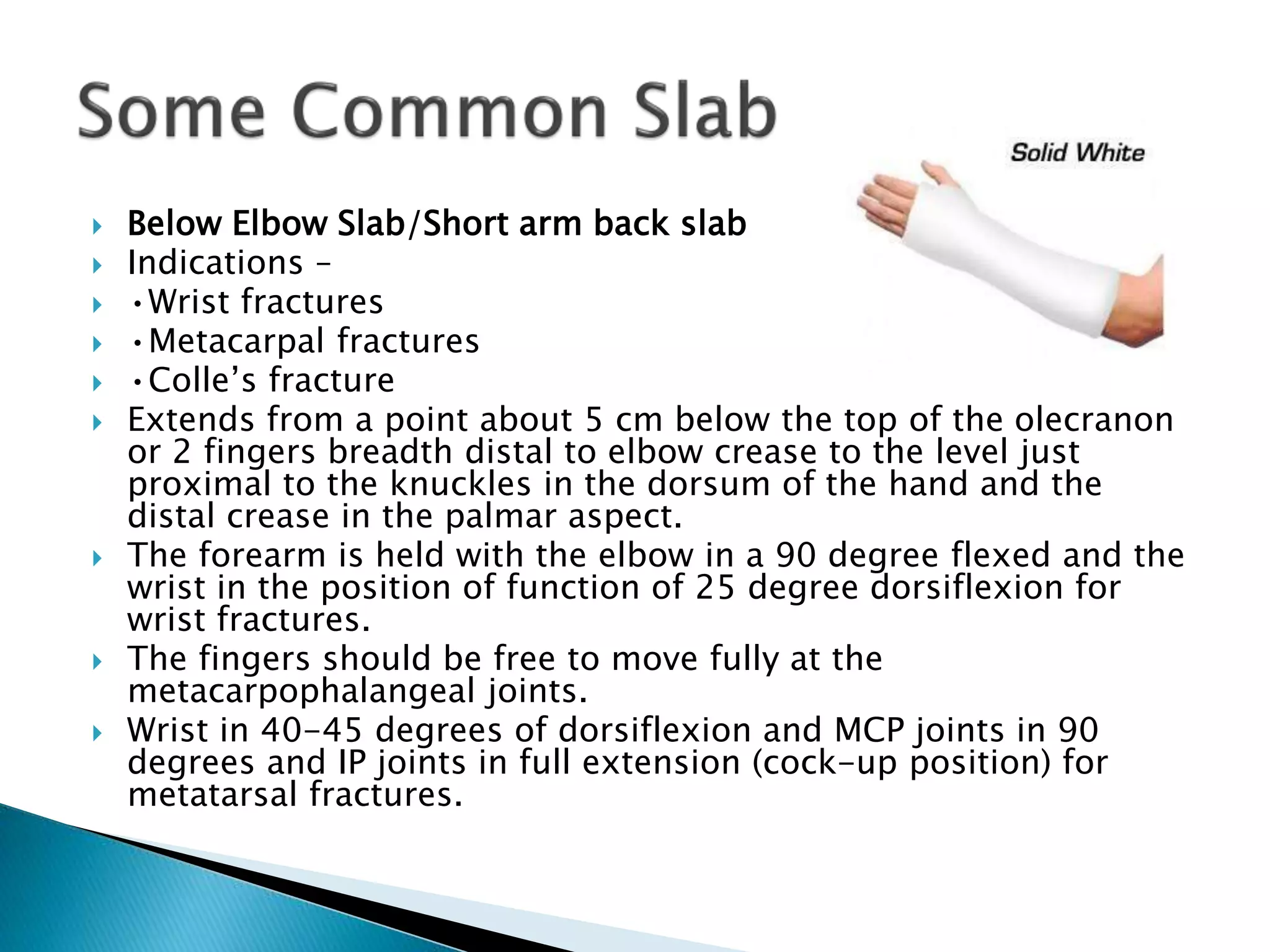
 Below Elbow Slab/Short arm back slab
 Indications –
 •Wrist fractures
 •Metacarpal fractures
 •Colle’s fracture
 Extends from a point about 5 cm below the top of the olecranon
or 2 fingers breadth distal to elbow crease to the level just
proximal to the knuckles in the dorsum of the hand and the
distal crease in the palmar aspect.
 The forearm is held with the elbow in a 90 degree flexed and the
wrist in the position of function of 25 degree dorsiflexion for
wrist fractures.
 The fingers should be free to move fully at the
metacarpophalangeal joints.
 Wrist in 40-45 degrees of dorsiflexion and MCP joints in 90
degrees and IP joints in full extension (cock-up position) for
metatarsal fractures.
Above elbow slab in elbow flexion/Long arm Back slab
 Indications
 Fracture both bones forearm
 Supracondylar fracture humerus of extension type
 Unstable proximal radius or ulnar #
Above elbow slab in elbow extension :
 Indications
 Olecranon Fracture
 Supracondylar fracture of humerus of flexion type.
 Extends from the middle of the upper arm to the
point just proximal to the knuckles in the dorsum of
the hand.patient's forearm is held in mid prone
position with the elbow in 90 flexed position or full
extension depending on the type of fracture.
 Indications :
 For Proximal and shaft of humerus fractures.
 Applied to the medial and lateral aspects of the
arm, encircling the elbow and overlapping the
shoulder.
 Utilizes dependency traction and hydrostatic
pressure to effect fracture reduction
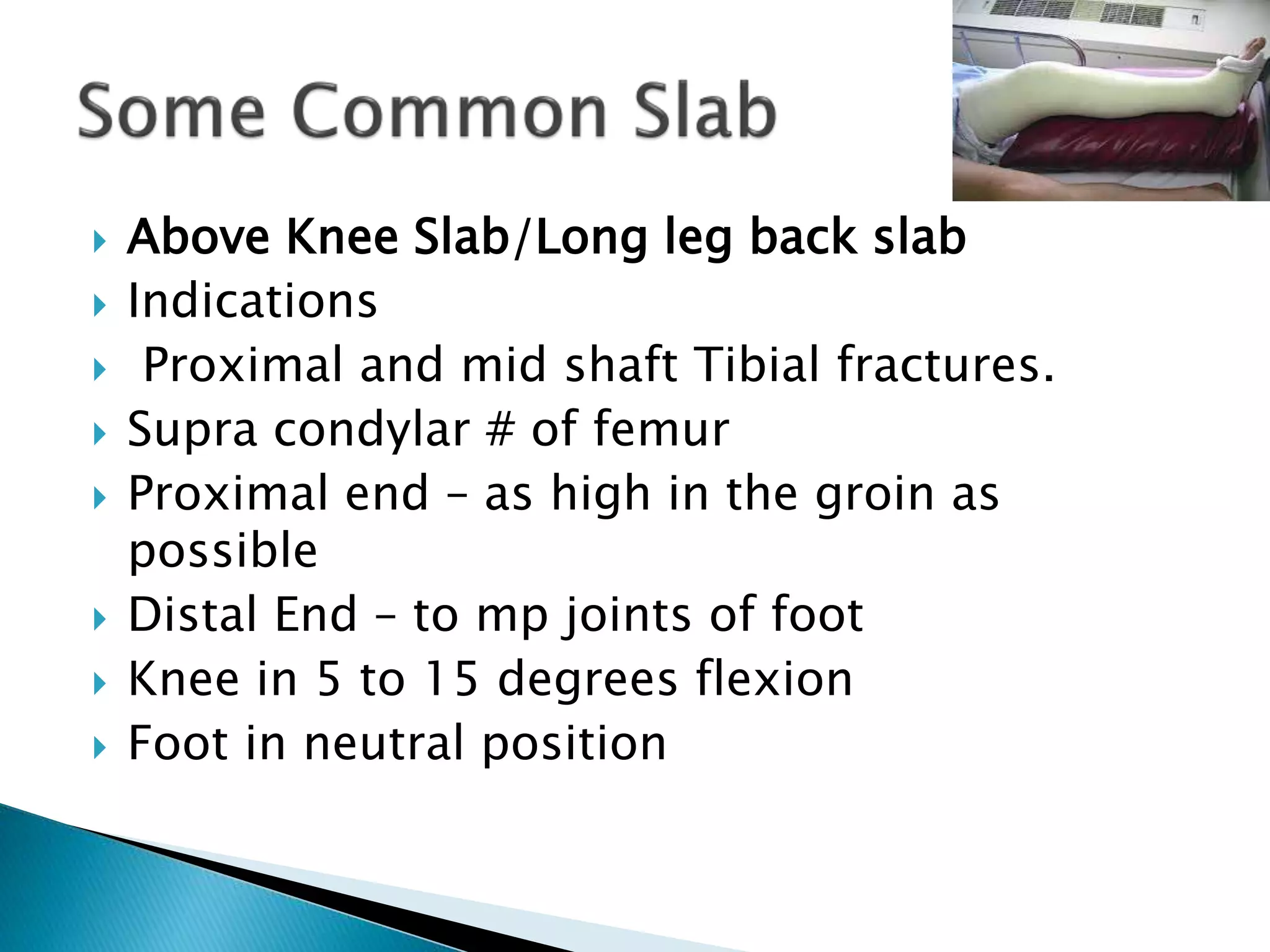
 Above Knee Slab/Long leg back slab
 Indications
 Proximal and mid shaft Tibial fractures.
 Supra condylar # of femur
 Proximal end – as high in the groin as
possible
 Distal End – to mp joints of foot
 Knee in 5 to 15 degrees flexion
 Foot in neutral position
When vascular damage is
suspected,encircling plaster is not
permissible until the danger of circulatory
complication has passed.Meanwhile ,skeletal
traction should be relied upon,or if necessary
a simple plaster slab can be bandaged lightly
to the limb
A complete plaster cast that is applied within a
few hours of injury or immediately after
operation,in cases when extensive swelling can
be expected should be split throughout its
length.The limb must be elevated until the
circulation is re established and the swelling
and oedema controlled
Mistakes may lead
to:
- Strangulation
- Volkmann’s ischemic
contracture
- Contribution to
Sudeck-dystrophy
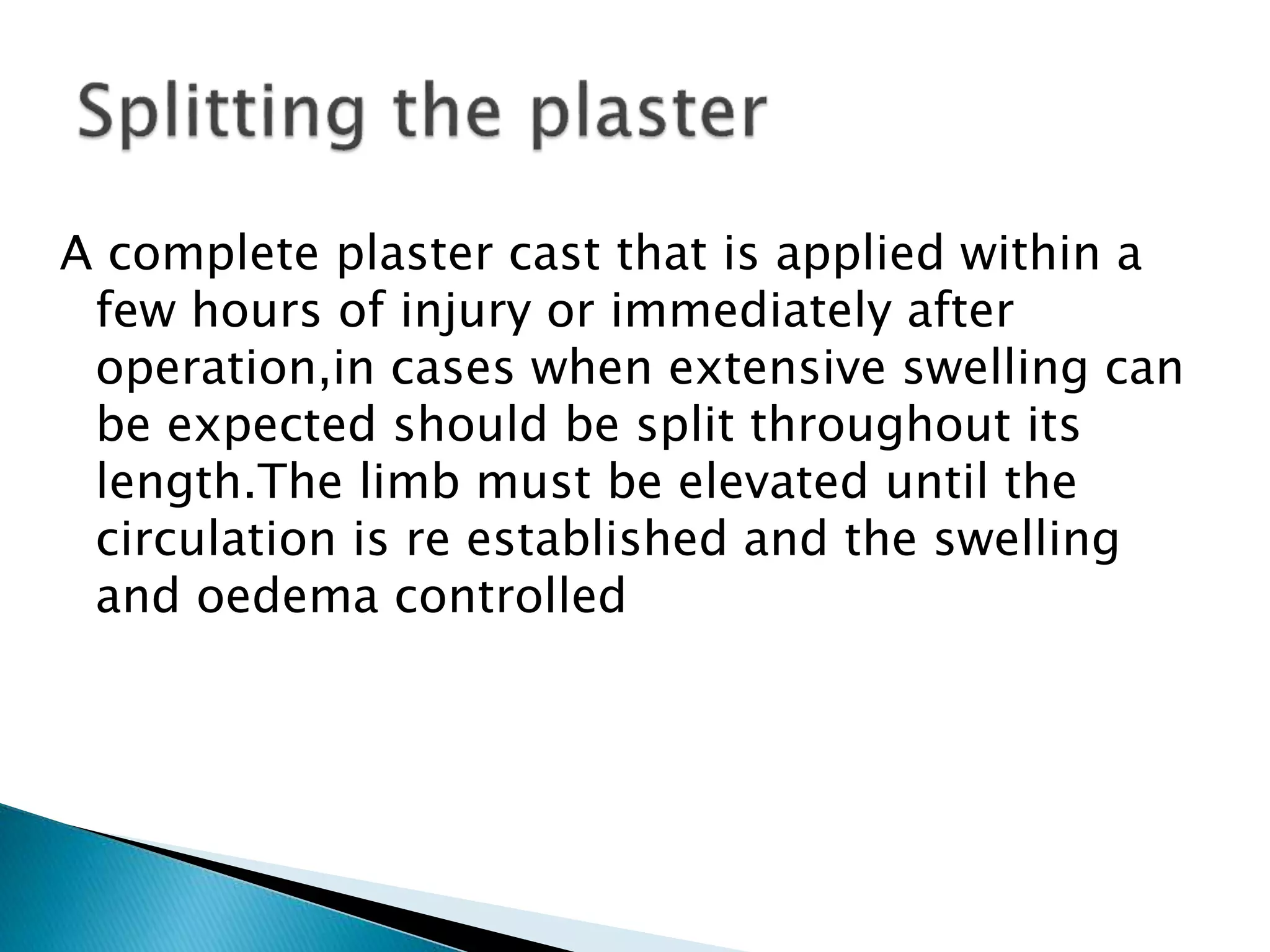
It is of great value to be able to correct minor degrees
of angulation without completely changing the
plaster.Yet even small degrees of angulations can be
corrected by a simple device of wedging and this can
be done with perfect control.
Under the guidance of X-rays fracture site is identified
and A linear cut is made round two thirds of the
plaster at the level of fracture on the concave side of
the angle. The linear division is opened to a wedge
which is held open by a small block of cork placed
between the two cut edges.Another radiograph is
taken and degree of correction may be increased or
decreased by inserting larger or smaller cork.When
the final radiograph proves alingment is perfect,the
gap in the plaster is filled and reinforced.
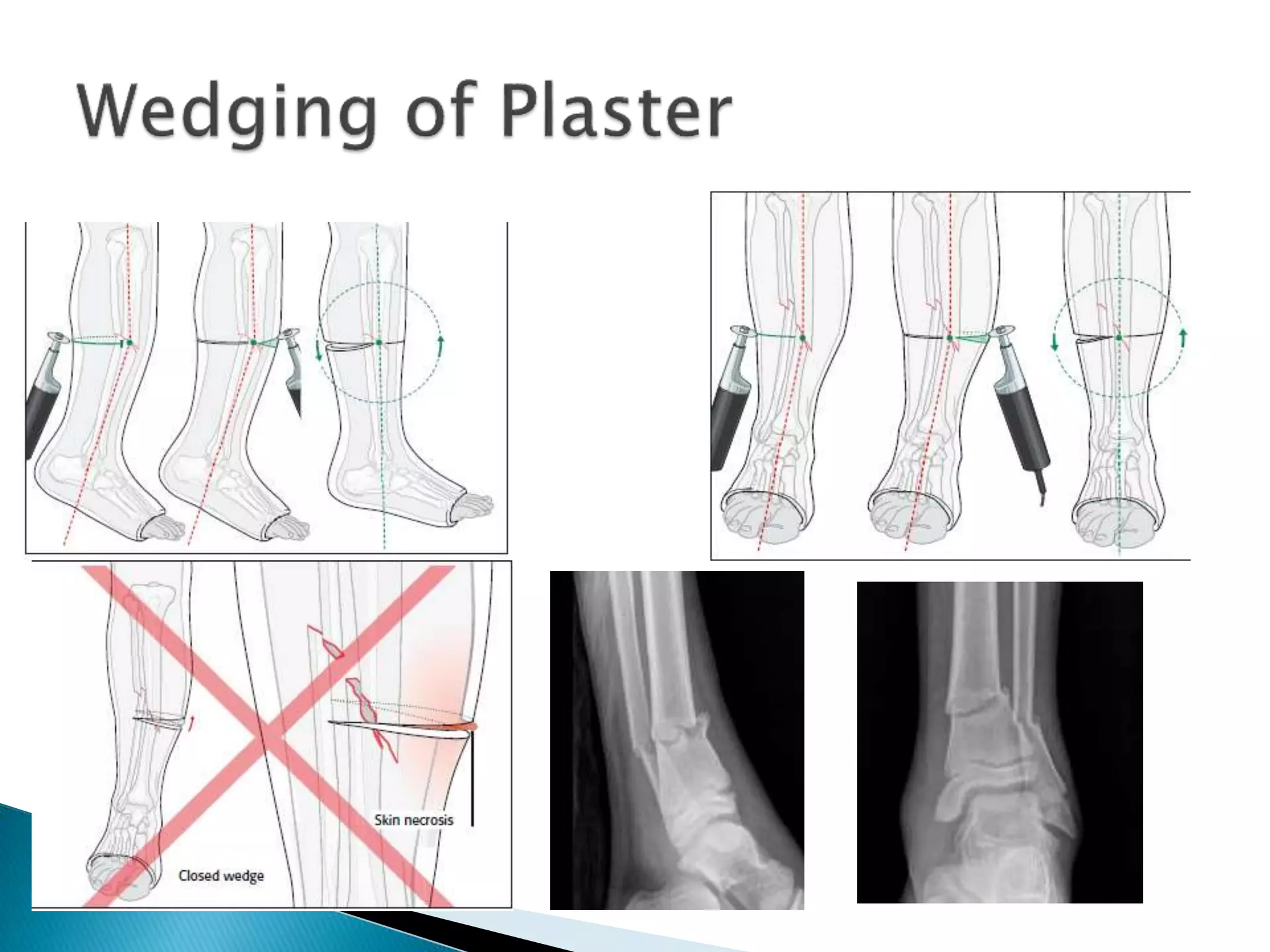
 Not usually encouraged
 Danger of edematous tissue herniating
through the window
Indicated in-
 Compound fractures discharging copious pus
 Compound fractures grafted with pinch
 graft or Thiersch graft
Counsel the patient on signs of neurovascular
compromise
 Warning signs
You should contact your doctor immediately if you
develop any of the following warning signs:
• Cast/splint is too tight
• Fingers or toes are swollen (a little is normal;a
lot is bad)
• Numbness (loss of feeling) in fingers or toes
• Can’t move fingers or toes
• Pain keeps getting worse
• “Hot spot” (burning and/or rubbing) under the
cast.
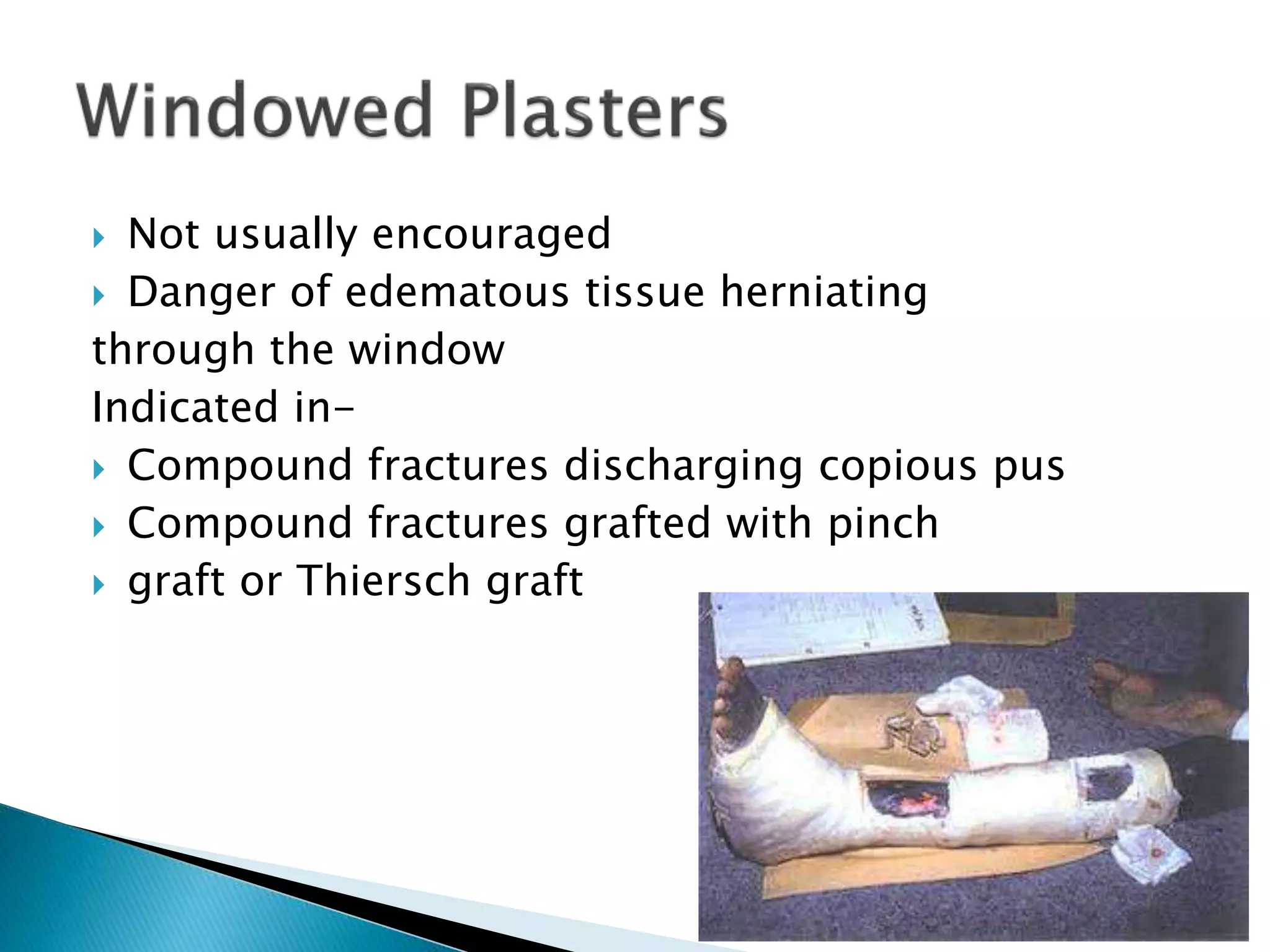
How to prevent swelling
To reduce the swelling, rest and elevate the injured
area above the level of heart.An injured foot or ankle
should be up on pillows while you are lying or sitting
partially upright. Once elevated, gentle finger or toe
motion is alright, but vigorous use may irritate the
injured area,increasing swelling and pain.Apply ice
to the injured area using a waterproof bag. This
helps relieve pain and swelling, even through the
cast or bandage.How to prevent stiffness
As soon as patient can, completely bend and
straighten the fingers/toes of injured limb for
a few seconds every hour while patient is
awake. Gentle stretching of the joints above
the cast (elbow, shoulder, knee, hip) is also a
good idea in most cases. Even if not
injured,shoulder especially can become stiff
and uncomfortable if not used normally for
long periods of time. If needed, use other
hand to help move limbs and joints through a
 Keep your cast dry:
Plaster casts “melt” if they get wet, and your skin can be harmed
from wet padding. Always use a waterproof cover or heavy
plastic bag when showering (no swimming or baths), and use a
hair dryer set to a low temperature if it becomes damp. Contact
your doctor if the cast becomes signifi cantly wet.
 Keep your cast clean:
Avoid dirty or dusty places, beaches, fields, etc, and avoid
activities that might soil your cast.
 Don’t overheat your cast:
If your cast is near a heater or fireplace it can become
overheated and burn you.
 Don’t put anything inside your cast:
Sometimes your skin itches inside the cast.This can be relieved
by applying an ice pack,or placing a hair dryer or vacuum cleaner
against one of the ends of the cast to drawair through it and
across your skin.
 Is my cast too tight?
Casts should feel snug,but not too tight. Tightness develops from
swelling inside the cast. Elevate and rest the limb. Eventually, the
swelling decreases. If tightness does not improve, call your doctor
promptly.
 Is my cast too loose?
Sometimes, as healing progresses, the cast begins to feel loose. This can
usually be checked by your doctor during a routine follow-up, but if the
cast slides signifi cantly up or down your limb it should be checked
promptly.
 What if my cast gets soft or breaks?
This can happen with any type of cast resulting in a cast that does not
protect your injury well,or that irritates your skin, perhaps causing
blisters or sores. Visit your doctor to get the cast repaired or replaced. If
it’s on your leg,stop walking on the cast and use crutches.
 How about jewelry?
Immediately after an injury, remove any rings, bracelets, and body
piercings.Because of swelling, they can become too tight.
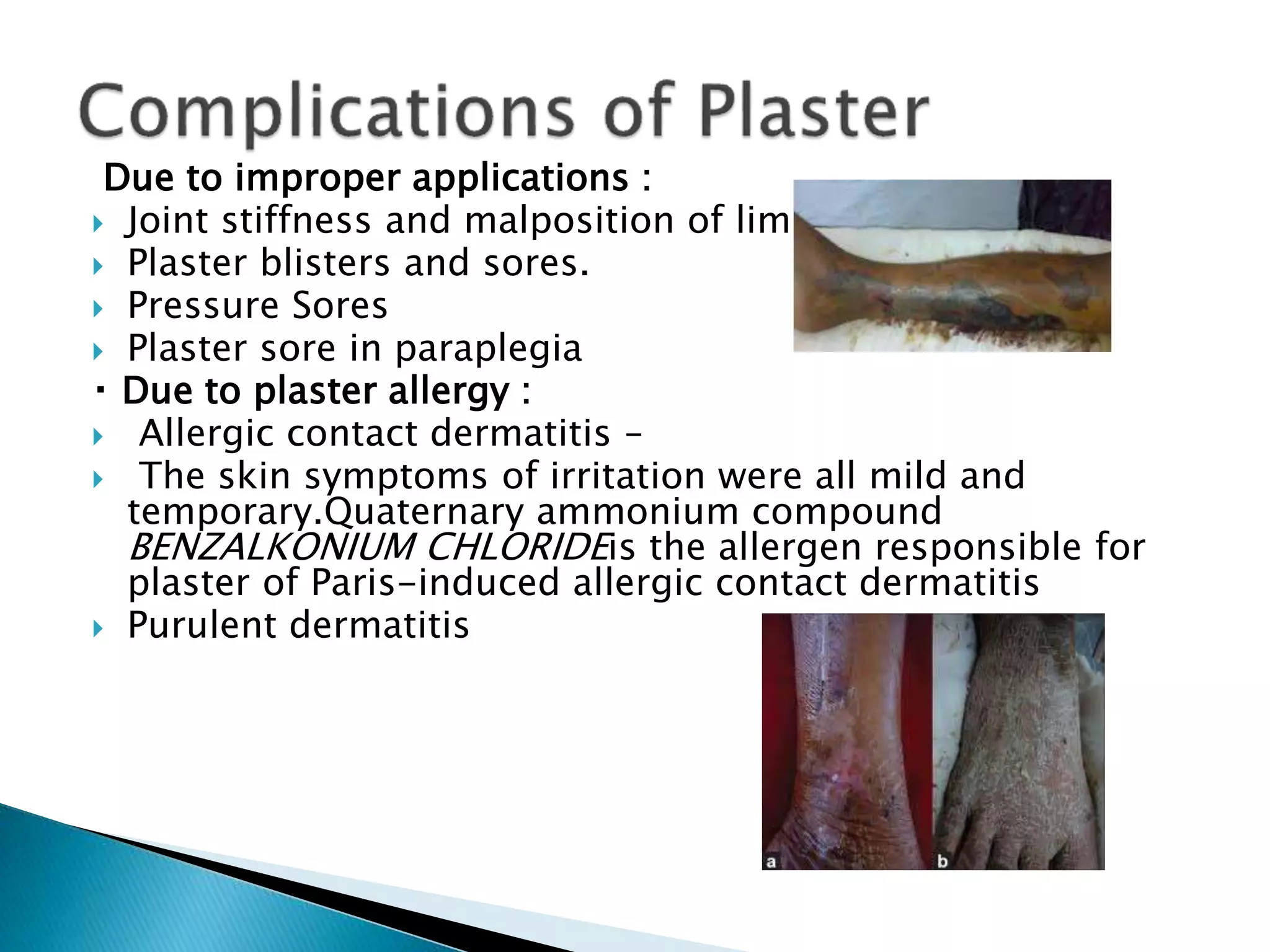
Due to improper applications :
 Joint stiffness and malposition of limb.
 Plaster blisters and sores.
 Pressure Sores
 Plaster sore in paraplegia
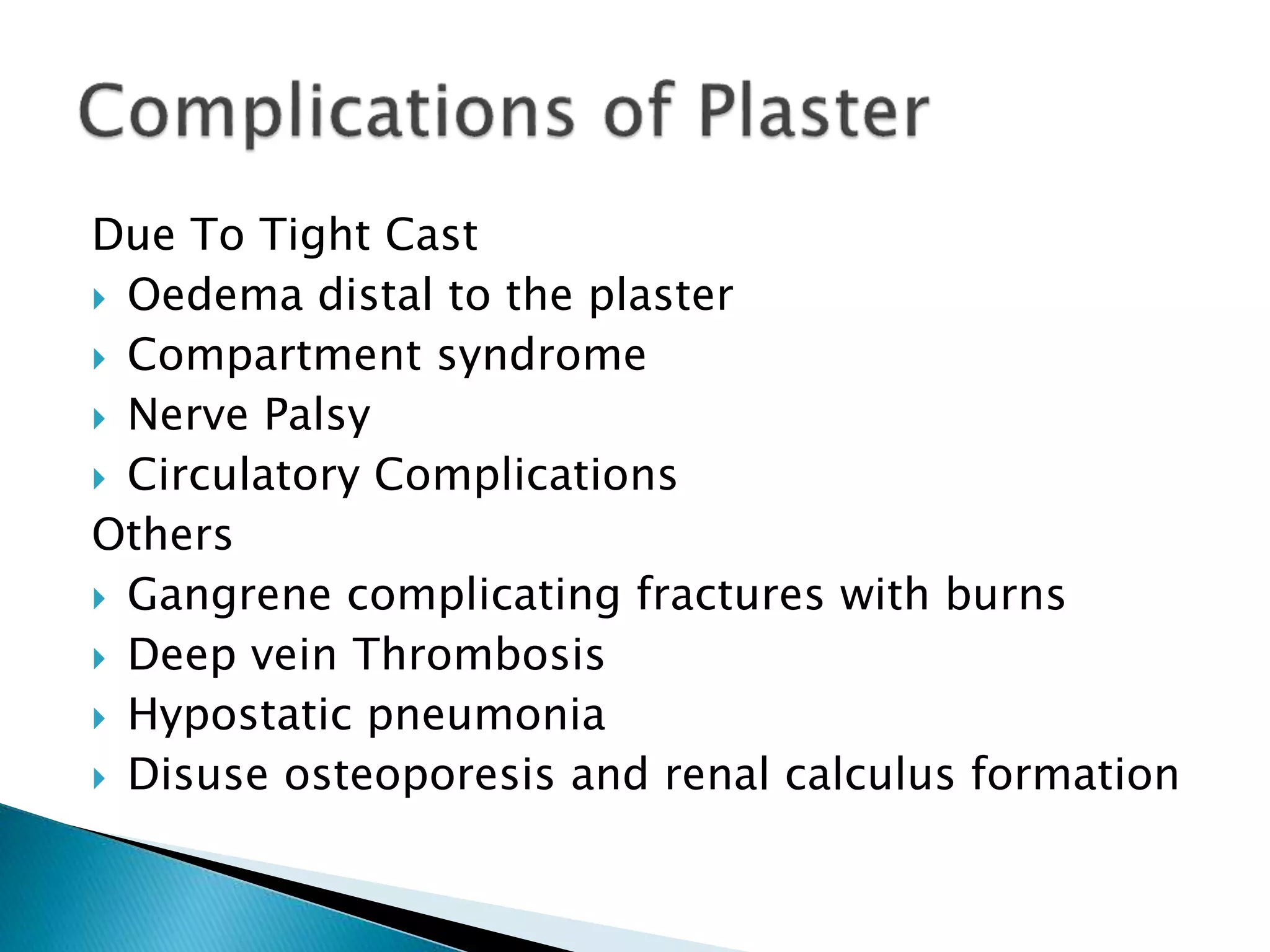
Due to plaster allergy :
 Allergic contact dermatitis –
 The skin symptoms of irritation were all mild and
temporary.Quaternary ammonium compound
BENZALKONIUM CHLORIDEis the allergen responsible for
plaster of Paris-induced allergic contact dermatitis
 Purulent dermatitis
Due To Tight Cast
 Oedema distal to the plaster
 Compartment syndrome
 Nerve Palsy
 Circulatory Complications
Others
 Gangrene complicating fractures with burns
 Deep vein Thrombosis
 Hypostatic pneumonia
 Disuse osteoporesis and renal calculus formation
PRESSURE TISSUE
DAMAGE
STRANGULATION
BULLAE-
FORM
SKIN LESION
When a limb is put into Plaster and the joints
immobilized for a long period , joint stiffness,
muscle wasting and osteoporosis are
unavoidable.
 This syndrome can be reduced to a minimum by
the early use of functional braces, isometric
exercise and early weight bearing.
 These in turn promote a rapid retrieval of
function.
 A constellation of symptoms and physical changes has
been
 called “fracture disease.”
 Prolonged immobilization, especially in a nonfunctional
cast, can lead to a vicious cycle of pain, swelling, and
unresolved edema.
 Edema fluid is a proteinaceous exudate that will congeal
and gets converted to a gelatinous material and deposited
as a scar
tissue around joints and tendons causing joint
stiffness,contracture and tendon adhesions.
 Muscle atrophy, brawny skin /induration, and osteoporosis
follow
 Reflex sympathetic dystrophy may sometimes occur and
further complicate the picture
Duration to keep Plaster or cast in situ:
The time duration is much dependent upon the
fracture site,type,soft tissue condition and proper
follow up with radiograph and functional
condition of the limb
Roughly the time duration assume:
For children:
Upper limb-3 weeks
Lower limb-6 weeks
For adult:
Upper limb-6 weeks
Lower limb-12 weeks
 Slabs are removed by cutting the bandage, carefully avoiding
nicking
the skin
 For casts
 – Using shears
» Heel of the shears must lie between plaster and skin, avoiding
bony prominences
» Avoid cutting over concavities
» The route of the shears should lie over compressible soft tissue
» The lower handle should be parallel to the plaster
 – Using electric saw
» Do not use unless there’s wool padding
» Do not use over bony prominences
» The cutting movement should be up and down not lateral
» Do not use blade if bent, broken or blunt
 Suitable for direct application
 Easy to mould or remould
 Nontoxic for patient
 Unaffected by water
 Transparent to x-rays
 Quick setting
 Able to transmits air, water, odour and pus
 Strong but light in weight
 Non-inflammable
 Non messy application and removal
 Long shelf life
 cheap
Plaster of paris ortho presentation

Plaster of paris ortho presentation

  • 1.
    Dr. Chinmoy Mazumder Indoormedical Officer Department of Orthopaedics
  • 2.
    Many thousands yearago the Egyptians immobilised fractures by linlen stiffen with gum or plaster,also starch,clay and egg albumin Plaster of Paris bandages were first used by Antonius Matthysen,A Dutch military surgeon in 1852 The name of the plaster of paris derived from an accident to a house built on a deposit of Gypsum,Near Paris.The house burnt down.When rain fall on baked mud of the floors it was noted that footprints in mud set rock hard.
  • 3.
    HISTORY Egypt - 5thDynasty Egypt (2465-2323 BC) First Splinting of Fractures. X-ray machine (1895): reduction is available Nowadays: fluoroscope (early 1960’s) and portable extremity CT-scanner Antonius Mathysen (1852): first cast fixation
  • 4.
    The plaster ofParis consists of roll of muslin stiffened by dextrose or starch and impregnated with the hemihydrate of calcium sulfate. (CaSO4.1/2H2O) When watwer is added,the calcium sulfate takes up its water of crystallization: 2(Caso4.1/2H2O) +3H2O----2 CaSO4.2H2O+Heat This is the process of setting and is an Exothermic reaction Plaster Of Paris incorporates 20% of water its soaks up,the remaining 80% lost during drying
  • 5.
    The best plastershould be a fairly wide mesh starch free crioline or muslin bandage,6 inches(15.2cm) wide and 4.6 meter long.The completed plaster bandage should be elastic and springy.An average 4 meter plaster bandage should weigh 8 ounces(224gm)and contain 85 to 90 percent by weight of plaster. Note: the setting of unmodified plaster starts about 10 minutes after mixing and is complete in about 45 minutes; however, the cast is not fully dry for 72 hours.
  • 6.
    Setting time –Time taken to convert from powder form to crystalline form Average time is 3-10 minutes Reduced by- High Temperature Salt solution Borax Solution Addition Of Resin Increased by Low temperature Sugar solution Setting time is three times longer at 5 C than at 50 C Movement of plaster while it is setting will cause gross weakening
  • 7.
    Drying time –Time taken for Plaster of Paris to convert from crystalline from to anhydrous form Influenced by ambient temperature and humidity The optimum strength is achieved when it is completely dry.
  • 8.
     To Supportfractured bones,controlling movement of fragments and resting the damaged tissues  To stabilise and rest joints in ligamentous injury  To support and immobilize joints and limbs post operatively until healing has occurred  To corresct a deformity  To ensure rest of infected tissues  To make negative mould of a part of body
  • 9.
     Plaster ofParis  Plaster Of Paris with Melanin Resin  Materials which undergo Polymerisation Water Activated Non water activated  Materials which undergo Polymerisation
  • 10.
    Advantages  Slower setting Infinitely moldable when wet  cheap Disadvantages  Heavy  Messy  Significantly weakened if cast is wet  Partially radio-opaque
  • 11.
    Based on PatternOf Application -Slab: POP encloses partial circumference ex:Short arm back Slab -Cast :POP encloses full circumference ex Short leg full Plaster -Spica: includes trunk and one or more limbs ex : Hip Spica -Brace: Splintage which can allow motion at adjacent joints Based on interposition of Material Unpadded-No material interposed in between Plaster Of Paris and skin A practice in antiquity Padded-Interposed material may be stokinette and wool or wool Alone This is current practice
  • 13.
    A. Plaster OfParis with melamine resin B. Fibreglass – Advantages  Lighter  Three times stronger than POP  Impervious to water  Radiolucent – Disadvantages  Costly  Less pliable  Requires gloves
  • 15.
    1.Examination and rehearsal 2.Plastering and molding 3. Reduction
  • 16.
     The surgeonshould examine the limb and fracture site, documenting any skin lesions and neurovascular status  Radiographs should also be reviewed thoroughly to determine fracture pattern  Examination of the displacement and assessment of the forces required to reduce and hold reduction  Need to assess Effect of gravity on the displacement Amount of force needed to correct the displacement Range of excursion from the position of greatest deformity to the position of apparent reduction
  • 18.
    • Plaster OfParis bandage • Crepe bandage Or Rolled Gauze (for slabs) • Casting gloves • Basin of water • Bandage scissors • Padding (Soffban or Simple cotton ) • Sheets • Adhesive tape “The water should be tepid, or lukewarm, with an ideal temperature between 22° and 25° C.”
  • 20.
     PADDING : 1-2 layers or more depending on the amount of swelling.  Extra over elbows and heels.  Be generous over bony prominences.  Always pad between digits when splinting hands/ feet or when doing buddy strapping.  Avoid wrinkles and lumps.  Not to be applied tightly- danger of ischemia !!  Just before completion of plaster application make sure that padding material(cotton ) is turned back and loose edges are secured with a turn or two of plaster bandage if cast is applied ; and with encircling gauze  bandage in case of slab application.
  • 22.
     Plaster tobe used is dipped completely with both hands into tepid or slightly warm water and held there till bubbling stops  Prior to this, for slabs, the required length is measured and layered. On average 10-12 layers for upper limb and 12-16 layers for lower limb would suffice  Lift out and momentarily bunch up at an angle to expel excess water.  If a slab is to be created, the wet plaster is kept on a flat surface and the hand is run from one end to another to get rid of air bubbles which may cause slab to be brittle and the layers to separate when dry
  • 23.
     Slab ismeasured into required length  For upper extremities use 8-10 layers and for lower extremities use 12-15 layers or upto 20 depending on size of the person  One joint above and one joint below.  Joints should be immobilized in functional position.  Not too tight or too loose i.e. adequate padding  Uniform thickness of plaster is preferred.  Trimmed to the requirement of of the area of application.
  • 24.
     Molded withpalm and not with fingers to avoid indentation.  Consolidate the layers of the slab to remove excess of air as retained air causes reduction of plaster strength.  Slab is positioned and smoothened out with the hands so that the slab fits closely to the contours of the limb.  Wet bandage is applied to avoid tightening from shrinkage after coming in contact with the slab.
  • 25.
     A layerof cotton-wool is interposed between the skin and plaster, which is firmly compressed against the limb by applying wet plaster bandage under tension.  The elastic pressure of the cotton enhances the fixation of limb by compensating for shrinkage in tissues.  Plaster is applied in distal to proximal with 50% overlap  Plaster is applied gently, compressing padding thickness by 50%  The padding is rolled over and the final turns of Plaster are rolled over it  Bandage is pressed and pushed round the limb by the pressure of thenar eminence under a strong pushing force directed in length of surgeon’s forearm.  Pressure is applied at the middle of width of bandage so that no excess of pressure can fall on either edge .
  • 26.
     Above Elbow Anabove elbow plaster cast or slab is applied from knuckles of hand (distal palmar crease anteriorly] and covers lower two thirds of arm  Below Elbow While distal extent is same as above, proximally the plaster ends below elbow crease.  Above Knee Distal extent is up to metatarsophalangeal joints and proximally it covers lower two thirds of thigh. • Below Knee Distal extent is same, proximal extent ends below knee.
  • 29.
     After applyingsufficient plaster,surgeon prepares to apply the rehearsed movement of reduction  Should be able to clearly recognize sensation of reduction  After applying rehearsed reduction, surgeon holds on, without further movement to allow put cast
  • 32.
     Patient shouldinform about thermal changes after application of plaster.  When a plaster has been applied over a fresh fracture or after operation upon a limb,careful watch must always be kept for possible impairment of the circulation.Undue swelling within a closely fitting plaster or splint may be sufficient to impede the arterial flow to the distal part of the limb.So Must check the vascular supply distal to the slab or cast.  Whenever possible,the injured limb should be elevated.In case of arm and forearm a sling may be used,provided the arm the arm is kept high enough.In case of lower limb the leg may be elevated on pillows and the end of the bed raised  Check X Ray should be done after application of each cast to confirm the acceptability of reduction.
  • 33.
     Attempting toplaster at the same time as attempting to hold a precise reduction.  Applying wool carelessly in shapeless lumps  Loose bandaging  Failing to recognize sensation of reduction through the plaster
  • 34.
     Below ElbowSlab/Short arm back slab  Indications –  •Wrist fractures  •Metacarpal fractures  •Colle’s fracture  Extends from a point about 5 cm below the top of the olecranon or 2 fingers breadth distal to elbow crease to the level just proximal to the knuckles in the dorsum of the hand and the distal crease in the palmar aspect.  The forearm is held with the elbow in a 90 degree flexed and the wrist in the position of function of 25 degree dorsiflexion for wrist fractures.  The fingers should be free to move fully at the metacarpophalangeal joints.  Wrist in 40-45 degrees of dorsiflexion and MCP joints in 90 degrees and IP joints in full extension (cock-up position) for metatarsal fractures.
  • 35.
    Above elbow slabin elbow flexion/Long arm Back slab  Indications  Fracture both bones forearm  Supracondylar fracture humerus of extension type  Unstable proximal radius or ulnar # Above elbow slab in elbow extension :  Indications  Olecranon Fracture  Supracondylar fracture of humerus of flexion type.  Extends from the middle of the upper arm to the point just proximal to the knuckles in the dorsum of the hand.patient's forearm is held in mid prone position with the elbow in 90 flexed position or full extension depending on the type of fracture.
  • 36.
     Indications : For Proximal and shaft of humerus fractures.  Applied to the medial and lateral aspects of the arm, encircling the elbow and overlapping the shoulder.  Utilizes dependency traction and hydrostatic pressure to effect fracture reduction
  • 37.
     Above KneeSlab/Long leg back slab  Indications  Proximal and mid shaft Tibial fractures.  Supra condylar # of femur  Proximal end – as high in the groin as possible  Distal End – to mp joints of foot  Knee in 5 to 15 degrees flexion  Foot in neutral position
  • 38.
    When vascular damageis suspected,encircling plaster is not permissible until the danger of circulatory complication has passed.Meanwhile ,skeletal traction should be relied upon,or if necessary a simple plaster slab can be bandaged lightly to the limb
  • 39.
    A complete plastercast that is applied within a few hours of injury or immediately after operation,in cases when extensive swelling can be expected should be split throughout its length.The limb must be elevated until the circulation is re established and the swelling and oedema controlled
  • 40.
    Mistakes may lead to: -Strangulation - Volkmann’s ischemic contracture - Contribution to Sudeck-dystrophy
  • 41.
    It is ofgreat value to be able to correct minor degrees of angulation without completely changing the plaster.Yet even small degrees of angulations can be corrected by a simple device of wedging and this can be done with perfect control. Under the guidance of X-rays fracture site is identified and A linear cut is made round two thirds of the plaster at the level of fracture on the concave side of the angle. The linear division is opened to a wedge which is held open by a small block of cork placed between the two cut edges.Another radiograph is taken and degree of correction may be increased or decreased by inserting larger or smaller cork.When the final radiograph proves alingment is perfect,the gap in the plaster is filled and reinforced.
  • 43.
     Not usuallyencouraged  Danger of edematous tissue herniating through the window Indicated in-  Compound fractures discharging copious pus  Compound fractures grafted with pinch  graft or Thiersch graft
  • 44.
    Counsel the patienton signs of neurovascular compromise  Warning signs You should contact your doctor immediately if you develop any of the following warning signs: • Cast/splint is too tight • Fingers or toes are swollen (a little is normal;a lot is bad) • Numbness (loss of feeling) in fingers or toes • Can’t move fingers or toes • Pain keeps getting worse • “Hot spot” (burning and/or rubbing) under the cast.
  • 45.
    How to preventswelling To reduce the swelling, rest and elevate the injured area above the level of heart.An injured foot or ankle should be up on pillows while you are lying or sitting partially upright. Once elevated, gentle finger or toe motion is alright, but vigorous use may irritate the injured area,increasing swelling and pain.Apply ice to the injured area using a waterproof bag. This helps relieve pain and swelling, even through the cast or bandage.How to prevent stiffness As soon as patient can, completely bend and straighten the fingers/toes of injured limb for a few seconds every hour while patient is awake. Gentle stretching of the joints above the cast (elbow, shoulder, knee, hip) is also a good idea in most cases. Even if not injured,shoulder especially can become stiff and uncomfortable if not used normally for long periods of time. If needed, use other hand to help move limbs and joints through a
  • 46.
     Keep yourcast dry: Plaster casts “melt” if they get wet, and your skin can be harmed from wet padding. Always use a waterproof cover or heavy plastic bag when showering (no swimming or baths), and use a hair dryer set to a low temperature if it becomes damp. Contact your doctor if the cast becomes signifi cantly wet.  Keep your cast clean: Avoid dirty or dusty places, beaches, fields, etc, and avoid activities that might soil your cast.  Don’t overheat your cast: If your cast is near a heater or fireplace it can become overheated and burn you.  Don’t put anything inside your cast: Sometimes your skin itches inside the cast.This can be relieved by applying an ice pack,or placing a hair dryer or vacuum cleaner against one of the ends of the cast to drawair through it and across your skin.
  • 47.
     Is mycast too tight? Casts should feel snug,but not too tight. Tightness develops from swelling inside the cast. Elevate and rest the limb. Eventually, the swelling decreases. If tightness does not improve, call your doctor promptly.  Is my cast too loose? Sometimes, as healing progresses, the cast begins to feel loose. This can usually be checked by your doctor during a routine follow-up, but if the cast slides signifi cantly up or down your limb it should be checked promptly.  What if my cast gets soft or breaks? This can happen with any type of cast resulting in a cast that does not protect your injury well,or that irritates your skin, perhaps causing blisters or sores. Visit your doctor to get the cast repaired or replaced. If it’s on your leg,stop walking on the cast and use crutches.  How about jewelry? Immediately after an injury, remove any rings, bracelets, and body piercings.Because of swelling, they can become too tight.
  • 48.
    Due to improperapplications :  Joint stiffness and malposition of limb.  Plaster blisters and sores.  Pressure Sores  Plaster sore in paraplegia Due to plaster allergy :  Allergic contact dermatitis –  The skin symptoms of irritation were all mild and temporary.Quaternary ammonium compound BENZALKONIUM CHLORIDEis the allergen responsible for plaster of Paris-induced allergic contact dermatitis  Purulent dermatitis
  • 49.
    Due To TightCast  Oedema distal to the plaster  Compartment syndrome  Nerve Palsy  Circulatory Complications Others  Gangrene complicating fractures with burns  Deep vein Thrombosis  Hypostatic pneumonia  Disuse osteoporesis and renal calculus formation
  • 50.
  • 51.
    When a limbis put into Plaster and the joints immobilized for a long period , joint stiffness, muscle wasting and osteoporosis are unavoidable.  This syndrome can be reduced to a minimum by the early use of functional braces, isometric exercise and early weight bearing.  These in turn promote a rapid retrieval of function.
  • 52.
     A constellationof symptoms and physical changes has been  called “fracture disease.”  Prolonged immobilization, especially in a nonfunctional cast, can lead to a vicious cycle of pain, swelling, and unresolved edema.  Edema fluid is a proteinaceous exudate that will congeal and gets converted to a gelatinous material and deposited as a scar tissue around joints and tendons causing joint stiffness,contracture and tendon adhesions.  Muscle atrophy, brawny skin /induration, and osteoporosis follow  Reflex sympathetic dystrophy may sometimes occur and further complicate the picture
  • 54.
    Duration to keepPlaster or cast in situ: The time duration is much dependent upon the fracture site,type,soft tissue condition and proper follow up with radiograph and functional condition of the limb Roughly the time duration assume: For children: Upper limb-3 weeks Lower limb-6 weeks For adult: Upper limb-6 weeks Lower limb-12 weeks
  • 55.
     Slabs areremoved by cutting the bandage, carefully avoiding nicking the skin  For casts  – Using shears » Heel of the shears must lie between plaster and skin, avoiding bony prominences » Avoid cutting over concavities » The route of the shears should lie over compressible soft tissue » The lower handle should be parallel to the plaster  – Using electric saw » Do not use unless there’s wool padding » Do not use over bony prominences » The cutting movement should be up and down not lateral » Do not use blade if bent, broken or blunt
  • 57.
     Suitable fordirect application  Easy to mould or remould  Nontoxic for patient  Unaffected by water  Transparent to x-rays  Quick setting  Able to transmits air, water, odour and pus  Strong but light in weight  Non-inflammable  Non messy application and removal  Long shelf life  cheap