PHC215
By Dr. Khaled Ouanes Ph.D.
E-mail: k.ouanes@seu.edu.sa
Twitter: @khaled_ouanes
INTRODUCTION TO
HEALTHCARE RESEARCH
METHODS
Primary Studies:
Selecting a Sample Population
Types of Research Populations
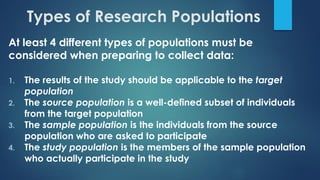
At least 4 different types of populations must be
considered when preparing to collect data:
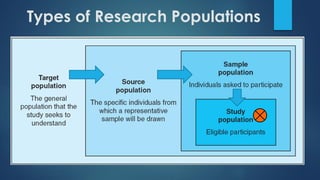
1. The results of the study should be applicable to the target
population
2. The source population is a well-defined subset of individuals
from the target population
3. The sample population is the individuals from the source
population who are asked to participate
4. The study population is the members of the sample population
who actually participate in the study
Types of Research Populations
Target Populations
 A well-defined study question identifies a target
population to which the results of the study should
apply.
 A target population might be quite narrow (like one
wing of a long-term acute care hospital) or relatively
large (like a whole country).
 Unless the target population is very small, measuring
the entire target population or even randomly
sampling from it may be impossible.
Source Populations
A source population (AKA sampling frame) consists of an
enumerated list of population members.
Example:
 All students of the same faculty/College
 All women with a breast cancer diagnosis in the past 5 years
who are indexed in a particular cancer registry
 All members of a professional sports league
 All households within 2 miles of a particular nuclear power
plant
Sample Populations
A source population is often much larger than
the sample size required for a study. In this
situation, only a portion of the source population
is selected to serve as a sample population.
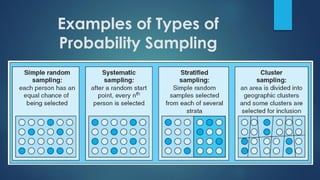
A variety of probability-based sampling
techniques can be used to select a sample
population.
Examples of Types of
Probability Sampling
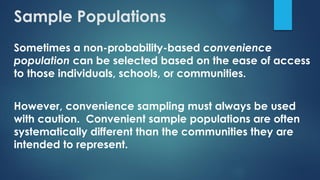
Sometimes a non-probability-based convenience
population can be selected based on the ease of access
to those individuals, schools, or communities.
However, convenience sampling must always be used
with caution. Convenient sample populations are often
systematically different than the communities they are
intended to represent.
Sample Populations
Study Populations
 The study population will consist of the members of
the sample population who can be located, who
consent to participation, and who meet all eligibility
criteria.
 A 100% participation rate is extremely rare.
 A low response rate may result in nonresponse bias
if the members of the sample population who agree
to be in the study are systematically different from
nonparticipants.
Study Populations
A less than 100% participation rate is usually not a
problem as long as the researcher:
 Uses suitable and carefully explained sampling
methods
 Takes appropriate steps to maximize the participation
rate
 Recruits an adequately large sample size
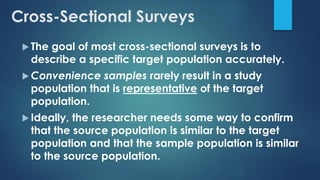
Cross-Sectional Surveys
 The goal of most cross-sectional surveys is to
describe a specific target population accurately.
 Convenience samples rarely result in a study
population that is representative of the target
population.
 Ideally, the researcher needs some way to confirm
that the source population is similar to the target
population and that the sample population is similar
to the source population.
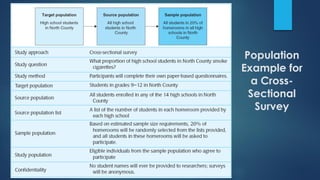
Population
Example for
a Cross-
Sectional
Survey
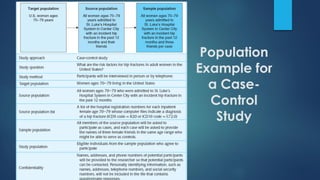
Case-Control Studies
All cases must have the same disease,
disability, or other health-related condition.
The controls must be similar to the cases in
every way except for their disease status, so
cases and controls should be drawn from
populations with similar demographics.
Population
Example for
a Case-
Control
Study
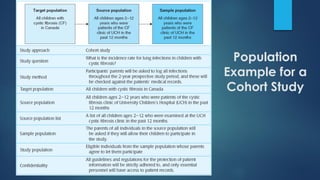
Cohort Studies
 Longitudinal cohort studies: the participants should be
representative of the source and target populations  The
requirements for longitudinal studies are similar to those for
cross-sectional studies, since both study designs recruit
population-based samples.
 Prospective / retrospective cohort studies: the exposed and
unexposed should be drawn from similar populations  The
recruitment of exposed and unexposed for cohort studies is like
the recruitment of the cases and controls for case-control
studies.
Population
Example for a
Cohort Study
Experimental Studies
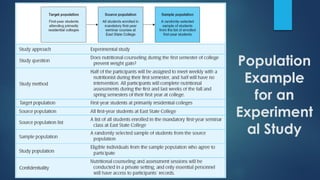
 Experimental studies require a source population
that is reasonably representative of the target
population.
 Safety is always the top priority in designing an
experimental study. The risk of harm to participants
can be reduced by selecting an appropriate source
population and defining strict inclusion and
exclusion criteria.
Population
Example
for an
Experiment
al Study
Vulnerable Populations
 Vulnerable populations in health research include some
people with poor health, some people with limited decision-
making capacity, and members of some socially
marginalized groups, among others.
 Despite the potential risks of including members of these
populations in research studies, including them is the only
way to study health issues in these groups.
Example: The health of prisoners can only be studied by conducting research in
prisons.
 Research conducted with members of vulnerable
populations requires extra consideration of the
potential risks of research to participants.
 The ability of every participant to provide informed
consent free from coercion must be assured.
 Concerns about the increased risks of adverse
effects from study participation must be addressed.
Vulnerable Populations
Community Involvement
Some studies benefit from or require the
participation and/or support of whole
geographic, cultural, or social communities
and their leaders.
Community-based studies often work best
when they use methods such as those
developed for Community-Based Participatory
Research.
Primary Studies:
Estimating Sample Size
Importance of Sample Size
An adequate number of study
participants is required to achieve valid
and significant results
Importance of Sample Size
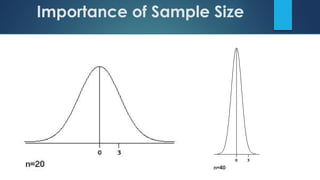
What you saw in the previous slide are 2 distributions of possible sample means
for 20 people (n=20) and 40 people (n=40), both drawn from the same
population. On each we have superimposed a sample mean weight change of
3kg. The curves are both centered on zero to indicate a null hypothesis of "no
difference" (ie. that the diet has no effect). It is more likely to be significant when
n=40 because the distribution curve is narrower and 3kg is more extreme in
relation to it than it is in the n=20 scenario, which points to how you can increase
the power of your experiment. The reason the n=40 curve is spikier is because of
something called the standard error of the mean.
Essentially, the larger the sample sizes, the more accurately the
sample will reflect the population it was drawn from, so it is
distributed more closely around the population mean. (Except
for some genetics studies)
Sample Size and Means
Bigger Samples Are Better
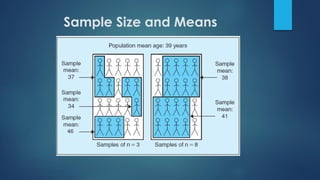
Large samples from a population are usually
better than small ones at yielding a sample
mean close to the true population value.
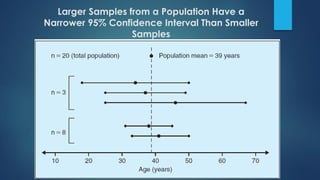
 When the sample size is small, the sample mean may
be quite far from the mean in the total population
from which the sample was drawn. This is represented
by a wide confidence interval that reaches far from
the sample mean.
 When the sample size is large, the sample mean is
expected to be close to the population mean, and
the confidence interval will be narrower.
Bigger Samples Are Better
Larger Samples from a Population Have a
Narrower 95% Confidence Interval Than Smaller
Samples
So, the goal is to recruit just the right number of
participants based on statistical estimations of how
many people are required to answer the study
question with a specified level of certainty.
 If more participants are recruited than are
statistically required, resources are wasted.
 If too few participants are recruited, the whole study
will be almost worthless because there will not be
enough statistical power to answer the study
question.
Importance of Sample Size
Sample Size Estimation
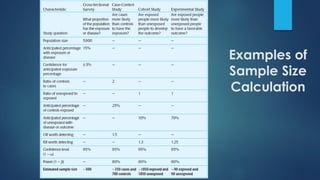
A sample size calculator – more accurately called a
sample size estimator – should be used to identify an
appropriate sample size goal.
Sample size estimators suggest an appropriate
minimum sample size based on a series of “best
guesses” the researcher makes about the expected
characteristics of the sample population.
When in doubt, err on the size of a larger sample!
Examples of
Sample Size
Calculation
Power Estimation
Another way to check for sample size requirements is
to work backward from the number of participants
likely to be recruited to see whether that sample size
provides adequate statistical power for the study
design.
Statistical power is the ability of a statistical test to
detect significant differences in a population when
differences really do exist.
Sometimes a sample population does not capture the
true experience of the population:
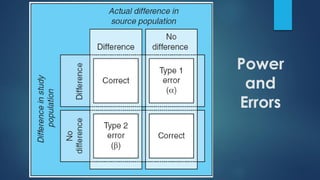
 Type 1 errors (α) occur when a study population
yields a significant statistical test result when one
does not exist in the source population.
 Type 2 errors (β) occur when a statistical test of data
from the study population finds no significant result
when one actually exists in the source population.
 Power = 1 – β
Power Estimation
Power
and
Errors
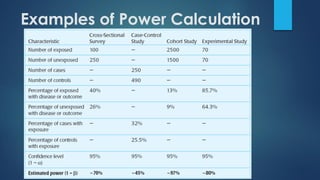
Examples of Power Calculation
Refining the Study Approach
Be prepared to rethink the study
question, study approach, and/or target
and source populations if the power for
the estimated number of participants is
not sufficient.
PHC215
By Dr. Khaled Ouanes Ph.D.
E-mail: k.ouanes@seu.edu.sa
Twitter: @khaled_ouanes
HEALTHCARE RESEARCH METHODS
Based on the textbook of introduction to health research methods – K.H. Jacobsen

HEALTHCARE RESEARCH METHODS: Primary Studies: Selecting a Sample Population and estimating sample size

  • 1.
    PHC215 By Dr. KhaledOuanes Ph.D. E-mail: k.ouanes@seu.edu.sa Twitter: @khaled_ouanes INTRODUCTION TO HEALTHCARE RESEARCH METHODS
  • 2.
  • 3.
    Types of ResearchPopulations At least 4 different types of populations must be considered when preparing to collect data: 1. The results of the study should be applicable to the target population 2. The source population is a well-defined subset of individuals from the target population 3. The sample population is the individuals from the source population who are asked to participate 4. The study population is the members of the sample population who actually participate in the study
  • 4.
    Types of ResearchPopulations
  • 5.
    Target Populations  Awell-defined study question identifies a target population to which the results of the study should apply.  A target population might be quite narrow (like one wing of a long-term acute care hospital) or relatively large (like a whole country).  Unless the target population is very small, measuring the entire target population or even randomly sampling from it may be impossible.
  • 6.
    Source Populations A sourcepopulation (AKA sampling frame) consists of an enumerated list of population members. Example:  All students of the same faculty/College  All women with a breast cancer diagnosis in the past 5 years who are indexed in a particular cancer registry  All members of a professional sports league  All households within 2 miles of a particular nuclear power plant
  • 7.
    Sample Populations A sourcepopulation is often much larger than the sample size required for a study. In this situation, only a portion of the source population is selected to serve as a sample population. A variety of probability-based sampling techniques can be used to select a sample population.
  • 8.
    Examples of Typesof Probability Sampling
  • 9.
    Sometimes a non-probability-basedconvenience population can be selected based on the ease of access to those individuals, schools, or communities. However, convenience sampling must always be used with caution. Convenient sample populations are often systematically different than the communities they are intended to represent. Sample Populations
  • 10.
    Study Populations  Thestudy population will consist of the members of the sample population who can be located, who consent to participation, and who meet all eligibility criteria.  A 100% participation rate is extremely rare.  A low response rate may result in nonresponse bias if the members of the sample population who agree to be in the study are systematically different from nonparticipants.
  • 11.
    Study Populations A lessthan 100% participation rate is usually not a problem as long as the researcher:  Uses suitable and carefully explained sampling methods  Takes appropriate steps to maximize the participation rate  Recruits an adequately large sample size
  • 12.
    Cross-Sectional Surveys  Thegoal of most cross-sectional surveys is to describe a specific target population accurately.  Convenience samples rarely result in a study population that is representative of the target population.  Ideally, the researcher needs some way to confirm that the source population is similar to the target population and that the sample population is similar to the source population.
  • 13.
  • 14.
    Case-Control Studies All casesmust have the same disease, disability, or other health-related condition. The controls must be similar to the cases in every way except for their disease status, so cases and controls should be drawn from populations with similar demographics.
  • 15.
  • 16.
    Cohort Studies  Longitudinalcohort studies: the participants should be representative of the source and target populations  The requirements for longitudinal studies are similar to those for cross-sectional studies, since both study designs recruit population-based samples.  Prospective / retrospective cohort studies: the exposed and unexposed should be drawn from similar populations  The recruitment of exposed and unexposed for cohort studies is like the recruitment of the cases and controls for case-control studies.
  • 17.
  • 18.
    Experimental Studies  Experimentalstudies require a source population that is reasonably representative of the target population.  Safety is always the top priority in designing an experimental study. The risk of harm to participants can be reduced by selecting an appropriate source population and defining strict inclusion and exclusion criteria.
  • 19.
  • 20.
    Vulnerable Populations  Vulnerablepopulations in health research include some people with poor health, some people with limited decision- making capacity, and members of some socially marginalized groups, among others.  Despite the potential risks of including members of these populations in research studies, including them is the only way to study health issues in these groups. Example: The health of prisoners can only be studied by conducting research in prisons.
  • 21.
     Research conductedwith members of vulnerable populations requires extra consideration of the potential risks of research to participants.  The ability of every participant to provide informed consent free from coercion must be assured.  Concerns about the increased risks of adverse effects from study participation must be addressed. Vulnerable Populations
  • 22.
    Community Involvement Some studiesbenefit from or require the participation and/or support of whole geographic, cultural, or social communities and their leaders. Community-based studies often work best when they use methods such as those developed for Community-Based Participatory Research.
  • 23.
  • 24.
    Importance of SampleSize An adequate number of study participants is required to achieve valid and significant results
  • 25.
  • 26.
    Importance of SampleSize What you saw in the previous slide are 2 distributions of possible sample means for 20 people (n=20) and 40 people (n=40), both drawn from the same population. On each we have superimposed a sample mean weight change of 3kg. The curves are both centered on zero to indicate a null hypothesis of "no difference" (ie. that the diet has no effect). It is more likely to be significant when n=40 because the distribution curve is narrower and 3kg is more extreme in relation to it than it is in the n=20 scenario, which points to how you can increase the power of your experiment. The reason the n=40 curve is spikier is because of something called the standard error of the mean. Essentially, the larger the sample sizes, the more accurately the sample will reflect the population it was drawn from, so it is distributed more closely around the population mean. (Except for some genetics studies)
  • 27.
  • 28.
    Bigger Samples AreBetter Large samples from a population are usually better than small ones at yielding a sample mean close to the true population value.
  • 29.
     When thesample size is small, the sample mean may be quite far from the mean in the total population from which the sample was drawn. This is represented by a wide confidence interval that reaches far from the sample mean.  When the sample size is large, the sample mean is expected to be close to the population mean, and the confidence interval will be narrower. Bigger Samples Are Better
  • 30.
    Larger Samples froma Population Have a Narrower 95% Confidence Interval Than Smaller Samples
  • 31.
    So, the goalis to recruit just the right number of participants based on statistical estimations of how many people are required to answer the study question with a specified level of certainty.  If more participants are recruited than are statistically required, resources are wasted.  If too few participants are recruited, the whole study will be almost worthless because there will not be enough statistical power to answer the study question. Importance of Sample Size
  • 32.
    Sample Size Estimation Asample size calculator – more accurately called a sample size estimator – should be used to identify an appropriate sample size goal. Sample size estimators suggest an appropriate minimum sample size based on a series of “best guesses” the researcher makes about the expected characteristics of the sample population. When in doubt, err on the size of a larger sample!
  • 33.
  • 34.
    Power Estimation Another wayto check for sample size requirements is to work backward from the number of participants likely to be recruited to see whether that sample size provides adequate statistical power for the study design. Statistical power is the ability of a statistical test to detect significant differences in a population when differences really do exist.
  • 35.
    Sometimes a samplepopulation does not capture the true experience of the population:  Type 1 errors (α) occur when a study population yields a significant statistical test result when one does not exist in the source population.  Type 2 errors (β) occur when a statistical test of data from the study population finds no significant result when one actually exists in the source population.  Power = 1 – β Power Estimation
  • 36.
  • 37.
    Examples of PowerCalculation
  • 38.
    Refining the StudyApproach Be prepared to rethink the study question, study approach, and/or target and source populations if the power for the estimated number of participants is not sufficient.
  • 39.
    PHC215 By Dr. KhaledOuanes Ph.D. E-mail: k.ouanes@seu.edu.sa Twitter: @khaled_ouanes HEALTHCARE RESEARCH METHODS Based on the textbook of introduction to health research methods – K.H. Jacobsen