L/O/G/O 
www.themegallery.com 
PANGASINAN STATE UNIVERSITY 
Graduate School 
Urdaneta City Campus 
INTRODUCTION 
TO POLICY 
PROCESS1 
1A requirement submitted by Michael John D. Sison in partial fulfillment of the 
requirements of the course Public Policy and Program Management (DM 219) under the 
Supervision of Dr. Reynaldo Gelido; Summer, S.Y. 2013-2014
Topic Outline: 
I. Definition and Basic Elements of Policy 
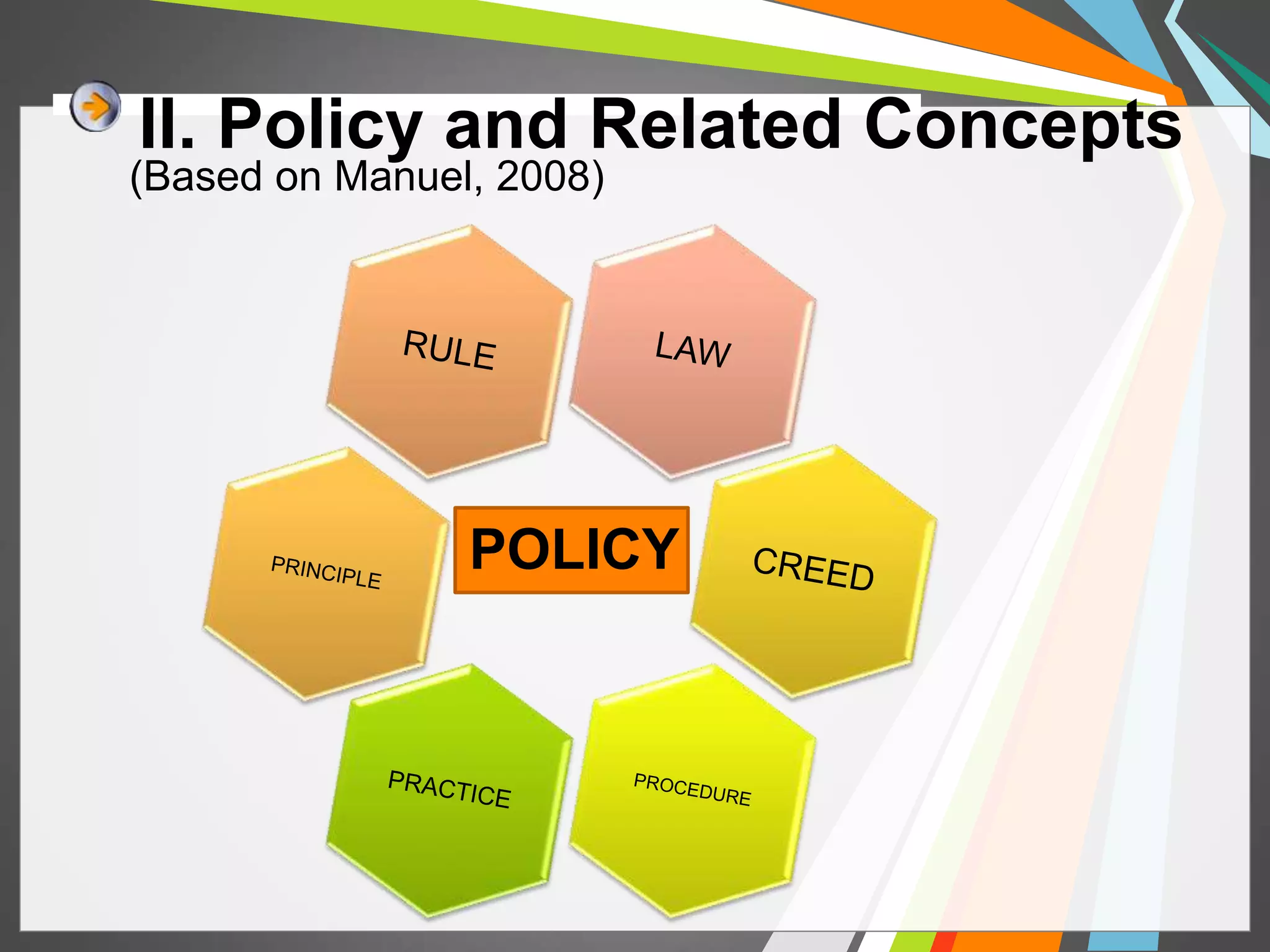
II. Policy and Related Concepts 
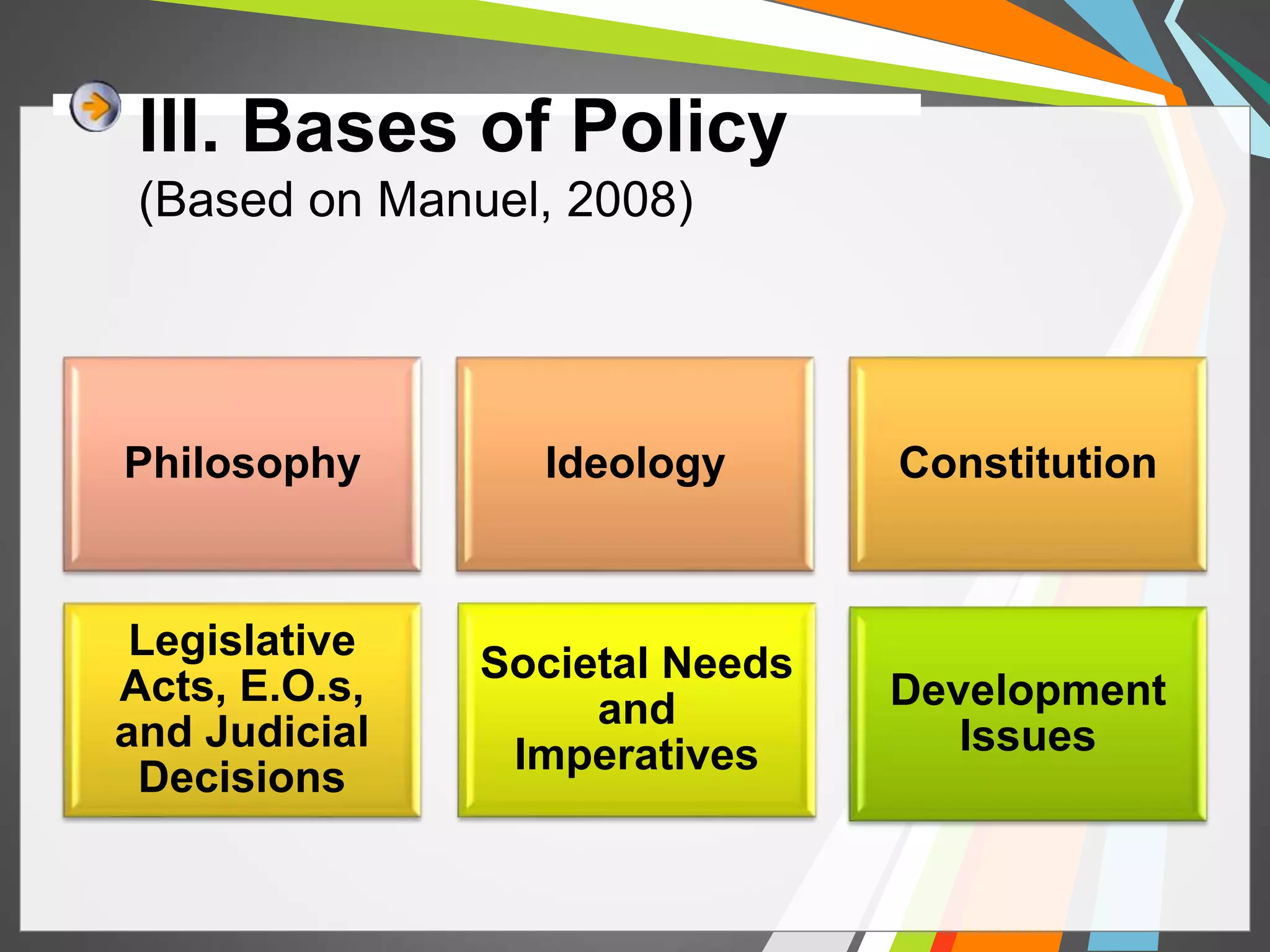
III. Bases of Policy 
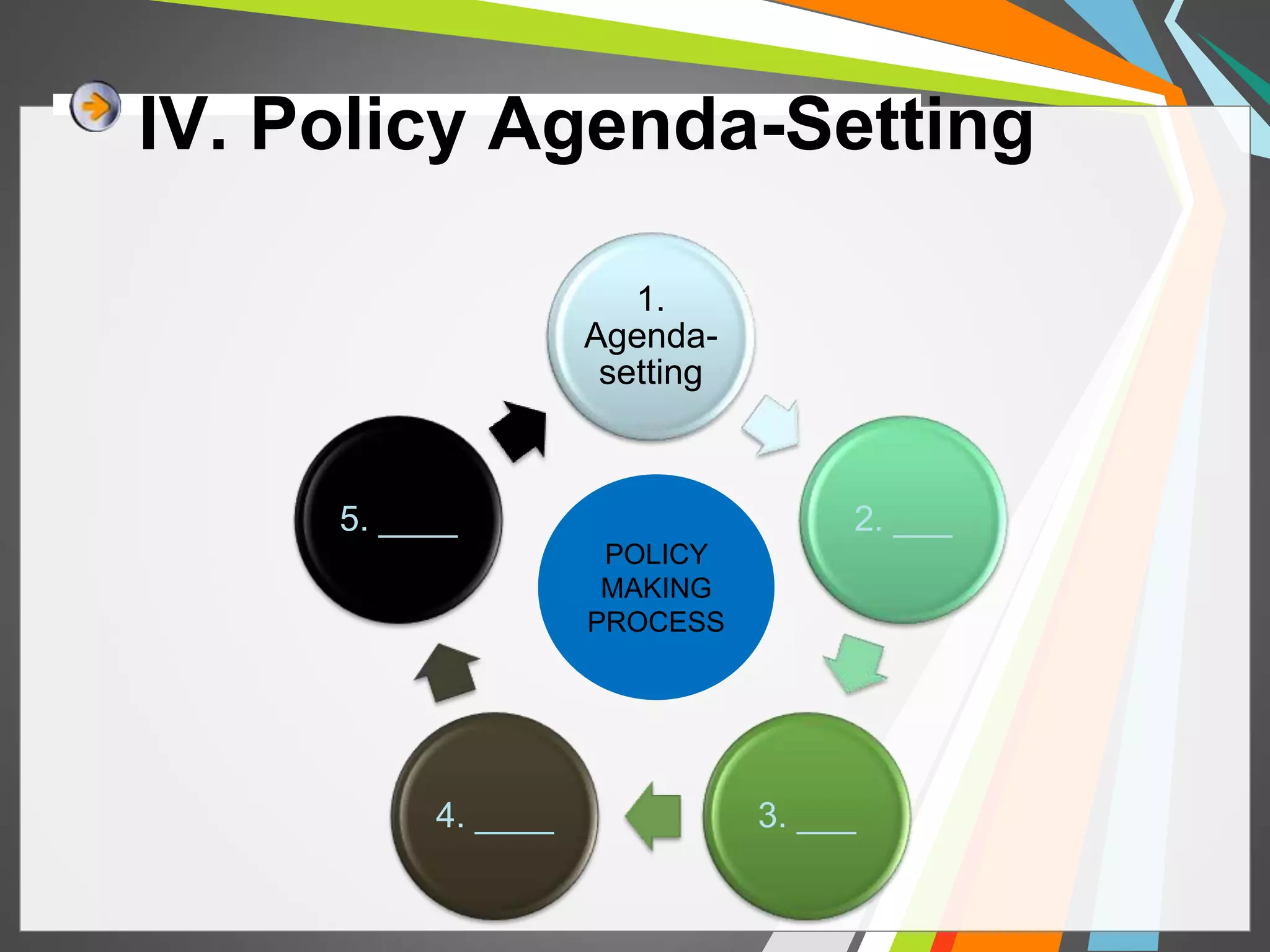
IV. Policy Agenda-Setting 
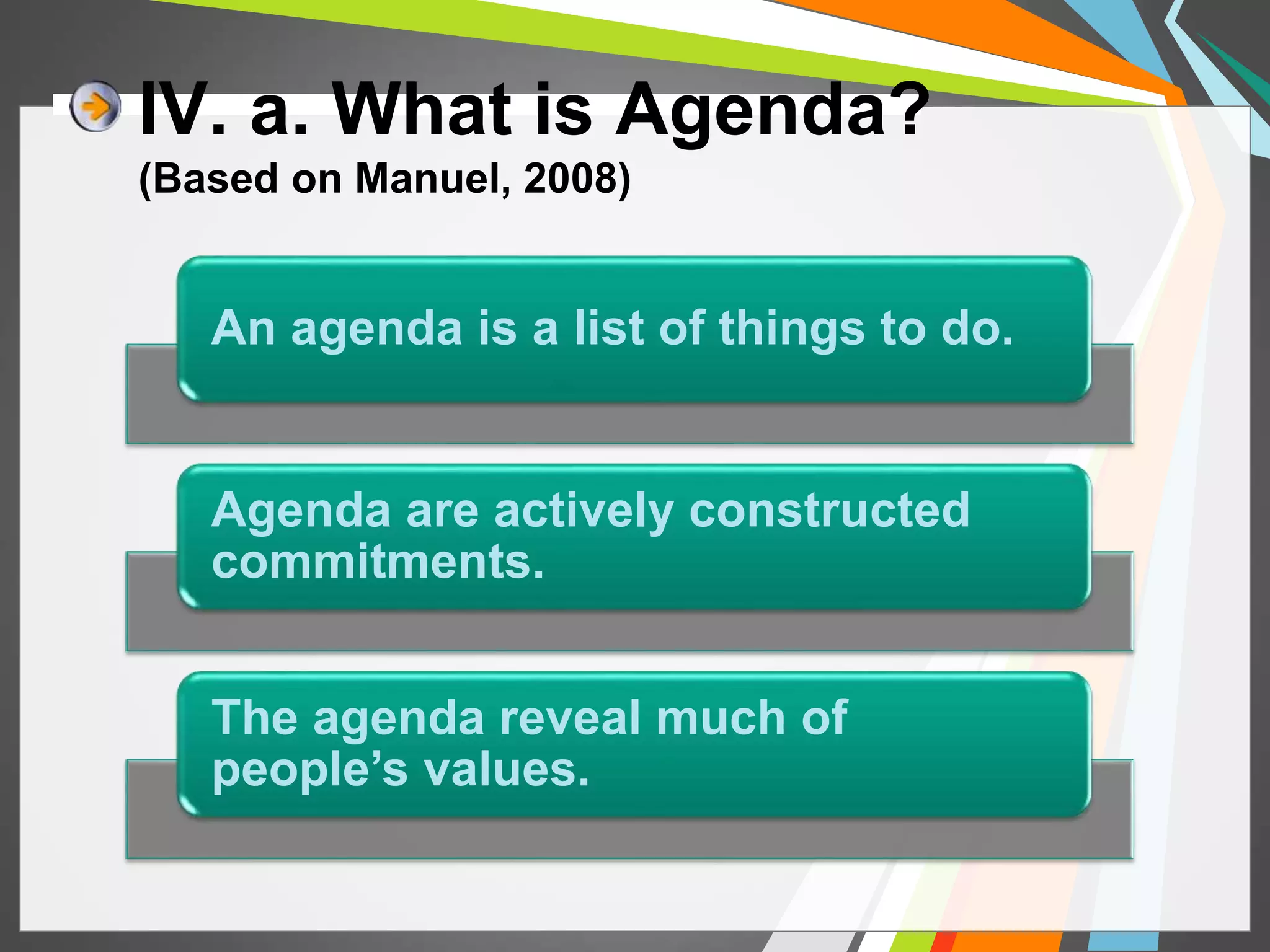
a. What is Agenda? 
b. How do groups gain access to the Policy 
Agenda? 
c. How do issues get to the agenda? 
d. The Policymaking Process 
V. 5 Cs (Importance of a Policy) 
VI. Revisiting VMOG 
VII. Issues and Concerns
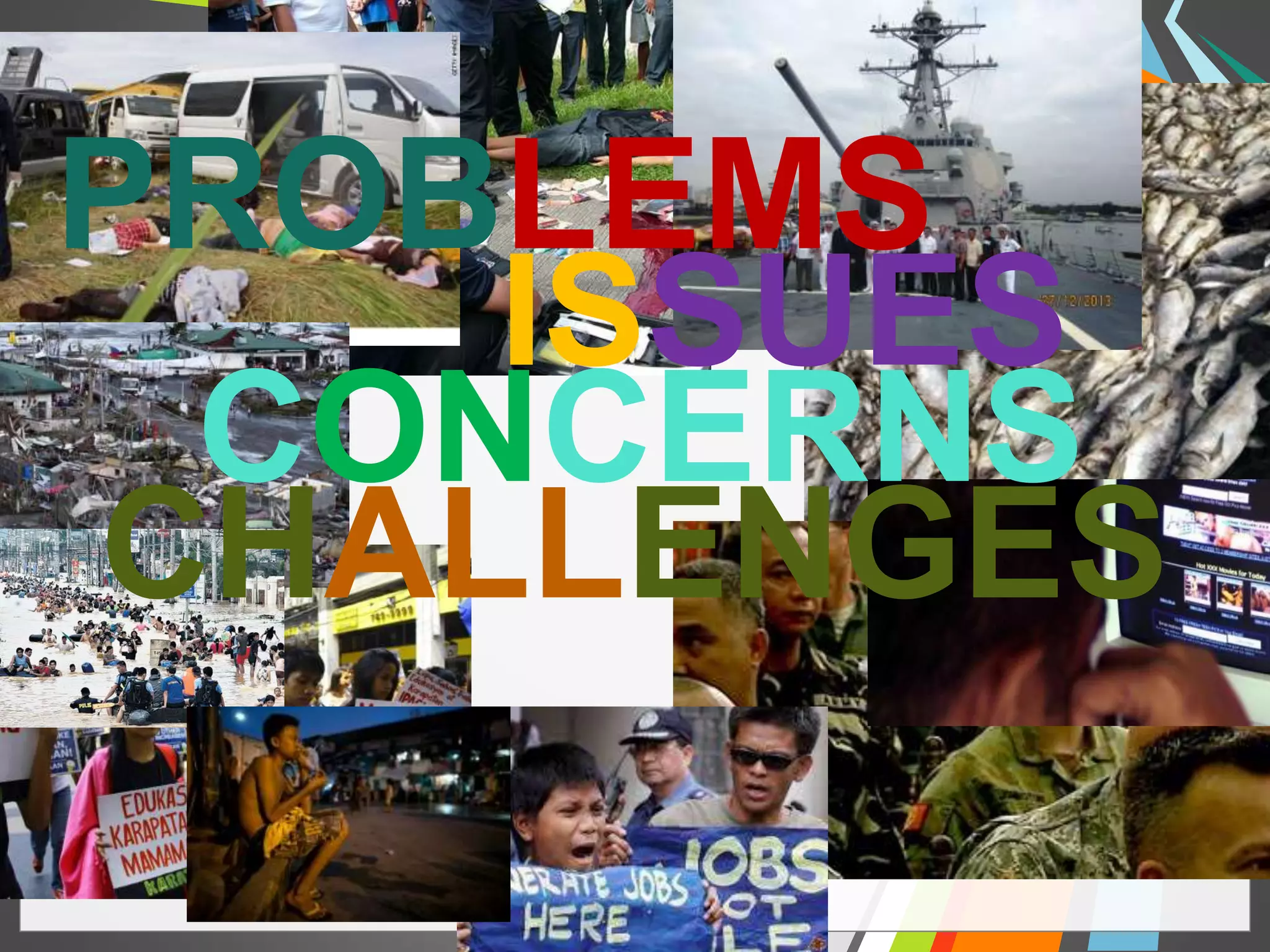
PROBLEMS 
ISSUES 
CONCERNS 
CHALLENGES
POLICY 
.
I. Definition of Policy 
pol·i·cy [pol-uh-see] 
noun, plural pol·i·cies. 
• a definite course of action adopted for the sake of 
expediency, facility, etc.: We have a new company policy. 
• a course of action adopted and pursued by a government, 
ruler, political party, etc.: our nation's foreign policy. 
• action or procedure conforming to or considered with 
reference to prudence or expediency: It was 
good policy to consent 
(Source: http://dictionary.reference.com/browse/policy).
I. Definition of Policy 
Policy is a principle or rule to 
guide decisions and achieve 
rational outcome. It contains the 
“WHAT” and the “WHY” (of) needs 
to be done (Carrera & Sumajit, 
2013).
I. Definition of Policy 
Policy is a purposive course of action or 
decision which is commonly set and 
perceived to be socially desirable to a great 
number of people (NEDA as cited by Miclat, 
2005). 
A good example of policy, in the context 
of a university, is to promote quality and 
relevant education (Miclat, 2005).
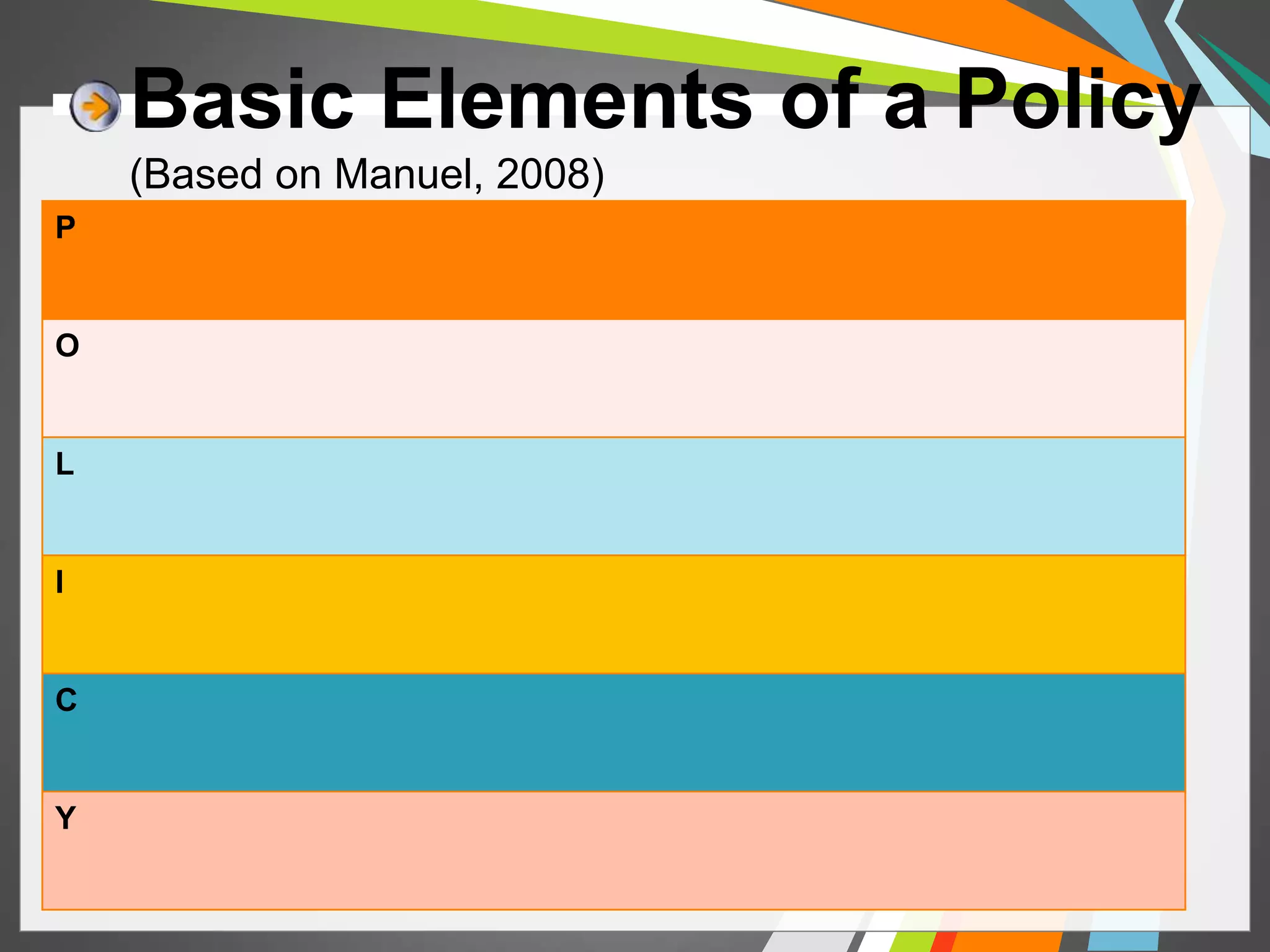
P 
O 
L 
I 
C 
Y 
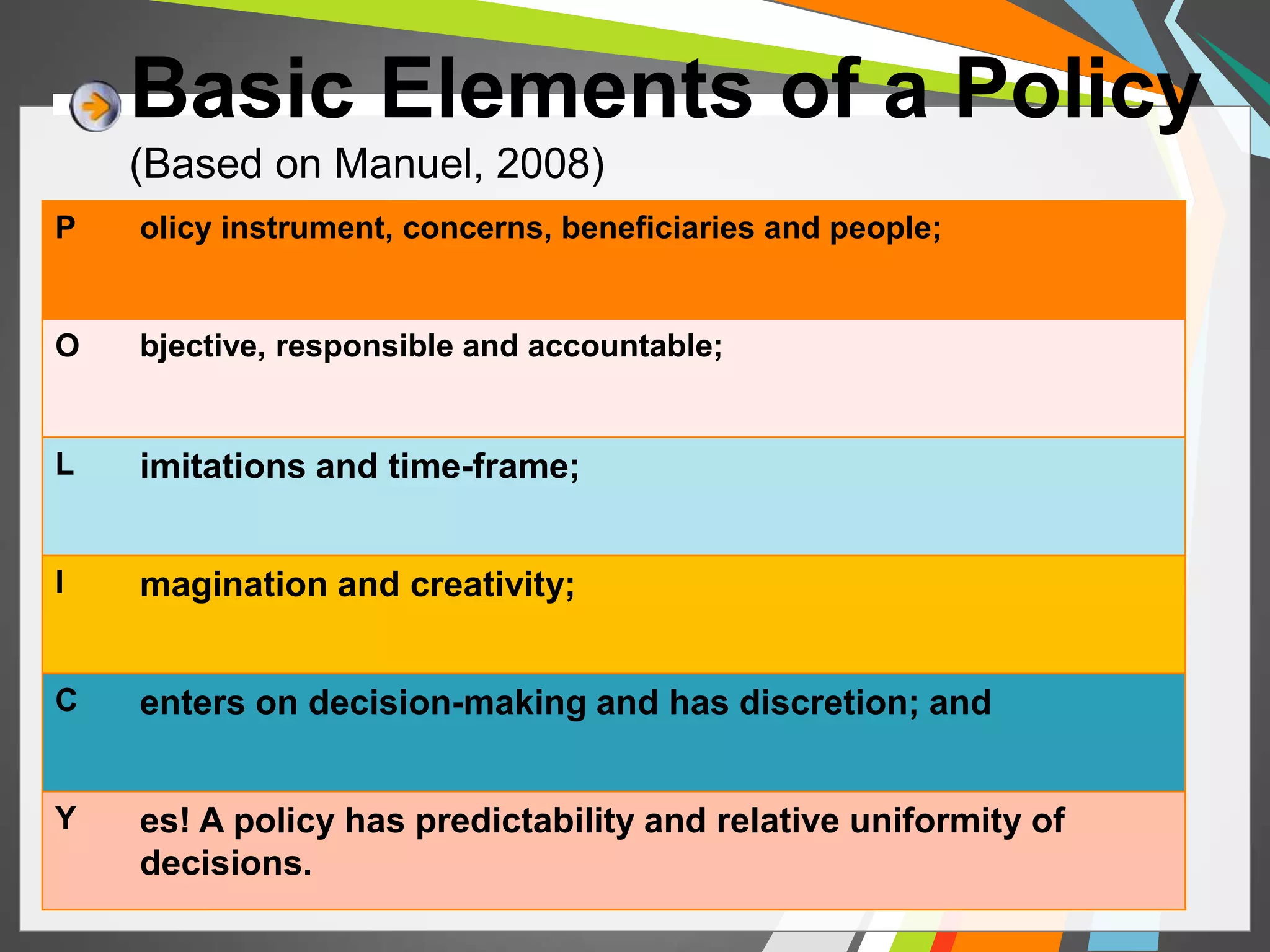
Basic Elements of a Policy 
(Based on Manuel, 2008)
Basic Elements of a Policy 
(Based on Manuel, 2008) 
P olicy instrument, concerns, beneficiaries and people; 
O bjective, responsible and accountable; 
L imitations and time-frame; 
I magination and creativity; 
C enters on decision-making and has discretion; and 
Y es! A policy has predictability and relative uniformity of 
decisions.
II. Policy and Related Concepts 
(Based on Manuel, 2008) 
POLICY
III. Bases of Policy 
(Based on Manuel, 2008) 
Philosophy Ideology Constitution 
Legislative 
Acts, E.O.s, 
and Judicial 
Decisions 
Societal Needs 
and 
Imperatives 
Development 
Issues
IV. Policy Agenda-Setting 
1. 
Agenda-setting 
2. ___ 
5. ____ 
POLICY 
MAKING 
PROCESS 
4. ____ 3. ___
IV. a. What is Agenda? 
(Based on Manuel, 2008) 
An agenda is a list of things to do. 
Agenda are actively constructed 
commitments. 
The agenda reveal much of 
people’s values.
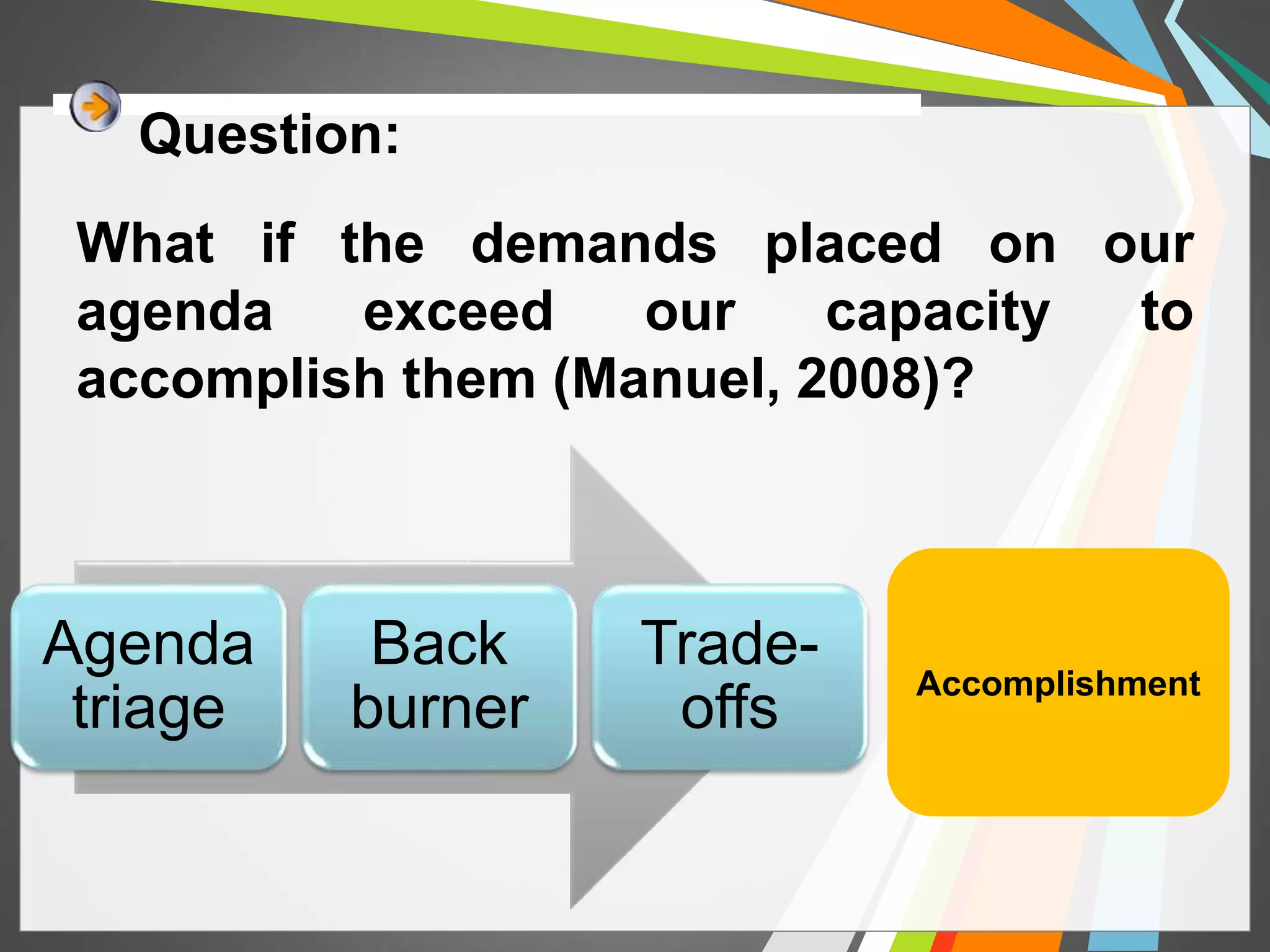
Question: 
What if the demands placed on our 
agenda exceed our capacity to 
accomplish them (Manuel, 2008)? 
Agenda 
triage 
Back 
burner 
Trade-offs 
Accomplishment
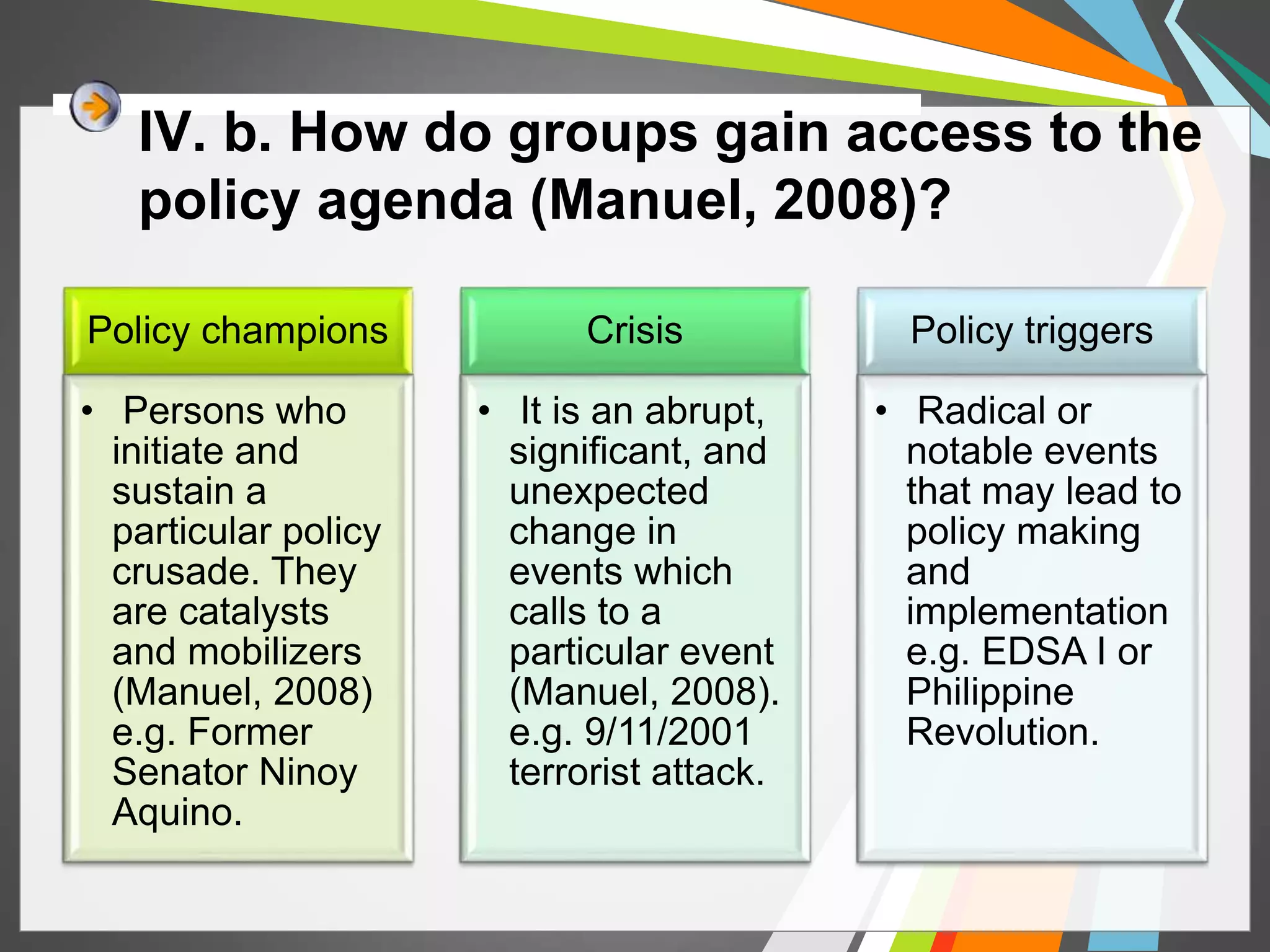
IV. b. How do groups gain access to the 
policy agenda (Manuel, 2008)? 
Policy champions 
• Persons who 
initiate and 
sustain a 
particular policy 
crusade. They 
are catalysts 
and mobilizers 
(Manuel, 2008) 
e.g. Former 
Senator Ninoy 
Aquino. 
Crisis 
• It is an abrupt, 
significant, and 
unexpected 
change in 
events which 
calls to a 
particular event 
(Manuel, 2008). 
e.g. 9/11/2001 
terrorist attack. 
Policy triggers 
• Radical or 
notable events 
that may lead to 
policy making 
and 
implementation 
e.g. EDSA I or 
Philippine 
Revolution.
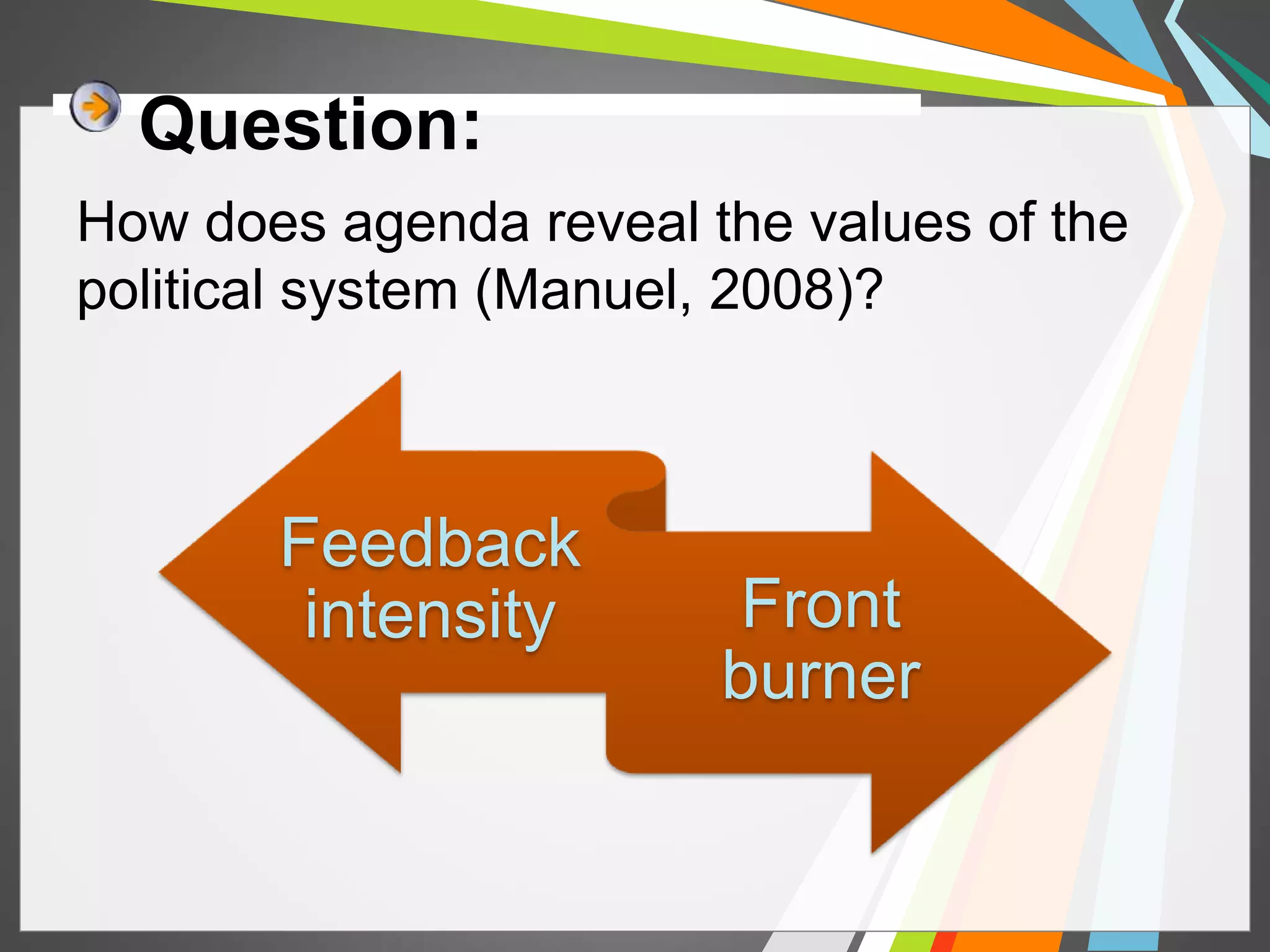
Question: 
How does agenda reveal the values of the 
political system (Manuel, 2008)? 
Feedback 
intensity Front 
burner
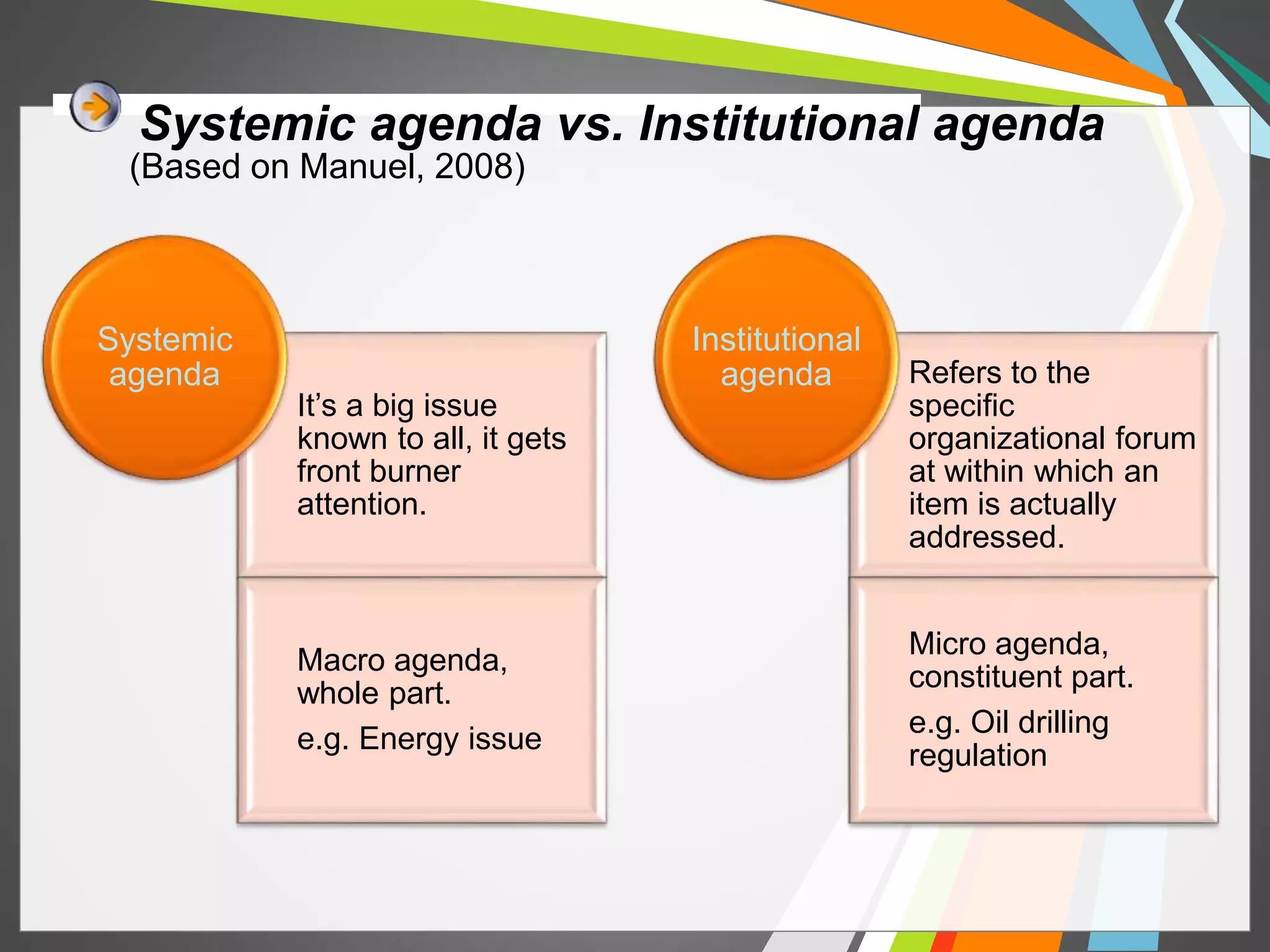
Systemic agenda vs. Institutional agenda 
Systemic 
agenda Refers to the 
It’s a big issue 
known to all, it gets 
front burner 
attention. 
Macro agenda, 
whole part. 
e.g. Energy issue 
specific 
organizational forum 
at within which an 
item is actually 
addressed. 
Micro agenda, 
constituent part. 
e.g. Oil drilling 
regulation 
Institutional 
agenda 
(Based on Manuel, 2008)
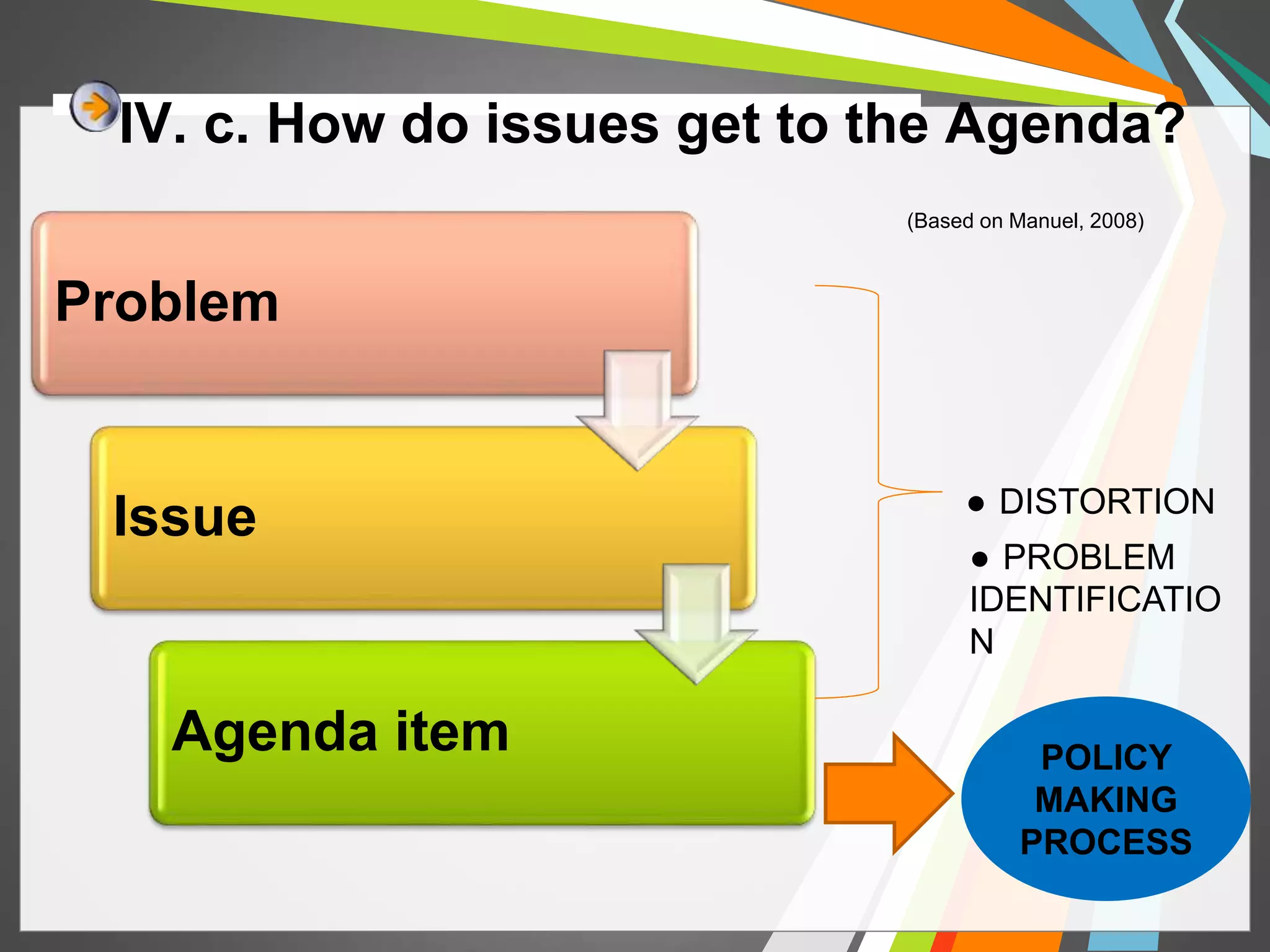
IV. c. How do issues get to the Agenda? 
Problem 
Issue 
Agenda item 
(Based on Manuel, 2008) 
● DISTORTION 
● PROBLEM 
IDENTIFICATIO 
N 
POLICY 
MAKING 
PROCESS
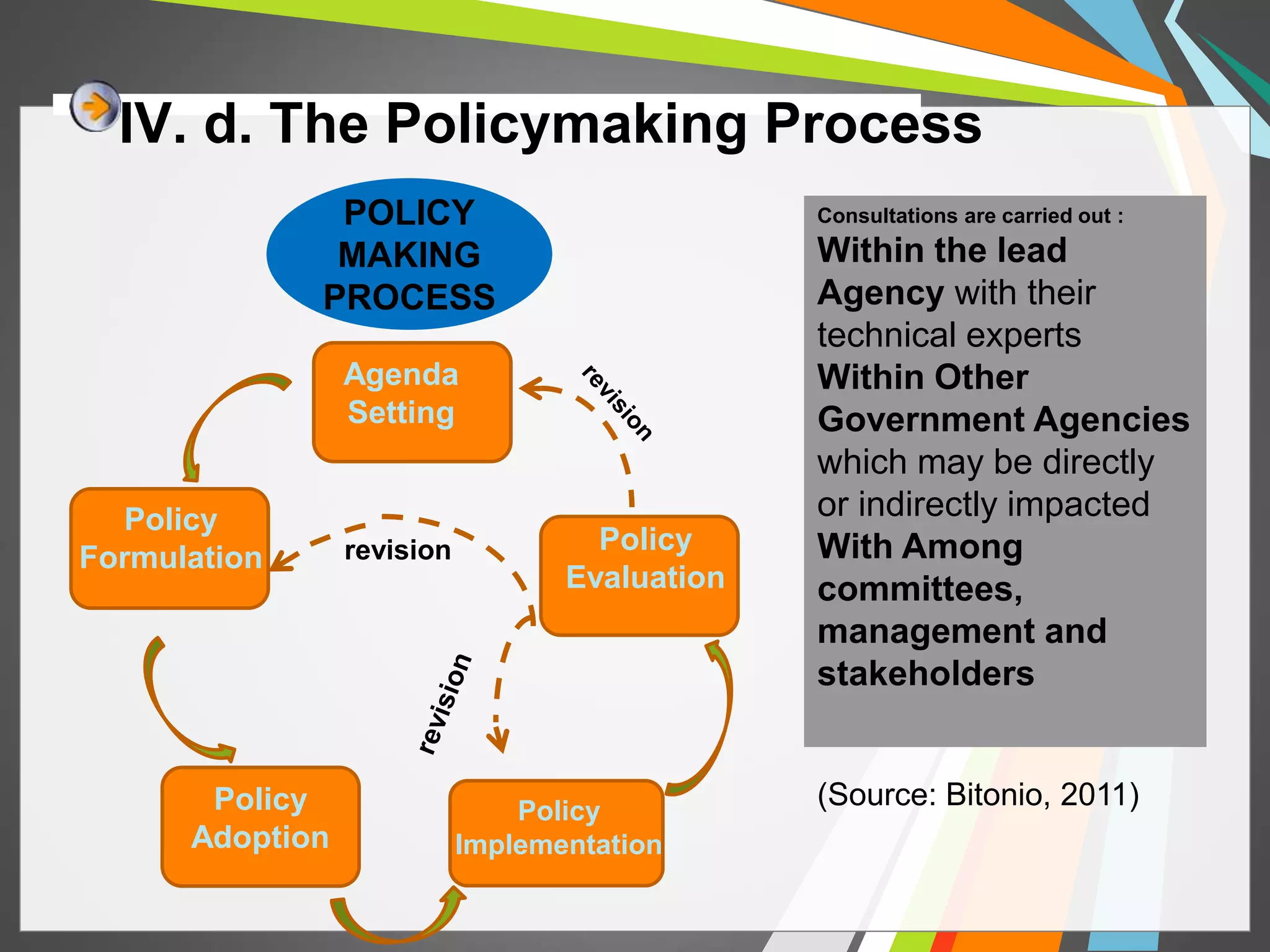
IV. d. The Policymaking Process 
POLICY 
MAKING 
PROCESS 
Agenda 
Setting 
Policy 
Formulation 
Policy 
Adoption 
Policy 
Evaluation 
Policy 
Implementation 
revision 
Consultations are carried out : 
Within the lead 
Agency with their 
technical experts 
Within Other 
Government Agencies 
which may be directly 
or indirectly impacted 
With Among 
committees, 
management and 
stakeholders 
(Source: Bitonio, 2011)
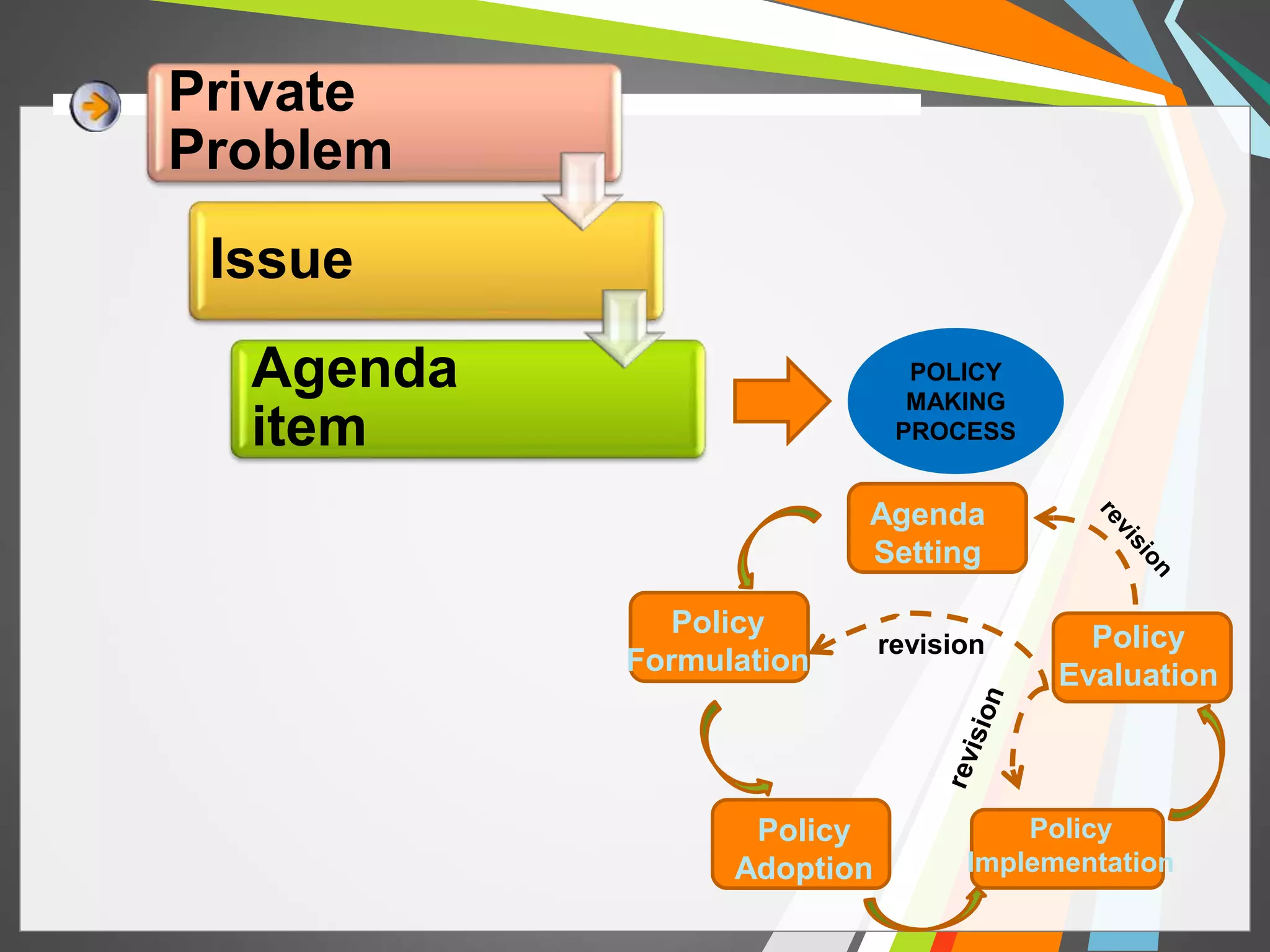
Private 
Problem 
Issue 
Agenda 
item 
POLICY 
MAKING 
PROCESS 
Agenda 
Setting 
Policy 
Formulation 
Policy 
Adoption 
Policy 
Evaluation 
Policy 
revision 
Implementation
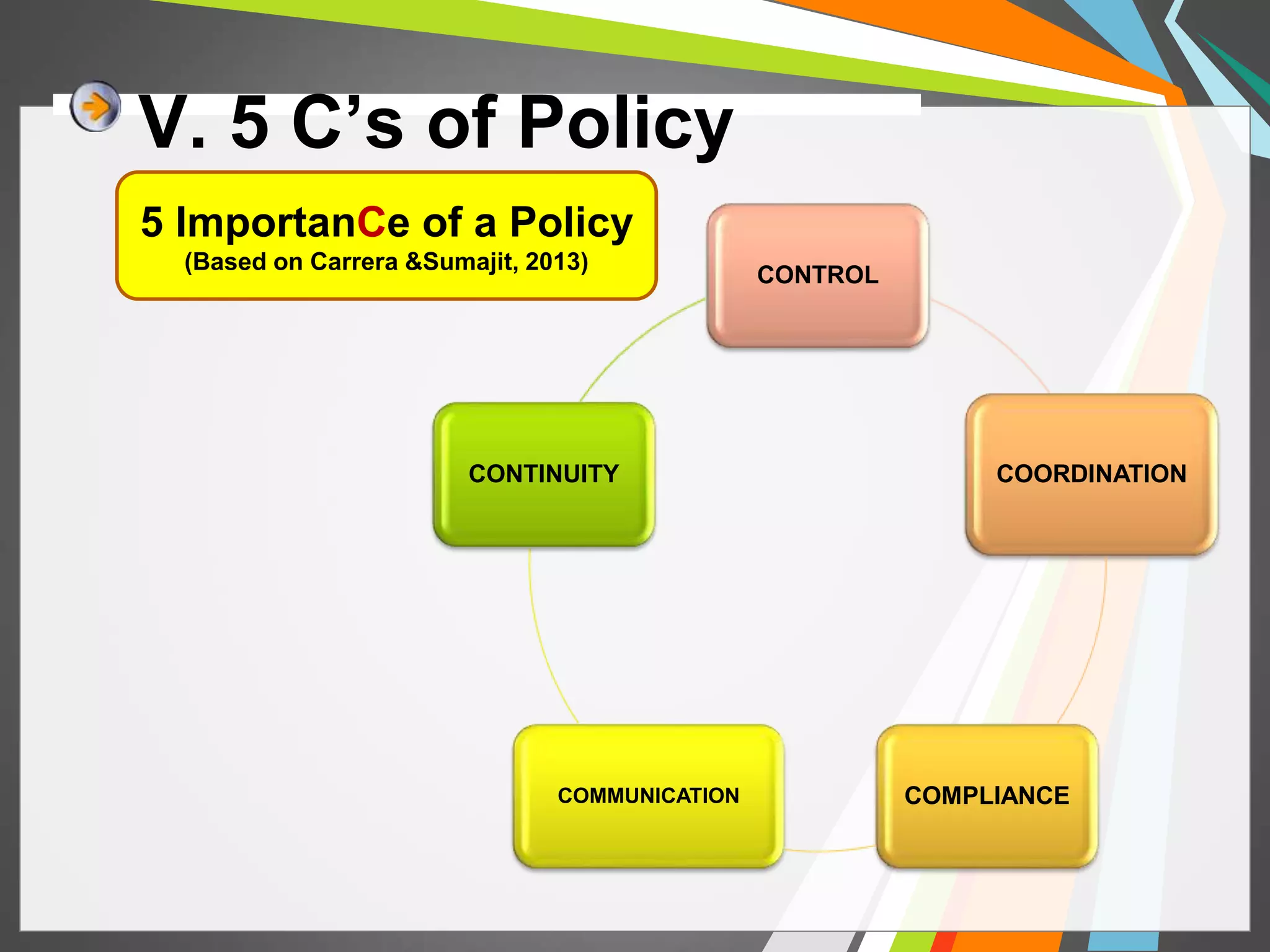
V. 5 C’s of Policy 
5 ImportanCe of a Policy 
(Based on Carrera &Sumajit, 2013) 
CONTROL 
COORDINATION 
CONTINUITY 
COMMUNICATION COMPLIANCE
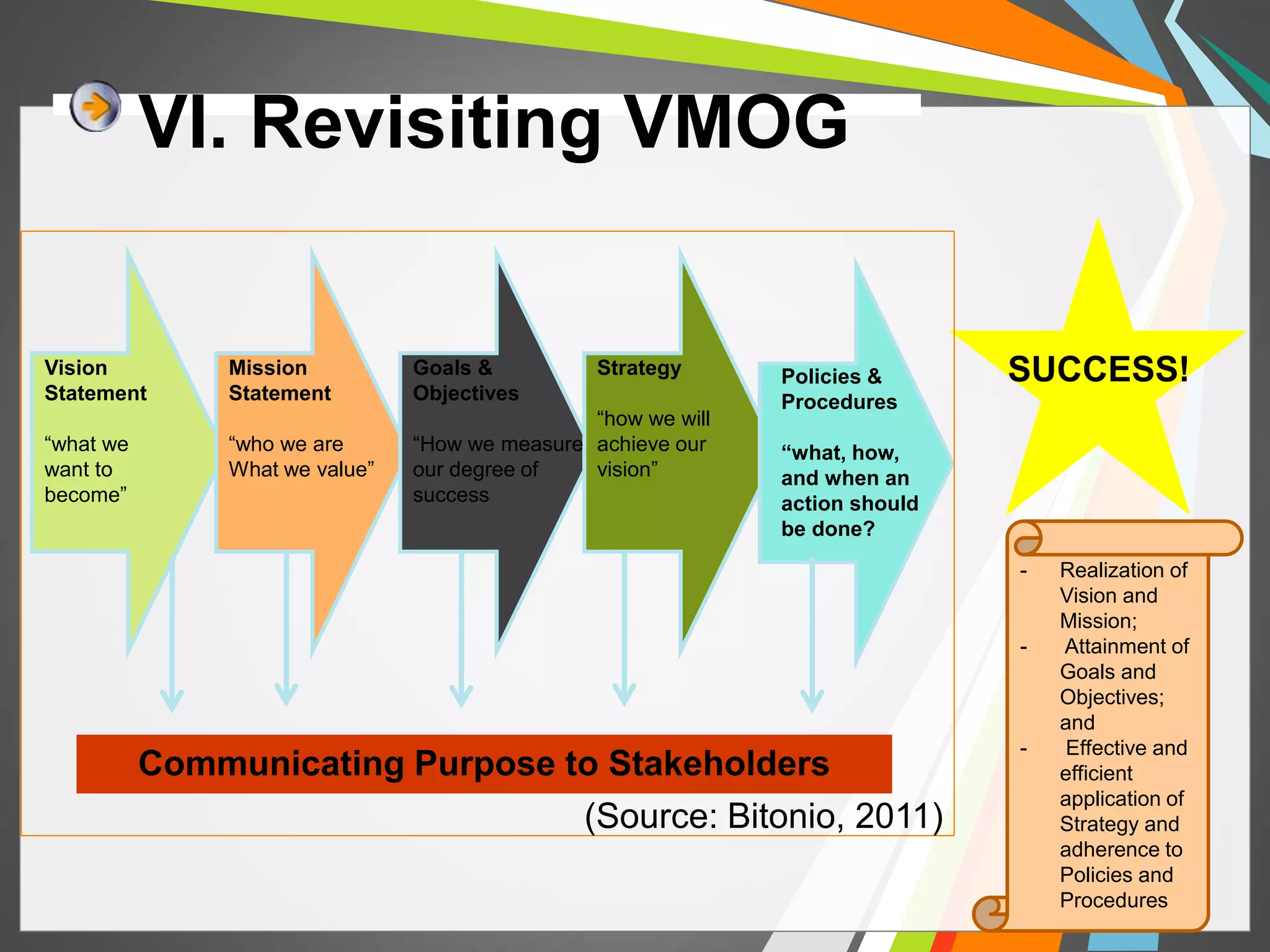
Vision SUCCESS! 
Statement 
“what we 
want to 
become” 
Mission 
Statement 
“who we are 
What we value” 
Goals & 
Objectives 
“How we measure 
our degree of 
success 
Strategy 
“how we will 
achieve our 
vision” 
Policies & 
Procedures 
“what, how, 
and when an 
action should 
be done? 
Communicating Purpose to Stakeholders 
(Source: Bitonio, 2011) 
- Realization of 
Vision and 
Mission; 
- Attainment of 
Goals and 
Objectives; 
and 
- Effective and 
efficient 
application of 
Strategy and 
adherence to 
Policies and 
Procedures 
VI. Revisiting VMOG
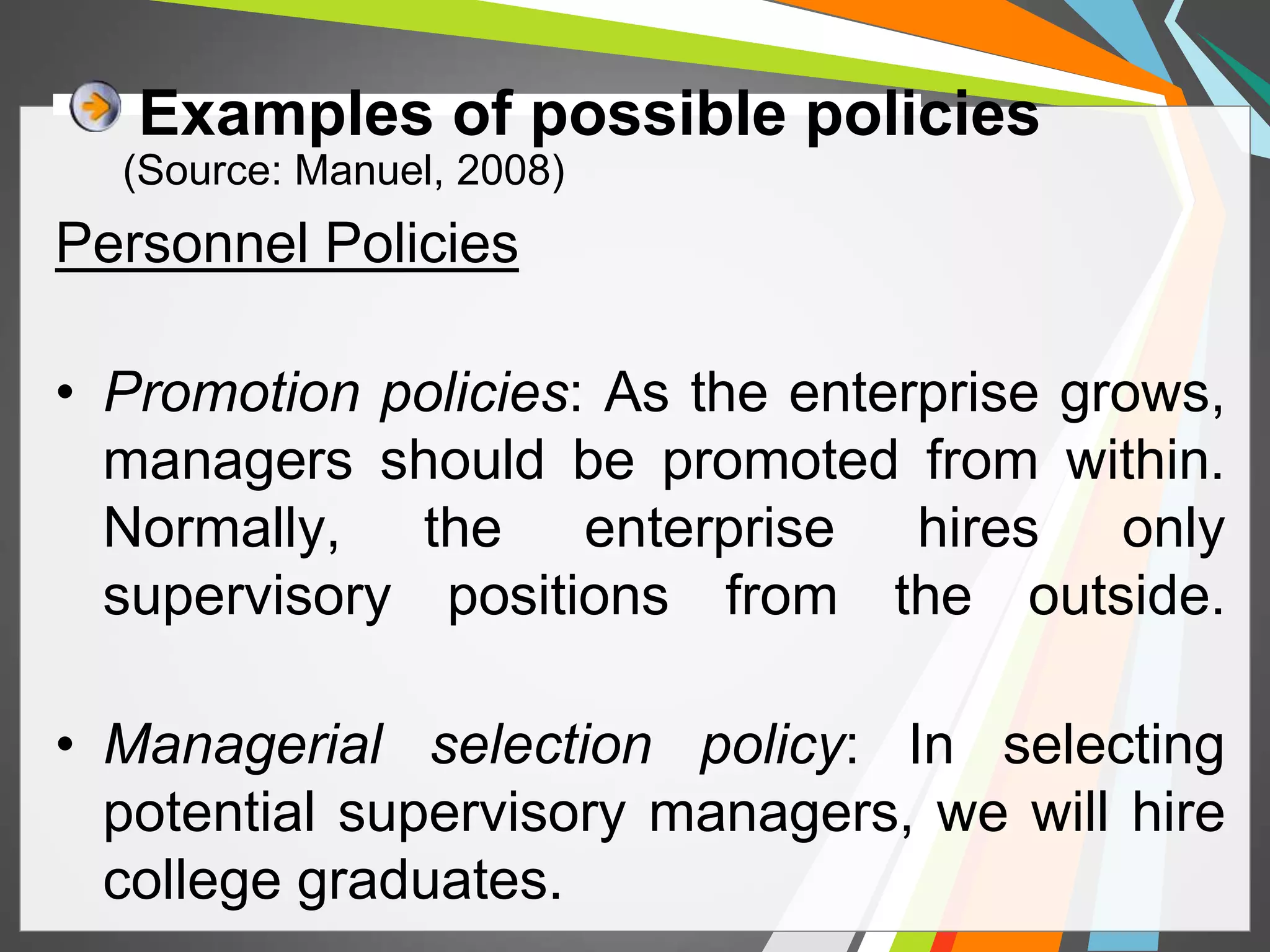
Examples of possible policies 
(Source: Manuel, 2008) 
Personnel Policies 
• Promotion policies: As the enterprise grows, 
managers should be promoted from within. 
Normally, the enterprise hires only 
supervisory positions from the outside. 
• Managerial selection policy: In selecting 
potential supervisory managers, we will hire 
college graduates.
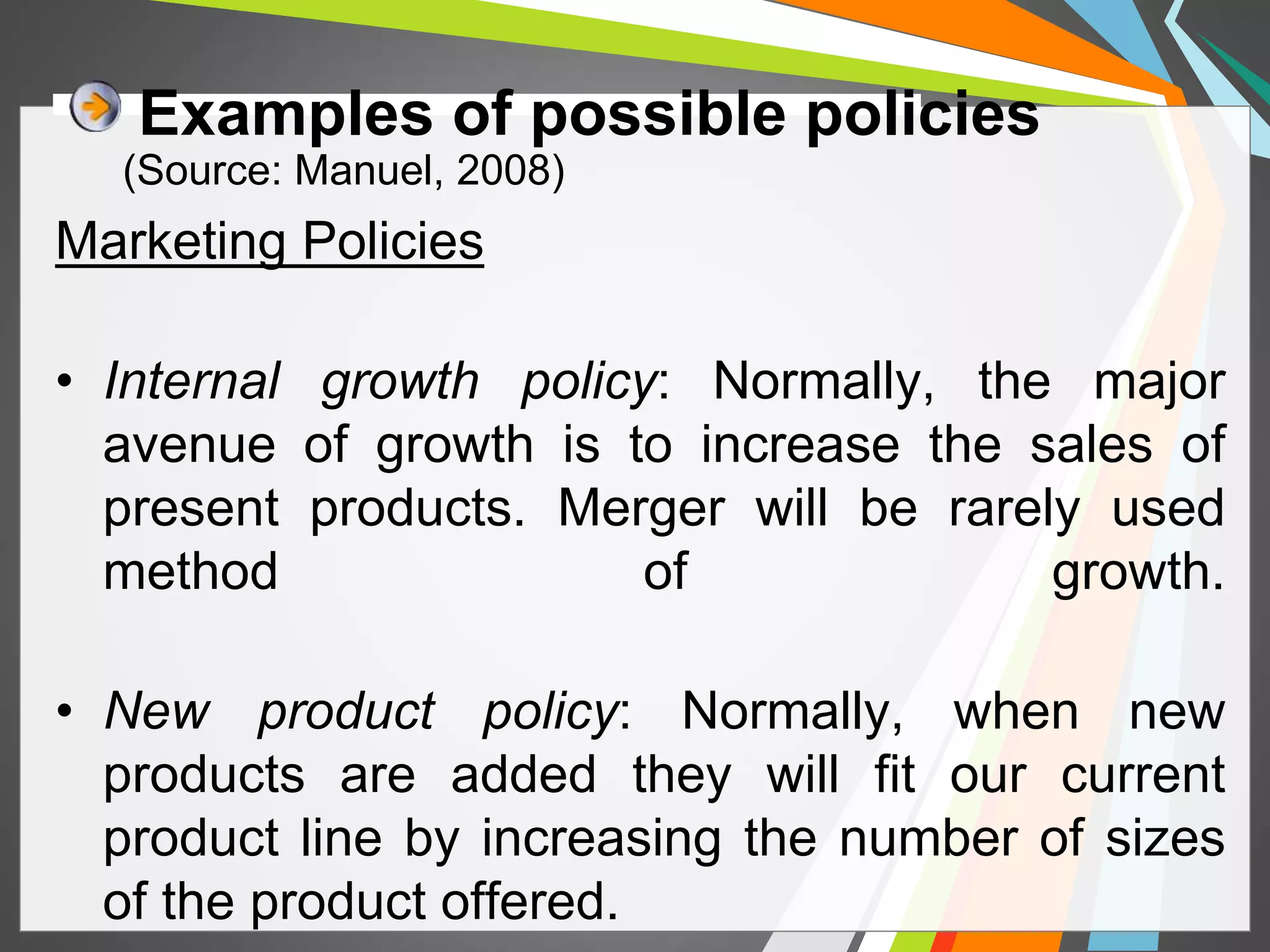
Examples of possible policies 
(Source: Manuel, 2008) 
Marketing Policies 
• Internal growth policy: Normally, the major 
avenue of growth is to increase the sales of 
present products. Merger will be rarely used 
method of growth. 
• New product policy: Normally, when new 
products are added they will fit our current 
product line by increasing the number of sizes 
of the product offered.
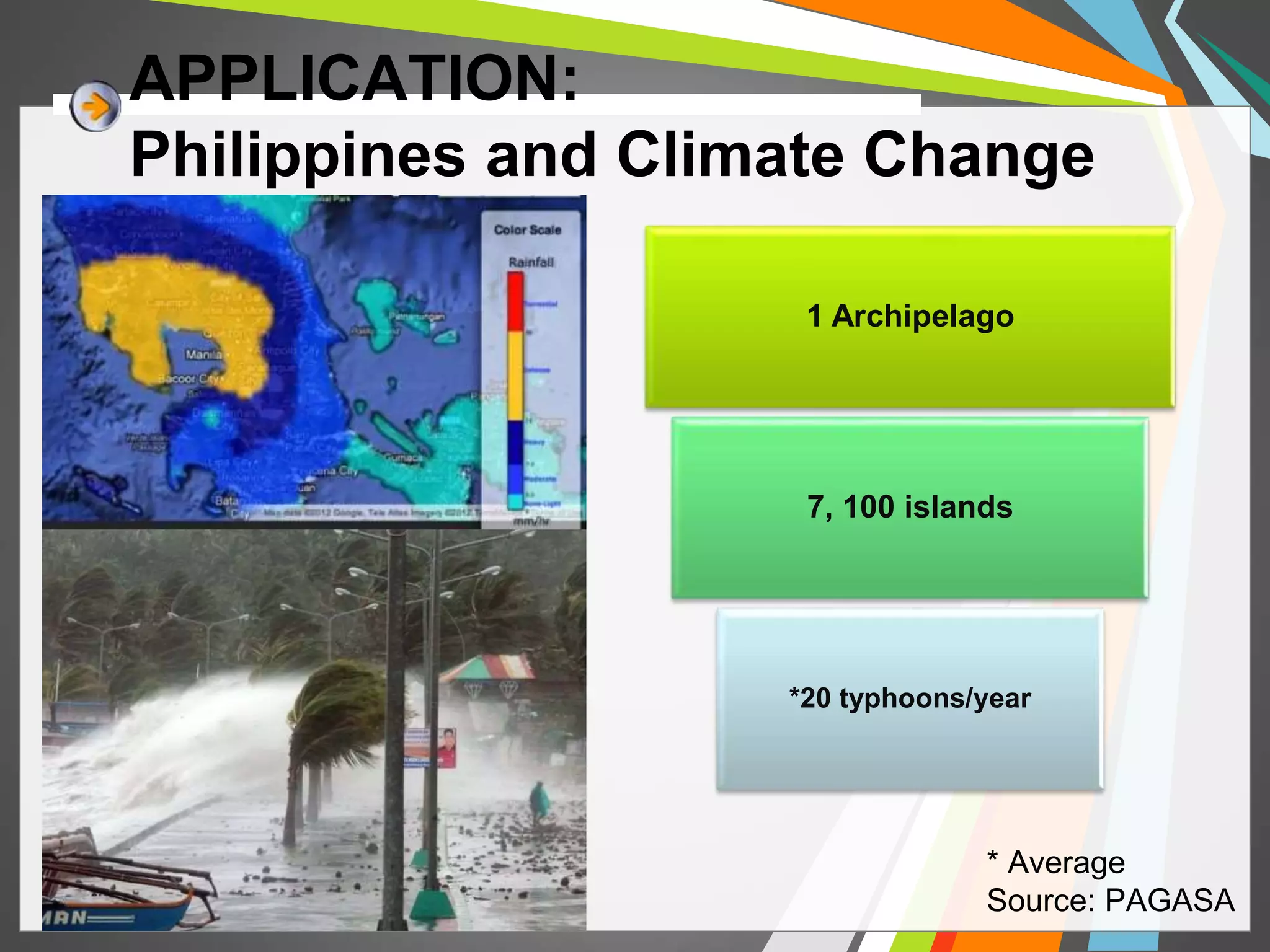
APPLICATION: 
Philippines and Climate Change 
1 Archipelago 
7, 100 islands 
*20 typhoons/year 
* Average 
Source: PAGASA
APPLICATION: 
Philippines and Climate Change 
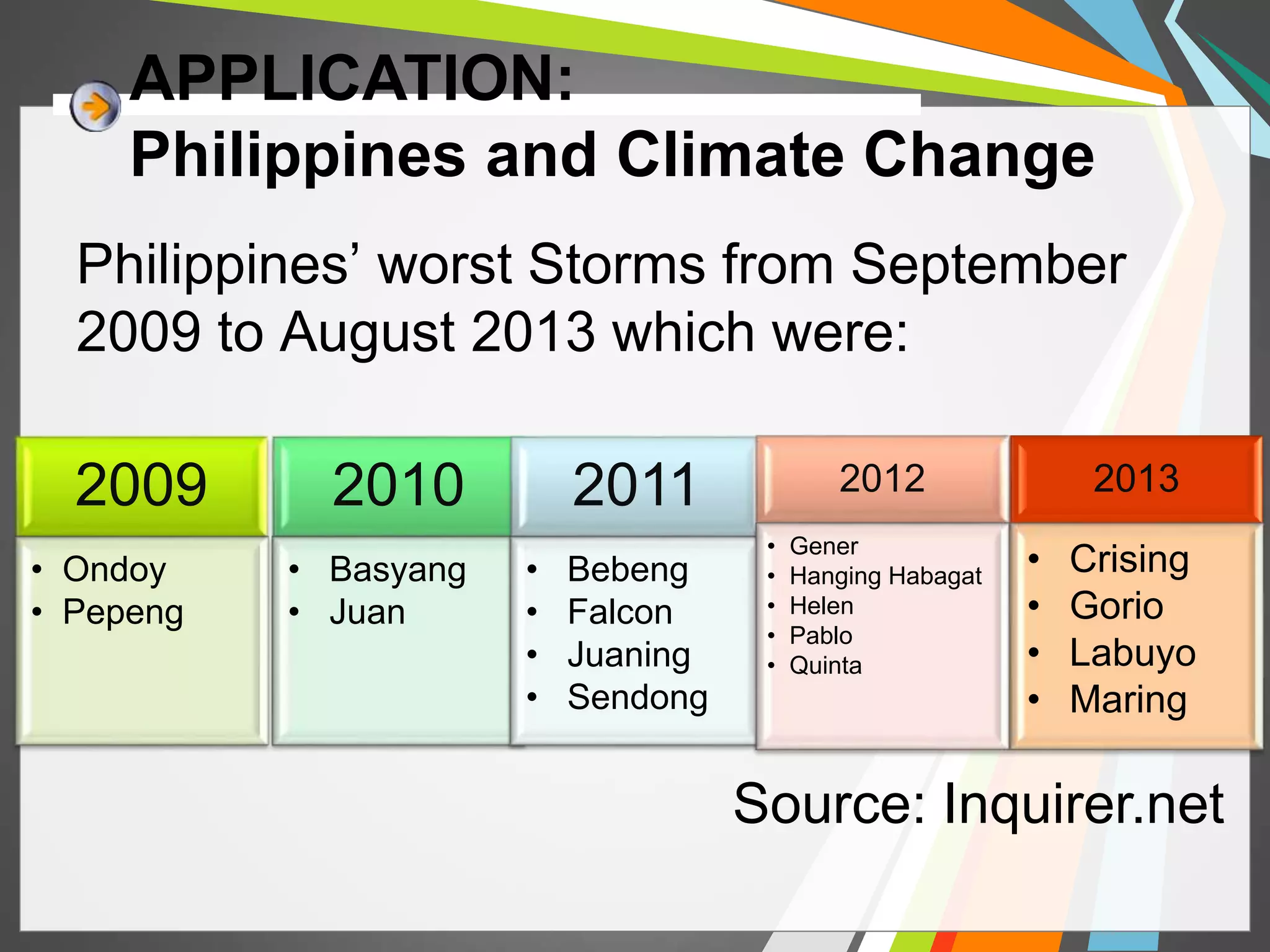
Philippines’ worst Storms from September 
2009 to August 2013 which were: 
Source: Inquirer.net 
2009 
• Ondoy 
• Pepeng 
2010 
• Basyang 
• Juan 
2011 
• Bebeng 
• Falcon 
• Juaning 
• Sendong 
2012 
• Gener 
• Hanging Habagat 
• Helen 
• Pablo 
• Quinta 
2013 
• Crising 
• Gorio 
• Labuyo 
• Maring
APPLICATION: 
Philippines and Climate Change 
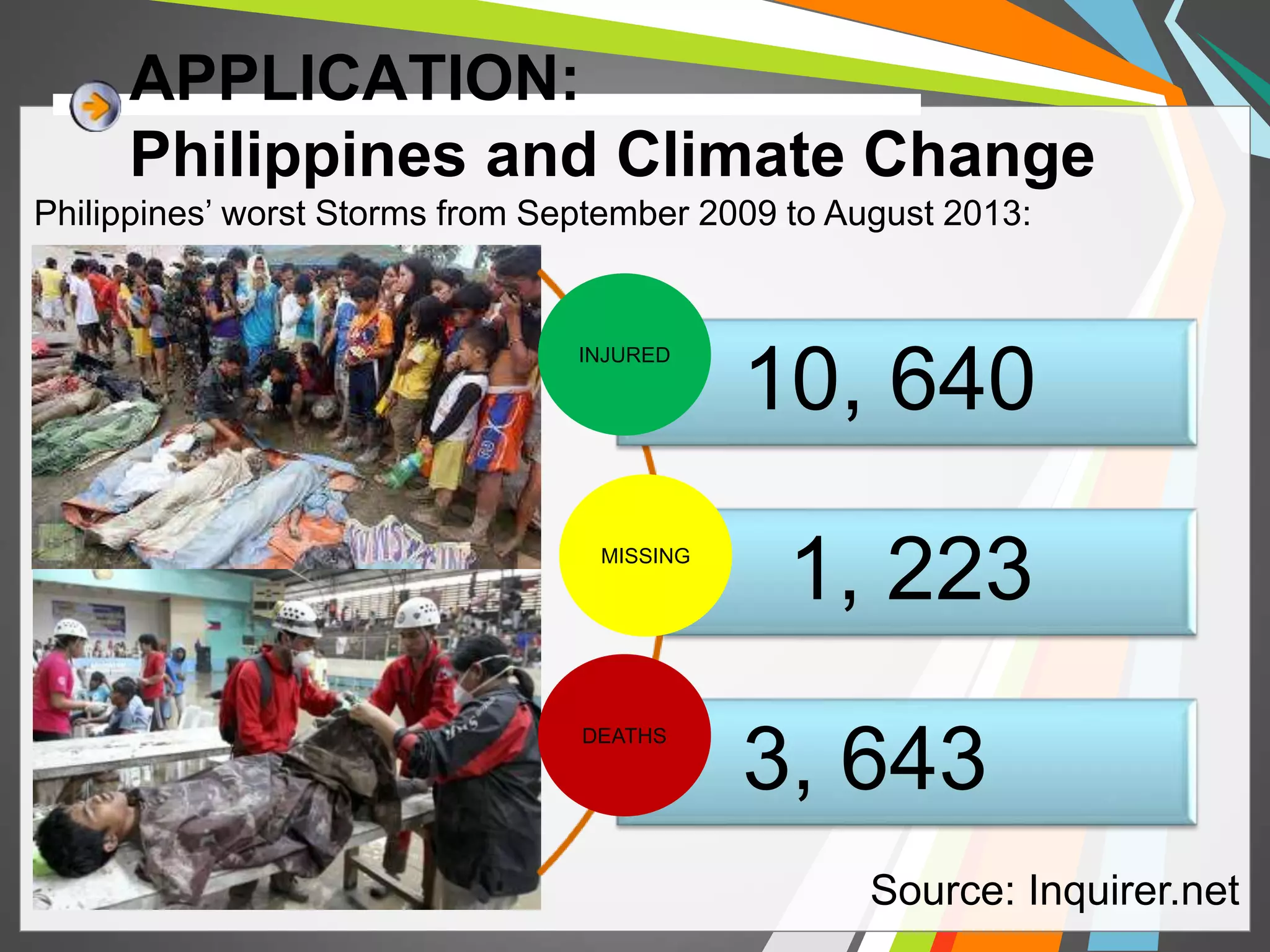
Philippines’ worst Storms from September 2009 to August 2013: 
10, 640 
1, 223 
3, 643 
INJURED 
MISSING 
DEATHS 
Source: Inquirer.net
APPLICATION: 
Philippines and Climate Change 
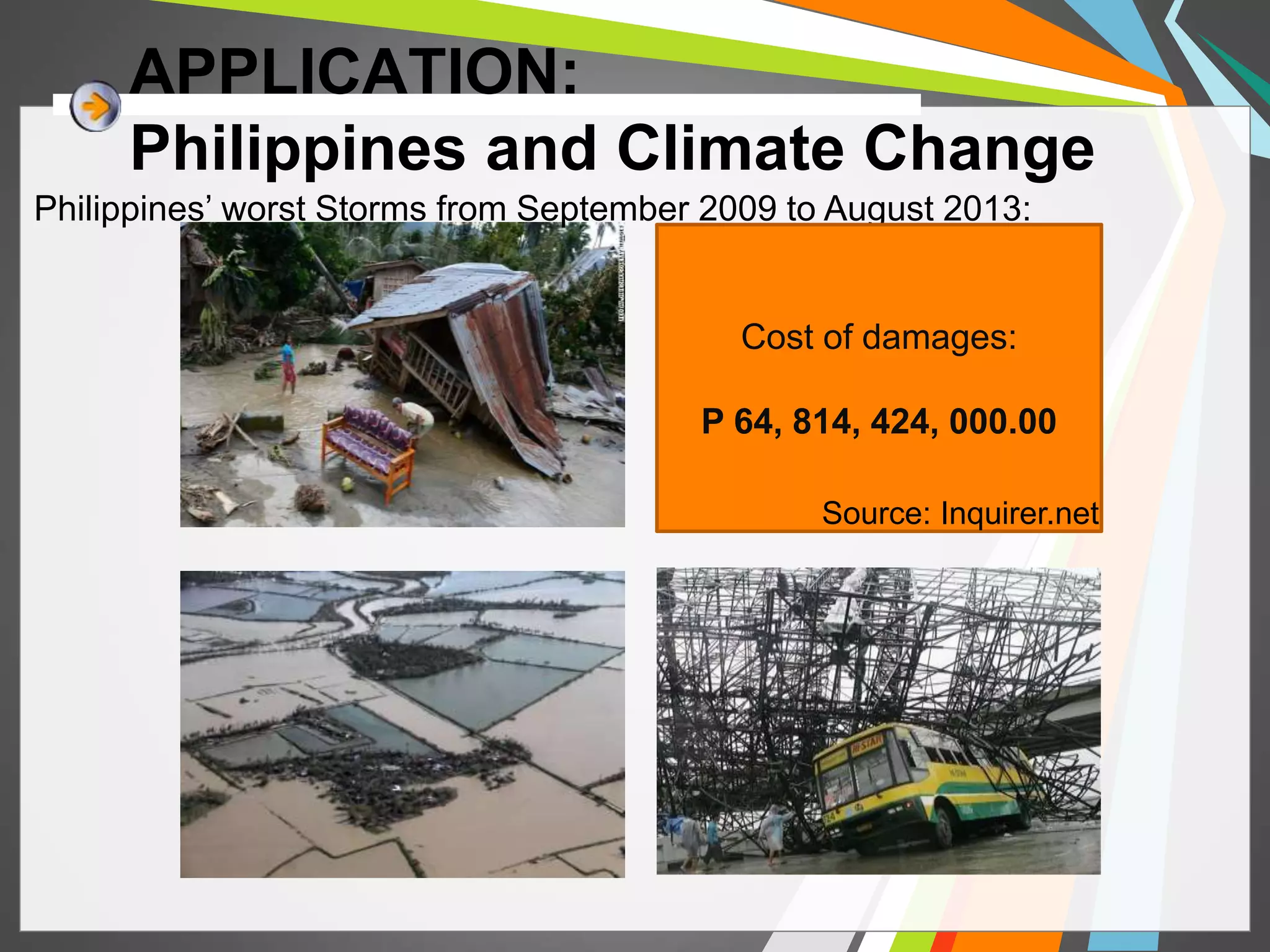
Philippines’ worst Storms from September 2009 to August 2013: 
Cost of damages: 
P 64, 814, 424, 000.00 
Source: Inquirer.net
Philippines and Climate Change 
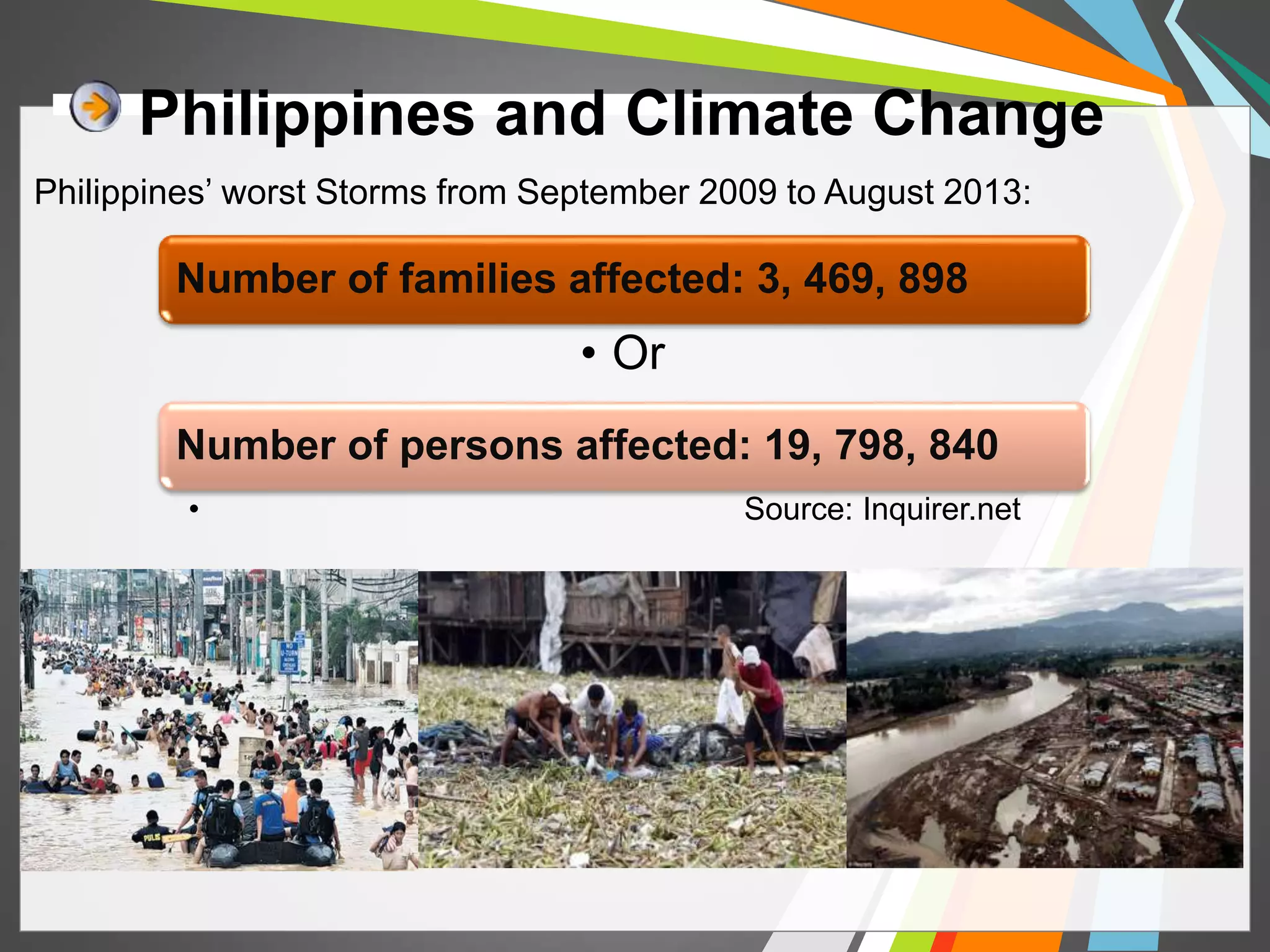
Philippines’ worst Storms from September 2009 to August 2013: 
Number of families affected: 3, 469, 898 
• Or 
Number of persons affected: 19, 798, 840 
• Source: Inquirer.net
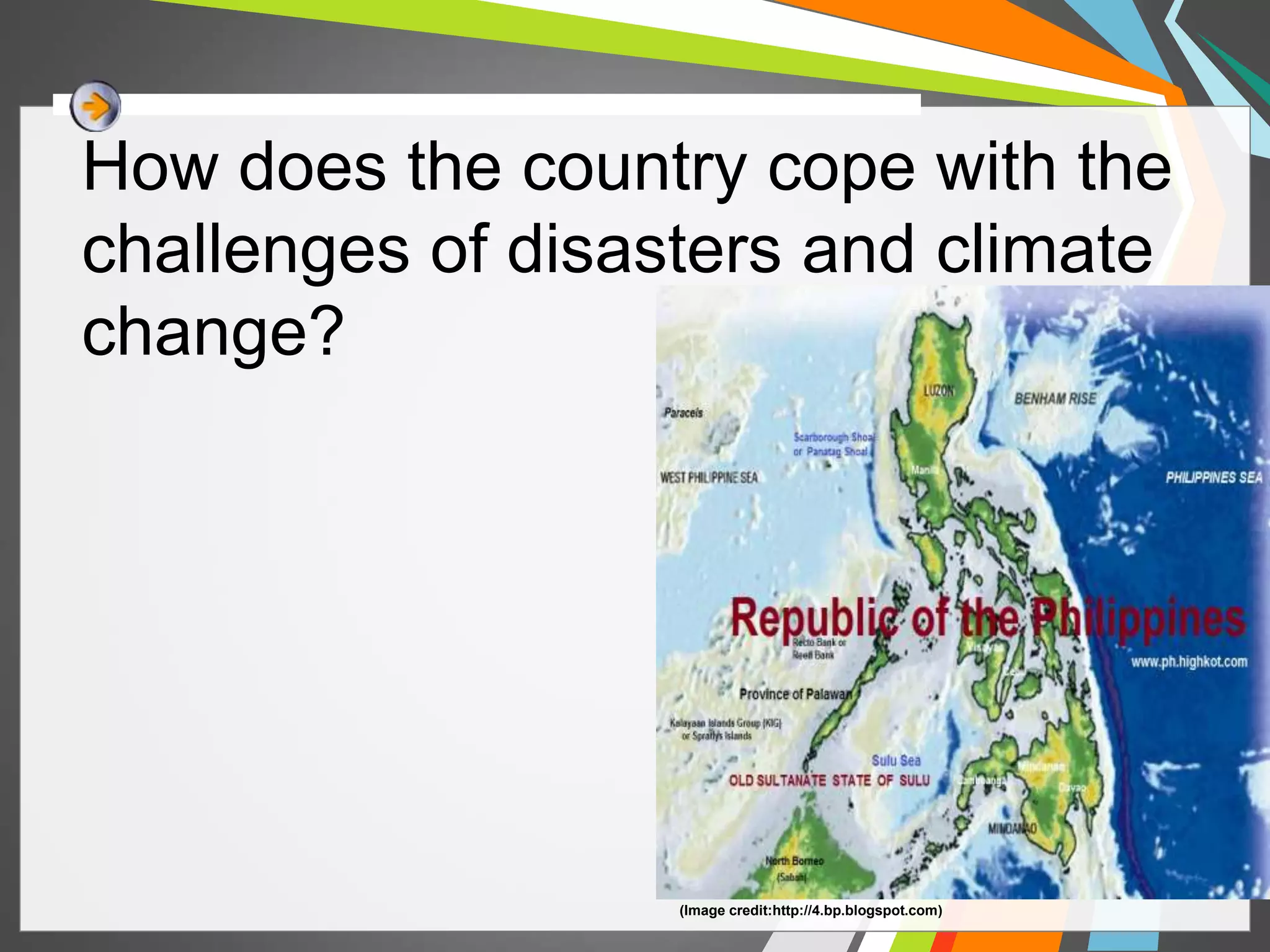
How does the country cope with the 
challenges of disasters and climate 
change? 
(Image credit:http://4.bp.blogspot.com)
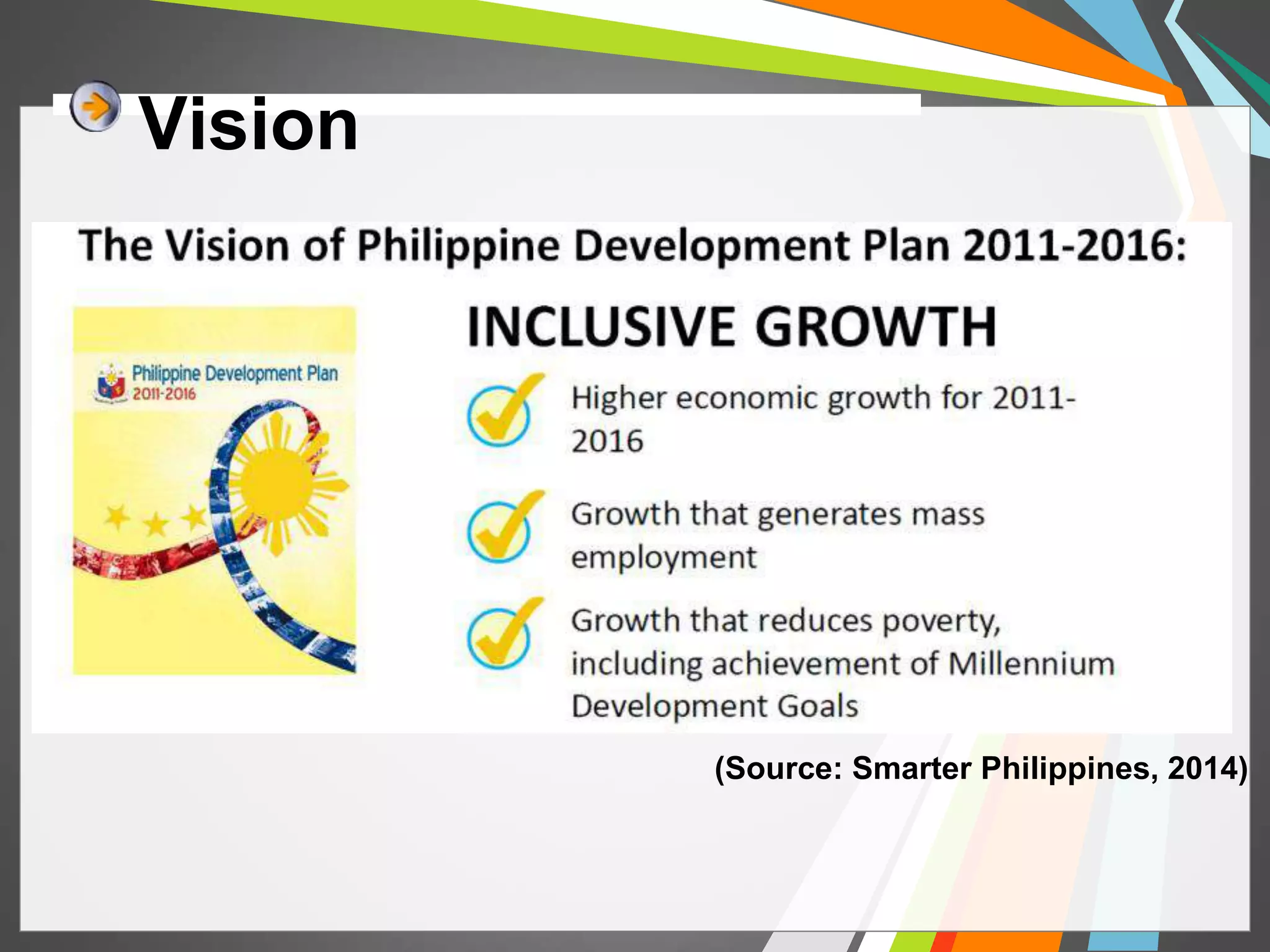
Vision 
(Source: Smarter Philippines, 2014)
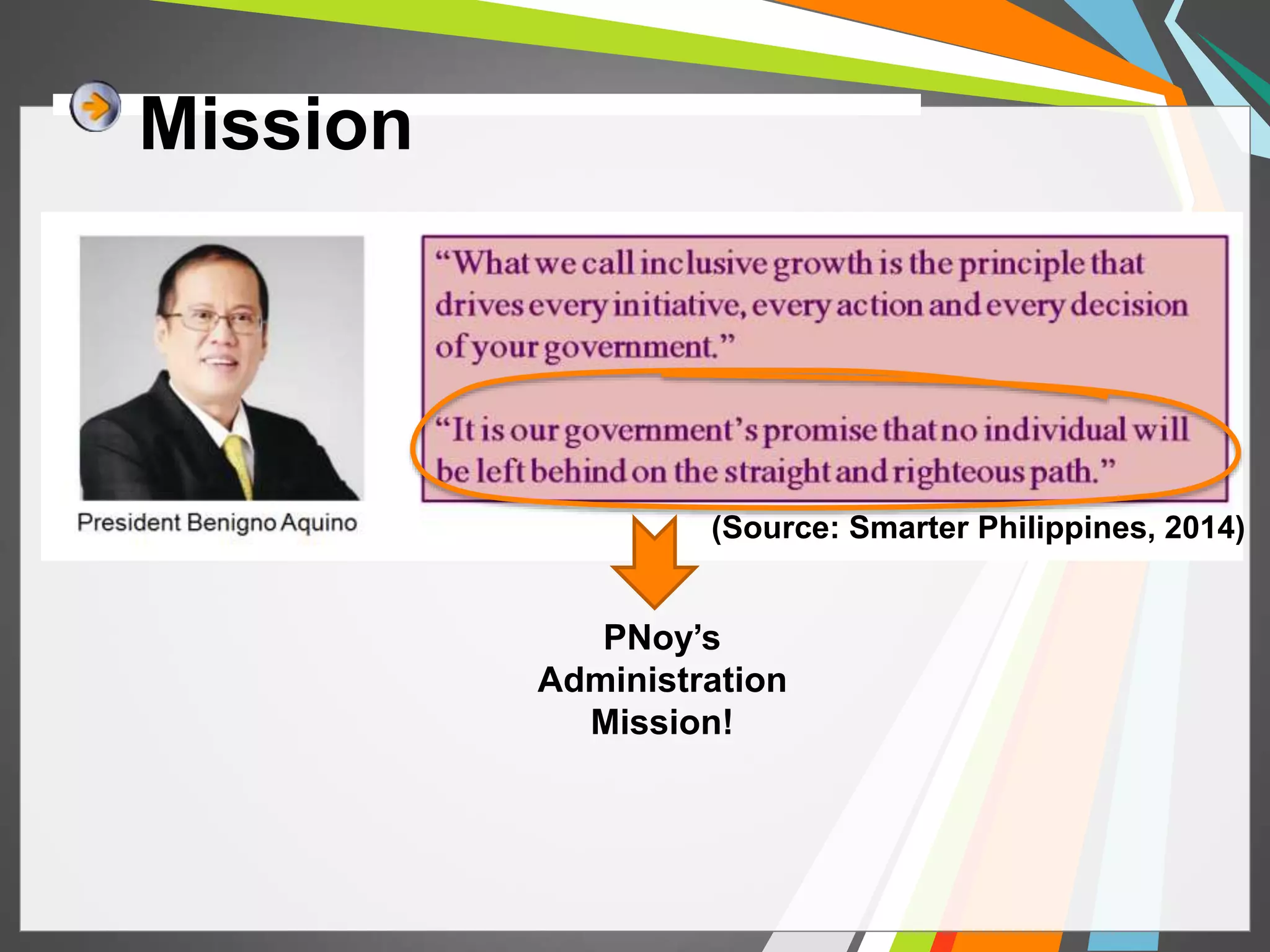
Mission 
(Source: Smarter Philippines, 2014) 
PNoy’s 
Administration 
Mission!
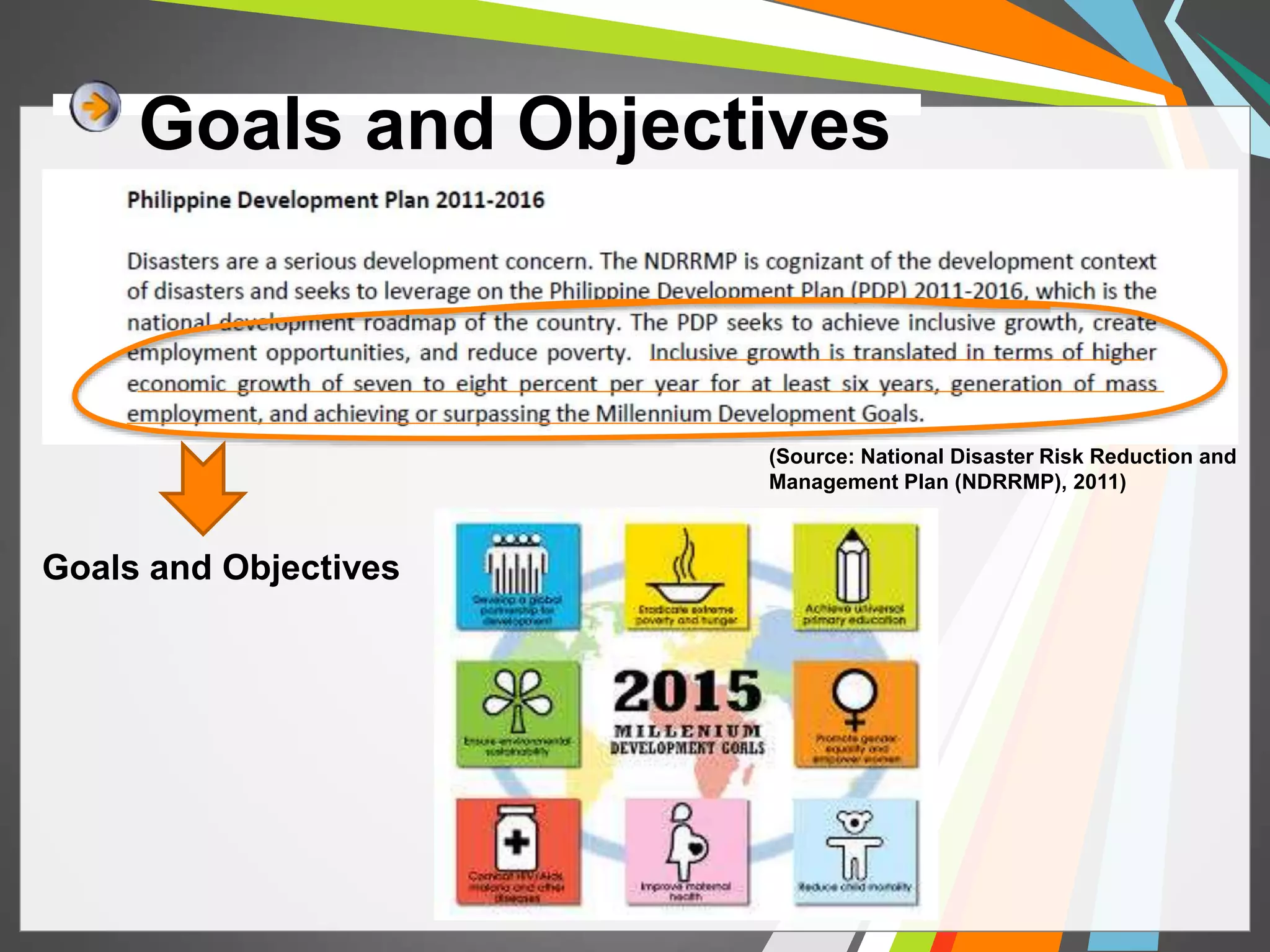
Goals and Objectives 
(Source: National Disaster Risk Reduction and 
Management Plan (NDRRMP), 2011)
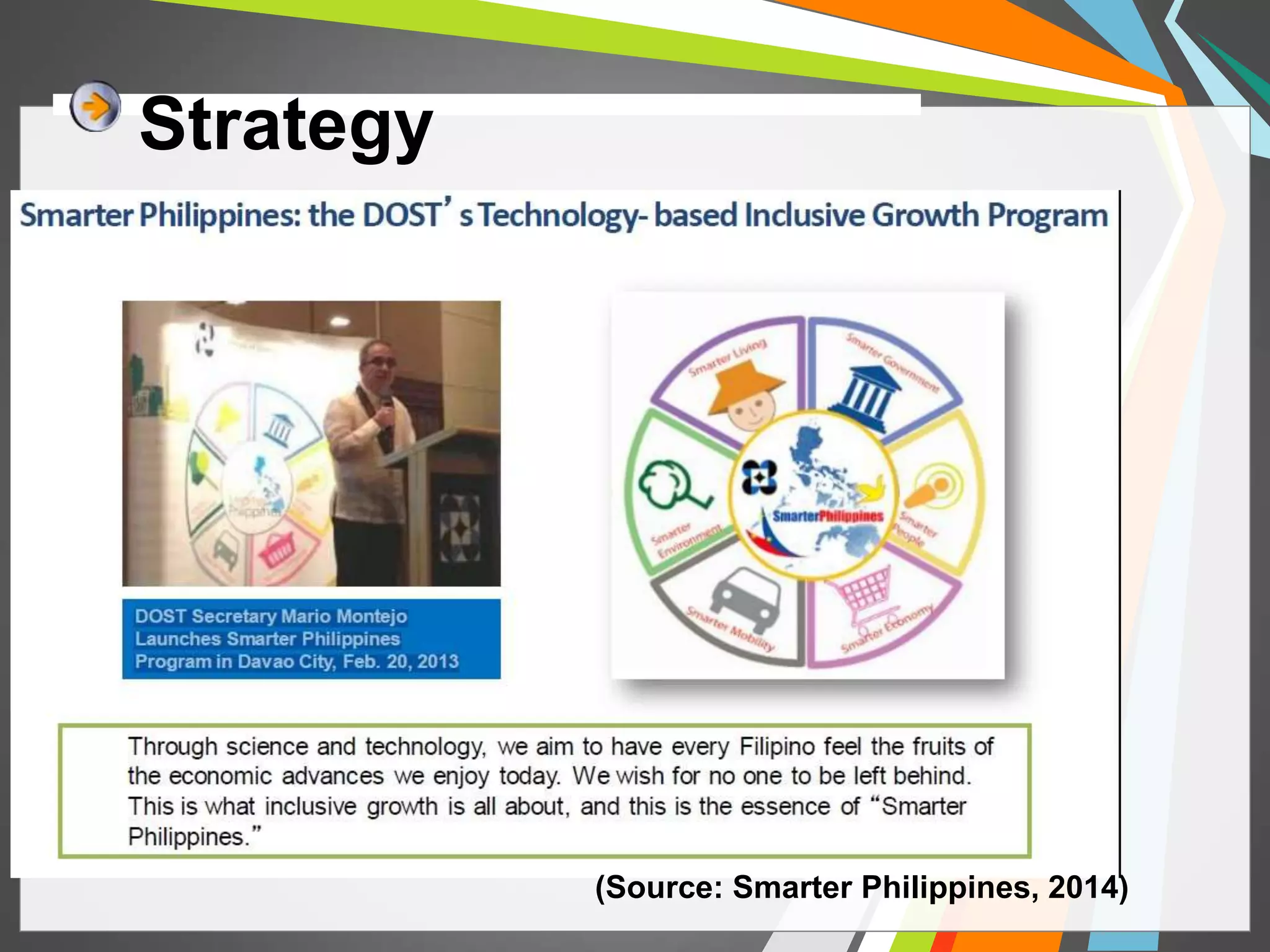
Strategy 
(Source: Smarter Philippines, 2014)
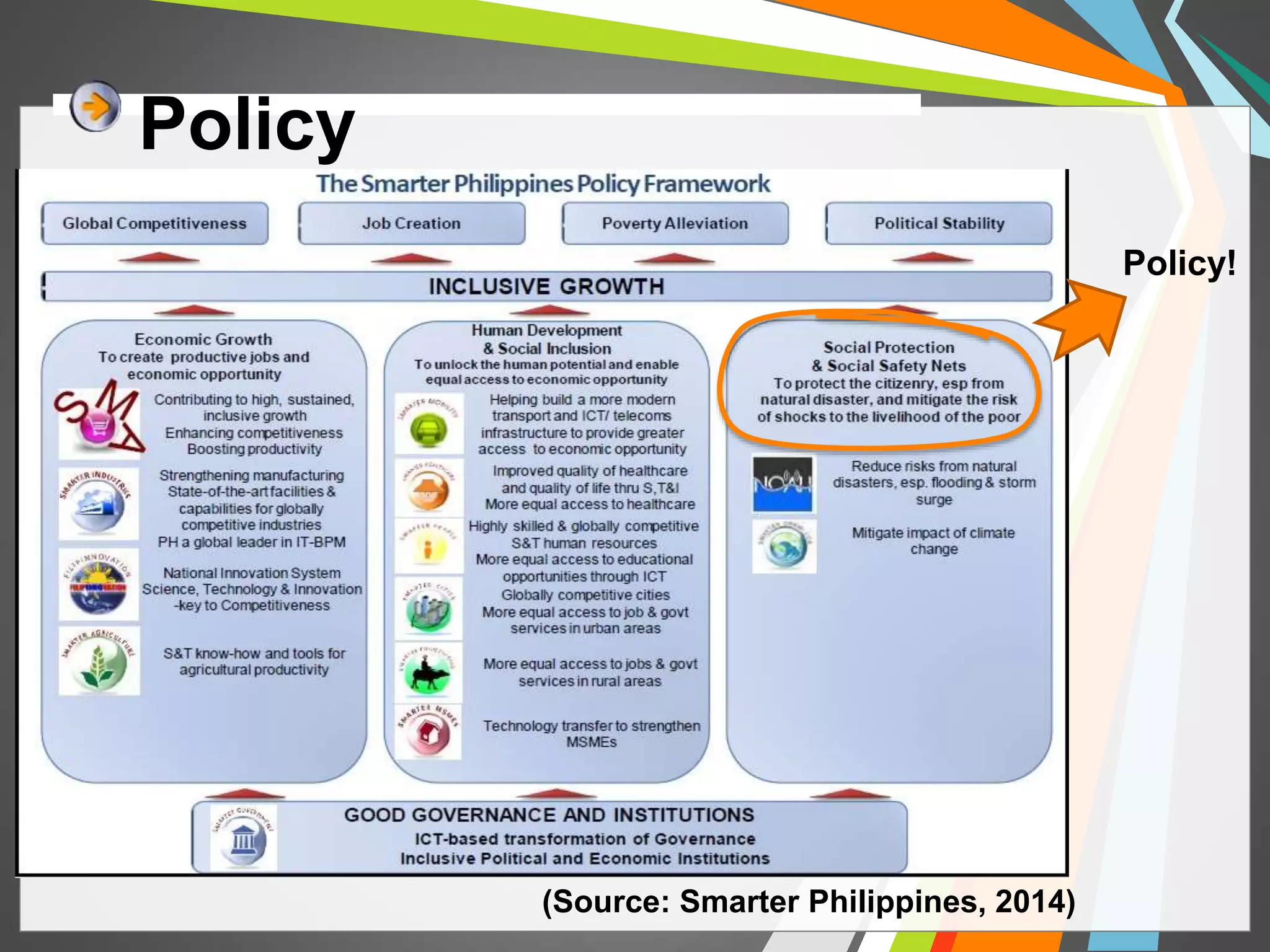
Policy 
Policy! 
(Source: Smarter Philippines, 2014)
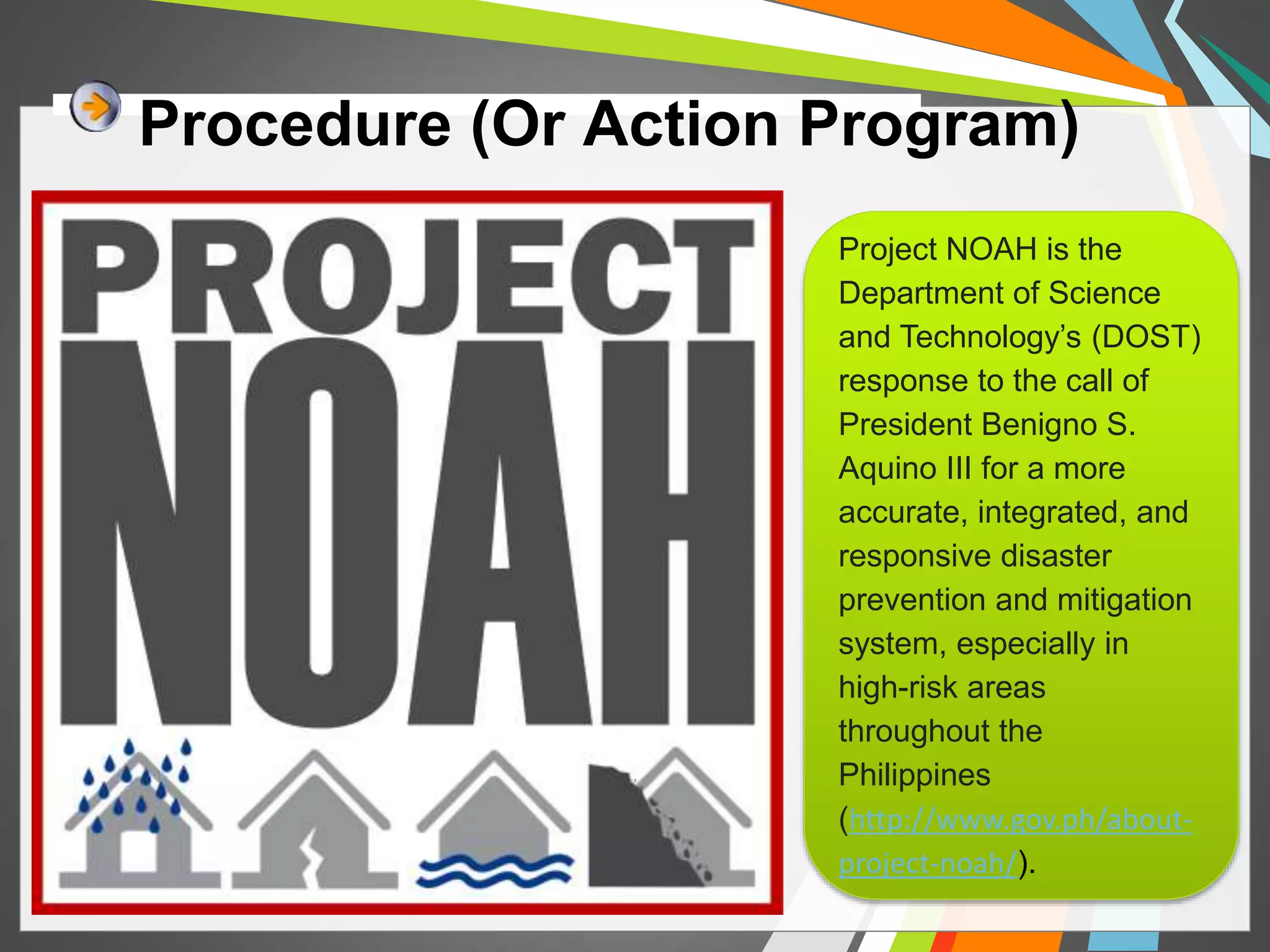
Procedure (Or Action Program) 
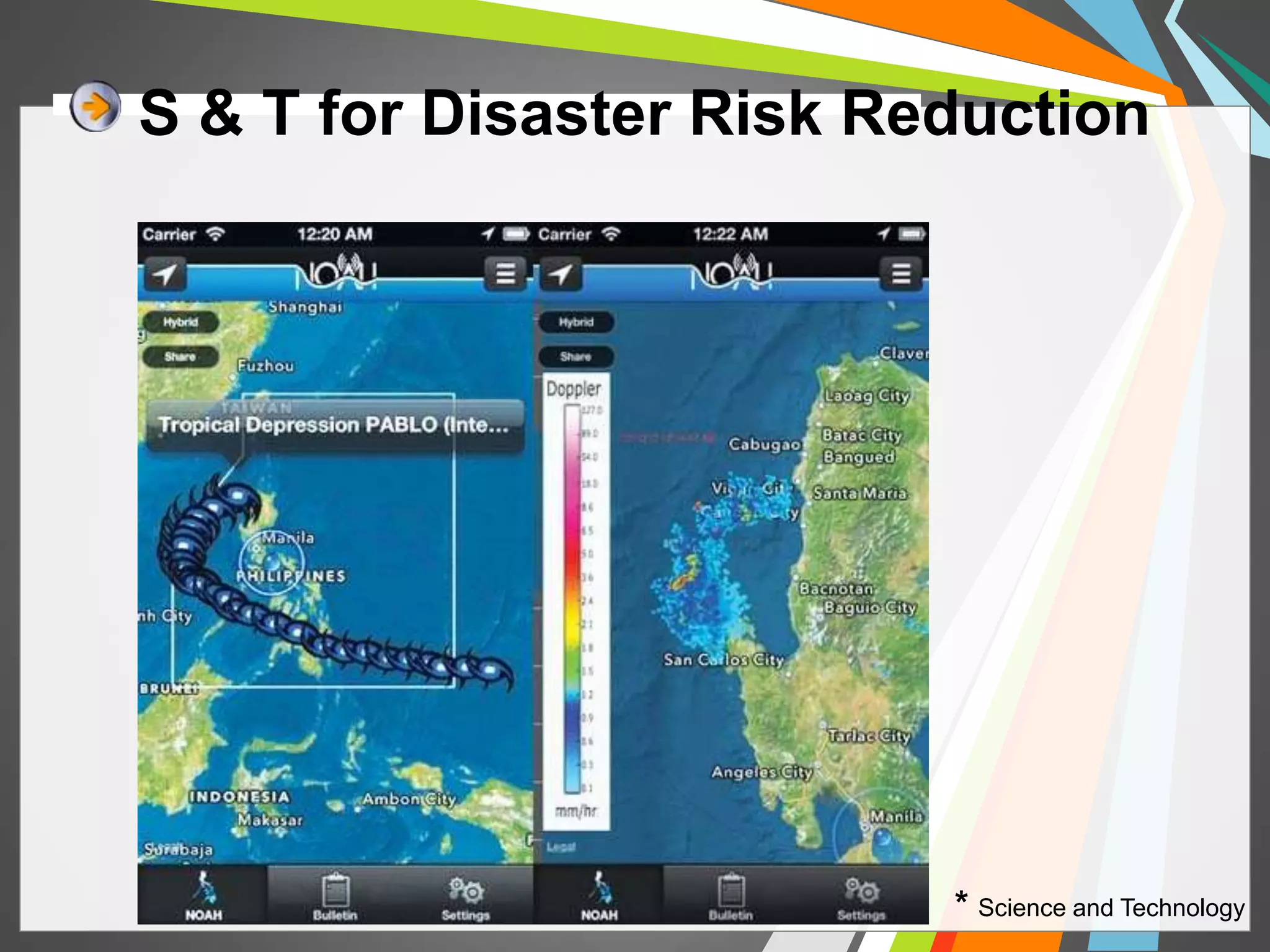
Project NOAH is the 
Department of Science 
and Technology’s (DOST) 
response to the call of 
President Benigno S. 
Aquino III for a more 
accurate, integrated, and 
responsive disaster 
prevention and mitigation 
system, especially in 
high-risk areas 
throughout the 
Philippines 
(http://www.gov.ph/about-project- 
noah/).
Philippines and Climate Change 
The Philippines is rising against the challenges 
of Climate Change. 
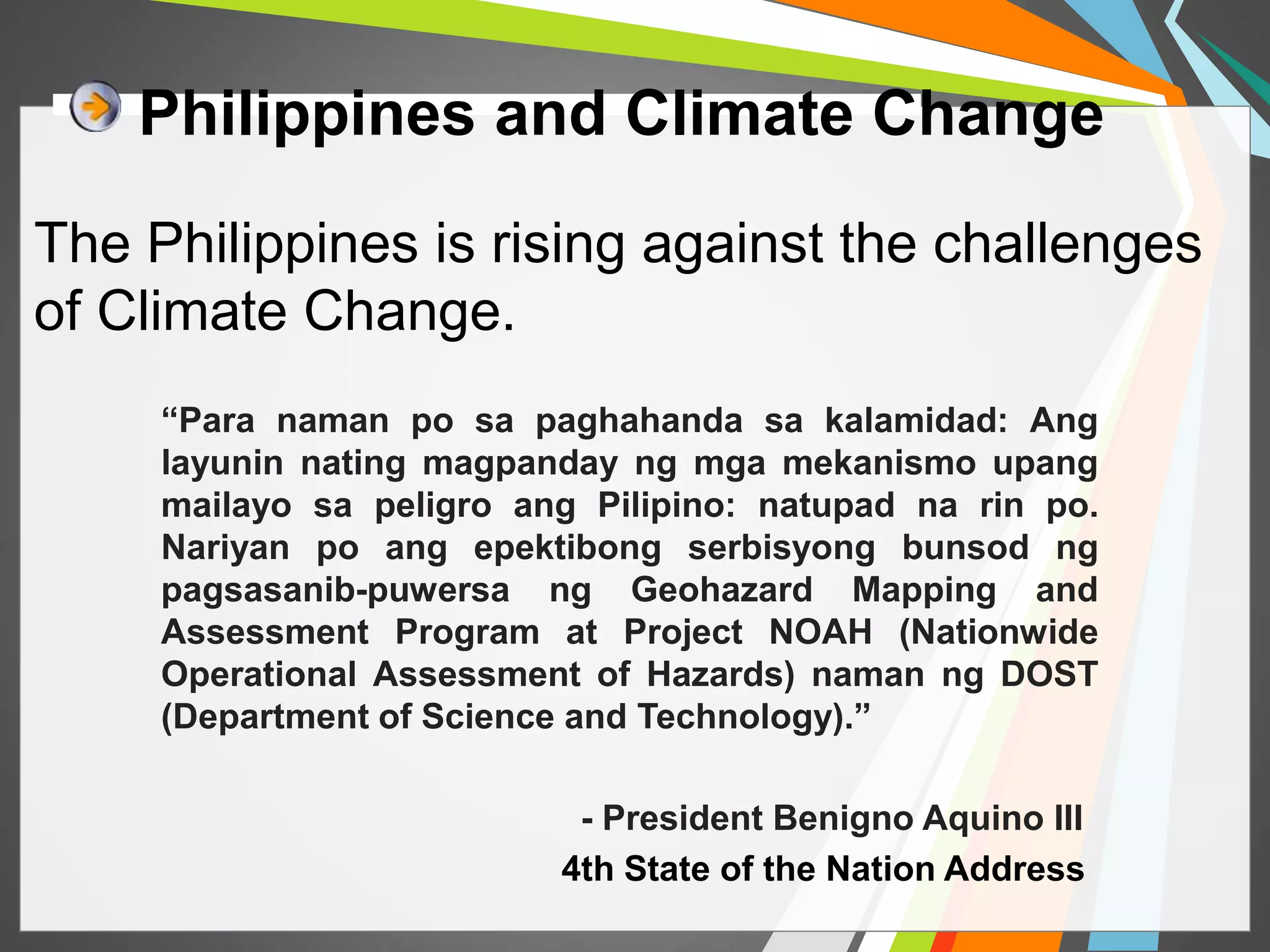
“Para naman po sa paghahanda sa kalamidad: Ang 
layunin nating magpanday ng mga mekanismo upang 
mailayo sa peligro ang Pilipino: natupad na rin po. 
Nariyan po ang epektibong serbisyong bunsod ng 
pagsasanib-puwersa ng Geohazard Mapping and 
Assessment Program at Project NOAH (Nationwide 
Operational Assessment of Hazards) naman ng DOST 
(Department of Science and Technology).” 
- President Benigno Aquino III 
4th State of the Nation Address
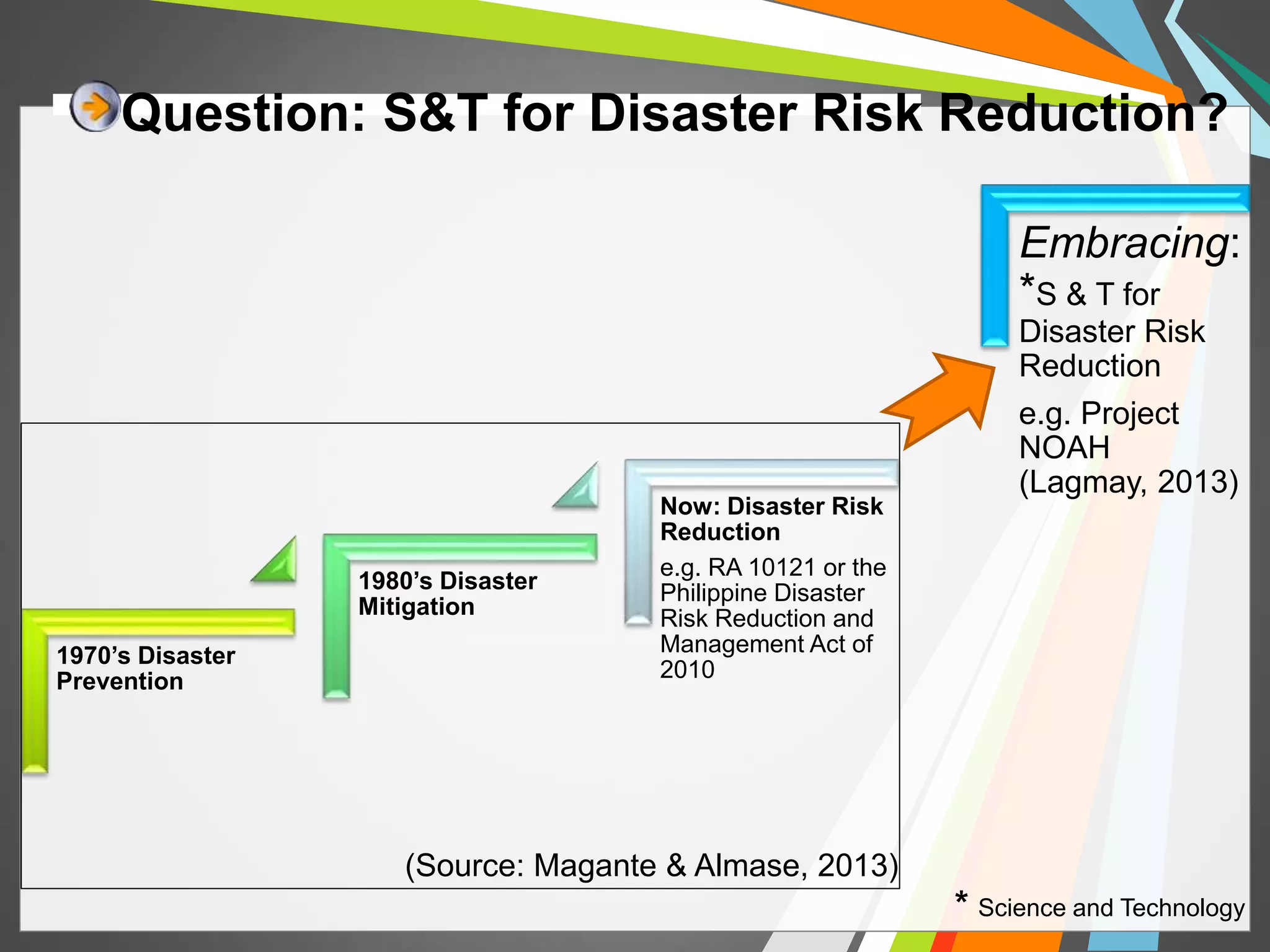
Question: S&T for Disaster Risk Reduction? 
1970’s Disaster 
Prevention 
1980’s Disaster 
Mitigation 
Now: Disaster Risk 
Reduction 
e.g. RA 10121 or the 
Philippine Disaster 
Risk Reduction and 
Management Act of 
2010 
Embracing: 
*S & T for 
Disaster Risk 
Reduction 
e.g. Project 
NOAH 
(Lagmay, 2013) 
(Source: Magante & Almase, 2013) 
* Science and Technology
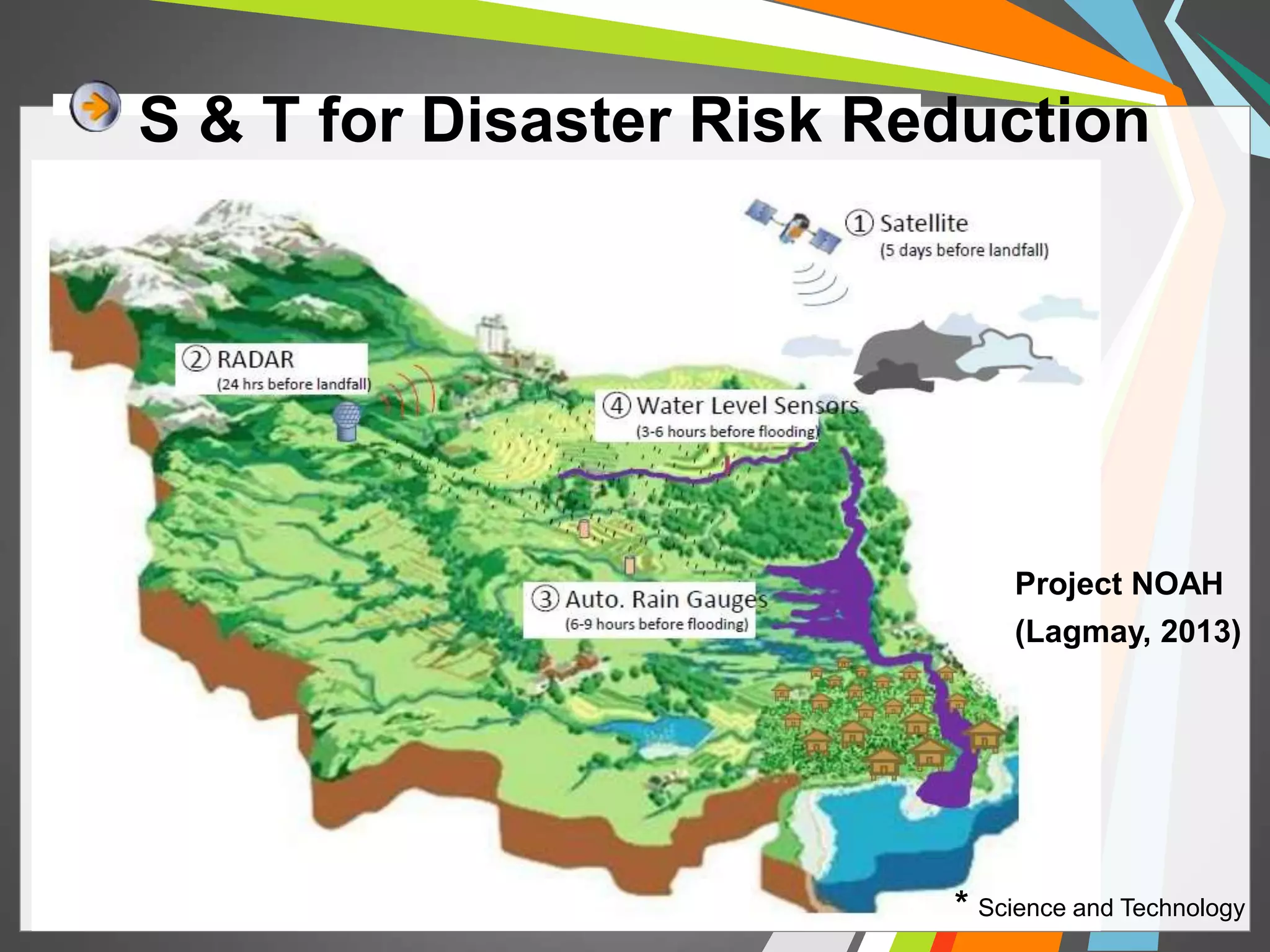
S & T for Disaster Risk Reduction 
Project NOAH 
(Lagmay, 2013) 
* Science and Technology
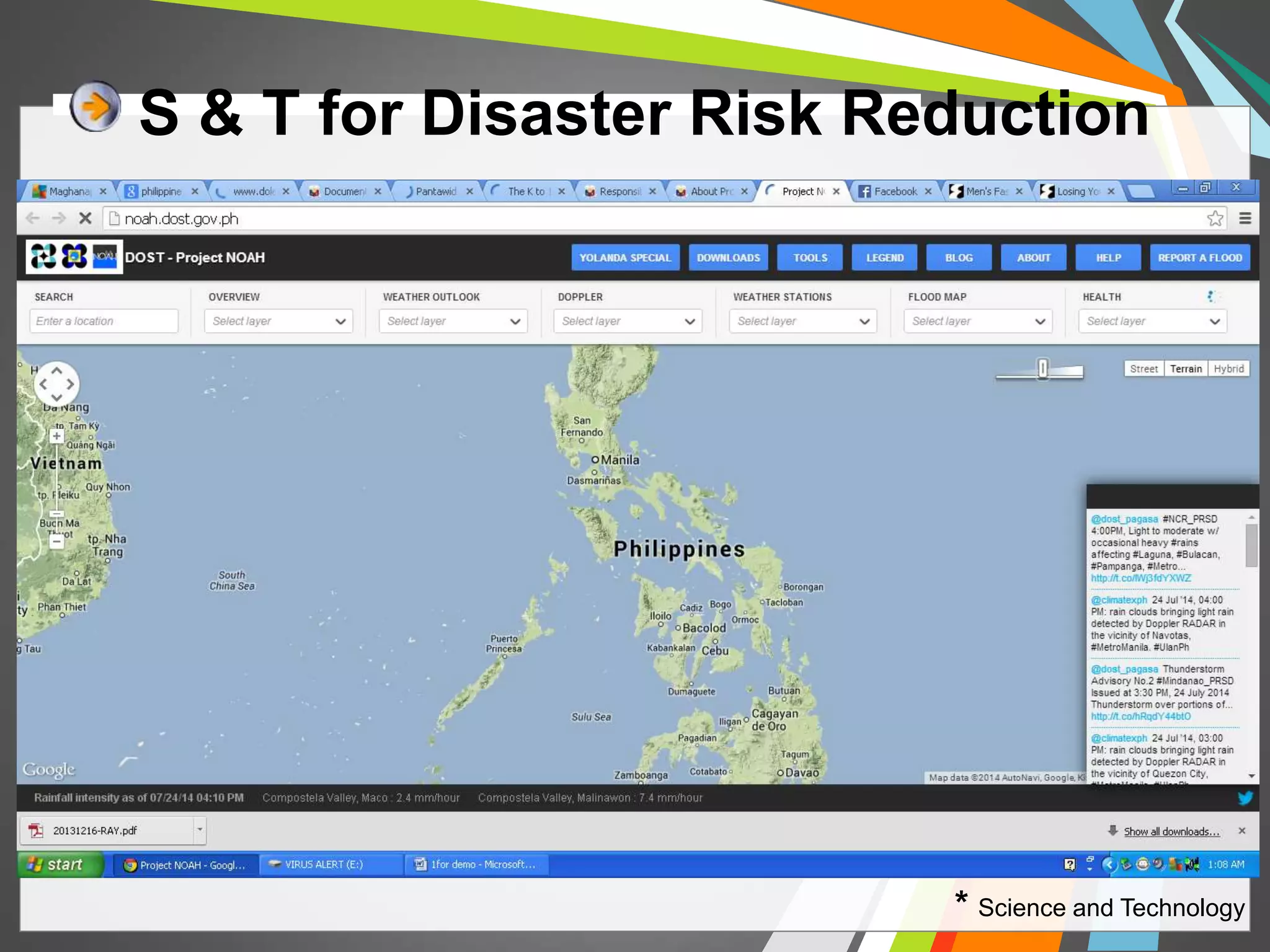
S & T for Disaster Risk Reduction 
* Science and Technology
S & T for Disaster Risk Reduction 
* Science and Technology
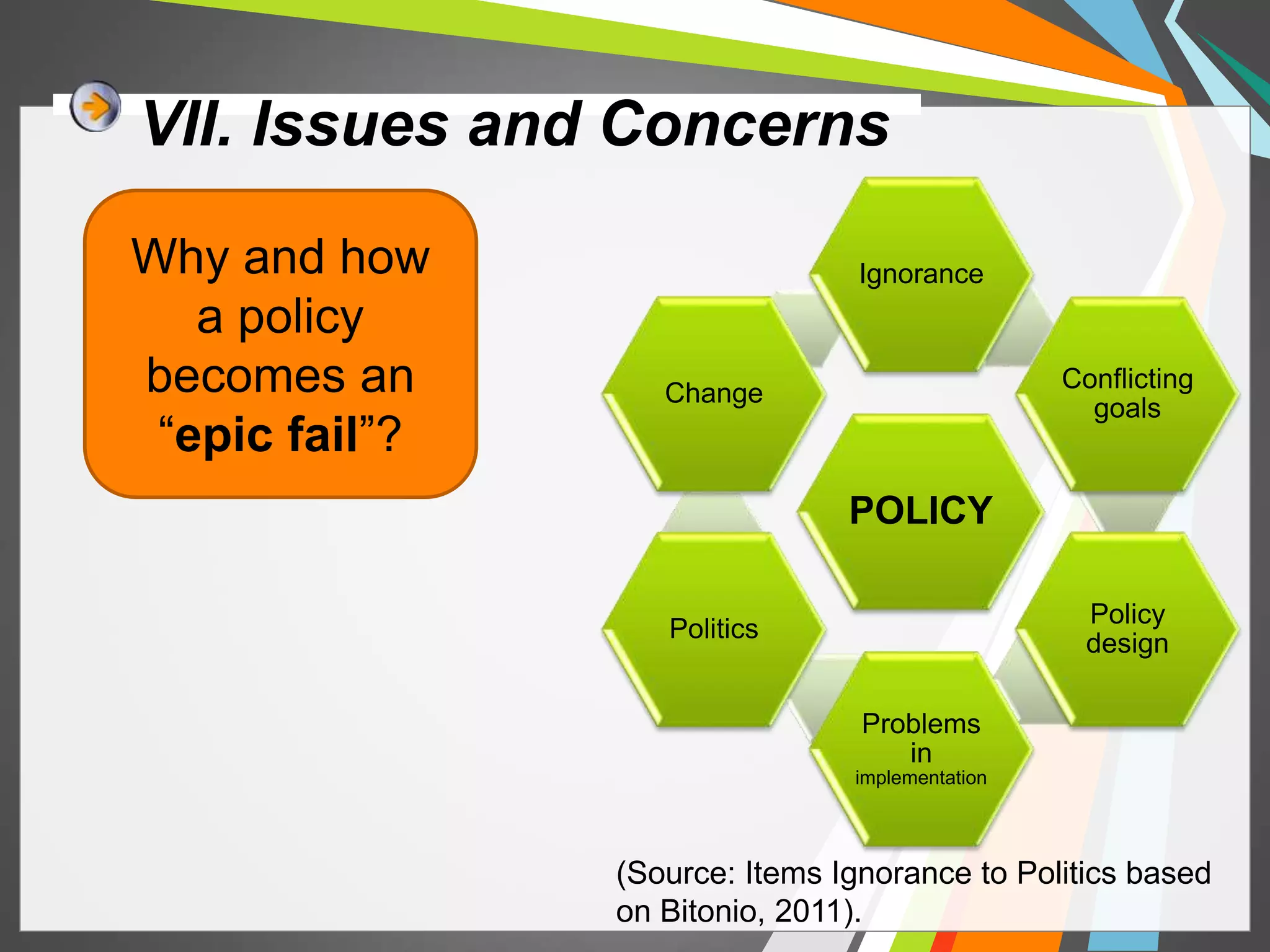
VII. Issues and Concerns 
Ignorance 
POLICY 
Conflicting 
goals 
Policy 
design 
Problems 
in 
implementation 
Change 
Politics 
Why and how 
a policy 
becomes an 
“epic fail”? 
(Source: Items Ignorance to Politics based 
on Bitonio, 2011).
Reference: 
READ MORE: 
A. Books 
•Manuel, Manolito C. EDM 333 Policy Process. Pangasinan State University Open University Systems. 2008 
•Miclat, Jr. Eusebio, F. Strategic Planning in Education: Making Change Happen 2005 
B. Web 
•Aquino, Benigno III. Fourth State of the Nation Address. http://www.gov.ph/2013/07/22/benigno-s-aquino-iii-fourth- 
state-of-the-nation-address-july-22-2013/ 
•Bitonio, Josefina. Policy Development: A Lecture-presentation for Goodminds Empowerment & Training 
Specialists and Advocacy Cooperative http://www.slideshare.net/coopjbb1/policy-devt-feb- 
26th?utm_source=slideshow&utm_medium=ssemail&utm_campaign=download_notificatio Nov. 22, 2011 
Retrieved August 09, 2014 
•Bitonio, Josefina. Policy Formulation. http://www.slideshare.net/jobitonio/what-is-a-policy? 
utm_source=slideshow&utm_medium=ssemail&utm_campaign=download_notificatio Nov. 22, 2011 
Retrieved August 09, 2014 
•Melchor III, Alejandro. Inclusive Growth Through a Smarter Philippines! 
http://www.slideshare.net/budmelchor/inclusive-growth-through-a-smarter-philippines#btnNext Feb. 18, 2014 
Accessed July 30, 2014 
•_________________. About Project NOAH. http://www.gov.ph/about-project-noah/ July 06, 2012 
• _________________. A Social Contract with the Filipino People. 
http://www.gov.ph/about/gov/exec/bsaiii/platform-of-government/ July 25, 2010
Reference: 
• __________________. Definition of Policy. http://dictionary.reference.com/browse/policy Accessed July 
30, 2014 
C. PDF 
• Carrera, Arloyd P. & Sumajit, Maribeth R. Policy Formulation. Slideshare 
• Lagmay, Alfredo Mahar Francisco A. Project NOAH S & T for Disaster Risk Reduction 2013 
• Martinez, Carlos C. Chapter IX Different Approaches to Policy Transfer in Innovations in Governance and 
Public Administration: Replicating what works, Department of Economic and Social Affairs, U.N. 2006 
• Magante, Gee Lyn, M. and Almase, Ananda Devi, D. Revisiting Disaster Management Policy in the 
Philippines: Some Issues and Concerns in NDCP Policy Brief (A Publication Series on National Security 
Issues by the National Defense College of the Philippines) April 30, 2013 
• _____________________. National Disaster Risk Reduction and Management Plan (NDRRMP) 
2011‐2028 http://www.slideshare.net/tudlo/national-disaster-riask-reduction-and-management-plan? 
qid=91b7071e-8116-4c12-8a4d-c3dc6c63f2f8&v=default&b=&from_search=8# April 13, 2014 
Retrieved August 12, 2014 
• ______________________. Smarter Philippines. Department of Science and Technology June 02, 2014 
D. Infographics 
• De Jesus, Julliane (Researcher) & Diamat, Mark (GFX) Philippines’ Worst Storms Since 2009. 
Inquirer.net 
NOTE: Slides 33 to 38 were author’s own analysis, with reference to slide 27. 
Disclaimer: 
The author claims no copyright ownership of all the photos or graphics used in this presentation and thanks all 
of those photographers/graphic artists who shared and published them thru internet.

Intro to Policy-making process

  • 1.
    L/O/G/O www.themegallery.com PANGASINANSTATE UNIVERSITY Graduate School Urdaneta City Campus INTRODUCTION TO POLICY PROCESS1 1A requirement submitted by Michael John D. Sison in partial fulfillment of the requirements of the course Public Policy and Program Management (DM 219) under the Supervision of Dr. Reynaldo Gelido; Summer, S.Y. 2013-2014
  • 2.
    Topic Outline: I.Definition and Basic Elements of Policy II. Policy and Related Concepts III. Bases of Policy IV. Policy Agenda-Setting a. What is Agenda? b. How do groups gain access to the Policy Agenda? c. How do issues get to the agenda? d. The Policymaking Process V. 5 Cs (Importance of a Policy) VI. Revisiting VMOG VII. Issues and Concerns
  • 3.
  • 4.
  • 5.
    I. Definition ofPolicy pol·i·cy [pol-uh-see] noun, plural pol·i·cies. • a definite course of action adopted for the sake of expediency, facility, etc.: We have a new company policy. • a course of action adopted and pursued by a government, ruler, political party, etc.: our nation's foreign policy. • action or procedure conforming to or considered with reference to prudence or expediency: It was good policy to consent (Source: http://dictionary.reference.com/browse/policy).
  • 6.
    I. Definition ofPolicy Policy is a principle or rule to guide decisions and achieve rational outcome. It contains the “WHAT” and the “WHY” (of) needs to be done (Carrera & Sumajit, 2013).
  • 7.
    I. Definition ofPolicy Policy is a purposive course of action or decision which is commonly set and perceived to be socially desirable to a great number of people (NEDA as cited by Miclat, 2005). A good example of policy, in the context of a university, is to promote quality and relevant education (Miclat, 2005).
  • 8.
    P O L I C Y Basic Elements of a Policy (Based on Manuel, 2008)
  • 9.
    Basic Elements ofa Policy (Based on Manuel, 2008) P olicy instrument, concerns, beneficiaries and people; O bjective, responsible and accountable; L imitations and time-frame; I magination and creativity; C enters on decision-making and has discretion; and Y es! A policy has predictability and relative uniformity of decisions.
  • 10.
    II. Policy andRelated Concepts (Based on Manuel, 2008) POLICY
  • 11.
    III. Bases ofPolicy (Based on Manuel, 2008) Philosophy Ideology Constitution Legislative Acts, E.O.s, and Judicial Decisions Societal Needs and Imperatives Development Issues
  • 12.
    IV. Policy Agenda-Setting 1. Agenda-setting 2. ___ 5. ____ POLICY MAKING PROCESS 4. ____ 3. ___
  • 13.
    IV. a. Whatis Agenda? (Based on Manuel, 2008) An agenda is a list of things to do. Agenda are actively constructed commitments. The agenda reveal much of people’s values.
  • 14.
    Question: What ifthe demands placed on our agenda exceed our capacity to accomplish them (Manuel, 2008)? Agenda triage Back burner Trade-offs Accomplishment
  • 15.
    IV. b. Howdo groups gain access to the policy agenda (Manuel, 2008)? Policy champions • Persons who initiate and sustain a particular policy crusade. They are catalysts and mobilizers (Manuel, 2008) e.g. Former Senator Ninoy Aquino. Crisis • It is an abrupt, significant, and unexpected change in events which calls to a particular event (Manuel, 2008). e.g. 9/11/2001 terrorist attack. Policy triggers • Radical or notable events that may lead to policy making and implementation e.g. EDSA I or Philippine Revolution.
  • 16.
    Question: How doesagenda reveal the values of the political system (Manuel, 2008)? Feedback intensity Front burner
  • 17.
    Systemic agenda vs.Institutional agenda Systemic agenda Refers to the It’s a big issue known to all, it gets front burner attention. Macro agenda, whole part. e.g. Energy issue specific organizational forum at within which an item is actually addressed. Micro agenda, constituent part. e.g. Oil drilling regulation Institutional agenda (Based on Manuel, 2008)
  • 19.
    IV. c. Howdo issues get to the Agenda? Problem Issue Agenda item (Based on Manuel, 2008) ● DISTORTION ● PROBLEM IDENTIFICATIO N POLICY MAKING PROCESS
  • 20.
    IV. d. ThePolicymaking Process POLICY MAKING PROCESS Agenda Setting Policy Formulation Policy Adoption Policy Evaluation Policy Implementation revision Consultations are carried out : Within the lead Agency with their technical experts Within Other Government Agencies which may be directly or indirectly impacted With Among committees, management and stakeholders (Source: Bitonio, 2011)
  • 21.
    Private Problem Issue Agenda item POLICY MAKING PROCESS Agenda Setting Policy Formulation Policy Adoption Policy Evaluation Policy revision Implementation
  • 22.
    V. 5 C’sof Policy 5 ImportanCe of a Policy (Based on Carrera &Sumajit, 2013) CONTROL COORDINATION CONTINUITY COMMUNICATION COMPLIANCE
  • 23.
    Vision SUCCESS! Statement “what we want to become” Mission Statement “who we are What we value” Goals & Objectives “How we measure our degree of success Strategy “how we will achieve our vision” Policies & Procedures “what, how, and when an action should be done? Communicating Purpose to Stakeholders (Source: Bitonio, 2011) - Realization of Vision and Mission; - Attainment of Goals and Objectives; and - Effective and efficient application of Strategy and adherence to Policies and Procedures VI. Revisiting VMOG
  • 24.
    Examples of possiblepolicies (Source: Manuel, 2008) Personnel Policies • Promotion policies: As the enterprise grows, managers should be promoted from within. Normally, the enterprise hires only supervisory positions from the outside. • Managerial selection policy: In selecting potential supervisory managers, we will hire college graduates.
  • 25.
    Examples of possiblepolicies (Source: Manuel, 2008) Marketing Policies • Internal growth policy: Normally, the major avenue of growth is to increase the sales of present products. Merger will be rarely used method of growth. • New product policy: Normally, when new products are added they will fit our current product line by increasing the number of sizes of the product offered.
  • 26.
    APPLICATION: Philippines andClimate Change 1 Archipelago 7, 100 islands *20 typhoons/year * Average Source: PAGASA
  • 27.
    APPLICATION: Philippines andClimate Change Philippines’ worst Storms from September 2009 to August 2013 which were: Source: Inquirer.net 2009 • Ondoy • Pepeng 2010 • Basyang • Juan 2011 • Bebeng • Falcon • Juaning • Sendong 2012 • Gener • Hanging Habagat • Helen • Pablo • Quinta 2013 • Crising • Gorio • Labuyo • Maring
  • 28.
    APPLICATION: Philippines andClimate Change Philippines’ worst Storms from September 2009 to August 2013: 10, 640 1, 223 3, 643 INJURED MISSING DEATHS Source: Inquirer.net
  • 29.
    APPLICATION: Philippines andClimate Change Philippines’ worst Storms from September 2009 to August 2013: Cost of damages: P 64, 814, 424, 000.00 Source: Inquirer.net
  • 30.
    Philippines and ClimateChange Philippines’ worst Storms from September 2009 to August 2013: Number of families affected: 3, 469, 898 • Or Number of persons affected: 19, 798, 840 • Source: Inquirer.net
  • 31.
    How does thecountry cope with the challenges of disasters and climate change? (Image credit:http://4.bp.blogspot.com)
  • 32.
    Vision (Source: SmarterPhilippines, 2014)
  • 33.
    Mission (Source: SmarterPhilippines, 2014) PNoy’s Administration Mission!
  • 34.
    Goals and Objectives Goals and Objectives (Source: National Disaster Risk Reduction and Management Plan (NDRRMP), 2011)
  • 35.
    Strategy (Source: SmarterPhilippines, 2014)
  • 36.
    Policy Policy! (Source:Smarter Philippines, 2014)
  • 37.
    Procedure (Or ActionProgram) Project NOAH is the Department of Science and Technology’s (DOST) response to the call of President Benigno S. Aquino III for a more accurate, integrated, and responsive disaster prevention and mitigation system, especially in high-risk areas throughout the Philippines (http://www.gov.ph/about-project- noah/).
  • 38.
    Philippines and ClimateChange The Philippines is rising against the challenges of Climate Change. “Para naman po sa paghahanda sa kalamidad: Ang layunin nating magpanday ng mga mekanismo upang mailayo sa peligro ang Pilipino: natupad na rin po. Nariyan po ang epektibong serbisyong bunsod ng pagsasanib-puwersa ng Geohazard Mapping and Assessment Program at Project NOAH (Nationwide Operational Assessment of Hazards) naman ng DOST (Department of Science and Technology).” - President Benigno Aquino III 4th State of the Nation Address
  • 39.
    Question: S&T forDisaster Risk Reduction? 1970’s Disaster Prevention 1980’s Disaster Mitigation Now: Disaster Risk Reduction e.g. RA 10121 or the Philippine Disaster Risk Reduction and Management Act of 2010 Embracing: *S & T for Disaster Risk Reduction e.g. Project NOAH (Lagmay, 2013) (Source: Magante & Almase, 2013) * Science and Technology
  • 40.
    S & Tfor Disaster Risk Reduction Project NOAH (Lagmay, 2013) * Science and Technology
  • 41.
    S & Tfor Disaster Risk Reduction * Science and Technology
  • 42.
    S & Tfor Disaster Risk Reduction * Science and Technology
  • 43.
    VII. Issues andConcerns Ignorance POLICY Conflicting goals Policy design Problems in implementation Change Politics Why and how a policy becomes an “epic fail”? (Source: Items Ignorance to Politics based on Bitonio, 2011).
  • 44.
    Reference: READ MORE: A. Books •Manuel, Manolito C. EDM 333 Policy Process. Pangasinan State University Open University Systems. 2008 •Miclat, Jr. Eusebio, F. Strategic Planning in Education: Making Change Happen 2005 B. Web •Aquino, Benigno III. Fourth State of the Nation Address. http://www.gov.ph/2013/07/22/benigno-s-aquino-iii-fourth- state-of-the-nation-address-july-22-2013/ •Bitonio, Josefina. Policy Development: A Lecture-presentation for Goodminds Empowerment & Training Specialists and Advocacy Cooperative http://www.slideshare.net/coopjbb1/policy-devt-feb- 26th?utm_source=slideshow&utm_medium=ssemail&utm_campaign=download_notificatio Nov. 22, 2011 Retrieved August 09, 2014 •Bitonio, Josefina. Policy Formulation. http://www.slideshare.net/jobitonio/what-is-a-policy? utm_source=slideshow&utm_medium=ssemail&utm_campaign=download_notificatio Nov. 22, 2011 Retrieved August 09, 2014 •Melchor III, Alejandro. Inclusive Growth Through a Smarter Philippines! http://www.slideshare.net/budmelchor/inclusive-growth-through-a-smarter-philippines#btnNext Feb. 18, 2014 Accessed July 30, 2014 •_________________. About Project NOAH. http://www.gov.ph/about-project-noah/ July 06, 2012 • _________________. A Social Contract with the Filipino People. http://www.gov.ph/about/gov/exec/bsaiii/platform-of-government/ July 25, 2010
  • 45.
    Reference: • __________________.Definition of Policy. http://dictionary.reference.com/browse/policy Accessed July 30, 2014 C. PDF • Carrera, Arloyd P. & Sumajit, Maribeth R. Policy Formulation. Slideshare • Lagmay, Alfredo Mahar Francisco A. Project NOAH S & T for Disaster Risk Reduction 2013 • Martinez, Carlos C. Chapter IX Different Approaches to Policy Transfer in Innovations in Governance and Public Administration: Replicating what works, Department of Economic and Social Affairs, U.N. 2006 • Magante, Gee Lyn, M. and Almase, Ananda Devi, D. Revisiting Disaster Management Policy in the Philippines: Some Issues and Concerns in NDCP Policy Brief (A Publication Series on National Security Issues by the National Defense College of the Philippines) April 30, 2013 • _____________________. National Disaster Risk Reduction and Management Plan (NDRRMP) 2011‐2028 http://www.slideshare.net/tudlo/national-disaster-riask-reduction-and-management-plan? qid=91b7071e-8116-4c12-8a4d-c3dc6c63f2f8&v=default&b=&from_search=8# April 13, 2014 Retrieved August 12, 2014 • ______________________. Smarter Philippines. Department of Science and Technology June 02, 2014 D. Infographics • De Jesus, Julliane (Researcher) & Diamat, Mark (GFX) Philippines’ Worst Storms Since 2009. Inquirer.net NOTE: Slides 33 to 38 were author’s own analysis, with reference to slide 27. Disclaimer: The author claims no copyright ownership of all the photos or graphics used in this presentation and thanks all of those photographers/graphic artists who shared and published them thru internet.

Editor's Notes

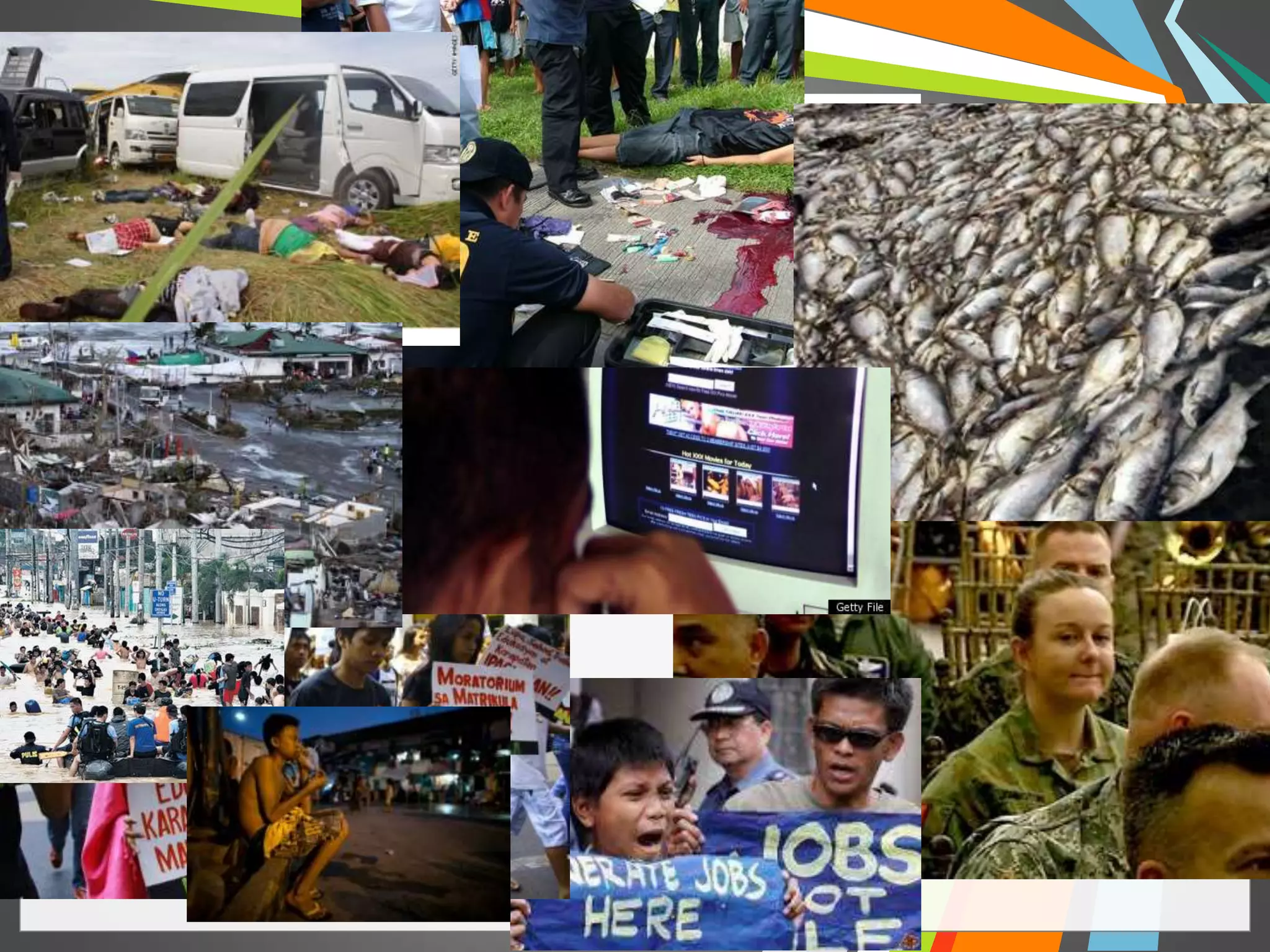
  • #4 The first stage in the public policy cycle is agenda-setting. Before a policy can be formulated, it must first command attention. A multitude of perceived problems and grievances compete for recognition at any given time. Some will get official consideration, but most will ignored or given only cursory treatment then soon abandoned. Constituent bitterness and disaffection is left in the wake (Manuel, 2008).
  • #5 Successful civil servants, NGO workers, politicians and their advisers all need to have a wide range of skills and knowledge to equip them to meet the constantly changing challenges of public policy and management. This includes the evolving dynamic between public agencies and the private and voluntary sectors. http://portal.publicpolicy.utoronto.ca/en/Courses/Pages/default.aspx There is no ‘one-size-fit-all’ solution and governance as not a ‘one-time exercise’. It is a continuos process of refinement, re-assessment of practices and strategies as well as incremental institutional development (Guido, Bertucci Innovations in Governance and Public Administration: Replicating what works)
  • #6 Word Origin & History policy  "way of management, government, administration," late 14c., from O.Fr. policie (14c.) "civiladministration," from L. politia "the state," from Gk. politeia "state, administration, government,citizenship," from polites "citizen," from polis "city, state," from PIE *p(o)lH- "enclosed space, often on A policy is a broad statement or group of statements used as guideline for managerial decision-making. It provides due discretion under bounded limits for imagination and creativity to the decision-maker. The policy ensures the predictivity and relative uniformity of decisions to be made by managers. Additionally, those who will affected by the policy, and the effectivity of its enforcement or execution are also included in the statement/s (Manuel, 2006).
  • #7 A POLICY IS A STATEMENT THAT PROVIDES A GUIDE FOR DECISION MAKING BY MEMBERS OF THE ORGANIZATION CHARGED WITH THE RESPONSIBILITY OF OPERATING THE ORGANIZATION AS A SYSTEM WITH THE PURPOSE OF ATTAINING THE ESTABLISHED OBJECTIVES OF THE AN ORGANIZATION. A policy is a predetermined course of action established as a guide toward accepted objectives. A policy is a statement, verbal, written or implied, of those principles and rules that are set by Board of Directors as guidelines on organizations actions
  • #8 Policy is then a series of action or procedures that is projected for a practical yet sociable results for people. Strategy, on the other hand, is the method or approach undertaken to accomplish development goals, objectives, and targets (NEDA, 1985). Policy: Promotion of quality and relevant education Strategy: Formulation of selective admission and retention, recruitment of competent teachers, enrichment of curricular programs , and provision of adequate library resources and laboratory equipment and apparatuses.
  • #10 Policy instrument refers to the mechanism whether this is already in place or to be established in the organization for the execution of the policy; Policy concerns refer to the problems and difficulties, or deviations in the attainment of objectives being met in the organization which the policy is made to address; Policy beneficiaries refer to direct and indirect beneficiaries of the policy objectives, etc.; and Effect on people, this means that a policy provides for the identified people who will be affected by the execution, review and evaluation of policy whether directly or indirectly. A policy is objective in the sense that, it provides for the attainment of expectations. Thus, has direction for something. It has also responsibility and accountability because managers will be the ones who’ll be responsible to implement the execution of policy and accountable for the results. A policy has limitations, that is, bounded limits, which states the limitations of the autonomy, freedom or discretion of the decision maker. It has also a time frame, that implementation and execution of policy is effected on a given date, and within a stated duration of time. It can be on a short-term or long-term periods. Imagination and Creativity refers to the decision maker’s intelligence and conceptual ability in consideration of the external and internal factors affecting the choice of the decision. This encourages the decision maker to think critically of the situation and consequences of the decision to be made. It provides therefore, the opportunity and the initiative for the manager to see things comprehensively and innovate strategies and processes to eliminate the causes of the problems. Decision making means that the manager is given the reasonable area for options, choices, or alternatives in making decisions to eliminate or minimize the causes of problems in the attainment of managerial effectiveness and efficiency in the operations. While, discretion refers to the given autonomy or freedom of the manager when solving problems and making decisions given the limitations as stated in the policy. Yes! In an organization, it is expected that the organizational or wide applications of decisions shall be made in consideration of the strategic and or long term goals and objectives. The policy provides the assurance that managers shall decide in consideration of the over all advantage to the organization and that managers should think and act as one in consideration of the primordial goals.
  • #38 The Project will harness technologies and management services for disaster risk reduction activities offered by the DOST through PAGASA, PHIVOLCS, and the DOST-Advanced Science and Technology Institute (ASTI), in partnership with the UP National Institute of Geological Sciences and the UP College of Engineering. The Project has the following components: • Distribution of Hydrometeorological Devices in hard-hit areas in the Philippines (Hydromet) that provide a better picture of the country’s surface water in relation to flooding; • Disaster Risk Exposure Assessment for Mitigation – Light Detection and Ranging (DREAM-LIDAR) Project produce more accurate flood inundation and hazard maps in 3D for the country’s flood-prone and major river systems and watersheds. • Enhancing Geohazards Mapping through LIDAR. The project, which is targeted to be completed by December 2014, shall use LIDAR technology and computer-assisted analyses to identify exact areas prone to landslides. • Coastal Hazards and Storm Surge Assessment and Mitigation (CHASSAM).  CHASSAM, which is targeted to be completed by December 2014, will generate wave surge, wave refraction, and coastal circulation models to understand and recommend solutions for coastal erosion. • Flood Information Network (FloodNET) Project. Targeted to be completed by December 2013 is a flood center that will provide timely and accurate information for flood early warning systems. The FloodNET  Project will come up with computer models for the critical RBs, automate the process of data gathering, modeling and information output, and release flood forecasts. • Local Development of Doppler Radar Systems (LaDDeRS). LaDDeRS seeks to develop local capacity to design, fabricate, and operate sub-systems of Doppler radars for remotely sensing the dynamic parameters of sea surface such as wave, wind field, and surface current velocity. • Landslide Sensors Development Project. This project is a low-cost, locally developed, sensor-based early monitoring and warning system for landslides, slope failures, and debris flow. As of May 2012, ten sensors have been installed in San Francisco, Surigao del Norte; Tago, Surigao del Sur; Tublay, Bugias, and Bokod in Benguet; Guihulngan City, Negros Occidental; St. Bernard, Southern Leyte;  and Tubungan, Iloilo. Additional sensors are expected to be deployed to not less than 50 sites by 2013. • Weather Hazard Information Project (WHIP). WHIP involves the utilization of platforms such as television (DOSTv) and a web portal (http://noah.dost.gov.ph),  which display real-time satellite, Doppler radar, ARG, and WLMS data to empower LGUs and communities to prepare against extreme natural hazards. This is complemented by activities, such as: a) conducting of IEC (Information, Education, and Communication) activities; and b) the processing and packaging of relevant and up-to-date information for public use. Project NOAH (Nationwide Operational Assessment of Hazard) is an inter-agency collaboration "to promote and integrate advanced science and technology to enhance disaster management and prevention capacity of the Philippine government."
  • #39 It’s included on the social contract of President Noynoy Aquino III with the Filipino people, and under environment it seeks transformational change therein, that is, inclusive urban developments where people of varying income levels are integrated in productive, healthy and safe communities..
  • #40 “Terminology never stands still,” as Twigg of the Hazard Research Center, Benfield University College London (UCL) asserted. According to him, terms evolve by expanding new ones and expanding the old. In the field of disaster management, the term “disaster prevention” in the 1970s had been changed to “disaster mitigation” in the 1980s. This was due to a realization that natural disasters are just impossible to prevent, for they can only be lessened. But even the more realistic term of mitigating disasters per se was later deemed to be unclear. With this, “disaster risk reduction” was thought about as the most appropriate term so far in reducing the risks and impacts of disasters in the post-modern world (NDCP, 2013).