Statutory Interpretation 2
ObjectivesTo understand how difficult it is to write an Act of Parliament without causing confusionTo understand how the 3 rules of interpretation were createdTo understand what is meant by a presumption
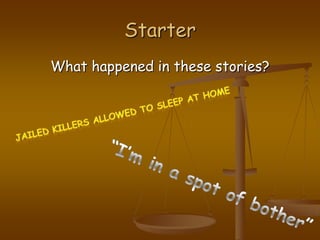
StarterWhat happened in these stories?Jailed killers allowed to sleep at home“I’m in a spot of bother”
PresentationsWatch the presentations and make your own notes on any areas you are unsure of.
Create an ActIn your group create an Act based on one of the following:Stop any form of animal crueltyEveryone must trade their car in for an electric carAll food that children are given must be healthyWhen you go on holiday you must know about the culture
Create an ActSwap your Act with another group.Highlight any problems which may occur from the Act you now have.Why would there be problems?How could these be rectified?
The 3 rulesLiteralGoldenMischief“Purposive approach”
LiteralGiving words their plain, ordinary, dictionary meaning.Pinner v Everett (1969)Lord Reid referred to “the natural and ordinary meaning of that word or phrase in its context”The rule developed in the 19th century in response to the fact that Parliament rather than the monarch was now the sovereign body in the UK
LiteralInland Revenue Commissioners v Ayrshire Employers Mutual Insurance Association Ltd (1946)Viscount Simmonds made it clear, even though the language used by Parliament failed to achieve its apparent purpose, “I must decline to insert words which might succeed where the draftsman failed”
LiteralMagor and St Mellons RDC v Newport Corporation (1952)Viscount Simmonds argued that for judges to change the wording of statutes would be a “naked usurpation of the legislative function”
LiteralDuport Steels Ltd v Sirs (1980)Lord Diplock said that “where the meaning of statutory words is clear and unambiguous, it is not for the judges to invent fancied ambiguities as an excuse for failing to give effect to its plain meaning because they themselves consider the consequences of doing so would be inexpedient, or even unjust or immoral”
LiteralNorthman v London Borough of Barnet (1978)Although Lord Denning said “the literal method is now completely out of date”, the literal rule is still used by judges.
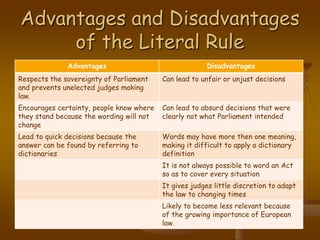
Advantages and Disadvantages of the Literal Rule
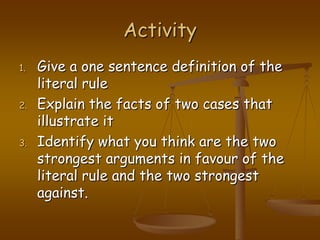
ActivityGive a one sentence definition of the literal ruleExplain the facts of two cases that illustrate itIdentify what you think are the two strongest arguments in favour of the literal rule and the two strongest against.
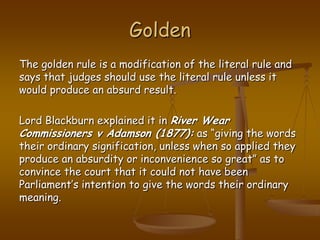
GoldenThe golden rule is a modification of the literal rule and says that judges should use the literal rule unless it would produce an absurd result.Lord Blackburn explained it in River Wear Commissioners v Adamson (1877): as “giving the words their ordinary signification, unless when so applied they produce an absurdity or inconvenience so great” as to convince the court that it could not have been Parliament’s intention to give the words their ordinary meaning.
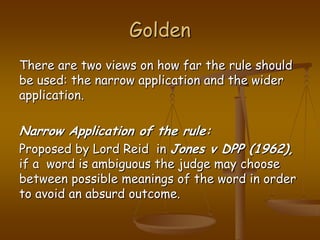
GoldenThere are two views on how far the rule should be used: the narrow application and the wider application.Narrow Application of the rule:Proposed by Lord Reid  in Jones v DPP (1962), if a  word is ambiguous the judge may choose between possible meanings of the word in order to avoid an absurd outcome.
GoldenR v Allen (1872)Section 57 of the Offences Against the Person Act 1861 stated that:“Whosoever being married shall marry any other person during the life of the former husband or wife ... shall be guilty of bigamy” It was impossible for a person already married to “marry” someone else – they might go through a marriage ceremony, but would not actually be married. Using the literal rule would make the statute useless. The courts there held that “shall marry” should be interpreted to mean “shall go though a marriage ceremony”
GoldenWider application of the rule:Where there is only one meaning, but this would lead to an absurd or repugnant situation, which for policy reasons would be unacceptable.Re Sigsworth (1935)Under the Administration of Estates Act 1925, the property of a person who died without making a will would pass to his or her next of kin.In this case, Sigsworth had murdered his mother.
GoldenAdler v George (1964)S.3 of the Official Secrets Act 1920 made it an offence to be found “in the vicinity of a prohibited place”. The accused was arrested in the inside the prohibited place; therefore, he argued he could not be convicted. It was clearly both repugnant and absurd that the offence could be committed by causing an obstruction in the vicinity of a prohibited place but not within the place itself.
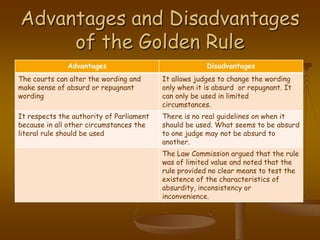
Advantages and Disadvantages of the Golden Rule
ActivityExplain the narrow explanation of the golden ruleName a case and explain how it fits the definitionExplain the wider application of the golden ruleName a case and explain how it fits the definitionIdentify two advantages of the golden rule
PlenarySummarise this lesson in 5 sentencesNow reduce to 5 wordsNow to 1 word

Statutory Interpretation 2

  • 1.
  • 2.
    ObjectivesTo understand howdifficult it is to write an Act of Parliament without causing confusionTo understand how the 3 rules of interpretation were createdTo understand what is meant by a presumption
  • 3.
    StarterWhat happened inthese stories?Jailed killers allowed to sleep at home“I’m in a spot of bother”
  • 4.
    PresentationsWatch the presentationsand make your own notes on any areas you are unsure of.
  • 5.
    Create an ActInyour group create an Act based on one of the following:Stop any form of animal crueltyEveryone must trade their car in for an electric carAll food that children are given must be healthyWhen you go on holiday you must know about the culture
  • 6.
    Create an ActSwapyour Act with another group.Highlight any problems which may occur from the Act you now have.Why would there be problems?How could these be rectified?
  • 7.
  • 8.
    LiteralGiving words theirplain, ordinary, dictionary meaning.Pinner v Everett (1969)Lord Reid referred to “the natural and ordinary meaning of that word or phrase in its context”The rule developed in the 19th century in response to the fact that Parliament rather than the monarch was now the sovereign body in the UK
  • 9.
    LiteralInland Revenue Commissionersv Ayrshire Employers Mutual Insurance Association Ltd (1946)Viscount Simmonds made it clear, even though the language used by Parliament failed to achieve its apparent purpose, “I must decline to insert words which might succeed where the draftsman failed”
  • 10.
    LiteralMagor and StMellons RDC v Newport Corporation (1952)Viscount Simmonds argued that for judges to change the wording of statutes would be a “naked usurpation of the legislative function”
  • 11.
    LiteralDuport Steels Ltdv Sirs (1980)Lord Diplock said that “where the meaning of statutory words is clear and unambiguous, it is not for the judges to invent fancied ambiguities as an excuse for failing to give effect to its plain meaning because they themselves consider the consequences of doing so would be inexpedient, or even unjust or immoral”
  • 12.
    LiteralNorthman v LondonBorough of Barnet (1978)Although Lord Denning said “the literal method is now completely out of date”, the literal rule is still used by judges.
  • 13.
    Advantages and Disadvantagesof the Literal Rule
  • 14.
    ActivityGive a onesentence definition of the literal ruleExplain the facts of two cases that illustrate itIdentify what you think are the two strongest arguments in favour of the literal rule and the two strongest against.
  • 15.
    GoldenThe golden ruleis a modification of the literal rule and says that judges should use the literal rule unless it would produce an absurd result.Lord Blackburn explained it in River Wear Commissioners v Adamson (1877): as “giving the words their ordinary signification, unless when so applied they produce an absurdity or inconvenience so great” as to convince the court that it could not have been Parliament’s intention to give the words their ordinary meaning.
  • 16.
    GoldenThere are twoviews on how far the rule should be used: the narrow application and the wider application.Narrow Application of the rule:Proposed by Lord Reid in Jones v DPP (1962), if a word is ambiguous the judge may choose between possible meanings of the word in order to avoid an absurd outcome.
  • 17.
    GoldenR v Allen(1872)Section 57 of the Offences Against the Person Act 1861 stated that:“Whosoever being married shall marry any other person during the life of the former husband or wife ... shall be guilty of bigamy” It was impossible for a person already married to “marry” someone else – they might go through a marriage ceremony, but would not actually be married. Using the literal rule would make the statute useless. The courts there held that “shall marry” should be interpreted to mean “shall go though a marriage ceremony”
  • 18.
    GoldenWider application ofthe rule:Where there is only one meaning, but this would lead to an absurd or repugnant situation, which for policy reasons would be unacceptable.Re Sigsworth (1935)Under the Administration of Estates Act 1925, the property of a person who died without making a will would pass to his or her next of kin.In this case, Sigsworth had murdered his mother.
  • 19.
    GoldenAdler v George(1964)S.3 of the Official Secrets Act 1920 made it an offence to be found “in the vicinity of a prohibited place”. The accused was arrested in the inside the prohibited place; therefore, he argued he could not be convicted. It was clearly both repugnant and absurd that the offence could be committed by causing an obstruction in the vicinity of a prohibited place but not within the place itself.
  • 20.
  • 21.
    ActivityExplain the narrowexplanation of the golden ruleName a case and explain how it fits the definitionExplain the wider application of the golden ruleName a case and explain how it fits the definitionIdentify two advantages of the golden rule
  • 22.
    PlenarySummarise this lessonin 5 sentencesNow reduce to 5 wordsNow to 1 word