MONOPOLY
Features of Monopoly Single seller of an unique product No close substitutes Price Maker- firm has control over price Barriers to entry
Why monopolies arise? Barriers to entry are restrictions on the entry of new firms into an industry Legal restrictions-licenses and patents Economies of scale Control of an essential resource- De-beers owns most of the diamond mines Natural monopolies
NATURAL MONOPOLIES A monopoly sometimes emerges naturally when a firm experiences economies of scale as reflected by the downward-sloping, long-run average cost curve  In these situations, a single firm can sometimes supply market demand at a lower average cost per unit than could two or more firms at smaller rates of output
The monopolist can choose either the price or the quantity, but choosing one determines the other Because the monopolist can select the price that maximizes profit, we say the monopolist is a  price maker More generally, any firm that has some control over what price to charge is a price maker
Competition vs monopoly: Monopoly Is the sole producer Faces a downward sloping demand curve Is a price maker Reduces price to increase sales Competition Many producers Faces a horizontal demand curve Is a price taker Sales cannot affect price
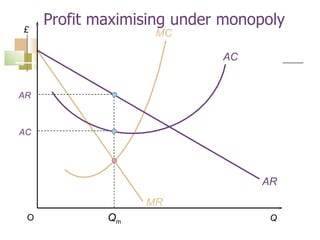
Profit maximization for a monopolist: The demand curve for the monopolist is downward sloping The marginal revenue curve is below the demand curve The monopolist maximizes profit by producing the quantity at which marginal revenue equals marginal cost It then finds uses the demand curve to find the price at which the consumers will buy that commodity
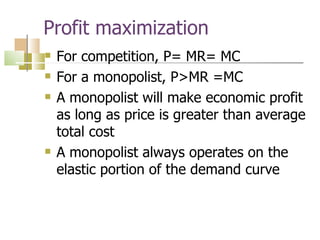
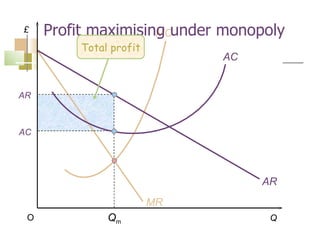
Profit maximization For competition, P= MR= MC For a monopolist, P>MR =MC A monopolist will make economic profit as long as price is greater than average total cost A monopolist always operates on the elastic portion of the demand curve
Profit maximising under monopoly £  Q  O MC   Q m MR AC AR  AC  AR
Profit maximising under monopoly £  Q  O MC   Q m MR AC AR  AC  AR Total profit
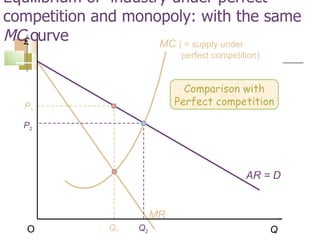
Equilibrium of  industry under perfect competition and monopoly: with the same  MC  curve £  Q  O MC  ( = supply under  perfect competition) Q 1 MR P 1 Q 2 AR = D Comparison with Perfect competition P 2
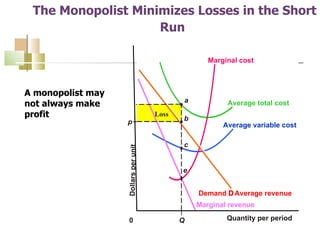
The Monopolist Minimizes Losses in the Short Run   p Marginal cost Average total cost Average variable cost Demand    Average revenue Marginal revenue 0  Q e c b a Loss Quantity per period Dollars per unit A monopolist may not always make profit
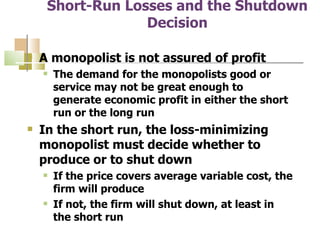
Short-Run Losses and the Shutdown Decision A monopolist is not assured of profit  The demand for the monopolists good or service may not be great enough to generate economic profit in either the short run or the long run In the short run, the loss-minimizing monopolist must decide whether to produce or to shut down If the price covers average variable cost, the firm will produce If not, the firm will shut down, at least in the short run
Monopolist’s Supply Curve The intersection of a monopolist’s marginal revenue and marginal cost curve identifies the profit maximizing quantity, but the price is found on the demand curve Thus, there is no curve that shows both price and quantity supplied    there is no  monopolist supply curve
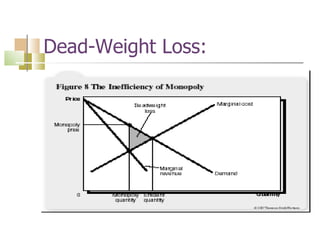
Dead Weight Loss: Since a monopolist sets its price above the marginal cost, the high price makes monopoly undesirable. The monopolist produces a level of output less than the socially efficient level output The welfare effect of a monopoly is similar to a tax, except that the government gets revenue from the tax whereas the private firm gets the monopoly profit
Dead-Weight Loss:
Price Discrimination Price Discrimination is the business practice of selling the same good at different prices to different customers even though the cost of producing for the two customers is the same Price discrimination is of three degrees: First degree or perfect price discrimination Second degree or block pricing Third degree price discrimination
First-degree :  the firm is aware of each buyer’s demand curve Second-degree :  the firm charges a different price, depending on the quantity each buyer purchases Third-degree :  the firm breaks buyers into groups based upon their price elasticity of demand Types of price discrimination
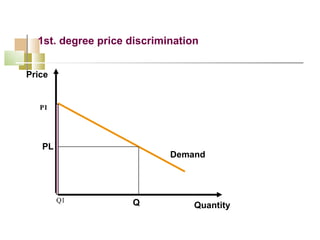
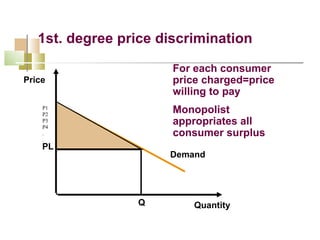
Perfect Price Discrimination refers to the situation when the monopolist knows exactly the willingness to pay of each customer and can charge  a different price for each unit sold. In reality perfect price discrimination is not possible . Block pricing refers to charging a different price for different ranges of quantity sold.
First Degree Price Discrimination (Perfect Price Discrimination) Each consumer is charged the price he/she is willing to pay. Producer takes all the consumer surplus
1st. degree price discrimination Price Quantity Demand PL Q P1 Q1
1st. degree price discrimination Price Quantity Demand PL Q For each consumer  price charged=price willing to pay Monopolist appropriates all consumer surplus P1 P2 P3 P4 . .
2nd Degree Price Discrimination (non - linear pricing) Different price is charged for a different quantity bought (but not across consumers). set one price for a 1st bundle, a lower price for a 2nd bundle, .... extract some, but not all of consumer surplus Note: In 3rd deg case=>different prices charged for different consumers In 2nd deg case=>different prices charged for different quantities (for same consumer)
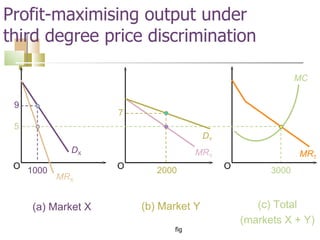
Profit-maximising output under third degree price discrimination fig O O O MR X MR Y MR T MC D Y 5 7 1000 2000 3000 (a) Market X (b) Market Y (c) Total (markets X + Y) 9 D X
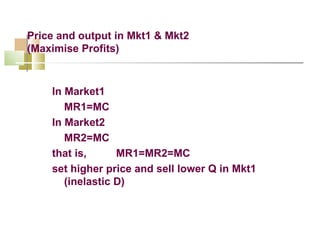
Price and output in Mkt1 & Mkt2 (Maximise Profits) In Market1 MR1=MC In Market2 MR2=MC that is,  MR1=MR2=MC set higher price and sell lower Q in Mkt1 (inelastic D)

Monoply revised

  • 1.
  • 2.
    Features of MonopolySingle seller of an unique product No close substitutes Price Maker- firm has control over price Barriers to entry
  • 3.
    Why monopolies arise?Barriers to entry are restrictions on the entry of new firms into an industry Legal restrictions-licenses and patents Economies of scale Control of an essential resource- De-beers owns most of the diamond mines Natural monopolies
  • 4.
    NATURAL MONOPOLIES Amonopoly sometimes emerges naturally when a firm experiences economies of scale as reflected by the downward-sloping, long-run average cost curve In these situations, a single firm can sometimes supply market demand at a lower average cost per unit than could two or more firms at smaller rates of output
  • 5.
    The monopolist canchoose either the price or the quantity, but choosing one determines the other Because the monopolist can select the price that maximizes profit, we say the monopolist is a price maker More generally, any firm that has some control over what price to charge is a price maker
  • 6.
    Competition vs monopoly:Monopoly Is the sole producer Faces a downward sloping demand curve Is a price maker Reduces price to increase sales Competition Many producers Faces a horizontal demand curve Is a price taker Sales cannot affect price
  • 7.
    Profit maximization fora monopolist: The demand curve for the monopolist is downward sloping The marginal revenue curve is below the demand curve The monopolist maximizes profit by producing the quantity at which marginal revenue equals marginal cost It then finds uses the demand curve to find the price at which the consumers will buy that commodity
  • 8.
    Profit maximization Forcompetition, P= MR= MC For a monopolist, P>MR =MC A monopolist will make economic profit as long as price is greater than average total cost A monopolist always operates on the elastic portion of the demand curve
  • 9.
    Profit maximising undermonopoly £ Q O MC Q m MR AC AR AC AR
  • 10.
    Profit maximising undermonopoly £ Q O MC Q m MR AC AR AC AR Total profit
  • 11.
    Equilibrium of industry under perfect competition and monopoly: with the same MC curve £ Q O MC ( = supply under perfect competition) Q 1 MR P 1 Q 2 AR = D Comparison with Perfect competition P 2
  • 12.
    The Monopolist MinimizesLosses in the Short Run p Marginal cost Average total cost Average variable cost Demand  Average revenue Marginal revenue 0 Q e c b a Loss Quantity per period Dollars per unit A monopolist may not always make profit
  • 13.
    Short-Run Losses andthe Shutdown Decision A monopolist is not assured of profit The demand for the monopolists good or service may not be great enough to generate economic profit in either the short run or the long run In the short run, the loss-minimizing monopolist must decide whether to produce or to shut down If the price covers average variable cost, the firm will produce If not, the firm will shut down, at least in the short run
  • 14.
    Monopolist’s Supply CurveThe intersection of a monopolist’s marginal revenue and marginal cost curve identifies the profit maximizing quantity, but the price is found on the demand curve Thus, there is no curve that shows both price and quantity supplied  there is no monopolist supply curve
  • 15.
    Dead Weight Loss:Since a monopolist sets its price above the marginal cost, the high price makes monopoly undesirable. The monopolist produces a level of output less than the socially efficient level output The welfare effect of a monopoly is similar to a tax, except that the government gets revenue from the tax whereas the private firm gets the monopoly profit
  • 16.
  • 17.
    Price Discrimination PriceDiscrimination is the business practice of selling the same good at different prices to different customers even though the cost of producing for the two customers is the same Price discrimination is of three degrees: First degree or perfect price discrimination Second degree or block pricing Third degree price discrimination
  • 18.
    First-degree : the firm is aware of each buyer’s demand curve Second-degree : the firm charges a different price, depending on the quantity each buyer purchases Third-degree : the firm breaks buyers into groups based upon their price elasticity of demand Types of price discrimination
  • 19.
    Perfect Price Discriminationrefers to the situation when the monopolist knows exactly the willingness to pay of each customer and can charge a different price for each unit sold. In reality perfect price discrimination is not possible . Block pricing refers to charging a different price for different ranges of quantity sold.
  • 20.
    First Degree PriceDiscrimination (Perfect Price Discrimination) Each consumer is charged the price he/she is willing to pay. Producer takes all the consumer surplus
  • 21.
    1st. degree pricediscrimination Price Quantity Demand PL Q P1 Q1
  • 22.
    1st. degree pricediscrimination Price Quantity Demand PL Q For each consumer price charged=price willing to pay Monopolist appropriates all consumer surplus P1 P2 P3 P4 . .
  • 23.
    2nd Degree PriceDiscrimination (non - linear pricing) Different price is charged for a different quantity bought (but not across consumers). set one price for a 1st bundle, a lower price for a 2nd bundle, .... extract some, but not all of consumer surplus Note: In 3rd deg case=>different prices charged for different consumers In 2nd deg case=>different prices charged for different quantities (for same consumer)
  • 24.
    Profit-maximising output underthird degree price discrimination fig O O O MR X MR Y MR T MC D Y 5 7 1000 2000 3000 (a) Market X (b) Market Y (c) Total (markets X + Y) 9 D X
  • 25.
    Price and outputin Mkt1 & Mkt2 (Maximise Profits) In Market1 MR1=MC In Market2 MR2=MC that is, MR1=MR2=MC set higher price and sell lower Q in Mkt1 (inelastic D)