Consumer equilibrium refers to a situation where a consumer spends their income on purchasing goods in a way that maximizes their satisfaction. It occurs where the marginal utility per rupee spent equals the price, or where the marginal rate of substitution between goods equals the ratio of their prices. This happens at the point where the budget line that shows all affordable combinations of goods is tangent to the highest possible indifference curve on the indifference map, representing the consumer's preferred combinations.
Total Utility
Thetotal satisfaction a consumer gets from a
given commodity /service
or
Sum of marginal utility is known as total utility
4.
Marginal Utility
Anaddition made to total utility by consuming
an extra unit of commodity. Sum of marginal
utilities derived from various goods is known as
total utility.
5.
Relationship between MUand TU:
i) When MU is positive TU rises.
ii) When MU is zero TU is maximum.
iii) When MU is negative, TU falls.
6.
Law of DiminishingMarginal
Utility
It states that as the consumer consumes more and
more units of a commodity , the marginal utility
derived from each successive units goes on
diminishing.
Demand for a commodity refers to the quantity
of a commodity which a consumer is willing to
buy at a given price in a given period of time.
7.
Consumer Equilibrium
Itrefers to a situation when he spends his given
income on purchase of a commodity ( or
commodities) in such a way that yields him
maximum satisfaction.
Budget Set
Itis the set of all possible combinations of the two
goods which a consumer can afford, given his income
and prices in the market.
11.
Budget line
:-It refers to all combinations of goods which a
consumer can buy with his entire income and
price of two goods.
Equation of Budget line
P1 X1 + P2 X2 = M
12.
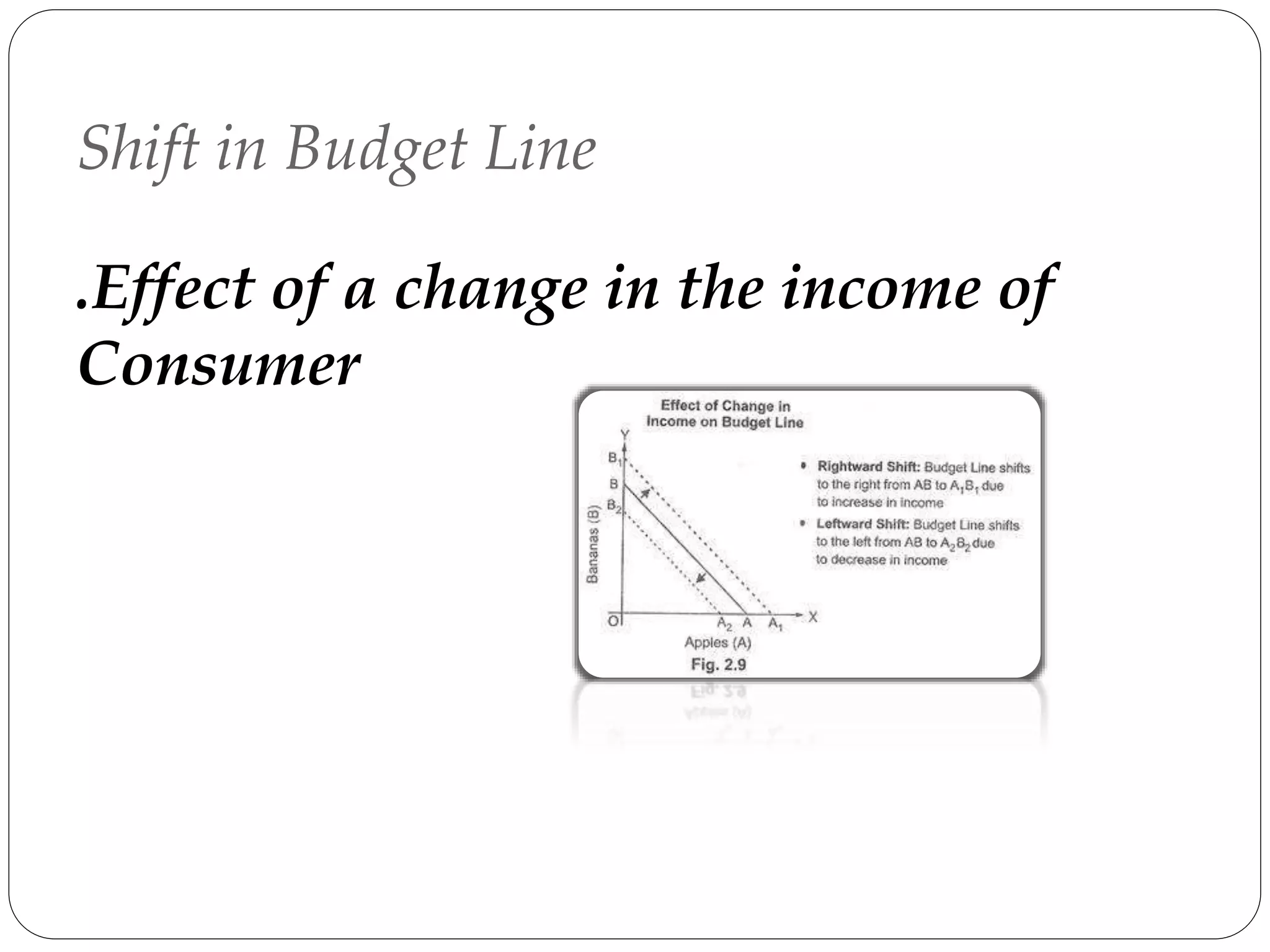
Shift in BudgetLine
.Effect of a change in the income of
Consumer
13.
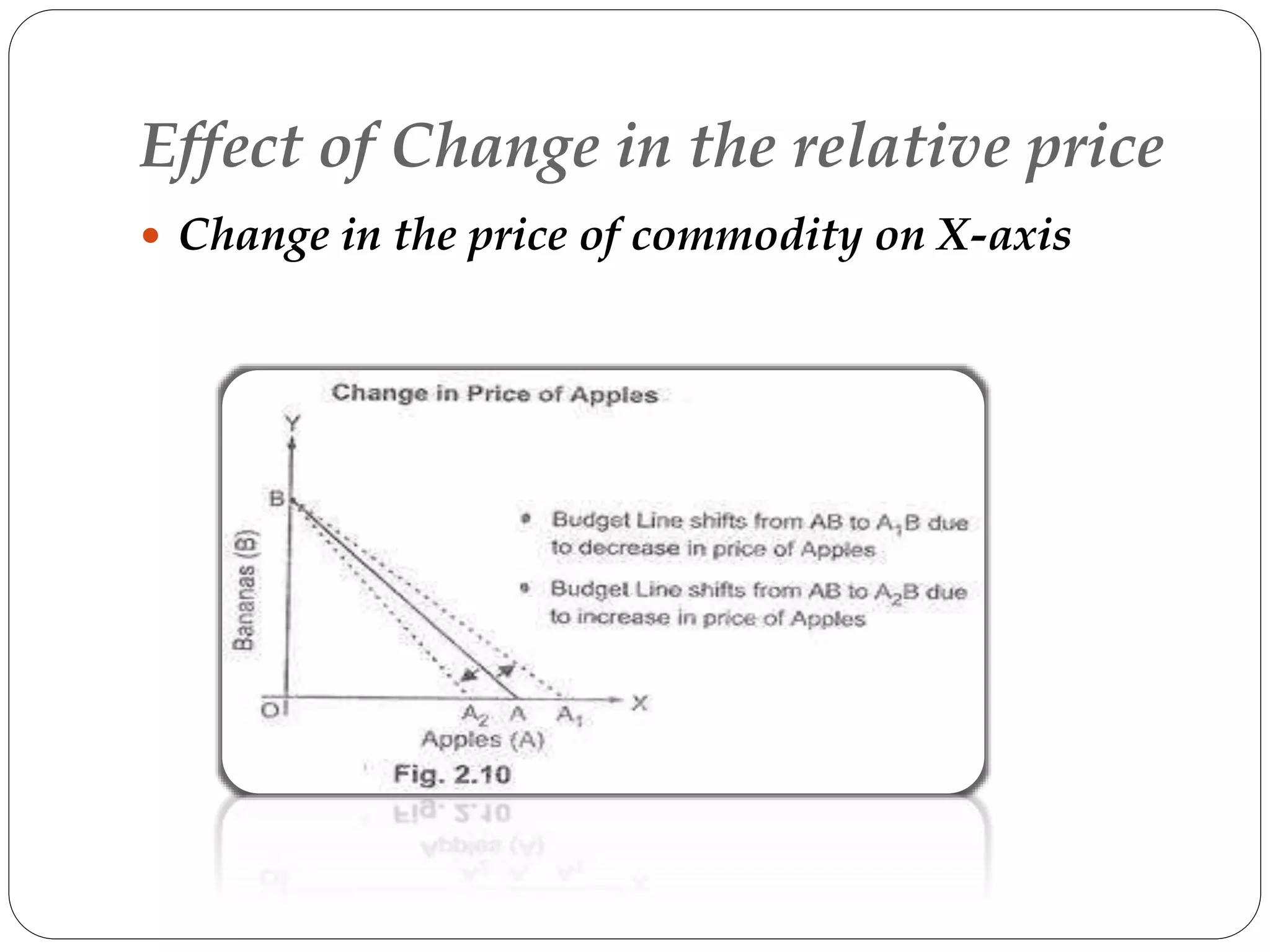
Effect of Changein the relative price
Change in the price of commodity on X-axis
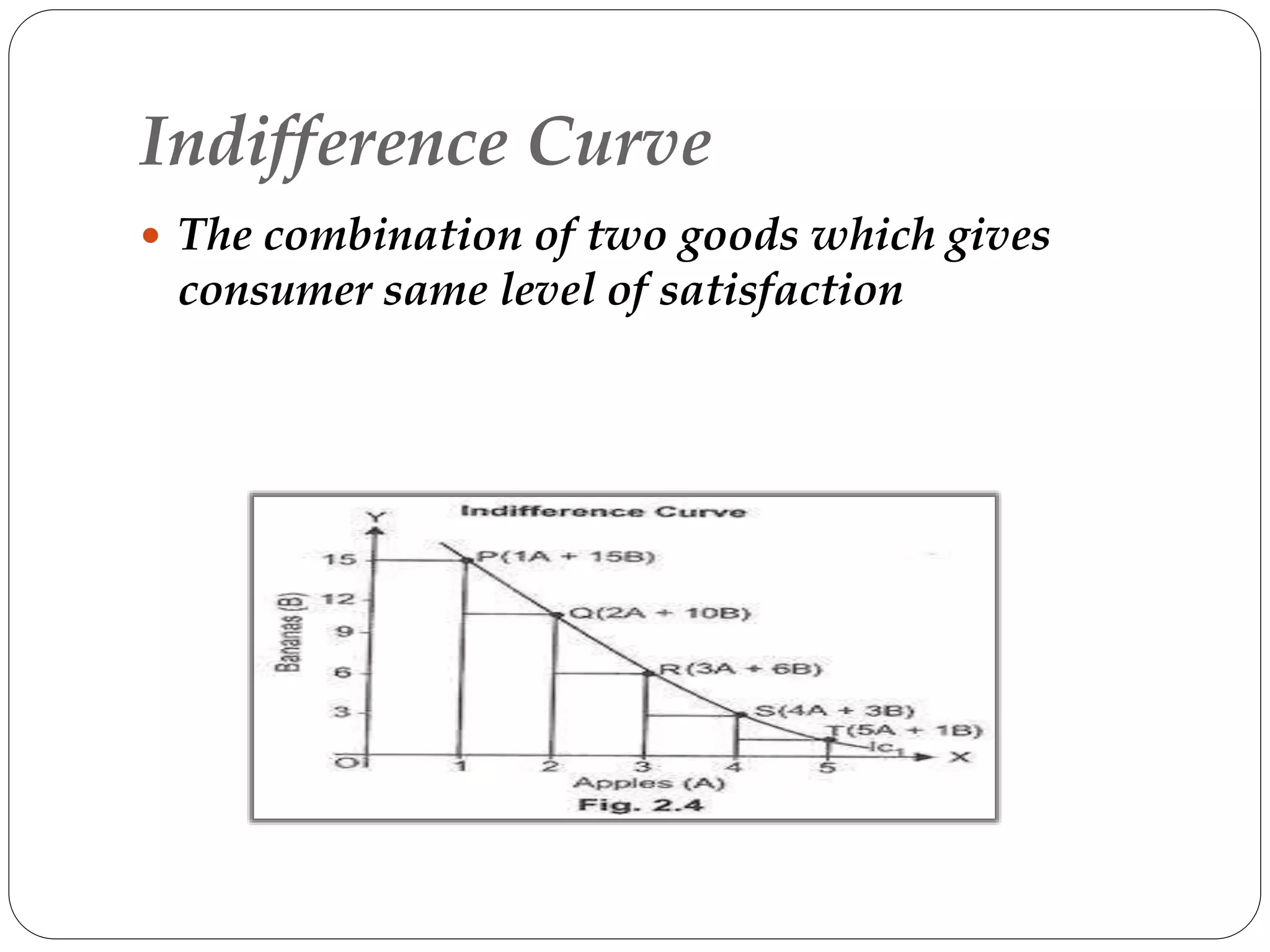
Indifference Curve
Thecombination of two goods which gives
consumer same level of satisfaction
16.
Properties of IC
It slopes downwards from left to right
It is always convex to the origin due to falling of
Marginal Rate of Substitution (MRS)
Higher IC always gives higher satisfaction
Two IC never intersect each other.
17.
Indifference Map
Groupof indifference curves that gives different
levels of satisfaction to the consumer
18.
Marginal Rate ofSubstitution
(MRS)
It is the rate at which a consumer is willing to give
up one good to get another good.
19.
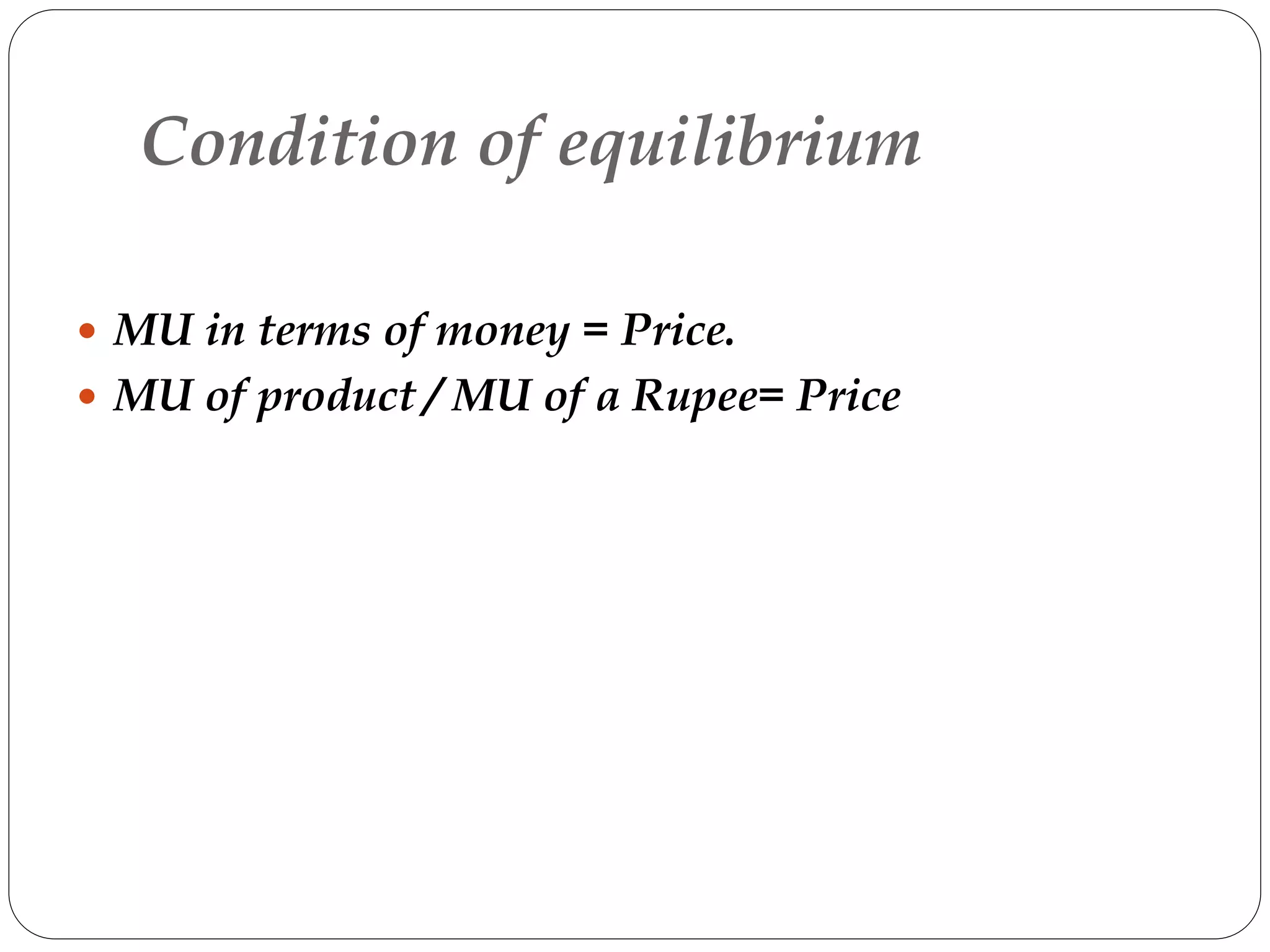
Consumer Equilibrium
Ata point where budget line is tangent to the
indifference curve, MRS = PX / PY ,
i.e., Marginal rate of substitution = ratio of
prices of two goods.
20.
Monotonic Preferences
Itmeans that a rational consumer always prefers
more of a commodity as it offers him a higher level
of satisfaction .
21.
Why MRS Diminishes
MRS falls because of the law of diminishing
marginal utility.