Presentation
Topic-
Theory of cost
Cost of production
In order to produce a good , every
firm , makes uses of factor of
production . The amount spent on the
use of factor of production is called
cost of production . Cost of production
mainly depend upon quantity of
production . Ordinarily ,cost of
production increases with increases in
output . It can therefore be said that
cost of production is a function of
quantity of output , i.e.,C=f(Q)
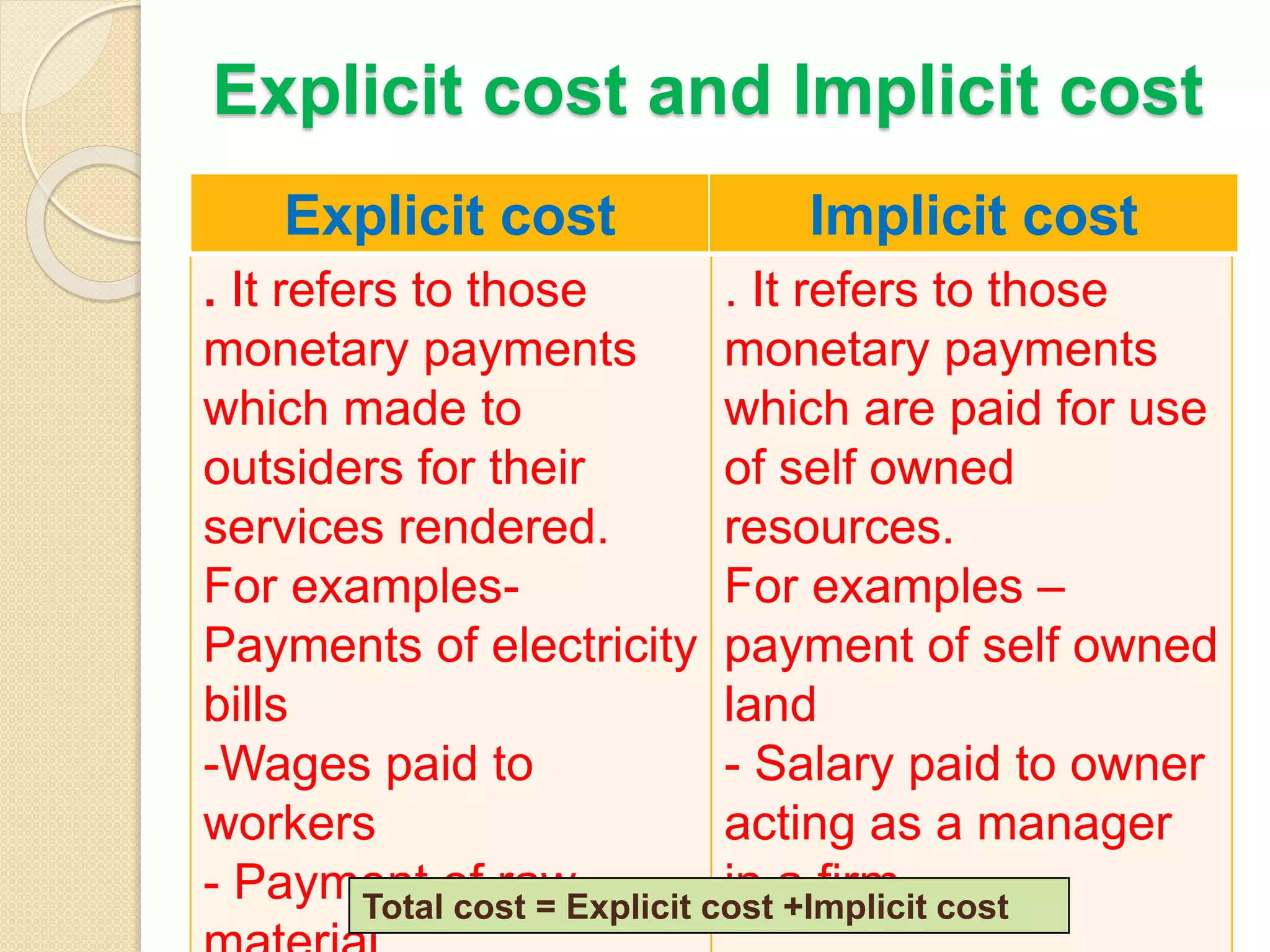
Explicit cost and Implicit cost
. It refers to those
monetary payments
which made to
outsiders for their
services rendered.
For examples-
Payments of electricity
bills
-Wages paid to
workers
- Payment of raw
mon
. It refers to those
monetary payments
which are paid for use
of self owned
resources.
For examples –
payment of self owned
land
- Salary paid to owner
acting as a manager
in a firm
Explicit cost Implicit cost
Total cost = Explicit cost +Implicit cost
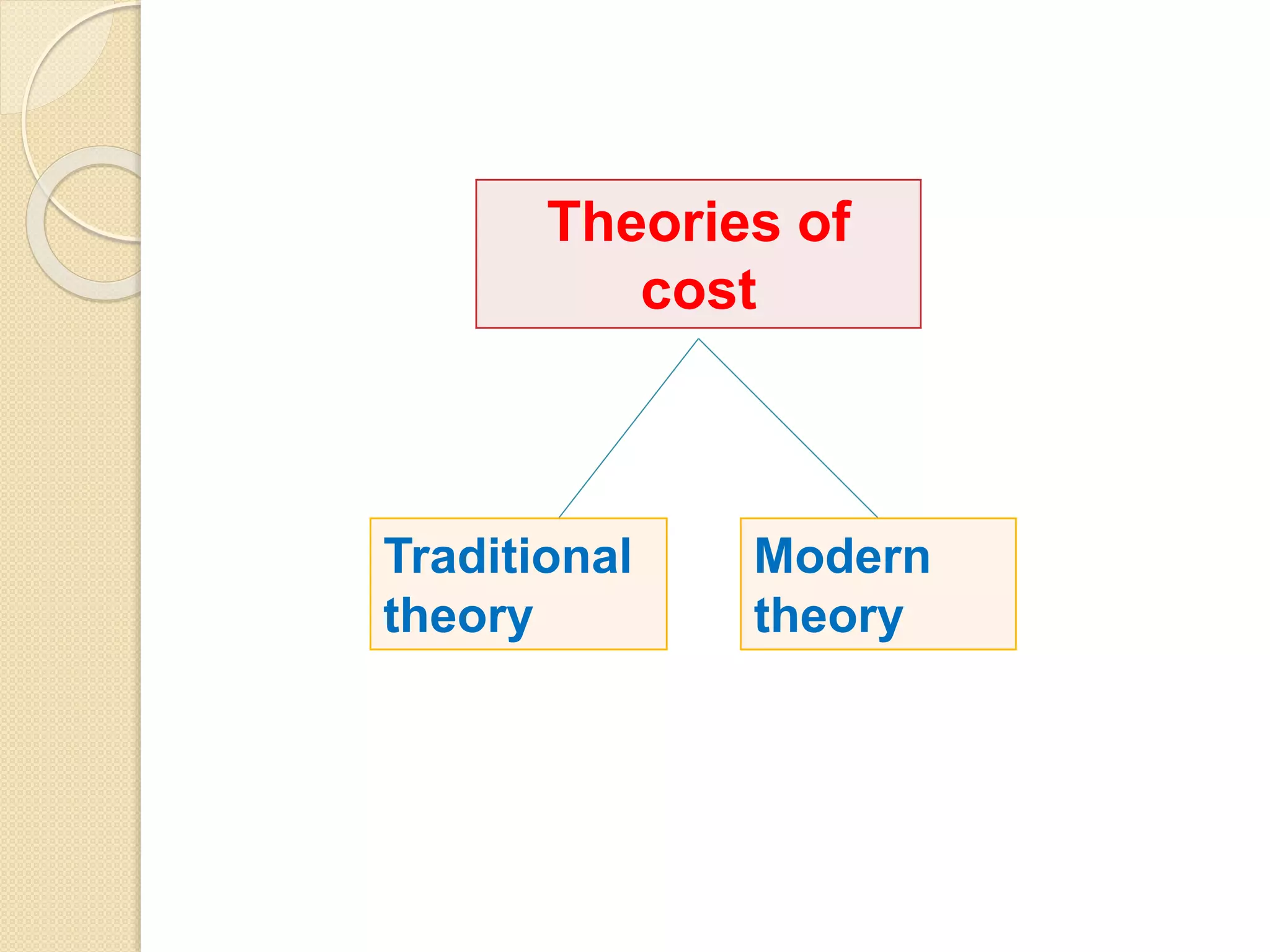
Theories of
cost
Traditional
theory
Modern
theory
Traditional Theory of Cost
 Under traditional theory, cost are
studied in two parts on the basis of
time-period: (i) Cost in short run
 (ii) Cost in the long run .
 Cost are mainly of three types :
 1. Total Cost
 2. Average Cost
 3.Marginal Cost
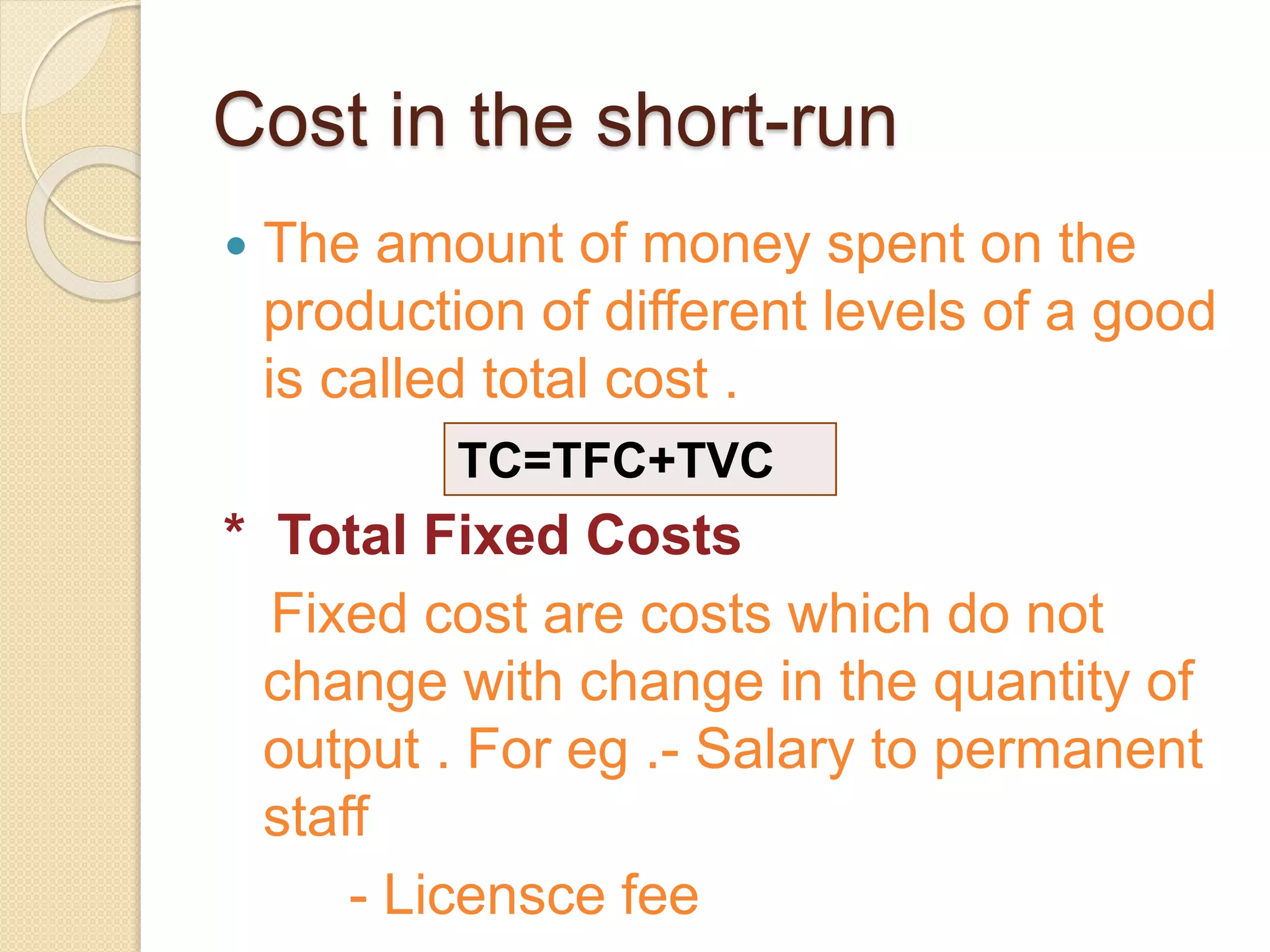
Cost in the short-run
 The amount of money spent on the
production of different levels of a good
is called total cost .
* Total Fixed Costs
Fixed cost are costs which do not
change with change in the quantity of
output . For eg .- Salary to permanent
staff
- Licensce fee
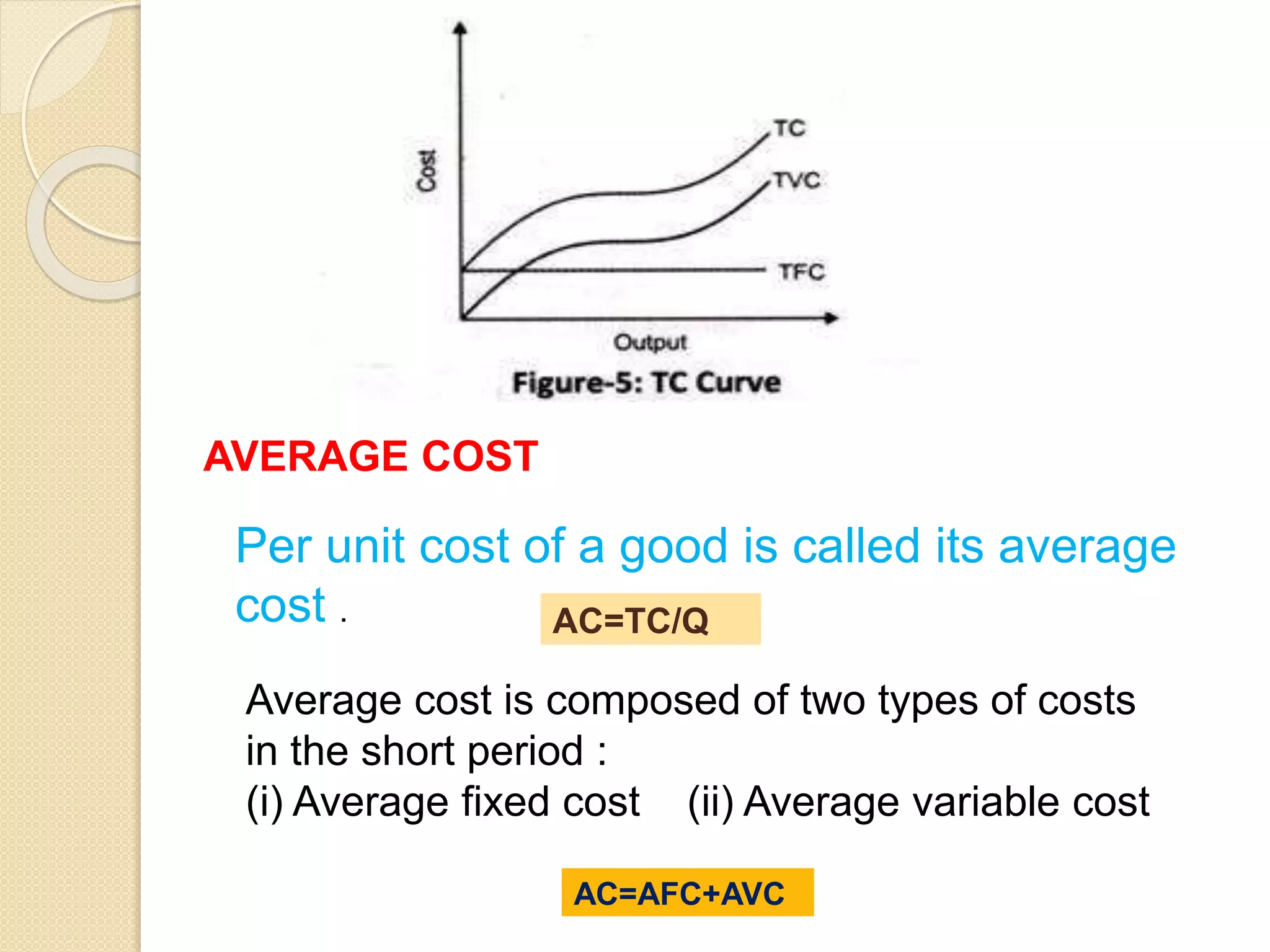
TC=TFC+TVC
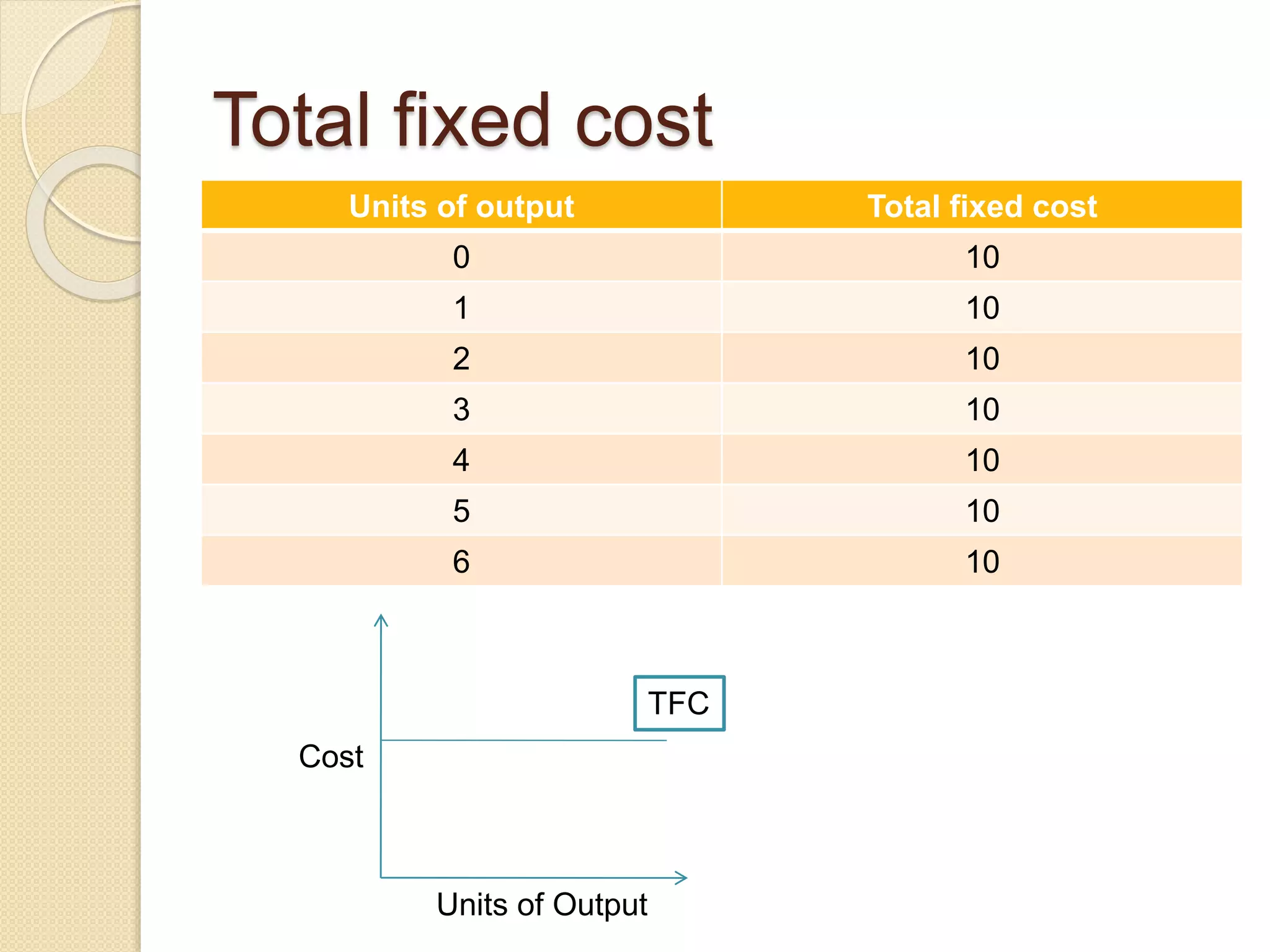
Total fixed cost
Units of output Total fixed cost
0 10
1 10
2 10
3 10
4 10
5 10
6 10
TFC
Cost
Units of Output
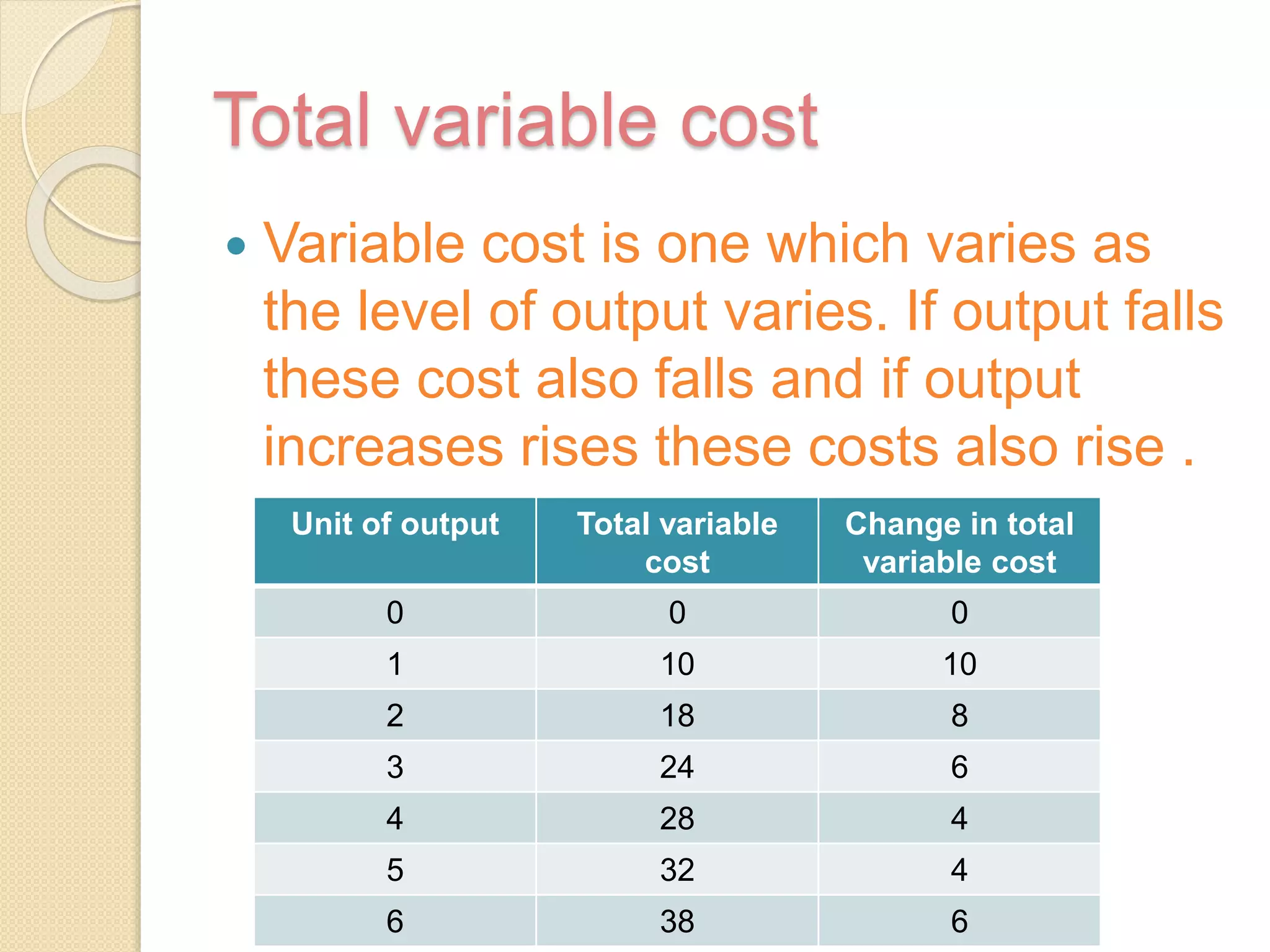
Total variable cost
 Variable cost is one which varies as
the level of output varies. If output falls
these cost also falls and if output
increases rises these costs also rise .
Unit of output Total variable
cost
Change in total
variable cost
0 0 0
1 10 10
2 18 8
3 24 6
4 28 4
5 32 4
6 38 6
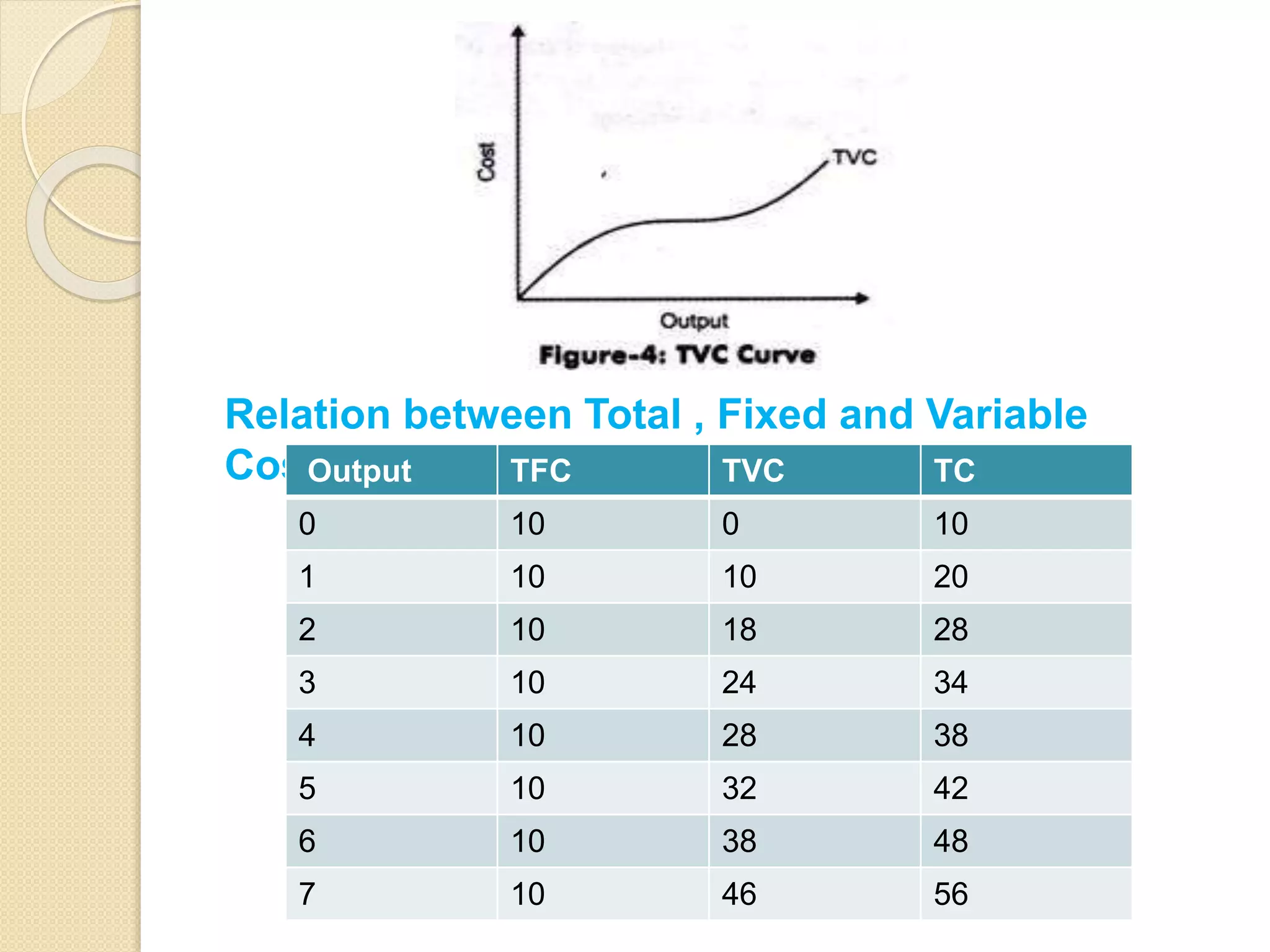
Relation between Total , Fixed and Variable
CostsOutput TFC TVC TC
0 10 0 10
1 10 10 20
2 10 18 28
3 10 24 34
4 10 28 38
5 10 32 42
6 10 38 48
7 10 46 56
AVERAGE COST
Per unit cost of a good is called its average
cost . AC=TC/Q
Average cost is composed of two types of costs
in the short period :
(i) Average fixed cost (ii) Average variable cost
AC=AFC+AVC
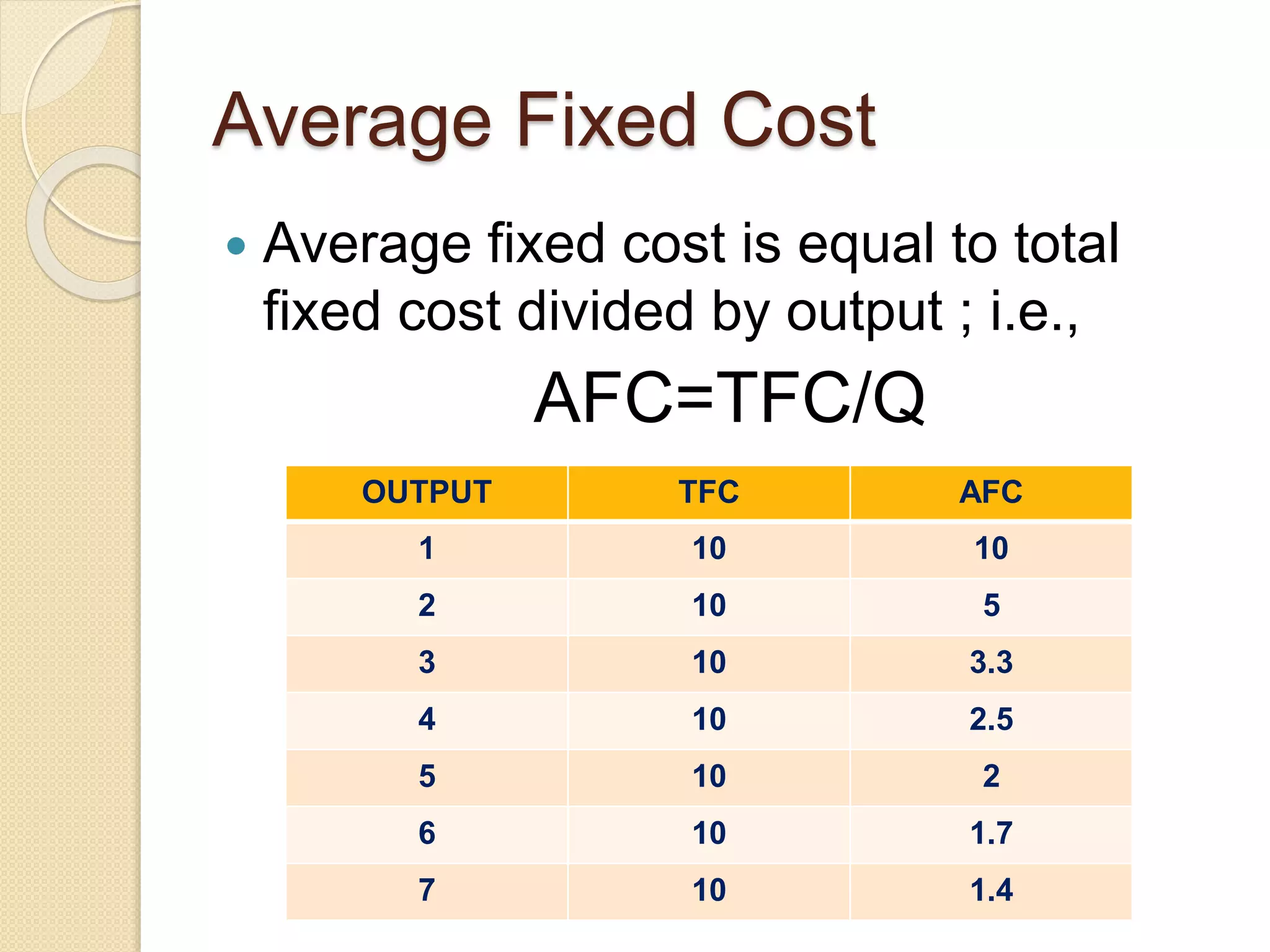
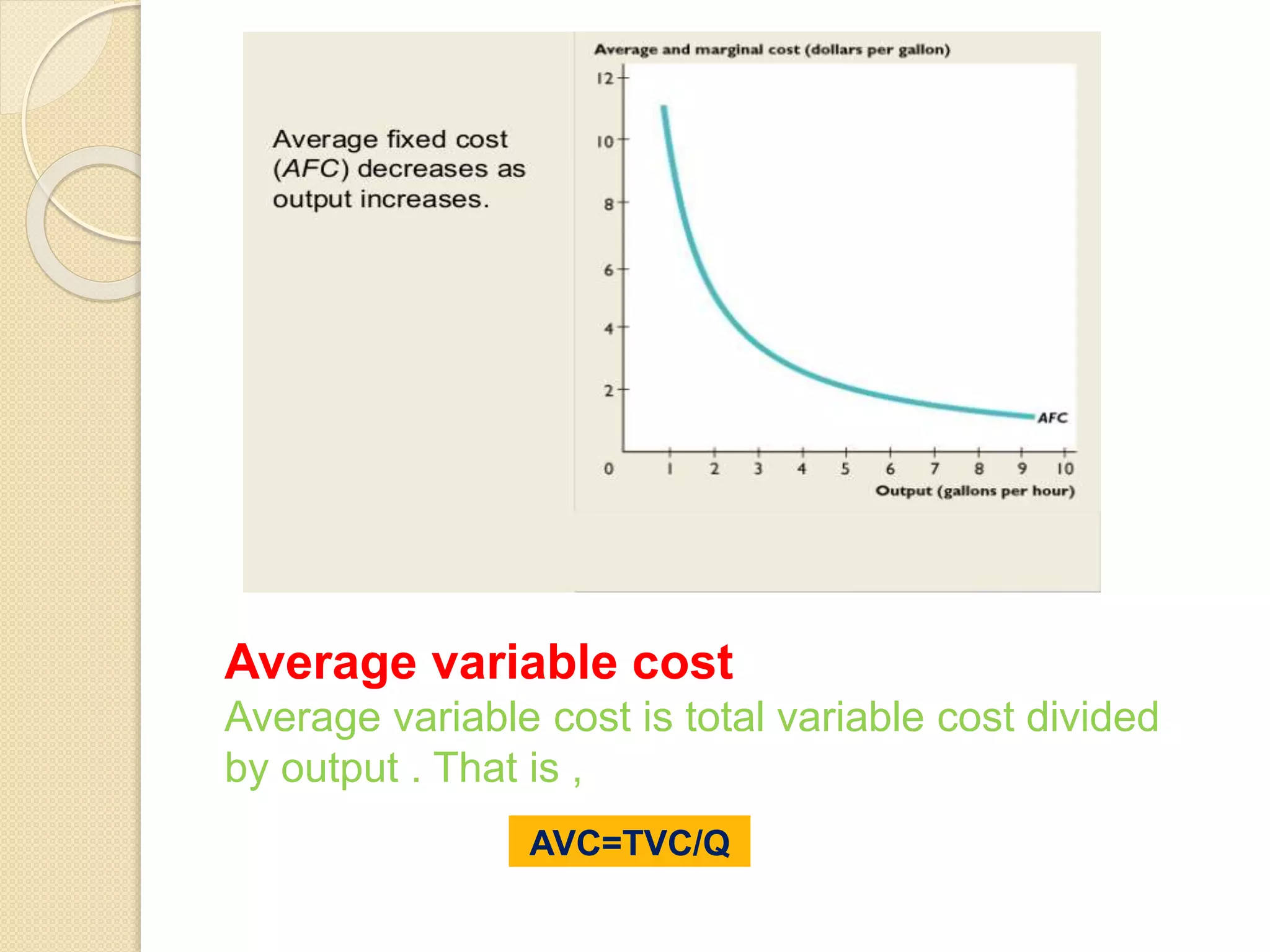
Average Fixed Cost
 Average fixed cost is equal to total
fixed cost divided by output ; i.e.,
AFC=TFC/Q
OUTPUT TFC AFC
1 10 10
2 10 5
3 10 3.3
4 10 2.5
5 10 2
6 10 1.7
7 10 1.4
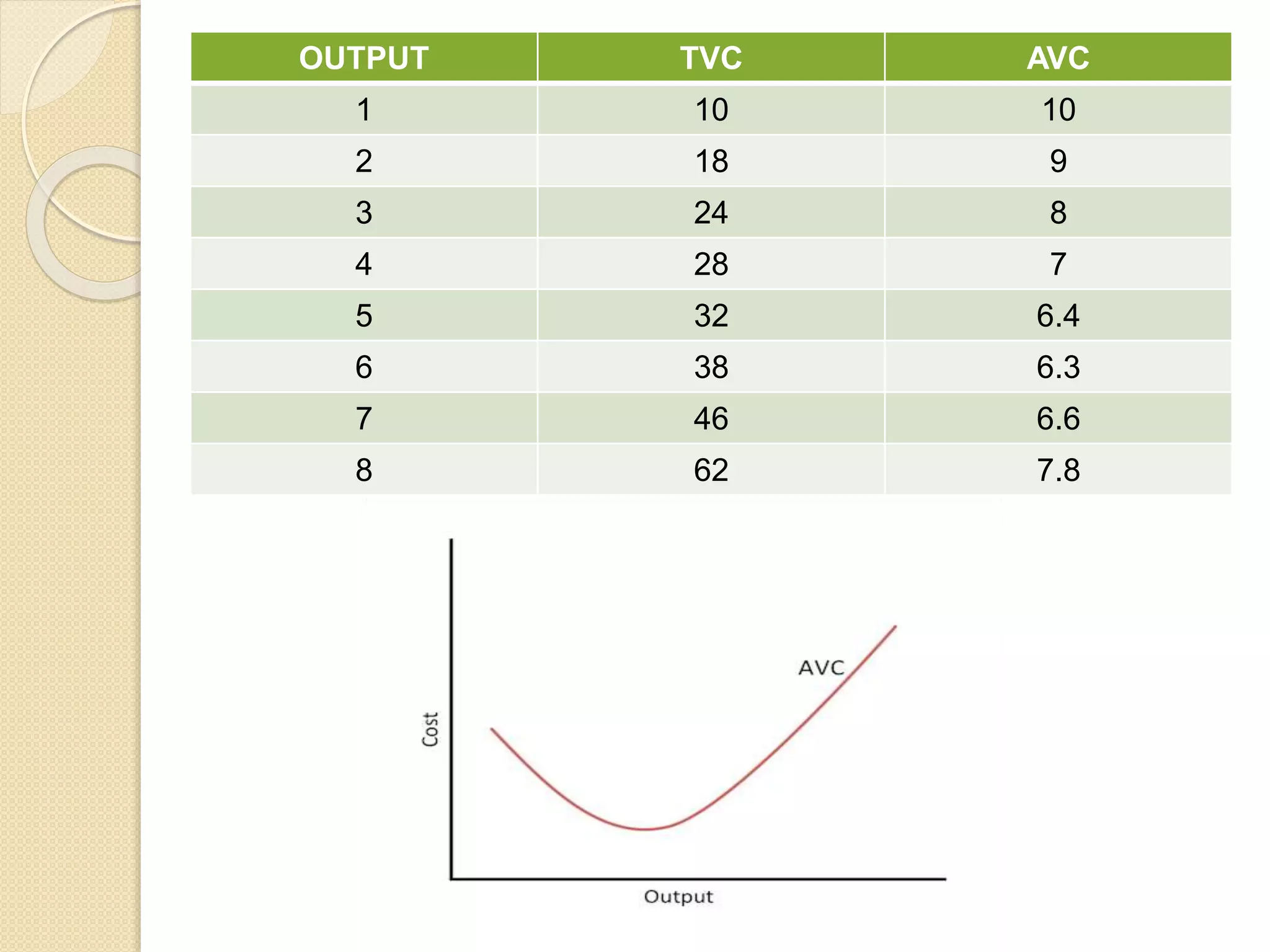
Average variable cost
Average variable cost is total variable cost divided
by output . That is ,
AVC=TVC/Q
OUTPUT TVC AVC
1 10 10
2 18 9
3 24 8
4 28 7
5 32 6.4
6 38 6.3
7 46 6.6
8 62 7.8
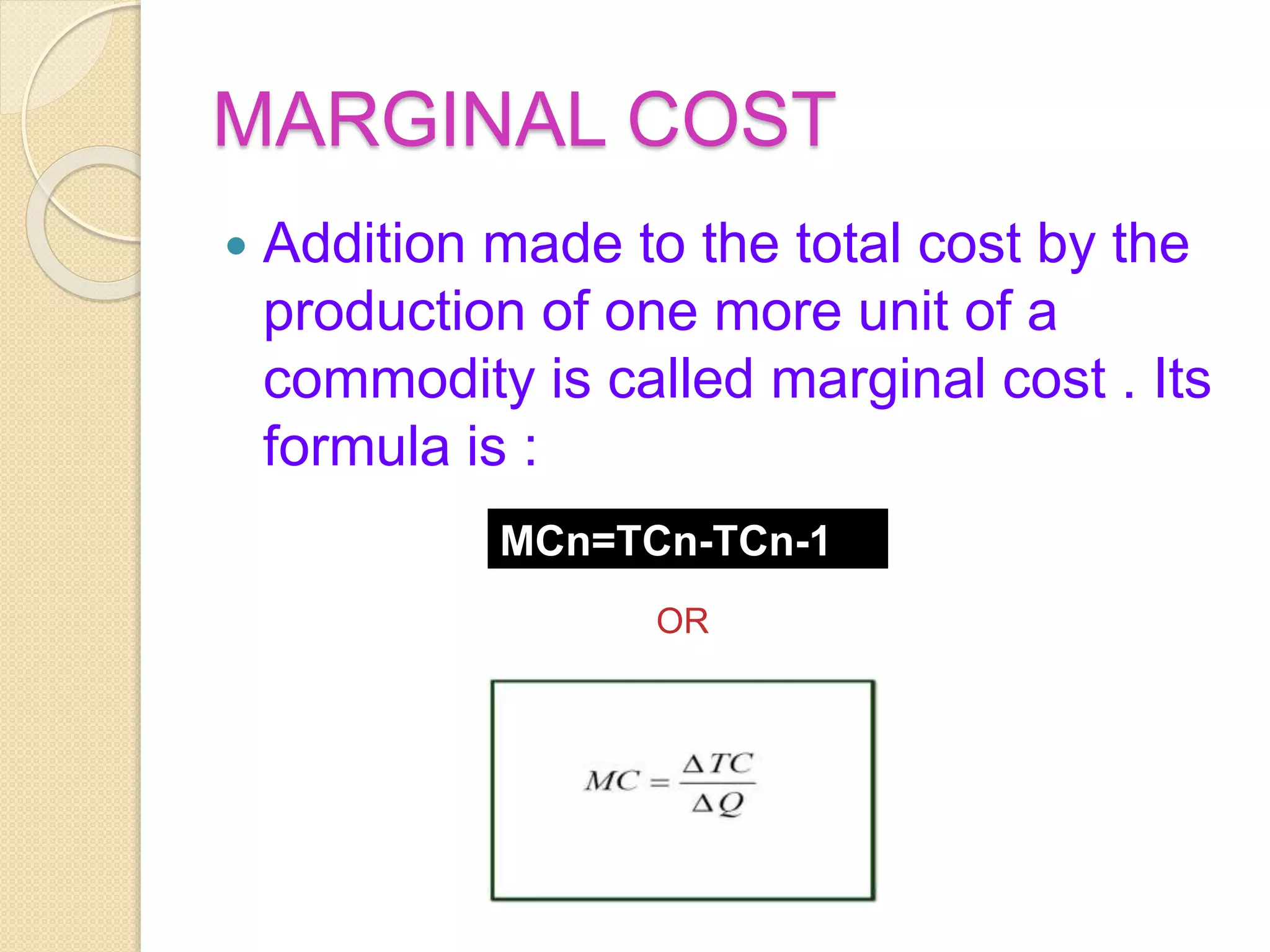
MARGINAL COST
 Addition made to the total cost by the
production of one more unit of a
commodity is called marginal cost . Its
formula is :
MCn=TCn-TCn-1
OR
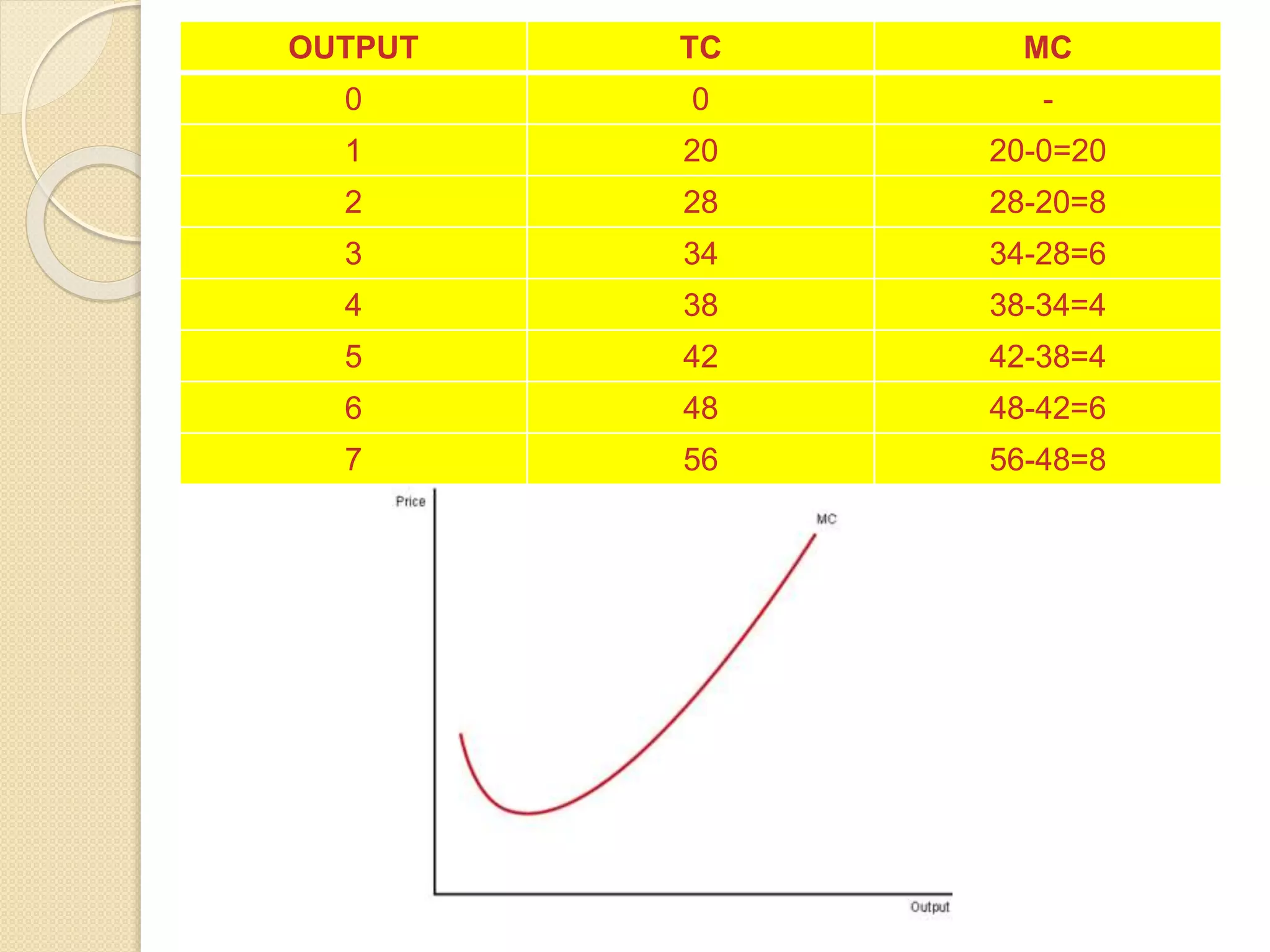
OUTPUT TC MC
0 0 -
1 20 20-0=20
2 28 28-20=8
3 34 34-28=6
4 38 38-34=4
5 42 42-38=4
6 48 48-42=6
7 56 56-48=8
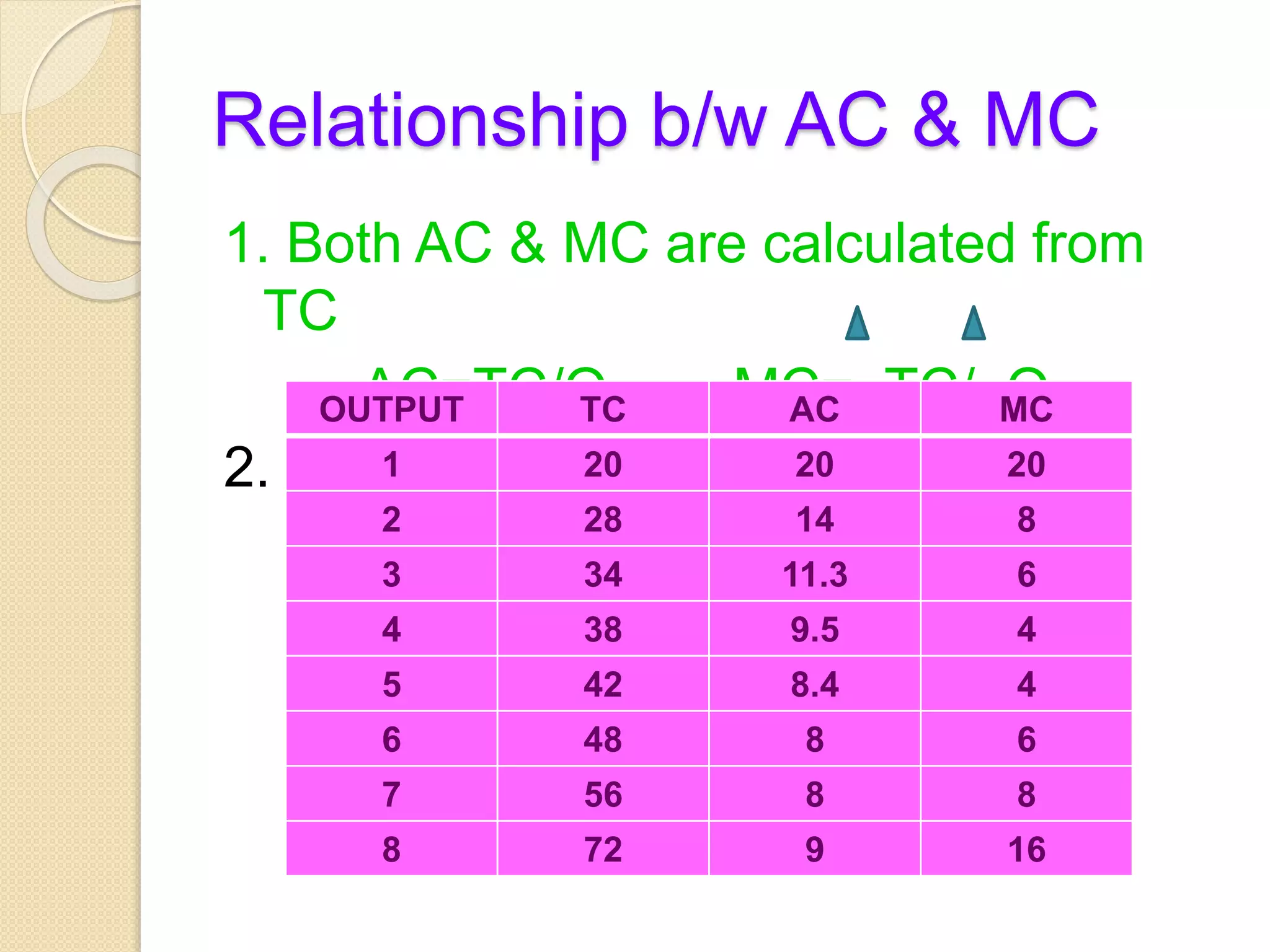
Relationship b/w AC & MC
1. Both AC & MC are calculated from
TC
AC=TC/Q MC= TC/ Q
2.
OUTPUT TC AC MC
1 20 20 20
2 28 14 8
3 34 11.3 6
4 38 9.5 4
5 42 8.4 4
6 48 8 6
7 56 8 8
8 72 9 16
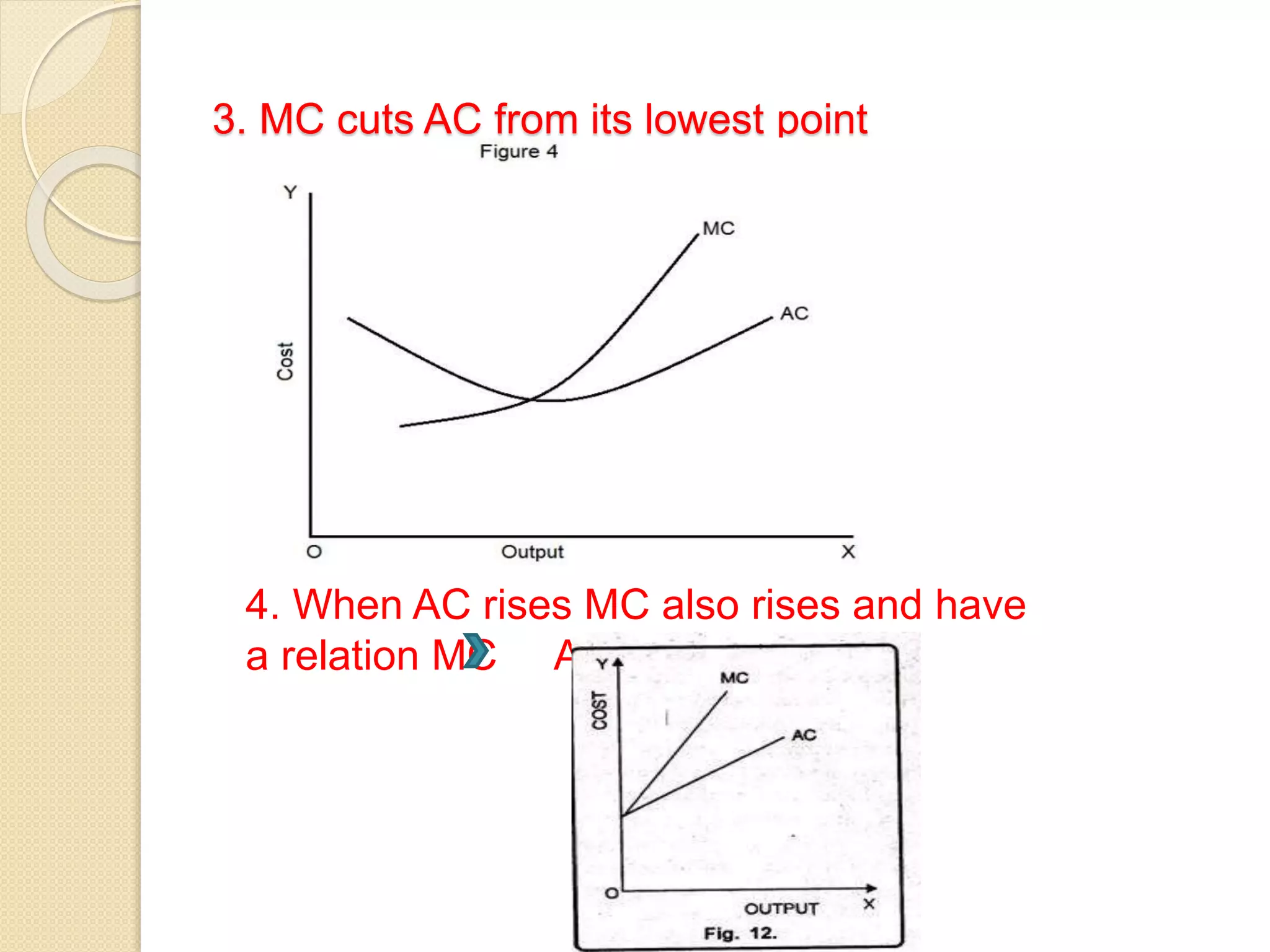
3. MC cuts AC from its lowest point
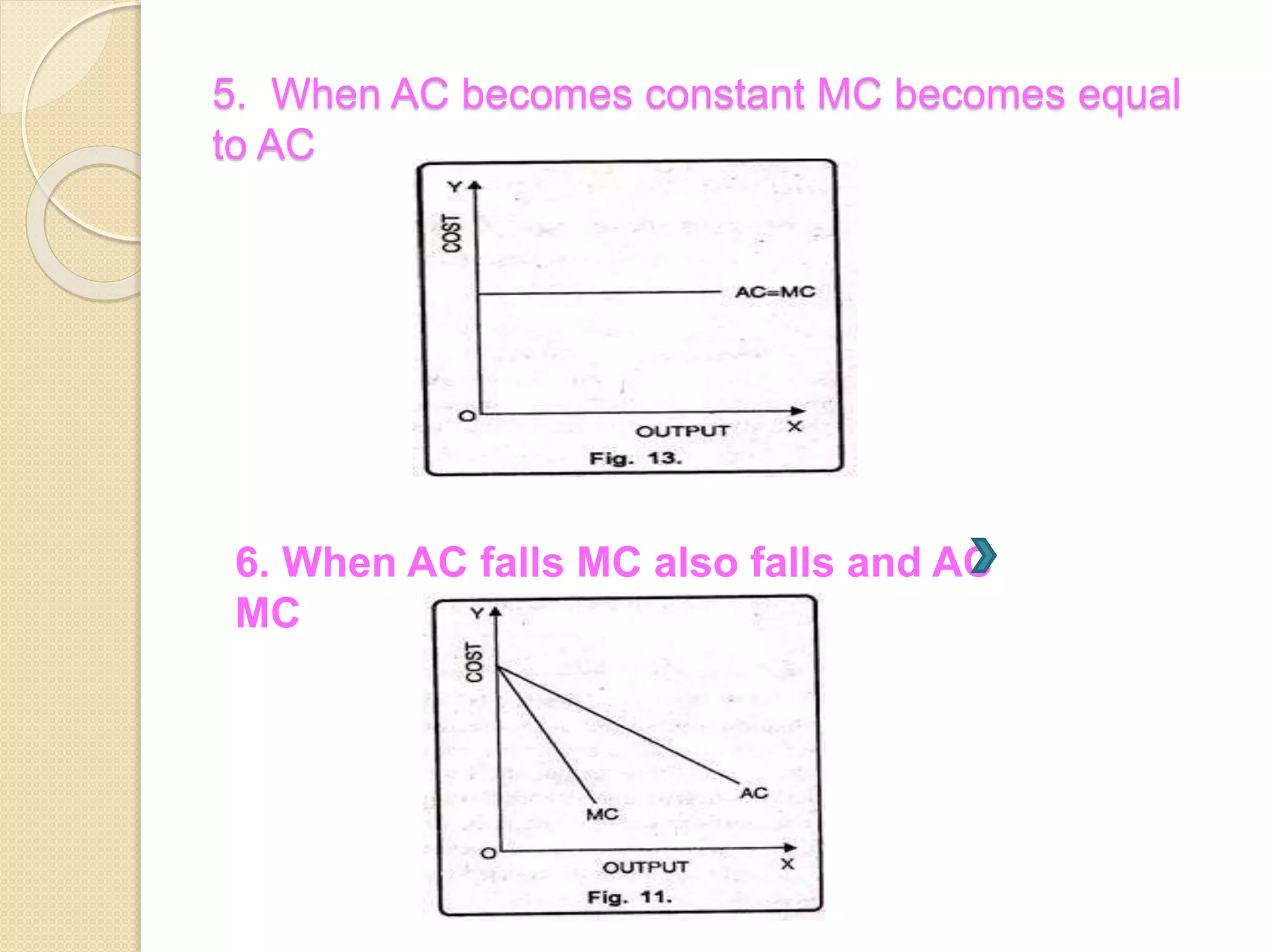
4. When AC rises MC also rises and have
a relation MC AC
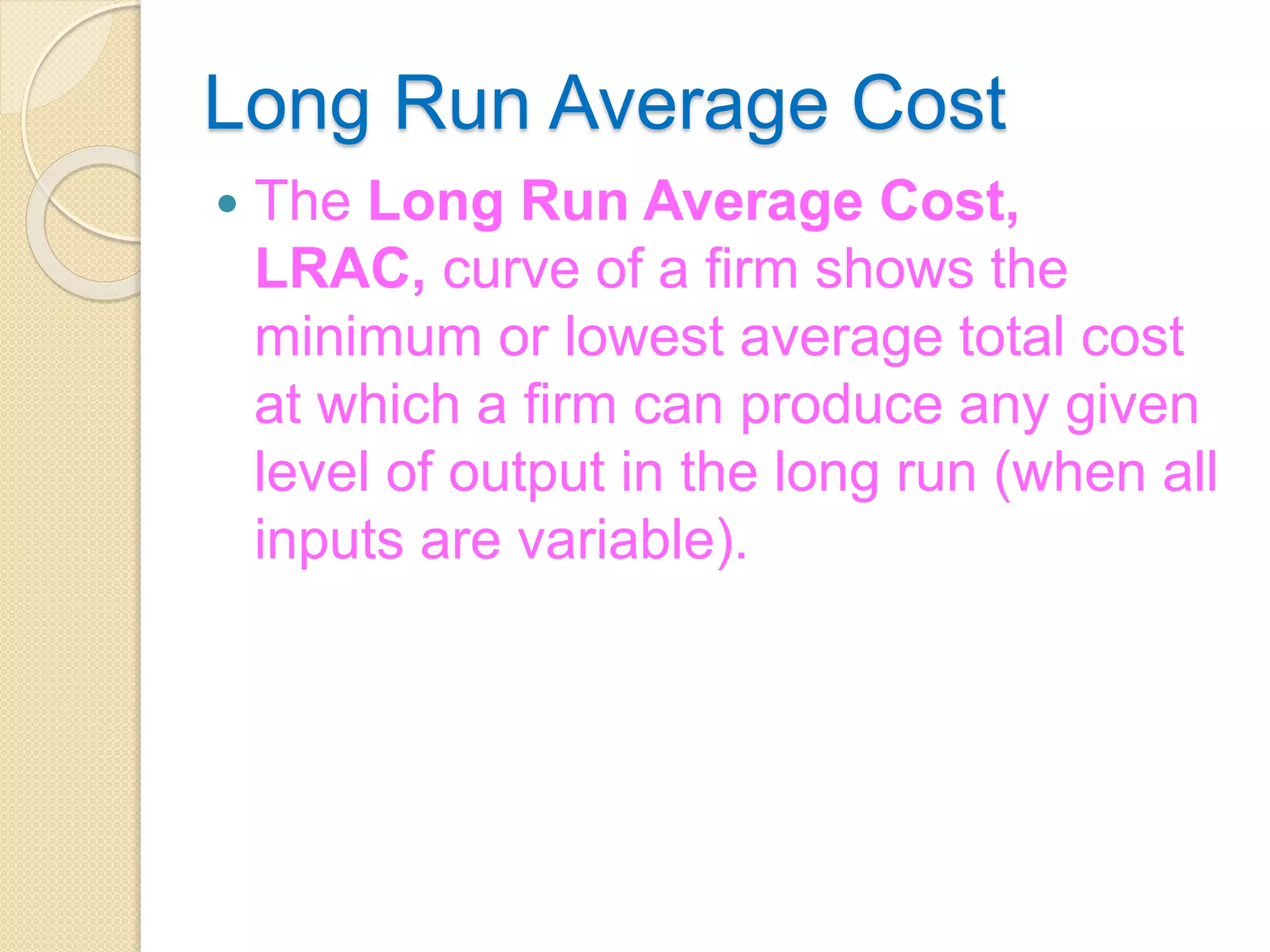
5. When AC becomes constant MC becomes equal
to AC
6. When AC falls MC also falls and AC
MC
Costs in the Long-Run
 Each firm operates under short-run
production conditions , but it formulates
long-run production plans . In order to
know about the production plans of a
firm , it becomes essential to study long-
run cost .
 No cost is fixed in long-run . All costs
becomes variable costs in this period .
As in the case of short-run , there are 3
concepts of costs in the long-run also
,namely , (1)Long-run total cost(LTC) ,
(2)Long-run average cost (LAC) ,
(3)Long-run marginal cost(LMC) .
Long Run Total Cost
* The long run total cost curve shows
the total cost of a firm’s optimal choice
combinations for labor and capital as
the firm’s total output increases.
* Note that the total cost curve will
always be zero when Q=0 because in
the long run a firm is free to vary all of
its inputs.
Long Run Average Cost
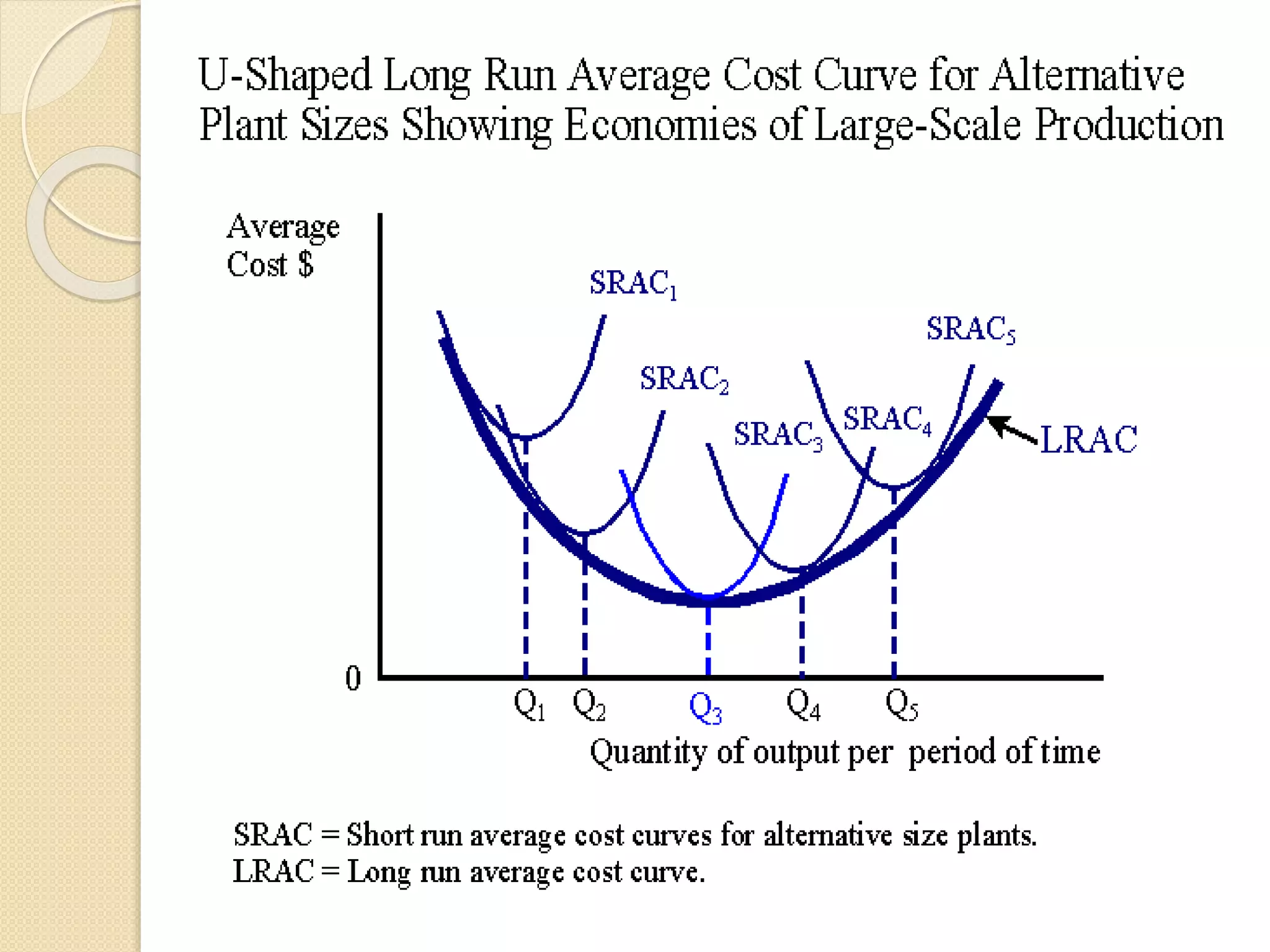
 The Long Run Average Cost,
LRAC, curve of a firm shows the
minimum or lowest average total cost
at which a firm can produce any given
level of output in the long run (when all
inputs are variable).
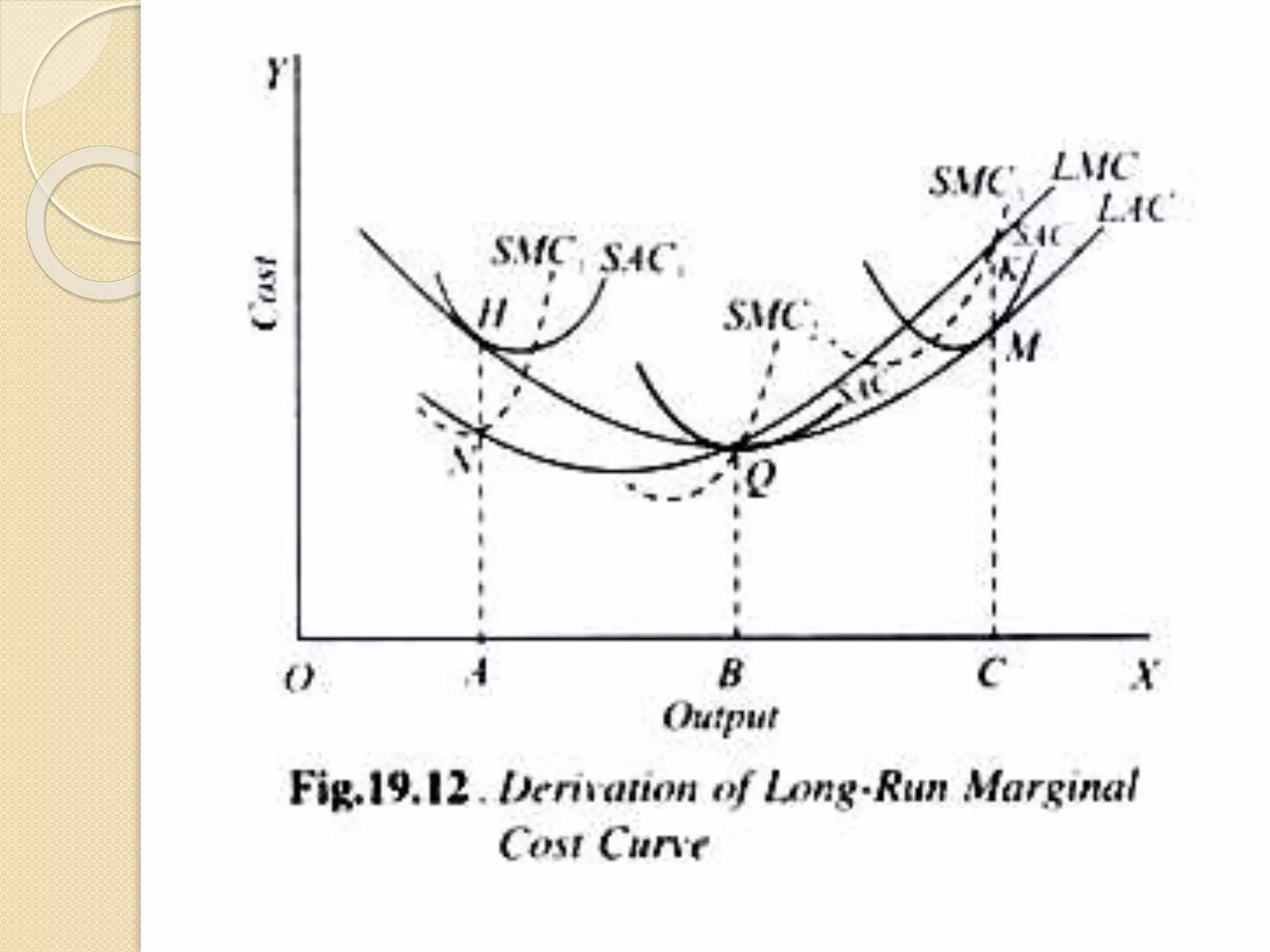
Long-run marginal cost
 LRMC is the minimum increase in
total cost associated with an increase
of one unit of output when all inputs
are variable. The long-run marginal
cost curve is shaped by returns to
scale, along-run concept, rather than
the law of diminishing
marginal returns, which is a short-
run concept.
Modern theory of cost curves
 Modern theory of cost curves has
been propounded by economists like
Stigler , Andrews etc . According to
traditional theory of cost curves , cost
curves are U-shaped . But according
to modern theory , in real life , cost
curves are L-shaped .
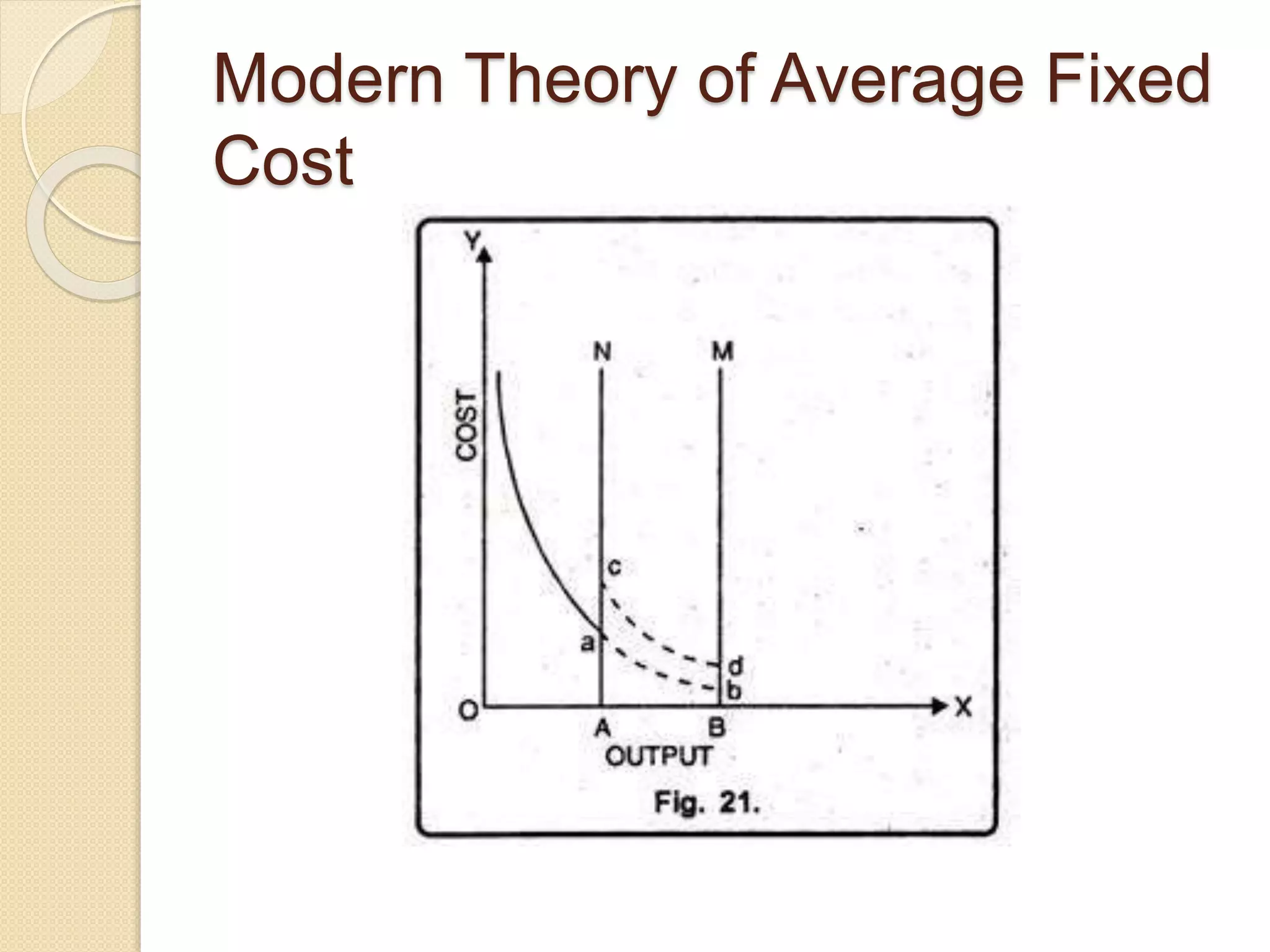
Modern Theory of Average Fixed
Cost
Average Variable Cost
Short run Average Cost Curve
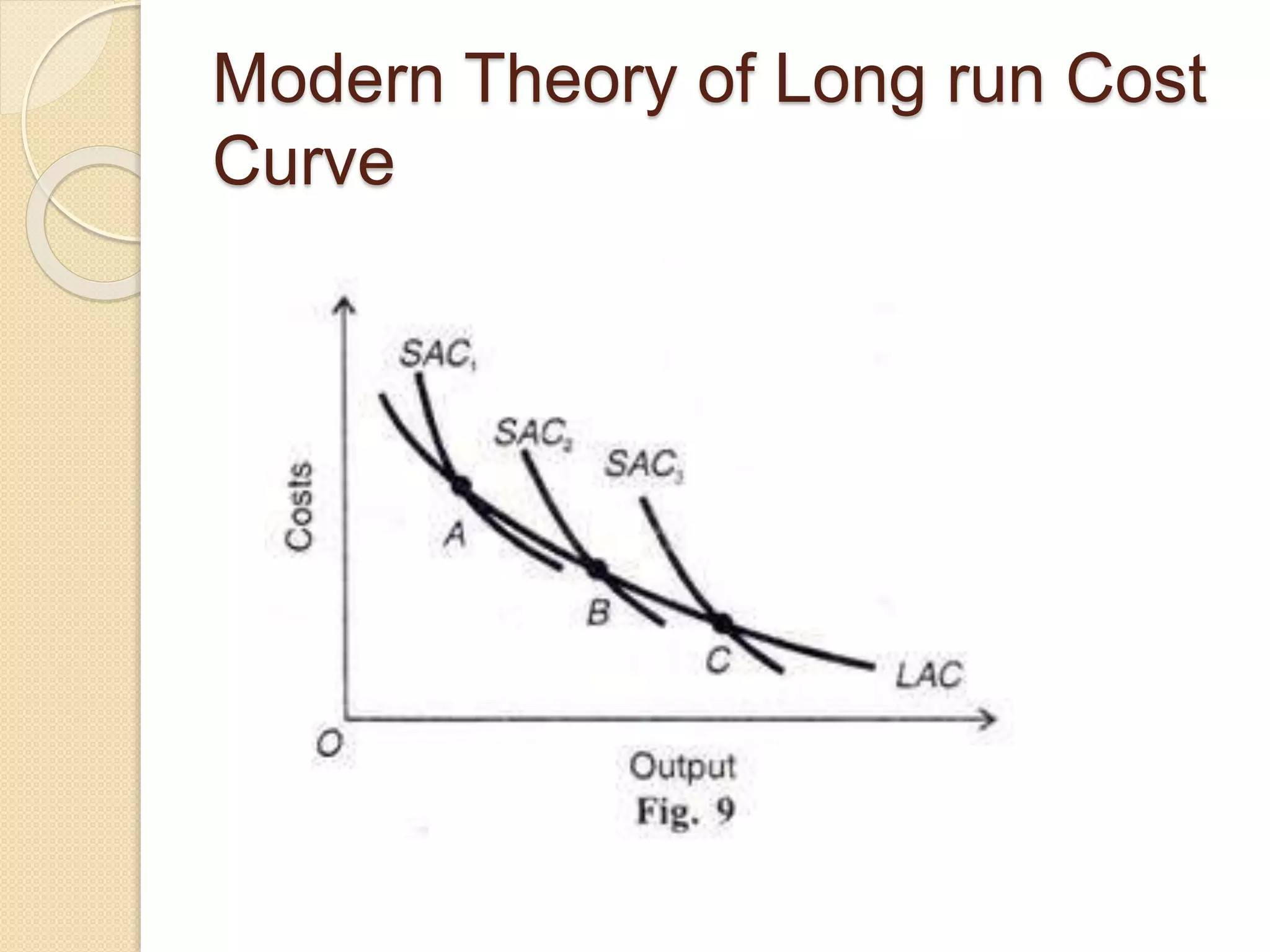
Modern Theory of Long run Cost
Curve
Long run Marginal Cost Curve
Thank you

theory of cost

  • 1.
  • 2.
    Cost of production Inorder to produce a good , every firm , makes uses of factor of production . The amount spent on the use of factor of production is called cost of production . Cost of production mainly depend upon quantity of production . Ordinarily ,cost of production increases with increases in output . It can therefore be said that cost of production is a function of quantity of output , i.e.,C=f(Q)
  • 3.
    Explicit cost andImplicit cost . It refers to those monetary payments which made to outsiders for their services rendered. For examples- Payments of electricity bills -Wages paid to workers - Payment of raw mon . It refers to those monetary payments which are paid for use of self owned resources. For examples – payment of self owned land - Salary paid to owner acting as a manager in a firm Explicit cost Implicit cost Total cost = Explicit cost +Implicit cost
  • 4.
  • 5.
    Traditional Theory ofCost  Under traditional theory, cost are studied in two parts on the basis of time-period: (i) Cost in short run  (ii) Cost in the long run .  Cost are mainly of three types :  1. Total Cost  2. Average Cost  3.Marginal Cost
  • 6.
    Cost in theshort-run  The amount of money spent on the production of different levels of a good is called total cost . * Total Fixed Costs Fixed cost are costs which do not change with change in the quantity of output . For eg .- Salary to permanent staff - Licensce fee TC=TFC+TVC
  • 7.
    Total fixed cost Unitsof output Total fixed cost 0 10 1 10 2 10 3 10 4 10 5 10 6 10 TFC Cost Units of Output
  • 8.
    Total variable cost Variable cost is one which varies as the level of output varies. If output falls these cost also falls and if output increases rises these costs also rise . Unit of output Total variable cost Change in total variable cost 0 0 0 1 10 10 2 18 8 3 24 6 4 28 4 5 32 4 6 38 6
  • 9.
    Relation between Total, Fixed and Variable CostsOutput TFC TVC TC 0 10 0 10 1 10 10 20 2 10 18 28 3 10 24 34 4 10 28 38 5 10 32 42 6 10 38 48 7 10 46 56
  • 10.
    AVERAGE COST Per unitcost of a good is called its average cost . AC=TC/Q Average cost is composed of two types of costs in the short period : (i) Average fixed cost (ii) Average variable cost AC=AFC+AVC
  • 11.
    Average Fixed Cost Average fixed cost is equal to total fixed cost divided by output ; i.e., AFC=TFC/Q OUTPUT TFC AFC 1 10 10 2 10 5 3 10 3.3 4 10 2.5 5 10 2 6 10 1.7 7 10 1.4
  • 12.
    Average variable cost Averagevariable cost is total variable cost divided by output . That is , AVC=TVC/Q
  • 13.
    OUTPUT TVC AVC 110 10 2 18 9 3 24 8 4 28 7 5 32 6.4 6 38 6.3 7 46 6.6 8 62 7.8
  • 14.
    MARGINAL COST  Additionmade to the total cost by the production of one more unit of a commodity is called marginal cost . Its formula is : MCn=TCn-TCn-1 OR
  • 15.
    OUTPUT TC MC 00 - 1 20 20-0=20 2 28 28-20=8 3 34 34-28=6 4 38 38-34=4 5 42 42-38=4 6 48 48-42=6 7 56 56-48=8
  • 16.
    Relationship b/w AC& MC 1. Both AC & MC are calculated from TC AC=TC/Q MC= TC/ Q 2. OUTPUT TC AC MC 1 20 20 20 2 28 14 8 3 34 11.3 6 4 38 9.5 4 5 42 8.4 4 6 48 8 6 7 56 8 8 8 72 9 16
  • 17.
    3. MC cutsAC from its lowest point 4. When AC rises MC also rises and have a relation MC AC
  • 18.
    5. When ACbecomes constant MC becomes equal to AC 6. When AC falls MC also falls and AC MC
  • 19.
    Costs in theLong-Run  Each firm operates under short-run production conditions , but it formulates long-run production plans . In order to know about the production plans of a firm , it becomes essential to study long- run cost .  No cost is fixed in long-run . All costs becomes variable costs in this period . As in the case of short-run , there are 3 concepts of costs in the long-run also ,namely , (1)Long-run total cost(LTC) , (2)Long-run average cost (LAC) , (3)Long-run marginal cost(LMC) .
  • 20.
    Long Run TotalCost * The long run total cost curve shows the total cost of a firm’s optimal choice combinations for labor and capital as the firm’s total output increases. * Note that the total cost curve will always be zero when Q=0 because in the long run a firm is free to vary all of its inputs.
  • 22.
    Long Run AverageCost  The Long Run Average Cost, LRAC, curve of a firm shows the minimum or lowest average total cost at which a firm can produce any given level of output in the long run (when all inputs are variable).
  • 24.
    Long-run marginal cost LRMC is the minimum increase in total cost associated with an increase of one unit of output when all inputs are variable. The long-run marginal cost curve is shaped by returns to scale, along-run concept, rather than the law of diminishing marginal returns, which is a short- run concept.
  • 26.
    Modern theory ofcost curves  Modern theory of cost curves has been propounded by economists like Stigler , Andrews etc . According to traditional theory of cost curves , cost curves are U-shaped . But according to modern theory , in real life , cost curves are L-shaped .
  • 27.
    Modern Theory ofAverage Fixed Cost
  • 28.
  • 29.
  • 30.
    Modern Theory ofLong run Cost Curve
  • 31.
  • 32.