 INTRODUCTION
 PERFECT COMPETITION
 FEATURES
 PURE COMPETITION &PERFECT COMPETITION –COMPARISION
 CONCEPT OF EQUILIBRIUM PRICE
 PRICE DETERMINATION UNDER PERFECT COMPETITION
 EQULIBRIUM OF A FIRM UNDER PERFECT COMPETITION
 IMPERFECT COMPETITION
 MONOPOLY
 FEATURES
 KINDS
 SOURCES
 PRICE AND OUTPUT DETERMINATION UNDER MONOPOLY
 LONG RUN MONOPOLY EQUILIBRIUM
 PRICE DISCRIMINATION
 OBJECTIVES
 CONDITIONS
 MONOPOLISTIC COMPETITION
 FEATURES
 PRICE DETERMINATION UNDER MONOPOLISTIC COMPETITION
 OLIGOPOLY
 FEATURES
 PRICE AND OUTPUT DETERMINATION UNDER OLIGOPOLY
 KINKED DEMAND CURVE THEORY
 PRICE LEADERSHIP MODEL
 TYPES
 DUOPOLY
 MONOPSONY
 BILATERAL MONOPSONY
 OLIGOPSONY
 PRICING POLICIES
 PRICING STRATEGIES AT DIFFERENT STAGES
 PROBLEMS IN PRICING OF A NEW PRODUCT
 The environment in which a product or service is sold
has a great effect on the available options for the buyer
and seller. We will now go through different markets.
Based on their characteristics, pricing in different
markets can be divided into the following groups:
 perfect competition
 monopolistic competition
 oligopoly
 monopoly
 The situation prevailing in a market in which buyers
and sellers are so numerous and well informed that all
elements of monopoly are absent and the market price
of a commodity is beyond the control of individual
buyers and sellers.
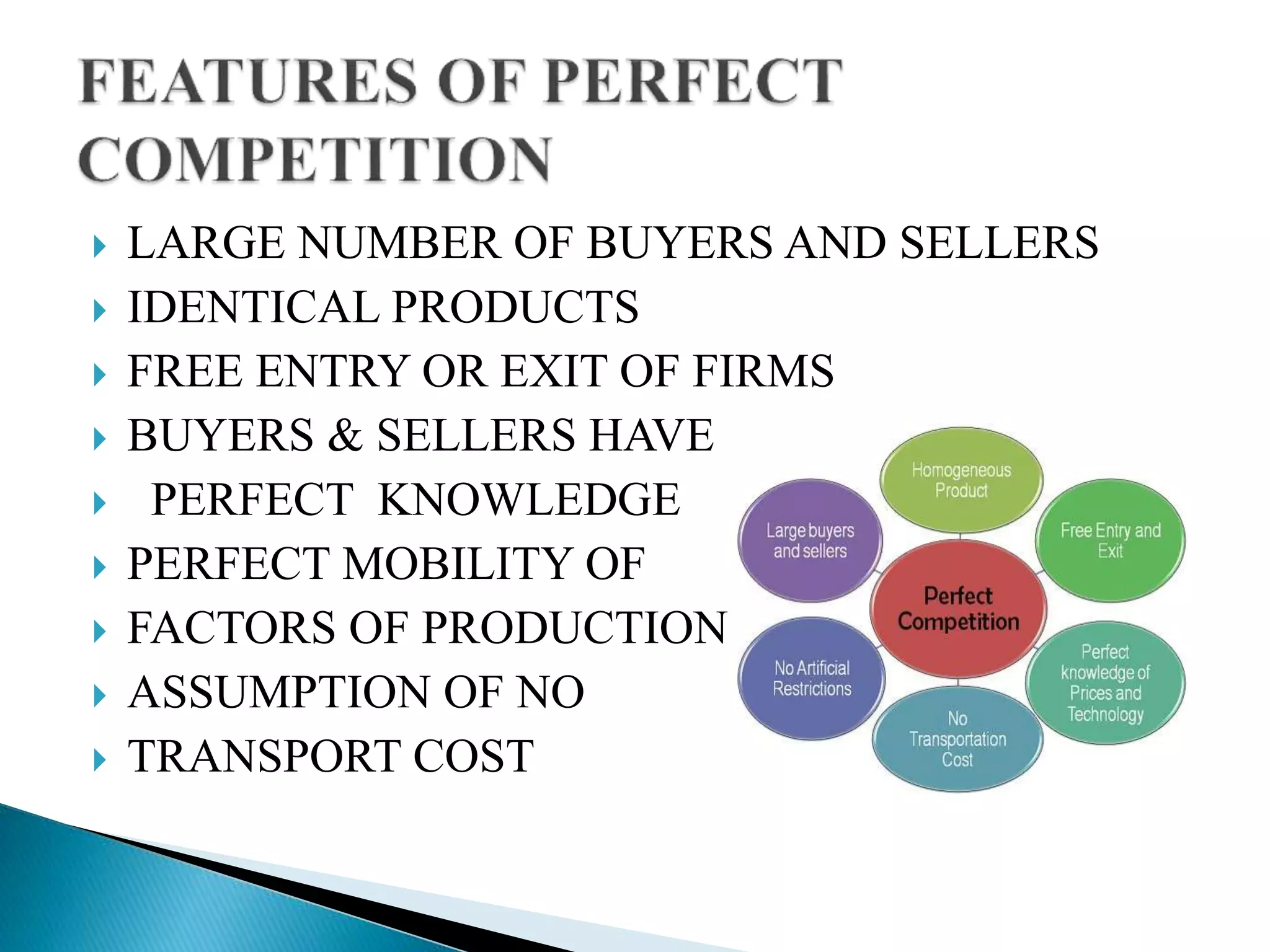
 LARGE NUMBER OF BUYERS AND SELLERS
 IDENTICAL PRODUCTS
 FREE ENTRY OR EXIT OF FIRMS
 BUYERS & SELLERS HAVE
 PERFECT KNOWLEDGE
 PERFECT MOBILITY OF
 FACTORS OF PRODUCTION
 ASSUMPTION OF NO
 TRANSPORT COST
 Pure competition exists when the first 3 conditions such
as existence of large no. of buyers & sellers ,identical
products ,free entry or exit of firms are fulfilled.
 Perfect competition is much broader than pure
competition with additional conditions as stated earlier.
 It is clear from the table that qty demanded and
supplied is equal at price Rs 3. All other levels of
prices, the qty demanded and supplied are not equal.
Hence the equilibrium price is RS 3.
 Price determination in market period
PERISHABLE GOODS
NON –PERISHABLE GOODS
 Price determination in the short period
 Price determination in long period
 Market conditions where individual firms can exercise
control over the price in varying degrees depending
upon the degrees of imperfect competition prevailing in
the market.
 Monopoly refers to a market situation
where one firm or a group of firms
which are combined to have a control
over the supply of the product.
 The product has no close substitutes.
 The cross elasticity of demand with every other product
is very low. This means that no other firms produce a
similar product. Thus, the Monopoly firm is itself an
industry and the monopolist faces the industry demand
curve.
 Single Producer or Seller
 Absence of Close Substitutes
 Barriers to the Entry of New Firm
 The firm is the price-maker and not price taker i.e., the
firm can sell more at lower price and less at higher
price.
 Monopolist is guided by the motive of profit
maximisation .
 The monopoly price is uncontrolled. There are no
restrictions on the power of the monopolist.
 PERFECT-No close substitutes
 IMPERFECT-There are close substitutes
 PRIVATE-Owned by private
 PUBLIC-Owned by government
 SIMPLE-Uniform price
 DISCRIMINATING-Different price
 LEGAL- Trademarks, patents etc
 NATURAL-As a result of natural advantages
 TECHNICAL-Through invention
 JOINT-Through amalgamation, cartels etc
 Economies of large scale production
 Economies of scope
 Exclusive ownership of raw materials
 Patent laws
SHORT RUN
 A Firm’s Short-Run Equilibrium in Monopoly
 Like in perfect competition, there are three possibilities for
a firm’s Equilibrium in Monopoly. These are:
 The firm earns normal profits – If the average cost = the
average revenue
 It earns super-normal profits – If the average cost < the
average revenue
 It incurs losses – If the average cost > the average
revenue
In the figure above, you can see that the price
per unit = OP = QA. Also, the cost per unit =
OP’. Therefore, the firm is earning more and
incurring a lesser cost. In this case, the per unit
profit is
OP – OP’ = PP’
Also, the total profit earned by the monopolist
is PP’BA.
 A monopoly firm maximizes profit at a higher level of
output in the long run as compared to short run. This is
because in the long run he can make adjustment in the
size of the plant.
 It is the practice of charging different prices for the
same product from different buyers.
TYPES
 Personal
 Local
 According to use
 To maximize profit
 To sell off accumulated inventories
 To penetrate into a new market segment.
 To take advantage of the economies of large scale
production.
 To enter into or retain export markets.
 Works under monopoly only
 Division of market into sub market
 Transfer of goods
 Elasticity of demand
 Consumer prejudices
 Government regulations
 Duty and tariff barriers
Monopolistic competition refers to a market situation in
which there are many producers producing goods which
are close substitutes of one another or where output is
differentiated.
 Presence of large number of sellers
 Product differentiation
 Independent price policy
 Non price competition
 Large number of buyers
 Free entry and exit
 Selling costs
 Absence of perfect knowledge
 The group concept
 SHORT RUN EQUILIBRIUM
 LONG RUN EQUILIBRIUM
 GROUP EQUILIBRIUM
➢ Type of imperfect competition.
➢ Market situation where there are a few firms or sellers
selling either differentiated or homogenous product.
➢ The lower limit of oligopoly is duopoly which is a
market situation consisting of two sellers.
 a) Few sellers
 b) Mutual Interdependence
 c) Homogenous or differentiated products
 d) Indeterminate demand curve
 e) Advertising and selling cost
 f) Price stability
 1) The concept of Kinked demand curve
 2) Price leadership model
 3) Pricing under collusion
 ➢ It was introduced by an American economist Paul M
Sweezy.
 ➢ It explains the situation of price rigidity under
oligopoly.
 ➢ The demand curve of an oligopolist firm has a ‘kink’
at the prevailing market price.
 ➢ The kink divides the demand curve into two parts.
The upper portion is more elastic and the lower potion
is less elastic.
 ➢ Price changes are consistently imitated by other
firms in the industry.
 ➢ One firm emerges as a price leader and fixes the
price of the product for the industry. The other firms
will adjust their output to this price.
 ➢ The price leader will be the one who owns the
largest market share or the one with the lowest cost of
production.
 Price leadership of the dominant firm
 Price leadership by a low cost firm
 Barometric price leadership
 Exploitative or aggressive price leadership
 DUOPOLY
Market situation in which there are only two sellers either
selling identical or differentiated products.
 MONOPSONY
Market situation where there is only one buyer in the
market
 BILATERAL MONOPSONY
Market situation when a monopoly of purchase is matched
with a monopoly of sale.
 Market situation characterised by the presence of many
sellers and few buyers.
General Considerations While Formulating A Price Policy
 Objectives of business
 Cost of the product
 Demand for the product
 Competition
 Channels of distribution
 Government legislations
 Business cycle
 Cost oriented pricing policy
1. Cost plus pricing
2. Rate of return pricing
3. Break even pricing
 Demand oriented pricing policy
 Competition oriented pricing policy
 SKIMMING PRICING
Skimming pricing is a pricing strategy where a high price
is charged in the initial stages of the introduction of a
product.
 PENETRATION PRICING
Penetration pricing is a pricing strategy where a low price
is charged in the initial stages of the introduction of a
product.
 Introduction stage
 Growth stage
 Maturity stage
 Decline stage
 Lack of market information
 Lack of standards
 Heavy promotional expenses
 Fear of customer rejection
 Test Marketing
 Production Planning
 Estimation of cost of production
THANK YOU

PRICING IN DIFFERENT MARKETS

  • 3.
     INTRODUCTION  PERFECTCOMPETITION  FEATURES  PURE COMPETITION &PERFECT COMPETITION –COMPARISION  CONCEPT OF EQUILIBRIUM PRICE  PRICE DETERMINATION UNDER PERFECT COMPETITION  EQULIBRIUM OF A FIRM UNDER PERFECT COMPETITION  IMPERFECT COMPETITION  MONOPOLY  FEATURES  KINDS  SOURCES  PRICE AND OUTPUT DETERMINATION UNDER MONOPOLY  LONG RUN MONOPOLY EQUILIBRIUM  PRICE DISCRIMINATION  OBJECTIVES  CONDITIONS
  • 4.
     MONOPOLISTIC COMPETITION FEATURES  PRICE DETERMINATION UNDER MONOPOLISTIC COMPETITION  OLIGOPOLY  FEATURES  PRICE AND OUTPUT DETERMINATION UNDER OLIGOPOLY  KINKED DEMAND CURVE THEORY  PRICE LEADERSHIP MODEL  TYPES  DUOPOLY  MONOPSONY  BILATERAL MONOPSONY  OLIGOPSONY  PRICING POLICIES  PRICING STRATEGIES AT DIFFERENT STAGES  PROBLEMS IN PRICING OF A NEW PRODUCT
  • 5.
     The environmentin which a product or service is sold has a great effect on the available options for the buyer and seller. We will now go through different markets. Based on their characteristics, pricing in different markets can be divided into the following groups:  perfect competition  monopolistic competition  oligopoly  monopoly
  • 6.
     The situationprevailing in a market in which buyers and sellers are so numerous and well informed that all elements of monopoly are absent and the market price of a commodity is beyond the control of individual buyers and sellers.
  • 7.
     LARGE NUMBEROF BUYERS AND SELLERS  IDENTICAL PRODUCTS  FREE ENTRY OR EXIT OF FIRMS  BUYERS & SELLERS HAVE  PERFECT KNOWLEDGE  PERFECT MOBILITY OF  FACTORS OF PRODUCTION  ASSUMPTION OF NO  TRANSPORT COST
  • 8.
     Pure competitionexists when the first 3 conditions such as existence of large no. of buyers & sellers ,identical products ,free entry or exit of firms are fulfilled.  Perfect competition is much broader than pure competition with additional conditions as stated earlier.
  • 9.
     It isclear from the table that qty demanded and supplied is equal at price Rs 3. All other levels of prices, the qty demanded and supplied are not equal. Hence the equilibrium price is RS 3.
  • 10.
     Price determinationin market period PERISHABLE GOODS NON –PERISHABLE GOODS  Price determination in the short period  Price determination in long period
  • 12.
     Market conditionswhere individual firms can exercise control over the price in varying degrees depending upon the degrees of imperfect competition prevailing in the market.
  • 13.
     Monopoly refersto a market situation where one firm or a group of firms which are combined to have a control over the supply of the product.  The product has no close substitutes.  The cross elasticity of demand with every other product is very low. This means that no other firms produce a similar product. Thus, the Monopoly firm is itself an industry and the monopolist faces the industry demand curve.
  • 14.
     Single Produceror Seller  Absence of Close Substitutes  Barriers to the Entry of New Firm  The firm is the price-maker and not price taker i.e., the firm can sell more at lower price and less at higher price.  Monopolist is guided by the motive of profit maximisation .  The monopoly price is uncontrolled. There are no restrictions on the power of the monopolist.
  • 15.
     PERFECT-No closesubstitutes  IMPERFECT-There are close substitutes  PRIVATE-Owned by private  PUBLIC-Owned by government  SIMPLE-Uniform price  DISCRIMINATING-Different price  LEGAL- Trademarks, patents etc  NATURAL-As a result of natural advantages  TECHNICAL-Through invention  JOINT-Through amalgamation, cartels etc
  • 16.
     Economies oflarge scale production  Economies of scope  Exclusive ownership of raw materials  Patent laws
  • 17.
    SHORT RUN  AFirm’s Short-Run Equilibrium in Monopoly  Like in perfect competition, there are three possibilities for a firm’s Equilibrium in Monopoly. These are:  The firm earns normal profits – If the average cost = the average revenue  It earns super-normal profits – If the average cost < the average revenue  It incurs losses – If the average cost > the average revenue
  • 18.
    In the figureabove, you can see that the price per unit = OP = QA. Also, the cost per unit = OP’. Therefore, the firm is earning more and incurring a lesser cost. In this case, the per unit profit is OP – OP’ = PP’ Also, the total profit earned by the monopolist is PP’BA.
  • 19.
     A monopolyfirm maximizes profit at a higher level of output in the long run as compared to short run. This is because in the long run he can make adjustment in the size of the plant.
  • 20.
     It isthe practice of charging different prices for the same product from different buyers. TYPES  Personal  Local  According to use
  • 21.
     To maximizeprofit  To sell off accumulated inventories  To penetrate into a new market segment.  To take advantage of the economies of large scale production.  To enter into or retain export markets.
  • 22.
     Works undermonopoly only  Division of market into sub market  Transfer of goods  Elasticity of demand  Consumer prejudices  Government regulations  Duty and tariff barriers
  • 23.
    Monopolistic competition refersto a market situation in which there are many producers producing goods which are close substitutes of one another or where output is differentiated.
  • 24.
     Presence oflarge number of sellers  Product differentiation  Independent price policy  Non price competition  Large number of buyers  Free entry and exit  Selling costs  Absence of perfect knowledge  The group concept
  • 25.
     SHORT RUNEQUILIBRIUM  LONG RUN EQUILIBRIUM  GROUP EQUILIBRIUM
  • 26.
    ➢ Type ofimperfect competition. ➢ Market situation where there are a few firms or sellers selling either differentiated or homogenous product. ➢ The lower limit of oligopoly is duopoly which is a market situation consisting of two sellers.
  • 27.
     a) Fewsellers  b) Mutual Interdependence  c) Homogenous or differentiated products  d) Indeterminate demand curve  e) Advertising and selling cost  f) Price stability
  • 28.
     1) Theconcept of Kinked demand curve  2) Price leadership model  3) Pricing under collusion
  • 29.
     ➢ Itwas introduced by an American economist Paul M Sweezy.  ➢ It explains the situation of price rigidity under oligopoly.  ➢ The demand curve of an oligopolist firm has a ‘kink’ at the prevailing market price.  ➢ The kink divides the demand curve into two parts. The upper portion is more elastic and the lower potion is less elastic.
  • 30.
     ➢ Pricechanges are consistently imitated by other firms in the industry.  ➢ One firm emerges as a price leader and fixes the price of the product for the industry. The other firms will adjust their output to this price.  ➢ The price leader will be the one who owns the largest market share or the one with the lowest cost of production.
  • 31.
     Price leadershipof the dominant firm  Price leadership by a low cost firm  Barometric price leadership  Exploitative or aggressive price leadership
  • 32.
     DUOPOLY Market situationin which there are only two sellers either selling identical or differentiated products.  MONOPSONY Market situation where there is only one buyer in the market  BILATERAL MONOPSONY Market situation when a monopoly of purchase is matched with a monopoly of sale.
  • 33.
     Market situationcharacterised by the presence of many sellers and few buyers. General Considerations While Formulating A Price Policy  Objectives of business  Cost of the product  Demand for the product  Competition  Channels of distribution  Government legislations  Business cycle
  • 34.
     Cost orientedpricing policy 1. Cost plus pricing 2. Rate of return pricing 3. Break even pricing  Demand oriented pricing policy  Competition oriented pricing policy
  • 35.
     SKIMMING PRICING Skimmingpricing is a pricing strategy where a high price is charged in the initial stages of the introduction of a product.  PENETRATION PRICING Penetration pricing is a pricing strategy where a low price is charged in the initial stages of the introduction of a product.
  • 36.
     Introduction stage Growth stage  Maturity stage  Decline stage
  • 37.
     Lack ofmarket information  Lack of standards  Heavy promotional expenses  Fear of customer rejection  Test Marketing  Production Planning  Estimation of cost of production
  • 38.