Welcome
topic: “ Monopoly market”
By
Andrews
What is monopoly market?
Monopoly is simply a market with only one
seller and no close substitutes for that seller’s
product
The word monopoly is made up of two
syllables mono and poly. Mono means single
while poly implies selling….
Definitions
• According to Prof. Ferguson, “A pure
monopoly exists when there is only one
producer in a market. There are no direct
competitors
• Mc Connell says, “Pure or absolute monopoly
exists when a single firm is the sole producer
for a product for which there are no close
substitutes
Reasons for monopoly
A. ownership of a key resource
B. Government franchise
C. Intellectual property protection in the form
of patents and copyrights
D. Natural monopoly
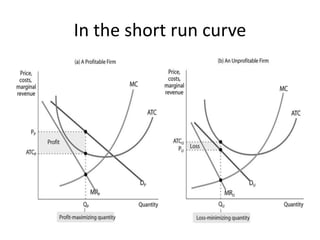
Features of monopoly
• A single seller has complete control over the supply of the
commodity
• There are no close substitutes for the product
• There is no free entry and exit because of some restrictions
• There is complete negation competition
• Monopolist is a price maker
• Since there is a single firm , the firm and industry are one and same
• Monopoly firm faces downward sloping demand curve .it means he
can sell more at lower price and vice versa.
Types of monopoly
• Perfect monopoly
absolutely zero level of competition
 Imperfect monopoly
product may have a remote substitute. So there is a fear
of competition to some extent
• Private monopoly
production is owned, controlled, and managed by private
body
• Public monopoly
production is owned, controlled, and managed by
government
• Simple monopoly
single price for all customers
• Discriminating monopoly
different prices for different customers for the same
product
• Legal monopoly
monopoly exists on account of trade marks, copyrights,
etc
• Natural monopoly
emerges as a result of natural advantages like good
location, abundant mineral resources etc
• Technological monopoly
emerges as a result of economies of large scale
production, use of capital goods, new production methods
etc.
• Joint monopoly
monopoly position through amalgamation, cartels, syndicates
etc
Advantages of monopoly market
• Avoids duplication and hence wastage of
resources
• Enjoys economies of scale
• Since monopolies make lot of profits, it can be
used for research and development and to
maintain their status as monopoly
• Price discrimination may benefits the
economically weaker section of the society
Disadvantages of monopoly market
• Poor level of service
• No consumer sovereignty
• Consumers may be charged with high price for
low quality products
• Lack of competition may lead to low quality
and outdated goods and service
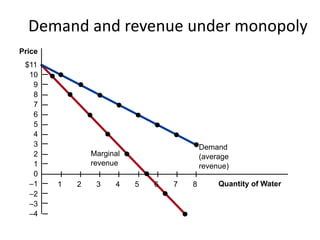
Demand and revenue under monopoly
Quantity of Water
Price
$11
10
9
8
7
6
5
4
3
2
1
0
–1
–2
–3
–4
Demand
(average
revenue)
Marginal
revenue
1 2 3 4 5 6 7 8
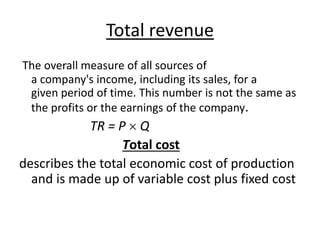
Total revenue
The overall measure of all sources of
a company's income, including its sales, for a
given period of time. This number is not the same as
the profits or the earnings of the company.
TR = P  Q
Total cost
describes the total economic cost of production
and is made up of variable cost plus fixed cost
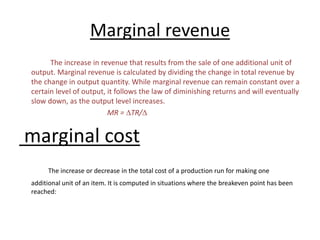
Marginal revenue
The increase in revenue that results from the sale of one additional unit of
output. Marginal revenue is calculated by dividing the change in total revenue by
the change in output quantity. While marginal revenue can remain constant over a
certain level of output, it follows the law of diminishing returns and will eventually
slow down, as the output level increases.
MR = DTR/D
marginal cost
The increase or decrease in the total cost of a production run for making one
additional unit of an item. It is computed in situations where the breakeven point has been
reached:
Determination of price and
equilibrium under monopoly
A monopolist is in equilibrium when he produces that
amount of output which yields him maximum total
profit. A monopolist is also in equilibrium in the short
period when he incurs minimum loss. Under monopoly,
price & equilibrium are determined by 2 different
approaches:
1. TR & TC Analysis
2. MR & MC Analysis
TR & TC curve analysis
1] Monopolist can earn maximum profit when the difference
between TR & TC is maximum.
2] By fixing different prices or by changing the supply of the
product, a monopolist tries to find out the level of output at
which the difference between TR & TC is maximum. That
amount of output at which a monopolist earns maximum
profit will constitute his equilibrium situation.
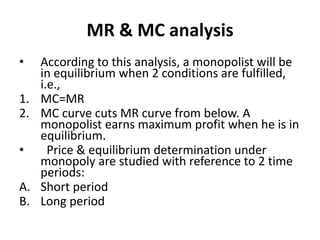
MR & MC analysis
• According to this analysis, a monopolist will be
in equilibrium when 2 conditions are fulfilled,
i.e.,
1. MC=MR
2. MC curve cuts MR curve from below. A
monopolist earns maximum profit when he is in
equilibrium.
• Price & equilibrium determination under
monopoly are studied with reference to 2 time
periods:
A. Short period
B. Long period
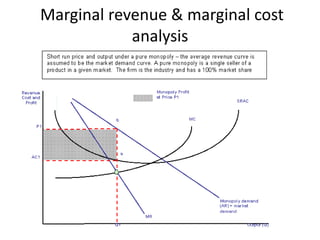
Marginal revenue & marginal cost
analysis
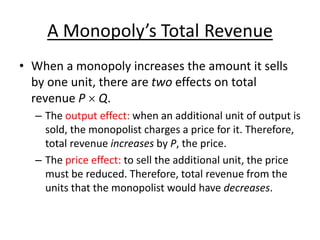
A Monopoly’s Total Revenue
• When a monopoly increases the amount it sells
by one unit, there are two effects on total
revenue P  Q.
– The output effect: when an additional unit of output is
sold, the monopolist charges a price for it. Therefore,
total revenue increases by P, the price.
– The price effect: to sell the additional unit, the price
must be reduced. Therefore, total revenue from the
units that the monopolist would have decreases.
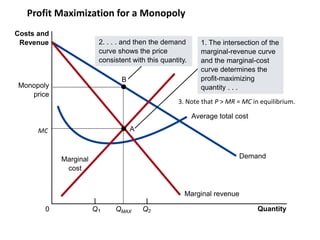
Profit Maximization for a Monopoly
QuantityQ Q0
Costs and
Revenue
Demand
Average total cost
Marginal revenue
Marginal
cost
Monopoly
price
QMAX
B
1. The intersection of the
marginal-revenue curve
and the marginal-cost
curve determines the
profit-maximizing
quantity . . .
A
2. . . . and then the demand
curve shows the price
consistent with this quantity.
MC
3. Note that P > MR = MC in equilibrium.
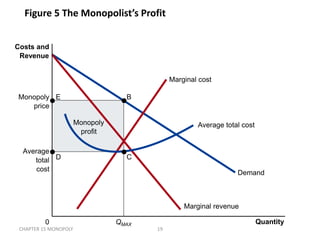
Figure 5 The Monopolist’s Profit
Monopoly
profit
Average
total
cost
Quantity
Monopoly
price
QMAX0
Costs and
Revenue
Demand
Marginal cost
Marginal revenue
Average total cost
B
C
E
D
19CHAPTER 15 MONOPOLY
Price discrimination
• One of the result of market power is price discrimination,
which refers to the sale of an identical good at different
prices to different consumers by a single seller.
• It allows a producer to reap the highest possible average
price for the output which increases TR and profit.
• Monopoly would charge higher prices from those who
have lower price elasticity of demand (more price-
inelastic demand)
• It requires the firm to eliminate possible resale of its
product otherwise it is ineffective. Price discrimination is
limited to firms that sell products that cannot be resold
Conditions for price discrimination
• The market for different classes of consumers
must be separable so that buyers of one
market are not in a position to resell the
commodity in the other
• The elasticity of demand must be different in
different markets
• There must be imperfect competition in the
market
Types of price discrimination
• First degree price discrimination
here the monopolist is aware of the maximum amount of money each consumer
will pay for any quantity. he, therefore, fixes his price accordingly so as to take
away the whole of the consumer’s surplus
• Second degree price discrimination
occurs when the monopolist captures a part of the consumer’s surplus and not the
entire amount consumer’s surplus. This type is practiced when there are many
consumers in the market with different tastes and incomes
• Third degree price discrimination
takes place when the seller divides his buyers into two or more classes and treats
each of them a separate market . for each class he charges a different price
Is price discrimination beneficial to
customers?
YES???
HOW??????
NO???
WHY???
Monopolistic competition?
market situation with large number of sellers
selling differentiated products…
eg: soft drink market thumsup,limca,gold spot
It is closer to perfect competition since it has
• Large number of sellers
• Free entry and free exit
• Perfect resource mobility
• Complete dissemination of market information
• Product differenciation
Product Differentiation
There are three important forms of product
differentiation:
• Differentiation by style or type – Sedans vs.
SUV’s
• Differentiation by location – Dry cleaner near
home vs. Cheaper dry-cleaner far away
• Differentiation by quality – Ordinary ($) vs.
gourmet chocolate ($$$)
Equilibrium position in monopolistic
market in the short period
Short-run refers to that period in which time is so short that a monopolist cannot change fixed
factors like: machinery, plant etc. Monopolist can increase his output in response to increase
in demand by changing his variable factors. Similarly, when demand decreases, the
monopolist will reduce his output by reducing variable factors & by slowing down the
intensive use of fixed factors. A monopolist will face any of the 3 situations in the short
period:
Super normal profit: If the price (AR) fixed by the monopolist in equilibrium is more than his AC,
then he will get super normal profits. The monopolist will produce up to the extent where
MC=MR.
Normal profit: If in the short run equilibrium MC=MR, the monopolist price AR=AC, then he will
earn only normal profit.
Minimum loss: In the short run, the monopolist may incur loss also. If in the short-run price falls
due to depression or fall in demand, the monopolist may continue his production so long as
the low price covers his AVC.
In the short run curve
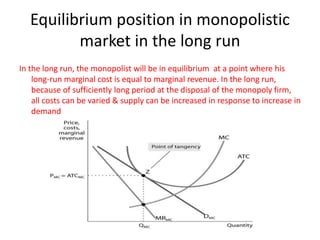
Equilibrium position in monopolistic
market in the long run
In the long run, the monopolist will be in equilibrium at a point where his
long-run marginal cost is equal to marginal revenue. In the long run,
because of sufficiently long period at the disposal of the monopoly firm,
all costs can be varied & supply can be increased in response to increase in
demand
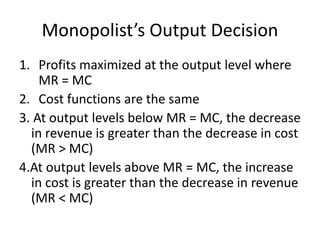
Monopolist’s Output Decision
1. Profits maximized at the output level where
MR = MC
2. Cost functions are the same
3. At output levels below MR = MC, the decrease
in revenue is greater than the decrease in cost
(MR > MC)
4.At output levels above MR = MC, the increase
in cost is greater than the decrease in revenue
(MR < MC)
Monopoly power
“Degree of price setting power held by
a supplier on the basis of its market share..”
Measuring monopoly power
• Traditional method
1] If a monopoly is faced with a perfectly elastic demand (just like a
perfectly competitive firm), the monopoly power is zero (no power).
2] The monopoly has more power if the demand is less elastic (or more
inelastic).
• Lerner's measure
according to this , the difference between the price charged by the
monopolist , and his marginal cost serves as the best measure of the
degree of monopoly power
For the competitive firm P=MC
for the firm with monopoly power P>MC
Lerner Index of Monopoly Power Measure of monopoly power calculated
as excess of price over marginal cost as a fraction of price….
Mathematically,
P= (P - MC)/P
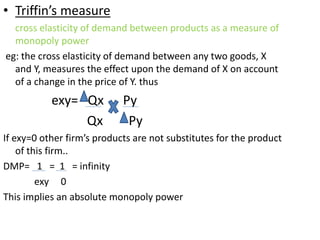
• Triffin’s measure
cross elasticity of demand between products as a measure of
monopoly power
eg: the cross elasticity of demand between any two goods, X
and Y, measures the effect upon the demand of X on account
of a change in the price of Y. thus
exy= Qx Py
Qx Py
If exy=0 other firm’s products are not substitutes for the product
of this firm..
DMP= 1 = 1 = infinity
exy 0
This implies an absolute monopoly power
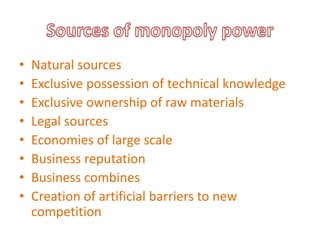
• Natural sources
• Exclusive possession of technical knowledge
• Exclusive ownership of raw materials
• Legal sources
• Economies of large scale
• Business reputation
• Business combines
• Creation of artificial barriers to new
competition
Monopoly and monopoly power??
are they both same??
thank you

Monopoly market a brief study for MBA

  • 1.
    Welcome topic: “ Monopolymarket” By Andrews
  • 2.
    What is monopolymarket? Monopoly is simply a market with only one seller and no close substitutes for that seller’s product The word monopoly is made up of two syllables mono and poly. Mono means single while poly implies selling….
  • 3.
    Definitions • According toProf. Ferguson, “A pure monopoly exists when there is only one producer in a market. There are no direct competitors • Mc Connell says, “Pure or absolute monopoly exists when a single firm is the sole producer for a product for which there are no close substitutes
  • 4.
    Reasons for monopoly A.ownership of a key resource B. Government franchise C. Intellectual property protection in the form of patents and copyrights D. Natural monopoly
  • 5.
    Features of monopoly •A single seller has complete control over the supply of the commodity • There are no close substitutes for the product • There is no free entry and exit because of some restrictions • There is complete negation competition • Monopolist is a price maker • Since there is a single firm , the firm and industry are one and same • Monopoly firm faces downward sloping demand curve .it means he can sell more at lower price and vice versa.
  • 6.
    Types of monopoly •Perfect monopoly absolutely zero level of competition  Imperfect monopoly product may have a remote substitute. So there is a fear of competition to some extent • Private monopoly production is owned, controlled, and managed by private body • Public monopoly production is owned, controlled, and managed by government • Simple monopoly single price for all customers
  • 7.
    • Discriminating monopoly differentprices for different customers for the same product • Legal monopoly monopoly exists on account of trade marks, copyrights, etc • Natural monopoly emerges as a result of natural advantages like good location, abundant mineral resources etc • Technological monopoly emerges as a result of economies of large scale production, use of capital goods, new production methods etc. • Joint monopoly monopoly position through amalgamation, cartels, syndicates etc
  • 8.
    Advantages of monopolymarket • Avoids duplication and hence wastage of resources • Enjoys economies of scale • Since monopolies make lot of profits, it can be used for research and development and to maintain their status as monopoly • Price discrimination may benefits the economically weaker section of the society
  • 9.
    Disadvantages of monopolymarket • Poor level of service • No consumer sovereignty • Consumers may be charged with high price for low quality products • Lack of competition may lead to low quality and outdated goods and service
  • 10.
    Demand and revenueunder monopoly Quantity of Water Price $11 10 9 8 7 6 5 4 3 2 1 0 –1 –2 –3 –4 Demand (average revenue) Marginal revenue 1 2 3 4 5 6 7 8
  • 11.
    Total revenue The overallmeasure of all sources of a company's income, including its sales, for a given period of time. This number is not the same as the profits or the earnings of the company. TR = P  Q Total cost describes the total economic cost of production and is made up of variable cost plus fixed cost
  • 12.
    Marginal revenue The increasein revenue that results from the sale of one additional unit of output. Marginal revenue is calculated by dividing the change in total revenue by the change in output quantity. While marginal revenue can remain constant over a certain level of output, it follows the law of diminishing returns and will eventually slow down, as the output level increases. MR = DTR/D marginal cost The increase or decrease in the total cost of a production run for making one additional unit of an item. It is computed in situations where the breakeven point has been reached:
  • 13.
    Determination of priceand equilibrium under monopoly A monopolist is in equilibrium when he produces that amount of output which yields him maximum total profit. A monopolist is also in equilibrium in the short period when he incurs minimum loss. Under monopoly, price & equilibrium are determined by 2 different approaches: 1. TR & TC Analysis 2. MR & MC Analysis
  • 14.
    TR & TCcurve analysis 1] Monopolist can earn maximum profit when the difference between TR & TC is maximum. 2] By fixing different prices or by changing the supply of the product, a monopolist tries to find out the level of output at which the difference between TR & TC is maximum. That amount of output at which a monopolist earns maximum profit will constitute his equilibrium situation.
  • 15.
    MR & MCanalysis • According to this analysis, a monopolist will be in equilibrium when 2 conditions are fulfilled, i.e., 1. MC=MR 2. MC curve cuts MR curve from below. A monopolist earns maximum profit when he is in equilibrium. • Price & equilibrium determination under monopoly are studied with reference to 2 time periods: A. Short period B. Long period
  • 16.
    Marginal revenue &marginal cost analysis
  • 17.
    A Monopoly’s TotalRevenue • When a monopoly increases the amount it sells by one unit, there are two effects on total revenue P  Q. – The output effect: when an additional unit of output is sold, the monopolist charges a price for it. Therefore, total revenue increases by P, the price. – The price effect: to sell the additional unit, the price must be reduced. Therefore, total revenue from the units that the monopolist would have decreases.
  • 18.
    Profit Maximization fora Monopoly QuantityQ Q0 Costs and Revenue Demand Average total cost Marginal revenue Marginal cost Monopoly price QMAX B 1. The intersection of the marginal-revenue curve and the marginal-cost curve determines the profit-maximizing quantity . . . A 2. . . . and then the demand curve shows the price consistent with this quantity. MC 3. Note that P > MR = MC in equilibrium.
  • 19.
    Figure 5 TheMonopolist’s Profit Monopoly profit Average total cost Quantity Monopoly price QMAX0 Costs and Revenue Demand Marginal cost Marginal revenue Average total cost B C E D 19CHAPTER 15 MONOPOLY
  • 20.
    Price discrimination • Oneof the result of market power is price discrimination, which refers to the sale of an identical good at different prices to different consumers by a single seller. • It allows a producer to reap the highest possible average price for the output which increases TR and profit. • Monopoly would charge higher prices from those who have lower price elasticity of demand (more price- inelastic demand) • It requires the firm to eliminate possible resale of its product otherwise it is ineffective. Price discrimination is limited to firms that sell products that cannot be resold
  • 21.
    Conditions for pricediscrimination • The market for different classes of consumers must be separable so that buyers of one market are not in a position to resell the commodity in the other • The elasticity of demand must be different in different markets • There must be imperfect competition in the market
  • 22.
    Types of pricediscrimination • First degree price discrimination here the monopolist is aware of the maximum amount of money each consumer will pay for any quantity. he, therefore, fixes his price accordingly so as to take away the whole of the consumer’s surplus • Second degree price discrimination occurs when the monopolist captures a part of the consumer’s surplus and not the entire amount consumer’s surplus. This type is practiced when there are many consumers in the market with different tastes and incomes • Third degree price discrimination takes place when the seller divides his buyers into two or more classes and treats each of them a separate market . for each class he charges a different price
  • 23.
    Is price discriminationbeneficial to customers? YES??? HOW?????? NO??? WHY???
  • 24.
    Monopolistic competition? market situationwith large number of sellers selling differentiated products… eg: soft drink market thumsup,limca,gold spot It is closer to perfect competition since it has • Large number of sellers • Free entry and free exit • Perfect resource mobility • Complete dissemination of market information • Product differenciation
  • 25.
    Product Differentiation There arethree important forms of product differentiation: • Differentiation by style or type – Sedans vs. SUV’s • Differentiation by location – Dry cleaner near home vs. Cheaper dry-cleaner far away • Differentiation by quality – Ordinary ($) vs. gourmet chocolate ($$$)
  • 26.
    Equilibrium position inmonopolistic market in the short period Short-run refers to that period in which time is so short that a monopolist cannot change fixed factors like: machinery, plant etc. Monopolist can increase his output in response to increase in demand by changing his variable factors. Similarly, when demand decreases, the monopolist will reduce his output by reducing variable factors & by slowing down the intensive use of fixed factors. A monopolist will face any of the 3 situations in the short period: Super normal profit: If the price (AR) fixed by the monopolist in equilibrium is more than his AC, then he will get super normal profits. The monopolist will produce up to the extent where MC=MR. Normal profit: If in the short run equilibrium MC=MR, the monopolist price AR=AC, then he will earn only normal profit. Minimum loss: In the short run, the monopolist may incur loss also. If in the short-run price falls due to depression or fall in demand, the monopolist may continue his production so long as the low price covers his AVC.
  • 27.
    In the shortrun curve
  • 28.
    Equilibrium position inmonopolistic market in the long run In the long run, the monopolist will be in equilibrium at a point where his long-run marginal cost is equal to marginal revenue. In the long run, because of sufficiently long period at the disposal of the monopoly firm, all costs can be varied & supply can be increased in response to increase in demand
  • 29.
    Monopolist’s Output Decision 1.Profits maximized at the output level where MR = MC 2. Cost functions are the same 3. At output levels below MR = MC, the decrease in revenue is greater than the decrease in cost (MR > MC) 4.At output levels above MR = MC, the increase in cost is greater than the decrease in revenue (MR < MC)
  • 30.
    Monopoly power “Degree ofprice setting power held by a supplier on the basis of its market share..”
  • 31.
    Measuring monopoly power •Traditional method 1] If a monopoly is faced with a perfectly elastic demand (just like a perfectly competitive firm), the monopoly power is zero (no power). 2] The monopoly has more power if the demand is less elastic (or more inelastic). • Lerner's measure according to this , the difference between the price charged by the monopolist , and his marginal cost serves as the best measure of the degree of monopoly power For the competitive firm P=MC for the firm with monopoly power P>MC Lerner Index of Monopoly Power Measure of monopoly power calculated as excess of price over marginal cost as a fraction of price…. Mathematically, P= (P - MC)/P
  • 32.
    • Triffin’s measure crosselasticity of demand between products as a measure of monopoly power eg: the cross elasticity of demand between any two goods, X and Y, measures the effect upon the demand of X on account of a change in the price of Y. thus exy= Qx Py Qx Py If exy=0 other firm’s products are not substitutes for the product of this firm.. DMP= 1 = 1 = infinity exy 0 This implies an absolute monopoly power
  • 33.
    • Natural sources •Exclusive possession of technical knowledge • Exclusive ownership of raw materials • Legal sources • Economies of large scale • Business reputation • Business combines • Creation of artificial barriers to new competition
  • 34.
    Monopoly and monopolypower?? are they both same??
  • 35.